Too many cooks spoil the broth and too many politicians spoil transit.
But there is one quote that leaves me puzzled:
The city chose an Alstom train with unproven technology that strained the limits of what an LRT system could do.
Light rail is anything but unproven, as it has been around in one form or another for about 125 years. The Citidis light rail vehicle family, which saw the first vehicles operate in 2006, now has well over 1,800 vehicles in operation in over 67 cities around the world! Also, the system is not LRT at all, rather a light-metro, with fully automatic operation, which as been around since the late 1960’s! There is nothing unproven at all.
Some historical context.
In September 2009, the City of Ottawa paid Siemens Canada Limited, PCL Constructors Canada Inc., Ottawa LRT Corp. and St. Lawrence Cement Inc. the sum of $36,718,500.00 in order to settle their lawsuit for the wrongful termination of a contract for the design, construction and maintenance of a light rail transit system in Ottawa.
The project consisted of 27 kms of electrified track, 21 specially designed and built vehicles, associated mechanical and electrical equipment and various buildings. Construction was to begin on October 15, 2006. The project was a public-private partnership between the Province of Ontario and the Government of Canada each agreeing to contribute $200 million in funding.
In October 2006, the Government of Canada announced that its funding contribution was conditional upon receiving a notice of support for the project from the newly elected City Council following the November 2006 municipal election. Following the municipal election, the newly elected council voted to change the scope of the project. The Federal and Provincial governments would not guarantee funding for the changed scope. In response, Ottawa terminated the contract on the basis that the condition precedent of funding from Provincial and Federal government had not been satisfied. The Project Agreement had limitation of liability clauses which purported to cap the plaintiff’s recovery at $2 million.
In June 2007, the plaintiffs commenced an action in Superior Court in Brampton, alleging fundamental breach and breach of the obligation to perform the Project Agreement in good faith. Brampton is the jurisdiction in which the lead plaintiffs were headquartered. In September 2008, the City of Ottawa’s motion for a change of venue from Brampton to Ottawa was dismissed. In September 2009 a settlement of the action was reached on the basis of a payment of $36, 718,500.00. Siemens Canada Limited, PCL Constructors and the Ottawa LRT Corp. were represented by McCarthy Tétrault LLP, Dean Novak, Siemens Canada Limited’s Assistant General Counsel, and Douglas Stollery, Q.C. General Counsel of PCL Constructors.
That’s right, Siemens was going to build a 27 km LRT system for $1 billion and a change of government changed it to a $2.1 billion 12.5 km light metro, using the proven
Alstom Citidis tram.
In the end, what did the inquiry do, except fuel the anti-LRT crowd (who do not know what LRT is) and ruin politcal careers. Will the inquiry improve the delivery of future transit projects or hinder, only time will tell.
‘Egregious violations of public trust’: LRT rushed into service, commission finds
‘Deliberate malfeasance is unacceptable in a public project,’ Justice William Hourigan writes in final report
The Ottawa Light Rail Transit Public Inquiry has released its final report into the city’s problem-plagued LRT network, making more than 100 recommendations on how to repair ‘egregious violations of public trust.’ (Stu Mills/CBC)
Both city officials and the companies that built Ottawa’s troubled Confederation Line made “egregious” errors during the construction and testing of the $2.1-billion LRT — errors that raise questions about whether the city is fit to oversee such massive infrastructure projects, according to the final report from the Ottawa Light Rail Transit Public Inquiry.
The city and Rideau Transit Group (RTG), which includes SNC-Lavalin, ACS Infrastructure and Ellis Don, lost sight of the public interest in their race to finish the LRT, which was late by more than 15 months, according to the report.
It’s clear the Confederation Line “was rushed into service” by RTG, which was under financial pressure due to construction delays and political pressure from the city, says the report.
Justice William Hourigan, the inquiry’s commissioner, released his 664-page report, complete with 103 recommendations for how to prevent similar issues in the future, on Wednesday morning.
It’s the culmination of almost a year’s work by the commission, which received a million documents, interviewed more than 90 witnesses and heard from more than 40 of them during 19 days of public hearings this past summer.
In his conclusion, Hourigan wrote: “While human errors are understandable and expected, deliberate malfeasance is unacceptable in a public project. When participants deliberately mislead the public regarding the status of a public undertaking, they violate a fundamental obligation that underlies all public endeavours.”
Since its September 2019 launch, the Confederation Line has been hampered by a litany of problems: malfunctioning doors, flattened and cracked wheels, faulty overhead power lines and broken axles, to name just a few.
Hourigan said there were many issues that led to the wide array of problems, including a pair of derailments last year — one near Tremblay station shut down LRT for nearly two months.
However, he singled out two instances in the project “that stand out as egregious violations of public trust.”
Misleading timelines ‘unconscionable’
He blasted RTG and its construction arm, OLRT-C, for repeatedly giving the city completion dates that it knew were “entirely unrealistic.”
“It was unconscionable that RTG and its main sub-contractor knowingly gave the City inaccurate information about when they would finish building the LRT,” Hourigan wrote in his report, adding that the gambit failed on a commercial level and further strained RTG’s already tense relationship with the city.
Worse, said Hourigan, is that the public suffered from the repeated misinformation.
“The leadership at RTG and OLRT-C seemed to have given no thought to the fact that the provision of this misinformation adversely impacted the daily lives of hundreds of thousands of people. The people of Ottawa trusted RTG and OLRT-C to be straight with the City and tell them honestly when the system would be ready.
“The Commission finds that RTG and OLRT-C betrayed that trust,” he wrote.
In a statement sent Wednesday night, RTG acknowledged the group and its subcontractors “have work to do to restore the public’s confidence” in the LRT.
RTG said it’s committed to working together with new Mayor Mark Sutcliffe, council and staff to address the issues raised.
“We have listened, engaged in, and taken this process very seriously,” reads the RTG statement.
Harsh words for former mayor, manager
Hourigan also had harsh words for both former city manager Steve Kanellakos, who resigned Monday, and former mayor Jim Watson for withholding information from the rest of council about the final testing phase of the Confederation Line, known as the trial running.
Council wasn’t told that the testing criteria for the LRT had been lowered to allow it to pass its final testing phase.
“This conduct irreparably compromised the legal oversight ability of Council and raises serious concerns about whether the City of Ottawa can properly complete significant infrastructure projects,” Hourigan wrote.
It also “prevented councillors from fulfilling their statutory duties to the people of Ottawa. Moreover, it is part of a concerning approach taken by senior City officials to control the narrative by the nondisclosure of vital information or outright misrepresentation,” he found.
“Worse, because the conduct was wilful and deliberate, it leads to serious concerns about the good faith of senior City staff and raises questions about where their loyalties lie.
“It is difficult to imagine the successful completion of any significant project while these attitudes prevail within the municipal government.”
He added there is no reason to believe the conduct during the trial running was an “aberration or that transparency has improved within the city.”
A litany of problems
Hourigan found that the Confederation Line’ problems were a consequence of myriad factors. Those include:
The city chose an Alstom train with unproven technology that strained the limits of what an LRT system could do.
RTG did not coordinate the work of its subcontractors and failed to ensure the integration of the various systems and components.
The relationship between the city and RTG became too adversarial, and Ottawa residents “face the spectre of a largely dysfunctional partnership operating and maintaining its light rail system for decades.”
The City rushed the LRT system into service before it was ready, largely due to political and public pressure.
RTG and its subcontractors did not provide adequate maintenance.
The recommendations also include that an independent monitor keep city council and the transit commission informed about ongoing changes and issues.
Hourigan also recommends that all levels of government examine whether a public-private-partnership (P3) contract model, used here for the first time ever in a transit project in Ontario, is appropriate.
Caution tape is strung up next to the site of an LRT train derailment on Ottawa’s Confederation Line on Sept. 19, 2021. A pair of major derailments last year contributed to the province’s decision to call a public inquiry. (Nicholas Cleroux/Radio-Canada)
Failure to collaborate
At a news conference Wednesday morning, Hourigan and the inquiry’s lawyers hammered home a key theme: that the city and RTG failed to work collaboratively, to the detriment of both the project and the residents of Ottawa.
“The people who live in this city, who visit it, deserve to have confidence that the LRT system is safe and that it will get them to where they need to go, on time, reliably, every time they get on the train,” said co-lead counsel Kate McGrann.
“People and entities engaged in public infrastructure projects like this must always, always always keep that public interest at the forefront of everything they do,” she said. “And that, as a guiding principle, was lacking at times — very key times — in this project.”
Provincial taxpayers deserve accountability for their money.
– Transportation Minister Caroline Mulroney
McGrann said it was the commission’s hope that the 103 recommendations would not just ensure the existing LRT network runs smoothly, but also guide the line’s Stage 2 expansions.
The commission’s lawyers also criticized the city’s daily recaps, which were sent out during the 19 days of testimony, saying it was something they’d never seen before at a public inquiry.
“We need to return to accountability and transparency with the City of Ottawa, rather than information control and spin,” said co-lead counsel John Adair.
In a statement, Transportation Minister Caroline Mulroney said the province would review the findings closely over the next few days.
“As a funding partner, provincial taxpayers deserve accountability for their money,” wrote Mulroney. “We will continue making sure that Ontario taxpayers and transit riders get the best value for their money possible.”
Both the PCs and the previous Liberal government invested hundreds of millions of dollars into the design and construction of both stages of the LRT network, as did the federal government.
Sutcliffe also vowed to improve transparency with city council and the finance and economic development committee when it came to providing updates on the Confederation Line’s performance.
“I came into this job with fresh eyes and an open mind on how best to get the LRT system back on track,” said Sutcliffe, who was elected mayor in October after Watson chose not to run.
Again, our friend, Mr. Cow’s comment is worthy of a post of its own.
To tunnel or not to tunnel: that is the question and tunneling or subway construction has become politcal and not technical issue.
In the late Victorian era, during the railway building boom, small railway companies almost went bankrupt building tunnels because it was thought at the time that a “real railway was not a real railway, unless it had a tunnel”. This lead to many railway tunnels built strictly for corporate prestige; very expensive corporate prestige.
The same is for subways today, where many subways, like the Broadway subway, are being built strictly for politcal prestige and to hell with the taxpayer!
The Broadway subway, built on a route with a fraction of the ridership that would demand a subway, is being built as a driver for land speculation and land development and that folks, in Metro Vancouver, is why rapid transit is built.
Costs are in $USD$
Yes, Canada, Australia, New Zealand and the USA especially, are generally more expensive to build rapid transit in than Asia, and PARTS of Europe. This is because these other countries have lower cost structures, Finland comes to mind, due to government price controls on most items. Developing economies, combined with high local populations can drive down certain construction costs greatly.
The European Union mostly, has government and an international subsidy system in place, specifically to lower construction costs. Many of which you could not be used in Canada, USA, Australia and New Zealand because they are outright illegal or would be considered highly prone to government or intergovernmental corruption and would most likely be interpreted as favoring already large, well connected international builders and engineering companies like, SNC Lavlin, Kewit and Bragados.
1. However, even Europe is now facing the same explosion of non construction related project cost increases that plague North Americans and Oceania projects. Europe is having to deal with huge insurance and legal cost increases, mainly due to the increased likelihood of using courts to slow large infrastructure projects, when the planning process fails too. An ageing workforce which means higher site and health injury costs. The huge increase in the cost of heavy construction equipment and its operations, like here in Canada, many European builders lease and don’t own their heavy equipment, which greatly increases equipment insurance and site insurance costs.
2. The system Europe had to control utility companies and their ancillary construction costs is braking down. Utility companies often force construction projects to over pay for updating sewer, water, cable and power lines, even on infrastructure outside of the construction zone. This is mainly due to industry privatization and their outright intransigence dealing with government construction projects around their utility infrastructure.
The US faces a big problem due to politics and the concentration of rapid transit projects in the same metropolitan areas, which are all growing. Not only are the projects that build tunnels, bridges and above grade viaducts for mainly heavy and light metros more expensive then building any rapid transit technology in physically segregated surface rights of way, keeping in mind that, tunnels , bridges and viaducts for LRT are expensive to construct as well. The number of easy to build rights of way for real BRT, LRT, Light Metros and Heavy Metros ars shrinking in number. For example, San Diego and Portland both early leaders in LRT are building far less because of the need to now upgrade older lines and all the cheap and easy to build in rights of way, are all gone. The low hanging fruit has all been picked.
Although not American, a graphic example, Manchester UK has built up an impressive and relatively inexpensive LRT network over the last 30 years (102 km’s worth) however, the last LRT system extension to one of Europe’s largest shopping malls, The Trafford Centre, was very expensive. This was because the surface extension had to travel above roads, bellow roads, beside roads, in the centre median of major roads and required significant sections of purchased private property because there were no more empty railway or former railway rights of way, to build on. This 5.6 km line was more expensive than the previous 2 projects, both of which, were significantly longer. This is why Manchester has been seriously investigating the Tram-Train concept (Light Rail Vehicles sharing the right of way on underused sections of mainline passenger and freight railway corridors). Something the area of Karlsruhe and Chemnitz Germany did very well and many other cities throughout Europe, are copying. A concept Zwei is a big supporter of.
The next problem is project concentration. There are 56 urban areas in the US with a population of greater than 1 million people and 81 urban areas with a population of greater than 750,000, according to the 2020 US Census. The vast majority (over 80%) of all real BRT, LRT, Light Metro, Heavy Metro and Regional Railway projects that were built in the U.S. for the last 15 years (the projects which cost the most), are in a small group of 14-18 metropolitan areas. BRT Lite, (express buses with nice bus stops) and the new Streetcar projects which generally all operate in mixed traffic, were not included.
Not only are these cities running out of cheap rights of way to build on, they represent a big proportion of the fastest-growing urban areas in the U.S. which means, these cities are by their very nature, are more expensive to build anything in. Most, not all of these cities are in states or metropolitan regions that are controlled by the Democratic Party, whom are far more likely than Republicans to significantly fund local transit operations and or build rapid transit of any kind. This is an enormous problem in the U.S., where entire transit operating budgets as well as rapid transit network construction projects, often can suddenly and or massively, get their funding cut because of a change in the controlling political party. This significantly drives up all costs. The results are predictable. Denver’s RTD, operates with a budget 2/3rd the size of Translink’s but serves a larger area and a population twice the size. There’s a reason most of Denver’s bus service, shuts down before 9 pm and that was before Covid 19. This is a terrible way to operate a transit system but they have no choice. Budget conscience people may applaud this but American cities are losing companies to Australian, Canadian and European cities simply because, they can’t get people to work before or past a certain times of the day, it’s costing real jobs. Locating a company in some massive suburban office park is becoming more difficult if the staff can’t get home by transit and must drive in or out of the office park for the majority of the day. It’s also more expensive for said company to have to maintain a huge parking lot or enormous multi-level suburban parking garage, than to build a smaller lot or structure and connect to a rapid transit station.
As I mentioned before, many older LRT and Metro systems in the US have stopped or severely cut back new construction to fund maintenance and upgrades of existing lines. Both Canada’s as well as the U.S.’s transit capital funding systems doesn’t do upgrade/maintenance funding well. These upgrade projects, something the SkyTrain really desperately needs, more than SkyTrain line extensions or new line projects, are expensive and time consuming because you have to keep the existing system running, while your doing the work. Toronto had to choose between shutting down the busiest rapid transit line in Canada for 3 to 4 years or shutdown sections of the line on weekends for 7 years (while the rest of it operates). It turned out to be 9 years, to do upgrades to the signaling, cabling, power system as well as right of way repairs on Line #1. All of which, just finished. Now line #2 and line #4 need to be done. The longer you wait, the longer it takes to do and the more it costs.
The huge cost of tunneling for subway projects are barely mentioned in the media.
€4.4 billion for 6 km of twin bore tunnel and seven stations equals CAD $6.08 billion or CAD $1.o1 billion per km to build.
This should give pause for thought to BC and regional politicians that the high cost of subway construction will negatively impact other transportation projects in the province. with the 7 km plus Broadway subway, Arbutus to UBC section, yet to be built, one can estimate the cost in excess of CAD $7 billion!
Locally, $7 billion can buy the following:
A completely rebuilt E&N railway providing up to three trains per hour per direction, servicing Victoria to Port Alberni and Courtney.
A complete Leewood/RftV regional railway providing up to 3 trains per hour per direction, servicing Vancouver to Chilliwack.
A stand alone European style tramway, running from BCIT to UBC and Stanley Park.
Easily 400 km of rail transit, connecting scores of towns, major destinations and tourist attractions, as well as providing an attractive and affordable alternative to the car.
Today, subways are the “flavour of the month”. Politicians love them because they firmly believe that the more money one spends on transit, the better it is and big business loves them because they receive huge amounts of taxpayer;s monies to build them.
Yet, building subways, creates a politcal myopia for transit investment, because the huge costs means only a small length of subway is actually built and the only alternative is building new and bigger highways, bridges and tunnels to carry the traffic, which is exactly what is happening with highway 99 from the Oak Street Bridge to White Rock!
The huge cost of subways, which in turn grossly inflates the cost of ‘rail transit’ makes new highway construction the only alternative.
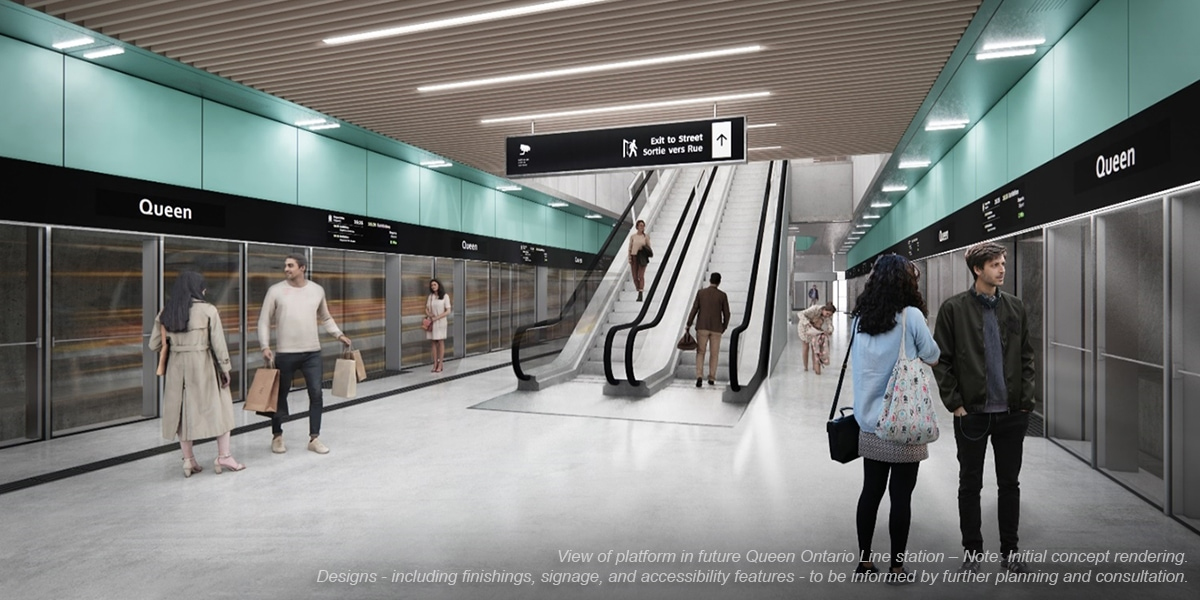
Toronto transit developer Metrolinx has awarded a €4.4bn privately-financed tunnelling contract to a joint venture of Ferrovial and Vinci Construction Grands Projets for the city’s Ontario Line mega project.
Set to last more than seven years (89 months), the JV will bore a 6km twin and build seven stations, six of them underground.
The JV is responsible for financing the work. Vinci said it has already mobilised credit from 11 banks.
Ferrovial said it was its construction division’s biggest ever project.
The Ontario Line will run 16km from Toronto’s southwestern downtown at Ontario Place to the Ontario Science Centre in the northeast. It will have a mix of overground and underground sections, and sections shared with other lines.
It is expected to carry up to 388,000 passengers a day and provide more than 40 connections to bus, streetcar, light-rail transit and regional rail services.
Elsewhere in Ontario, Vinci is working in a joint venture on a 28km extension of Ottawa’s Confederation Line.
The past few month, Zwei has been on the road, throughout the lower mainland attending rugby games (my son plays first div.) and has made a very depressing observation.
Despite over $30 billion invested or will be invested in the regional light metro system, traffic is getting worse and congestion, spiced with gridlock is endemic. It took me a the same amount of time to drive from Squamish to Cypress Bowl Road, in West Vancouver, to drive from Cypress Bowl Road to the 2nd Narrows Bridge!
In the Fraser Valley, Highway 1 is a shambles almost every day from Abbotsford to 200th Street in Langley.
Local roads are clogged with traffic and the buses, except for Vancouver proper, seem not well patronized.
Side streets are clogged with cars and parking has become the new cash cow for cities.
The following three question must be asked, by regional politicians:
Are we getting good value for money with our SkyTrain light metro system?
Has the SkyTrain light metro system created a modal shift from car to transit?
Is our regional transportation system user friendly?
The answers are not very politically palatable and TransLink is using every smokescreen, every ruse to hide the fact that the answers to the three questions is no.
This leaves an even more important question.
Will further investment in our regional light metro system improve regional transit?
The answer again is no as doing the same thing over and over again, ever hoping for different boarders on madness.
Rail for the Valley’s Leewood study gives some answers, with a Chilliwack to Vancouver, regional rail service, using the the former and still used BC electric interurban route, but it seems it is too simple and not expensive enough, $1.5 billion, to warrant politcal action. A modern regional rail service would not be a panacea but, it would give a credible and affordable option for people traveling between Vancouver and Chilliwack.
The evidence is in plain sight, yet many of our politicians remain blind, deaf and speechless and insist doing the same thing over and over again, because if anything, elevated SkyTrain or subways make damn good background for photo-ops at election time.
40 years of SkyTrain has not created a modal shift from car to transit.
By comparison the $2.7 billion, 3.5 mile (5.7 km) Broadway subway costs $772 million/mile and the $4.6 to $5.1 billion 10 mile (16 km) Surrey Langley SkyTrain will cost $467 million to $510 million/mile to build.
Oh yes, the estimated $1.5 billion 80 mile (130 km) Leewood/RftV regional railway connecting Vancouver to Chilliwack costs a mere $18.75 million/mile to build.
Something to think about.
From Mass Transit.
US: Why Are U.S. Transit Projects So Costly? This Group Is on the Case.
Nov. 2, 2022
For the last two years, a group of researchers at the New York University Marron Institute of Urban Management has been building a big database of transit projects around the world. Their goal: To understand what drives the costs of transit project.
By Jared Brey
Source Governing (TNS)
Nov. 1—For the last two years, a group of researchers at the New York University Marron Institute of Urban Management has been building a big database of public transit projects around the world. Their goal: To understand what drives the costs of transit projects, what makes some places more expensive than others, and how costs can be brought down.
The Transit Costs Project is led by Eric Goldwyn, an assistant professor and program director in the Transportation and Land Use Program at the NYU Marron Institute, along with research scholars Alon Levy, Elif Ensari, Marco Chitti and a group of international contributors. To date, the group has built a database with details on hundreds of projects, sourced from popular media, trade publications and official plans. And they’ve begun publishing in-depth case studies on a handful of individual cities, including projects in Boston and New York in the high-cost category, and Stockholm, Italy and Istanbul in the low-cost category, based on additional data gathering and hundreds of interviews.
This month, the Transit Costs Project is planning to publish an overview of its findings. Among them: The United States is the sixth most expensive country in the world when it comes to building rapid rail projects. The reasons why range from the politicization of project management to the expanding role of consultants, the costs of labor, and efforts to limit disruption to normal traffic flow during construction. In this Q&A, Goldwyn speaks with Governing about what makes transit building so expensive in the U.S., and what might be done to improve costs. The conversation has been edited.
Governing: Can you tell me briefly about this research group and why you started digging into this topic?
Eric Goldwyn: We’re all transport researchers and we’ve been following this stuff for years. We noticed that in America the costs seem to be higher than they are in other parts of the world. My colleague Alon, who has been collecting some of this data since 2008, started to see that U.S. projects across the board were more expensive. The first thing that we wanted to do was create a comprehensive database of these costs. Alon had been collecting a couple projects at a time and I had a database of probably 200 projects. So when we finally launched our project we hired some Chinese-speaking people and some people who can read Arabic: People who can cover a lot of places we couldn’t cover on our own.
Our database is now something like 900 projects in 58 or 59 countries. And, unsurprising to us, America has, I think, the sixth highest costs in the world. And it’s actually worse than that, because the thing that’s really expensive is building things underground versus at-grade or elevated. In the countries that are more expensive than the U.S., they’re building 65 percent or more of their projects underground, and in the U.S., we’re only building like 37 percent of our projects underground. So we’re choosing a less expensive method and we’re still very close to being the most expensive in the world.
Governing: So, at a broad level, why do costs matter? You mention that the U.S. is the sixth most expensive. Why shouldn’t it be?
Eric Goldwyn: If it costs $1 billion a mile or $2 billion a mile, depending on the city you live in, it’s very hard to scale at more than a mile or two at a time. It’s very hard to raise those sums of money to build something. If you’re moving toward a more global average of, say, $350 million to $400 million a mile, then a total of $4 billion or $5 billion can get you 10 or 12 miles of rail instead of 2 miles. All of a sudden that’s a big line. You can do a lot more with it.
I can give an example from our Boston case. We looked at the Green Line extension, and the plan in the earliest phases was to build seven stations, going up to Medford, Mass. And because the costs became so prohibitive, they just cut that last station and didn’t extend it all the way. That reduces the amount of access people have to transit. And that means people in that part of Medford are still more likely to drive. So from our perspective, if you want to be serious about getting people out of cars, you need to come up with a public transport system that provides anywhere-to-anywhere connectivity, and for bigger cities, subways are really good at that.
Governing: Is it also the case that high costs give opponents ammunition to oppose transit projects and turn political will against them?
Eric Goldwyn: In general, if you want to build confidence in public works, you have to be able to do them on schedule and on budget. And if those budgets are artificially inflated or veer dramatically from global averages or peer city averages — which they do in a lot of ways — it just begs the question of, what’s going on? I think people’s conclusions tend to be incompetence, corruption or a combination of the two. I’m not saying I agree with them. But that does not breed positive feelings for transit or public works in general.
Governing: One of the things that comes up in the reports is that politicization of decision-making at the micro-scale raises costs. Can you describe an example of how that works?
Eric Goldwyn: There are a couple different ways. If you look at Seattle, for instance, their board at Sound Transit is all elected officials. And they have to approve the decision to pick a locally preferred alternative. Building transit is sometimes controversial at a very local level. Some people maybe want the train to go here or there or don’t want it to cut through this or that sensitive area. So when you have elected officials who feel the heat on those things, they might say, you know, “Let’s study this alternative.” Or “Let’s not make a decision on this for another three months.” Or, “Let’s extend the comment period so people can air whatever they want to air.” You can look at the West Seattle and Ballard project — they’ve extended the comment period one or two times and they’ve postponed making a decision on the locally preferred alternative. That’s just kicking the can down the block.
To use simple numbers, if you have a $5 billion project and you assume 5 percent inflation per year, then every year you’re not making a decision, it costs $250 million. Every six months you’re not making a decision, it’s $125 million. So if you decide to study something for six more months, OK, we can do that, but you have to understand that’s going to add, at a minimum, $125 million to this project cost. It’s useful to understand some of those tradeoffs. Delaying something that you’re going to do, after you said you’re going to do it, comes at a cost.
The same is true of building an expensive station. In Boston, if they’d agreed to build cheaper stations from the outset, the money saved on building the six stations a little bit cheaper could have been used to build that seventh station. You could have had seven stations that are less ornate and less bespoke and customized, but, you know, it’s transit: You’re not supposed to stand there and gaze at the murals. You’re supposed to get on a train and get on with your life.
Governing: Is there a relationship between previous efforts to cut costs and the high costs we have now? One thing I was noticing in your reports was that the outsourcing of design and professional work can raise costs when public employees don’t have the in-house expertise to manage those projects.
Eric Goldwyn: Consultants are usually more expensive than in-house staff. And you need consultants for certain things. If you look at New York or Boston, you don’t need to have a station designer in-house because you don’t build that many stations. But oftentimes what we’ve found is that consultants are brought on to answer the questions of, what do we need to be doing? Rather than an agency telling the consultant what they need to be doing, the consultant starts to do stuff and the agency is like, “Well, that’s not really what we want. We need you to go study this other thing.” They’re billing you by the hour and those costs accumulate.
There was a light rail project in North Carolina that never advanced into getting federal money. Because this agency had never really built anything, they had to hire a consultant. They spent like $150 million just on the consultants doing the design work and the meetings. That’s $150 million that’s gone to nothing; the project is dead. In that example, what you would like to see is if the federal government had like a SWAT team of experts who could come in and help a city that is thinking about doing a light rail or a streetcar and has never done something like that before. In the Italian case that’s exactly what they’ve done. There’s a group in Milan called Metropolitana Milanese which has existed since the 1950s. They have built, planned and designed a 60- or 70-mile metro subway system. They’ve been hired out by other cities in Italy to help them with their planning and design work.
You’re always going to need to hire people to build this stuff, but some of the design, planning and early engineering is within the realm of what a professional civil servant could do. These are somewhat standardized, off-the-shelf technologies. You’ve got to fit them into the city and there are unique quirks that need to be dealt with, from geology to utilities to property owners, but fundamentally it’s some track either buried in the ground, elevated, or underground. And the stations are just boxes with different flourishes.
Governing: You mentioned Milan. What are the commonalities, if there are any, in cities that have lower costs for these transit projects?
Eric Goldwyn: The one thing we see is a heavy emphasis on standardization of design and really trying to economize as much as possible. In Istanbul, they’re building something like 300 kilometers of subway. And they’ve been making changes and optimizing things as they go. They’ve learned lessons about how to build the most efficient station for their circumstance. Using different tunneling technologies, they’ve figured out ways to do less excavation but still create all the space they need for passengers and platforms.
In the U.S., where labor costs are quite high, wherever you can have a better interaction between time and labor, the cheaper a project is going to be. So if you’re doing something that is very time intensive, it’s going to be very expensive. If you’re building something large, it’s more time-intensive than something that’s small. And if you’re doing it with expensive labor, those things multiply.
Governing: How should officials approach the question of labor? People often don’t want to make labor cheaper because you don’t want to pay people less. There’s positive aspects of having high labor costs too.
Eric Goldwyn: One of the reasons we did our Stockholm case is that it’s a low-cost city, but their labor costs are very high. I think we figured out that their tunnel workers make basically the equivalent of $90,000 a year, and then double that in benefits. In this industry there are lots of labor-saving technologies, like tunnel-boring machines, for instance. But the way that our project agreements in the U.S. are often structured, they don’t really capture all of the benefits of that labor-saving technology. It’s not about paying people less. It’s about, don’t spend as many hours doing something, and don’t use as many people to do that thing. You know, I don’t want to work in a tunnel: Those people that do should get paid well and get good health benefits.
We also have very generous overtime, and that is not a common occurrence in other places we’ve looked at. In France it’s capped at 25-50 percent of the hourly rate, but you can only work 10 hours of overtime or something. In New York, if you work Saturday and Sunday, you get paid double time. If you work after the standard eight hours you get bumped up. And the way we do work, we only let them do work on some awkward hour on the weekend, so that means you’re automatically paying the double rate.
There are a lot of things that are very mundane and people wouldn’t think are that important, but if you don’t let a lane or two of traffic be shut down so they can dig a big hole, that just means they’re going to dig it much more slowly and they’re going to have to dig it at weird hours of the day, so it’s going to be much more expensive. If you just said, “yeah it’s going to be annoying, but let’s just do it and get it over with,” that would be, I would argue, a better way to go.
Governing: So what are the recommendations, and what levels of government should be implementing them?
Eric Goldwyn: At the federal level, it would be nice to see some sort of group of experts who have built mass transit work as a public-sector consultant. They could be hired out at a discounted rate by different municipalities or transit agencies.
At the top level, the politics in decision-making, we see that as the most important part of all this. We need to have champions in office who are cheerleading these projects. One of the things that’s interesting in this research is how often government agencies or utility companies gum up these projects because they want something. If you want to shut down a street to cut a hole and build your subway station, you need a department of transportation to approve that. But you’re most likely going to hit some sewer pipes or electric lines or whatever. So if you need to have those moved or power them down, you need to get the utility to sign off on that. Getting all those people to agree is not easy. Sometimes they’ll say, “We’ll do it, but you have to give us new pipes, or you have to replace a mile in each direction.” There’s all these opportunities for extraction, and there needs to be someone at a high enough power, like a mayor, who is saying, “Cut the crap. We need to get this done. They’ll replace whatever it is that they’re taking out but they’re not going to do extra stuff.” You can’t keep trying to extract more and more bribes from these megaprojects.
We also argue a lot in favor of making things transparent in terms of costs. One of the big things that they did in Italy to combat increasing costs from corruption — they had a big corruption scandal in the 1980s — was making what’s known as reference prices. This is what it costs to pour a cubic yard of concrete, what it costs to build a mile of embedded track, and so on. Because that information is public it has this two-way effect. The contractors now know this is what we can build to, and the public knows and the agency knows that when they get in a bid and it looks very different from these numbers, something must be up. That transparency, we think, is really quite useful.
Governing: Can politicians depoliticize things?
Eric Goldwyn: Well, it’s not that exactly. You want it to be more politicized in some sense, because you want people to say this is important and we care about this. And you want them to say that continuously. You don’t want them to say it once and then give up on the project, because that’s often what happens. But you don’t want them meddling into the project. What you want is a governor who is like, “Yes, I approve the spending on this, it achieves the goals I want to achieve. You, the technical experts, are empowered to figure out how to get there.” You want someone who will macromanage, not someone who will micromanage.
It all comes down to having people at the top that are like, “it’s important that we build this thing in a cost-effective, speedy fashion.” If you have a governor, mayor, head of agency who is laser-focused on that stuff, it solves all of these downstream problems. Because they won’t tolerate the operating agency saying they need to build all this other stuff. At the political level it’s got to be a recognition that our costs are whacky and we have to get a grip on some of this stuff if we’re serious about building transit and decarbonizing the transport system and, from my perspective, building better cities.
Sadly, the same is true in BC and Canada, where politicians fully believe the more money one spends on transit, the better is is.
We are currently spending around $11 billion to extend the SkyTrain light metro system a mere 21.7 km.
Current Cost Estimates:
Surrey Langley SkyTrain – $4.6 billion to $5.1 billion
Broadway subway – $2.7 billion to $3 billion+
Mid life rehab of Expo Line – $3 billion (More than $1.5 billion already spent, if one includes station rebuilding with longer platforms for 5 car trains)
(Needs to be completed before full operation can commence on the SLS and subway)
Total – $10.3 billion to $11.1 billion
Is this good value for money or would the following be a better investment?
RftV – Leewood Vancouver to Chilliwack passenger service – $1.5 billion
A BCIT to UBC/Stanley Park European style tram. $2 billion
A new multi track Fraser River rail bridge – $1.5 billion
A rebuilt E&N railway, offering the same service as the RftV/Leewood Plan $2 billion to $3 billion.
Each one of the aforementioned projects, would greatly benefit the region/province. A combined cost estimate of $7 to $8 billion, for over 400 km of rail transit would leave around $2 to $3 billion to be spent on other transit investments in the province.
The region and province still adhere to the tired old doctrine of investing billions of dollars on a grossly over engineered and hugely expensive, yet obsolete proprietary light metro system, which in the end does little to improve transit or mitigate the emissions of harmful pollutants that add to global Warming and climate change.
But ……. it certainty helps winning votes at election time!
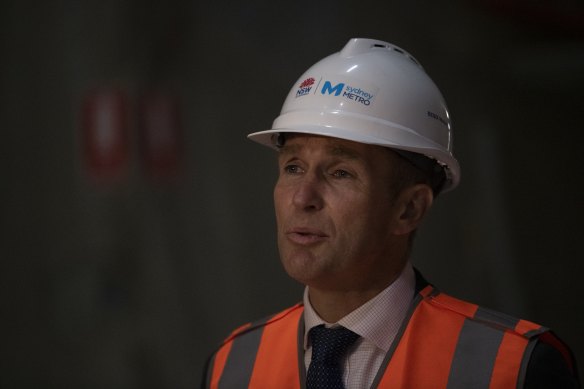
NSW megaprojects are being over-engineered with tonnes of unnecessary, costly materials driving up the price and carbon footprint of the multibillion-dollar builds, Infrastructure Minister Rob Stokes has warned.
Stokes said NSW would fail to reach its goal of a net zero economy by 2050 without addressing overservicing in its $110-billion infrastructure pipeline, where concrete and steel are being superfluously added to projects.
NSW Infrastructure Minister Rob Stokes says the state must rethink how it approaches large infrastructure projects.Credit:Rhett Wyman
Carbon emissions from construction material – including concrete and steel – are estimated to represent up to 10 per cent of Australia’s carbon output. A new report produced by Stokes and Infrastructure NSW has flagged including those emissions in the business cases of future projects.
“We want things to be robust and well-built, but that shouldn’t mean just throwing more concrete and steel into our bridges, roads and railways,” Stokes told the Herald.
“There is an irony here. Because we’ve got very conservative design standards we’re actually putting more concrete and steel into roads and bridges and railways than anyone else in the world.”
Stokes pointed to the recent construction of the multibillion-dollar Metro rail lines as an example of a project that could have used less material without impacting design integrity.
Infrastructure Minister Rob Stokes says some Metro stations may have been over-engineered. Credit:Wolter Peeters
“I think there is a general awareness that we have been very conservative and over-designed some of our station boxes on Metro lines,” he said.
The government is spending tens of billions of dollars on the Metro, which will connect the CBD to the west and south-west of the city, as well as a line to service the new Western Sydney Airport when it opens in 2026. The projects have been hampered by cost blowouts.
Station boxes are excavated for underground platforms, concourses and facilities, while major developments are often installed above them.
Stokes said a “compliance culture” in NSW had led to an intense focus on mitigating risk and liability in both the government and private sectors.
“I think every engineer that touches a project on the way through … just wants to ensure that their responsibility is entirely mitigated by throwing a bit of extra concrete and steel at it,” he said.
“The sum total of all these little decisions where people are just effectively covering their back means that we’re paying way over the odds, and also contributing toward global climate emissions because of our innate design conservatism, so we need to challenge that.”
The senior minister, who will retire from politics at the next state election, said that more thoughtfully designing the state’s largest projects would cut emissions, save time and taxpayer cash.
“We should be very proud of the fact that we are designing very, very robust structures, but the question we need to ask is, ‘Are we over designing them?’. There’s a cost imperative to that for the taxpayer,” he said.
“But there’s also a climate imperative because every bit of extra design constraint that adds to the bulk of a structure is making it more carbon intensive.”
The Infrastructure NSW discussion paper, set to be released this week, recommends a whole of government approach to measuring emissions in infrastructure.
The Decarbonising Infrastructure Delivery report says multibillion-dollar investment decisions were being made without any understanding of carbon mitigation or management over the life of the asset. It warns that could result in potentially higher costs to retrofit projects to achieve net-zero in the future.
The report also recommends maximising the use of recycled material in building.
The United Kingdom, including the Glasgow Airport Investment Area, and Europe are cited as examples of governments including the carbon impact of projects when weighing up their benefits and cost.
The government paper follows a report produced by Infrastructure Partnerships Australia which earlier this year called for ambitious, lower-carbon outcome requirements in major projects.
Stokes said future state governments would need to rethink the way they approached big projects, and instead start by questioning whether they should even go ahead at all.
“One of the very best ways we can decarbonise infrastructure is actually asking whether we need such an expensive megaproject design intervention in the first place. Maybe there are other ways to achieve the same objective,” he said.
The Morning Edition newsletter is our guide to the day’s most important and interesting stories, analysis and insights. Sign up here.
We should have listened to the experts in the 1980’s when the then social Credit government forced ALRT onto the regions regional transit planning.
We should have listened again to American Transit Expert, Gerald Fox in 2008.
The Evergreen Line Report made me curious as to how TransLink could justify continuing to expand SkyTrain, when the rest of the world is building LRT. So I went back and read the alleged Business Case (BC) report in a little more detail. I found several instances where the analysis had made assumptions that were inaccurate, or had been manipulated to make the case for SkyTrain. If the underlying assumptions are inaccurate, the conclusions may be so too.
We should have listened to the 62% of those voting against TransLink’s transit plans in the 2015 plebiscite.
$11 billion needed to build a mere 21.7 km of SkyTrain light metro should be setting off major alarm bells in Metro Vancouver and Victoria, but those alarm bells have stayed quiet.
You don’t meet people of substance here. You meet flakes. The press is dominated by yellow journalism. Rarely if ever have I read a real piece of investigative journalism. You do not meet people who form their opinions based upon facts. When you encounter Vancouverites and engage them in the discussion of social issues the argument usually become circular and they end of talking only about themselves. There is a kind of deep insecurity that comes from profound feeling of self loathing that is hard wired into the political culture here. Narcissism is the dominate religion and worshiping at the Temple of Mammon; real estate speculation is the Holy Grail.
We must listen to the experts today, as the alternative is more highways, more cars, more gridlock and more pollution.
Hundreds of thousands of trips are taken on Metro Vancouver’s buses and trains every day, but are enough commuters able to get to where they really need to go?
After the civic elections, TransLink is getting a new Mayors’ Council this fall and one expert believes the transit authority and its leaders need to start steering transit development toward change.
“I’ve long argued it’s well past time to do that because our transit model is not suited for the way the region is growing,” Patrick Condon with the Urban Design Program at the University of British Columbia said. “Most of the job growth is not in downtown Vancouver, it’s throughout the region, and it’s very dispersed in many, many locations.”
Condon says the current hub-and-spoke model presumes that all the jobs are downtown and all the workers live in the suburbs, but it’s no longer the case that all roads lead to Vancouver.
“We committed to the SkyTrain system in the 1980s and we seem very reluctant to move away from it into a system that’s much more affordable and much more capable of serving a distributed region with a distributed system of transit,” he told CityNews.
He says surface light rail and express buses are much more affordable ways to move people than using an elevated or underground SkyTrain system, particularly the “fantastically expensive” Broadway subway line currently under construction in Vancouver.
“The problem [with the SkyTrain] is, because of its nature, it can never serve, within reasonable distance, everybody in the region. It’s impossible to serve everybody with such an expensive system. There are much more affordable systems that can reach closer to people’s homes and can bring them to where they want to go if it’s not downtown Vancouver.”
Condon points to the “political brouhaha” in Surrey as an example.
“When Doug McCallum regained the mayoral seat four years ago, he immediately switched away from a completely funded light rail system that was going to serve Guildford, downtown Surrey and Newton, preferring to extend SkyTrain out to Langley without the funding. And they still don’t have the money to go out to Langley. It’s a terrible situation”
Condon argues the at-grade, light rapid transit plan would have served a denser population area, it was cheaper to build and it was fully funded.
“Now you have a situation, which I don’t think was fully recognized during the last election, where most of the job and housing growth are occurring south of the Fraser [River]. The City of Vancouver has a population growth of less than one per cent over the past couple of years whereas, when you get south of the Fraser, it ranges from about 1.8 per cent in Surrey to over three per cent in Langley.”
The good news, according to Condon, is that the growing Lower Mainland is arranged along a corridor.
“It would be relatively easy to service this constellation of linear communities, from Surrey to Langley to Abbotsford to Chilliwack, with a reasonably inexpensive system that just connects the dots.”
That’s if we consider the region as a whole, beyond the Metro Vancouver area served by TransLink, he notes.
“We don’t really think about [the region past Langley] as part of our metropolitan area but it most certainly is and that’s where the growth is happening. And to extend a super expensive subway out to UBC on the premise we are going to add another couple hundred thousand people to Vancouver really defies the gravitational pull of where growth is going.”
The inaugural meeting of the next TransLink Mayor’s Council on regional Transportation is November 17th.
Gravy Train: Used to refer to a situation in which someone can make a lot of money for very little effort.
Mr. Cow’s comment in the previous post, deserves a post of its own, because it could be a game changer in regional transit planning.
Criticizing regional transit planning has been somewhat taboo with the mainstream media, thus the public know very little of the ingredients needed to plan for an affordable and user friendly transit route, let alone a transit system or network.
Currently, major transit planning decisions, comes from the Premier’s Office, through the Ministry of Transportation, to TransLink, which was, since inception, designed to keep regional mayors on base with the Premier’s wishes. Everything else is window-dressing.
The switch from LRT to light metro, thus using the Movia Automatic Light Metro (MALM) system, was well orchestrated by the now deposed Mayor of Surrey, Doug McCallum. With a litany of half baked “facts” and questionable motives, the Premier’s office got what it wanted and cemented the deal by making it a Premier John Horgan politcal promise.
Did Horgan want a Expo line extension to Langley?
Probably, because the NDP have had an ongoing relationship with Bombardier Inc. and SNC Lavalin (who owned the patents for the proprietary railway), since the NDP flip flop from LRT to ART (an earlier name of MALM) with the Broadway-Lougheed R/T project, later known as the millennium Line. The old faces responsible for this bit of politcal intrigue are once again working for the provincial NDP and to build a stand alone LRT system, would be embarrassing for the government.
Alstom now owns the proprietary railway and owns, Bombardier’s patents (and by all accounts wants to ditch this lemon as fast as they can) and what was once cozy deals between Bombardier and SNC Lavalin with the provincial government are no more.
The the SLS Extension Project (Surrey to Langley SkyTrain Extension Project) will be the first project affected by Ottawa’s funding cuts for rapid transit projects and if the project goes over the now $4.6 billion budget, the province will have to pick up the extra cost.
Gerald Fox, predicted this, back in 2008, with his critique of the Evergreen line:
But, eventually, Vancouver will need to adopt lower-cost LRT in its lesser corridors, or else limit the extent of its rail system. And that seems to make some TransLink people very nervous.
I would say today, those same “some” at TransLink are again, very nervous indeed!
Well the news broke last night and it hit Ottawa like a bomb. Federal funding is going to be cut to reign in our yearly budget deficit. The expected effect on infrastructure funding is a drop in new federal infrastructure funding by 25% -50% per year. Existing agreements will be honoured.
However, that means no increase in federal funding for the SLS Extension Project (Surrey to Langley SkyTrain Extension Project) regardless of the expected increases in capital (construction) costs. The province of B.C. will have to cover 100% of all future cost increases for the SLS project. Remember, you guys haven’t tendered the project yet to outside bidders or given the cost of O.M.C. #5 which will add its costs (the last estimate was $530 million) to the existing $4.01 Billion budget of the project.
For the period of 1997-2028, the federal government has provided / will provide, an average of $113.2 million to build 742 metres of Skytrain/Canada Line per year. The federal percentage of total project funding has been at an average of 31.3%. Unfortunately, the actual total federal financial coverage of major rapid transit projects, for each project, has been steadily dropping from 33% for the first stage of the Millennium Line, to 28.8% for the SLS extension. Since 1997 the inflation rate that the federal government has been covering is an average of 8% (7.98%) per year. This will not continue indefinitely.
So the amount of federal funding is going to drop for rapid transit projects nationally, believed to be 25% – 50%, that means, unless your cities and provinces are going to pick up the slack, the building rate of multi-billion rapid transit projects is going to slow down dramatically. Therefore lower cost projects are going to replace the extreme higher cost ones. Fewer subways/heavy rail metro and light metro projects (like Skytrain) more simpler, cheaper BRT and LRT projects. Projects that will most likely be almost completely on surface routes, mainly due to cost. For example, BRT and LRT projects like the Pie IX BRT Extension in Montreal/Laval or Finch Avenue West, Eglinton Crosstown East extension and the Eastern Waterfront LRT projects in Toronto.
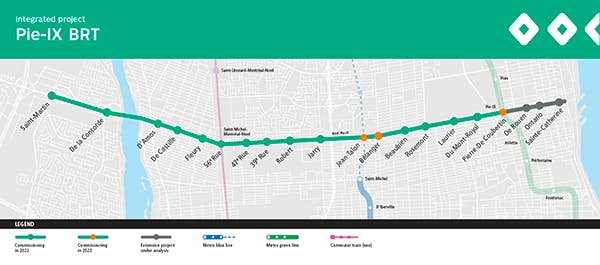
Starting November 7, Montreal’s new BRT service will run between Saint-Martin boulevard in Laval and Pierre-De Coubertin in Montreal.
The 13-km BRT line will serve eastern Laval and cross through four Montreal boroughs, offering transfers to the Green metro line (Pie-IX station), STL services in Laval and the exo5 commuter train line to Mascouche (St-Michel-Montréal-Nord station).
Since these buses will be using exclusive reserved lanes, they will not be slowed by vehicle traffic and will be given priority by traffic lights throughout the route.
What?
In Vancouver the City of Vancouver and TransLink say that LRT on Broadway would cause massive traffic disruptions and congestion!
At the time of commissioning, 28 BRT shelters will be available (there will eventually be 38) and will be accessible to those with functional limitations. New traffic infrastructure, including pedestrian crossing lights with digital and audio countdown will allow pedestrians to cross to shelters safely. Laval users will get a 750-space parking lot encouraging them to leave their cars behind. An immediate improvement in user comfort comes thanks to bus shelters that can accommodate 100 people simultaneously, simplifying ascent and descent.
The $390 million project will get riders from Laval to the Olympic Stadium in record time and will relieve of the pressure on north-south traffic, the city counting on 70,000 people using it daily (pre-pandemic data) with metro rush hour frequency. Over time, the STM will adjust the BRT rollout according to the change in post-pandemic ridership, active STM-led worksites as well as those under the responsibility of the MTQ at the Pie-IX Bridge and de la Concorde.
This busway will move more people upon opening per day (70,000 per day), than $4.5 Billion Surrey to Langley Skytrain extension or the Broadway B-Line express bus.
Cheaper (officially $390 million, includes a new bridge to Laval) than the Skytrain, moves more people and as a light to medium capacity busway can handle up to 150,000 per day. Convert it to a full capability surface LRT line you get even more passenger capacity as well as the lower operating costs of rail.
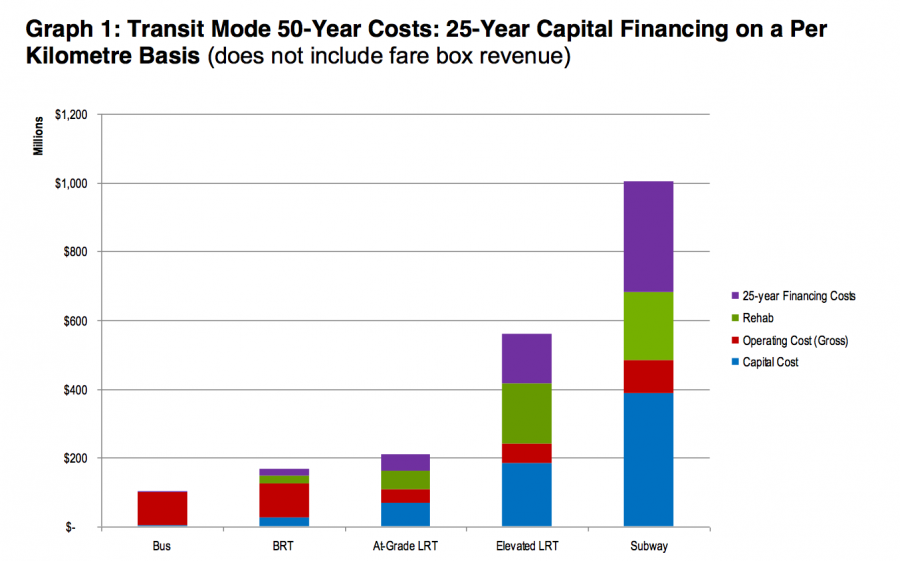
Toronto’s MetroLinx 50 year cost per km. comparison of BRT and LRT
The full graphic.
This begs the question: Why build with BRT, when for just a few dollars more, one can build with LRT and have all the benefits that come with light rail?
The picture of Pie IX Blvd. shows how easily a busway or a surface LRT line would fit on a 6 lane road like Broadway.
Montreal’s Pie-IX BRT service to begin Nov. 7
Oct. 17, 2022
The first portion of the bus rapid transit line will open in early November as part of a gradual commissioning of the line.
The Pie-IX Bus Rapid Transit (BRT) line will begin service on Nov. 7 as part of a gradual opening of the full line. Buses will operation between Saint-Martin in Laval and Pierre-De Coubertin Avenue in Montréal. The exceptions to this service will be in the Jean-Talon area where a pedestrian tunnel to the future Blue Line remains under construction and the Pie-IX bridge where renovations will be completed in 2023.
Société de transport de Montréal
A map of the Pie-IX BRT with the green sections representing what will open for service on Nov. 7, 2022.
The 13-kilometer (eight-mile) Pie-IX BRT project is a joint effort between the Autorité régionale de transport métropolitain (ARTM), the City of Montréal, the Ministère des Transports (MTQ), the Société de transport de Montréal (STM), and their partners, the City of Laval, the Société de transport de Laval (STL), exo, the Société québécoise des infrastructures (SQI) and the boroughs served by the projects.The line features traffic signal priority and reserved lanes to speed STM, STL and exo buses; accessible bus shelters with pedestrian safety enhancements and a new fare structure between zones. At the opening of the line, it will have 28 stops, but eventually include 38 stops.
The BRT will also offer transfers to the métro Green line (Pie-IX station), STL services in Laval and the exo5 commuter train line to Mascouche (St-Michel-Montréal-Nord station).
This is a must read as maintenance is one of the least understood functions of operating a transit system. It is often ignored by politicians because most politicians do not understand it nor want to due to unpleasant tax implications that tend to be embarrassing at election time. The Ottawa LRT/Light-Metro is a very good example of politcal ignorance of maintenance.
I doubt any politician running in the upcoming civic elections has an understanding of the maintenance required for the light metro system and especially for a subway.
How many political candidates running in Metro Vancouver understand that the 21.7 km expansion of the SkyTrain light metro system will add more than $70 million annually to the operating costs of the light-metro system. And that is from TransLink’s own numbers, which numbers tend to be very forgiving of the system.
The current mayor wants a SkyTrain subway (a true oxymoron) , not only to UBC, but a new 19 km route to Metrotown!
What are the long term maintenance costs for this?
In Vancouver, it is all the more important subject because our fully automated SkyTrain light metro system is also a driverless system, which means maintenance must be done with regularity and often.
A fully automatic and driverless system must be at 100%, if not, it cannot operate as the safety systems will prevent it.
This is why when a light-metro train fails on the track (and I have been told this happens more often these days) an attendant must walk out onto the guideway and drive the train manually to the next station, then drive it to the next siding. This greatly slows the service.
That’s the difference between maintenance and repair. Repair is when you fix something that’s already broken. Maintenance is about making something last.
The following graph, again illustrates the much higher operating (including maintenance) and rehab (again more maintenance) costs on subway and elevated transit, when compared to at-grade transit.
The noble but undervalued craft of maintenance could help preserve modernity’s finest achievements, from public transit systems to power grids, and serve as a useful framework for addressing climate change and other pressing planetary constraints.
The R32 trains, nicknamed the Brightliners for their shiny unpainted exteriors, were built to last 35 years. (Imagine that: Your lifespan stamped into metal, your death prefigured.) When they were finally retired from service in January, they had been riding the rails of New York City for no less than 58 years and were, by most accounts, the oldest operating subway cars in the world. That’s 23 unplanned years of hauling people across New York. A whole generation got to see those stainless-steel beauties creaking down the tunnel to the platform, with their crinkle-ridged exteriors and back-lit advertisements.
In a way, it was a small miracle that they lasted so long, an “anomaly,” as one mechanic told me. Except it wasn’t really. It took a lot of work from a lot of people, day after day, year after year.
I recently went to talk to some of those responsible for that work at the MTA maintenance facility in Corona, Queens. There are 13 of these massive workshops across the city, scattered from Coney Island to the banks of Westchester Creek in the Bronx. This one is in a remote pocket of the city, an area given over mostly to massive buildings and spaces: Citi Field, Flushing Meadows Park, the sprawling train yard. It’s like a hospital but an industrial one, scaled up to care for its multi-ton patients.
Standing around the break room with their arms crossed and ID badges dangling, heads full of train-talk, several maintenance workers took turns explaining the process: Railcars roll off the main tracks into a long rectangular building. The cars are lifted to eye level, inspected and repaired if needed. Most of them get to leave that day — back to work, like the rest of us. But some are moved over to a special track for trickier jobs.
We went for a walk along the service tracks in a big group, everyone chiming in, pointing to the parts that needed repairs or replacing: the truck, the brakes, the AC units. They told me the fleet is split into two camps, one called “legacy,” the other “millennial.” The former were built before 2000, the latter after. The millennial fleet is tougher to repair in some ways because there are more electronics in the cars. Maybe you’ve heard your grandfather complain about this, how engines are too damn complicated these days. Siu Ling Ko, a chief mechanical officer for the train cars, told me the shells may last 40 years. The electronics, though, not so much.
The legacy fleet has its own problems, of course, and is more prone to failures overall. Replacement parts are harder to find; the firms that made them — the Budd Company, Pullman-Standard and Westinghouse — are long gone. Many components are well past their design life, and mechanics have to pluck similar parts from retired vehicles or engineer substitutes. It’s a very ad-hoc, improvisational process that relies on the know-how that long-time employees build up over years.
But there’s a method to the madness, and a hard-earned one. Back in the 1980s, when the crumbling, graffiti-covered subway was the stuff of reactionary urban nightmares, MTA president David L. Gunn kicked off an ambitious overhaul of the system, including capital improvements, the famous graffiti removal program and more routine repairs. In 1990, this approach solidified as the scheduled maintenance system. Now, every two to three months, more than 7,000 railcars are taken in for inspection with the goal of catching problems before they happen.
“Maintenance has to be valued outside of austerity, and right now it’s unclear if our current economic system is capable of that.”












Recent Comments