Vested interests: Reason for involvement in an undertaking or situation, especially an expectation of financial or other gain.
Vested interests is the real reason for transit planning in metro Vancouver.
It is also the reason why the SkyTrain Lobby is so powerful because they are the useful idiots of vested interests.
Harsh words indeed.
Despite the local hype and hoopla, Metro Vancouver’s continued transit expansion centered on light metro certainly does not benefit transit riders. as mode share for people using transit is slowly eroding with higher ridership numbers attributed to steady population growth in metro Vancouver.
The following graph illustrates the steady erosion of transit customers and this is pre Covid.
Metro Vancouver Mode Share 2017
In Vancouver the vested interest wanting light metro construction is the bike and auto lobbies; engineering companies; cement manufacturers; land developers/speculators: and politicians, each with expectations in financial, politcal or other gains.
What is missing, especially in the age of climate change and global warming, is an affordable alternative to the car.
Those who regularly support extending SkyTrain light metro, remain blind and deaf to the the many issues pertaining to light metro construction and light metro operation. Most do not have the faintest idea about transit and transit mode and bleat in unison, like Orwell’s sheep, “SkyTrain good, LRT bad”. The SkyTrain Lobby love to cherry pick information to suit their cause but the one question they continually ignore is:
Why, after being on the market for 45 years, only seven Movia Automatic Light Metro systems (a proprietary light metro that now has had four owners) have been built?
In an era of unprecedented investment in public transit, the proprietary MALM system has failed to find a market and is avoided as a dated light metro system with no advantages in operation when compared to much cheaper light rail.
Again, who has copied Vancouver’s P-3 Canada Line?
The Caisse du Depot (one of the concessionaires of the P-3 Canada Line) of Quebec saw how easy it was to make sizable profits from dishonest politicians and uninformed taxpayers by building Montreal’s P-3 REM light metro.
It seems the vested interests want more SkyTrain light metro, eagerly to drain the taxpayer of even more scarce amounts of income in the form of increased taxes and subsidies.
This is the very sad legacy of Metro Vancouver’s regional transportation planning, the vested interests continue to make huge profits from the rubes who have failed to ask questions and demand oversight of transit planning and operation.
As Barnum observed; “There is a sucker born every minute” and the vested interests just love suckers.
The following news story reminds me of the Cambie St. subway fiasco with the Canada line subway.
Fake tears from the city of Vancouver politicians, TransLink and the provincial NDP masquerade the fact that they knew this was going to happen and they do not give a damn about the merchants involved.
On the local TV last night, small businesses along the Broadway construction zone are seeing huge drop in sales and a big increase in debt, due to closure of sidewalks.
Shades of the Canada Line debacle on Cambie 15 years ago!
BC’s Transportation Minister Ian Flemming, trundled out the old tried and true comment from the Canada Line days” that profits will return many fold as stated in the business case, after completion”.
Sorry, that maybe true for a surface light rail line, but not for a subway because subways tend to do the opposite and sterilize surface businesses between subway stations!
Just more politcal BS, justifying the BS Line!
From August 2021.
An interesting passage from Steve Munro’s critique of Neptis, which I was reading to gain some insight into the organization, in response to Mr. Burgess’s comment.
Towards the end of this lengthy report, this paragraph stood out.
The whole point of Transit City was to provide improved local, trunk services and to remain on the surface wherever possible to minimize capital costs while avoiding the sterilization of between-station areas with the wide spacing typically found on subway projects.
Let me restate the point of concern.
………. (transit is) to remain on the surface wherever possible to minimize capital costs while avoiding the sterilization of between-station areas with the wide spacing typically found on subway projects.
So now the truth come out, the Broadway subway will sterilize surface business’s along Broadway, between the subway stations.
This contrary to what TransLink and the Mayor of Vancouver is saying! This contrary to hosannas being sung about the subway by the Daily hive and the rest of the mainstream media.
The Broadway subway will harm surface businesses and the City of Vancouver and TransLink are cowards for not telling merchants the truth, that the Broadway subway will sterilize Broadway!
Rail for the Valley’s goal is the reintroduction of a modern Vancouver to Chilliwack interurban service, using the former and still in use, BC Electric route.
This route would provide good rail communication for Vancouver, Cloverdale, Langley, Abbotsford, the burgeoning communities of Vedder/Sardis and finally Chilliwack, with regularly scheduled regional rail service. 15 years ago RftV naively thought that a TramTrain service would be ideal. Soon the realization that ossified bureaucracies and equally ossified politicians could not or would not see 20 minutes into the future and doubled down on more SkyTrain light metro construction. Instead, RftV opted for light Diesel Multiple Unit’s(DMU’s) instead of TramTrains.
The Leewood Study estimate for such an “interurban service was around $1 billion and today, with inflation, the cost would be around $1.5 billion for the 130 km route. This cost compares very favourably with the current estimate of about $11 billion to extend the Expo and millennium Lines a mere 21.7 km!
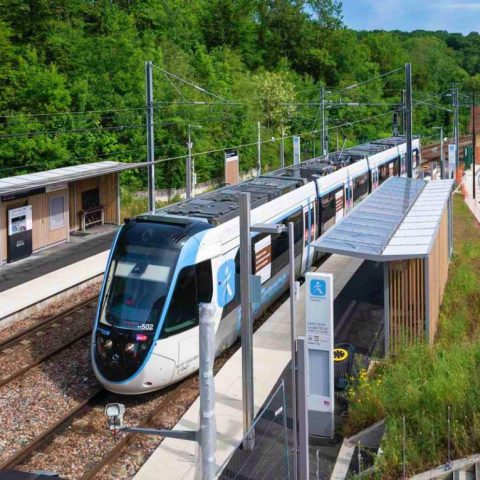
Simply put, a TramTrain is a modern tram or streetcar, so designed it can operate on the mainline railway, thus able to give a transit customer a premium service that a bus or commuter train or a light metro cannot give.
A TramTrain serving Paris.
The concept of the TramTrain, explodes so many local myths about trams and LRT that the powers that be just ignore the mode.
Today, there are 26 TramTrain operations around the world, with an additional 30 more in various stages of planning.
TramTrain would be an ideal transit alternative not only for the Fraser Valley, but for Vancouver Island and the ever growing Okanagan region.
All three mentioned BC locations could see over 400 km or rail transit in the form of TramTrain built and installed at less cost than the $11 billion for a mere 21.7 km of SkyTrain light metro.
It seems trouble is brewing on Broadway and for the sixth time since Jan.1 a media outlet has repeated the TransLink and City of Vancouver’s nonsense that Broadway is the busiest transit route in North America.
Well it isn’t and never was and my guess is that TransLink, the provincial NDP and the CoV are softening up the taxpayer for some bad fiscal news about the now $2.7 billion, 5.7 km Broadway Subway.
Posted by zweisystem on Thursday, February 28, 2019
For the past several years, the SkyTrain Lobby, politicians and academics have all said, almost in unison, that Broadway was the busiest transit corridor in Canada, if not North America.
The old Joseph Goebbels quote is true; “If you tell a lie big enough and keep repeating it, people will eventually come to believe it.”
Thus for the past several years the big Broadway lie, enabled by TransLink has ingrained the notion that Broadway is the most heavily transit route in Canada.
Fact Check!
In a letter to several news organizations, all metro mayors and other interested parties, I laid the foundation that Broadway was not the busiest transit route in Canada .
Stung by this, TransLink wrote a letter to myself and in a round about way claimed that Broadway “is our region’s most overcrowded bus route.”
No apology and not even a hint of remorse, TransLink continues to boast about Broadway!
Finally, on January 31, 2019, you contacted several news organizations and this Secretariat raising concerns over TransLink’s assertion that the 99 B-Line is the busiest bus route in the US and Canada. TransLink is confident in its data collection and peer comparisons, noting that the 99 B-Line route on the Broadway Corridor moves 60,000 customers per day on articulated buses running every three minutes at peak times. This is our region’s most overcrowded bus route. Pass ups are already common, as our regular riders on that route are fully aware. TransLink projects that the 99 B-Line from Arbutus to UBC will be at capacity in the peak when the Millennium Line extension from Commercial-Broadway to Arbutus opens.
Just a minor footnote, according to TransLink the 99B moves about 60,000 customers a day, but of course that is both ways, as TransLink slyly tries to once again inflate the real ridership on Broadway.
Why?
The big prize is the now $3.5 billion Broadway SkyTrain subway to Arbutus and TransLink does not want the truth to upset the subway bulldozer!
After receiving a number of abusive amount of Emails about the post (all deleted), has indicated to me that most people do not have a firm grounding in modern public transport philosophy, nor a good knowledge of provincial finances. Most forget, that in the end, both LRT and light metro are trains and there is only one taxpayer.
Many Vancouver Island rail advocates firmly believe that Vancouver Island is financed separately from the Province of BC, which is pure rubbish.
Very few people understand that $11 billion needed to finance a 21.7 km extension to the Expo and Millennium Lines 21.7 km in Metro Vancouver is one of the main reasons the province has ignored the plight of the E&N and of course RftV’s Valley rail project.
People don’t realize today that the Expo Line (the name SkyTrain was chosen by a public contest on a local radio station) was built strictly for politcal purposes by the then Social Credit government, using the proprietary Advanced Light Rail Transit (ALRT) system, renamed from the original Intermediate Capacity Transit System ICTS), which was unmarketable.. Each extension of the Expo line was designed to fit in the Social Credit’s three to four year election cycle.
Photo-ops and 10 second sound bites for electioneering were more important than a sound regional transit plan.
When the NDP were in power in the 90’s, they too understood the power of rapid transit and forced the Millennium Line using Bombardiers completely rebuilt ALRT/ICTS system, which they called Advanced Rapid Transit. To help sell this almost unsalable proprietary railway, the NDP contrived a report claiming that the only reason to build rapid transit was for land use purposes or in other words, rapid transit (SkyTrain) would be a driver for land development.
Subsequent provincial and civic politicians jumped on the development and densification band wagon and with that came the land speculators and higher property values. With higher property values came increased taxes and as taxes increased, rents and leases also increased. Fueled by illegal money laundering, from local casinos and compliant politicians, a modern day land rush was created where land speculators assemble lands along present and future rapid transit routes, then made handsome profits selling the land to land developers, who then induced local politicians to allow even higher densities, allowing bigger profits.
Today, Metro Vancouver is fast becoming unlivable, with basic housing being unaffordable: tent cities along main thoroughfares: drug induced death rate, almost unsurpassed in North America and endemic traffic congestion in the region.
What went wrong?
There is no simple answer, except that politicians just love those photo-ops and 10 second sound bites for the evening news in front of SkyTrain guideways, that rapid transit will solve our transportation woes; our housing woes; and generally anything else that sounds good in the media.
Thus politicians keep demanding the same thing be done, over and over again and spending obscene amounts of money, building small rapid transit extensions that have proven to do the opposite of what was promiced.
This reminds me of the of the Hans Christian Anderson’s fable, the Emperor’s New Clothes.
Two swindlers arrive at the capital city of an emperor who spends lavishly on clothing at the expense of state matters. Posing as weavers, they offer to supply him with magnificent clothes that are invisible to those who are stupid or incompetent. The emperor hires them, and they set up looms and go to work. A succession of officials, and then the emperor himself, visit them to check their progress. Each sees that the looms are empty but pretends otherwise to avoid being thought a fool.
Finally, the weavers report that the emperor’s suit is finished. They mime dressing him and he sets off in a procession before the whole city. The townsfolk uncomfortably go along with the pretense, not wanting to appear inept or stupid, until a child blurts out that the emperor is wearing nothing at all. The people then realize that everyone has been fooled. Although startled, the emperor continues the procession, walking more proudly than ever.
Like the fable The Emperor’s New Clothes, doing the same thing over and over again, by building more SkyTrain light-metro lines ever hoping for different results, has gutted the province’s ability to fund other and intentionally better transit projects in the province.
Like the fable, the vain emperor or premier (city mayors as well) walk the streets naked, proud at achieving nothing. TransLink and provincial transportation strategies are equally naked, reduced to doing the same thing over again, hoping for different results.
How many deaths must happen before the province decides to have a regional rail strategy?
The message was tragically brought home to roost Christmas Eve with the fatal bus crash on highway 97C, the Okanagon Connector, where a intercity bus crash claimed four lives, that the province desperately needs a regional transportation strategy.
The provincial government, despite promises to the contrary, have not acted and in fact, seem to be retreating from any provincial transportation strategy.
With foul weather shifting to once every 100 of 50 year events, with global warming and climate change, are now becoming almost annual events yet all level of governments seem to be ossified in planning, where inaction and myopia seems to be the only plan.
Last weeks transportation chaos which saw Vancouver International airport reduced to a shambles; public transit collapsed; two major bridges (Alex Fraser and Port Mann) closed due to falling ice and finally a tragic bus accident on the eve of Christmas are the shape of things to come.
BC and Canada’s love affair with “rubber on asphalt” transportation solutions must end and investment instead go to a national regional rail strategy. The anti-rail bias is striking and rail investment is based on an electability standard of what project’s photo-ops and 10 second sound bites on the evening news which will provide the more votes!
The province is spending $11 billion, extending the Metro Vancouver’s SkyTrain light metro system a mere 21.7 km; a system that has proven over and over again that it does not operate well or at all in snow. By comparison, the Rail for the Valley/Leewood Study regional rail plan would cost $1.5 billion.
As well, the SkyTrain light metro system has no track record of modal shift and in fact is seen today by many international transportation planners and engineers as an operating museum piece on par with the Wuppertal Schwebebahn.
The province needs a viable regional rail transportation strategy and it needs it now.
The current provincial and federal governments do not have any such strategy and political fake tears and condolences on the evening news to highway related carnage is getting more then tiresome, as the very same politicians do nothing to solve the issue.
BC desperately needs a regional rail strategy, but doing nothing seems to be the present course of action.
As mentioned many times before the province is spending $11 billion to extend the SkyTrain light-metro a mere 21.7 km in voter rich metro Vancouver, yet the E&N rots into oblivion; the RftV project is shunned and the Okanagan rail corridor has been ripped up.
Shame on the current provincial government; shame on the federal government, the blood of four dead bus passengers are on your hands.
In the era of Global Warming and climate change, not having a regional passenger rail strategy is more than an embarrassment, it is a a failure of political fiduciary duty.
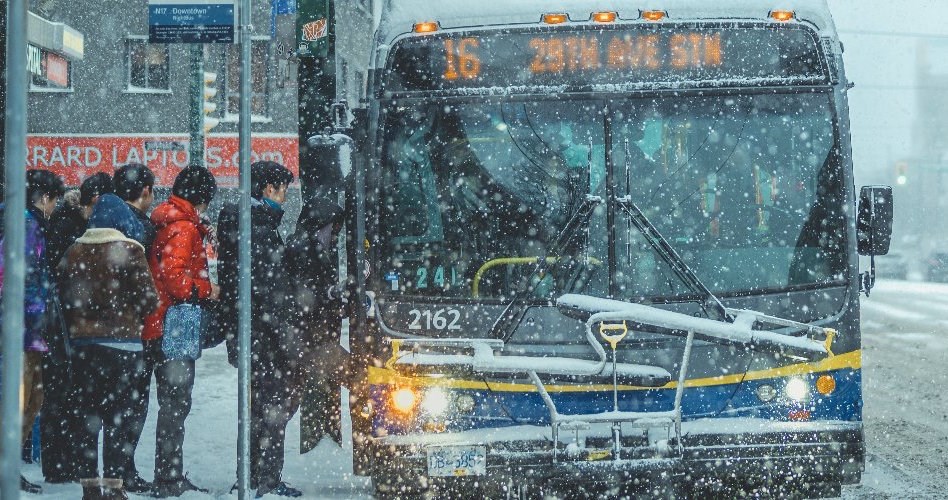
I find it more than interesting that our hugely expensive rapid transit system once again fails in the snow.
Oh, the excuses are many but TransLink, the Minister of Transportation and the premier will never admit to the fact that our SkyTrain light metro system just isn’t up to scratch in adverse weather.
Even the Canada Line splutters along in snow and ice, yet scores of tramways operate with little problems in the snow, with a good examples everywhere.
What is more than galling is that TransLink with the provinces nod, is extending the Expo line to Langley, where it is known to snow a lot.
TransLink gets another big FAIL this week, but no one seems to care!
A Karlsruhe TramTrain in deep snow in the countryside.
TransLink asks people to avoid non-essential travel during the current winter storm warning in effect for Metro Vancouver, Dec. 23, 2022. Photo: @translink/Twitter
Friday morning (Dec. 23) TransLink issued a statement saying that extra staff has been working overnight to ensure public transit across Metro Vancouver can keep moving.
However, in the past few hours, ice build-up on SkyTrain’s guideway has caused multiple track issues and significant service disruptions. There is extra staff working to clear the issues but TransLink strongly advises customers to avoid travel at this time.
The Expo Line is currently halted while de-icer trains run through the system and multiple stations are closed, including Braid, Sapperton, Scott Road, Gateway, Surrey Central, and King George.
The Millennium Line is experiencing delays and there is no service currently between Lougheed and Burquitlam stations.
On the Canada Line there is no service between Bridgeport and Richmond–Brighouse stations. And there is also no service from Templeton to YVR–Airport.
Travellers to YVR are able to catch an airport shuttle from Templeton station.
TransLink says that the Coast Mountain Bus Company is re-routing bus resources to try and move people who are affected by SkyTrain disruptions.
With a winter storm warning in effect, people who must take Transit are warned to expect delays and build in extra travel time.
People can track their buses and see SkyTrain service updates on TransLink’s Trip Planner and on Twitter. You can also sign up for customized Transit Alerts for your route.
TransLink’s snow plan for severe weather is in effect and they promise they are in constant communication with each regional municipality to advise which roads and routes should be prioritized for plowing and clearing.
More…………
SkyTrain Expo Line service suspended amid Vancouver ice storm
Inclement weather has caused the suspension of operations on Metro Vancouver’s Expo Line SkyTrain, according to TransLink.
The transit provider had warned ahead of the winter storm that riders should be prepared for considerable delays. In an update Friday afternoon, TransLink said service on the Expo Line had been suspended. The Millennium and Canada lines were also experiencing delays.
TransLink said bus bridges were in effect between Columbia and King George stations, as well as between Joyce and Metrotown stations.
The Millennium Line was not running between Lougheed and Burquitlam stations, and the Canada Line had no service between Bridgeport and Richmond-Brighouse stations, nor between Templeton and YVR Airport, the agency said.
An airport shuttle was operating between Templeton Station and the airport, according to TransLink.
The transit provider blamed the delays and shutdowns on “ice build-up” on SkyTrain guideways.
“We are doing everything possible to resume service as quickly as possible, but our strong advice to customers is to avoid travel at this time,” it said in a statement.
TransLink said de-icer trains were being run through the system, and bus operator Coast Mountain Bus Company was rerouting buses to help people affected by SkyTrain disruptions.
On Thursday, as it prepared for the storm, TransLink said it had activated its snow plan and brought in extra staff.
Metro Vancouver was under a winter storm warning Friday as heavy snow was forecast to give way to freezing rain and then heavy rain.
Environment Canada warned that ice-clogged storm drains and melting snow made localized flooding “likely” as temperatures warmed Friday evening and Saturday.
The storm caused the closure of the Port Mann and Alex Fraser bridges due to concerns about ice bombs dropping onto vehicles.
The weather also extended travel woes at YVR, with 146 flights cancelled as of Friday morning, and further cancellations expected throughout the day.
An overview of Quebec City’s proposed new tramway, something all out civic and provincial politicians should see.
In the new design for Quebec City’s tramway network, northbound vehicular traffic will be redirected, leaving more space for pedestrians on De la Couronne Street. (Ville du Québec)
My name is (name withheld by request) and I have been involved with transit issues in the lower mainland for four decades. I have been a forty year member of the Light Rail Transit Association and through my long membership, I have been advised by transit experts, both in Canada, the USA and abroad. I am the person responsible for the Leewood Study, an independent study by Leewood Projects UK, about the viability of reinstating the former Vancouver to Chilliwack interurban service with modern TramTrain or light diesel multiple units, on behalf of the Rail for the Valley group.
The Lower mainland has a glaringly expensive transit problem; Metro Vancouver mayors, the province and TransLink have approved spending around $11 billion dollars, extending the Expo and Millennium Light-Metro lines 21.7 km.
Is this a good investment of tax dollars or are the regional civic and provincial politicians condemning the region to a very expensive, yet obsolete regional rail system by doing the same thing over and over again, hoping for different results.
This massive expenditure, extending the Millennium and Expo Lines a mere 21.7 km will attract little new ridership because there will be little or no improvement for the transit customer, despite the promises of TransLink and the bellicose claims by politicians.
The $2.8 billion, 5.7 km Broadway subway, is literally a subway to nowhere. The terminus for the subway at Arbutus can be traced to the early 1990’s Broadway – Lougheed Light Rail Project, where Arbutus was seen to connect to future LRT operating on the Arbutus Corridor. Subways have proven to be little incentive for transit customers and a major inconvenience in forced transfers from bus to subway, means many former transit customers may opt for the car instead.
Subways are very poor in attracting new ridership, especially subways to nowhere.
In Surrey, former Premier Horgan’s recent political promise to extend the Expo Line to Langley, has grave financial implications, akin to the FastFerry fiasco, which has followed the NDP as an Albatross around its political neck, for two and half decades. Simply, the Millennium Line extension to Langley has become far too costly, for what good it will do.
This possible $5 billion investment for 16 km of new line, confirms Bent Flyvberg’s Iron Law of Mega-projects specifically addresses why politicians are obsessed with infrastructure at any cost.
…the “political sublime,” which here is understood as the rapture politicians get from building monuments to themselves and their causes. Mega-projects are manifest, garner attention, and lend an air of proactiveness to their promoters. Moreover, they are media magnets, which appeals to politicians who seem to enjoy few things better than the visibility they get from starting mega-projects. Except maybe cutting the ribbon of one in the company of royals or presidents, who are likely to be present lured by the unique monumental and historical import of many mega-projects. This is the type of public exposure that helps get politicians re-elected. They therefore actively seek it out.
It is time TransLink stops its deliberate game of confusion with Metro Vancouver’s light-metro system, which has led to decades ill-advised investments, which has cost the taxpayer many times more for the present light-metro system, than it should have.
Metro Vancouver’s regional light-metro system, is called SkyTrain and the SkyTrain light-metro system is made up of two distinct railways:
The Canada Line, a conventional railway, built as a light metro and uses ‘off the shelf’ Electrical Multiple Units (EMU’s) currently supplied by ROTEM of Korea. As built, the Canada Line, with 40 metre to 50 metre station platforms, has limited its maximum capacity to around 9,000 persons per hour per direction. A two car train-set is 41 metres long.
The Expo and Millennium Lines operate an unconventional, proprietary and often renamed light-metro system, now called Movia Automatic Light Metro (MALM), whose cars are only supplied by Alstom. Alstom has purchased Bombardier’s rail division, earlier this year. No other car manufacturer has an “off the shelf” operating vehicle, let alone a production line for such a vehicle, thus the transit system is deemed proprietary as there is only one supplier.
The SkyTrain Light-metro System to scale, including station platform lengths.
The MALM system uses linear induction motors (LIM’s) and is not compatible in operation with any other railway except its small family of seven systems.
The five previous names for MALM are, in descending order (owner of the proprietary railway in parenthesis).
Innovia Light Metro (Bombardier)
Advanced Rapid Transit (Bombardier)
Advanced Light Metro (Lavalin)
Advanced Light Rail Transit (the Urban Transportation Development Company)
Intermediate Capacity Transit System (the Urban Transportation Development Company)
The six other operating authorities, operating MALM systems are either abandoning operation when the cars’ have become “life expired” or have signaled they are not going to expand their systems, leaving Vancouver the sole customer for MALM.
A technology bias exists at TransLink. Internationally the MALM system is considered long obsolete as it costs more to build, operate and maintain than conventional light rail or even a heavy rail metro. Cities that built light-metro, such as Ottawa and Seattle, use light rail vehicles, as they are much cheaper to operate and far more flexible in operation, especially for future expansion.
TransLink continues to use this cunning method of manipulating analysis to justify SkyTrain in corridor after corridor, and thus succeeds in keeping its proprietary rail system expanding.
Gerald Fox, Noted American engineer, retired.
TransLink’s well oiled propaganda machine, churning out ”fake news” and “alternative facts” has created the local SkyTrain myth. The SkyTrain myth has fuelled the SkyTrain Lobby, which repeats TransLink’s fake news so much that politicians and the public have come to believe the SkyTrain myth.
The Broadway subway is testament to the power of the SkyTrain myth. Funding for the $2.83 billion Broadway subway has been approved, yet its foundation is one of half truths and questionable planning.
The North American Standard for building a subway is a transit route with traffic flows in excess of 15,000 persons per hour per direction (pphpd), yet peak traffic flows on the 99B Line is about 2,000 pphpd, based on 3 minute, peak hour headway’s. Maximum transit flows on Broadway are less than 4,000 persons per hour per direction!
TransLink’s two top planners were fired for their opposition to the subway, by publicly stating the obvious; that there wasn’t the ridership on Broadway to justify an almost $3 billion subway.
TransLink quite happily lets people believe that Broadway is the “most heavily used transit route in Canada“, but instead claims “This is our region’s most overcrowded bus route.”, when there is a threat of professional or legal accountability.
“The problem with TransLink is that you can never believe what it says; TransLink never produces a report based on the same set of assumptions.”
Former West Vancouver Clr. Victor Durman, Chair of the GVRD (now METRO) Finance Committee.
The former Mayor of Surrey’s flip flop from LRT to SkyTrain was also predictable, as the bureaucrats at TransLink did their best to ensure this would happen.
The well oiled SkyTrain Lobby was in full force with every bit of classic fake news and alternative facts they could muster, yet ignored the fact that MALM is now considered obsolete internationally and only seven such systems have been built in over forty years and no sales for the past 18 years!
The former Mayor of Surrey’s election claim that a SkyTrain extension from King George station to Langley City could be completed for $1.65 billion, was later exposed to be false, yet the Mayor’s Council on Transit, the Minister of Transportation took no action!
The fix was in!
The $1.65 billion figure pales when compared to the present estimate of $4.6 billion to $5.1 billion.
The cost of the Surrey/Langley/Line is so expensive that the provincial government has broken the one project into two projects in an attempt to hide the true cost.
The guideway project, with a cost estimate now of $4.1 billion.
The Operations and Maintenance Centre #5 project, which must be completed before the line can enter into revenue operation, is now estimated to cost $500 million to $1 billion on top of the now estimated $4.1 billion for the guideway! The stated costs do not include the costs for new vehicles.
TransLink, the provincial and federal governments stay mute on the true costs of extending the SkyTrain light-metro system.
With the NDP promising to complete the proprietary MALM railway to Langley, a very costly issue arises.
The aging Expo line is desperately in need of a major rehab. This rehab includes a major overhaul and expanded electrical supply; a new automatic train control system, all the switches being replaced on both the Expo and Millennium Lines to permit faster operation and all stations must be rebuilt to deal with the higher customer flows which come with a higher capacity. The rehab is said to cost between $2 billion to $3 billion and must be done before any extension to Langley is built. TransLink has already signed a $1.47 billion resignalling contract with Thales, leaving the necessary and much needed electrical rehab and upgrades waiting for future funding. The cost also does not include station rebuilding, nor vehicle purchases.
When the driverless SkyTrain breaks down.
The combined annual operating costs for the Broadway subway and the full Expo Line to Langley will exceed $70 million annually. Will this cost be taken from the regional bus system, to pay for two very questionable and politically frivolous transit projects?
If taxes are not greatly increased, this will certainly happen.
How is this to be funded?
Is a $4.6 to $5.1 billion expanding MALM 16km a good investment, especially when ridership on opening day, according to Translink, will be less than what the Broadway 99 B Line bus carried pre Covid?
By comparison, 2022 cost for The Rail for the Valley’s Leewood Study, for a 130 km, Vancouver to Chilliwack passenger service, using the BC Electric rail line, servicing North Delta, Cloverdale, Langley, Abbotsford, Sardis and Chilliwack and connecting the many business parks, universities and colleges along the route, would cost $1.5 billion.
TransLink does not support the Leewood Study’s Vancouver to Chilliwack rail service because it would outperform their $4.6 to $5.1 billion, 16 km extension to the Expo and Millennium Lines and very embarrassing questions would be asked.
“But, eventually, Vancouver will need to adopt lower-cost LRT in its lesser corridors, or else limit the extent of its rail system. And that seems to make some TransLink people very nervous.”
Gerald Fox
With the Covid-19 emergency now waning and major demographic changes taking place, a major rethink must be done on how we provide an affordable regional rail system. Metro Vancouver’s light-metro system has been well studied, yet those cities who have done so, have invested in light rail instead!
Why, after four decades of unprecedented investment in regional rail transit, has no one copied Vancouver’s light metro system, including the exclusive use of the proprietary MALM system?
Of the seven of the now called MALM systems built in the past forty years, Toronto is soon tearing down their version of MALM and Detroit’s version will soon follow, as both systems’ infrastructure are near being “life expired”.
Two of the later versions of MALM, marketed at the time as Advanced Rapid Transit (ART) built in Malaysia and Korea have embroiled both the patent holders, SNC Lavalin and Bombardier in legal proceedings, including charges of bribery. For added insult, the American government refused to subsidize any ART system because it is overly expensive to build and operate and was poorly designed!
The Everline. The Korean government swore after the conclusion of its court case with Bombardier, they would never buy this or any other Bombardier product, ever again.
It is time to put an end to MALM expansion or the provincial government and current mayors, will become like Marley’s ghost, dragging an ever longer chain made of empty cash-boxes, IOU’s, red ink, bare pursesand increased taxes wrought in union made steel, election, after election for decades to come.
Remember the FastFerries?
Today, TransLink continues to be toxic with taxpayers and extending MALM to Langley or continuing the Broadway subway to UBC will make TransLink and all who supported the gold-plated extensions radioactive politically, on a Chernobyl scale.
For forty years regional and civic transportation planners and engineers have got it wrong. But, because of very good, publicly funded PR machines in Victoria, and local cities and municipalities, plus the lack of any honest reporting by the local media, regional politicians keep building with the obsolete light metro. Metro Vancouver’s SkyTrain light-metro system has convinced other cities to build with light rail because there is no real advantage with building the much more expensive light metro system.
It is time regional politicians rethink present regional rail transit planning, where today’s hugely expensive planning will exacerbate growing congestion and gridlock and certainly greatly increase already high taxes. The SkyTrain light metro system has become a politcal “tar-baby” and continues to be a showcase how Metro Vancouver’s regional transit planning has continued to get it wrong!
It is interesting how TransLink has used this cunning method of manipulating analysis to justify SkyTrain in corridor after corridor, and has thus succeeded in keeping its proprietary rail system expanding. In the US, all new transit projects that seek federal support are now subjected to scrutiny by a panel of transit peers, selected and monitored by the federal government, to ensure that projects are analyzed honestly, and the taxpayer interests are protected. No SkyTrain project has ever passed this scrutiny in the US.


















Recent Comments