Again, old Zwie, the Curmudgeon Laurette of transit, is delighted that Vancouver T.E.A.M. mayoralty candidate Colleen Hardwick is talking LRT while those running against her are still talking dated light-metro.
So, let us have a look at costs of the three proposals.
T.E.A.M’s Hardwick’s 58 km of LRT
The Aprox. 7 km Millennium Line subway extension from Arbutus to UBC, not including cars, is estimated cost between $5 billion to $6 billion.
The 18 km Hurontarion LRT now under construction, including cars, is costing $1.4 billion or about $78 million/km.
Using the Hurontario LRT as an example the cost of T.E.A.M’s 58 km LRT proposal is $4.5 billion.
This is far cheaper than 7 km subway.
Forward Together’s Kennedy Stewart 18 km Loopie Line
As stated in a previous post, the cost of the Loop line based on the current per km cost of the Broadway subway at $526 billion/km, would be around $10 billion!
ABC’s Ken Sim’s approx. 18 km Hastings Street, 2nd Narrows Crossing,North Shore Line
Again, based on the cost of the current Broadway subway is estimated to cost a little due to the fact of major engineering needed to cross Burrard Inlet, would be well over $10 billion.
Put another way, T.E.A.M.’s $4.5 billion, 58 km, provides 22 km more LRT, at a quarter of the cost of the combined Forward/ABC’s $20 billion, 36 km of SkyTrain!
Final Notes:
LRT will offer a higher Capacity than the SkyTrain proposals.
Alstom, which now owns the proprietary Movia Automatic Light Metro (MALM) system, erroneously called SkyTrain (which is the name of the regional light metro system) has indicated it will cease production of then proprietary railway when the last paid orders are completed in 2025.
Only seven of the often renamed MALM systems have been built since the late 1970’s
Being a generic transit mode, there will always be suppliers for light rail, unlike the proprietary MALM system.
T.E.A.M’s LRT offering much more LRT at a far cheaper cost.
With less than two weeks left until Vancouver’s municipal election, mayoral candidates are hoping to move voters to the polls with their plans for public transit.
In a plan presented on Wednesday, councillor and mayoral candidate Colleen Hardwick pitched her idea of getting rid of the Broadway Subway extension and developing four light rail lines across Vancouver.
Hardwick says creating the 58 kilometres of light rail can be done for the same price as the University of British Columbia (UBC) SkyTrain extension.
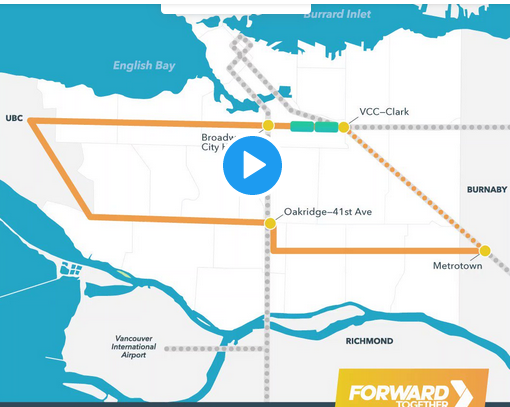
Incumbent mayor Kennedy Stewart recently announced the “Vancouver Loop,” his plan to connect UBC to the Expo Line via the new Broadway Subway extension, and back around to Metrotown via 41st and 49th Avenue.
The extension along Broadway to UBC has been approved and is already well underway. As for the rest of the “loop” to Metrotown, there is currently no approvals or funding in place.
On Tuesday, candidate Ken Sim held an event with the mayors of North Vancouver, Maple Ridge, and Coquitlam to pitch a SkyTrain line to the North Shore along Hastings Street.
The line to the PNE would connect to North Vancouver and to the West Coast Express.
“To tackle the big transportation challenges facing our region, we need to work collaboratively with other municipalities and senior levels of government,” Sim said in a tweet.
Sim and the mayors say that presenting a “united voice” for transit needs in Metro Vancouver will help with funding, and getting new projects built.
Derailment: the action of a train or tram leaving its tracks accidentally.
When TransLink invents new terms for a train derailment, you know they are trying to hide something.
Two bolts sheared on a turnout or switch is not a coincidence, rather it points to a lack of maintenance on the system.
That TransLink is hiding the derailment as a dislodgment, is just a continuation of TransLink’s campaign of misinformation, fake news and alternative facts.
That the NDP did not compel TransLink to tell the truth, is another indication that they do not care about safety on public transit.
And where is Transport Canada?
Ontario had a public inquiry with their new transit system, due to faulty maintenance, as well as other issues, yet with the SkyTrain light-metro system, safety issues are swept under the carpet, out of sight, out of mind!
The Expo and millennium Lines use movable frog switches, which gives a good ride for cars traversing the switch. This Marx O-Gauge switch is a good illustration of a a movable frog switch.
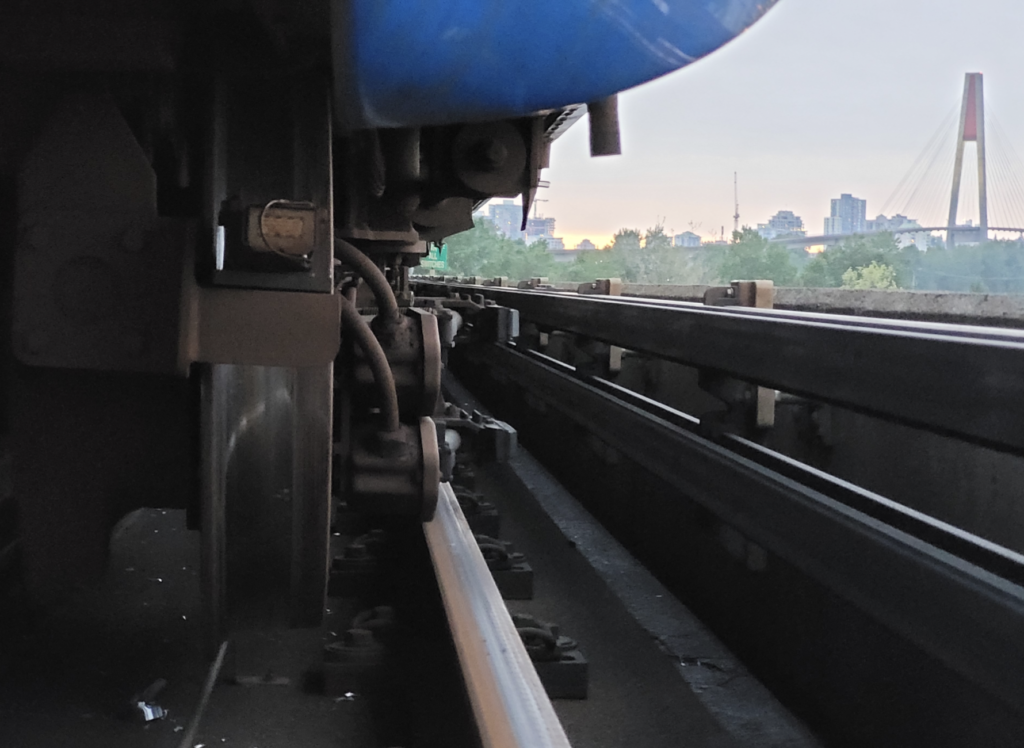
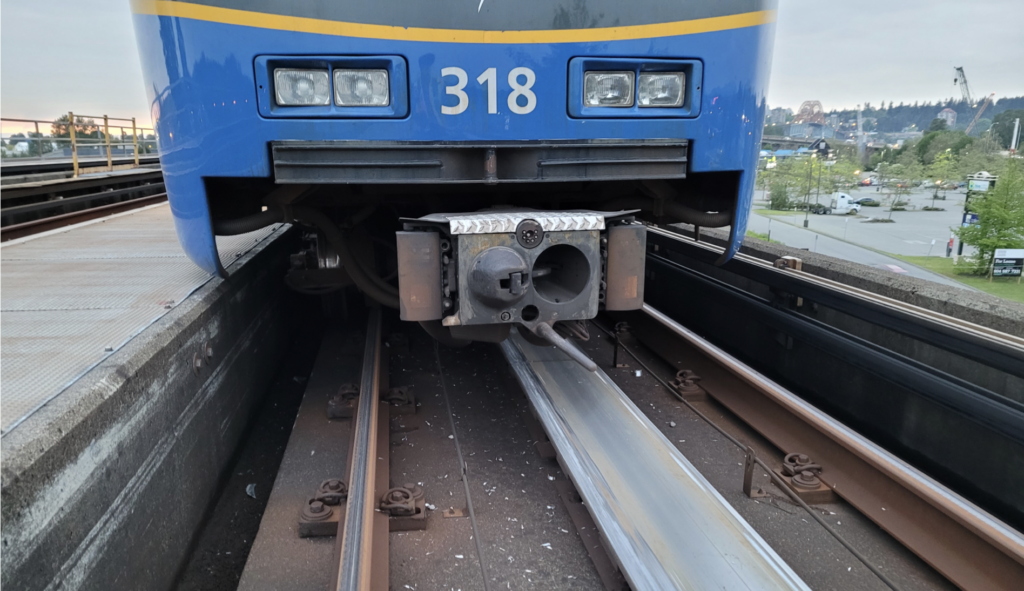
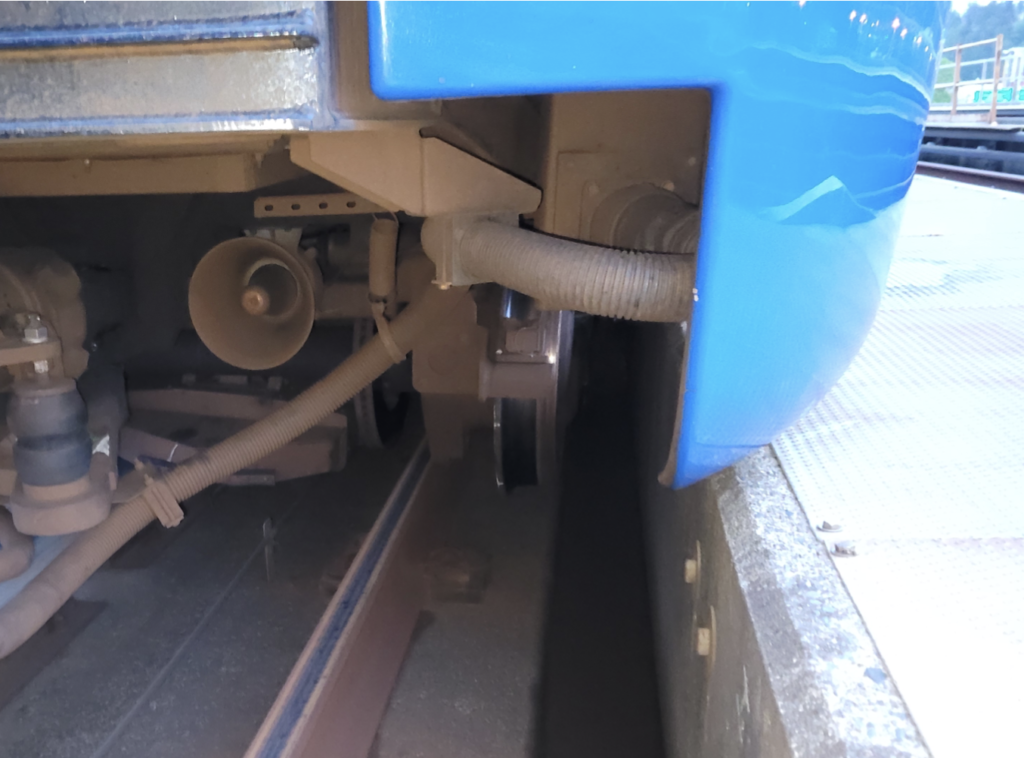
A SkyTrain derailed near Scott Road station last May because of what TransLink has called “almost simultaneous failure of two bolts” at one of the mainline’s 124 turnout switches.
On May 30 at 7:40 p.m., two cars of a four-car Mark 11 train derailed: both trucks of the third car and the rear truck of the fourth car went off the rail, disrupting rapid transit service to and from Surrey for 24 hours.
TransLink originally downplayed the severity, calling it a “track issue” and “stalled train” before saying the train had been “partially dislodged.” No injuries were reported, though passengers stuck on the train for a half-hour needed attendants to walk them back to the station.
Email released under freedom of information indicates that the switch, which enables a train to move from one set of tracks to another, should have received a thorough annual inspection earlier in May, but received a bi-weekly inspection on the morning of May 29. A bi-weekly inspection generally involves a track-level visual and condition assessment and lubrication of movable components. A work order log shows that technicians dealt with faults at the same turnout switch, known as DC47, from early 2021 all the way to April of this year.
Guideway supervisor Nick Micelotta’s May 31 handover report said that two “K-plate bolts sheared at the head.” The switch was not movable and that a burning smell was coming from the train. Micelotta’s report said the derailment caused extensive damage.
“LIM [linear induction motor] cap was scraped for about two track sections, concrete wall was hit by collector shoe assembly that was ripped off the train, handrail right above it was hit by the train and walkway cover inserts/bolts were torn off on one side,” Micelotta wrote.
TransLink’s rail division, B.C. Rapid Transit Co., waited for Technical Safety BC’s approval for rerail and repair. Revenue service resumed after 7:47 p.m. on May 31.
“We have never had this incident or similar incident occur before,” TransLink spokesperson Tina Lovegreen said by email.
Lovegreen said the impact of trains on rail causes wear and tear and loosening of components over time.
“Immediately after this incident, we inspected all frogs [common crossings] and bolts across the system, none showed the same problem as DC47,” Lovegreen said.
A report to the Sept. 28 TransLink board meeting said the incident was a major reason why Expo and Millennium lines did not meet service delivery and on-time performance targets in the second quarter.
Operations vice-president Mike Richard said SkyTrain was 95.7% on-time, below the 96.5% target. There were 12 delays over 30 minutes, including the derailment, three switch issues, two power issues, two extended medical emergencies, two objects falling into the track, one extended trespasser in the track area and one train door problem.
TransLink has six levels of switch inspection, ranging from a daily visual inspection using a sweep train to the hands-on yearly inspection, which includes lubrication of movable components, a complete hardware condition assessment and cleaning of all components throughout the switch.
The completed inspections log for DC47 showed there had been 11 biweekly switch inspections in 2022 before the derailment, plus a hands-on quarterly in February. The work order for a May 18 annual inspection was not completed.
Three work orders in 2021 focused on problems with the fastening systems.
“Both heads on the K-plate bolts sheared off. Bolts were stuck inside the plate,” said the entry for Jan. 9, 2021.
The “K-plate bolt [was] found with its head sheared off and the bolt shank drifting out of the hole,” on July 7, 2021.
The K-plate bolt appeared to be loose during Oct. 18, 2021 work, “So I went to tightened it and it was snapped already. There is history on this frog (Siemens) for adapter plate and K-plate & bolts snapping.”
Lovegreen said the bolts used were recommended and authorized by the original equipment manufacturer and there was no indication that bolt failures were specific to Siemens machines. She also said there was no “go slow zone” in place at the time of the incident at the DC47 switch.
While the incident was called a derailment by SkyTrain managers throughout the email disclosed, TransLink’s communications department refers to the incident as a “dislodgement.” Richard repeated the same word during his Sept. 28 presentation to the TransLink board.
“Given only one part of the train was dislodged from the track, it was more appropriate to refer to the incident as a partial dislodgment,” Lovegreen said.
At least some politicians get it, some politicians actually read this blog, obviously Vancouver’s current mayor Kennedy Stewart does not read this blog and more pity to him.!
In a re-election bid, Mayor Kennedy Stewart has promised to build a SkyTrain loop in central Vancouver.
Really?
What will be the cost of this SkyTrain subway loop Mr. Mayor?
Brief recap of SkyTrain light metro costs:
Millennium Line extension to Arbutus – Cost: Over $3 billion (without cars).
Expo Line Extension to Langley, Project 1 – Guideway cost: $4 billion. (cars not included)
Expo Line Extension to Langley, Project 2 – Operations & Maintenance Centre #5 cost: $500 mil. to $1 bil.
(The two projects must be completed before operation can start.)
Expo and Millennium Line Mid life Rehab: Over $3 billion ($1.47 billion re-signalling contract now let)
All of the above must be completed before trains can operate on any of the extensions
So let us look at proposed SkyTrain extensions.
Arbutus to UBC subway – Now estimated at $6 billion (not including cars)
North Shore Rapid Transit – Now estimated to cost in excess of $5 billion. (Realistically, it will be over $10 billion!)
Kennedy Stewart’s 19 km SkyTrain loop – cost unknown.
My estimate, based on the current per km cost of the Broadway subway at $526 billion/km – $10 billion!
I would think regional mayors would have something to say about this, but this is the silly season and politicians will tell all sorts of porkies to win elections. This one, by Kennedy Stewart is in the realm of sparkle ponies and pixie dust.
Postscript:
1) Alstom, which now owns the proprietary Movia Automatic Light metro (MALM) system (SkyTrain is the name of the regional light metro system and not the trains that operate on them) and as the system is deemed unsalable by Alstom due to large operational and maintenance costs and corporation has two “in house” light metro systems, has indicated that production will cease in 2025 after the last orders for MALM cars is complete. Only seven such systems have been sold since 1980, leaving Vancouver the sole customer for the proprietary railway.
With the American government refusing to subsidize any SkytTrain project in the US and two ongoing criminal cases in Korea and Malaysia, involving both Bombardier and SNC Lavalin over the sale of MALM, Alstom is not actively marketing the system.
2) Werner Antweiler, a professor of Economics in UBC’s Sauder School of Business hasn’t a clue about public transit or rail transit and demonstrates this point with his comments. Really, why continue building with the classic “Edsel’ of transit systems, that cost a lot more to build, operate and maintain than its competitors., especially on transit routes lacking the ridership to sustain a subway.
Question: Why does anyone bother to listen to economists anymore? The profession has become an embarrassment, and the most respected economists have shown themselves to have as much predictive power as a deck of tarot cards. Stephen Moore
3) In 2018, the now discredited Mayor of Surrey’s flip-flop from LRT to SkyTrain, took a $1.63 billion light nail project and turned into a $4.5 billion to $5 billion light-metro project!
4) Construction is now proceeding with the 18 km Honontario LRT, which total cost, including cars, is $1.4 billion.
Kennedy Stewart says if re-elected as mayor, he would accelerate plans for the “Vancouver Loop” – a new SkyTrain line that would connect Metrotown to UBC.
Stewart and his team announced he would make the business case for the project and ask that the line be prioritized. It’s already part of TransLink’s 2050 vision.
“With having 44,000 people a day moving along this corridor, it is really, really busy,” Stewart told reporters.
He added that with densification and population growth, the region will only get busier. The project is part of his Forward Together party’s attempt to alleviate pressure on busy transit corridors and address climate change.
The proposed Vancouver Loop would connect with the Broadway SkyTrain extension and link UBC to Metrotown along 41st and 49th Avenues.
Werner Antweiler, a professor of Economics in UBC’s Sauder School of Business, said the project is something that would be needed in the long-term.
“There is, of course, a significant demand from UBC students,” he explained in an interview with CTV News. “But there’s also going to be more development all along that line, especially in the Jericho Lands that will be developed by a group of Indigenous communities in in Vancouver – so we need to look at the future.”
Vancouver can’t go it alone. Although there’s no pricetag and no timeline, what we do know is the multi-billion dollar project will need help from the province and the federal government to be completed.
Stewart acknowledged that challenge.
“What I have to do, what I’ve done before is to go off and get funding and continuing to convince folks this is a worthwhile investment,” Stewart added.
Lisa Dominato, who is running for re-election as a city councillor with the ABC Party, said part of the issue is there’s currently no funding for a line to UBC. She told CTV News Stewart just re-announced priorities already set.
“Perhaps the mayor is trying to deflect from the fact that he’s supported roe pricing and transport pricing in the city,” Dominato said. “Perhaps that’s a deflection on his part.”
ABC and Forward Together have exchanged harsh words around the issue of road pricing with Stewart accusing his opponents of misrepresenting his views.
Opposition parties say the biggest concern they hear is affordability. Colleen Hardwick, a city Councillor who is now running for mayor with the TEAM slate, said she didn’t think the project was needed now, and maybe not even in the future.
“I think that we can achieve much more in terms of distributed surface rail than spending all of this money on SkyTrain, but I just don’t think it’s in the cards … as we are staring down a potential recession,” she told CTV News.
One challenge for Stewart is that other mayors have also made promises to deliver on projects from TransLink’s long-term plan.
“I wish the mayor luck in getting this project prioritized,” said Antweiler. “But the overall the TransLink plan actually is very sensible, because it also looks at rapid bus transit in many places where we wouldn’t be looking at a subway system.”
In 2018, Surrey’s Doug McCallum won the hotly contested mayoral race after promising to scrap light rail and instead replace it with SkyTrain.
“It’s silly season, isn’t it? And this is the kind of big announcement that’s quite common when you get into election season. But to me, it’s sparkle ponies and pixie dust,” said Hardwick.
Municipal elections take place across the province Oct. 15.
Civic election time in the Lower mainland is often called the “silly season”, by pundits because of the “silly” promises made by politicians.
Present Mayor Kennedy Stewart has promised to build a SkyTrain loop in central Vancouver,
Really?
What will be the cost of this SkyTrain subway loop Mr. Mayor?
Brief recap:
Millennium Line extension to Arbutus – Cost: Over $3 billion (without cars).
Expo Line Extension to Langley, Project 1 – Guideway cost: $4 billion. (cars not included)
Expo Line Extension to Langley, Project 2 – Operations & Maintenance Centre #5 cost: $500 mil. to $1 bil.
Expo and Millennium Line Mid life Rehab: Over $3 billion ($1.47 billion re-signalling contract now let)
All of the above must be completed before trains can operate.
So let us look at proposed SkyTrain extensions.
Arbutus to UBC subway – Now estimated at $6 billion (not including cars)
North Shore rapid Transit – Now estimated to cost in excess of $5 billion.
Kennedy Stewart’s 19 km SkyTrain loop – cost unkown.
Zwei’s estimate, based on the current per km cost of the Broadway subway at $526 billion/km – $10 billion!
I would think regional mayors would have something to say about this, but this is the silly season and politicians will tell all sorts of porkies to win elections. This one, by Kennedy Stewart is in the realm of sparkle ponies and pixie dust.
As Zwei has said over and over, “SkyTrain planning is for strictly politcal reasons and nothing more”.
Incumbent Vancouver mayor announces SkyTrain loop expansion
Vancouver Mayor Kennedy Stewart has announced plans to expand the SkyTrain within the city, and connect major centres in a “loop” if he and his party are re-elected in October’s civic election.
In a release Monday from Stewart’s Forward Together party, the plan brings together the already in service Expo Line, the under-construction Broadway Subway, the city-approved extension to the University of British Columbia, with a new line in South Vancouver to create a loop across the city.
The new line would run along 41st and 49th Avenue, connecting UBC to Metrotown in Burnaby, and serve major attractions such as Langara College and Oakridge Centre.
“Completing the Vancouver Loop will help us meet our livability and climate emergency goals,” the incumbent mayor said. “I fought hard at TransLink Mayors’ Council to extend the Broadway Subway to UBC and secured millions of dollars from partners to fund it. If re-elected, I will fight just as hard to build the Vancouver Loop extension and expand rapid transit in South Vancouver.”
Forward Together says the new loop would link 18 neighbourhoods across the region, some of which do not have close SkyTrain access currently.
“We are in a climate emergency, which is why expanding rapid transit is so important. It will get people out of cars, alleviate congestion, lower emissions, improve our health, save time and money, and accelerate our push to become a 15-minute city,” Forward Together council candidate Tesicca Truong said. “Investing in rapid transit, especially in South Vancouver, will improve residents’ access to services, education and employment. I’m proud to be part of the team that will deliver this vision.”
The Broadway Subway between VCC-Clark and Arbutus is scheduled to open in 2025. The extension to UBC has been approved with stations confirmed and planning underway, however, full funding has not yet been secured for the extension.
Vancouver council prides itself on being Green. Vancouver Council, especially the Green members and the pretend Green mayor want a subway. Their problem is, a subway consumes a lot of cement, which in turn creates a lot of pollution in the form of CO2 emissions.
Here we have a conundrum, in order to continue the masquerade of being Green by building a subway, you will produce a lot more pollution than if a subway was not built.
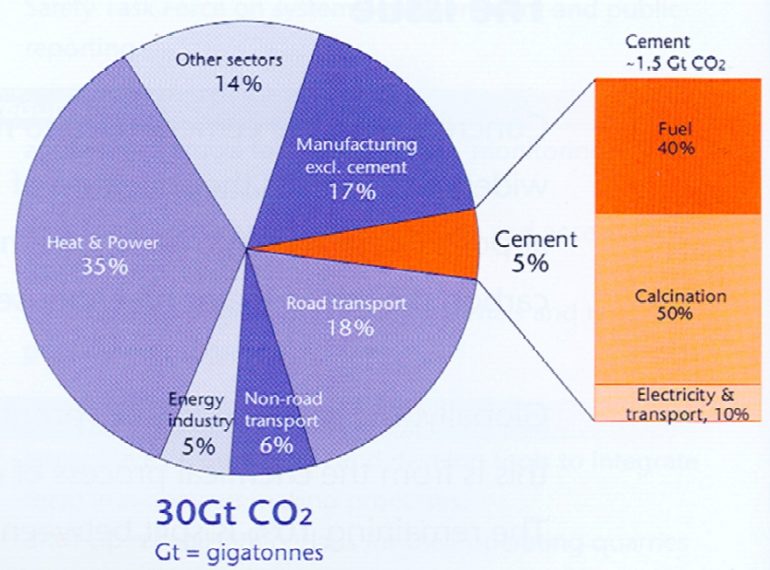
The most astonishing thing about cement is how much air pollution it produces.
Manufacturing the stone-like building material is responsible for 7% of global carbon dioxide emissions, more than what comes from all the trucks in the world. And with that in mind, it’s surprising that leading cement makers from LafargeHolcim Ltd. in Switzerland to Votorantim Cimentos SA in Brazil are finding customers slow to embrace a greener alternative.
Their story highlights the difficulties of taking greenhouse gases out of buildings, roads and bridges. After wresting deep cuts from the energy industry, policymakers looking to extend the fight against global warming are increasingly focusing on construction materials and practices as a place to make further reductions. The companies are working on solutions, but buyers are reluctant to pay more.
“There is so far too little demand for sustainable materials,” said Jens Diebold, head of sustainability at LafargeHolcim. “I would love to see more demand from customers for it. There is limited sensitivity for carbon emissions in the construction of a building.”
Significant Share
The cement industry’s CO2 emissions were more than all the trucks on the road in 2017
While architects and developers concentrate on the energy used by their buildings, it’s actually the materials supporting the structure that embody the biggest share of its lifetime carbon footprint. Cement’s contribution to emissions is especially immense because of the chemical process required to make it.
About two-thirds of the polluting gases that come from cement production stem from burning limestone. Kilns are heated to more than 1,400 degrees Celsius (2,600 Fahrenheit), about four times hotter than a home oven set to the self-clean cycle. Inside the kiln, carbon trapped in the limestone combines with oxygen and is released as CO2, the most abundant greenhouse gas.
A ton of cement yields at least half a ton of CO2, according to the European Cement Association. That’s more than the average car would produce on a drive from New York to Miami. And a single mixer truck can carry about 13 tons. Hundreds or even thousands of tons go into ordinary office buildings.
It is an interesting comparison that in Vancouver, 5.7 km of SkyTrain light-metro subway will cost over $3 billion and 16km of new SkyTrain light metro in Surrey and Langley will cost around $5 billion (both projects will actually cost over $11 billion for 21.7 km of new line, including the much needed rehab), while in Ontario 18 km of the Hurontario LRT will cost only $1.4 billion.
In Metro Vancouver, 21.7 km light-metro expansion will cost close to $507 million/km, while in Ontario 18 km of LRT will cost around $78 million/km.
Put another way, one could build 6.5 times more per km building with LRT than with light metro. Instead of 21.7 km of SkyTrain, one would get 141 km or more of new line, for $11 billion, building with LRT!
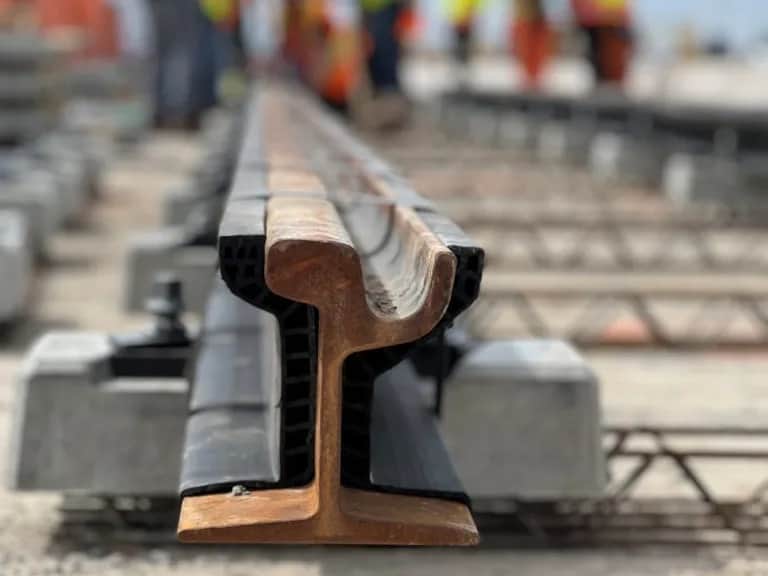
Starting this Sunday (Aug. 28), drivers on Hurontario St. in Mississauga and Brampton will be faced with a series of rolling partial intersection closures as the first tracks on the main section of a $1.4-billion light rail transit (LRT) route will be laid.
The tracks “will be laid along the centre of Hurontario St., where construction will occur at every other intersection to allow for detours,” officials with Metrolinx, the provincial agency overseeing the huge Hazel McCallion LRT project, said in a news release today (Aug. 25). “This is a key sign of progress for the 18-kilometre rapid transit line.”
Project leaders note that while the first tracks were actually laid earlier this year at the route’s Operations, Maintenance and Storage Facility on the Mississauga-Brampton border, “…this is the first track installation along the LRT guideway where the light rail vehicles will run on Hurontario St.”
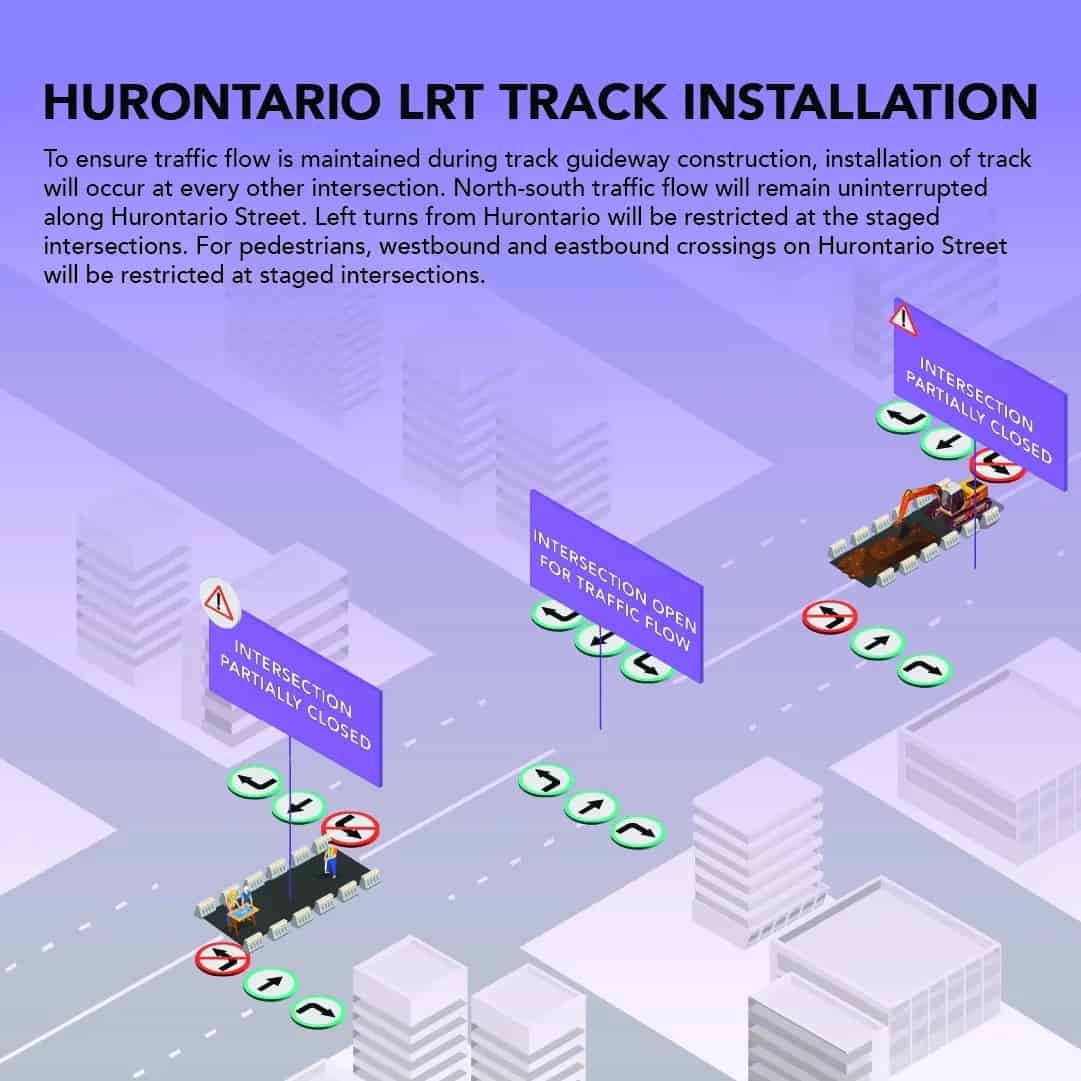
The ongoing partial intersection closures will restrict drivers from turning left in both directions while driving along Hurontario St.
“With this approach, the track installations can occur quickly and more efficiently with less impact overall,” Metrolinx officials say. “Once the track is laid, the intersections will reopen with no more than two consecutive intersections being closed at the same time.”
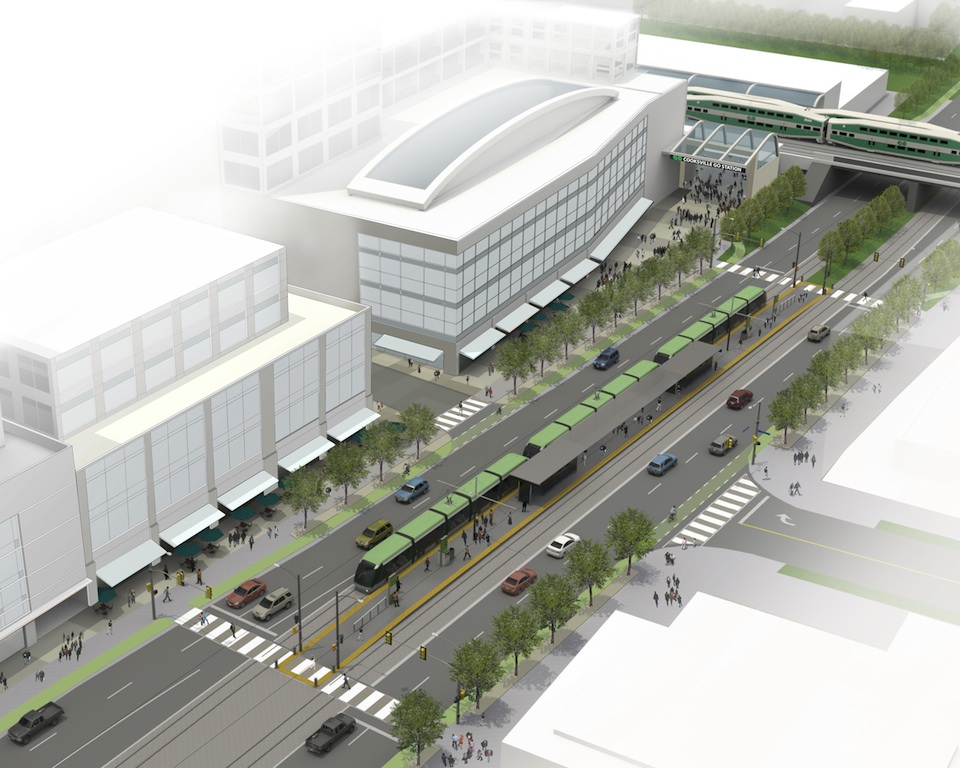
(Image: Metrolinx)
Work begins on Aug. 28 at the intersection of Hurontario St. and Milverton Dr./Watline Ave. (just north of Matheson Blvd.) and will continue until Sept. 16.
Additionally, project leaders say, the Hurontario St. and Sandstone Dr./Brunel Rd. intersection (just south of Britannia Rd.) will be partially closed from Sept. 6 until Sept. 28.
Metrolinx says work at both intersections is expected to be completed by October.
Track installation will also be ongoing on Hurontario St. at Aldridge St./Traders Blvd. and Matheson Blvd.
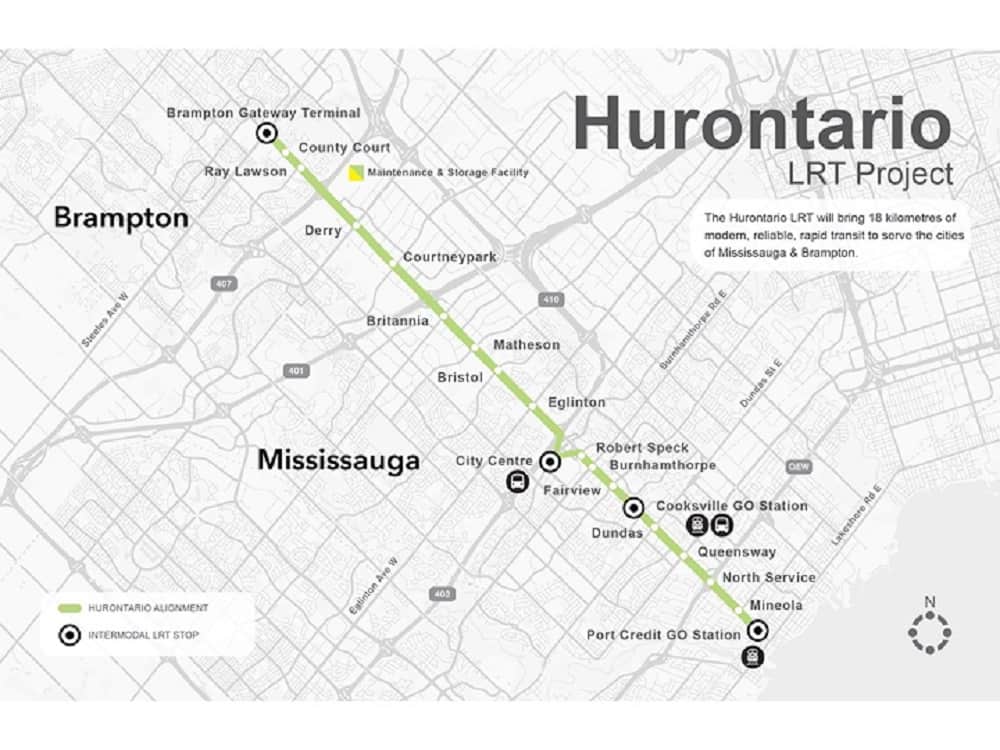
Port Credit GO is the starting point of the LRT route, which when up and running will make 19 stops between south Mississauga and Brampton. It will connect to major transit systems including GO Transit (Milton and Lakeshore West Lines), the Mississauga Transitway, Brampton Transit, ZUM and MiWay.
Meanwhile, City of Mississauga officials are still aggressively pushing for reinstatement of initial plans to create an “LRT loop” that would more directly and conveniently serve condo residents and office workers in the city’s downtown core around Square One.
Rail for the Valley is not in the habit of printing obituaries, but Adam Fitch was a good friend to Rail for the Valley and this blog.
Zwei received the following email from the daughter of Adam Fitch:
This is Emily Fitch, Adam’s elder daughter. If you can, please join me on Monday, September 19th to attend Adam’s funeral and burial. Adam died yesterday evening at St. Paul’s hospital, surrounded by family. He had been battling a blood infection for the previous three weeks.
Funeral Details:
Monday September 19, 2:30-4:00pm
Schara Tzedeck Cemetery
2345 Marine Drive, New Westminster. 5 mins’ walk west of 22nd Street skytrain station.
I only met Adam Fitch twice, but we constantly sent emails to each other for about a decade about transit and transit planning. He was one of the professional planners who advised me on the subject of transit and transportation in the modern urban setting. He was a fountain of information and I had my knuckles rapped a few times about mistakes made in regional planning and transportation.
Adam was also one of the few planners in BC who actually understood transit mode, bus, tram (LRT) light metro and subway, a rarity in BC.
He will be deeply missed.
Again, I offer my condolences from Rail for the Valley to his family.
It is the civic election season, or more fondly called the “silly season” and all sorts of claims and promises are made.
Recently on a local radio talk show a politcal wannabe claimed that; “SkyTrain operates almost free because it does not have any drivers and is cheaper than LRT” and the host agreed with the person!
This sort of nonsense has been going on for decades, where people who should know better, make outlandish claims for the SkyTrain light metro system, without even a notion of understanding of the regional light rail system.
So, let us look at the costs of the current Expo and Millennium Line projects.
The Millennium Line extension to Arbutus
The Millennium Line extension to Arbutus can trace its ancestry back to the old Broadway-Lougheed rapid transit project where originally planned light rail would stop at the Arbutus Corridor where it would hook up to proposed light rail operating on the former Arbutus Corridor interurban route.
The NDP shelved this project, when the flip flopped from LRT to the proprietary Advanced Rapid Transit (ART), which, at the time, was the latest rebranding of the former proprietary Advanced Light Rail Transit (ALRT) system used on the Expo Line. The NDP further debased regional transit planning when they promised to pay two thirds of SkyTrain only construction West of Commercial Drive.
The flip-flop from Light Rail to Light Metro and with the province paying two thirds of the cost, gave Vancouver politicians the idea that having subways, makes a city world class, without even a hint of knowledge of the true cost of subways and their lack of ability in attracting ridership. But, they make good background for politcal photo-ops.
In April 2018, it was announced that the cost of the 5.7 km Broadway subway or Millennium Line extension to Arbutus will cost $2.83 billion.
Accounting for inflation and that cement costs have risen two to three times the rate of inflation, the cost of the subway will be more.
How much more?
Accounting just for inflation, the project now costs $3.19 billion and rising.
All the more embarrassing is that the subway will cater to peak traffic flows less than 4,000 pphpd, with the Broadway 99-B Line bus currently having a maximum capacity of 2,000 pphpd!
Expect the bad news that the cost of the subway will exceed its original estimates after the next civic elections.
The Expo Line Extension To Langley
This project has even more dubious history than the Broadway subway.
With the cost of SkyTrain light-metro ever increasing, TransLink set in motion of a plan to build LRT to connect central Surrey and Langley to the light-metro network.
The planning was fraught with issues, as TransLink designed the proposed LRT as a road rebuilding project with rails which drove up costs. Another problem, TransLink designed the proposed Surrey LRT as a “poor man’s” light metro and failed to understand that LRT was not light metro.
Evidently the bureaucrats at TransLink do not understand the differences between LRT and light-metro.
In the 2018 Civic Elections, former City of Surrey Mayor Dough McCallum ran on a ticket which included a switch from LRT to light-metro because he was an expert about transit, being around when the Millennium line was built, and that he could build the 16 km Expo line extension to Langley for $1.63 billion.
The public bought into this nonsense and McCallum was duly elected and the switch from LRT to Movia Automatic Light Metro was made.
Fast forward to 2022 and the cost to extend the SkyTrain light-metro system to Langley has become so expensive that the the project has been split into two contracts in an effort by the provincial government to hide the costs.
Contract 1: The guideway, which is now estimated to cost over $4 billion, of which 40% will be paid for by the federal government.
Contract 2: The operations and maintenance centre #5, which is now estimated to cost $500 million to $1 billion and must be completed before the line opens.
Thus the true cost of the 16 km Expo Line extension to Langley is $4.5 billion to $5 billion+!
The Partly Funded Mid Life Rehab
What is not included with the cost of the SkyTrain light metro extensions, is the estimated $3 billion mid life rehab of the Expo and Millennium Lines. As mentioned several times before, the Expo and Millennium Lines need a complete re-signalling; a renewed and enhanced electrical supply; and the replacement of switches (points), and a sundry of lesser items to be renewed or replaced before the extensions are opened.
From Toronto’s MetroLinx – the 50 year costs of rapid transit.
Disclaimer:I do not advocate for “slip coaches” on either the E&N or the RftV/Leewood plan, rather just a historical look back at passenger railway practice.
In 2022, if one mentions a “slip coach” I would think Transport Canada would be in a nervous collapse.
The last “slip coach” operated on British rail in 1960, but the practice of dividing passenger trains at stations and joining other rail services to separate destinations, is common today on many European railways.
According to British railway lore, the “slip coach” was born when a rail official was riding in a train car that came an unexpected stop. The rest of the express train kept going while his carriage glided to a gentle halt in front of a midway station. As the story goes, the coupling chain broke in transit, so the guard on the slipped car used his handbrake to slow and guide it carefully to a halt alongside the platform. Fascinated by the accident, the official wondered: could we do this on purpose? Thus, in the mid-1800s, train operators began detaching passenger cars in motion, sending them into stations without motive power of their own.
The more likely actual origin story is a little less sudden and dramatic, but nonetheless fraught. Before slip cars, there were reckless rail car detachments — a locomotive might simply slow down a bit to provide some give while an engineer decoupled rear cars on the fly.
Once a slip coupling was developed, there was theoretically no limit to the number of cars that could be slipped or how many times it could be done along a route. An express train between London and Glasgow could, for instance, drop a few cars off in one smaller town or city along the way, then a few others in another (as long as there was a guard manning a set of brakes in the lead car slipped at each stop). The slipped cars could then open up to let riders off, or be attached to another train, routing them along without people needing to transfer.
It now seems hydrogen powered trains are now mainstream and set to become the worlds least polluting transit mode.
It is time Canada and BC politicians get on board the H-Train, but I am afraid in Canada, politicians and bureaucrats have left at the station and gone to the airport to travel on the taxpayer’s dime, first class, to their destinations.
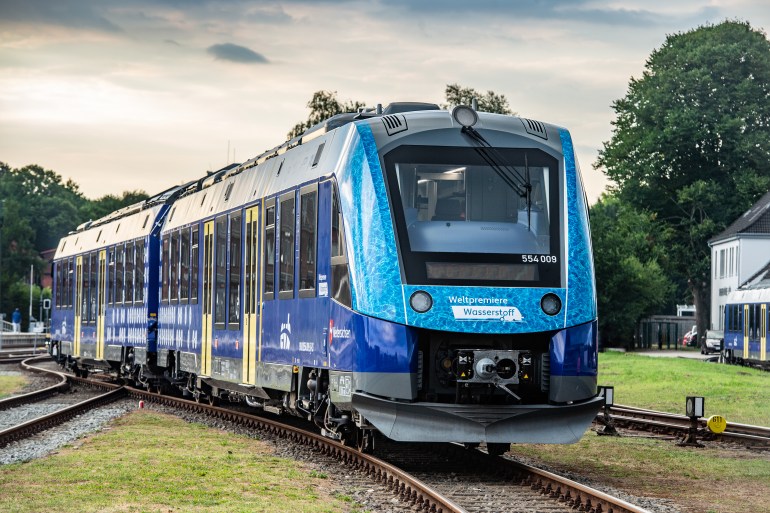
Germany inaugurates world’s first hydrogen-powered train fleet
A fleet of 14 trains powered entirely by hydrogen is launched in Germany’s Lower Saxony state.
A fleet of 14 trains were provided by French industrial giant Alstom [Alstom handout/EPA]
Published On 24 Aug 202224 Aug 2022
Germany has inaugurated a railway line powered entirely by hydrogen, a “world premiere” and a significant step forward for green train transport despite nagging supply challenges.
A fleet of 14 trains provided by French industrial giant Alstom to the German state of Lower Saxony has replaced diesel locomotives on the 100km (60 miles) of track connecting the cities of Cuxhaven, Bremerhaven, Bremervoerde and Buxtehude near Hamburg.
“We are very proud to put this technology into operation together with our strong partners as a world premiere,” Alstom CEO Henri Poupart-Lafarge said in a statement on Wednesday.
Hydrogen trains have become a promising way to decarbonise the rail sector and replace climate-warming diesel, which still powers 20 percent of journeys in Germany.
Billed as a “zero emission” mode of transport, the trains mix hydrogen on board with oxygen present in the ambient air, thanks to a fuel cell installed in the roof. This produces the electricity needed to pull the train.
Regional rail operator LNVG said the fleet, which cost 93 million euros ($93m), would prevent 4,400 tonnes of CO2 being released into the atmosphere each year.
Run for its money
Designed in the southern French town of Tarbes and assembled in Salzgitter in central Germany, Alstom’s trains – called Coradia iLint – are trailblazers in the sector.
The project created jobs for up to 80 employees in the two countries, according to Alstom.
Commercial trials have been carried out since 2018 on the line with two hydrogen trains but now the entire fleet is adopting the groundbreaking technology.
The French group has inked four contracts for several dozen trains between Germany, France and Italy, with no sign of demand waning.In Germany alone “between 2,500 and 3,000 diesel trains could be replaced by hydrogen models”, Stefan Schrank, project manager at Alstom, told the AFP news agency.“By 2035, around 15 to 20 percent of the regional European market could run on hydrogen,” according to Alexandre Charpentier, a rail expert at consultancy Roland Berger.
Hydrogen trains are particularly attractive on short regional lines where the cost of a transition to electric outstrips the profitability of the route.
Currently, about one out of two regional trains in Europe runs on diesel. But Alstom’s competitors are ready to give it a run for its money.
German behemoth Siemens unveiled a prototype hydrogen train with national rail company Deutsche Bahn in May, with a view to a rollout in 2024.
But, despite the attractive prospects, “there are real barriers” to a big expansion with hydrogen, Charpentier said.
For starters, trains are not the only means of transport hungry for the fuel.
The entire sector, whether it be road vehicles or aircraft, not to mention heavy industry such as steel and chemicals, is eyeing hydrogen to slash CO2 emissions.
Ambitious plan
Although Germany announced in 2020 an ambitious seven-billion-euro ($7bn) plan to become a leader in hydrogen technologies within a decade, the infrastructure is still lacking in Europe’s top economy.
It is a problem seen across the continent, where colossal investment would be needed for a real shift to hydrogen.
“For this reason, we do not foresee a 100-percent replacement of diesel trains with hydrogen,” Charpentier said.
Furthermore, hydrogen is not necessarily carbon-free: only “green hydrogen”, produced using renewable energy, is considered sustainable by experts.
Other, more common manufacturing methods exist, but they emit greenhouse gases because they are made from fossil fuels.
The Lower Saxony line will in the beginning have to use a hydrogen by-product of certain industries such as the chemical sector.
The French research institute IFP specialising in energy issues says that hydrogen is currently “95 percent derived from the transformation of fossil fuels, almost half of which come from natural gas”.
Europe’s enduring reliance on gas from Russia amid massive tensions over the Kremlin’s invasion of Ukraine poses major challenges for the development of hydrogen in rail transport.
“Political leaders will have to decide which sector to prioritise when determining what the production of hydrogen will or won’t go to,” Charpentier said.
Germany will also have to import massively to meet its needs.
Partnerships have recently been signed with India and Morocco, and Chancellor Olaf Scholz sealed a green hydrogen deal with Canada on a visit this week, laying a path for a transatlantic supply chain.







Recent Comments