Old Zwei has told you so, operating driverless trains is very expensive.
In December 2019, it was reveled that the SkyTrain Light metro system (Expo and millennium Lines, had over 900 employees.
That is over 900 workers for just two rail lines.
The Canada line, being a P-3, has it own employees and the number of people working on the SNC Lavalin.Caisse du’Depot lead concession operating the light metro line is deemed proprietary and not released.
In 201 it was revealed that the driverless Canada Line had 180 control room workers, maintenance people and attendants and are represented by B.C. Government and Service Employees Union who are currently negotiating a new contract.
Thus the SkyTrain light metro line has over 1,080 unionized workers and this does not include management.
What what is even more expensive is extending driverless trains into areas of smaller populations simply because the huge maintenance costs to keep a driverless train operating far outweighs any transportation benefits. This is the problem facing the Expo line extension to Langley as the $40 million annually in extra operation and maintenance costs (TransLink’s estimates) and the $500 million to $1 billion Operations and maintenance centre, far outweigh any benefits.
What will happen is simple, the now $5 billion Expo line extension will cannibalize the rest of the transit system and with inflation and a general reluctance of the taxpayer to pay more taxes will mean the money must come from the rest of the transit system in higher fares and user fees.
And to think, that because of the actions of the current idiot Mayor of Surrey, who said he could build the Expo line extension to Langley for $1.63 billion, supported by the other idiot mayors on the Mayor’s Council for Transit, yet for a little more than half the cost of the current 16 km, $5 billion light metro extension to langley, a larger light rail network, extending to Langley would be opening in 2024!
Driverless train, operating at-grade also need to be protected by 3 metre, razor wire topped fencing.
Costs of Sydney’s driverless train conversion outweigh the benefits
The NSW government’s industrial dispute with rail unions over the new intercity trains is tipped to add hundreds of millions of dollars to costs on Australia’s largest infrastructure project that has already blown out by billions.
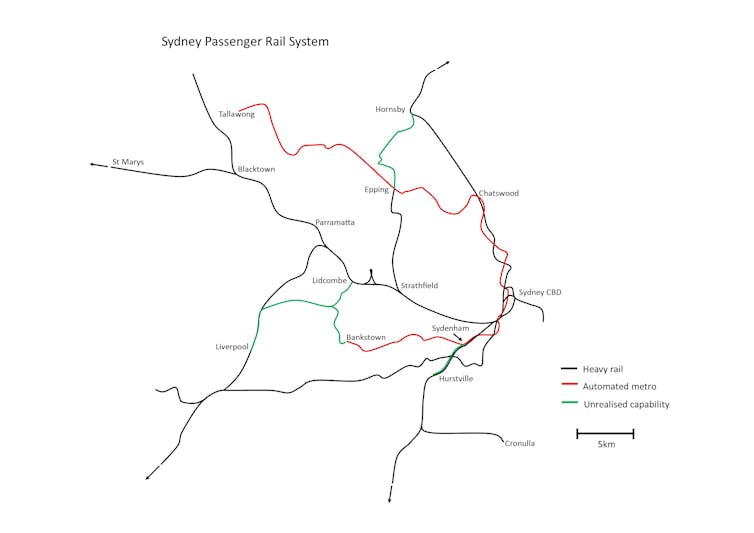
But even without overruns pushing the cost of the driverless-train project to more than A$55 billion, the economics of the “Sydney Metro” project are questionable – in particular the decision to cannibalise parts of the existing Sydney train network to create one of the four planned automated routes.
The new driverless trains – as used in megacities throughout the world – have fewer seats, increased standing room, and more doors than Sydney’s main fleet of double-decker trains, making them better suited to peak-time congestion.
The Metro project promises to deliver up to 15 services an hour (every four minutes) to cope with Sydney’s growing population.
Driverless trains will eventually operate on three lines from the CBD (to the northwest, west and southwest) and one in far-western Sydney, connecting to the city’s second airport site at Badgery’s Creek.
By far the biggest cost for the project are new tunnels under the harbour and CBD. Our focus, however, is on the merits of cannibalising existing rail infrastructure – namely the rail line to Bankstown, about 16km southwest of the Sydney CBD – for the southwest Metro line.
This part of the project involves converting 11 stations between Bankstown and the inner-eastern suburb of Sydenham. (A new tunnel has been built from Sydenham into the CBD, where the line links to the Northwest Metro line).
Our analysis shows the costs, disruptions and lost opportunities associated with converting this line for the Metro network outweigh the benefits and potential savings, largely achieved from replacing drivers.
Straightening the line
Automated trains are now commonplace in cities throughout Asia, Europe and the Middle East. Their high-frequency services and platform screen doors enable the transport of large numbers of commuters with minimal staff supervision. They have proven safe and effective
The issue is whether they are worth cannibalizing existing services for. There are two main calculations to consider: the initial cost; and the ongoing costs.
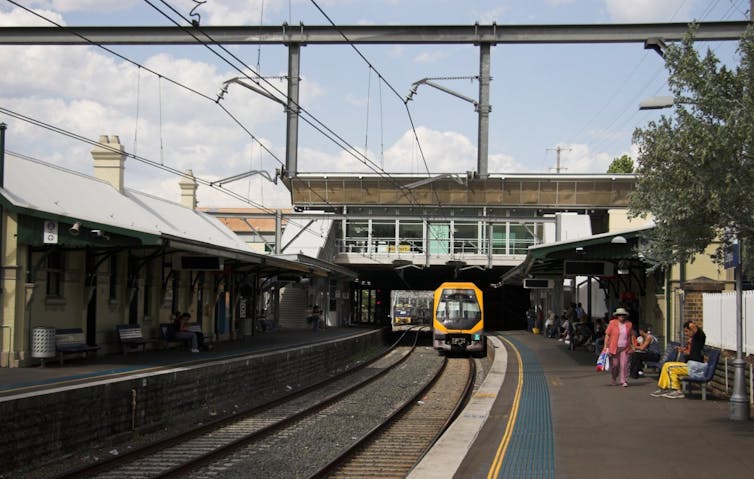
In terms of initial costs, the Bankstown line is not well-suited for automatic trains. Automatic trains, which stop precisely at gateways on enclosed platforms, require straight platforms. The Bankstown line, and five of its station platforms, are sharply curved.
Straightening up: the curved platform of Campsie train station, on the Bankstown line in south-western Sydney, is being converted for automatic trains as part the NSW government’s Sydney Metro rail project.Wikimedia Commons, CC BY
Calculating the full cost of making these right for driverless trains is complicated, because maintenance and renovations to improve accessibility and amenity would have happened in any circumstance.
Based on the NSW government’s public announcements, we estimate converting the line and stations to driverless trains will cost about A$1 billion. We conservatively estimate $500 million of that is purely to meet the operating requirements of driverless trains. This excludes the cost of new train storage, control systems and power upgrades specifically incurred by the choice of automated trains.
Savings on drivers
On the other side of the ledger are potential savings – notably on driver costs. We estimate operating the Bankstown railway as an automated metro will save about $15 million a year on driver costs.
This is based on the driver cost of providing train services at least every 10 minutes all week, and every five minutes during peak times. The NSW government has indicated Metro services will operate up to every four minutes, but the timetable for the Bankstown line metro is not yet public.
We estimated driver costs based on the May 2022 timetable for the Bankstown line – about 1,500 services a week (1,210 during the week, and 324 at weekends). To approximate matching the higher frequency promised by the Metro trains, we calculated driver costs for 1,900 services a week.
This would require employing about 100 drivers, allowing for normal working hours, holidays and other leave. Based on the cost of employing a driver, including administrative overheads, being about $150,000 a year, the savings from replacing drivers on this line is about $15 million a year.
Assuming a 5% rate of return on the $500 million cost to automate the line, this saving is offset by the $25 million a year in opportunity costs on the $500 million line conversion.
Time for a rethink
Augmenting established rail networks with new automated rail services is one thing. Cannibalising existing infrastructure to build those new lines is quite another.
Fortunately for taxpayers, the NSW government is not repeating this conversion approach with the other Metro lines.
By our calculation, Sydney would be better served by following the approach adopted in Melbourne and Brisbane. Both cities are investing heavily in new rail lines, but they are acquiring new trains compatible with their existing railway systems.
This would make much more sense for the Metro line yet to be built between the CBD and the western-Sydney centre of Parramatta.
Greater compatibility will enable services to be readily extended onto existing tracks west of Parramatta while avoiding the cost and complexities of the Bankstown line conversion.
It is the sad, same old story, when politicians play trains with multi billion dollar transit projects, things go south all too quickly.
In 2018, then mayoralty candidate, Doug McCallum claimed he was an expert and he could build the Expo Line extension for $1.63 billion. Fast forward to 2022 and the cost for the Expo line extension to Langley is now pushing $5 billion!
The now elected, but somewhat disgraced mayor (due to a pending criminal charge) is now pushing for a 60,00 seat sports area somewhere on the rapid transit line to increase usage.
Fool the public once, why not fool the public again.
The Mayor should read RftV’s previous blog post about the current land rush happening all along the the proposed R/T line. How much will the land cost, if any is available?
It is necessary for a new transit line to have a commissioning period, over several months to ensure a future smooth operation.
Vancouver’s new ALRT system had so many problems it took years to fix and the rail corrugation problems still plague the system.
In Ottawa, politcal interference played a large part in providing a transit system that did not have all the bugs ironed out and now they are going to pay the price for their arrogance.
It is oh so easy to blame light rail; it is so easy to blame the other guy. What is not so easy is to blame one’s self.
As with most transit projects, politicians assume they are the experts and that they know best.
Ha, ha, ha!
In Vancouver, it is the same but the mainstream media thinks it impolite to blame SkyTrain, so they blame LRT elsewhere, go figure.
Everyone else to blame for LRT failures, everyone involved tells inquiry
Ted RaymondCTV News Ottawa Digital Multi-Skilled Journalist
Published Wednesday, August 17, 2022
The written closing submissions in the province’s public inquiry into Stage 1 of Ottawa’s light rail transit project are a summary of the finger-pointing seen and heard during the live testimony in June and July.
The inquiry posted the final closing submissions from nine involved parties, including the city of Ottawa, the Rideau Transit Group—which built and now maintains the Confederation Line—train manufacturer Alstom, and others.
A common theme that emerged is that the interested parties were not at fault, but were instead the victims of the other parties involved.
For example, Alstom said in its closing submission that micromanagement from the city of Ottawa, which Alstom said was inexperienced in major infrastructure development, was to the detriment of the project.
“To make up for this inexperience, the City retained an army of expert consultants to guide them through every aspect of the Project, from design and construction to operations and maintenance. Yet, the City often failed to heed its experts’ advice,” the submission said. “Instead, under extreme public scrutiny in Ottawa, the City was pressured to make short sighted decisions, to ‘act tough’ with its contractor partner, and, ultimately, to put the System into service before it was ready.”
The city, meanwhile, blamed the consortium it contracted to build the LRT system.
Noting several issues that plagued the line since its launch, including door failures, wheel cracks and two significant derailments, the city said all of the blame lies at the feet of the builder.
“RTG’s failures to perform its design, construction and maintenance obligations cannot be blamed on the City. In particular, these failures do not arise from the City’s procurement approach, the structure and content of the Request for Proposals, the adequacy of the Project Agreement, the City’s oversight of the Project or any of the other criticisms of the City’s conduct raised by Commission counsel during this Inquiry,” the city’s closing submission said. “None of those matters caused or contributed to the issues that led to the breakdowns and derailments.”
But RTG said the problems that arose when the system launched were “reasonably common problems” for a complex infrastructure project and blamed the impact to transit riders on city officials.
“The problems with the project had an outsized impact on Ottawa’s residents because their municipal government set unrealistic expectations,” RTG said. “Elected officials promised the public a turnkey system and campaigned on delivering it with no delays. When their own advisors warned them that no complex transit system, newly-built and operated, would launch problem-free, the political die was already cast.”
Alstom said its staffing and planning levels were appropriate and it overcame the challenges of building a new supply chain, but also said it was “set up to fail” from the very beginning.
“Unfortunately, Alstom’s maintenance team was set up to fail by circumstances out of its control, including a lack of transparency and information sharing from Ottawa Light Rail Transit Constructors (OLRTC) leading up to and during Revenue Service Availability (RSA), and RTG’s decision to shift the burden of a highly degraded and immature system from OLRTC to RTM and Alstom,” the train builder said.
“The City and RTG’s decision to start Revenue Service before the System was 100% ready presented enormous challenges for RTM and Alstom, as anticipated by RTG.”
The city’s closing submission said it felt at times that the “public sector was on trial” but staff defended their actions during the procurement, launch, and running of the system.
“[T]he City believes that a fair-minded and impartial observer can only come to one conclusion – the City’s conduct, and the conduct of its representatives, is not responsible for the previous and continuing issues facing the LRT,” the city said.
RTG stressed that it was ready to launch, but had issues with its subcontractor, Alstom.
“The Commission heard evidence from many parties that the Confederation Line was safe and ready for service at RSA. RTM was ready to perform its maintenance obligations at RSA,” the consortium wrote.
“Despite RTM’s readiness, it needed to rely on its subcontractor, Alstom. Though the RTG Parties’ constantly pushed Alstom maintenance (and it represented that it was ready for RSA), the reality was that Alstom maintenance was not prepared for RSA.”
Through all of this, the union representing transit operators said the problems with the LRT affected the entire transit system, had a negative impact on customers and, ultimately, on OC Transpo rank and file.
“Residents of Ottawa were promised that the years of disruptions to their roadways and transit networks during the construction of Phase 1 would be worth it because the light rail system would deliver this “safe and reliable” transit service from its inception,” The Amalgamated Transit Union Local 279 wrote in its closing submission.
“Regrettably, what the evidence has shown over 18 days of testimony and countless exhibits is that not only has the Confederation Line fallen far short of being a reliable form of public transportation, but it has also shown that virtually everyone connected with the project knew this was going to be the reality before the system’s public launch in September of 2019.”
The ATU blamed the public-private partnership model (P3) as inherently flawed.
“The adoption of a public/private partnership (P3) model for the construction and operation of the Confederation Line rather than having OC Transpo operate the system directly (i) unduly fragmented the operations and maintenance of the transit system; (ii) prevented OC Transpo managers from responding to service challenges; and (iii) generally led to a lack of public accountability for the system’s failures.”
The inquiry was called following two derailments in six weeks last summer, the second of which kept the Confederation Line closed for 54 days.
The commissioner leading the public inquiry into Ottawa’s light rail transit system has received a three-month extension to finish the final report, pushing the deadline beyond the Oct. 24 municipal election. Justice William Hourigan will have until Nov. 30, 2022 to submit his final report.
The inquiry originally had a deadline of Aug. 31, which would have enabled a final report to be tabled before the election, but it always included the possibility of an extension.
Mayor Jim Watson is not running for re-election in 2022 and neither are several city councillors.
Eighteen days of public hearings were held at the University of Ottawa from June 13 to July 7, with 41 witnesses testifying. The commission also conducted formal interviews with dozens of witnesses, hosted an expert panel on public-private partnerships, and received more than 550,000 documents related to the LRT system.
Like the Millennium Line extension to Arbutus more commonly known as the Broadway subway, the main reason for extending the SkyTrain light metro system is to give politcal friends and insiders, mainly land speculators and land developers the ability of make large profits by assembling land, having council up-zone the land to allow for higher densities, by building towers and high rise condos.
This game has been played in metro Vancouver ever since the NDP did their infamous switcheroo from light rail to light metro for what is know known as the Millennium Line, in the 1990’s
Building rapid transit has been about land development, rather than moving people and sadly, the taxpayer will soon learn that extending the proprietary light metro to Langley will be extremely costly, with annual added operating costs of more than $35 million annually.
Total cost of the project is now around the $5 billion mark, not including cars or the much needed $2 to $3 billion rehab of the aging Expo line. Let us also remember that this line is a mere 16 km long and according to TransLink’s own numbers, will carry less customers than the Broadway B-Line Bus did in 2019.
Like the land-rush in Vancouver with the Broadway subway or Millennium line extension to Arbutus Street, extending the Expo Line to Langley is all about moving money and not passengers.
Brown areas are within a five-minute walk of one of the planned local SkyTrain stations. Areas in tan are within a 10-minute walk. (Langley City OCP)
Most land on City SkyTrain route already bought by developers: realtor
Langley City land assemblages are ready to be redeveloped over the next few years
Much of the land in downtown Langley City, particularly along the main SkyTrain corridor, which runs down Fraser Highway and then Industrial Avenue to 203rd Street, can be redeveloped as part of the City’s most recent update to its Official Community Plan (OCP) adopted last year.
“That whole area is going to change significantly,” said Gordon Kleaman, a Re/Max realtor from North Vancouver who recently brokered a deal for a big planned housing project in downtown Langley City.
Kleaman was the realtor for the sale of three lots of low-rise, older apartments on Eastleigh Crescent, a few blocks from the planned SkyTrain terminus at Industrial Avenue and 203rd Street.
The three-lot, 1.38 acre land assembly reportedly sold for $18 million to a developer now planning a six-storey condo complex, along with 159 townhouse units.
Right now, the core areas alongside the SkyTrain line, and near its terminus, include a mix of uses, from low-rise residential, to big box shopping centres, restaurants, and small shops. There are also a significant number of car dealerships, auto shops, parts dealers, and light industrial buildings.
“Most of those are already purchased,” Kleaman said of the light industrial districts.
Developers are willing to pay a premium to buy within Langley City, he noted, because the City has a reputation for processing development applications faster than Surrey or Langley Township.
In the City, an application can take months, rather than years.
But that means a lot of plans won’t come to the City right away.
“They’ll time the market,” he said. Developers will wait until the market is right for their project, comfortable in the knowledge that they can get their project approved in a timely manner.
Kleaman said another land assembly on 196th Street, near the other main SkyTrain station in Langley, didn’t sell for as much as the Eastleigh Crescent site, because it was outside the City’s boundaries.
“That was one of the factors in pricing,” he said.
The City is planning for significant population growth and increasing density over the next three decades, and SkyTrain and other forms of public transit are key to its OCP.
As of 2019, there were 28,085 people in Langley City. By 2050, the City expects there to be 41,438.
The mix of types of housing will radically change.
While Langley City has long had plenty of low-rise apartment buildings, it also had many areas of single-family housing, especially near the Nicomekl River and on the west side of the City south of 56th Avenue.
But condos and townhouses are being rapidly built, and the arrival of SkyTrain and more mixed-use housing downtown will change that.
As of the creation of the OCP, there were 7,260 apartments, 1,945 townhouses or duplexes, and 3,760 single family homes in the City.
The “total capacity” for those three types is 24,713 apartments, 6,094 duplexes and townhouses, and 3,046 single family homes. Total capacity isn’t a goal, but a measure of how many homes the City could accommodate.
That growth is to be focused in the City’s central areas, with 91 per cent of new households and 99 per cent of new jobs expected to be in the City’s “regional city centre,” an area north of 53rd Avenue and the Nicomekl, and between 196th Street to the west and the Langley Bypass to the east.
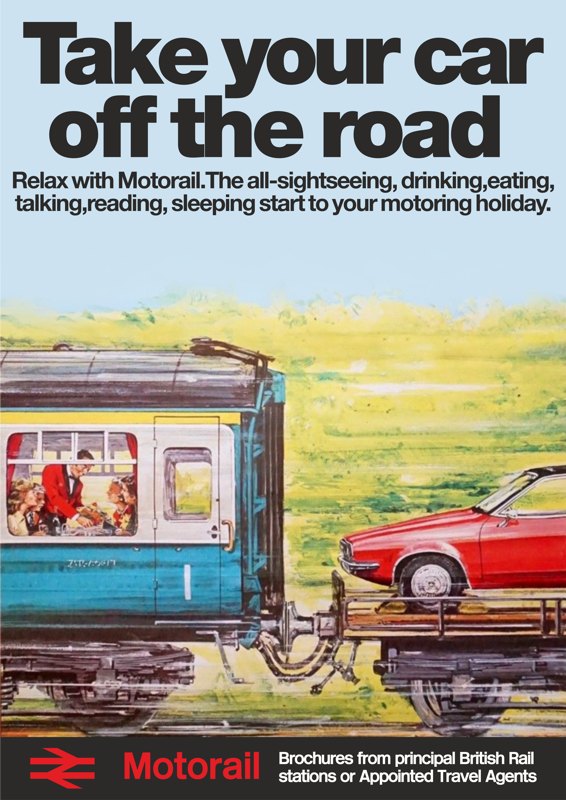
A little known service offered by railways is the car shuttle or MotorRail.
A motorail train or accompanied car train (ACT) is a passenger train on which passengers can take their car or automobile along with them on their journey. Passengers are carried in normal passenger carriages or in sleeping carriages on longer journeys, while the cars are loaded into autoracks, car-carriers, or flatcars that normally form part of the same train.
Motorail was the brand name for British Rail’s long-distance services that carried passengers and their cars, ultimately part of the InterCity sector.
The service had originated in June 1955 with the introduction of the Car-Sleeper Limited between London and Perth. The service operated between June and September conveying car and driver for £15 return, inclusive of sleeping berth. In 1961 it was reported that over 50,000 cars had been transported and a new two-tier transporter was introduced to expand the capacity.
The Motorail brand was introduced in 1966 with the opening of the Kensington Olympia Motorail terminal. Serviced ceased in 1996
British Rail wasn’t the only railway offering car shuttles, as most railways crossing the Alps offered car shuttles through long tunnels and the Deutsche Bahn still operates a car shuttle to the island of Sylt.
The Channel tunnel also offers a roll on – roll off car shuttle through the tunnel.
This begs the question, with very expensive gas prices and the limited endurance of electric vehicles, combined with the large distances involved in BC and Canada, cannot the reinvention of Motor Rail or car shuttles be that far off?
At best, an electric car can travel around 300 km to 400 km or put another way, one can travel from Vancouver to Salmon Arm or Trail before recharging. Taking a Car-Go-Rail type service would both enhance ones travel by electric car and provide a service reducing auto traffic on our highways.
It is time to think 20 minutes into the future and just for the traveler, but the entire tourist industry.
A lot has been said that the Leewood/Rail for the Valley scheme would not attract much ridership because it isn’t fast, yet the same folks who use this excuse to nay say the “return of the interurban” fail to realize that the Vancouver to Chilliwack rail route will service many new destinations thus user friendliness combined with comfort of a modern D/EMU will attract ridership.
The planned 16 km, $4.5 to $5 billion Expo Line extension to Langley does not serve any new destinations which the current transit customer cannot get to by bus or bus plus transfer to the Expo Line. There is no real attraction in taking the Expo line, except as a regular transit customer. You may save 10 to 15 minutes in travel time, traveling past Surrey Centre, but is that time savings worth $5 billion?
With many transit customers having to take a bus to the Expo line stations, the time savings for the 16 km extension is over rated.
Simplicity is the key for a rural railway. A simple station for Ottawa’s Trillium Line.
Now let’s have look at the proposed Leewood/RftV plan and see the many new destinations that will be served by the proposed service.
As the Leewood RftV plan is a regional railway, let us look at selected destinations along its 130 km route:
1) Vancouver
2) North Delta – providing a faster travel time to Vancouver than the Expo line.
3) Central Surrey – high density housing plus business parks.
4) Cloverdale – front door service for the proposed hospital and Kwantlen Polytechnic University.
5) Langley – Central Langley and KPU Langley
6) Trinity Western University – front door service
7) Gloucester Business Park
8) Downtown Abbotsford – University of the Fraser Valley
9) Huntington – US Border and Abbotsford International airport
10) Yarrow/Vedder – For Cultus lake
11) Sardis
12) Chilliwack
Not including town centres, there are eight new destinations directly serviced by the “interurban”, including: central Surrey business parks; KPU and the proposed Cloverdale hospital; KPU Langley; Trinity Western University; the Gloucestor business Park; the University of the Fraser Valley; and the American boarder at Huntington/Sumas (only a few km away from Abbotsford airport – YXX).
Secondary destinations would be Vancouver, Chilliwack, Cultus Lake and YXX. Then there is the tourist appeal of such a service, which the Expo Line extension does not have..
The Leewood/RvtV plan would attract far more new customers as a far cheaper cost, showing the cost effectiveness of the rural railway. A cost effectiveness that the province, Metro Vancouver, TransLink and the Mot refuse to acknowledge.
Building more, cheaper should be the mantra for new transit projects, especially in the age of Global Warming and climate change and the regional or rural railway provides exactly what is so desperately needed.
The essence of a rural railway, an affordable alternative to the car.
Recommendations to save Japan’s rural railways issued
28 July 2022
JAPAN: A study group formed by the Ministry of Land, Infrastructure, Transport & Tourism has published its report into whether and to what extent rural railways across the country can be revived.
From the Railway Gazette.
Ottawa O-Train, a modern DMU operating on a single track rural railway.
The following was sent to the usual suspects.
Around the world, investment in regional and rural railways is recognized as necessary for the fight against Global Warming and Climate Change, yet in BC and in Canada there is silence.
In Europe over a thousand km of disused or abandoned railways are now being refurbished for regional passenger service; in the UK, long abandoned rail routes are being relaid for new regional passenger rail services.
In BC and in Canada there is silence.
In BC and in Canada, railways are deemed obsolete by politicians and senior bureaucrats, who enjoy free first class travel on national and regional air services, leaving the car as the only affordable mode of transport for the average person.
The provincial and Canadian governments are investing in transit, but it is the wrong kind of transit.
Example: The much photo-opped Expo Line extension to Surrey will cost (including the guide-way and new operations and maintenance centre but not the vehicles) $4.5 billion to $5 billion, yet upon opening, according to Translink’s own numbers, carry less ridership than what the Broadway B-Line buses carried in 2019!
In comparison, $4.5 billion to $5 billion would buy you a completely refurbished E&N Railway, offering a maximum service of 3 trips per hour per direction from Victoria to Courtney and a Vancouver to Chilliwack modern Interurban service, offering a maximum of three trips per hour per direction and a European style tramway connecting UBC to BCIT and Stanley Park.
The $3 billion Millennium Line, Broadway subway is more of the same “Photo-op” transit planning. Upon opening, the Millennium Line’s automatic train control system will be upgraded at a cost of $1.47 billion (not included with the subway cost) to allow a maximum capacity of 7,500 persons per hour per direction, yet the North American standard for building a subway, is a transit route with traffic flows in excess of 15,000 pphpd!
Please, tell me why the business cases for both projects did not mention this?
The answer is: BC Government business cases are politcal documents masquerading as technical documents.
The current heat dome is another sign of increasing Global Warming, but our politicians including the so called Greens, remain mute; our mainstream media largely remain mute and only regional newspapers seem brave enough to question current government spending on photo-op ready transit schemes.
What will it take for politicians to stop doing the same thing over and over again, ever hoping for different results and take real action and not staged photo-ops with empty promises.
Two major transit schemes, the E&N and the return of the Interurban to the Fraser Valley, providing 360 km of regional railway which will provide an user-friendly and affordable alternative to the car, can be built for much less money than the proposed 16 km, $4.5 to $5 billion Expo Line extension to Langley!
Could it be that regional, provincial, and federal politicians and bureaucrats are afraid that a much cheaper regional railway solution would provide a superior transportation alternative when compared to the current blinkered rapid transit only planning?
When will all politcal parties demand an affordable transportation option for the transit customer and taxpayer, instead of the current and hugely expensive rapid transit, which seems to be built for pre-election photo-ops.
One tires of the endless staged photo-ops, full of meaningless promises currently being offered, by politicians who seem not to care.
Real action is needed.
Global Warming and climate change will not wait for the next election cycle.
Edmonton’s Duewag U-2 LRV. Edmonton transit planners were greatly influenced by German Stadtbahns and when the system first opened it became the world first light rail system.
The following has been posted on Facebook and other transit blogs with some unfavorable comments about RftV.
First off, the article is by Alon Levy, a chap I have never heard of before, who has been described as an expert.
An expert, well I think not, but neither is good ole Zwei for that matter, but I consult with experts and I try to keep well informed on transit developments around the world.
I am flattered Zwei has been mentioned, which is good because it tells me other people read the blog, but that is where it ends.
Rail for the Valley has been concerned for one route and that is the former BC electric interurban route from Vancouver to Chilliwack and reinstating a passenger service, using modern trains. TramTrains would be ideal because we could create in the future (I stress future) mini tram networks in Abbotsford, Langley and of course a natural tie in with the originally planned Surrey LRT project.
Rail for the Valley engaged Leewood Projects (UK) to do a study on the viability of such a service and the result was the Leewood Report.
I have never advocated a Stadtbahn service for metro Vancouver, though it would be desirable, instead of our local SkyTrain light metro service. Using TramTrain or a variant would provide flexibility in design and application, unheard of with the current proprietary Movia Automatic Light metro, used on the Expo and Millennium Lines and the EMU’s on the Canada Line.
The problem with SkyTrain has always been cost and it is safe to say that taxpayers have paid three time more than they should have, by allowing politicians to “play trains” by continuing to build with the proprietary light metro.
The comparison to Stockholm is rather absurd, as Stolkholm has 7 T-Banana or subway routes; 6 commuter rail routes; 2 light rail routes; and 6 tram routes! Vancouver pales with 2 1/2 metro routes; and one very limited commuter rail route with only 5 trains in, coming into the city in the morning and 5 trains out, in the evening.
Hindsight is 20 /20 but………………..
If the region had invested in light rail, as was originally planned, we could conceivably have the Stadtbahn style system for Metro Vancouver, extending out to Chilliwack!
A real expert would have pointed this out!
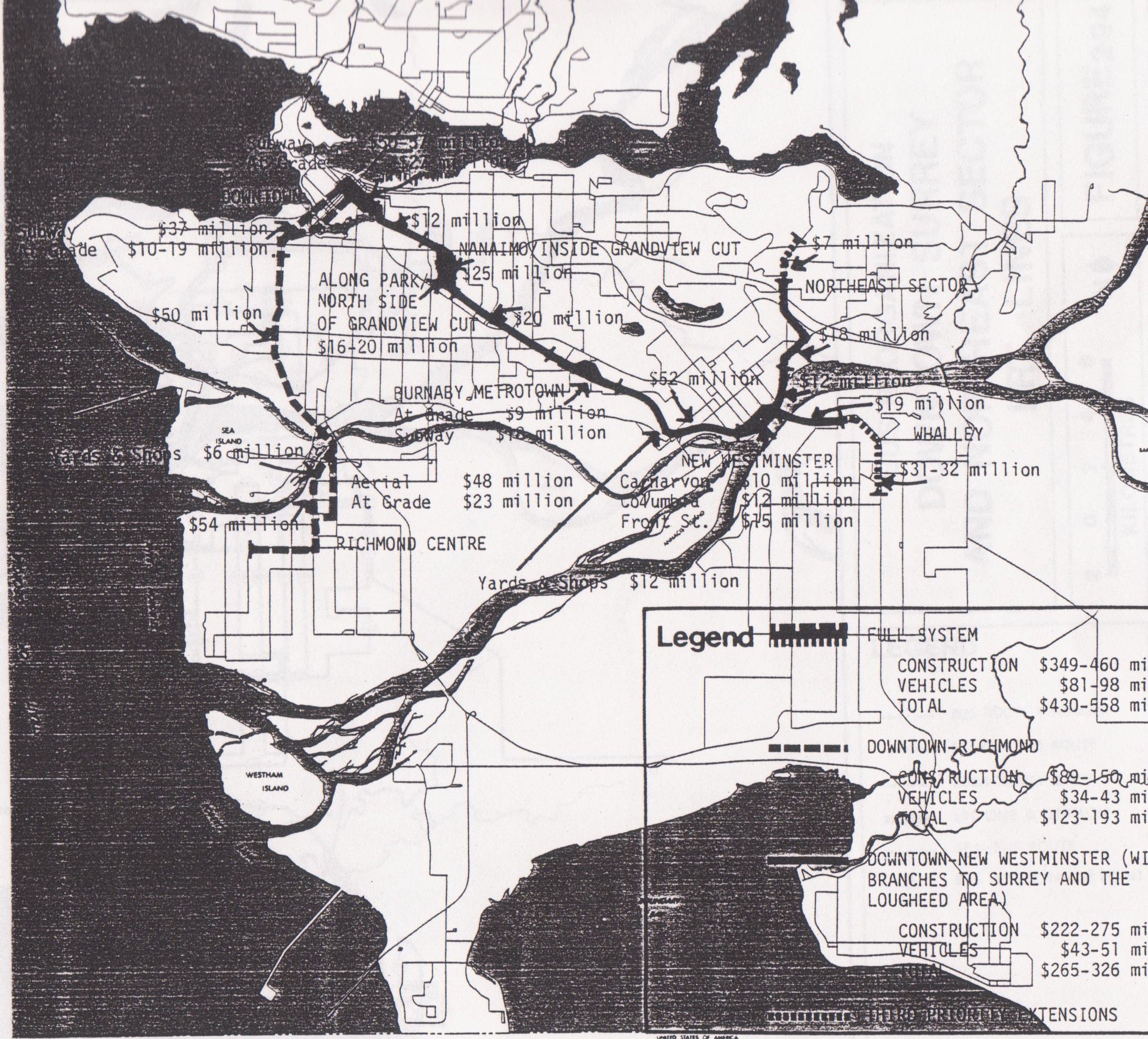
In 1978, the cost of the full system, as planned for LRT was $430 mil. ($1.8 billion, 2022) to $558 mil. ($2.4 billion in 2022) T0day, the 16 km Langley extension is said to cost aprox. $5 billion!
For Walkability and Good Transit, and Against Boondoggles and Pollution
Vancouver, Stockholm, and the Suburban Metro Model
I was asked by an area advocate about SkyTrain, and this turned into a long email with various models to compare Vancouver with. In my schema contrasting suburban metro systems and S-Bahns, Vancouver is firmly in the first category: SkyTrain is not commuter rail, and Vancouver’s commuter rail system, the West Coast Express, is so weak it might as well not exist. The suburban metro model forces the region to engage in extensive transit-oriented development, which Vancouver has done. Has it been successful? To some extent, yes – Vancouver’s modal split is steadily rising, and in the 2016 census, just before the Evergreen Line opened, was 20%; supposedly it is 24% now. But it could have done better. How so?
Could Vancouver have used the S-Bahn model?
No.
There is a common line of advocacy; glimpses of it can be found on the blog Rail for the Valley, by a writer using the name Zweisystem who commented on transit blogs like Yonah and Jarrett‘s in the 2000s. Using the name of Karlsruhe’s tram-train as inspiration, Zwei has proposed that Vancouver use existing commuter rail corridors in suburban and exurban areas and streetcars in the urban core.
The problem with this is that Vancouver has very little legacy mainline rail infrastructure to work with. There are two mainlines serving city center: the Canadian Pacific, and Canadian National. The CP line hugs the coast, full of industrial customers; the CN line is farther inland and has somewhat more fixable land use, but the Millennium Line partly parallels it and even after 20 years its ridership is not the strongest in the system. Most of the urban core is nowhere near a rail mainline.
This is completely unlike the Central European S-Bahn-and-streetcars systems, all of which have legacy commuter lines radiating in all directions, and use legacy streetcars rather than newly-built light rail lines. In the last generation they’ve expanded their systems, building connections and feeding rapid transit, but none of these is a case of completely getting rid of the streetcars and then restoring them later; the busiest system that’s entirely new, that of Paris, is largely orbitals and feeders for the Métro and RER.
Vancouver did in fact reuse old infrastructure for the suburban metro concept. The Expo Line involved very little greenfield right-of-way use. Most of the core route between the historic core of Vancouver and New Westminster is in the private right-of-way of a historic BC Electric interurban; this is why it parallels Kingsway but does not run elevated over it. The tunnel in Downtown Vancouver is a disused CP tunnel; this is why the tracks are stacked one over the other rather than running side by side – the tunnel was single-track but tall enough to be cut into two levels. This limited the construction cost of the Expo Line, which the largely-elevated Millennium Line and the partly underground, partly elevated Canada Line could not match.
The Stockholm example
In my post about S-Bahns and suburban metros, I characterized Stockholm as an archetypal suburban metro. Stockholm does have an S-Bahn tunnel nowadays, but it only opened 2017, and ridership so far, while rising, is still a fraction of that of the T-bana.
Stockholm’s choice of a full metro system in the 1940s, when it had about a million people in its metro area, had its critics at the time. But there wasn’t much of a choice. The trams were fighting growing traffic congestion, to the point that some lines had to be put in a tunnel, which would later be converted for the use of the Green Line as it goes through Södermalm. Working-class housing was overcrowded and there was demand for more housing in Stockholm, which would eventually be satisfied by the Million Program.
And there were too few commuter lines for an S-Bahn system. Swedes were perfectly aware of the existence of the S-Bahn model; Berlin and Hamburg both had S-Bahns running on dedicated tracks, and Copenhagen had built its own system, called S-Tog in imitation of the German name. But they didn’t build that. None of this was the integrated Takt timetable that Munich would perfect in the 1970s, in which branches could be left single-track or shared with intercity trains provided the regular 20-minute headways could be scheduled to avoid conflicts; the track sharing required in the 1940s would have been too disruptive. Not to mention, Stockholm had too few lines, if not so few as Vancouver – only two branches on each of two sides of city center, with most of the urban core far from the train.
So Stockholm built the T-bana, with three highly branched lines all meeting at T-Centralen, the oldest two of the three having a cross-platform transfer there and at the two stations farther south. The roughly 104 km system (57 km underground) cost, in 2022 US dollars, $3.6 billion. Stockholm removed all the regular streetcars; a handful running all or mostly in private rights-of-way were retained with forced transfers at outlying T-bana stations like Ropsten, as was the narrow-gauge Roslagsbana (with a forced transfer at KTH, where I worked for two years).
At the same time the T-bana was under construction, the state built the Million Program, and in the Stockholm region, the housing projects were designed to be thoroughly oriented around the system. The pre-Million Program TOD suburb of Vällingby was envisioned as part of a so-called string of pearls, in which towns would radiate from each T-bana station, with local retail and jobs near the station surrounded by housing. In 2019, the T-bana had 1,265,900 riders per workday, Citybanan had 410,300, and the remaining lines 216,100; Sweden reports modal split for all trips and not just work trips, but the commute modal split appears to be 40% or a little higher, a figure that matches Paris, a metro area of 13 million that opened its first metro line in 1900.
So why is Stockholm better?
There are parallels between Stockholm and Vancouver – both are postwar cities with 2.5 million people in their metropolitan areas with rapid growth due to immigration. Their physical geographies are similar, with water barriers inhibiting the contiguous sprawl of many peers. Both extensively employed TOD to shape urban geography around the train: Stockholm has Vällingby and other, less famous examples of TOD; Vancouver has Metrotown and smaller examples of residential TOD along the Expo Line, alongside a famously high-rise downtown. But the T-bana has more than twice the annual ridership of SkyTrain, and Stockholm has around twice the modal split of Vancouver – this is not a matter of Canadians riding buses more than Europeans do. So what gives?
Part of it is about TOD models. Stockholm is an exceptionally monocentric city, and this has created a lot of demand for urban rail to Central Stockholm. But Vancouver’s high-rise city center has a lot of jobs, and overall, around 30% of Metro Vancouver jobs are in the city or the University Endowment Lands (that is, UBC), and the proportion of Stockholm County jobs within an equivalent area is similar. Vancouver has never built anything as massive as the Million Program, but its housing growth rate is one of the highest in the world (around 11 gross units/1,000 people per year in the 2010s), and much of that growth clusters near the Expo Line and increasingly also near the worse-developed Millennium and Canada Lines.
I suspect that the largest reason is simply the extent of the systems. SkyTrain misses the entire West Side of Vancouver west of Cambie, has poor coverage in Surrey and none in Langley, and does not cross the Burrard Inlet. The T-bana has no comparable lacunae: Roslag is served by Roslagsbanan, and the areas to be served by the under-construction extensions are all target TOD areas with much less present-day density than North Vancouver, the cores of Fairview and Kitsilano, or the town centers in Surrey other than Whalley.
What’s more, Stockholm’s construction costs may be rising but those of Vancouver (and the rest of Canada) are rising even faster and from a higher base. Nya Tunnelbanan is currently budgeted at $3.6 billion in PPP terms – 19 underground km for about the same cost as the existing 104 – but Vancouver is building half of the most critical SkyTrain extension, that under Broadway, for C$2.83 billion (US$2.253 billion in PPP terms) for just 5 km, not all underground. The projected cost per rider is still favorable, but it’s less favorable for the planned extension to Langley, and there’s no active plan for anything to the North Shore.
The silver lining for Vancouver is that the West Side is big and underdeveloped. The region has the money to extend SkyTrain not just to Arbutus as is under construction but all the way to UBC, and the entire swath of land between Central Broadway and UBC screams “redevelop me.” The current land use is a mix of mid-rise, townhouses (“missing middle”), and single-family housing; Shaughnessy, whose northern end is within a kilometer of under-construction SkyTrain stations, is single-family on large lots, and can be redeveloped as high-rise housing alongside closer-in areas. Canada does not have Europe’s allergy to tall buildings, and this is a resource that can be used to turn Vancouver into a far more transit-oriented city along the few corridors where it can afford to build. The suburban metro is always like this: fewer lines, more development intensity along them.
What Zwie has tried to convey for decades, that the driverless light-metro is a money hog and building more, will only see more tax money sucked into this heavily subsidized black hole.
Part of the problem is that the mainstream media and TransLink’s lil darlin, the Hive do not report on costs, just the hype and hoopla of building more SkyTrain.
The financial debate is purposely not reported as not to dampen local SkyTrain hue and cry by the local SkyTrain lobby.
The following comment by Haveacow, a Canadian transportation Engineer is a must read for all those armchair SkyTrain enthusiast and then wonder about this:
At the same time that billions of dollars are being lavished on two very expensive, yet completely unnecessary light metro extension, Emergency Care is collapsing in the province.
One can almost draw a straight line from SkyTrain expansion to eroding healthcare in the province.
The Skytrain really isn’t a regional distance based, rapid transit system. It is a inner suburb to downtown or a inner suburb to inner suburb rail rapid transit system.
The line extension fron Surrey to Langley (SLS) is and will be showing just how expensive the technology is to build and how expensive it will be to operate. Even 22 years after opening it will still be only moving around 5000 passengers per km per day or about 75% of the current passengers per km/per day average of the existing system. This means that this portion of the Expo line from Surrey to Langley will require more subsidy to operate than the already existing Skytrain system does simply due to geographic distance and attract fewer passengers at the same time.
Nothing illustrates the geographic limitation of the technology more than current SLS extension does. Each new significant segment of Skytrain, anything more than 8 to 10 km that is built further and further out from existing Skytrain yards seems to require, an entirely new yard or a major expansion of an existing one, just so servicing and train-set redeployment can be done efficiently and in a timely manner. Train storage and actual maintenance capacity is a whole separate issue. That means each extension becomes even more expensive due to the fact that, a new yard and servicing site must be constructed each time the system grows outward horizontally. Ottawa’s LRT system desperate to keep costs down, make the new yards, light maintenance centres instead of full ones, saving hundreds of millions of dollars without seriously impacting maintenance. Each new Skytrain Yard or OMC (operations and maintenance centres) is and must be because of the automation, a full service yard.
Yes, as a rail network grows in length and number of train-sets, more storage and servicing capacity is needed. However this driverless railway system requires very large, heavily protected and computerized yards, instead of just a simple set of ladder track (multiple sets of track sidings used for storage) connected to and parallel to the main line running track itself, no large storage buildings required, just a protected operations caban and maybe extra fencing.
This is how GO Transit builds new Train Storage facilities. Actually maintenance is done at 2 very large maintenance centres on a specific schedule. Keep in mind, this is a system with over 500 km of main line track and over 850 engines and passenger coaches with very little automation. The new GO Transit Region Rail Network (formerly GO RER) won’t change this situation too dramatically until, a lot of the planned Bi-Level EMU’s are purchased because the EMU’s will require an entirely new separated or a severely altered existing maintenance centre.
The following should be Emailed to every politicians, federal, provincial and civic in BC.
Here is something else to think about. This line extension, according to TransLink and the provincial government of BC, is going to move 56000 passengers a day upon opening in 2028. That’s roughly 53% of the daily passengers per line-km average for the rest of the SkyTrain system (3500 passengers per km per day vs 6613 passengers per km per day).
They both admits that this is the equivalent to what the 99 B express bus line moved per day in 2019. They are spending billions to move the same number of passengers you already move on Broadway with buses. They are currently spending $2.83 Billion to move passengers in a 5.7 km SkyTrain tunnel under Broadway, the busiest corridor in the city. Yet it’s good to spend somewhere between $1.67 billion and $2.17 billion more, to move the same number of passengers per day between Surrey and Langley.
Our South-East Bus Transitway moved more people than that per day in 2019 and it sure wouldn’t cost that much to build.
Toronto spent only $2.3 million on King Street in downtown Toronto to improve passenger service on a streetcar corridor which moved more people per day in 2019 than the SLS line extension will move on opening day (84000 vs 56000) at a cost of billions.
In BC, Business Cases are a dime a dozen and are merely politcal documents masquerading as technical ones.
It is photo-op silly season and with premier Horgan desperately trying to find a legacy project, the Expo Line extension to Langley is his current baby.
NDP leadership hopefuls where also there vying for their 10 second sound bytes as were federal Liberal MP’s ever ready for a snap election. Of course municipal politicos were in abundance as the October civic elections draw closer.
Will the Expo Line extension ever be built?
There was no mention of the new Operations and Maintenance Centre, needed before the start of operations, which will cost a fair chunk of change, as well silence on the much needed upgrades to the aging Expo Line.
The problem, I see with this light metro is. “who is going to use it?”
Very few people in Langley are commuting to Vancouver, or to central Surrey for that matter.
So let us wait until the contracts are awarded and see what the real costs will be.
The politicians had their fun and as a roof top parkade in East Vancouver collapsed, a 2 minute TV news clip will be reduced to 1 minute! Them’s the breaks.
Next stage in Surrey Langley SkyTrain extension unveiled
The new Surrey Langley SkyTrain extension is set to be complete by 2028, after officials approved the project’s business case.
The B.C. government, along with the federal government, provided more details on the major transit link Thursday.
Transportation Minister Rob Fleming, Minister Responsible for TransLink George Heyman, and Minister of State for Infrastructure Bowinn Ma spoke, along with Cloverdale-Langley City MP John Aldag on behalf of Federal Infrastructure Minister Dominic LeBlanc.
“This is the fastest growing region in the province. There is no doubt about it that every city here has a piece of that Surrey Langley, Langley municipality. We’ve made record investments because of this growth in things like hospitals, higher education, schools, childcare. And now, as I said, for the first time in 30 years, a massive rapid transit expansion,” Fleming said.
A sketch of the proposed 140 Station in Surrey. (B.C. Government / TransLink Image)
Once complete, the extension will connect the booming area south of the Fraser from King George Station in Surrey to 203 Street in Langley.
The cost of the project is slated to be $3.95 billon, with additional funds secured to build up transit around the stations, bringing the total cost to $4.01 billion.
“For this line we’re confirming a scope addition that is very important for our province and for people’s health and transportation needs generally, and that is $60 million in active transportation improvements that will complement the SkyTrain line along the Fraser Highway, bringing the total investment to $4.01 billion,” Fleming said.
The province unveiled the business case months ahead of schedule, and despite pandemic delays, the project is still expected to be complete two years ahead of schedule.
The link to Langley was earlier expected to be complete in 2030, however, the Surrey portion of the project is behind schedule as that was set to be done by 2025.
While details where conversations regarding the next steps were still ongoing in recent years, shovels have already broken ground on the 16-kilometre extension.
(B.C. Government / TransLink Image)
Using available funding, work has begun in the Fleetwood area, as many commuters have likely noticed.
Last July, the federal government gave $1.3 billion in funding and promises were renewed that the extension would be built all in one go.
TransLink was initially supposed to take the lead on the project, but the province has since taken it over.
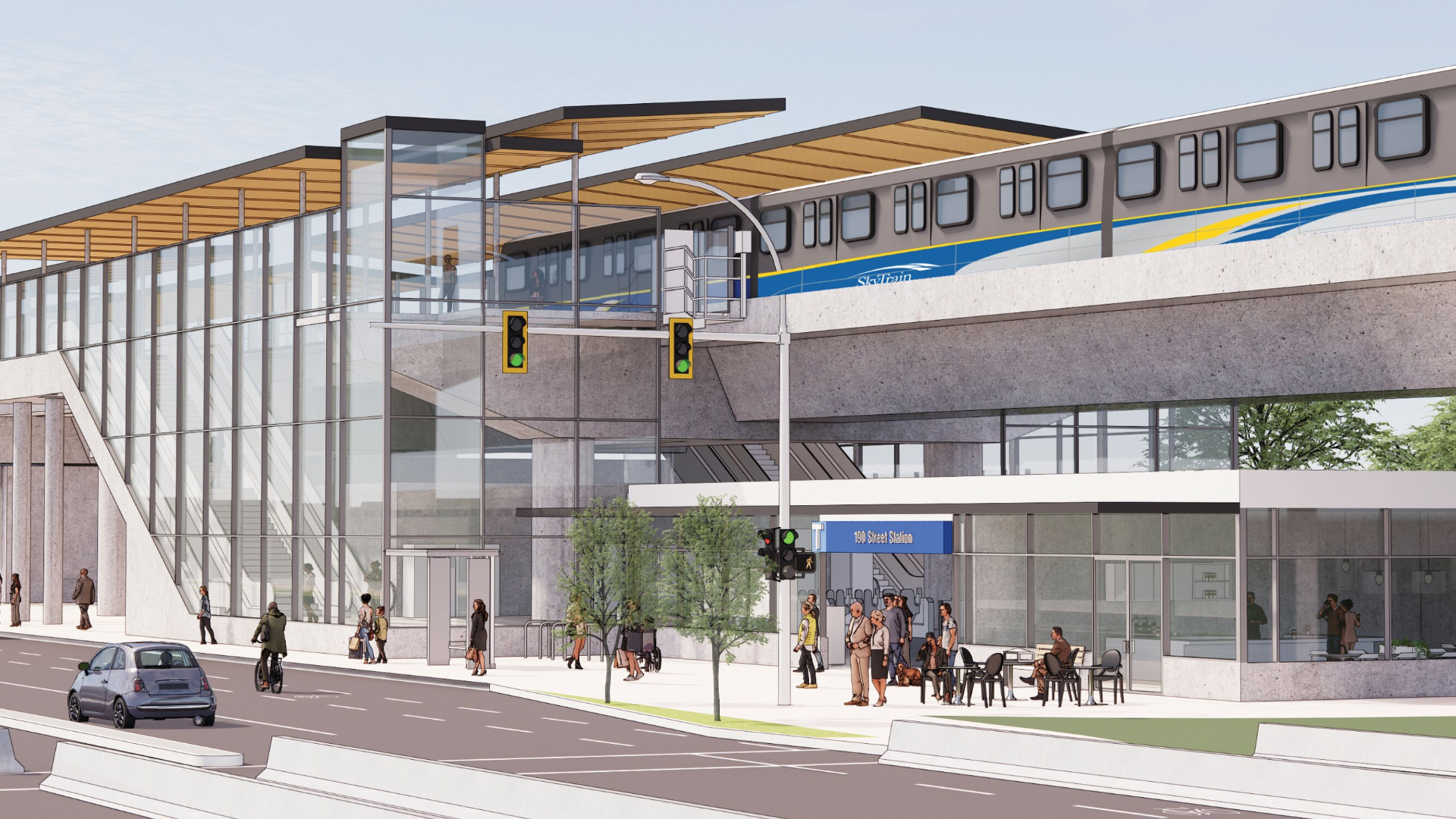
The look of the 190 Station in the Surrey Langley SkyTrain project. (B.C. Government / TransLink Image)
The province says completion is scheduled for late 2028.
The following news release came to Zwei via Montreal and Germany and answered one very important question, which TransLink is ashamed to reveal locally.
The cost of the signalling rehab is $1.47 billion!
This is not chump change, but serious coin, which must come from somewhere.
Well, I can guess: a little from the Ministry of health; a lil from the Lytton rebuilding program and most, if not all funding that maybe would have gone to the E&N or even the Rail for the Valley project. come to think of it, $1.47 billion could fund the “full meal deal” Leewood Study, with three trains per hour between Chilliwack and Vancouver.
We now will have to wait for the other shoe to drop, multi billion dollar plus cost to refurbish and enhance the electrical supply for the light-metro.
TransLink awards Thales SkyTrain train control contracts
Contracts enable a 22km extension of the fully automated SkyTrain system.
TransLink has awarded two contracts to Thales for upgrading the train control technology on the Expo and Millennium lines of Metro Vancouver.
TRANSLINK has awarded Thales two contracts to provide train control technology under the Expo and Millennium Line Upgrade Programme for the SkyTrain network in Vancouver.
The contracts include a new Operations Control Centre and a new fully automated depot, Operations Maintenance Centre 4. These two new facilities are key components of the upgrade programme.
The system will be expanded from 80km to 106km by 2028, with 41 new trains expected to be in service by the end of 2027.
TransLink says that in 2018 the Expo and Millennium lines saw on-time performance of 96.38% – the best punctuality on record for SkyTrain and higher than that achieved by most major metros in North America.
The government of Canada, the government of British Columbia, and the region have committed to investing $C 1.47bn ($US 1.1bn) in the Expo and Millennium Line Upgrade Programme until 2027.
When the programme is fully implemented, the Expo Line will be able to accommodate 17,500 passengers per hour per direction, and the Millennium Line will be able to handle 7500 passengers per hour per direction, a 32% and 96% increase respectively.
















Recent Comments