For several years now, Mr. Cow and Zwei have been reminding people that there needs to be a $3 billion or so, rehab done to the Expo and Millennium Lines before any expansion can take place.
There was no budget for this.
Nonsense! Screamed the SkyTrain lobby. Fake news ranted the SkyTrain boosters.
Well, not any more as Zei and Mr. Cow seem to be bang on!
What is interesting, there is no dollar figure which is troublesome. What is TransLink afraid of?
What is a contract, without a dollar figure? Is TransLink afraid to tell the public, pre civic election, that huge tax increases will be needed to fund the rehab? Is TransLink afraid that pro SkyTrain politicians will fail to be elected or reelected?
It seems this well cobbled news release from TransLink is afraid to tell the taxpayer and voter, that there will be massive property tax increases in 2023 to pay for this.
Let me repeat this prediction: “THERE WILL BE HUGE PROPERTY TAXES IN 2023 TO PAY FOR THIS!
Thales was awarded by TransLink two new contracts under the Expo and Millennium Line Upgrade Program to enable a 22 km expansion of the fully automated Metro Vancouver SkyTrain system, with 41 new trains expected to be in service by end of 2027.
Thales will provide its SelTrac™ Communications-Based Train Control (CBTC) technology to deliver a new Operations Control Centre and a fully automated depot named Operations and Maintenance Centre 4.
For almost 40 years, Thales has delivered state-of-the-art train control technology for the SkyTrain system. These new projects will directly support TransLink’s 2050 Vision to provide convenient, reliable, affordable, safe and comfortable, and carbon-free transit for Metro Vancouver. The system had over 114 million boardings in 2019.
The SkyTrain has better on-time performance than the metros in most major cities in North America; the SkyTrain is also environmentally friendly – TransLink customers save 1.3 million kgs of GHGs by choosing transit over driving a car each day.
TransLink has awarded two contracts to Thales for the provision of train control technology for their new Operations Control Centre and a new fully automated depot, Operations Maintenance Centre 4. These two new facilities are key components of the Expo and Millennium Line Upgrade Program, necessary to support SkyTrain system expansions to 2045 and beyond to better serve Metro Vancouver passengers. The system will be expanded by 22 km, from 80km to 106 km by 2028, with 41 new trains expected to be in service by the end of 2027.
These two new contracts represent two new key milestones in the almost 40-year partnership between Thales and TransLink covering the entire history of the Metro Vancouver SkyTrain. Thales’ state-of-the-art train control technology will support TransLink’s 2050 Vision to provide convenient, reliable, affordable, safe and comfortable, and carbon-free transit for Metro Vancouver. The system had over 114 million boardings in 2019.
According to TransLink, in 2018 the Expo Line and Millennium Lines saw an on-time performance (OTP) of 96.38% — the highest performance level on record for SkyTrain and higher than the performance level of the metros in most major cities in North America. The SkyTrain is environmentally friendly – according to TransLink, its customers collectively save 1.3 million kgs of GHGs by choosing transit over driving a gasoline car each day.
“We are building on an over 35-year partnership with TransLink as we support their vision for the future of transit in Metro Vancouver. The provision of our SelTrac™ technology to these two new facilities represents the next page in our shared history with TransLink.” Alcino De Sousa, VP & Managing Director, Thales Urban Rail Signalling
The new Operations Control Centre (OCC2) includes a Control Room and the capacity for SkyTrain expansions into the future. Thales will provide the Automatic Train Control (ATC) elements for the new Operations Control Centre (OCC2), which will feature the latest in train control, network, and cybersecurity technology. Thales will be working with local partners and suppliers to deliver this project successfully.
To keep up with passenger ridership increases, the SkyTrain system expansions have driven a corresponding need for more trains, and, in turn, increased train storage and maintenance. Additional capacity will be available in the new Operations Maintenance Centre (OMC4). Thales delivered OMC1, the first fully-automated train storage yard (depot) in the world in 1986. OMC4 is a fully automated depot, allowing quick deployment of trains into service. This approach is both cost-effective and staffing effective, providing the best value for Metro Vancouver citizens. OMC4 will feature storage for 145 cars (29 trains), a vehicle interior cleaning and inspection facility, a train wash track, and maintenance shops.
When a new transit line is built, months of testing must take place before commissioning the line for public service. This did not happen in Ottawa.
Many people do not realize that the Ottawa LRT operation is automatic, just like Vancouver’s light metro system and the new line suffers the same ills that plague Automatic Train Contolled systems elsewhere.
Automatic Train Control (ATC) systems operate poorly in the the snow, if they work at all.
We have forgotten, that the Expo Line, when it first opened, only operated 5 minute headway’s and literally had maintenance staff ride the system for almost a year to, deal with technical faults. The system was down many times a day to deal with problems and the mainstream media stayed mute.
The P-3 maintenance contract for the Ottawa LRT proved to be problematic as the concessionaire put profits over performance.
A quote from our friend Haveacow, who worked on the Confederation Line, expresses exasperation on the double standard in Canada, where if one mentions LRT, the full force of Ottawa is upon you, but a government favourite, Movia Automatic Light Metro (used on the Expo and Millennium Lines) once owned by Bombardier (with engineering patents owned by another government favourite, SNC Lavalin), gets a free pass
I’m not saying the Confederation Line shouldn’t have been investigated but a relatively new line with inexperienced staff and a frustrated public forced a joint federal-provincial court led inquiry. How come no one is pushing for one when one of your (Expo Line) trains derails on a massive bridge at a turnout (switch), which stops it dead in its tracks by the way and forces the line out of service for most of a day, no calls for an investigation, where’s the headlines? Our LRT inquiry is national news. If I hadn’t turned to look at Zwei’s website I wouldn’t have even known this happened. A yes, a glorious double standard indeed!
We also have a local transit fiasco caused by a metro Vancouver mayor, who claimed that the Expo Line extension to Langley would cost a mere $1.63 billion. he claimed he was an expert and supported by some very dubious transit bloggers, changed from light rail to SkyTrain light metro. Today, the estimated cost of the 16 km extension may top $4.9 billion!
WHY NO INQUIRY ABOUT THIS?
When politicians involve themselves with transit planning, two things are for sure; the costs will increase dramatically and the end product will be inferior to what was originally planned.
The evidence heard Thursday on the ninth day of public inquiry into the Confederation Line was the most damning for the city so far.
The City of Ottawa willingly accepted a light rail system it knew was likely unreliable and changed criteria to make it easier for Rideau Transit Group to pass the final testing of the Confederation Line.
Testimony from city engineer and rail manager Richard Holder confirmed that the city accepted the LRT — and put it into service — while making a calculation it would fix problems after passengers began riding.
“I’m going to suggest to you that the city knew that there were reliability issues with the system at the time that it decided to launch public service,” commission co-lead counsel Kate McGrann said to Holder in one particularly illuminating exchange.
“We knew that there would be some reliability issues,” he responded. “Yes, we did. We didn’t anticipate that there would be reliability issues to the extent that we would have derailments.”
McGrann persisted: “The city knew that the reliability issues could interfere with the provision of reliable service to the public?”
Holder responded that train-maker Alstom, which is also the company in charge of maintenance, had been reporting improvements.
“That is not an answer to my question, sir,” said McGrann. “My question was, the city knew that there were reliability issues that could interfere with the provision of reliable service to the public.”
“That’s correct,” Holder replied.
City agreed LRT was done while all 34 cars had issues
It was an important last step in the process of handing over the Confederation Line to the city — and one that came with a $59-million payday.
But the city rebuffed RTG’s substantial completion claim and the project’s independent certifier sided with the city. In a May 2, 2019 letter to RTG, the city said 25 vehicles had defects that were “extensive and ongoing and result in a lack of access to the complete fleet.
“The vehicles have not been shown to be reliable.”
On July 26, 2019, RTG reapplied for substantial completion, and this time the city — and the independent certifier — accepted.
But it turns out the city agreed the LRT was basically finished — and paid out $59 million — even though there was a long list of outstanding problems it decided to waive and defer.
System-wide failure to meet fleet requirements due to ongoing defects/deficiencies.
– One of the defects the city waived
These were not so-called minor deficiencies, which are allowed under the contract, but items that “could be considered to be quite significant, [a] key one being the number of vehicles that would be available at revenue service availability,” testified Holder.
The unresolved items included the light rail vehicles — all 34 of them. There wasn’t a single rail car that didn’t have an open issue.
Another outstanding problem the city waived? A system-wide “failure to meet fleet requirements due to ongoing defects/deficiencies.”
Delays like this one in October 2019 were common in the early days of LRT service. Now, a public inquiry has heard the city knew there would be reliability problems. (Giacomo Panico/CBC)
It’s unclear why the city would agree the Confederation Line was substantially complete while aware of these details, but Holder testified that the city believed the train defects would improve between substantial completion and before RTG handed it over to the city, which turned out to be just a month later.
As well, the Confederation Line had to go through a period of trial running before the city accepted it, which Holder said added another layer of protection for the city.
Test scoring made easier during trial run
Although the light rail contract called for a 12-day trial test period, the requirements for what constituted a pass were vague — so the city and RTG agreed between them on the specific criteria in 2017.
But in the lead-up to the 2019 trial run, the city and RTG’s construction arm agreed on a generally tougher version of the scorecard. The inquiry heard that the LRT performance called for in 2019 better mirrored what the city was expecting in a light rail system, as per the contract.
But within days of the start of the trial running, Holder got called in to speak with senior city leadership to discuss the criteria.
And when the independent certifier from Altus Group sent the city its validation statement of the trial running dated Aug. 23, 2019, it described how the criteria was changed back to the 2017 version during the trial run period.
First, the requirement to run 15 trains during morning and afternoon rush hours was reduced to 13.
“They were having challenges to get 15 trains in the morning,” Holder told the commission.
As well, the performance measure that indicates how many trains are out on the track for customer service and for how long — called the aggregate vehicle kilometre availability ratio, or the AVKR — was lowered to 96 per cent from 98 percent.
And that bar of 96 per cent would only have to be met on nine of the trial test days — not each of the 12 days. So the system could experience three terrible service days in less that two weeks, and those days wouldn’t be counted.
Finally, there was a requirement that the train reliability (again, the AVKR) not fall below 90 per cent on any day of the trial testing.
But that was changed to a requirement that no three consecutive days see train availability below 94 per cent, meaning RTG could have — in McGrann’s words — “two very bad days” and still pass.
RTG successfully completed the trial run on Aug. 22, 2019, and the next day Mayor Jim Watson announced the city would officially take over the Confederation Line — and that the city would open it to the public on Sept. 14.
Holder said the system was safe and that he never received any specific advice not to launch it. RTG felt it was ready and would incur significant penalties if the system didn’t work, he pointed out.
McGrann asked Holder if there continued to be reliability issues after both substantial completion and after the LRT was launched, and Holder agreed.
He said the city “was aware the reliability of the system would improve” but that at the start of public launch “there may be issues that would impact availability.”
Hint: Regional mayors, with little knowledge about transit, are promising everything, but without a mention of raising taxes to fund those gold plated pre election goodies!
I have one question: Funding?
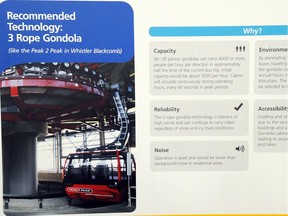
It all sounds good, bike lanes here, a gondola there, a UBC subway (strange, no mention of the Expo Line extension to Langley) and exploring extending SkyTrain to Port Coquitlam and rootin-tootin Newton, but no mention of funding.
Funny that. Oh, by the way proprietary Movia Automatic Light Metro trains used on the Expo and Millennium lines line will be out of production, as Vancouver is now the only customer, by the time a decision is made.
Sorry, I forgot, then there is the $3 billion (inflation you know) rehab of the above to proprietary railway lines, needed and needed soon, lest any more “dislodgements” happen.
Oh, by the way, that $200 million gondola for SFU is now going to cost $300 million, inflation again; but I again ask; funding?
$21 billion is still a lot of coin and in today’s post Covid reality, that coin is going to be hard to come by.
Don’t hold your breathe, this mere window dressing for the 2022 Civic elections, where every city in metro Vancouver gets a piece of the pie before the election, but there will be meagre offerings after October when fiscal reality will hit the new Mayor’s Council on Transit with a vengeance.
Which mayor on the mayor’s council will campaign for higher taxes, before October’s election to pay for all this transit largesse?
Answer: None!
The classic transit mistake. We are spending tens of billions of dollars connecting areas of high density and not building transit to satisfy transit customers travel needs.
Metro Vancouver’s $21-billion transit plan, which includes a gondola to SFU, approved
The plan also includes doubling bus service and adding 450 kilometres of new traffic-separated cycling paths.
Metro Vancouver’s Transport 2050 plan—which includes doubling bus service— has been approved.Photo by Jason Payne /PNG
A new gondola to Simon Fraser University, doubling the bus service, and hundreds of kilometres of new cycling paths are some of the transit plans approved by regional authorities on Thursday.
Metro Vancouver’s 10-year transportation plan was approved by the Mayors’ Council and TransLink’s board of directors and outlines a list of priorities.
Those priorities include nine new traffic-separated Bus Rapid Transit lines, extending the Millennium Line from Arbutus to the University of British Columbia, increasing HandyDART service by 60 per cent, and exploring other SkyTrain extensions, including to Newton in Surrey and to Port Coquitlam.
Also receiving a green light Thursday was a plan for 450 kilometres of new traffic-separated cycling paths, including bike networks in every Metro Vancouver Urban Centre, and 200 more bike lockers, according to a Metro Vancouver news release.
And Metro Vancouver will extend SeaBus service start and end times to match SkyTrain’s service hours.
The Transport 2050: 10-Year Priorities plan is estimated to cost $21 billion over the decade and will need significant new revenue sources and investments from all levels of government to deliver, according to Metro Vancouver.
The region said it will be delivered in phases and funded through a series of future investment plans.
Earlier this year, Burnaby Mayor Mike Hurley said it would be challenging to get the proposed $200-million gondola built to Simon Fraser University because of a funding crunch.
Burnaby city council has endorsed a 2.6-kilometre route option for TransLink’s gondola proposal between SkyTrain’s Lake City Way station and SFU’s Town Centre.
Burnaby public looks over Translink plans for the Burnaby Mountain Gondola Transit Project at a community open house on May 25, 2011, in Burnaby. The plan is for a 2.6 km tramway system linking Production Way skytrain station with SFU campus.Photo by Steve Bosch /PROVINCE
The Transport 2050 plan is Metro Vancouver’s long-term vision to accommodate anticipated population growth of one million over the next three decades.
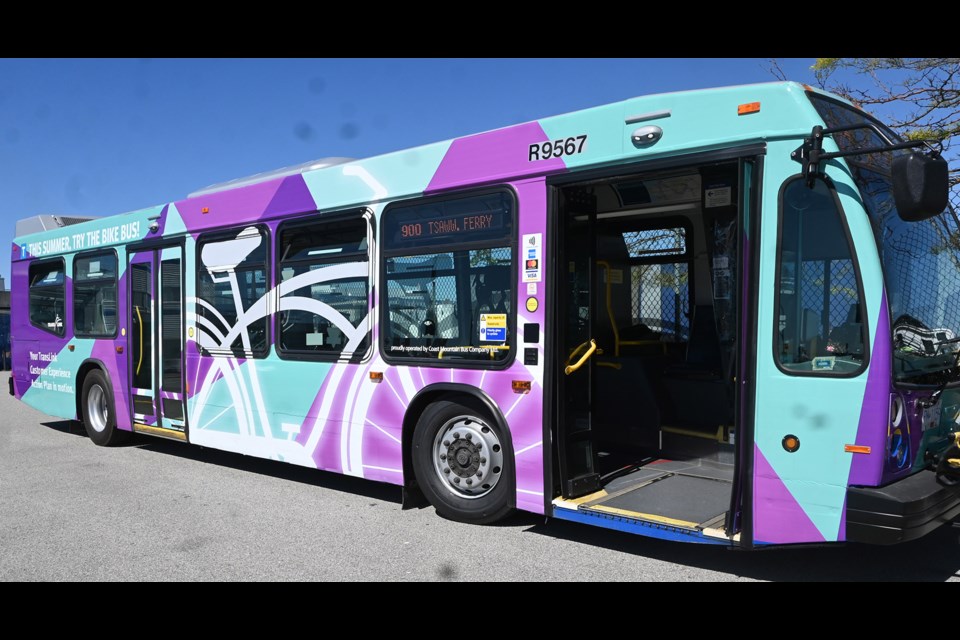
Zwei has been long advocating for bus services dedicated to cyclists on important routes and the new 900 bus from Bridgeport Station to the Tsawwassen Ferry Terminal, via the Ladner Loop, certainly fits the bill.
Well done!
TransLink launches new summer bike bus in Tsawwassen
The Bike Bus will follow the existing 620 route, with separate loading and unloading bays at Bridgeport Station and Ladner Exchange
Looking to cycle out to the Tsawwassen ferry terminal this summer?
If so TransLink has you covered.
On Friday morning at the Tsawwassen BC Ferry terminal, TransLink launched a new summer service for cyclists.
The Bike Bus will provide more room for bicycles on the Bridgeport Station to Tsawwassen Ferry Terminal route this summer – one of the most popular routes for its cycling customers, says TransLink.
The Bike Bus is a retrofitted bus with seven interior bicycle racks, bringing the total bike capacity aboard to nine, from the standard two. The extra room means more cyclists will be able to reach the Tsawwassen Ferry Terminal via the Massey Tunnel using transit.
“The return of warm weather means more people are cycling to their favourite B.C. destinations,” says TransLink CEO Kevin Quinn. “We’re excited to launch the Bike Bus, as it will better connect our customers with one of the most popular Metro Vancouver routes for summer travel and ensure they can easily explore our beautiful region.”
The Bike Bus will follow the existing 620 route, with separate loading and unloading bays at Bridgeport Station and Ladner Exchange. The bus will be displayed as 900 Bike Bus to Bridgeport Station or Tsawwassen Ferry, depending on the route.
Bike Bus summer service details:
Bridgeport Station to Tsawwassen Ferry Terminal
July 1 to Sept. 5, 2022
Fridays, weekends, holidays
8 a.m. to 8 p.m.
Hourly departures to align with ferry sailings to Swartz Bay
The project is part of TransLink’s Customer Experience Action Plan, announced in March.
“Exploring B.C.’s natural beauty by bike is an exhilarating experience, but it can be challenging to get to the ferry terminal with your bike and gear,” explains HUB Cycling’s Executive Director Erin O’Melinn. “TransLink’s new Bike Bus makes that easier and responds to the long-time demand from people who bike for transportation but face gaps in the cycling network.”
The Bike Bus is currently funded for summer 2022. If the project is successful, it could become a permanent seasonal route says TransLink.
As the Horgan government seems to be on snooze control, transit issues, except for the E&N (more on that in a future post) which continues to rot away, a look at Australia’s Gold Coast tram is in order.
A modern tramway that defies the current dated thinking in BC and metro Vancouver.
Stage 1
In 2009, the Queensland Government committed $464 million to the Gold Coast Rapid Transit (GCRT) project, supplementing $365 million committed by the Federal Government and $120 million provided by Gold Coast City Council.
*
In June 2011, the GoldLinq consortium comprising Bombardier Transportation, Downer EDI, Keolis, McConnell Dowell and Plenary Group was awarded the contract to build and operate the Gold Coast light rail line for 18 years under a Public Private Partnership.
*
In August 2012, the cost of the initial 13 km (8.1 mi) section was estimated at $1.6 billion.Construction began on the Gold Coast University Hospital station shell in July 2010. In late 2010, early roadworks began in Broadbeach and Southport.
*
By November 2013, much of the work was complete with the southern section at Broadbeach being the only section of trackwork to be completed. Testing commenced on the northern section of the line in October 2013. The line opened on 20 July 2014, with a free travel day, before normal operations began on 21 July.”
*
The system had significant impact on property both directly and indirectly in the corridor. A total of $170 million was allocated for property resumptions. The Queens Park Tennis Club and Southport Croquet Club were both relocated.
Stage 2
Gold Coast University Hospital, the original northern terminus and the only underground station in the system.
*
After the successful opening and operations of Stage 1, the Queensland Government announced in February 2016 with plans to extend the light rail line from the University Hospital to the Helensvale railway station, providing a connection with the Gold Coast railway line that connects the city with Brisbane, the state capital of Queensland. Financial commitment from the state and federal governments needed to progress with the extension was finalised in late 2016. The new extension includes 7.3 km (4.5 mi) tracks and 3 new light rail stations, with Helensvale being the new northern terminus for the line. Construction commenced in 2016 with plans to be completed in time for the 2018 Gold Coast Commonwealth Games in April 2018. Construction finished early, ahead of schedule with passenger services commencing in December 2017.
Stage 3
The Queensland Government, in conjunction with the Gold Coast City Council and the Federal Government, announced the plan to extend the light rail line 6.4 km (4 mi) south, from the existing Broadbeach South station to Burleigh Heads. Completion is estimated to be in 2024. Stage 3B, a further extension to Coolangatta, is expected to commence after Stage 3 is completed.
The extension to Burleigh Heads is to be built by Queensland State Government, with the City of Gold Coast and the Federal Government contributing funding. The preliminary business case was completed in February 2018. Eight new light rail stations were proposed. It is estimated that the extension will cost approximately $670 million,[18] with construction commencing in 2022 and taking three years to complete.
Stage 4
The Gold Coast City Transport Strategy 2031 supports a future expansion to Coolangatta via the Gold Coast Airport. The 14 km (8.7 mi) extension of the light rail line from Burleigh Heads station would continue south along the Gold Coast Highway, passing through the southern suburbs of Palm Beach and Tugun, before terminating at the airport.
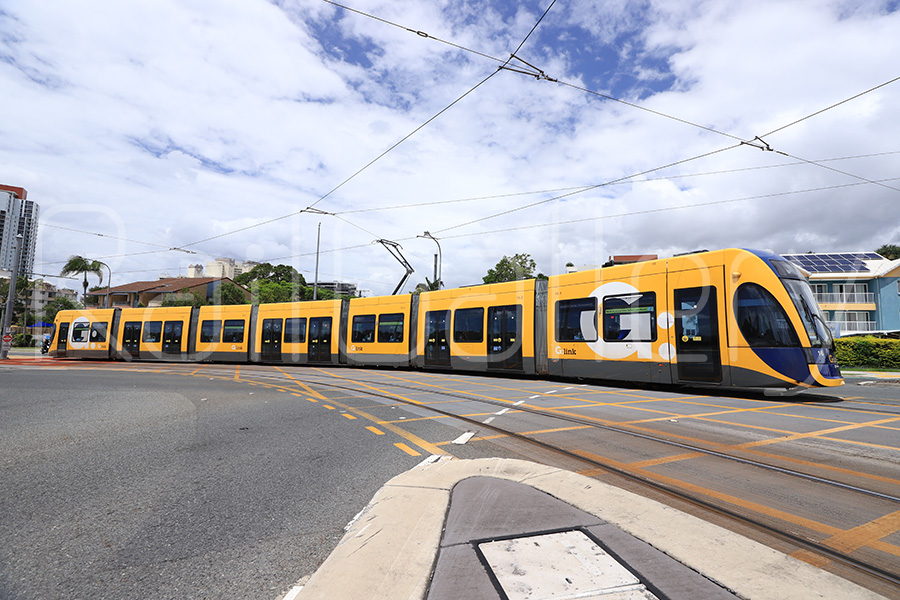
Gold coast tram crossing a highway Photo: LRTA
Please notice the Gold coast Tram crossing two multi lane lane highways, which in BC would be deemed by politicians, bureaucrats and engineers, impossible to do!
A Bombardier (now Alstom, Flexity tram.
Based on Bombardier’s highly successful FLEXITY family of light rail vehicles that combines proven technology with continuous improvement and innovation, the Gold Coast tram has been specifically styled by Bombardier’s Industrial Design team in Brisbane to include a wave motif on the cab front. The tram is 43.4 m long and 2.65 m wide with seven modules for higher capacity and better passenger flow. Maximum capacity is 309 persons. These trams also feature the most powerful air-conditioning system for this class of tram, suitable for Australia’s hot summers.
With my long association with the LRTA, I have made many contacts with professionals in the transit industry, who have guided me and given me much information on modern public transport.
The following questions deserve an answer.
Is current regional transit planning viable in the post Covid world?
Is the current light-metro only planning viable in Metro Vancouver?
Has the current light-metro network provided an affordable and user-friendly alternative to the car?
Are politicians honest with public transit planning?
Important questions that must be answered before we invest another nickel in our regional light-metro system.
Overview
The region has today, a very serious problem with transit and the ill-informed actions four years ago by Surrey Council. Cancelling LRT and demanding light metro has set back regional transit for decades. The anti-LRT rhetoric, all too common in council chambers and the media, has no basis and reminded me of former American President Trump’s all too common tirades of fake news and alternative facts. The anti-LRT crowd would have us believe that no one builds with light rail, but the truth of the matter is the complete opposite.
The SkyTrain light-metro system is actually two very different railways. The Canada line, a conventional electric railway, operating electrical multiple units or EMU’s on a grade separated rights-of-way and the Expo and Millennium Lines, operates the proprietary and often rebranded proprietary light metro system which latest brand name is Movia Automatic Light Metro (MALM) system which now owned by French transportation conglomerate, Alstom, after they purchased Bombardier’s troubled rail division. The Canada line EMU’s and the Expo and Millennium Line cars are not compatible in operation. MALM cars can only operate with MALM vehicles.
Alstom is also the sole supplier of MALM vehicles, as no other company has an operable “off the shelf” model.
Do we need to rethink transit?
The Canada Line
The Canada Line was former Premier’s Gordon Campbell’s foray with a transit P-3’s and so unappealing was the Canada Line P-3, that the eventual winning consortium did not have to assume risk and obtained a very sweet maintenance contract. Assuming risk on a project is the hallmark of a P-3 project, transferring risk from government to the private sector.
The then Liberal government, through TransLink, signed a secret agreement with the SNC Lavalin lead consortium that all south of the Fraser bus routes must transfer their customers onto the Canada line to complete their trip to Vanvcouver, forcing an unwanted and user-unfriendly transfer, where pre Canada line, there was none. This agreement has come back to haunt TransLink, post covid, as many former transit customers have opted to abandon taking transit altogether!
This agreement has stalled any meaningful improvement to transit South of the Fraser.
TransLink now pays the SNC Lavalin lead consortium operating the Canada line P-3 around $110 million annually.
As the Canada Line is a P-3, it is very hard to get accurate figures as most are concealed under a confidentiality clause in the contract.
The Canada line can only operate 41 metre two car trains and has slightly more than half the capacity of the MALM Lines.
To increase capacity, over $1.5 billion must be spent lengthening platforms, rationalizing track locations, and much more.
As the Canada line is a conventional railway, it has far more in common with modern LRT than it does with MALM.
The Movia Automatic Light Metro Lines
The Expo and Millennium lines use a Linear Induction Motor (LIM) powered proprietary railway, which has a history of marketing failures. First developed by the Ontario Crown Corporation, the Urban Transportation Development Corporation (UTDC) , named Intermediate Capacity Transit System (ICTS), in the early 1980’s. During the same period, modern LRT entered the urban rail market and potential customers soon found that ICTS cost more to build and operate and had less capacity than LRT, thus making ICTS more expensive to operate in the long term.
Like the Ford Edsel, ICTS was a marketing lemon.
The name was changed to Advanced Light Rail Transit (ALRT) to compete against LRT, which fooled no one except politicians in Victoria and Metro Vancouver, who forced the system onto Metro Vancouver after a politcal deal was done with the province of Ontario.
Lack of sales saw the dissolution of the UTDC and ALRT sold to Lavalin and the marketing name was changed to Automatic Light Metro (ALM). Lavalin went bankrupt during the time it was trying to sell ALM to Bangkok and the technical patents were sold to Bombardier inc. and the newly combined SNC Lavlain retained the engineering patents.
The name was again changed to Advanced Rapid Transit (ART), with Bombardier manufacturing a completely redesigned vehicle and included it in their Innovia Line of proprietary light metros, including monorail.
ART had a checkered and unhappy history and the brand was combined with the Innovia product line. Lack of sales later saw the Innova product line combined with the Movia heavy-rail metro line.
The real problem was light rail made ALRT obsolete by the mid 1980’s and there is clear evidence that BC Transit and the Social Credit government knew that, what is now called the Expo Line, was inferior to LRT, hiding the fact with a well oiled propaganda campaign that still exists today!
Only seven such systems have been built since the late 1970’s and only three are seriously used for urban transit. Toronto and Detroit will soon tear theirs down, with the remaining four, other than Vancouver and Kuala Lumpur, being airport or theme park people movers.
Kuala Lumpur, Malaysia and Yongin, Korea systems have embroiled Bombardier in corruption cases over “success fees” paid to senior bureaucrats and politicians.
There has not been a sale of MALM for over fifteen years and soon Alstom may cease production altogether as TransLink is the only remaining customer.
Compared with light rail, over two hundred new LRT systems have been built during the same period.
The reason for SkyTrain’s demise is simple as it costs up to ten times more than light rail to install; it costs more to operate and maintain than light rail (up to 60% more); has less capacity than light rail and lacks the inherent flexibility of light rail in operation!
Metro Vancouver taxpayers have easily paid up to three times more for light-metro than they should have, thus Metro Vancouver, for the money invested, has one third the “rail” network it would have had building with light rail!
The Worn out Expo Line
The Expo Line is now approaching 37 years in operation and because it operates small cars (which have to do two times the work as a regular metro car to carry the same amount of people) is wearing out a lot faster than comparative light rail lines and needs an extensive and extremely expensive rehab before any thought of increasing capacity can be entertained.
Transport Canada’s Operating Certificate for MALM, limits capacity to 15,000 persons per hour per direction. To increase capacity, around $3 billion dollars must be spent on a general rehab of the existing Expo Line and to a lesser extent, on the Millennium Line. This cost includes lengthening station platforms to 100 or 120 metres to permit longer trains; replacing and upgrading the electrical supply; replacing and upgrading the the automatic train control system (this includes about 10,000 km of re-wiring); replace at least one section of guideway; replace all switches with new switches to permit faster operation; and a lot more.
This is extremely important that this must be done before any thought of extending SkyTrain to Surrey and beyond to Langley.
You can extend SkyTrain, yes, but it will create massive overcrowding on the Expo line from New Westminster to downtown Vancouver as only a limited number of trains can be operated.
The mayor of Surrey’s ill founded belief that SkyTrain can be built for the same cost as LRT will cheat Surrey into having any “rapid transit” in the near future. Had he consulted with real experts at the time, he would find that the HATCH Study for SkyTrain to Langley cost $2.95 billion.
Today’s bill for the Expo Line extension may top $4.95 billion!
SkyTrain construction consumes up to ten times more cement than light rail and the cost of of cement is increasing at two to three times the rate of inflation, thus the cost for SkyTrain to be built to Langley soon exceed $4 billion, with TransLink now hinting that the cost will be as high as $4.95 billion. The longer it takes to build SkyTrain, the more costly it will become when compared to light rail!
What is happening with Surrey’s council is a grifter’s bamboozle, hiding the fact that no rapid transit will be built any time soon.
Premier Horgan has made a grave politcal mistake, promising the SkyTrain extension to Langley, with the project now well over $1 billion underfunded, again perpetuating the all too common politcal interference in local transit planning!
Surrey Council’s plan for SkyTrain, will not reduce congestion and will greatly limit Surrey’s ability to build “rail” transit in the future.
The Broadway SkyTrain Subway
The Broadway SkyTrain subway is more questionable planning by TransLink and the Mayor’s Council on Transit.
In North America, the recommended traffic flows needed on a transit route that would require a subway is around 15,000 pphpd and in Europe the threshold for a subway construction, because of the ability of light rail to cater to high traffic flows, is in excess of 20,000 pphpd! TransLink has just recently announced that the maximum capacity of the Millennium line will be a mere 7,500 when the subway opens, half the capacity that would justify a subway!
Peak hour traffic flows on Broadway is around 4,000 pphpd. Checking the time table for the 99B, which sees a peak hour service of 3 minute headway’s 20 trips per hour per direction), giving a peak hour capacity of 2,000 pphpd.
The real cost of the Broadway subway will be $3.2 to $3.5 billion and for what, a badly designed subway that will not attract ridership due to large distances between stations and will not reduce congestion as it does not go anywhere.
For all the hype and hoopla about the Broadway subway, it will be a Pandora’s box of high costs and operational disappointments. Also, studies from Toronto show that subway’s sterilize businesses between stations, something that the city of Vancouver is going to find out very soon.
A Broadway subway will also increase TransLink’s operating costs by a minimum of $40 million annually.
There was no technical reason to build a subway under Broadway, only a political one!
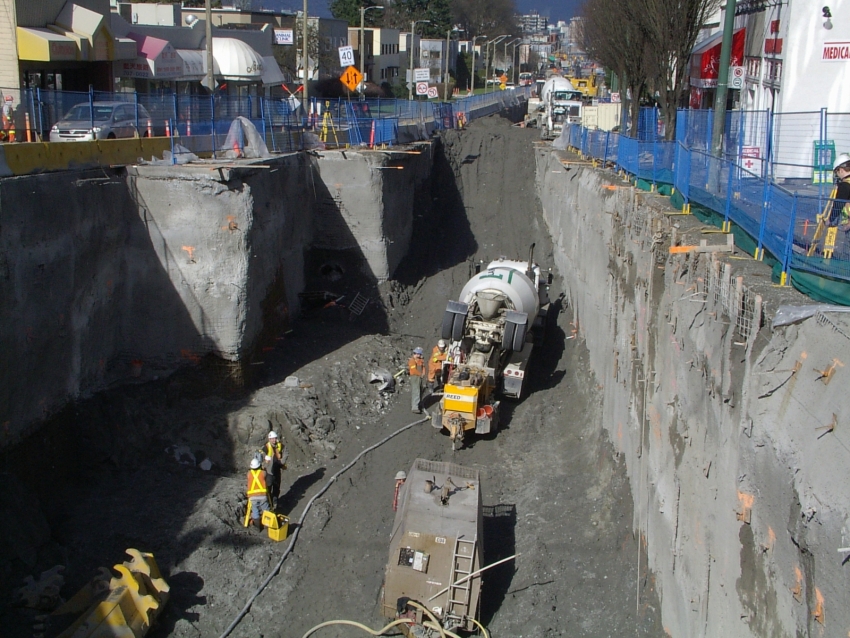
Is cut and cover subway construction coming to Broadway?
The Coming Post Covid Transit Fiasco
It is clear that TransLink is now faced with a massive financial fiasco as its two showcase rapid transit projects are rapidly devolving into a financial and a transit train wreck.
Noted American transit engineer, Gerald Fox, in a 2009 review of the Evergreen Line’s Business Case and found major inaccuracies, stated:
But, eventually, Vancouver will need to adopt lower-cost LRT in its lesser corridors, or else limit the extent of its rail system. And that seems to make some TransLink people very nervous.
The 1999 Greer report also found major issues with continued SkyTrain planning:
The main conclusion of this review is that the most relevant information advanced in support of the SkyTrain option was misleading, incomplete or unsubstantiated.
More specifically, the review found: cost comparisons appear to have been contrived to favour SkyTrain over LRT;
– no ridership (demand) analysis was reported to justify the high capacity system;
– air quality and transportation benefits are unsubstantiated;
– accelerated construction advantages of SkyTrain were clearly unrealistic;
– risks associated with the SkyTrain car manufacture have not been assessed.
The shock effect of fiscal reality of continued building with the unsustainable SkyTrain light-metro has yet to make its appearance, but it will and with a vengeance.
Then why is TransLink proposing transit solutions that they know that they cannot afford, such as the $5 billion plus subway completion to UBC and the $5 billion plus North Shore Rapid Transit proposal?
Parting words
One modern tram (which has the same maximum speed as SkyTrain) is as efficient as four MK.1 cars and three MK. 2/3 cars, thus making for much cheaper maintenance costs for light rail. Ottawa’s new LRT can carry more people at a much cheaper cost.
Contrary to the expected screams of “shock and disbelief” from the usual suspects; this is about being a ‘canary in the coal mine’, warning of a major, light metro lead transit fiasco in the near future. There is no moral fibre by regional politicians to challenge the misinformed Mayor of Surrey and his desire for the continued use of the proprietary MALM system and the increased costs that come with it.
Sadly, the anti-LRT lies and propaganda by the well established SkyTrain Lobby, which is entrenched in both major political parties; Ministry of Transportation; TransLink, universities, the media and regional bureaucracies, will ensure that there will be no affordable LRT solution in the foreseeable future.
The fear of the truth and the possibility of legal or professional action maintains the status quo and makes sure no one will rock the “SkyTrain” boat.
Today, by continuing to build with the obsolete MALM system, we are building a 1980’s transit system base on extremely dated 1960’s and 70’s transit philosophy, where rapid transit was designed to be out of the way of the car and recently modified for Vancouver to use SkyTrain as a driver for quick profits for land speculators, land developers, and more recently money launders.
In the 21st century, successful transit systems are user friendly, something that Metro Vancouver’s transit system is not!
This is from a 1983 article in Modern Tramways and compare, TransLink promises that
the opening capacity of the $3 billion Broadway subway will be 7,500 pphpd!
An user-friendly transit system that has the inherent ability to attract the motorist from the car, thus a successful public transit system is seen as a product and if the product is good, customers willingly use it and if not, the customer will opt, if he or she can, for the car. This explains the success of light rail and the lack of success of SkyTrain and light-metro.
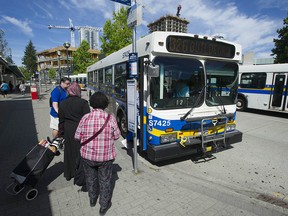
In Vancouver, transit customers are treated as cattle, crammed into buses and forcibly made to transfer to the SkyTrain system (over 80% of SkyTrain’s ridership, first take the bus) so TransLink can pretend it’s doing a good job. In Metro Vancouver, politicians pretend that SkyTrain is a “world class system”, yet internationally, the Canada Line is considered a classic white elephant and the LIM powered MALM is considered more of a historical curiosity, like the Wuppertal Schwebebahn, than anything else.
No one has copied Metro Vancouver’s transit planning, nor its exclusive use of light-metro and the Broadway subway may even be the next Charleroi (Belgium), where a metro was built but with no funds to buy cars or operate it, has remained derelict for over thirty years.
In a 2008 letter to a Victoria transit group, American transit expert Gerald Fox critiques the business case for the Evergreen Line has become a prediction of metro Vancouver’s light metro ills.
“I found several instances where the analysis had made assumptions that were inaccurate, or had been manipulated to make the case for SkyTrain. If the underlying assumptions are inaccurate, the conclusions may be so too.”
And adding:
” It is interesting how TransLink has used this cunning method of manipulating analysis to justify SkyTrain in corridor after corridor, and has thus succeeded in keeping its proprietary rail system expanding. In the US, all new transit projects that seek federal support are now subjected to scrutiny by a panel of transit peers, selected and monitored by the federal government, to ensure that projects are analyzed honestly, and the taxpayers’ interests are protected. No SkyTrain project has ever passed this scrutiny in the US.”
Zwei has real issues from the following two statements from BC Transportation Minister Rob Fleming.
. “In fact, what they analyzed was the superiority of high-frequency bus service, both from a capacity point of view – to move people out of their cars as the member wished for – and also to give flexibility in terms of service coverage, to be able to service a number of very dispersed destinations that are part of that area
Highway 99 through to the year 2080 did not give ridership projections that would support light rail of SkyTrain systems”
Really, Transportation Minister, Rob Fleming?
Where have buses actually created a modal shift? Why has Ottawa shifted from true BRT to light-rail?
High frequency bus service will fail, simply for the fact, the BC Liberals inked a deal with the SNC Lavalin lead consortium, operating the Canada Line faux P-3, that ll south of the Fraser bus services must force customers to transfer to the Canada Line. Well, if Minister Fleming wanted any proof that this does not attract new customers, just look at South Delta and South Surrey bus services ,where the predicted new ridership did not materialize and pre-covid, was seeing a continued decline in ridership, as mode share for transit is slowly declining in metro Vancouver.
Minister Fleming also does not understand what light rail is and lumps it in with SkyTrain light metro, which modern light rail made obsolete decades ago.
Why?
Light rail is a mode that can deal economically with traffic flows of between 2,000 and 20,000 passengers per hour per direction, thus effectively bridging the gap between the maximum flow that can be dealt with using buses and the minimum that justifies a metro.
Simply, LRT is far cheaper to build, far cheaper to maintain and operate, has a higher capacity and is flexible in operation.
The Canada Line which is a heavy rail metro, built as a light metro and presently has less capacity than a modern streetcar!
No wonder TransLink and Flemming are misleading both the voter and taxpayer!
The current cost to extend the Expo Line to Langley is now around $400 million/km all found, while modern LRT could be built between $35 mil/km to $50 mil/km or put another way, for one kilometre of Canada line we could build 8 to 11 km of modern LRT and have a transit system that from the start have a much higher capacity than the present Canada Line’s max. capacity of 9,000 pphpd!
So sad that in an age of Global Warming and climate change, TransLink and the NDP hides behind misleading information, to continue their “rubber on asphalt” only transit planning.
Shame on TransLink – Shame on Rob Fleming.
As Transportation Minister Rob Fleming seems either ignorant of modern LRT or is deliberately misleading the residents of Delta and Surrey about modern LRT, either way, he must resign, it is the only honourable thing to do!
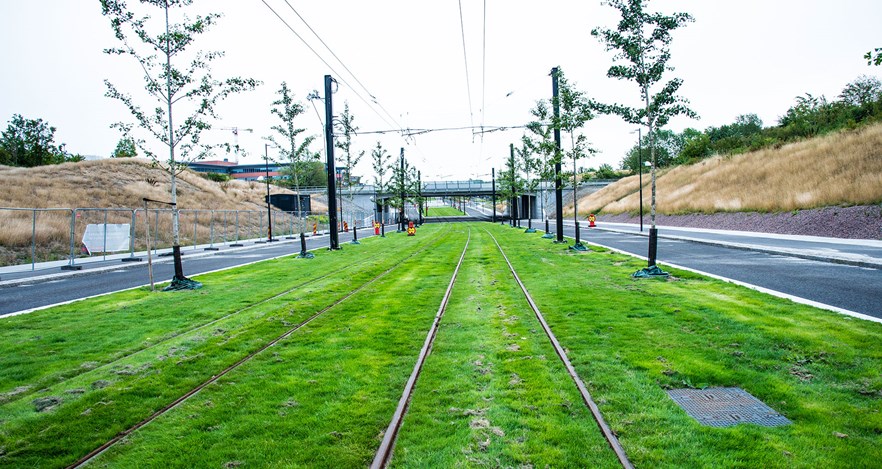
LRT in a highway median in Sweden.
Light rail coming through Delta shot down, again
The new eight-lane immersed tunnel to replace the aging George Massey Tunnel is to be completed in 2030
Light rail going through Delta and onto South Surrey isn’t seen as a possibility, even in the long-term.
South Delta can forget about rapid transit coming through the community the foreseeable, or even long-term, future.
During the May 31 provincial government budget estimates debate, Delta South Liberal MLA Ian Paton posed several questions regarding the George Massey Tunnel replacement project to Transportation Minister Rob Fleming.
Noting South Surrey and White Rock and fast growing, and the aim should be to get people out of their vehicles, Paton once again pointed out the original bridge project cancelled by the newly-elected New Democrat government included a provision for future light rail.
“My question to you: with this tunnel being so modern, so high-tech, why wouldn’t we look to the future of some sort of light rail capability through the middle of the tunnel? Eventually, one day – maybe 10 years, maybe 20 years, maybe 30 years from now – we could get light rail. There’s tonnes of room down the middle of Highway 99 and the medians on either side for light rail to go down to South Surrey, White Rock,” said Paton, according to transcripts of the debate.
Fleming responded that there’s “actually been some fairly recent regional thinking” on the subject by TransLink and by the Mayor’s Council in its recent 2050 plan.
“In fact, they looked as far ahead as 2080, through TransLink and their planners. Highway 99 through to the year 2080 did not give ridership projections that would support light rail of SkyTrain systems,” noted Fleming. “In fact, what they analyzed was the superiority of high-frequency bus service, both from a capacity point of view – to move people out of their cars as the member wished for – and also to give flexibility in terms of service coverage, to be able to service a number of very dispersed destinations that are part of that area. SkyTrain, going through farmland, going down the Highway 99 corridor, did not have the ability to disperse to a number of endpoint destinations.”
Fleming also noted the analysis received came from TransLink, with regional mayors around the table also looking at the data to make the determination on where the greatest pressure points will be and what areas will have lesser population growth.
It’s the same message former Transportation and Infrastructure Minister Claire Trevena conveyed in 2020 on the question of adding future rapid transit capability for the new crossing.
At that time, Delta Mayor George Harvie said he was shocked by her response.
“Insofar as no need for light rail, I’m shocked. I’m working with my fellow mayors. We’re looking at what the next 20-to-30 years is going to require, and light rail is needed south of the Fraser. With all the people that we have coming, most of them are going to be residing and relocating to south of the Fraser where the properties are a little less expensive. But again, I’m shocked. I just drove the tunnel, as you know, and it’s a tough drive….we need to get people out of their cars and if we’re not thinking in the future, we’re going to have problems here,” Harvie said two years ago.
According to Metro Vancouver’s Draft 2050 document, Frequent Transit Development Areas (FTDAs) are intended to be additional priority locations to accommodate concentrated growth in higher density forms of development. They are identified by member jurisdictions and located at appropriate locations within the Major Transit Growth Corridors.
Corridor FTDAs are intended to accommodate medium development densities and forms that are consistent with bus-based rapid transit, while Station Area FTDAs are intended to accommodate higher development densities and forms that are consistent with rail-based rapid transit.
Meanwhile, among Paton’s other questions to Fleming last week was whether the new tunnel project would include a second exit out of Ladner, an issue recently raised by the City of Delta, which is asking the province to include another exit.
Fleming responded that they are having “active discussions” with Delta staff about the scope of the project.
The province is currently in an early engagement phase of the environmental assessment process for the Initial Project Description. The new tunnel project is to be further refined based on feedback received.
A Detailed Project Description is to be ready by next summer.
Following the environmental assessment, construction of the new tunnel is to commence and finish by 2030.
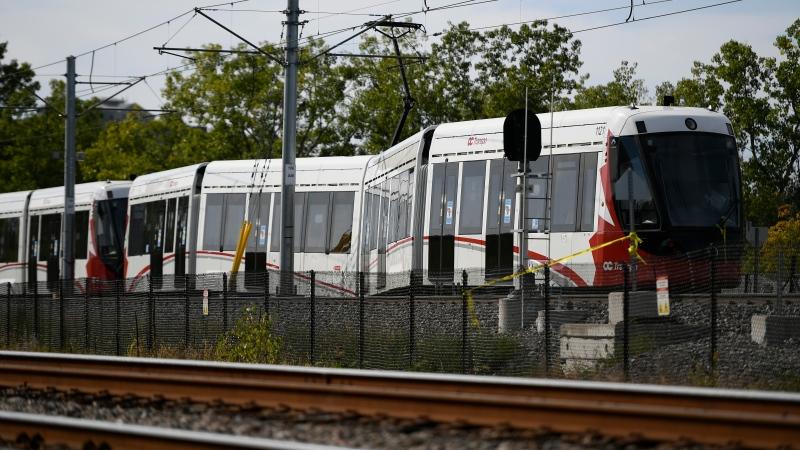
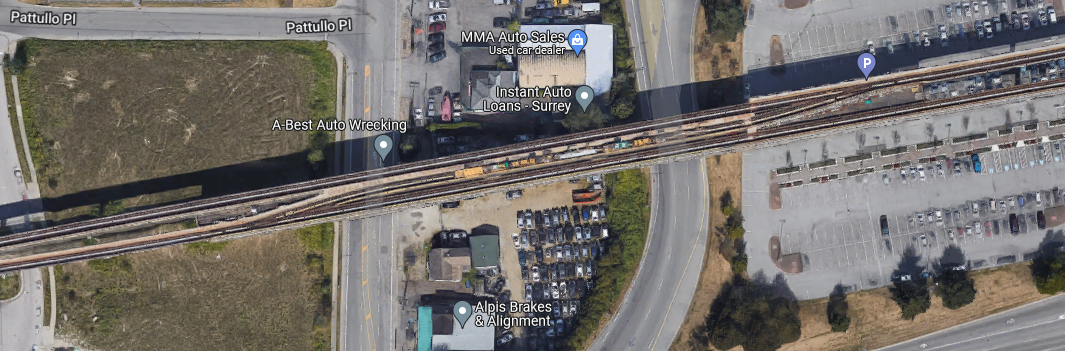
Well the truth is out, a Movia Automatic Light Metro vehicle has derailed on the SkyBridge.
UPDATE: “Crews have identified a failed switch as the cause of the track issue,” notes another update Tuesday. “This has led to a SkyTrain being partially dislodged from the tracks.”
Being honest is just not in TransLink’s mandate and for almost 14 hours, TransLink never gave a hint of a derailment and still calls a derailment a dislodgement.
One wonders, why cannot TransLink be honest with the public about the issue and why do they try to hide the fact a MALM vehicle derailed on a switch!
TransLink says a track issue on the SkyBridge has interrupted service between Columbia and Scott Road stations Tuesday.
Extra bus service is in place, but commuters connecting between Surrey and New Westminster are being warned to give themselves extra time.
Service on the Millennium Line, Canada Line, Production Way segment of the Expo Line are unaffected.
As of noon Tuesday, crews continue to work on repairing the track issue, but there is no estimated time of reopening.
“Crews have identified a failed switch as the cause of the track issue. This led to a SkyTrain being partially dislodged from the tracks on Monday evening. SkyTrain safety protocols were immediately initiated, and the passengers were safely removed from the train within 10 minutes. Crews have since inspected other switches on the system and ensured they are operating safely with no issues,” TransLink said.
“Crews have been working overnight and through the morning to lift the train back onto the tracks and repair the switch. The safety of our staff is a top priority, which is why it was crucial to continue this work with daylight. They are working hard to resolve the issue in order to resume regular service.”
The business types with the Surrey Board of Trade don’t seem quite up to date with the cost of Transit projects in Metro Vancouver.
The provincial governments Friday news release (Friday is always used for bad news which is hopefully forgotten by Monday) that the “B.C. government commits $2.4B to transit in Metro Vancouver“, was more of a face saving venture after last Friday’s $1 billion museum announcement was received with a resounding dull thud by voters.
Nothing like a transit announcement to get the people back on your side.
So the NDP’s spin doctors and damage control team reissued a rather tired meme that the provincial government is committing$2.4 billion to transit – hurrah!
But with the 5.8 km $2.8 billion Millennium Line extension including the contentious Broadway subway, now said to cost well over $3 billion and the partially funded 16 km, Expo Line extension to Langley, serious funding problems are appearing.
Remember when the Mayor of Surrey said it was going to cost $1.63 Billion for the whole 16 km?
You should remember because that cost estimate was given the toss soon after and the estimated cost more than doubled to $3.95 billion. Well hold on to your hats because TransLink is now hinting that the cost for this 16 km line may top $4.95 billion! Thus leaving the project more than $2 billion unfunded.
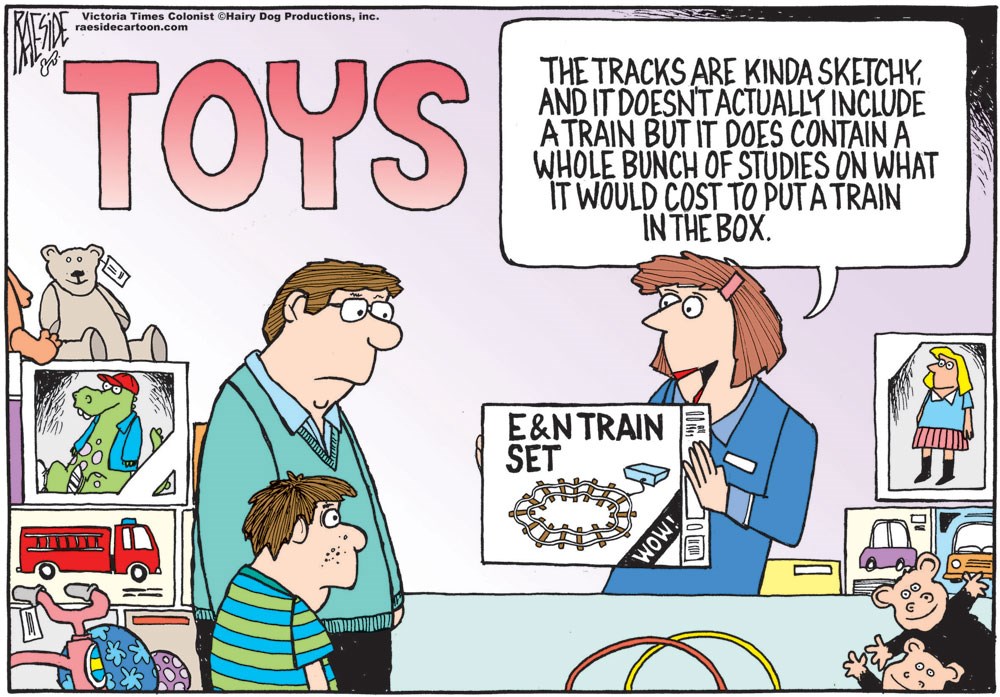
Then there is that pesky $3 billion rehab of the Millennium and especially the Expo line, desperately needed before the extensions open so the system can operate more trains! There is no funding for this and TransLink and the provincial government will not even admit to it!
Broadway subway – $3 billion+
Expo Line extension to Langley – $5 billion
Expo Line mid life rehab – $3 billion
That is a total of $11 billion dollars and the NDP are only going to fund $2.4 billion?
TransLink and the provincial NDP has just sent a strong message to the Surrey board of Trade…..
No Rapid Transit for You!
Surrey needs more than SkyTrain, board of trade says
B.C. investing $2.4B in Metro Vancouver public transit improvements with Surrey-Langley SkyTrain and ‘electrification’ of bus fleet included
The provincial government announced Friday it is investing $2.4 billion in Metro Vancouver public transit improvements with the Surrey-Langley SkyTrain extension and the “electrification” of TransLink’s bus fleet included in that.
This, a press release states, is part of the government’s “ongoing commitment” to fund 40 per cent of a 10-year vision wrought by the Mayors’ Council on Regional Transportation.
“This sounds like a repeat announcement,” Surrey Board of Trade CEO Anita Huberman said. “Knowing how construction projects develop in this region, we don’t think this Skytrain project will be in service until 2030.”
Noting Skytrain is very expensive to build throughout Surrey, she added, “There are other progressive modes of transportation technology.
“The investment announced today is positive but Surrey needs more transportation investments than this Skytrain line,” Huberman said.
The old E&N Railway is on lie-support, with only a glimmer of hope that the right thing will be done and establish a regional railway, serving Victoria, Courtney and Port Alberni and the many communities that the rail line runs through.
Remember global warming and climate change?
Remember the town of Lytton being cremated?
Remember the Merrit, Princeton and the Fraser Valley being drowned under flood waters?
Remember all three highways leaving Metro Vancouver closed for weeks due to the roads and highways being washed out?
It seems events of 2021 have been politely forgotten by government.
Jackass Mountain washout
Using established railways is a very cost effective way in providing a transit service that will attract the motorist from the car, but very sadly, last year’s massive forest fires and monsoon rains have been forgotten.
Dark clouds are now on the horizon and the “rails to trails” folks and the cycle lobby are circling the E&N, like vultures to pick clean the carcass, for their own immediate interests.
Both “rails to trails” and the cycle lobby are well versed in the art of misleading people and directing the conversation to their point of view.
“Trains are antique”; or “we don’t want a choo-choo”; or the tried and true “no one will use it”, are the common arguments used in the media, by the anti rail crowd.
The goal of these groups is to use the abandoned right-of-way for cycling, with no thought of using the railway as an alternative to the car.
Politicians love the rails to trails and cycles lobbies because they offer photo-op ready cheap investments and “bicycles are good for the environment, right?”
Using established rail lines greatly cuts the cost of using rail transit as “Greenfields” construction is cost prohibitive in most cases.
Zwei has read a lot about how both the “rails to trails and cycle lobbies manipulate the media to suit their own ends and I am afraid that those advocating for a regional rail solution for the E&N have been suckered by the slick marketing and media techniques used by those who would rather the E&N disappear.
It also seems the NDP government is silently waiting for the demise of the E&N so they can allocate portions of the line to the rails to trails folks, the cycle lobby and first nations for cheap election time photo-ops.
It is time to use it or lose it.
There is a lot more to be said, but suffice to say I am afraid the vultures a circling, with full NDP government approval, ready for the kill.







 This is from a 1983 article in Modern Tramways and compare, TransLink promises that








Recent Comments