The precedent set by the Canada Line Cambie St. cut and cover is coming to Broadway and that means “to hell with the small business”.
The mayor and council knew this would happen; TransLink knew this would happen (and why TransLink hired a professional spin doctor as CEO) as they know that they will not pay a cent in compensation.
For added insult, rents will increase due to the subway and many businesses will be “sterilized” after the subway opens.
The huge amount of politcal dishonesty is now laid bare and in an election year and I hope the politcal peanut gallery supporting this $3 billion boondoggle, get the boot this fall.
Worries Broadway Plan will be like Canada Line construction resulting in lost businesses
Sentheepan Senthivel has been the owner of Greens Market on Broadway near Maple Street for 12 years and he admits he’s never felt so hopeless.
He wants the city to give impacted businesses a property tax break until the project wraps up.
“We’re burning through cash.
“Burnt through about $225,000 already in six months and we’re down about $650,000 in revenues, so quite a bit of money for a small business to just swallow. This is the hardest it’s been since I opened. When I first opened when I was young, didn’t have much cash — that was hard — but this is like… you can’t do anything.”
He says he hasn’t heard from provincial or city officials as the construction and road closures impede people from stepping into his store.
“I’m feeling it’s a battle you can’t win, you’re fighting against giants, and everyone is just pushing you around and throwing you in different directions. [There’s] a lot of lip service and every answer is, ‘No.’ They can’t do this, they can’t do that — it’s definitely emotionally draining.”
Additionally, Senthivel has started an online petition to help local businesses survive.
The idea of giving tax breaks to businesses is something that’s echoed by Leonard Schein with the Cambie Village Business Association.
He was affected by the Canada Line construction more than 10 years ago and is one of the lead plaintiffs in a class-action lawsuit connected to the project, that is still dragging its way through the courts.
“It would mean that other residents of Vancouver would probably pay three cents more on their property tax for a whole year. It would be insignificant because it would be spread among the whole city. I wish they would do that. We tried to get them to do it to the Cambie Village and they didn’t.”
He feels the province and city have done nothing to help small businesses, he feels, are crucial to the community.
“It’s not going to be a lot of money. They’re talking about a project that’s over $2 billion, it’s going to be less than 0.001 to compensate those businesses for their losses.”
Schein says the city and province should look to other big cities which have undertaken similar projects, specifically in the U.S., to see how they handled the fallout.
“What was does in the United States is businesses put in their financial statements before the construction, during the construction and after the construction so it’s clear what they’ve lost during that time period and the government gives them that amount so that they’re made whole again.”
Both men are worried this project will end up very much like the Canada Line construction which, Schein adds, resulted in more than three dozen businesses going bankrupt.
‘I’m unable to function’
Regardless of how council votes on the redevelopment plan for Broadway, people who live along the corridor are already experiencing the effects of the loaded construction work.
Karl Prevost rents a commercial space at Broadway and Main Street and lives in a condo in that same building. He says he’s dealing with the noise while he’s at work, and then when he goes home for the evening, there’s no relief.
“I’venotbeenabletoreallymake it more thanfivedaysinmyapartment. BeforeI hadtoleaveforaweekasaresultofthenoiselevelsandlackofsleep.”
Prevost tells CityNews the constant noise and vibrations have impacted his health and his business, saying the noise feels never-ending.
“It’s unbearable to be exposed to those noise levels consistently over that period of time. Is it maddening. There’s been times when the vibrations from the work are so loud … my pen jumps across my desk.”
In a statement to CityNews, the City of Vancouver says, “City bylaws, including sound limitations, do not apply in the Province’s construction-required lands. The Province’s contractor ultimately determines how the work is coordinated and is responsible for construction notifications to residents and businesses.”
Prevost says due to what he calls a lack of regulation around noise, the constant construction is taking a major toll on his health and productivity.
“I’ve run this company for 20 plus years now, and for the first time in the last year, I’ve missed several morning meetings as I’m unable to function. It was so bad a while ago that I was actually physically sick, like throwing up while I was working.”
Prevost is one of the over 200 people who has signed up to speak on the proposal Wednesday, and he says he plans on making sure his concerns are addressed.
The Business Case for the E&N has been released and the cost provided ($431 million) seems quite cheap, compared to the Expo and Millennium Line extensions, where the cost per km is over $400 million/km (over $500 million/km for the Broadway subway).
What has proven to work elsewhere, will work here; using rail to provide an affordable and user friendly alternative to the car.
Time to start looking for some used DMU’s.
And while we are at it, there’s the Valley Rail project, just waiting for some investment as well!
The Business Case for Rail Service on Vancouver Island ICF Initial Business Case 2022 PRESS RELEASE ISLAND CORRIDOR FOUNDATION RELEASES BUSINESS CASE FOR RAIL SERVICE RESTORATION May 16, 2022 – The Island Corridor Foundation today released a Business Case highlighting detailed analysis, including data from the Provincial and Federal Governments in support of the full restoration of rail service to Vancouver Island. The Business Case provides for the upgrading of the entire 290 km rail system on the Island, from Victoria to Courtenay and from Parksville to Port Alberni. The Business Case proposes a mixed-use rail system that would have a peak hour commuter system in the Langford – Victoria corridor, inter-regional passenger service that would operate twice daily between Victoria and Courtenay, as well as freight operations on the entire system, with emphasis on key ports in Port Alberni and Nanaimo. The system will also support passenger excursion operations in the tourist market and special event transportation. “We are very pleased to bring forward the Business Case as it defines the very real and urgent need for safe, efficient, reliable, and environmentally sustainable transportation options on Vancouver Island. It also demonstrates that the proposed rail system can address those needs, it is financially viable, and can be sustained for future generations” said Larry Stevenson, CEO of the Island Corridor Foundation. The Business Case estimates the construction costs for the project to be $381 million and $50 million for the acquisition of rail equipment for a total cost of $431 million. Costing for the project is based on the 2020 Island Rail Corridor Condition Assessment updated to reflect 2023 dollars. “The Business Case is an important step toward having rail restored to the island however there is still a lot of work to be done to make it a reality. The Business Case highlights the unresolved issues emanating from the original land grants that brought the railway to Vancouver Island. We believe the resolution of those issues is critical to bringing rail back to the Island and call on the Provincial and Federal governments to work with Island First Nations to settle those issues as part of this proposal” said Dr. Judith Sayers, Co-Chair of the Island Corridor Foundation. The Business Case has been provided to the Provincial and Federal governments for their review and consideration with the request for the establishment of a formal working group to begin the work of bringing rail back to Vancouver Island. The Island Corridor Foundation is a non-profit society and federally registered charity established for the purposes of owning and managing the rail corridor on Vancouver Island. Initial Business Case can be found here. Island Corridor Foundation Island Corridor Foundation| 250-754-7254 | Box 375 Stn Ave, Nanaimo, BC V9R 5L3 | islandrail.ca Island Corridor Foundation | Box 375 Stn A, Nanaimo, V9R 5L3 Canada Unsubscribe ad377@ncf.ca Constant Contact Data Notice Sent by andreathomas@islandrail.ca powered by Try email marketing for free today!
The Daily Hive has become TransLink’s official mouthpiece and sadly the Daily Hive, knows very little about transit and even less about SkyTrain light metro.
*
It is my belief that this article, in part, is in response to this letter to the editor which appeared in the Langley Advance Times.
The article below is unbelievably inconsistent and lacking in basic information.
*
First the province of B.C. says that, the Surrey-Langley SkyTrain extension is a two stage or two part project, that was combined into a single stage (the entire 16 km length built all at once) for an approximate price of $3.95 Billion.
The mayor of Surrey said in 2018 that the whole thing could be built for only $1.63 Billion, remember that whopper.
At the end of the article the writer reports that the OMC#5 (the 5th SkyTrain storage and maintenance yard) is going to be separated from the project an built separately for a cost range of $500 Million to $1 Billion.
*
So it’s now a two stage project that has to be tendered separately. Ironically, the OMC#5 will have to start the tendering process later this year, an entire year earlier than the actual line so they both finish around the same time? My too many years of planning transportation projects knowledge understands that, if the line and yard are being tendered on two separate tendering schedules, you have a two stage project.
So one or two stages what is it?
Now The Important Part
If the yard (OMC#5) is to cost around $500 Million – $1 Billion has the cost of the actual line dropped at all?
The article’s writer or the province of B.C. doesn’t mention this at all. If the line is still going to cost around $3.95 Billion, that means the total cost for the single stage project has gone up to somewhere between $4.45 Billion -$4.95 Billion.
That’s a 12.3% -25.6% cost increase in 1 year!
The article says by 2050 the extension will be moving 80,000 passengers a day but that’s 28 years from now, 22 years after it opens. What’s it going to be carrying in 2028, when the line is planned to be open?
No one, not the province or TransLink wants to tell you, why?
So, let’s get this straight. Surrey and Langley will have a SkyTrain line extension that will cost at a minimum $4 Billion ($3.95 Billion) but could increase up to $4.95 Billion or (essentially $5 Billion) and that extension might move only 80,000 people a day, 22 years after it’s expected opening day.
What amazes, is that, the line is completely above grade, with a yard, no tunnels and it is expected to cost between $4 Billion and $5 Billion!
All for an 8 station, 16 km long extension that, will force many downtown bound passengers from Langley on a trip that will take over an hour, that’s without the need for transferring somewhere else.
This is not a short distance regional VIA Rail train where the seats are comfortable, where they have luggage racks and offer food and beverages, this is supposed to be rapid transit. Still nobody knows the actual planned capital cost or how many passengers this line will carry on its opening day.
This project sounds worse and worse the closer to construction it gets.
I would like to thank Mr. Cow for bringing this issue to me in such clarity.
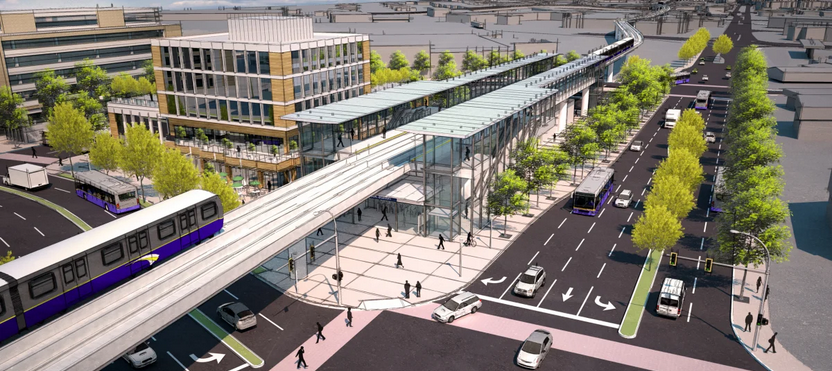
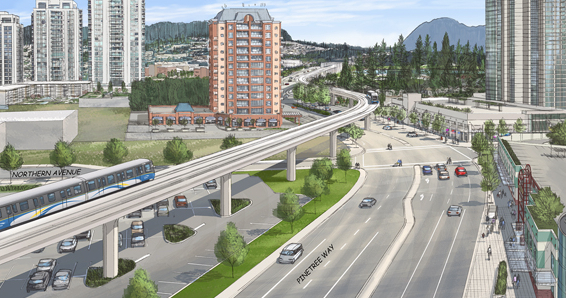
The provincial government has revealed its conceptual design approach for the entire 16-km-long Surrey-Langley SkyTrain project for public consultation.
A total of eight additional stations are planned for the Expo Line along Fraser Highway between the existing terminus at King George Station to Langley City Centre.
Seven stations will have side platforms, while the Expo Line’s new easternmost terminus of 203 Street Station will have a centre platform.
The entire extension will be elevated, with the alignment running down the centre of Fraser Highway through Green Timbers Urban Forest to 152 Street Station, on the north side between 152 Street and 166 Street stations, on the south side through the Serpentine River and Agricultural Land Reserve, and returning to the north side for the final stretch before the Surrey-Langley City municipal border.
For the final approach within Langley City to 203 Street Station, the elevated guideway will be on the south side of Industrial Avenue.
Three station-serving bus exchanges are planned, including for 166 Street Station, 196 Street Station, and 203 Street Station. The latter of these stations, as the terminus, will have a particularly larger bus exchange to enable bus connections to communities in eastern Metro Vancouver and the Fraser Valley.
A four-lane roadway standard will be maintained for the reconfigured Fraser Highway to accommodate the elevated guideway. As well, project planners intend to take advantage of the SkyTrain project to create an active transportation corridor following the elevated guideway, with wide sidewalks and protected bi-directional bike lanes.
Additionally, the consultation emphasizes on the approach of spurring high-density, transit-oriented development to enable both more housing options and affordable housing, retail and services, employment spaces, recreation and entertainment uses, and educational facilities near the SkyTrain stations. As stipulated by both the provincial government and TransLink in exchange for the major transit investment, both the City of Surrey and Langley City are engaged in various planning processes of creating new area plans that densify areas around stations.
By 2050, it is anticipated 100,000 people will be living within 800 metres of the new stations, and over 20,000 new jobs will be accessible by SkyTrain. The combined population of Surrey, Langley City, and Langley Township will also rise by 420,000 people, and the overall workforce will grow by 147,000 new local jobs.
Furthermore, by 2050, ridership on the Surrey-Langley extension of the Expo Line will reach an average of 80,000 passengers per weekday.
The travel time is projected to be 22 minutes between King George Station and the new terminus of 203 Street Station in Langley City Centre, and 65 minutes on a one-train ride between Waterfront Station and 203 Street Station.
As of 2021, the Surrey-Langley SkyTrain had an estimated construction cost of $3.95 billion for the entire project — built as a single phase reaching Langley, instead of the previously contemplated two phases. This project is confirmed, with the federal government committing $1.3 billion for its share.
Similar to how the Millennium Line Broadway Extension is currently being carried out, the provincial government took over this Expo Line extension project from TransLink last year, and is currently leading planning efforts towards implementation.
The current public consultation will lead to the finalization of the new business case for the entire extension by Fall 2022.
By early 2023, the provincial government will launch the bidding process for a contractor, starting with request for qualifications (RFQ). Shortlisted contractors will then be invited to submit a detailed bid through the request for proposals (RFP) stage in Spring 2023, with an aim to award the contract by the middle of 2024. Construction is expected to begin in late 2024 or early 2025 for an opening by late 2028.
Noticeably absent from the Surrey-Langley SkyTrain project scope is the inclusion of an additional operations and maintenance centre (OMC5) serving the Expo Line, which will be located in Langley. The provincial government’s BC Major Infrastructure Projects Brochure, published earlier this spring, suggests the OMC5 facility will be a separate project, with an estimated cost range within the category of between $500 million and $1 billion. Procurement for OMC5 will start in the latter half of 2022, with construction anticipated between 2023 and 2028. This will be a very significant facility to accommodate both Surrey-Langley SkyTrain car operations and the overall long-term growth of the SkyTrain car fleet.
Before major construction begins in about two years on the Surrey-Langley SkyTrain, about $128 million in advance work and site preparation activities will be conducted, including widening Fraser Highway through Green Timbers to a four-lane standard, relocating BC Hydro power lines and structures, relocating other utilities, and property acquisitions.
On the local TV last night, small businesses along the Broadway construction zone are seeing huge drop in sales and a big increase in debt, due to closure of sidewalks.
Shades of the Canada Line debacle on Cambie 15 years ago!
BC’s Transportation Minister Ian Flemming, trundled out the old tried and true comment from the Canada Line days” that profits will return many fold as stated in the business case, after completion”.
Sorry, that maybe true for a surface light rail line, but not for a subway because subways tend to do the opposite and sterilize surface businesses between subway stations!
Just more politcal BS, justifying the BS Line!
From August 2021.
An interesting passage from Steve Munro’s critique of Neptis, which I was reading to gain some insight into the organization, in response to Mr. Burgess’s comment.
Towards the end of this lengthy report, this paragraph stood out.
The whole point of Transit City was to provide improved local, trunk services and to remain on the surface wherever possible to minimize capital costs while avoiding the sterilization of between-station areas with the wide spacing typically found on subway projects.
Let me restate the point of concern.
………. (transit is) to remain on the surface wherever possible to minimize capital costs while avoiding the sterilization of between-station areas with the wide spacing typically found on subway projects.
So now the truth come out, the Broadway subway will sterilize surface business’s along Broadway, between the subway stations.
This contrary to what TransLink and the Mayor of Vancouver is saying! This contrary to hosannas being sung about the subway by the Daily hive and the rest of the mainstream media.
The Broadway subway will harm surface businesses and the City of Vancouver and TransLink are cowards for not telling merchants the truth, that the Broadway subway will sterilize Broadway!
Montreal’s politicians listen to the public far more about transit than Metro Vancouver’s politico’s. The public were growing very disenchanted having an elevated railway go through Montreal’s downtown and maybe would take such disenchantment to the next civic election.
Well, the civic government has pulled the carpet from under the Caisse and in response, they have abandoned REM East.
This means the project is no longer a CDPQ Infra property development transportation project but now a mainly federal- provincial infrastructure project that, will be run jointly between the City of Montreal and the Government of Quebec. As are most of the traditional rapid transit projects in the Province of Quebec. This means also, unlike the existing REM project, there is no ban on other non-REM rapid transit lines that can cross transfer passengers between this project and other new or existing Montreal rapid transit lines.
REM is a light metro and like other light-metros, it has become a “tar baby”…………………
A tar baby is something from which it is nearly impossible to extricate oneself
………………. once you built one, with all the bureaucrats and planners involved desperate trying to save credibility, it is almost impossible to plan for anything else than a light-metro.
REM East was the last straw in Montreal, with a bank dictating how transit was to be built, but light metro now remains with damage already done and cannot be undone.
As one critic of REM said in an email:
The atmosphere of the May 2 press conference hid the fact that the East REM is alive, and worse for the resident community and the environment than before. You have to throw out the REM de l’Est, the REM de Laval, the REM de la Rive-Sud and all the other REMs.
Unlike Montreal, Vancouver’s civic and provincial politicians do not have the moral fortitude to abandon SkyTrain planning in favour of just as effective and less costly public transit alternatives.
REM
Quebec takes over REM de l’Est project after CDPQ Infra backs out
Montreal mayor calls original plan with elevated tracks ‘a historic mistake’
CBC News ·
After butting heads with the creators of the REM de l’Est over a plan to install elevated tracks in Montreal’s downtown core, Premier François Legault announced that the Quebec government will be taking over the massive public transit project and scrapping its downtown portion.
The original developer, CDPQ Infra — a subsidiary of Quebec’s pension fund manager, the Caisse de dépôt et placement du Québec — is now out. Legault and Montreal Mayor Valérie Plante made the announcement on Monday at a news conference.
Legault said the plan to have elevated tracks did not gain “social acceptability.” The province will also explore other major changes as well.
Without the elevated platforms, the project, which came with an initial price tag of $10 billion, is no longer viable for CDPQ Infra, the premier said. He also added that he understands why the developer would no longer want to proceed.
It’s not yet clear how these major changes will affect the project’s price tag and timeline. The REM de l’Est was first supposed to be completed in 2029.
“People that know me know that I don’t have a lot of patience and I want this project to be completed as quickly as possible,” Legault said.
“It is crucial for the development of the east end of Montreal.”
On Monday, Plante described the initial plan to have elevated tracks in the eastern part of downtown as a “historic mistake that absolutely had to be avoided.”
Plante’s concerns were echoed by a report from an expert advisory committee, which said the elevated platforms would be an eyesore and would “fracture” the urban landscape. There were also concerns it would erode the quality of life in nearby neighbourhoods, including the city’s historic Chinatown.
Experts and officials had raised concerns that the proposed design of the REM de l’Est, with its elevated platforms, would divide neighbourhoods and make some areas less accessible to pedestrians and cyclists. (CDPQ Infra)
Montreal’s mayor has long been pushing for the city to have a heavier hand in shaping the public transit project.
Moving forward, the major partners working with the province will be the regional transit planning agency for the greater Montreal area (ARTM), the Société de transport de Montréal (STM), the City of Montreal and the province’s Transport Ministry.
In a statement, a Québec Solidaire MNA accused the Legault government of being incompetent in matters of public transit.
“The government will finish its mandate with a mess and by not delivering anything concrete to the east end of Montreal in matters of transit,” said Alexandre Leduc, who represents the Hochelaga-Maisonneuve riding.
The REM de l’Est was originally set to include 23 stations along 32 kilometres of track, stretching from downtown to the eastern neighbourhoods of Pointe-aux-Trembles and Montréal-Nord, which have long been underserved by public transit, through a mix of underground tunnels and elevated tracks.
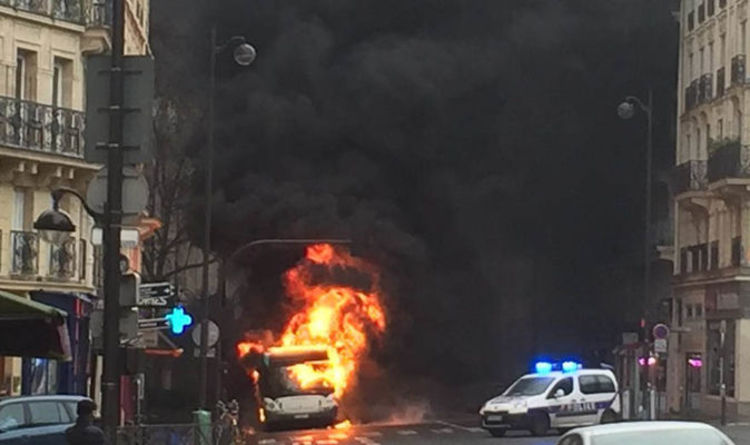
An electric RATP bus caught fire this morning in Paris.
An electric RATP bus, traveling on line 71, caught fire this Friday morning around 8 a.m., near the Bibliothèque-François-Mitterrand stop, in the 13th arrondissement of Paris.
This is the third fire of this type of bus in the Île-de-France in the space of a month
A frightening experience, thankfully no injuries or fatalities?
It seemed an inordinate length of time before les sapeurs-pompiers turned up.
Cardinal Fang is presuming the RATP bus was powered by rechargeable battery cells & not hydrogen.
The Cardinal is afraid that we are going to see a lot more of these incidents from around the world in the next few years, until municipal authorities, politicians & the transport industry wake up & realise that, wireless and on-board vehicle power systems are not as efficient as the lobby believe and do have safety issues.
With the cost of the Expo Line extension to Langley, exceeding the last estimate of $3.95 billion; the Broadway subway completion to UBC now exceeding $5 billion; and of course that pesky $3 billion rehab to the Expo and millennium Lines that TransLink refuses to acknowledge publicly, just where will be funding for this short line?
*
There is no funding and a SkyTrain line to Newton will not happen and TransLink knows this. This is pure smokescreen to hide the fact that SkyTrain will probably not reach Langley and even the most ardent supporters of SkyTrain in Surrey are circling the wagons.
*
The following letter was printed in the Langley Advance Times, which given the stance in the past where negative news about SkyTrain light metro was politely omitted from local papers, this published letter shows that there are cracks appearing in the SkyTrain facade.
The following quote, poses many questions:
It (BRT) is significantly cheaper than SkyTrain investments at $15-million per kilometre, versus $400 million per kilometre for the train.
$400 million/km for SkyTrain?Is this now the real cost of the Expo Line extension to Langley? That would put the cost of 16 km Expo Line extension to Langley at $6.4 billion! No wonder TransLink is trying to put the “big sell” for BRT for the Fraser Valley.
*
Still, Rail for the Valley’s updated Leewood Study would cost less than $1.5 billion for 130 km (less than $11.5 million/km) of a regional light diesel multiple unit line from Vancouver to Chilliwack, with a maximum of three trains per hour servicing North Delta, Cloverdale (and the proposed new hospital KPU); Langley, Trinity Western University, Abbotsford, and Veddar/Sardis (Cultus Lake).
*
It seems that TransLink and the provincial government would rather spend billions of dollars on prestige projects and never admit that Rail for the Valley’s Leewood Study, provided an affordable solution at a cost less than the six figured salaried bureaucrats could come up with.
Ottawa’s O-Train light DMU.
People wait to board the 301 Brighouse bunch to Richmond at Newton Exchange on Friday, March 20, 2020. (File photo: Lauren Collins)
Transportation
TransLink wants to explore SkyTrain extension into Newton
But the BIA executive director wonders how much longer the town centre will have to wait
TransLink says it wants to explore a potential SkyTrain extension to Newton within the next 10 years.
The transit company unveiled its priorities for the first 10 years of its Transport 2050 plan Wednesday (April 20) and the possibility of a Newton line made the list.
But while one Surrey city councillor lauds talk of a Newton SkyTrain line, the leader of a local business group says Newton is still waiting for there to be “real investment” in the community.
“According to the Transit 2050 plan update that was recently released, it seems that other communities have leapfrogged Newton,” said Philip Aguirre, executive director for the Newton Business Improvement Association.
“Newton has the population, the jobs, and the ridership but still has no commitment or real investment in the community. In the year 2032 will we still be talking about ‘exploring other potential SkyTrain extensions, including Newton in Surrey?’”
Aguirre says he wonders how long Newton will have to wait to get rapid transit down King George Boulevard to the town centre.
In 2018, after the majority Safe Surrey Coalition was voted in, Surrey’s light rail transit (LRT) project was cancelled and focus switched to the Surrey-Langley SkyTrain extension project.
Newton Town Centre would have been home to one of the terminus stations for LRT, which would have run from Guildford down 104 Avenue to City Centre and then up King George Boulevard to Newton. The fully funded and approved project would have been completed by 2024.
In Wednesday’s announcement, TransLink said it plans to spend the next 10 years doubling its regional bus service, expanding its rapid bus service, and completing the majority of its new bike and walkways. These priorities are outlined in TransLink’s Transport 2050 strategic plan, which
According to a discussion guide from TransLink, the transit authority is looking to invest in rapid transit on up to 11 corridors, which includes the King George Boulevard and Scott Road corridors. Along King George Boulevard, TransLink is looking to extend RapidBus or Bus Rapid Transit (BRT) from Surrey Centre to White Rock and “complete an exploratory business case of grade separation and technology alternatives, including SkyTrain, between Surrey Centre and Newton.”
Surrey Coun. Doug Elford was thrilled with TransLink’s plan, which was unanimously adopted by the TransLink Mayor’s Council in January.
“I think it’s critical. We do have a rapid bus planned, for now, which I think is fantastic in the short-term,” he said. “But in the long-term, I think SkyTrain to Newton and then eventually all the way to the south would be ideal. That’s something that we would be advocating for. I know the mayor has advocated for that before.”
Elford added he’s glad it’s Newton Skytrain made the list of 10-year priorities.
“At least that indicates that it’s in the thought process. I mean, once we get the line developed in Langley, it’s my understanding – that I’ve heard through the grapevine – that it will be designed so that an extension to Newton would be very feasible, engineered so it would be very feasible.
“It’s going to happen. it’s just a matter of time.”
Meantime, the major focus of the next decade is on bus rapid transit — buses that operate in fully separated lanes with signal priority designed to keep buses moving.
In Surrey, TransLink’s 10-year priorities include BRT on several corridors with two of those in Surrey: King George Boulevard from Surrey to White Rock and Scott Road, an upgrade from the R6.
TransLink said the bus rapid transit routes will be serviced by zero emissions or low emissions vehicles. Riders will prepay before boarding and buses have more spacious interiors to allow higher passenger capacities — similar to a rapid light rail experience. It is significantly cheaper than SkyTrain investments at $15-million per kilometre, versus $400 million per kilometre for the train.
It’s officially a GO (sorry for the pun), all the EA’s are done, we have the company’s (2 Consortium’s) ready and the work thankfully, has already started. We are about to create what will be, electric regional railway service on the core part of the GO network (about 263 km worth of it. It will be on 5 of the 7 GO Train lines. The total cost is expected to be around $27-$30 Billion.
THIS IS A BIG DEAL because it will really be a game changer for the entire GGH planning Region (Greater Golden Horseshoe Region -Toronto’s official and legally defined, commuting zone) none of this unofficial GTA crap anymore. This area has a current population of 9.87 million and an area of 31,561 km2. The entire province of Ontario has only 14.5 million in population. By 2051 the GGH Region is expected to have 15 million. The federal and provincial governments have already built:
8.8 km of Subway,
2 Bus-ways of 52 km (18 km of heavy Bus-way in Mississauga and 34 km of Light Bus-way in York Region)
They are both spending big for the current round of projects:
2 subway extensions about 17km in total (1 already under construction and 1 to start next year)
1 15. 5 km long Automated Metro Line, (under construction)
1 19 km LRT line (11 km of it in tunnels) about to open and a 9.2 km extension (8 km of it in tunnels and yes, it’s under construction)
3 Surface LRT lines, Finch West-11km, Hamilton B-Line-10 km, what was the Hurontario Line but is now the Hazel McCallion LRT Line-18 km (all under construction)
That’s almost 100 km of rail rapid transit under construction or about to open, with more Subway, LRT and full scale BRT lines (real BRT lines with actual busways not BRT Lite, Vancouver) coming in the future.
Unfortunately, THIS JUST ISN’T ENOUGH.
Subways/Heavy rail/Metros can’t go everywhere. Even LRT and BRT have limits because like a Metro, Light Metro, LRT and BRT lines, they all have geographic travel limits. These lines can’t or more accurately, shouldn’t try to service into regional distances, they aren’t designed for it. Any operating cost saving you think you are getting is blown apart if the lines are too long. This is one of the big issues with the Langley extension of the Expo Line. It’s becoming too long to be useful. Do you want to go from Langley and sit for over an hour, stopping at every stop along the way to get to downtown Vancouver. I like trains and that would be hard for me. Considering the cost to build, the ever increasing high cost of operating the Expo Line, contrary to popular belief, the Expo Line isn’t cheap to operate. Add in the really small numbers this line extension will generate, is it worth it?
Even the most ardent subway proponents here know that, although you could probably get a few more km’s of outward expansion from of a couple of Toronto’s existing Subway lines, any of the major planned extensions are all, well within the boundary of the City of Toronto.
Could LRT and BRT lines go regional distances outside of the boundary of the City of Toronto yes, some have definite plans too but, if you are going to travel those kinds of distances, you sure can’t stop at every station. As the distance increases stopping at every stop takes too long for most commuters and offering local and express services on rail systems eats up huge amounts of carrying capacity. That’s why most of New York’s express subway lines operate on the older but numerous 4 track sections. The cost of building lines this long and grand are well documented but it’s the operating costs are where the real devil is.
It’s important to remember that, there are 30 separate, regional, semi-regional and municipal transit agencies in the GGH Region. There is some interest in having a common fare structure but due to the vastly different funding levels, provided to each of the agencies, an overarching super-regional transit agency is functionally and technically, a difficult issue (my thesis was on this subject), it’s more than likely, politically impossible.
No other local transit agency in Ontario, let alone the GGH Region wants to spend TTC levels (European spending levels) on their operational transit budget and Torontonians won’t tolerate less service. There basic operating and service frequency levels exceed TransLink’s by over 30%. It’s almost at what Montreal local transit service levels are. The current provincial government, well no provincial government, has had the desire to create an agency like TransLink here, even the pathological budget conscious Conservatives of the 1990’s “Common Sense Revolution” weren’t up for it. So the only answer is to use GO Transit, like it was originally intended, as a regional wide bridging service for all the region’s individual transit agencies.
Instead of normal commuter rail service on the cheap and already existing railway rights of way. Instead of dropping Billions on rapid transit lines built from scratch, that become more and more unaffordable to build and operate the longer they get, spend money on expanding the long distance rail lines that already exist. You go to true regional railways instead of commuter railways.
Where there is 1 track build another. When you have a 3 track corridor expand it to 4 tracks. Having to use over powered diesel locomotives to move longer and longer trains of passenger cars. Go electric, it provides the constant high power needed to move heavier longer trains. The electric trains can move and accelerate faster as well. Yes $27-$30 Billion is a lot but for 263 km of great electric powered service plus another 259 km of upgraded diesel train service. Think about it, how much would 263 km of SkyTrain cost? (a minimum of $65,750,000,000, based on current per km cost of SkyTrain, not including the extra costs for subway construction)
This why destroying Montreal’s Deux-Montange electric commuter rail line (Canada’s only one) for the s**t storm that is the REM is such a tragedy. The transit agency even owned all the track, including the tunnel into downtown Montreal and the yard for the EMU’s (Electric Multiple Units). The new REM line will actually have less passenger carrying capacity than the peak hour capacity they gave up using the EMU’s. It was only a lack of vision and budget that kept them from greatly expanding the line’s service. It not only destroyed one line, it essentially killed a brand new commuter rail line to eastern Montreal, equipped with dual diesel and electric powered locomotives, that shared the tunnel and downtown rail right of way as part of its route.
The improved GO service will be 1 train every 15 minutes, all day, both directions. Service of at a minimum of 1 train per hour, all day, both directions using diesel trains (off peak) on most of the remaining sections of the network and most of outer portions of the electrified lines, peak hour service will be higher on the rest of the network. The system is expected to be fully complete by 2032 and will run from 5 am to 2 am, daily. The first operating portions will be available by late 2026-early 2027.
The existing GO Train system has 7 rail lines, using 526.1 km of track (GO owns about 70% of it), with 90 locomotives and 845 Bi-Level passenger coaches (120 Cab-Control cars for push-pull operations). Initially, electric locomotives will be purchased and Bi-Level 4 section (4 Car) EMU’s will come later. 4 Section (Car) EMU’s are going to be used because they can be easily joined to form 8 and 12 section (car) trains in the peak hours and more financially viable, 4 car trains for weekends or late evening service.
The Lakeshore East and West lines already have a minimum service frequency of every 30 minutes (off peak), both directions, all day, between Hamilton-Toronto Union (Lakeshore West) and Toronto Union-Oshawa (Lakeshore East).
Currently, the system uses Bombardier designed (originally UTDC), Bi-Level passenger equipment similar to the West Coast Express.
The diesel locomotives are tier 3&4 (the highest 2 levels) compliant and considerably more powerful than the ones WCE (West Coast Express) uses. GO Transit uses MPI (Motive Power International) MP40 PH-3C, tier 3 compliant at 4000 hp (horse power) and MPI MP54AC, tier 4 compliant at 5400 hp. WCE uses 3000 hp tier 3 compliant, diesel locomotives. GO Transit must use these behemoths because the Lakeshore East Line, Lakeshore West Line (with some through service to Niagara), the Kitchener Line (with some through service to London) all use 12 car trains and the 4 remaining lines use either 8 and 10 car trains.
Cheers,
Haveacow
Toronto’s service transit service area, superimposed on Metro Vancouver.
The Expo and Millennium Line are the region’s Rail Rapid Transit Lines that connect key locations across Metro Vancouver. The Expo Line opened in 1985 and was the region’s first rail rapid transit line. Since its inception over thirty years ago, the region has extended the original Expo Line from Vancouver to Surrey and built the Millennium Line to reach Coquitlam.
To accommodate the future growth of the region, and to support longer trains and more frequent service, we are making major investments over the next ten years. These upgrades will keep the system safe, reliable, and comfortable for our current and future customers.
When the program is fully implemented, the Expo Line will be able to move 17,500 passengers per hour per direction, and the Millennium Line will be able to move 7,500 passengers per hour per direction. This represents a 32 and 96 per cent increase respectively over the existing capacity.
What, increase the Millennium Line capacity to 7,500 pphpd?
I know that the term capacity is not used, but it is certainly has been inferred!
The Business Case analysis assumes a capacity of 4,080 for LRT, on the Evergreen Line which it states is not enough, and compares it to SkyTrain capacity of 10400.!
Yet today, according to TransLink, the Millennium Line’s Capacity is much less than 7,500 pphpd and nowhere near the 10,400 pphpd as claimed in the Evergreen line’s business case!
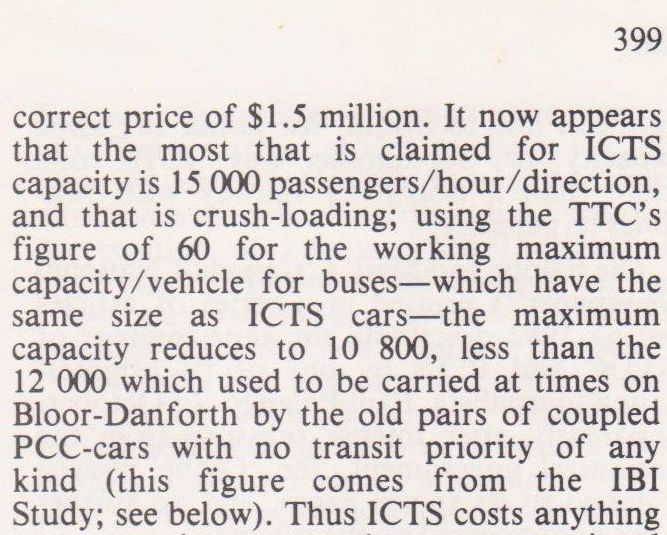
This also points to the City of Vancouver’s bogus claim that an at-grade LRT could only manage slightly more than 7,000 pphpd on Broadway, despite the fact that coupled sets of PCC cars were moving an excess of 12,000 pphpd, on the Toronto’s Bloor/Danforth line, in the late 1040’s!
An excerpt from Modern Tramways in 1983.
So, has TransLink, again, been caught selling “Porkies”.
Is this the reason the Millennium Line can only operate two car trains is because it cannot operate four car trains because it was not designed to operate four car trains from the start?
This could also explain BC’s Attorney General, David Eby’s reluctance to pursue any sort of investigation of TransLink and why due diligence of transit projects is no longer practice by the province and Metro Vancouver.
Where is the mainstream media? Hiding in a corner, afraid to tackle real issues, it seems!
This upgrade program also shows that there is not the ridership potential on the Broadway to justify a subway, even after the upgrade.
What is being hidden from the public is the simple fact a modern, at-grade LRT/tram could easily handle the projected traffic flows which the Millennium Line subway to UBC can handle, but also handle increased traffic flows at a far cheaper cost than the current, full build $8 billion Broadway/UBC, with a limited capacity of a mere 7,500 pphpd – afterupgrade!
More and more, the evidence is adding up that TransLink aand the chief benificarry of the Broadway subwaym the city of Vancouver, has not been honest with the public, more and more, there is a need for a judicial inquiry into TransLink and current transit planning, yet premier John Horgan and Attorney General David Eby remain deaf for such an inquiry.
Malcolm Johnston, local transit advocate and long time thorn in the side of TransLink, is offering his views of the pre civic election hype regarding the oten announced Massey Tunnel replacement.
The one issue that puzzles Zwei is the idea that a bridge will carry more traffic than a tunnel, if both have equal traffic lanes, the carrying capacity of both would be the same.
That politicians are selling the idea that the new tunnel will solve local transit issues, which is tantamount of gifting the public with false information because despite the new tunnel extra lanes and increased capacity, the Oak and Knight Street bridges will still only offer the same four lanes northbound and four lanes southbound. Steveston and New Westminster Hwy’s will still have only two lanes in each direction and are gridlocked (as Zwei found out recently) in peak hours.
The problem with bus service is that customers want their direct bus service back to Vancouver and not to be forcibly transferred to the Canada Line in a very inconvenient way.
So this begs the question, asked in the letter from Mr. Johnston:
Where is the extra traffic going to go?
Letters: Hype and hoopla about nothing
The fake news and the alternative facts concerning the bridge or tunnel constantly spewed by the BC Liberals, the NDP and local mayors is breathtaking
Letter to the editor Mar 24, 2022 7:00 PM
Editor:
The hype and hoopla with the re-announcement of a new tunnel, replacing the perfectly good Massey Tunnel, shows a complete failure in regional transportation planning and a complete omission of any thought to Global Warming.
The Massey Tunnel replacement was a BC Liberal initiative, to build a bridge to replace the current tunnel, thus allowing Cape Max. tankers and colliers to Surrey Docks to load dirty Montana coal and Braken oil, transported by the BN&SF Railway, saving wheelage charges paid, for using BC Rail’s Delta Supper Port line.
The fake news and the alternative facts concerning the bridge or tunnel constantly spewed by the BC Liberals, the NDP and local mayors is breathtaking
What will a $4 billion tunnel do? Create more congestion and more gridlock
Any time savings made will soon be lost as more traffic will use Highway 99 and with Richmond roads now gridlocked in peak hours and no new crossing servicing North of the Fraser, will turn this major highway into a $4 billion parking lot.
Studies show that increasing a highway’s capacity in urban areas, generates more traffic, leading to continued congestion and gridlock.
Contrary to the “pork pies” being sold by MLA’s and mayors, no rapid transit will ever use the new bridge or tunnel.
The Canada Line will not be expanded and Bus Rapid Transit or BRT is nothing more than a political gimmick, to build more highways.
Global warming; the heat dome; and last November’s destructive monsoon, sent a blunt message to our politicians that we must change and sadly the message has fallen on deaf ears. Our elected officials, still believing that higher taxes will cure global warming, continue with good old BC “black top politicas” and Translink is still planning for obsolete, 1980 transit solutions for 2022.
This witch’s brew of rubber on asphalt planning will lead the region to a financial & transportation fiasco within the next decade.
Malcolm Johnston
followed by…….
Letters: If you have a better solution, let’s hear it
The reality that opening the new tunnel in 2025 (I think) will cause gridlock somewhere else on the #99 raises another issue
Letter to the editor Mar 31,
Editor:
Re: Hype and Hoopla about Nothing – letter from Malcolm Johnston (online, March 24).
Mr. Johnston appears to be making the point that the replacement of the Massey Tunnel with more lanes of traffic will simply cause even more gridlock elsewhere along the #99.
I can’t be sure, but that seems to be the purpose of his letter.
I have always thought that any expansion project is meant to cater for suppressed demand, or forecast demand if the planners get it right. When a new wing is built on a hospital, it usually fills up very quickly. Is this because more people are getting sick? Probably not. More likely, some of the population has not been able to receive the hospitalization they deserve quickly enough until the extension is commissioned. Does the fact that the extension fills up so quickly mean that it shouldn’t have been built? Not at all.
The same with any arterial road expansion. The planners know there is suppressed demand and future demand waiting for the expansion. The fact that it attracts a whole lot of additional traffic is proof of this, and, I must say, justifies the expansion project very quickly. I’m sure the new Massey Tunnel will be a case in point.
The reality that opening the new tunnel in 2025 (I think) will cause gridlock somewhere else on the #99 raises another issue. No expansion project can keep lockstep pace with increasing demand. Projects by their nature are “lumpy” and not perfectly incremental, so the planners have to go with the expansion project that will bring the most public convenience per dollar, and then keep planning the next expansion accordingly.
If Mr. Johnston knows of a way to expand arterial roads incrementally according to incremental demand, he should let the Roads Department know right away instead of writing letters about “black top politicas” and fake “fake news”.
Chris Stanton
A printed rebuttal
Editor:
Letters: Playing a fool’s game
The daily congestion at the Massey Tunnel, should have been a win for TransLink
Letter to the editor
Mr. Stanton’s letter, replying to my letter (which appeared on-line last week), seeks an answer.
The simple belief, adding more road-space will solve congestion, is a fool’s game as it will just attract more vehicles, creating greater congestion and gridlock at choke points.
The gridlock on Highway 1 from the North Shore to Abbotsford, during peak hours, is daily proof that adding more road-space does not cure congestion.
The failure of TransLink and the Mayor’s Council on Transit, to provide user-friendly transit for South of the Fraser, is more than an embarrassment, it is a show of incompetence. The empty buses now plying city streets are alarm bells no one is listening to.
The daily congestion at the Massey Tunnel, should have been a win for TransLink to provide a successful user-friendly transit service, but TransLink is not up to the task and taking the car is the only real solution.
All TransLink seems capable of is planning for stale, dated 1970 transit solutions for 2022 and beyond. Multi-billion dollar light metro schemes are being built for land speculation and land development, rather than providing a good public transit alternative.
With ample fake news and alternative facts, to hide current incompetence, politicians play the good old “rubber on asphalt” political game, building more roads, bigger bridges and tunnels for more cars, creating more pollution, at a critical time that we are supposed to be reducing greenhouse gasses.
The sad fact is, gridlock is good for reducing pollution, as it should force the government to look at other solutions, but in B.C., that is not happening as both the NDP and Liberal governments seem to do the same thing over and over again, ever hoping for different results








People wait to board the 301 Brighouse bunch to Richmond at Newton Exchange on Friday, March 20, 2020. (File photo: Lauren Collins)






Recent Comments