Another View on the High Cost of Expensive Grade Separated Infrastructure
The following post comes from the LRPPro Transit blog and the comments from Herr Wolfgang are extremely pertinent to the situation evolving with Metro Vancouver’s light metro network. Simply, no one; not oneAi??politicianAi??or current transit planner has factored in the high cost of maintenance that will be needed in the coming years for SkyTrain’s and the Canada Line’s deteriorating grade-separated infrastructure.
Subways are extremely expensive to maintain as water seepage does great damage over time and the scouring effect of the dust and debris inside a subway are propelled piston like with each passing train through the tunnelAi??which acts as a sandblaster requiringAi??regular costlyAi??maintenance.
SkyTrain’s cement viaductsAi??are alsoAi??showingAi?? their age with signs of flaking, which in time will lead to more serious problems in the near future, especiallyAi??with the corrosive coastal atmosphere.
There are persistent rumours that over $1 billion dollars must be spent to upgrade justAi??the SkyTrain viaducts in the next 20 years and experience from overseas shows that the subway tunnels will also need expensive renovations, much sooner rather than later.
What all this means is that TransLink must find the money, not just to keep the transit system in operation, but must find more money to keep the present infrastructure in good repair.
What all this indicates is that the SkyTrain and the Canada line are ticking financial time-bombs, which regional taxpayers must ante up more and more tax money to keep TransLink’s financial fiasco from exploding.
Me thinks the South of the Fraser municipalities should seriously think of saying adiA?s to TransLink and go it alone, with much cheaper to build and much cheaper to maintain light rail. TransLink’s financial time bomb is tickingAi??louder andAi??louder!

> Most light-metro systems today were designed in the late 60’s and
> 70’s, to fill a gap between what a non articulated tram or streetcar
> could carry and that of a heavy-rail metro. To add extra panache,
> most new light metro systems were driverless, so the claim of cheaper
> operating costs could help sales. Then the light rail Renaissance
> happened, with new designed articulated LRV’s and the concept of the
> reserved rights-of-way, which meant that at-grade LRT could provide
> the same quality of service as a much more expensive grade-separated
> light-metro at a far cheaper cost. Revenue operation of light metro
> also demonstrated that automated transit systems also cost more to
> operate than LRT. Modern light-rail, with its cheaper construction
> costs and cheaper operating costs, made light-metro obsolete.One thing that struck me with public infrastructure projects is that
the overbloated cost of certain projects is often even exploited for
image promotion by political careerists:“Look at all the good we are doing: We are investing ($XYZ) monies into
public transportation in the next (N) years!”In a book about the construction of the subway in Munich, the director
(long retired, probably deceased by now) of the municipal agency which
was specifically set up for this project openly cited the extreme cost
of tunnels as an actual *benefit* (!) of the project for political
decision makers and as *the* reason to chose a “heavy rail” subway.Cheaper solutions, such as the building of short tunnels on selected
“choke points” of the streetcar network, as recommended by technical
experts at that time, would have offered less opportunities for the
politicsters to make their mark. And since something like 90% of the
construction cost was financed with federal and state subsidies
anyway, they had no reason to care for cost efficiency.< prayer wheel>
The point that everyone deliberately chose to ignore back then was that
all that shining, brandnew infrastructure needs to be maintained, even
though initially it came nearly for free for the municipality. To
camouflage this in the accounts, the infrastructure was symbolically
evaluated at just 1 DM. Result: No asset depreciation had to be “put
aside” from the revenue, faking better cost recovery. But obviously,
asset depreciation originally was made legally mandatory not without a
reason. To cater for maintenance cost. Which cannot be financed now.
Which would have been obvious from the start, if it had not been
deliberately camouflaged by accounting fraud. Oops. Remind me, what were
rules meant to be good for?< /prayer wheel>
> Sadly the LRT Renaissance has not reached the USA as many new LRT
> lines (Seattle) are nothing more than very expensive mini-metros in
> drag. I feel, many new so-called LRT lines in the USA are both badly
> planned and heavily gold plated. Thus for many transit projects the
> cost for LRT is almost the same as a light metro! This ‘metro’ creep
> planning has made LRT almost unsellable and has given rise to BRT! A
> simple 17 km streetcar/LRT line in Victoria BC, is said to cost
> almost $950 million! This is utterly ridiculous, but the outfit hired
> to cost out LRT for Victoria, used costs from Seattle and other
> gold-plated American schemes. “Metro’ creep has affected the ability
> to build LRT across the boarder in Canada! It is safe to say that in
> the USA transit planning is 25 years behind Europe and instead from
> learning from success overseas, many planners are blundering ahead
> with extremely dated and very expensive light rail plans which in
> reality resemble light metro, especially with the costs. I know all
> the excuses on this side of the pond about modern LRT, but things
> have changed and if the effort was made to introduce real European
> LRT/tramway, I think we will win the transit wars; but if we continue
> to build hugely expensive hybrid metro type systems, the door will be
> wide open to all sorts of gadgetbanen and bus based transit systems
> that will do little in reducing traffic congestion and gridlock, but
> are wonderful in increasing taxesI remember reading an article a long time ago about a comparison between
the LRT systems at Edmonton and Calgary. The article concluded that
since Edmonton chose to build their system with complete grade
separation which required lots of tunneling, cost became prohibitive
and the whole “system” essentially remained a torso. Whereas in Calgary,
infrastructure cost was kept much lower by building lines without
complete grade separation, which allowed implementation of a more
extensive network, yielding much higher ridership and better cost
recovery.Judging from Wikipedia, it seems that Calgary has now switched to
planning expensive tunnels as well, at least partially… 🙁Sincerely,
W…….
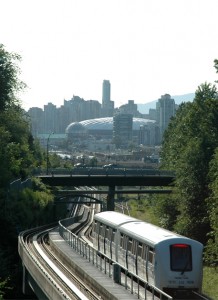 Is the aging SkyTrain a ticking financial time-bomb?