Light Rail & Tramways Growth Continues With new Openings in 2010
From May’s issue ofAi??Ai??Tramway’s & Urban Transit comes a list of new LRT openings in 2010, almost one every six weeks. The following is a partial list of new LRT/tram and TramTrain systems.
It is interesting to note the increase of TramTrain expansion, both in Europe and in North America. Also, when compared to metro construction at about $150 million/km to $200 million/km, we can effectively build a complete LRT on Broadway for about the same cost of 3 km. of subway.

Firenze Italy: 14 February 2010
Route 1
Cost: A?ai??sAi??170mil. (CAD $228.02 mil.)
Length: 7.4 km
Vehicles: 17 LRV’s
Cost per km: $30.8 mil/km.

Austin Texas, 22 March 2010
Rail for the Valley Take Note
Route: 1
Cost: USD $300Ai??Ai??mil.Ai??Ai??(CAD $302 MIL.)
Length: 51km
Vehicles: 6 TramTrains
Cost per km: $6 mil/km.

Bergen Norway, 22 June 2010
Route: 1
Cost: A?ai??sAi??274 million (CADAi??Ai??$368.25 mil.)
Length: 9.8 km.
Vehicles: 12 LRV’s – 5 TramTrain
Cost per km: CAD $37.58 mil/km.

Mulhouse,Ai??Ai??13 December Ai??Ai??2010
Route: 1
Cost : A?ai??sAi??137 mil. (CAD $184.5 mil.)
Length: 24 km.
Vehicles: 12 TramTrains
Cost per km: CAD $7.7 million/km
The Broadway Follies – TransLink does the Gong Show
Here we go again, TransLink’s famous planning exercises that in the end will please no one and achieve very little. There is no bold ‘grand plan’ but more of the same, a little BRT here; a little SkyTrain there, with a hint of LRT thrown in to keep the trolley-jolly types happy. With all the information available today, with all the examples of modern LRT, TransLink goes back to its dated and questionable planning practices which are a blend of distortions and misinformation.
The present six alternatives, save for one, are expensive and unworkable and begs the question: “Does TransLink have the revenue streams to fund any of them?”
The one alternative, the sixth and last, the Best Bus Alternative is probably theAi??Ai??only doableAi??Ai??option, which then poses the question: “Why waste the publics time with five expansive and unworkable transit solutions?”
The Light Rail Committee’s 1990’s plan, the BCIT to UBC and Stanley Park LRT is simply a much superior plan, which had a vision for Vancouver’s transit needs for the next half century. Alas, notAi??Ai??in Vancouver, where tunnel vision, subway tunnel’s that is, still rules how TransLink bureaucrats still plan for transit.
If TransLink is to have any credibility, it must ‘think out of the box’, they have not and what they present as transit planning is the ‘same old song and dance’, with TransLink’s patented ‘dog and pony show’. Transit customers and regionalAi??Ai??taxpayers deserve better.
The following are the six transit alternatives presented by TransLink.
Ai??
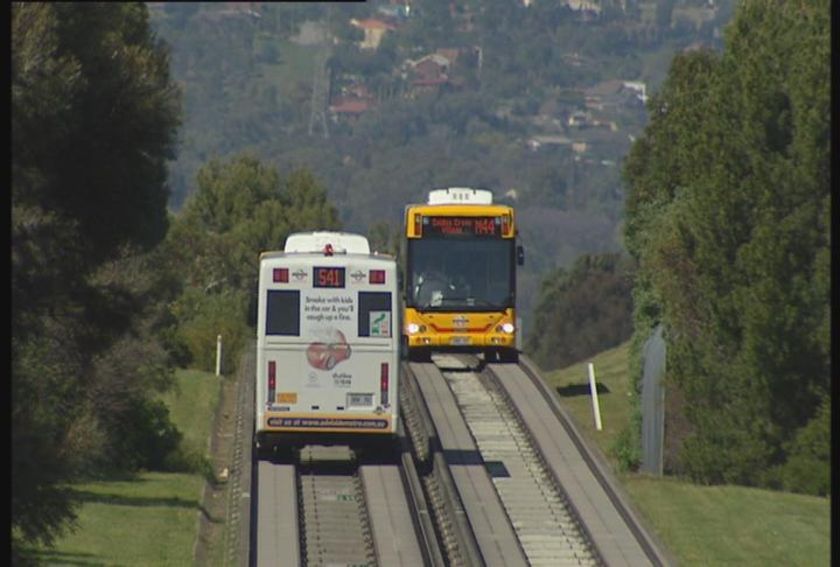
BRT Alternative
Buses are not ‘rapid transit’ as the definition for ‘rapid transit’ isAi??Ai??a heavy-rail metro installation. BRT in North America is really express buses or buses operating on a busway. For buses to truly compete against ‘rail‘ they must be guided, either kerb guided orAi??Ai??rail guided (optical guidanceAi??Ai??has been proven far tooAi??Ai??troublesome), which requires a ‘reserved rights of ways‘ or a route used exclusively by transit. Guided bus has proven to be a third less costly to build than light rail, but has proven disappointing in operation, by not attracting new ridership. For many a bus, is a bus and perceived as a second rate transit mode and remain taking their cars.
BRT, if built, would prove only slightly cheaper to build than LRT, with none of the operating benefits.
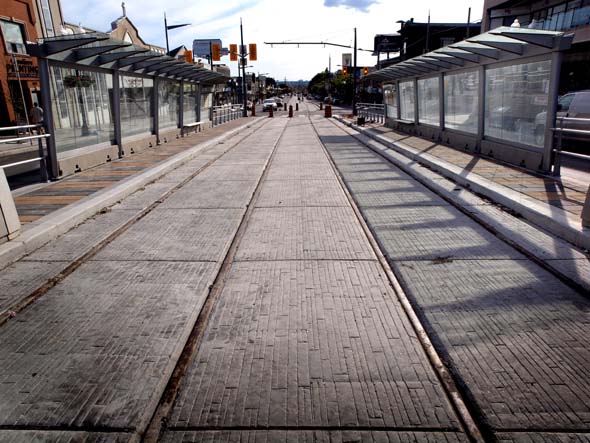
LRT Alternative 1
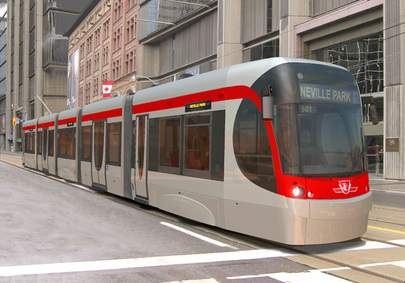
Like BRT, LRT is by definition not ‘rapid transit’, but is light rail a separate ‘rail’ mode built to solve different transportation problems. What makes LRT different from a streetcar is the concept of a ‘reserved rights-of-ways’ (RRoW’s), where the streetcar operates on an exclusive route free from traffic, add in preemptive signaling at intersections andAi??Ai??LRT operation can rival its much more expensive cousin heavy-rail metro, in operation. Modern LRT has all made light-metro such a as VAL and our SkyTrain obsolete.
Clearly,Ai??Ai?? TransLink has only dusted off BC Transit’s Broadway Lougheed ‘rapid transit’ planning from the early 90’s and cobbled together this loser. No thought has been made to provide a customer friendly transit service and again TransLink planners prove that they plan for LRT as a ‘poor man’s’ SkyTrain.
Ai??
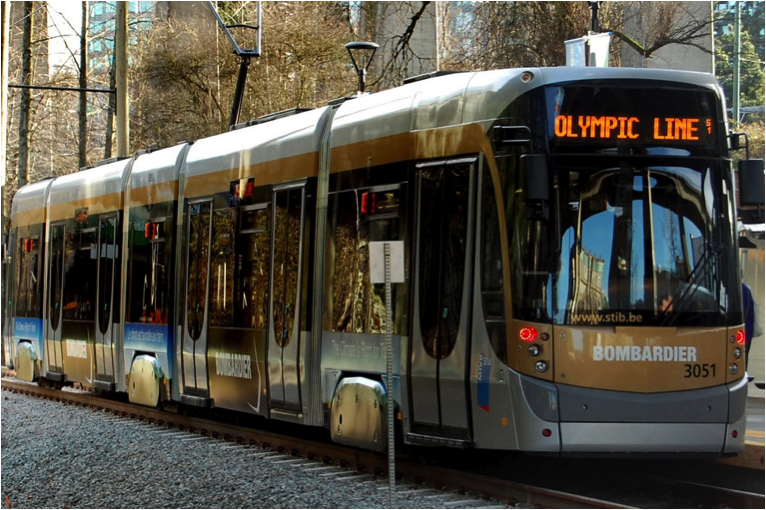
LRT Alternative 2
The second LRT alternative, feeding a second line to the Olympic Line, seems to have been planned on a back of an envelope to take advantage of the recent success of the now closed Olympic Line. Another daft TransLink plan.
Ai??Ai??
Ai??Ai??
Ai??Ai??
Ai??Ai??
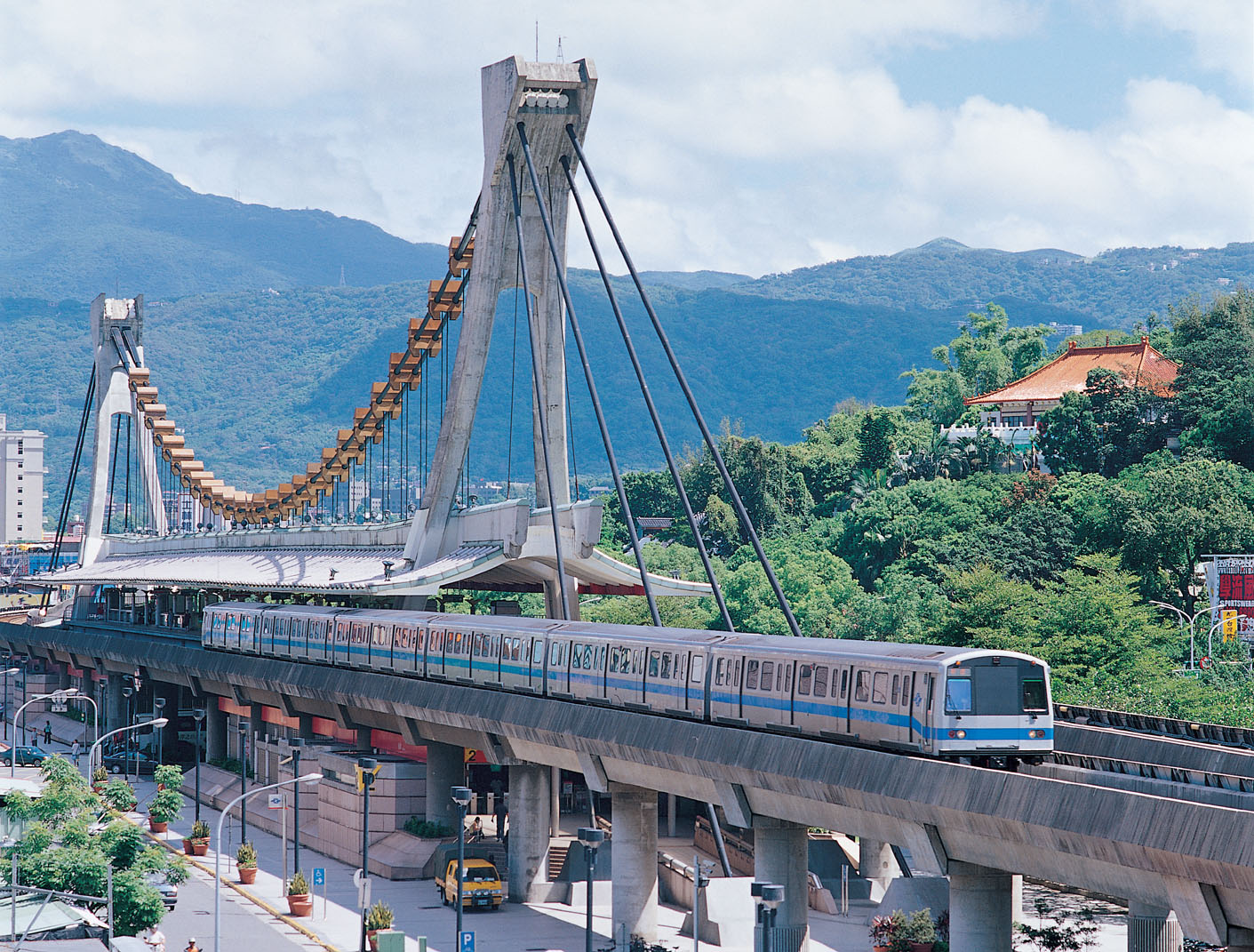 RRT Alternative
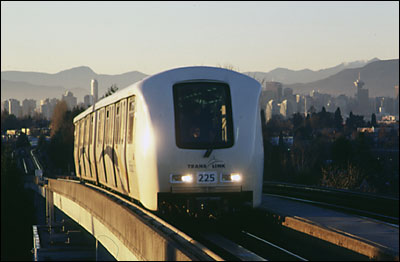
It seems that TransLink is scared by the term subway or metro and use the very strange term Rapid Rail Transit, more to confuse people than anything else. The name is to infer that it is fast and for TransLink, the speed of a transit line is their mantra. But the higher speed from a metro comes from grade separation and fewer stations, which means an expensive ‘shadow’ bus operation to try to feed the metro. Metros are very expensive to build and are not very good in attracting new ridership and guess what, SkyTrain is a metro, yet has seemed very poor in attracting the motorist from the car. Strange to, that SkyTrain was first conceived to be elevated to mitigate the massive cost of subway construction.
Rail Rapid Transit or metro is only built if ridership demand (15,000 pphpd or more) warrant the huge expenditures required to build and operate the mode.
 Combo Alternative
This is truly bizarre and it seems TransLink is trying to please Bombardier, by having a ‘rail‘ option for both theirAi??Ai??LRT/tram line of vehicles and SkyTrain. Really, what has been proven over and over again is that transfers deter ridership, yet TransLink loves to force transfers on transit customers. This option is expensive and extremely poorly thought out.
Ai??Ai??
Ai??Ai??
Ai??Ai??
Best Bus Alternative
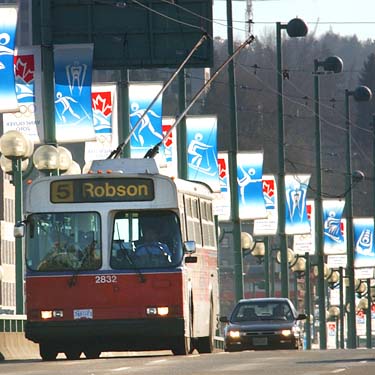
It wouldAi??Ai??save TransLink a lot of grief and money by promoting an European style of bus service with stops every 400m to 500m,Ai??Ai?? with faster commercial speedsAi??Ai??and better productivity. The Best Bus is well past its ‘Best By’ date but probably will be the winning option due to TransLink horrendous financial problems.
Parry People Movers For Granville Island?
Ai??Ai??Granville Island was once a large industrial site, serviced with rail and when Granville Island was commercialized in the 1970’s the tracks were left in situ, with a promise of a (at the time) funky horse drawn tram. The tram service did not materialize, but the tracks and switches remain. With very little capital outlay, compared with other transit projects on the drawing board, it is not beyond imagination for a local Parry People Mover tram service to operate on the island, which would be a great benefit for island mobility and tourist fun , as wellAi??Ai?? it does rain in Vancouver and having a tram service would be a benefit.
The Parry people Mover is powered by a flywheel energy storage, allowing electric tramway systems without overhead wires and railcars powered by small prime movers running on gas, diesel or hydrogen – all with very high energy efficiency and very low emissions ofAi??Ai??pollutants and noise. This allows for small vehicles to operate in locals where larger, more expensive Ai??Ai??rail vehicles cannot.
What the Parry People Mover does show,Ai??Ai??is that there is a light rail solution for almost every transportation need and maybe the powers that be should investigate a PPM tram serviceAi??Ai??for Granville Island.

A Parry People Mover in an urban setting
Ai??
Ai??
Ai??
Railcar success
From Railfuture
http://www.railfuture.org.uk/tiki-page.php?pageName=RailFuture
The A?ai??i??Ai??brilliant tram-style serviceA?ai??i??A? connecting Stourbridge Town and Stourbridge Junction won praise last week from Transport Secretary Lord Adonis.
Ai??
During a pre-election political visit to Stourbridge on 13 April, Lord Adonis undertook a personal inspection of the new light-weight railcar service which operates under the London Midland rail franchise.Ai??Ai?? He also visited the maintenance depot.Ai??He was full of praise for what had been achieved by the local engineers who had designed and built the railcars, JPM Parry & Associates of Cradley Heath.
Ai??
Lord Adonis told reporters that the Parry People Movers railcars A?ai??i??ai??? which have been running since May 2009 A?ai??i??ai??? could offer new opportunities for the UK transport authorities and also had good export potential.
Ai??
He took a return trip on the branch line on board one of the railcars and was given evidence of the operationA?ai??i??ai???s environmental, engineering and service achievements.
Ai??
The Parry People Movers railcars use less than one-third of the fuel required by the former heavy railcars and give similar reductions in carbon dioxide emissions.They are providing Stourbridge Town with its best-ever rail service A?ai??i??ai??? a 50 per cent increase in frequency on weekdays and Saturdays with a regular 10-minute interval service in each direction, where previously it ran at irregular intervals around four times per hour.
They give a journey time two to three times quicker than the bus using local roads.
They have reduced the cost of the branch line operation to less than half that incurred running conventional heavy rolling stock.
The railcars are low noise, low emission and provide good access for passengers in wheelchairs, or with luggage and buggies, by having a floor height level with the station platform.
They have equalled the highest performance elsewhere on the rail network, operating over 99.5 per cent of scheduled services in intense shuttle operation.
Ai??
Lord Adonis was told similar light-weight railcars had potential for expanding the railway A?ai??i??ai??? introducing new services on lines not currently open to passengers.
Ai??
John Parry, chairman of the company which makes the railcars, said: A?ai??i??Ai??We are delighted that the Secretary of State has shown such interest in our light-weight railcars in their first full-service operation.Ai??A?ai??i??Ai??We hope that he and his opposite numbers in other parties will see how the combined economic and environmental benefits of this technology could bring about a new era for local rail services, bringing attractive transport links to many more communities and providing them with easy access to mainline trains so more people can move from road to rail transport.A?ai??i??A?
Ai??
Parry People Movers Ltd was founded in 1991 to develop rail transport based on the flywheel energy store, which allows vehicles to run extremely efficiently and to recapture their braking energy for re-use when accelerating.Ai??PPML’s rail vehicles offer the quality of modern light rail transport without the need for electrical power supply, giving excellent environmental performance and energy efficiency at lower costs than conventional technology.Ai??
PPML technology can be used on both railways and on urban tramways.Ai??
Information from Parry People Movers Limited, Overend Road, Cradley Heath, West Midlands B64 7DDA?ai??i??A?Telephone: +44 (0)1384 569553 ,Fax: +44 (0)1384 637753A?ai??i??A?E-mail: info@parrypeoplemovers.com
Website: www.parrypeoplemovers.com
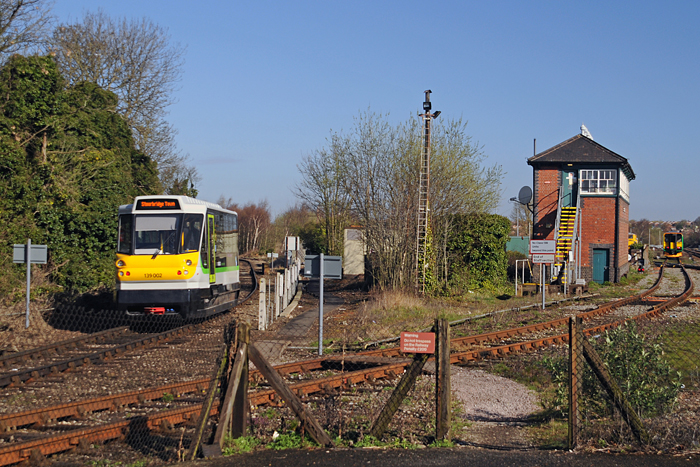
A Parry People Mover on the Stourbridge branch.
Transit Agency Approves Cuts, and More Bad News Looms – From the New York Times
It seems that New York’s Metropolitan Transportation Authority is in dire fancial straights, just like our TransLink. What should not be forgotten is that even though New York has a vast subway system and massive daily ridership, mainteneace cost for that subway are massive and contributing to their finacial plight.
For those preaching a subway solution as the only transit solution for Broadway, maybe leaving a financial time bomb for future generations if the subway doesn’t carry the ridership that justifies subway construction. If a SkyTrain subway is built under Broadway, watch for the elimination of the U-Pass andAi??Ai??the introduction of aAi??Ai??$5.00Ai??Ai??one zoneAi??Ai??ticket and those will be the least of both transit customers and Vancouver taxpayer’s worries.
Transit Agency Approves Cuts, and More Bad News Looms
By MICHAEL M. GRYNBAUM
Published: March 24, 2010
The Metropolitan Transportation Authority formally approved on Wednesday a slate of severe service cuts that will eliminate two subway lines and dozens of bus routes in the city and create longer, more-crowded trips for the regionA?ai??i??ai???s transit riders.
The cuts, which will help close a budget gap of about $400 million, will not go into effect until June, but discussions have already begun about how the board will address an anticipated budget deficit of nearly another $400 million. And there is a growing, if reluctant, consensus that higher fares and tolls will be necessary; the only question is when and by how much.
A 7.5 percent fare increase is scheduled for next year. Agency officials have calculated how much revenue could be gained from various fare and toll structures, according to people familiar with the discussions. The topic has come up in private conversations between Jay H. Walder, the authorityA?ai??i??ai???s chairman, and friends and colleagues.
And the question has arisen whether an even bigger increase would be preferable to losing yet more service.
Mr. Walder has repeatedly said that he does not want to raise fares this year, and people familiar with his thinking say that he is determined to keep that pledge.
Asked on Wednesday if next yearA?ai??i??ai???s increase might be larger than 7.5 percent, Mr. Walder said only that the authority would consider the specifics of the next increase later this year.
A?ai??i??Ai??The first priority right now is on reducing our costs,A?ai??i??A? he said.
With little possibility of a state bailout, however, the authorityA?ai??i??ai???s options are limited.
The cuts approved on Wednesday, which prompted a widespread outcry from riders, will save the authority about $93 million.
The authority has cut administrative costs by 15 percent and laid off hundreds of station agents, and Mr. Walder said on Wednesday that it was renegotiating contracts with its suppliers and trying to drive down labor costs.
The authority still plans to eliminate discounted fares for students, which would save $214 million, but that proposal was not considered by the board on Wednesday, adding to the sense that the worst was yet to come.
The authorityA?ai??i??ai???s only path toward generating significant revenue is a fare increase. Longtime transit planners believe that an increase of 10 to 12 percent A?ai??i??ai??? which would raise the base fare to about $2.50 A?ai??i??ai??? might be necessary to make up the gap. (Several have shared those thoughts with the chairman.)
A?ai??i??Ai??ThereA?ai??i??ai???s definitely going to be a fare increase; now the question is will it be enough?A?ai??i??A? said Allen Cappelli, a board member. A?ai??i??Ai??Probably not.A?ai??i??A? He said that the board had not yet discussed the prospect of a bigger increase.
With discounts for multiple-ride MetroCards, the average fare paid by a subway rider was $1.47 in January, far less than the $2.25 base fare and 8 cents higher than the average ride in 1996.
A?ai??i??Ai??Based on a comparison of New York City to other major urban areas, thereA?ai??i??ai???s clearly elasticity in the fares,A?ai??i??A? said Kathryn S. Wylde, chief executive of the Partnership for New York City, a business group that Mr. Walder meets with regularly. A?ai??i??Ai??Fares could go up without losing ridership,A?ai??i??A? she added.
The 7.5 percent fare increase approved for next year was part of an attempt to create a regular pattern of increases for the New York City system that would roughly follow inflation, similar to a system in London, where Mr. Walder worked previously.
There was a growing sense among officials on Wednesday that straphangers would be facing more pain in coming months.
At a news conference, Mayor Michael R. Bloomberg warned New Yorkers to A?ai??i??Ai??save your angerA?ai??i??A? for the authorityA?ai??i??ai???s next set of cuts. A?ai??i??Ai??This is just the beginning,A?ai??i??A? the mayor said. A?ai??i??Ai??The next round, I would think, would be much worse.A?ai??i??A?
Under the plan approved on Wednesday, the V and W trains will be eliminated and the M line will no longer run in Lower Manhattan and parts of Brooklyn. Bus riders will lose 34 routes, including 13 express ones. Several other bus lines will be truncated or rerouted.
The Long Island Rail Road will reduce service on several lines, and eliminate overnight service between its Atlantic Avenue terminal and Jamaica. Trains on the Port Washington line will run every hour, instead of every 30 minutes, except during rush hours.
Metro-North Railroad will eliminate a handful of trains.
A?ai??i??Ai??The only thing I fear more than the vote I have to cast today,A?ai??i??A? John Banks, another board member, said on Wednesday, A?ai??i??Ai??is the vote IA?ai??i??ai???m going to be asked to cast in the near future.A?ai??i??A?

Clean, affordable light rail also delivers economic lift

Brussels' light rail system uses Bombardier equipment on segregated lanes. Greg Gormick argues that light rail transit lines in Europe and the United States have revived cities and reducted pollution and traffic congestion.
From the Star.com
Clean, affordable light rail also delivers economic lift
Critics of Toronto’s Transit City plan ignore the evidence in many European cities
Greg Gormick
In the ideal world, an informed public debate over the TTC’s $10 billion Transit City light rail transit (LRT) plan would hone it into a scheme fully responsive to the needs of transit users and residents who live along the line.
Instead, Transit City is being lambasted by a cadre of critics who hope to derail it, but without really knowing anything about LRT.
To be fair, the various parties involved in Transit City have done a deplorable job explaining LRT to the plan’s opponents.
As a result, the average Torontonian has no idea of social, environmental and economic benefits of this cost-effective form of rail transit.
In the Toronto context, the first thing that needs to be understood is that LRT and streetcars are not the same beasts. They are related, but there are massive differences between these two approaches to urban transportation.
LRT is a postwar European development that grew out of the conventional streetcar. As Western Europe got back on its feet after World War II, rising car ownership gradually chewed into transit ridership. Some cities followed the North American example and abandoned their streetcars. But many others embarked on evolutionary programs to build on the streetcar’s strength as an intermediate-capacity technology filling the gap between high-capacity subways and lower-capacity buses.
The result was a series of technological and operational advances that included:
- Larger and faster rolling stock with higher capacity and labour productivity.
- Better track to provide a smoother and quieter ride.
- Wider spacing of stations or car stops, leading to reduced travel times.
- Innovative fare collection systems for faster passenger loading and unloading.
- Pre-emptive, transit-priority signalling at intersections.
- Separated rights-of-way to minimize conflicts with automobiles.
But European LRT also involved much more than just tracks and rolling stock. There, urban planners embraced the concept of transit-oriented land-use development, using fast, frequent and convenient rail transit services as a means of controlling outer suburban development and making the inner cities more accessible, vibrant and appealing.
European cities also used LRT as an opportunity to totally re-engineer and improve their streets for all users under a concept known as lateral segregation. Each user A?ai??i??ai??? transit rider, motorist, cyclist and pedestrian A?ai??i??ai??? is assigned a portion of a street and each is segregated from the other in order to accommodate their varying requirements. Every element of the street is re-engineered accordingly: traffic lanes, parking, taxi stands, traffic management systems, cycling lanes, sidewalks, street lighting and all aspects of the A?ai??i??Ai??street furniture.A?ai??i??A?
The total effect is one of calming the street while also invigorating it economically and socially. LRT now plays a major role in both large and medium-sized European cities. More than 30 cities that abandoned their streetcars A?ai??i??ai??? including Paris, London and Barcelona A?ai??i??ai??? have built new LRT lines since the late 1970s and others are hopping aboard.
The success of European LRT was not lost on planners and politicians in some North American cities that abandoned their traditional streetcar systems and paid the price for it in traffic gridlock, unacceptable levels of air pollution and rampant suburban sprawl. In 1978, Edmonton inaugurated North America’s first all-new LRT with service-proven German equipment and designs. The LRT concept has spread to 22 other North American cities and more than 30 additional systems are now under construction or in planning.
When properly implemented A?ai??i??ai??? as it has been in cities as diverse as Dallas, San Diego and Portland, Ore., A?ai??i??ai??? LRT has delivered exactly what its advocates predicted. It has sparked a transit revival, luring commuters out of their cars and reducing emissions. It has acted as an economic catalyst, encouraging compact, transit-oriented development. And it has revived deteriorated residential and commercial neighbourhoods, generating considerable on-street activity and boosting property values.
To believe that the opposite will be the result with LRT on streets such as Sheppard, Eglinton and Finch flies in the face of worldwide experience. These main thoroughfares are probably better suited to LRT than many of those in U.S. cities, where it has proved its value as a fast, clean and affordable form of transit that boosts livability.
Some Torontonians maintain that we should be building subways instead of LRT. But subways cost about four times as much per kilometre and they are financially sustainable only where there are huge volumes of passengers ready to ride them on opening day. That is not the case in Toronto on the lines proposed for LRT.
Change is always frightening. But to allow an uninformed fear of the city-changing benefits of LRT to kill Transit City would doom Toronto to more car dependency, congestion, pollution and economic stagnation.
Other cities with which we compete for residents, jobs and investment are embracing LRT as one means to improve their social, environmental and economic attractiveness. Can we afford not to? I think not.
Greg Gormick is the Canadian contributing editor of the rail and transit trade magazine Railway Age. He wrote the TTC’s 2004 consulting report, The Streetcar Renaissance: Its Background and Benefits.
The Livable Blog Talks Broadway Transit
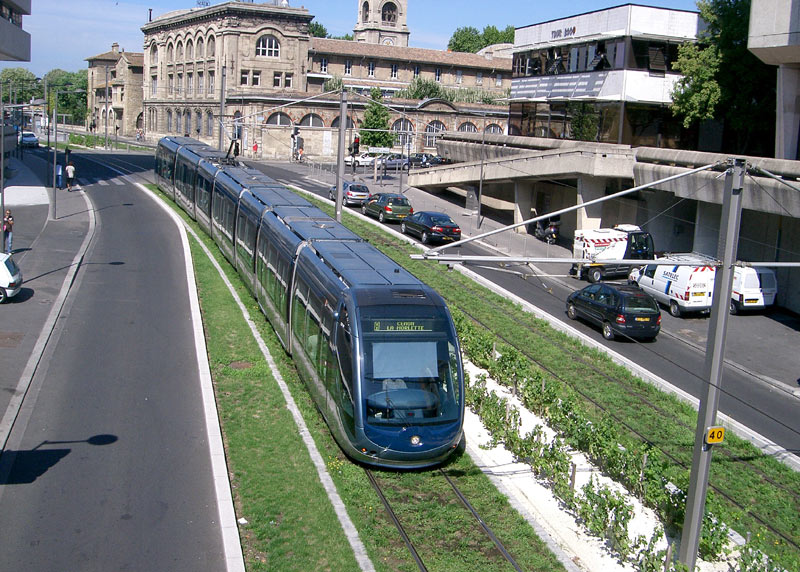
Do our politicians have the foresight to do this on Broadway?
The Livable Blog has an interesting discussion about “rail” transit on Broadway.

Le tram in Grenoble France
Some Sunday Reading – The "Automatic Metro" or AGT Debate – Too Much Bunkum By The AGT Lobby

French transit authorities were the first to extensively lawn LRT RoW's
In various other transit oriented blogs, the myth that automatic operation of trains saves operating costs is perpetuated ad nauseum. Those who try to set the record straight are subjected to a sort of ‘Spanish Inquisition’ and are treated as latter day heretics. What is so Monty Pythonish about this is that back in the 1980’s and early 90’s several papers were published and many studies done comparing LRT to AGT (Automatic Guided Transit), showing that LRT tended to be not only cheaper to build, but cheaper to operate. Only on transit routes with extremely high traffic flows is automatic operation warranted.
It is in France, where the greatest scrutiny of LRT and AGT, has taken place, where the Central government sponsored VAL mini-metro system competed against LRT. At the time, VAL was manufactured by MATRA, a leading French arms manufacturer and the French government felt that if VAL was rejected in favourAi??Ai??of LRT in French cities and towns, it would reflect badly on international arms sales. Behind a background of extremely generous government funding (sound familiar?) for initial VAL installation, scores of studies were done done comparing the two modes. The studiesAi??Ai??tended toAi??Ai??show that LRT was cheaper to build; cheaper to operate; and better able to attract new ridership than AGT. This intense debate over AGT (VAL) heralded an unprecedented expansion of LRT in France, making the country a leader in both modern transit design and operating philosophy.
In North America, trying to promote AGT transit, including SkyTrain, instead of much cheaper LRT is like promoting a Boeing 707, instead of a Boeing 787 DreamLiner.
The following may provide some interesting reading.
http://www.lightrailnow.org/facts/fa_monorail002.htm
http://onlinepubs.trb.org/onlinepubs/tcrp/tcrp_rpt_13-d.pdf
http://www.lightrailnow.org/facts/fa_monorail003.htm
http://pubsindex.trb.org/view.aspx?id=295713
A COMPARISON OF SOME NEW LIGHT RAIL AND AUTOMATED-GUIDEWAY SYSTEMSAbstract:
The past decade has seen dramatic developments in urban rail transit, particularly in the field of light rail transit (LRT). At the same time, several proprietary automated systems have been developed and deployed, often claiming superior levels of service and cost-effectiveness. Data are now becoming available that make it possible to check, for the first time, how well the new automated-guideway transit (AGT) systems are meeting their promoters’ claims, and to compare such systems with the new conventional LRT systems. Methodologies are presented to collect and screen performance data from different systems in a uniform manner, and examples are developed to show how these data can be used to compare modes using actual operating information to the maximum extent. When new AGT systems are compared with new LRT systems, or when AGT and LRT are compared on identical alignments, it appears that the cost of additional maintenance and supervising staff and additional “non-staff” budget may exceed the savings that AGT systems achieve by eliminating operators. Although the new AGT systems represent a further advance in the development of urban transit technological capabilities, and reflect great credit on those who have built and financed them, they may also contain the seeds of future problems. Having a significantly higher construction cost per mile than LRT, urban areas with AGT will tend to have smaller rail networks than equivalent areas selecting LRT. Being proprietary systems in limited use, they may experience future procurement problems, particularly if the promoter goes out of business. Being a contemporary, high-technology product, there is also a high risk of obsolescence in future years.

Integrated transit solutions needed – A Letter in the Chilliwack Progress
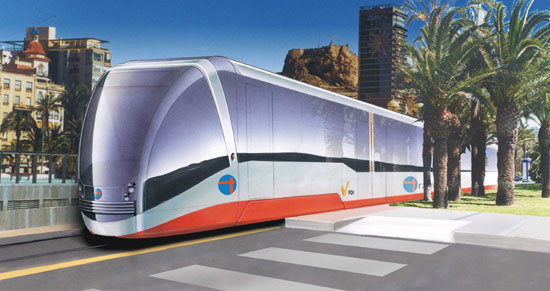
The following is another letter published in the Chilliwack progress supporting a ‘rail’ connection from Chilliwack to Vancouver.
Integrated transit solutions needed
Published: April 13, 2010 12:00 PM
As a student I am concerned about how politicians are not looking towards our future. There is no alternative to getting in and out of cities such as Abbotsford and Chilliwack without the use of a car. This needs to change.
A light rail needs to be added between Chilliwack and Vancouver. Putting in this railway would cost far less than it is costing to widen the Port Mann Bridge, which is seen as a necessity. This railway would provide far more job opportunities for people who either do not have a car, or cannot afford the price of gas. They would be able to get city jobs as it allows easy commuting.
As many people in the past have pointed out, building more roads does not cut down congestion. It does not work now, and it never has. There needs to be an alternate way to get around. By having a railway, not only would it reduce congestion on the roads, it would also drastically reduce pollutants.
Many people nowadays are complaining about the prices of gas. Electric cars may help reduce greenhouse gases, but wonA?ai??i??ai???t help with the road congestion. By installing a railway, gas wouldnA?ai??i??ai???t be needed as much or as often.
There really needs to be a change in the Transit System. This railway from Chilliwack to Vancouver via Abbotsford Airport would offer a real integrated transport solution and politicians need to realize this.
http://www.bclocalnews.com/fraser_valley/theprogress/opinion/letters/90761289.html
From Seattle – A light-rail tunnel is best solution for Bellevue and region – NOT!

I see that the city of Bellevue,Ai??Ai??located directly East ofAi??Ai??Seattle across Lake Washington, wants to put the proposed LRT in a tunnel under the city. ThisAi??Ai??extremely expensiveAi??Ai??bit of transit planning reflects the power of the auto lobby to push public transit underground, thus greatly increasing costs, while at the same time deterring ridership. This blinkered attitude reflects that in North America, the car is king and light rail or LRT is a metro/subway by another name.
What transit planners in Seattle forgets is that LRT operating on a “reserved rights-of-ways” (RRoW) doesn’t have the conflicts with auto traffic as many would have them believe. The very nature of a RRoW prevents interaction with auto traffic except at light controlled intersections. It is the RRoW that has made light metro, such as VAL and SkyTrain/ART obsolete.
A LRT service will be just as predictable and fast as a subway and contrary to the subway/metro crowd, surface LRT is actually safer than subway operation. The claim that there are many accidents on a surface LRT ignores the fact that over twice as many people are killed on SkyTrain (with associated 2 to 3 hour train stoppage) than LRT operations about the same size, such as Calgary!
What is ignored is thatAi??Ai??the vast majorityAi??Ai??of tram/light rail accidents with autos are caused by auto drivers ignoring light and or street signals. The fact is a tram/LRT – car intersection is about ten times safer than a car – car intersection. Also ignored is the high cost of tunnel/subway maintenance and protection, where a recent Seattle transit tunnel incident highlighted the problem of teen gangs taking over the tunnel, fighting, etc.,Ai??Ai??requiring expensive security to be maintained during hours of operation!
Rail for the Valley would think it prudent that transit planners in the Seattle region start looking at cheaper ‘rail’ alternatives such as disused (East Side Line?) or seldom used freight lines with TramTrain service, rather than squander hundreds of millions of dollars on needless, expensive, and prestigiousAi??Ai??subway construction that will ensure limited or no future expansion.
A light-rail tunnel is best solution for Bellevue and region
The city of Bellevue and Sound Transit must keep pressing forward on an agreement to bring light rail into Bellevue, write guest writers Ron Rauch and Sue Baugh. A short tunnel bringing passengers near the transit center is a costlier but better long-term option for the city and the region.
By Ron Rauch and Sue Baugh
Special to The Times
LIGHT rail to the Eastside must serve the heart of downtown Bellevue near the transit center, where the most riders will be. On that much, Bellevue and Sound Transit agree.
It’s down to how we get there: on the surface A?ai??i??ai??? or in a tunnel? Thursday, the Sound Transit Capital Committee will make its recommendation to its board.
Bellevue leaders have coalesced behind a shorter tunnel, known as C9T, under our busy downtown streets. Sound Transit studies say that will serve more riders than a surface route and avoid downtown traffic. But the tunnel is about $300 million beyond the project’s budget, and the agency is asking Bellevue to share in the cost.
The city is currently offering up to $150 million, and can commit that without raising taxes. Sound Transit’s choice is to meet Bellevue’s good-faith efforts on the tunnel or choose a problematic surface route for downtown.
The tunnel is worth it.
Predictable and fast service will draw more riders to the system. The less light rail competes with cars, buses, bikes and pedestrians in limited right of way, the more attractive it becomes.
Our region’s land-use plans put downtown Bellevue at the epicenter of growth on the Eastside. Downtown 2030 targets call for jobs to double to 79,000 and residents to triple to 19,000.
Downtown Bellevue, on less than 2 percent of the city’s land area, can absorb the growth with the right blend of transportation investments. Even then, the traffic forecasts look nasty. We know that half of all commuters in 2020 must come either by bus or by something other than driving alone, or the network will become dysfunctional.
Built to serve this growth, light rail will be a long-term asset for Bellevue and the region. We need to connect the dots, to put stations in the major employment and population centers. That means a link to centers like Seattle and Bellevue with the best possible routing.
Voters backed a light-rail system that would offer easier connections to more places, not one stuck in traffic, causing delays and creating safety risks. A surface route through downtown would cross three major arterials, including Northeast Fourth Street with some 20,000 vehicles per day.
Light-rail systems in other cities traverse downtown streets and serve thousands of riders daily. Each system also bears a record of accidents, mostly minor and some fatal, with other forms of travel. News archives from those cities tell those stories.
However, the crash rate in Bellevue’s growing downtown would be zero with a tunnel.
All told, light rail is a safe mode of travel. But we can’t ignore the odds: Mixing trains with traffic will cause accidents and system delay. Sound Transit and Bellevue have a chance now to avoid both. Just because an at-grade system can work doesn’t mean it’s the best solution.
While there’s no easy way to thread light rail through downtown, the shorter tunnel option is closest to getting it right for the future of our city and region.
Fortunately, Sound Transit rebounded from early missteps on Central Link to win voter confidence for a major expansion. The agency’s leadership today is focused on the best outcome for East Link and the region.
So what is it worth to Sound Transit and Bellevue to provide the safest, most effective light-rail service? The stakes are high as we plan for 2030 and well beyond.
Sound Transit and the city must keep their negotiation alive and reach a deal. If we’re truly buying light rail for our future A?ai??i??ai??? with riders, access and our economy in mind A?ai??i??ai??? the tunnel is the way to go.
Ron Rauch, left, is a shareholder with Clark Nuber, P.S., and current chair for the Bellevue Downtown Association Board of Directors. Sue Baugh is a director with Commerce Real Estate Solutions/Cushman & Wakefield Inc. and chair of the BDA’s Light Rail Committee
UBC SkyTrain Subway Gaining Steam – Is it An Unstoppable Train?

For 1 subway line, one can build many LRT/streetcar lines
One year ago, with Cambie Street merchant’s Susan Heyes lawsuit against TransLink fresh in many peoples minds, any thought of a SkyTrain subway under Broadway was quietly ignored. Now, with TransLink teetering on the brink of bankruptcy, Vancouver’s political bloggists and mainstream media are gung-ho promoting a SkyTrain subwayAi??Ai??under Broadway to UBC.
The tired old clichA?Ai??’s, that helped toAi??Ai??sell the Expo, Millennium, and Canada Lines to the public are trotted out as transit fact, while light rail is so belittled, one wonders why anyone would build with it. In recent weeks, radio commentators openly questioned ridership data for the Evergreen Line and intimated that it was not worth the investment, while a UBC SkyTrain subway was. What isAi??Ai??so tiresome is that no “real” transit experts are interviewed and specialists in light rail are treated as lepers by the mainstream media; no wonder that so many peoples opinions are warped in the METRO area.
Why then, this mad rush for a $4 billion SkyTrain subway to UBC?
ThereAi??Ai??are many answers to this question, the first is that it will be Vancouver’s ‘last kick at the can’ for large amounts for ‘transit monies’ to be spent in the city. With the population of the City of Surrey soon to overtake Vancouver in city population,Ai??Ai??Surrey politiciansAi??Ai??will quite rightly demand a more equitable spending of transitAi??Ai??taxes, making sure that Surrey and the rest of the Fraser Valley will get much more for theirAi??Ai??transit tax dollars.
Vancouver’s residents and politicians have this strangeAi??Ai??notion that ‘they are the centre of the universe’ and a ‘world class city’. To be a ‘world class city’ Vancouver needs subways, as all ‘world class cities’ have subwaysAi??Ai??and definitely don’t have trams (well almost never). Rapid transit is not for practical use, rather it is built for political prestige, a sort of international bragging rights for being a world class city. With the mainstream media so entrenched in Vancouver’s myopic vision, they also support a SkyTrain subway to UBC, just as the mainstream media supported the hugely expensive Canada line because it serves the airport and as everyone knows, no city can be considered world class until it has a metro to serve the airport.
Vancouver’s former Mayor and City Manager, now Premier and the Premier’s close confident were the driving force behind the RAV/Canada line subway under Cambie St.Ai??Ai??and so designed the project’s criteriaAi??Ai??as to not allow modern light rail to be built on the abandoned but existing rapid transit route that bisects Vancouver from the Fraser River to False Creek, the Arbutus Corridor! By doing so, they drove up the cost, from wellAi??Ai??under $1 billion to over $2.5 billionAi??Ai??while at the same time reduced the scope ofAi??Ai??the subwayAi??Ai??line to a point that it has less capacity than LRT, if it had been built instead! The same may happen with aAi??Ai??Broadway subway; needing billions of dollars more in future upgrades!
There is also the continued clarion call for densification by pseudo transit experts and some academics, yet no one to date, who advocates “higher densities for rapid transit” actually states what density is needed and forAi??Ai??what mode. Certainly a light rail option along Broadway would cost at least one fifth to one sixth of that of a SkyTrain subwayAi??Ai??(a simple streetcar, even less)Ai??Ai??and it would be logical to deduce that a LRT option would need one fifth to one sixth the density to sustainAi??Ai??compared toAi??Ai??a subway option. Vancouver’s West End has the highest residential densities in Canada, yet the downtown peninsula is ill served by transit and doesn’t have even a metro station!
The recent Olympics have shown that if you massively restrict parking and close bridges and vehicle access to Vancouver’s CBD, people will use transit. A lot of people used TransLink’s transit system during the the two week Olympic party but many did not pay, rather just hopped on the SkyTrain and Canada Lines at will. It did not snow during the Olympics, so SkyTrain did not show its aversion to snow, by 5 kph operation or 15 minute dwell times at stations.
The Olympic Line was free for all and just using two vehicles,Ai??Ai??carried over 500,000 customers during its brief operation in Vancouver.
Is there a need for better transit on Broadway? Yes! Do we need to spend over $4 billion to build a subway under Broadway? No! So why then is there a massive push byAi??Ai??Vancouver elites, who seldom, if ever use transit,Ai??Ai??to built a massively expensive subway on a route that could be just as easily served by a much cheaper light rail? Answer that question and then the public would have the answer why Vancouver is the only city in the world that pursues a strictly light-metro option for urban ‘rail’ transit.
Only in Vancouver you say; a great pity for the regional taxpayer.



Recent Comments