The Broadway Follies Part 3 A?ai??i??ai??? Questions & Answers about SkyTrain

We continueAi??Ai??with the question and answer format about Broadway’s transit issues, with a focus on SkyTrain. Vancouver is the only city in the world that continues to plan and build solely with automatic (driverless) light-metro and many people would like to know why. First, we must tackle the issue of SkyTrain and answer questions posed about the SkyTrain light-metro system.
- Q: What is SkyTrain?

- A: SkyTrain is the local name given to the Urban Transportation Development Corporation (UTDC) proprietary light-metro system, now owned by Bombardier Inc.
- Q: What is ALRT?
- A: ALRT or Advanced Light Rail Transit, was the second name designated for the proprietary light-metro system. ALRT superseded the original designated name of ICTS or Intermediate Capacity Transit system, as only two such transit systems were built. SkyTrain is now marketed as ART or Advanced Rapid Transit. ICTS was first developed to mitigate the high cost of subway construction.
- Q: Is the Canada Line SkyTrain or LRT?
- A: No, the Canada Line is a conventional metro and incompatible with the SkyTrain system.

- Q: Is SkyTrain a proprietary railway because it is automatic or driverless?
- A: No, question of automatic or driverless operation is the type of signaling system used (SELTRAC moving block system). SkyTrain is considered an unconventional proprietary railway because it is powered by Linear Induction Motors or LIMs in stead of regular ‘squirrel cage’ motors..
- Q: Is SkyTrain cheaper to operate than light rail because it is driverless?
- A: No, the savings in driver’s wages operating with LRT is nullified by the use of attendants, transit police, and a large maintenance staff to keep the metro in operation. SkyTrain’s annual operating costs are over 50% greater than comparable light rail systems.
- Q: Is SkyTrain faster than LRT?
- A: No, SkyTrain is only faster than LRT because the routeAi??Ai??it operates on has been designed to be faster, many LRT systems operate at speeds up to 30kph faster than SkyTrain on select portions of their routes. SkyTrain’s maximum speed is 80 kph, while newer TramTrains now have maximum speeds of over 110kph! Given identical routes, with the same number of stations with the same quality of rights-of-ways, SkyTrain would be no faster than light rail.
- Q: Is SkyTrain as popular as many claim?

- A: No. There are only seven SkyTrain type operations built around the world. 2 – ICTS; 1 – ALRT; 4 – ART.
- Q: Does SkyTrain have a greater capacity than LRT?
- A: No.
- Q: Does SkyTrain attract more ridership than LRT?
- A: No, despite unsubstantiated claims by TransLink, there is no study or any proof at all that SkyTrain actually attracts more ridership than light rail.
- Q: Does SkyTrain pays its operating costs as claimed by TransLink.
- A: No. TransLink conveniently forgets to include the annual provincial subsidy of over $230 million. Also TransLink does not divulge how it apportions fares between bus and SkyTrain, thus there is no way to validate the claim.


The Broadway Follies Part 2 – Questions & Answers about LRT

Zwei received a phone call from a confused citizen regarding a transit meeting he attended in Vancouver about transit options for Broadway. It seems a state of confusion reigns about what LRT is, what LRT can achieve, and modern transit in general. This is not to unexpected as TransLink has never been clever about LRT and generally has misinformed the public as a result.
The following are some common questions that the average person needs answers for, if he/she is able to make an informed decision on transit issues.
- Q: What is LRT?
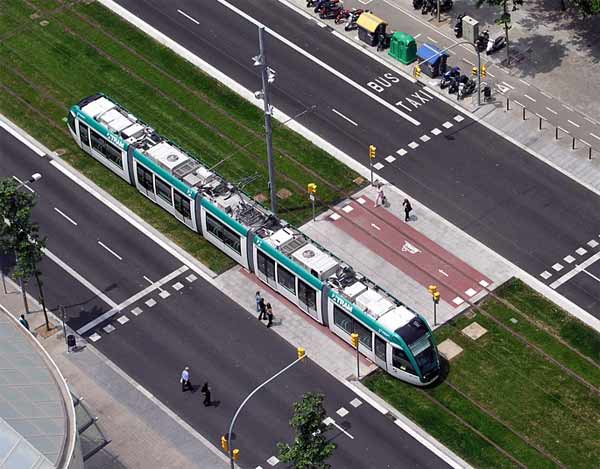
- A: LRT or light rail transit is a steel wheel on steel rail transit vehicle, mostly electrically powered from an overhead wire. LRT can handle traffic loads of between 2,000 and 20,000 persons per hour per direction (pphpd)Ai??Ai??thus effectively bridging the gap of what can be economically be handled by buses and that which needs a metro.
- Q: What is a streetcar?
- A: A streetcar is a light rail vehicle which operates on-street, in mixed traffic, with little or no signal priority at intersections.
- Q: What is the difference of a streetcar and LRT?
- A: The difference between a streetcar and LRT is when the streetcar operated on a reserved rights-of-ways or a route reserved for the exclusive use of a streetcar and with priority signaling at intersections. By operating on a RRoW, a streetcar is free of traffic and other obstructions, thus obtain higher efficiencies and commercial speeds.
- Q: what is a tram?
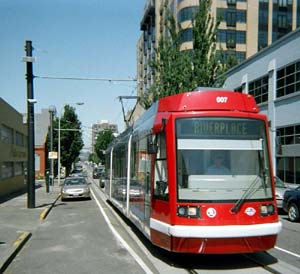
- A: A tram is an European term for a light rail vehicle or streetcar.
- Q: What is capacity?
- A: Capacity is a function of headway and consists ofAi??Ai??several variables including vehicle capacity and train length. Modern LRT can obtain capacities of over 20,000 pphpd! A transit route operating LRVs, with a vehicle capacity of 200 persons, operating at 10 minute headways, is said to have a capacity of 1,200 pphpd (200 LRV capacityAi??Ai??x 6 trains per hour or one train every 10 minutes).
- Q: What is headway?
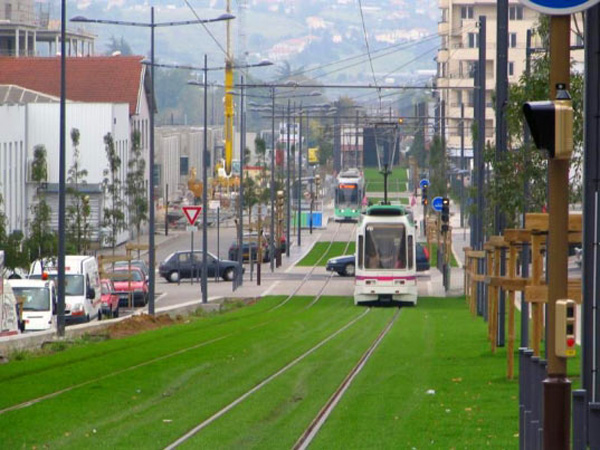
- A: Headway is the time between trains on a transit route. If a transit route is operating at 6 trains per hour, it is operating at 10 minute headways.
- Q: What is the minimum headway which LRT can operate?
- A: The minimum safe headway that streetcarsAi??Ai?? can operate at is about 30 seconds.
- Q: It has been said that LRT causes massive delays at intersections, is this true?
- A: No it is not true. LRT with priority signaling (the ability to preempt a traffic signal in favour of the LRV) causeAi??Ai??less delay than a standard light controlled intersection. The time for a LRV to clear an intersection is about 4 seconds.
- Q: It has been said that LRT is much slower than a subway, is this true?
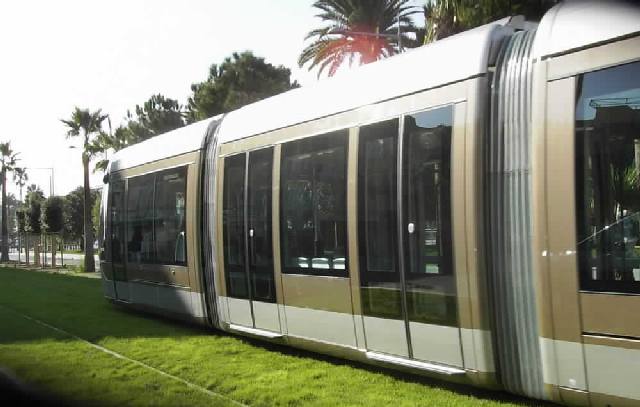
- A: No, not so; the commercial Ai??Ai??speed of a transit line is as fast as it has been designed to be. Generally speaking, subways have fewer stops than LRT, thus obtains higher commercial speeds, but at the same time the higher speed sacrifices the customers ability toAi??Ai??access the transit system. Given an equal quality RoW, with equal number of station per route, there is no difference in commercial speed.Ai??Ai??Modern LRT, operating on RRoW’s can obtain almost the same commercial speeds as a subway.
- Q: I a subway safer than LRT?
- A: No, subways tend to have a higher death rate than light rail, the SkyTrain metro system’s annual death rate is about 2 to 3 times higher than Calgary’s C-Train.

A Basel Light Controlled Road, Centred Tram Stop

The following is a short video of a Basel light controlled, road centred tram stop.
http://citytransport.info/mpg/traffic-signal-tramstop320.mpg
Please note the following:
- The cyclist stops for the red light.
- Taffic light red cycle, 32 seconds.
- Dwell time 15 seconds.
- Reserved rights-of-way – hatched and crossed lines on the tram route.
Seattle City Council approves First Hill streetcar line
While Vancouver dithers on approving a tram/LRT line for the city, Seattle council have approved its second streetcar or tram line,Ai??Ai??the First Hill Streetcar Line.
The problem in Seattle is, streetcars are not seen as LRT, rather something else as light rail is planned as a very expensive light metro. Only when Seattle gets a few years of experience with revenue operationAi??Ai??with a streetcar will the ‘penny drop’ that streetcars are indeed light rail and a reserved rights-of-way or a HOV lane with rails is just as effective as a hugely expensive viaduct or a even more expensive subway tunnel.
In Vancouver, one doubts that the ‘penny will drop’ as the city council and TransLink fumbles and bumbles along planning hugely expensive ‘pie in the sky’ subway lines instead of proven effective LRT/tram lines.

Seattle City Council approves First Hill streetcar line
A First Hill Streetcar route on Broadway was unanimously approved Monday by the Seattle City Council.
A First Hill Streetcar route on Broadway was unanimously approved Monday by the Seattle City Council.
The $130 million line is to open in 2013, connecting the International District/Chinatown light-rail station to the train station on Capitol Hill scheduled to open in 2016. A short loop will pass King Street Station and Pioneer Square.
Voters approved the line as part of a regional $18 billion Sound Transit expansion measure in 2008.
Streetcars will run every 10 minutes serving hospitals, Seattle University and densely populated neighborhoods. The technical challenges include overhead wiring conflicts with electric Metro trolleybuses; and how to share the streets with storefront parking spaces and proposed bicycle lanes.
The Seattle council said it would seek transit funds to study a north extension, beyond the light-rail station at Denny Way.
An unofficial route map, by transit fan Oran Viriyincy, is at:
Ai??Ai??http://oran.hoshiru.net/files/transit/1sthill_streetcar_map.pdf
http://seattletimes.nwsource.com/html/localnews/2011776131_streetcar05m.html
Stephen Rees’s blog – Bond shies away from major TransLink reforms – well worth a read.
Many who read the Rail for the Valley blog also read Stephen Rees’s blog, but for the growing number of overseas visitors, his most recent post; “Bond shies away from major TransLink reforms” is well worth a read.
http://stephenrees.wordpress.com/2010/05/02/bond-shies-away-from-major-translink-reforms/
Seattle Transit – Kemper Freeman is suing to stop light-rail expansion to Eastside
The transit debate in Seattle is veryAi??Ai??interesting and far more entertaining than anything here in Vancouver.Ai??Ai??Unlike Seattle, Vancouver’s business elite’s glad-handed the hugely expensive RAV/Canada line because they knew some of the over $2.5 billion spent on the metro would find its way into their businesses pockets. The LRT and metro debate in Vancouver Ai??Ai??has been more about “how much money will come my way“, rather than what is good for the city. The anti LRT charade practiced by the SkyTrain lobby masquerades the real issue, how much of the taxpayer’s money can be diverted to business and union pocket by building gold plated mini-metro in the region instead of much cheaper light rail.
In Seattle, where “free speech” is still practiced as a citizen’s right (unlike Canada, where free speech is treated as aAi??Ai??quaint holdover from earlier times), Seattle businessman Kemper Freeman, has for many years, fought the good fight against LRT. Zwei doesn’t believe a word what he says and certainly, overwhelming evidence has certainly shown that building new highways does little to solve congestion and may even exacerbate gridlock. Yet, Mr. FreemanAi??Ai??by asking questions and having those questionsAi??Ai??being answered by Seattle’s transportation authority, happily willAi??Ai??cement the case for the planned Eastside light rail.
The problem in Seattle, is that the ‘metro lobby’ has a firm hold on planning and light rail is designed more to be a metro rather than LRT. Like Vancouver, Seattle’s transit plannersAi??Ai??have squandered and areAi??Ai??squandering huge sums on grade separated (viaduct or tunnel) rights-of-way, which massively drives up costs and makes LRT a metro andAi??Ai??NOT LIGHT RAIL.
It is this light metro planning, with its huge associated costs that Mr. Kemper is fighting and I wonder if planned light rail in the Seattle region was indeed real LRT and not a hybrid mini-metro system, much of the sting in Mr. Kemper’s lawsuits would be blunted.
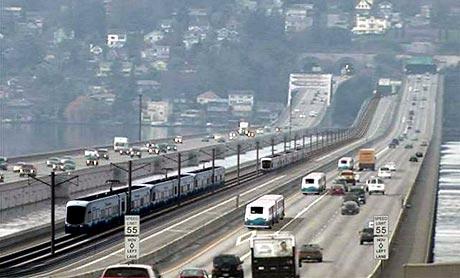
From the SEattle Times
Kemper Freeman is suing to stop light-rail expansion to Eastside
Kemper Freeman, Bellevue’s most powerful landowner, has spent millions battling light rail. Now, in what may be his final fight, he is suing to stop Sound Transit’s Eastside expansion.
By Katherine Long
Seattle Times Eastside reporter
It’s been 18 months since Puget Sound voters passed a $17.9 billion measure to extend light rail to Lynnwood, Federal Way and the Eastside. And by the decades-long timetables of such massive public-works projects, things are humming along.
On the Eastside, the Sound Transit board has picked its preferred route through downtown Bellevue. Contractors are boring holes in the soft earth along Bellevue Way. Every time we buy something in urban King, Snohomish and Pierce counties, a portion of the sales tax goes to pay for expanding light rail.
Kemper Freeman is trying to slam on the brakes.
The owner of Bellevue Square, Bellevue Place and Lincoln Square is one of nine suing to prevent Sound Transit from running light rail over the Interstate 90 bridge, arguing that converting the center lanes of the bridge for rail violates the state constitution because a portion of the project was paid for with gas-tax money.
“It is black-and-white illegal to do what they’re doing,” he says.
For more than a decade, Freeman has spent millions of dollars of his own money trying to influence transportation issues.
But in recent years, the most powerful businessman in Bellevue keeps finding himself on the losing side. His detractors have painted him as a dinosaur whose ideas about how to move people from place to place are out of date.
The I-90 lawsuit represents perhaps Freeman’s last chance of stopping light rail in its tracks.
The case has been accepted by the state Supreme Court and will be heard this fall. If successful, it could derail plans not only to use I-90 for light rail, but State Route 520 as well.
Aubrey Davis, former chairman of the Washington State Transportation Commission, thinks the lawsuit has little chance of success. Freeman “can’t understand why we can be so stupid to spend all this money on light rail A?ai??i??ai??? but that’s the way people are voting,” Davis says.
“I think he is, in a sense, Don Quixote with his lost causes, and I do think he tilts at windmills.”
Former legislator
Kemper Freeman is 68 years old, a tall, trim man with salt-and-pepper hair. He rides Harley-Davidson motorcycles, collects Leica cameras, loves to ski and has been married for 45 years to Betty Austin Freeman. His daughters, Amy Schreck and Suzanne McQuaid, and their husbands, Kevin Schreck and Howard McQuaid, work for Kemper Development Co., and when Freeman retires A?ai??i??ai??? if he ever decides he wants to retire A?ai??i??ai??? they will take over the business.
A former state legislator who served in the 1970s, he is courtly and gregarious A?ai??i??ai??? a real gentleman, one city councilmember says A?ai??i??ai??? but also blunt at times, and prone to saying things that can look bad in print.
Freeman thinks light rail is a waste of taxpayer money, and there are cheaper, faster ways to solve our transportation problems. He wants to expand the area’s freeways, but also says he supports bus-rapid-transit, free bus service and increased use of van pools.
He is an outspoken critic of Sound Transit, believing it represents the worst kind of big spending, unaccountable government agency. “They just plain plow on, irrespective of anyone or anything,” he says. With characteristic hyperbole, he adds: “It’s in the culture of the place. I won’t call ’em crooks, but if it goes on long enough, it’s the makings of something worse than Chicago.”
A conservative Republican, Freeman is suspicious of big government projects. But he’s not the only one; some Democrats have questioned the wisdom of rail as well.
“Kemper has had important insights about transportation,” says Doug MacDonald, the former secretary of the state Department of Transportation, who thinks light rail makes sense along the heaviest-traveled sections of Interstate 5, but not as a way to solve traffic woes on the Eastside.
But Freeman, MacDonald says, has “largely been debunked and ignored by people who have made a caricature of his positions for their own purposes.”
Freeman is aware of this.
“Here’s what they say: They say Kemper Freeman, the developer” A?ai??i??ai??? Freeman draws this word out A?ai??i??ai??? “from Bellevue” A?ai??i??ai??? and he draws that word out, too A?ai??i??ai??? “and all its bad overtones; everybody knows it’s something bad; he doesn’t want minorities coming to his nice, upscale shopping center, therefore he is not going to let transit come to Bellevue.”
Is this true?
“That has never, ever, ever been part of my mind or thought process at all. That is a pure, synthesized vilification,” Freeman says. “That’s how they explain what a freak I am to each other.”
Five years ago, in a Seattle Post-Intelligencer profile about his business success, Freeman differentiated Bellevue Square from others by remarking that Southcenter Mall patrons wear hair curlers and flip-flops when they go shopping.
Out in the blogosphere, words like those can take on a life of their own.
If people have built a portrait of Freeman as a snobby, freeway-loving Bellevue developer, it’s fair to say that he’s built his own narrative about his foes. They’re the car-hating members of the Sierra Club who support light rail precisely because it is a terrible way to move people around the region.
Its supporters know light rail does not work, Freeman argues, but because it sucks up so many of the available transportation dollars, it has the desired effect of shutting down growth.
“The dominant view of the Sierra Club is to stop everything that matters,” he says. “Not all of them; there are some wonderful people. But the leadership is pretty radical. They don’t understand the role of the economy. They don’t understand how things work.”
Political spectrum
How you feel about Kemper Freeman likely depends on what side of the political spectrum you’re on. Freeman is a Republican in a region full of Democrats. But when it comes to developing property, he knows how things work.
Freeman’s father, Kemper Sr., opened Bellevue Square in 1946, before Bellevue was incorporated. His son could have managed the family business without much effort and done well, but “he constantly reinvents it and refreshes it,” says Mark Baerwaldt, a Belltown entrepreneur and financier who has worked with Freeman on light-rail opposition campaigns. “He has one of the more successful malls anywhere in the U.S.”
Freeman’s developments have molded and shaped downtown Bellevue. He’s also been instrumental, and generous, in supporting the growth of Overlake Hospital Medical Center, where he serves as a trustee. He led the capital campaign for the Bellevue Arts Museum. He donated downtown property worth between $8 million and $12 million for a planned performing-arts center, and he and his wife are heading up the fundraising. In the 1990s and early 2000s, Freeman turned his analytical, businessman’s mind to fixing the Eastside’s traffic problems A?ai??i??ai??? hiring his own engineers, commissioning his own studies. He estimates he has spent between $3 million and $4 million trying to understand what could solve gridlock.
He spent a lot to influence the debate, as well. In the last six years, he’s shelled out $1.1 million in campaign contributions, according to the state Public Disclosure Commission A?ai??i??ai??? most of that spent on exploring a pro-roads initiative and waging war against light rail.
He fears that if traffic becomes hopelessly congested, it will choke off the stream of shoppers who come to his mall, his hotels and his city. “Vitality comes from activity,” he says.
Freeman also believes our area has a fraction of the density that makes light rail a good solution in cities like New York and Singapore. Here, he says, a fast network of buses and robust use of van pools make more sense.
Bellevue City Councilman John Chelminiak calls Freeman a member of the “old guard” that fails to see transit brings a different set of benefits, including reliability, frequent service and a way to connect dense urban centers. The Bellevue City Council went on record in favor of light rail in 2006.
“He has excellent points, but they’re not the only excellent points,” Chelminiak says.
His contention
The I-90 lawsuit contends that running light rail on the floating bridge is unconstitutional because the bridge was built, in part, with gas-tax money. The state’s 18th amendment bars the sale or lease of roads purchased with gas tax money for non-highway purposes.
Sound Transit officials have argued that federal, state and local agreements going back to 1976 designate the I-90 center lanes for high-capacity transit.
Davis, the former transportation commission chairman and a former Mercer Island mayor, was involved in the 1976 agreement over widening I-90. He says the middle lanes were reserved for high-capacity transit, which was understood to mean rail. And the corridor was built primarily with federal money, which does not have the same restrictions on how it is spent. “Their legal case seems awfully flimsy,” he says.
One attorney representing Freeman is Phil Talmadge, a former Democratic state senator and former state Supreme Court justice. Talmadge has long been opposed to light rail A?ai??i??ai??? as have some other Democratic leaders. Former King County Executive Ron Sims also opposed the 2008 Sound Transit measure.
“There are a vast number of things I disagree with him on,” says Talmadge of Freeman. “But … light rail is nuts. It doesn’t make any sense from a fiscal standpoint.”
Freeman says he spends 30 percent of his time “community-building” A?ai??i??ai??? trying to make Bellevue a better place. He counts his activism on transportation issues as an extension of that work, and he hopes that if the lawsuit is successful, Sound Transit will be forced to dust off its own reports and invest in bus-rapid transit and van pools. He believes it could be done in three years, be built for half the cost and move 200 to 300 percent more people.
“If you would call me the day after, hopefully, we won, I would say to you: ‘We didn’t win A?ai??i??ai??? the state of Washington won,'” Freeman said. “‘We’ve just saved Sound Transit from themselves.”
http://seattletimes.nwsource.com/html/localnews/2011756951_kemper02m.html
Lieutenant GovernorA?ai??i??ai???s Award for Canada Line builder SNC-Lavalin criticized – From the Georgia Straight

An interesting article from the Georgia Straight, shining some light on SNC Lavalin wining the Lieutenant GovernorA?ai??i??ai???s Award for Engineering Excellence. Deserved or not, the comments (on the Georgia Straight Link) are worth reading. Somehow building an economy metro line, that does nothing special and when the taxpayer is kept from finding the real cost, is not worthy of any award.
Lieutenant GovernorA?ai??i??ai???s Award for Canada Line builder SNC-Lavalin criticized – From the Georgia Straight
By Travis Lupick
ItA?ai??i??ai???s been described in the media as A?ai??i??Ai??the big winnerA?ai??i??A? of the 2010 Awards for Engineering Excellence, which were presented on April 24. And indeed, for its work on the Canada Line, SNC-Lavalin Inc. did take home the prize of the nightA?ai??i??ai???the Lieutenant GovernorA?ai??i??ai???s Award for Engineering Excellence.
But the companyA?ai??i??ai???s record is far from spotless, former Cambie Street merchant Susan Heyes was quick to pronounce.
A?ai??i??Ai??The Canada Line project and SNC knowingly chose a method of construction that caused scores of businesses to fail,A?ai??i??A? Heyes told the Straight by phone. A?ai??i??Ai??This unreasonable, preventable nuisanceA?ai??i??ai???and SNCA?ai??i??ai???s lack of social responsibilityA?ai??i??ai???is not worthy of an award, but rather of a warning: this must never happen again.A?ai??i??A?
The owner of Hazel & Co. is embroiled in a lawsuit related to the Canada Line that names as a defendant InTransit B.C. Limited Partnership, a company partly owned by SNC.
In May 2009, a B.C. Supreme Court judge found InTransit, TransLink, and Canada Line Rapid Transit Inc. A?ai??i??Ai??whollyA?ai??i??A? responsible for a substantial loss of income by Hazel & Co. That decision is under appeal.
During the Canada LineA?ai??i??ai???s construction, SNC also came under fire for its treatment of temporary foreign workers.
In December 2008, the B.C. Human Rights Tribunal ruled that members of Local 1611 of the Construction and Specialized WorkersA?ai??i??ai??? Union were discriminated against by their employers.
Along with the other respondents named in the complaint, SNC was ordered to pay the Latin American workers $10,000 each as A?ai??i??Ai??compensation for injury to dignityA?ai??i??A?.
An InTransit representative could not immediately be reached for comment.
Glenn Martin, executive director of Consulting Engineers of British Columbia, the organization that oversees the Lieutenant GovernorA?ai??i??ai???s Award for Engineering Excellence, told the Straight that the award was bestowed on SNC A?ai??i??Ai??based on the merit of the projectA?ai??i??A?.
A?ai??i??Ai??It is an award for engineering excellence,A?ai??i??A? she said, adding, A?ai??i??Ai??It boils down to looking at the A?ai??i??E?wow factorA?ai??i??ai??? of what the project is, and what sort of creative, innovative, excellent engineering goes into the project.A?ai??i??A?
Martin explained that a panel of industry leaders examines a variety of criteria when deliberating on potential recipients of the award, and noted that the emphasis is on the individual projects being considered.
SNCA?ai??i??ai???s controversies extend beyond the Canada Line. SNC Technologies Inc., a former subsidiary of SNC-Lavalin, has been criticized for supplying the U.S. military with bullets for use in Iraq. The division of the company that manufactured munitions has since been sold.
Another Dayliner crash on Vancouver Island – Why Do Car Drivers Believe They Have The Right To Go Through a Red Light?

Here we go again, another car driver ignoring railway crossing lights and bell and proceeds to crash into a train. One has little sympathy for car drivers ignoring the rules of the road, but until our provincial ministry of transportation takes seriously the fact that car drivers deliberately disobeying ‘red’ lights should be prohibited from driving for at least six months. We are getting extremely tough on ‘drink and drive’ violations but the most basic tenets of the rules of the road, stopping at red lights, is taken lightly.
Don’t blame the train, blame the car driver.
A google view of the Drinkwater railway crossing.
Train and car collide in Duncan
The Via Dayliner train and a car collided this morning at Drinkwater Road in Duncan on the trainA?ai??i??ai???s trip from Victoria to Courtenay.
A woman in the car was taken to hospital, with police saying it appears her injuries are not life-threatening.
The incident happened at about 9:45 a.m., as the train was heading north.
Police and other emergency personnel quickly shut down Drinkwater Road, and extracted a woman from the wrecked vehicle, which was struck on the passenger side.
Train passengers milled about outside the stopped Dayliner, shocked by the crash, as did locals who heard the commotion and came to see what was going on.
Port McNeil’s Henry Gonzalez and Lorraine Landry were sitting near the middle of the Dayliner when they made the unexpected stop.
A?ai??i??Ai??We heard a big thud and we got a jolt and then we looked out the window and we saw a car skidding off to the side of the pavement,A?ai??i??A? Gonzalez said.
After that people started yelling A?ai??i??Ai??emergencyA?ai??i??A? according to another passenger.
Gonzalez said he and Landry had experienced a much more eventful journey than they had expected when they planned to A?ai??i??Ai??do the touristy thingA?ai??i??A? and take the train to Victoria and back.
On Thursday they made the first leg of their journey, heading to the province’s capital. During that trip the police had to board the train to remove a drunken passenger when they arrived in Nanaimo.
A?ai??i??Ai??My gosh, it happened fast,A?ai??i??A? said Landry of Friday morning’s crash.
Fellow passenger Michel Cortie of Montreal is a self-professed train lover who has taken trains around the world.
A?ai??i??Ai??This is my first ever crash though,A?ai??i??A? he said, as he looked down the track at the stopped Dayliner.
A?ai??i??Ai??I’ve never seen anything like this,A?ai??i??A? said Balbir Minhas, who lives near where the accident occurred. He and friend Parmjit Manhas were alerted by sirens and came to see what was happening.
A?ai??i??Ai??Look at the car,A?ai??i??A? he said, surveying the caved in side of the red four-door.
Via Rail Canada’s Catherine Kaloutsky confirmed the company’s head office had learned about the collision involving a Via train and one car.
A?ai??i??Ai??The two buses have been ordered and confirmed for those passengers who have been stranded on the train to get them to their final destinations,A?ai??i??A? she said.
Kaloutsky said Via Rail would conduct its own internal investigation in addition to the one being done by police.
Campbell’s "Reshuffling of The Deck Chairs on TransLink" Can’t Hide The fact That TransLink, is Steering Directly Into a Financial Iceberg!

B.C. moves to make TransLink, BC Ferries more efficient
By Doug Ward, Vancouver SunApril 29, 2010The provincial government says that legislation being introduced today in the legislature will bring efficiencies to TransLink and BC Ferries.
Ai??Ai??The series of amendments are in response to a report filed in November by B.C. comptroller-general Cheryl Wenesenki-Yolland who found that TransLink was plagued by “significant operational issues” and has not worked hard enough to manage its finances.
Ai??Ai??One amendment will allow service improvements to proceed at any time, rather than on the restrictive annual process currently in place. The legislation also amends the requirement for a fully-funded plan from 10 years to three years.
Ai??Ai??The legislation also requires an outlook plan from years four to 10, focusing on future services.
Ai??Ai??”The board and management at TransLink should be commended for already taking action on key recommendations of the comptroller-general,” said Transportation and Infrastructure Minister Shirley Bond in a media statement.
Ai??Ai??”In recent months the company has taken significant steps to find efficiencies to help meet its financial goals.”
Ai??Ai??Bond said the comptroller-general found that BC Ferries is “well managed overall” but had recommended improvements to B.C. Ferry governance, transparency and regulations on executive-compensation.
Ai??Ai??To that end, an amendment being introduced today would subject B.C. Ferries and the B.C. Ferry Authority to the Freedom of Information and Protection of Privacy Act, in order to improve transparency.
Ai??Ai??Another amendment will ensure, according to a media statement, that compensation for future B.C. Ferries executive and board is comparable to other public sector organizations.
Ai??Ai??The legislation will also separate the B.C. Ferry Services board of directors from the B.C. Ferry Authority. A final amendment will include reservation fees in the price cap regulated by the B.C. Ferry Commission.
http://www.vancouversun.com/moves+make+TransLink+Ferries+more+efficient/2967452/story.html
Two Tram projects planned in northern France. What no VAL?

The Mongy in Lille France. The huge cost of VAL ensured this tramway's survival.
What is interesting about this announcement is that the new tram projects are planned near Lille France, which operates the VAL automatic mini-metro. The two approved tram or light-rail lines are very close to the City of Lille and the VAL mini-metro system. This poses the question: Why not build with VAL?
French cities that have built with VAL,Ai??Ai??do notAi??Ai??continue building with VAL, as it is just too expensive to build and costly to operate. SkyTrain costs about the same to build and operate than VAL, yet TransLink doesn’t care about the taxpayer and still continues to plan for the SkyTrain mini-metro or any mini-metro for that matter, instead of light rail. And with any alternative to SkyTrain is offered, it is so poorly planned or the costs are so inflated that SkyTrain appears to be the best option. This is planning by deceit and deception;Ai??Ai??Ai??Ai??no wonder TransLink has a terminal case of financial bankruptcy.
From the Railway Gazette
April 2010
Tram projects planned in northern France
FRANCE: A consortium comprising Systra, Inexia, Eccta, Ilex and Urbanica has been appointed to manage two tram projects in northern France. The contract was awarded by the Artois-Gohelle local transport authority, which is responsible for public transport in an area comprising 115 towns and villages with a total population of 600 000.
The first route connecting LiA?Ai??vin, Lens and HA?Ai??nin-Beaumont will be 20Ai??Ai??8 km long with 30 stops. The second will be 17Ai??Ai??4 km long, running from Bruay-la-BuissiA?A?re to BA?Ai??thune and Beuvry and will have 24 stops. The tram lines will serve key destinations in 18 towns and villages and are part of an initiative to regenerate the former mining area.
Systra will be responsible for project management and, with Inexia, for engineering and systems. Eccta is in charge of infrastructure, roads and services, while Ilex and Urbanica will handle architecture, landscaping and urban design.
The consortium is due to present its proposals for the two routes by autumn 2010. Construction is expected to start in 2011 with revenue service set for 2014. The project will cost around A?ai??sAi??657m.



Recent Comments