Road tolls coming – welcome to tax and spend TransLink
Road tolls, the clarion call of tax and spend bureaucrats and politicians.
What the boys and girls wanting road tolls or road pricing is more taxpayers money to waste on nextAi??to useless SkyTrain expansion, new posh offices, and ever higher salaries; better public transit is just an excuse, but not in the cards.
For road tolls to succeed, one must have a credible public transit network to act as a viable alternative to the car; the Vancouver Metro region doesn’t have, nor is one being planned. The Vancouver Region and its planners have adopted a very dated light-metro philosophy, where a mass of bus routes feed a light-metro route which acts as a spine. Sure one gets high ridership on the light-metro, but most ofAi??the transit customersAi??taking the light-metro have transfered from a bus. TransLink has admitted that over 80% of SkyTrain’s ridership first take a bus and transfer to the light-metro.
This sort of bus and light-metro planning has proven both expensive and almost unworkable, yet TransLink continues with this dated planning. If one reads Eric Chris’s letter in the previous post, TransLink’s ridership matches population growth, nothing more, which is more proof that TransLink’s present transit planning has failed.
Yet, TransLink and its ponderous bureaucracy continues with this failed transit philosophy with the Evergreen Line and evidence points that the TransLink ‘spin‘ has bamboozled regional mayors and councilors that TransLink needs more and more money, yet there is no evidence that the huge amounts of taxAi??money and secret subsidiesAi??already earmarked for TransLink is wisely spent.
Regional mayors act like carnival rubes, just waiting to get their (read ours) pockets picked clean, by well seasoned hucksters.
If the region wants road pricing to work, this is the transit that must happen:
- All day, seven days a week,Ai??express buses from South Delta and South Surrey, with a minimum 20 minute frequency, to downtown Vancouver, with no forced transfer on the RAV/Canada Line.
- The full build Rail for the Valley/Leewood TramTrain from Vancouver and Richmond to Rosedale.
- A BCIT/UBC/Stanley Park LRT/tram.
- A Whiterock to Surrey Central LRT/tram, with direct service via the RftV/Leewood TramTrain to Vancouver.
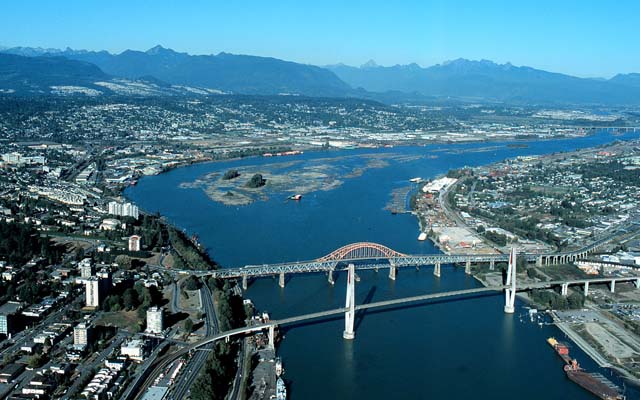
- A new joint three track Fraser River Rail Bridge/six lane car bridge, replacing the Patullo Bridge.
- All day/weekend servcie by the West Coast Express.
This is the transit plan that would justify road pricing in the region and somehow I don’t think the bright sparks at TransLink are even beginning to understand what is needed to justify regional road pricing in the Metro Vancouver Region.
EXCLUSIVE: Road tolls recommended for Metro Vancouver
By DON CAYO, Vancouver SunFebruary 24, 2012 6:03 AM
A comprehensive road pricing scheme ai??i?? tolls that youai??i??d have to pay to drive pretty well anywhere in Metro Vancouver ai??i?? is the method favoured by provincial and regional bureaucrats to finance TransLinkai??i??s ambitious spending plans well into the future.
But they have many other ideas on how to extract, over time, hundreds of millions of dollars from taxpayers. The proposals are outlined in a confidential report, Evaluation of Revenue Sources to Support Transportation Improvements in Metro Vancouver, that was distributed to hand-picked political and stakeholder groups earlier this month. The proposals cover the gamut ai??i?? from fuel and carbon taxes to property taxes, development fees and fare hikes, as well as stiff new or additional levies on everything from parking to business payrolls, car rentals, hotel rooms and goods transported around the region.
The Joint Technical Committee, composed of senior executives from the Ministry of Transportation and Infrastructure, TransLink, and the cities of Vancouver and Surrey, ranks more than 20 proposals according to technical suitability and ai??i?? as the committee members interpret the broad direction theyai??i??ve received from the regionai??i??s mayors ai??i?? political desirability.
Next, for any of these measures to be adopted, the regional Mayorsai??i?? Council that oversees TransLink will have to decide which options it wants, and the provincial government will have to pass enabling legislation.
A copy of the document obtained by The Sun says the move to road pricing could be implemented in various ways, including by tolling major water crossings, tolling entry and exit points to defined areas of Metro Vancouver ai??i?? possibly varying by time of day ai??i?? or by tracking and charging for total kilometres driven. All these options were given high or fairly high ratings on all four criteria taken into account: the impact on peopleai??i??s transportation choices, the impact on families and the economy, fairness and transparency, and the ability to generate and sustain revenues.
One table in the report estimates a toll of $1.60 per trip at major bridges and tunnels ai??i?? which are not named ai??i?? could raise $100 million a year. Another table suggests toll revenue could total between $100 and $200 million a year.
However, the report notes one drawback ai??i?? none of these road-pricing schemes could be implemented in time to meet TransLinkai??i??s 2013 needs.
The Mayorsai??i?? Council has said in the past that TransLinkai??i??s existing revenue sources, as authorized by provincial legislation, arenai??i??t adequate to meet its needs. The province has approved a new fuel tax of two cents a litre to cover a portion of the revenue needed while long-term options are explored. A plan was also approved to authorize a limited-time property tax increase, averaging about $23 per homeowner, for 2013 and 2014 to fund TransLinkai??i??s short-term needs if long-term funding isnai??i??t found before then.
However earlier this month, several Metro Vancouver mayors called for an independent audit of the transit authority to ensure it is running efficiently before additional taxes and tolls are considered. TransLink Commissioner Martin Crilly is already reviewing the agencyai??i??s financial picture ahead of deciding whether to allow a 12.5-per-cent transit fare hike that could go into effect next year.
TransLink has been struggling to finance the growing regionai??i??s transportation needs. In December, the agency predicted an $83-million deficit for 2011, while transit ridership grew by five per cent. Additionally, TransLink has several massive projects in the works including: the $1.4-billion Evergreen Line, to which it has committed $400 million; upgrades to the Expo Line, estimated to cost between $850 million and $1.1 billion over 30 years; and a $150-million upgrade to the Main Street, Commercial-Broadway and Metrotown SkyTrain stations to take place over ai???the next few years,ai??? according to its website.
The confidential report outlines several other options the politicians are likely to consider.
Other highly ranked options are:
ai???An increase in the Metro Vancouver fuel tax, now 17 cents a litre. This could bring in $30-$100 million a year, and is one of just six options that could be adopted in time to meet 2013 funding needs.
ai???A new regional carbon tax, or a portion of the provincial carbon tax being designated for TransLink. These are the richest options, with revenue potential estimated at more than $200 million a year. A regional carbon tax, the document says, could be implemented by 2013, although it doesnai??i??t see the same possibility for a designated portion of the provincial carbon tax, possibly because it was temporarily frozen by this weekai??i??s provincial budget and itai??i??s now to be subject to a year-long review.
ai???An increase in parking sales tax from its current level of 21 per cent. The revenue estimate of $10-$30 million implies that it would go up between 4.5 and 13.5 percentage points to range between 25.5 and 34.5 per cent. This, too, could be done at the stroke of a pen, but it wouldnai??i??t bring in enough to fully meet TransLinkai??i??s immediate needs.
ai???A new vehicle registration fee ai??i?? either a flat fee, or one based on emissions standards, or on the ownerai??i??s proximity to public transit. This could bring in $100-$200 million a year, and it could be implemented quickly.
ai???Transit fare increases over and above the rate of inflation. Increases of 10 to 33 per cent would bring in $30-$100 million in potential revenue, but theyai??i??re not flagged as something that could be implemented right away.
ai???Higher property tax with a portion allocated to public transportation. This could raise $100-$200 million and be implemented quickly.
ai???A benefiting area tax, which would mean an extra assessment on property that gained value because of its proximity to a major transportation development. This could raise $30-$100 million, though itai??i??s not on the list of measures suitable to meet needs in 2013.
ai???Project tolls, described as ai???charges for use of a new facility that would otherwise have been free to use.ai??? This could raise $100-$200 million, and is not on the list of ready-to-implement strategies.
A second list of six strategies is given a medium ranking based on their technical merit and political sensitivity, and thus might still be considered by the politicians.
These options are:
ai???A flat levy per property that, the document says, could raise $10-$30 million a year, an amount that implies an annual rate of $13-$39. It could come into effect in time to partly cover TransLinkai??i??s 2013 plans.
ai???A regional sales tax that, at a rate of 0.6 per cent, could raise $30 million.
ai???A parking levy on all stalls, free or paid, that could raise $10-$30 million at a rate of $25 to $75 per stall.
ai???An employer payroll tax that could raise $30-$100 million at a rate of $30-$90 a year per employee.
ai???Development charges when land is subdivided or building permits are issued. This could raise $10-$30 million at rates of $1,500-$4,500 per family home, $650-$1,950 per apartment, and $1.25-$3.75 per square foot of commercial space.
ai???New charges to municipalities that see their property tax revenue increase as a result of new transportation facilities. This would bring in an undetermined amount.
Finally, there are four areas that were ranked as low in potential ai??i?? a vehicle sales tax, a car rental fee, a fee for goods transported in the region and a hotel tax.