Transit is about moving people stupid!
Interesting news item, from all places, the SkyTrain friendly CKNW radio station.
VANCOUVER/CKNW(AM980)
10/7/2011
Just as the mayors vote today on funding for the Evergreen Line, a report by the transportation commissioner says TransLink’s ridership predictions may just be wishful thinking.
The Province newspaper reports commissioner Martin Crilly wrote last week that the growth predictions for ridership on the proposed Evergreen Line appear somewhat optimistic, and may not be based on logic.
His skepticism stems from the Evergreen Line being built in the relatively low-density Tri-Cities area.
The problem I have with Mr. Crilly is that he is stuck in the density trap and seems to be of the school that massive densification is needed to justify “rapid transit“, while forgetting the fact that modern LRT being much cheaper to build, would require much less of his cherished density to operate economically.
Being soundly criticized and booted from manyAi??so-called transit friendly blogs becauseAi??IAi??advocate a simple message that “Transit is to move people not create density.”, I have been amazed at the nonsense being passed as good transit philosophy. Ai??Development will happen along transit lines but the massive densification advocated by the rapid transit/SkyTrain types maybe counter productive, especially if the populace of the newly densified areas do not work nor commute anywhere near where the rapid transit lines go and take the car instead.
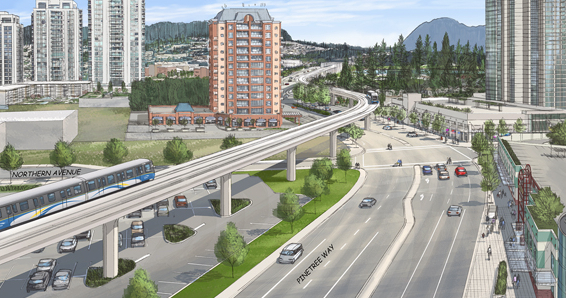 The (N)Evergreen Line is a forgotten spur line of the original Broadway-Lougheed LRT projects and was omitted because we could only afford a much smaller SkyTrain Millennium Line (same was true of the original Expo Line which originally terminated in New Westminster and was much smaller than the original 3 line LRT plan) and now another $1.4 billion is needed to complete it.
The problem with the Millennium Line is that TransLink has been telling ‘Porkies’ about ridershipAi??all along, first exposed by Gerald Fox’s 2008 letter –
From: A North-American Rail Expert (Gerald Fox)
Subject: Comments on the Evergreen Line ai???Business Caseai???
Date: February 6, 2008 12:15:22 PM PST (CA)
Greetings:
The Evergreen Line Report made me curious as to how TransLink could justify continuing to expand SkyTrain, when the rest of the world is building LRT. So I went back and read the alleged ai???Business Caseai??? (BC) report in a little more detail. I found several instances where the analysis had made assumptions that were inaccurate, or had been manipulated to make the case for SkyTrain. If the underlying assumptions are inaccurate, the conclusions may be so too. Specifically:
Capacity. A combination of train size and headway. For instance, TriMetai??i??s new ai???Type 4ai??? Low floor LRVs, arriving later this year, have a rated capacity of 232 per car, or 464 for a 2- car train. (Of course one must also be sure to use the same standee density when comparing car capacity. I donai??i??t know if that was done here). In Portland we operate a frequency of 3 minutes downtown in the peak hour, giving a one way peak hour capacity of 9,280. By next year we will have two routes through downtown, which will eventually load both ways, giving a theoretical peak hour rail capacity of 37,000 into or out of downtown. Of course we also run a lot of buses.
The new Seattle LRT system which opens next year, is designed for 4-car trains, and thus have a peak hour capacity of 18,560. (but doesnai??i??t need this yet, and so shares the tunnel with buses). The Business Case analysis assumes a capacity of 4,080 for LRT, on the Evergreen Line which it states is not enough, and compares it to SkyTrain capacity of 10400.!
Speed. The analysis states the maximum LRT speed is 60 kph. (which would be correct for the street sections) But most LRVs are actually designed for 90 kph. On the Evergreen Line, LRT could operate at up to 90 where conditions permit, such as in the tunnels, and on protected ROW. Most LRT systems pre-empt most intersections, and so experience little delay at grade crossings. (Our policy is that the trains stop only at stations, and seldom experience traffic delays. It seems to work fine, and has little effect on traffic.) There is another element of speed, which is station access time. At-grade stations have less access time. This was overlooked in the analysis.
Also, on the NW alignment, the SkyTrain proposal uses a different, faster, less-costly alignment to LRT proposal. And has 8 rather than 12 stations. If LRT was compared on the alignment now proposed for SkyTrain, it would go faster, and cost less than the Business Case report states!
Cost. Here again, there seems to be some hidden biases. As mentioned above, on the NW Corridor, LRT is costed on a different alignment, with more stations. The cost difference between LRT and SkyTrain presented in the Business Case report is therefore misleading. If they were compared on identical alignments, with the same number of stations, and designed to optimize each mode, the cost advantage of LRT would be far greater. I also suspect that the basic LRT design has been rendered more costly by requirements for tunnels and general design that would not be found on more cost-sensitive LRT projects.
Then there are the car costs. Last time I looked, the cost per unit of capacity was far higher for SkyTrain. Also,it takes about 2 SkyTrain cars to match the capacity of one LRV. And the grade-separated SkyTrain stations are far most costly and complex than LRT stations. Comparing 8 SkyTrain stations with 12 LRT stations also helps blur the distinction.
Ridership. Is a function of many factors. The Business Case report would have you believe that type of rail mode alone, makes a difference (It does in the bus vs rail comparison, according to the latest US federal guidelines). But, on the Evergreen Line, I doubt it. What makes a difference is speed, frequency (but not so much when headways get to 5 minutes), station spacing and amenity etc. Since the speed, frequency and capacity assumptions used in the Business Case are clearly inaccurate, the ridership estimates cannot be correct either. There would be some advantage if SkyTrain could avoid a transfer. If the connecting system has capacity for the extra trains. But the case is way overstated.
And nowhere is it addressed whether the Evergreen Line, at the extremity of the system, has the demand for so much capacity and, if it does, what that would mean on the rest of the system if feeds into?
Innuendos about safety, and traffic impacts, seem to be a big issue for SkyTrain proponents, but are solved by the numerous systems that operate new LRT systems (i.e., they canai??i??t be as bad as the SkyTrain folk would like you to believe).
Iai??i??ve no desire to get drawn into the Vancouver transit wars, and, anyway, most of the rest of the world has moved on. To be fair, there are clear advantages in keeping with one kind of rail technology, and in through-routing service at Lougheed. But, eventually, Vancouver will need to adopt lower-cost LRT in its lesser corridors, or else limit the extent of its rail system. And that seems to make some TransLink people very nervous.
It is interesting how TransLink has used this cunning method of manipulating analysis to justify SkyTrain in corridor after corridor, and has thus succeeded in keeping its proprietary rail system expanding. In the US, all new transit projects that seek federal support are now subjected to scrutiny by a panel of transit peers, selected and monitored by the federal government, to ensure that projects are analyzed honestly, and the taxpayersai??i?? interests are protected. No SkyTrain project has ever passed this scrutiny in the US.
Victoria
But the BIG DEAL for Victoria is: If the Business Case analysis were corrected to fix at least some of the errors outlined above, the COST INCREASE from using SkyTrain on the Evergreen Line will be comparable to the TOTAL COST of a modest starter line in Victoria. This needs to come to the attention of the Province. Victoria really does deserve better. Please share these thoughts as you feel appropriate.
As one can see, TransLink’s business case is on very shaky ground and now Mr. Crilly is sounding alarm bells on the project. The problem with the Evergreen Line is that for transit customers wishing to go toAi?? Vancouver, the West Coast Express is a faster and seamlessAi??ride and those who wish to commute elsewhere, other than Metrotown or Lougheed Mall, will need to inconveniently transfer to another SkyTrain or bus.
Like the Canada Line, for many, the (N)Evergreen Line will be inconvenient and taking the car will just be a better option.
Until we design our regional rail and transit system to cater to customer needs, instead of academic, bureaucratic and political needs, taking the car will be the option for those who can afford to, leaving the rest of the transit system to decay, mainly being for the poor, the elderly and students. Why should the taxpayer ante up two cents more a litre for that?
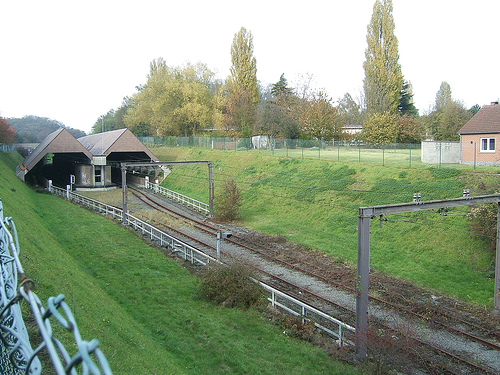
A never used section on the Belgium Charleroi pre-metro.
Over optimistic ridership numbers, doomed some completed lines to rust away, never seeing a paying customer.