CancA?n tram-train feasibility study commissioned
It is so sad that just about every country in North America and Europe are looking a TramTrain (Interurban) to help solve regional transit problems, except Canada andAi??especially BC and Metro Vancouver. That the now obsolete SkyTrain mini-metro is still being planned for the lower mainland only shows how backward and irrelevant our regional transit planning has become.
That TransLink and the any regional mayors refuse to accept the simple fact that modern LRT has made SkyTrain obsolete over two decades ago, just illustrates how delusional regional politicians have become about regional transit planning.
In Metro Vancouver we plan for myths.
From the Railway Gazette
CancA?n tram-train feasibility study commissioned
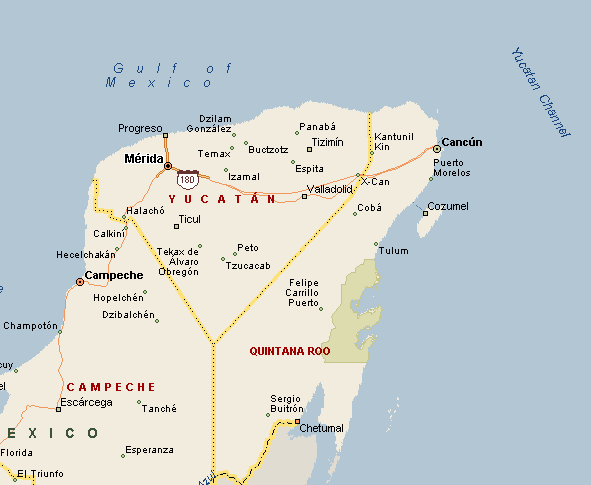
MEXICO: Spanish metre-gauge operator FEVE is to undertake feasibility studies for a new tram-train network serving Caribbean resorts between CancA?n and Tulum.
FEVE is to study a route linking CancA?n with Cozumel, Solidaridad, Benito JuA?rez, Isla Mujeres and Tulum, serving an area containing some of the most important tourist destinations in Mexico.
It says that an efficient, low-cost rail system would improve transport options for tourists and local residents alike, reducing dependency on road transport while minimising environmental impact.
The framework agreement signed by Rodrigo Borge Angulo, Governor of Quintana Roo state, and FEVE President Marcelino Oreja also makes provision for the Spanish company to provide operating and training assistance as well as rolling stock.



Mexico is mired in corruption surrounding drugs and we are mired in corruption surrounding transit. At least politicians in Mexico are doing the right thing and going with trams – air trains used by TransLink aren’t being considered.
Getting back to the transit corruption – TransLink is using U-Passes to put people onto bee-lines and air trains in Vancouver. There is the UBC, City of Vancouver (COV) and TransLink triangle of deception and corruption. Let me explain.
Cash strapped UBC wanted to use the parking spaces at UBC for condo development to make money from the condos. It couldn’t do this without coming up with some trick to fool everyone, so it concocted the express No.99 bee line route as a supposed big time saver which was going to increase ridership, reduce pollution and reduce traffic congestion. It might have increased transit ridership but it increased pollution and traffic congestion to do it.
Vehicle reduction by the No 99 is insignificant and buses on the roads have caused far more congestion and pollution than the cars removed by the U-Pass.
Poor students are being forced to take the No. 99 because there is nowhere to park at UBC and because UBC jacked up the cost of parking to dissuade all but the rich students, who are driving BMWs and don’t care whether they have to pay $6 daily to park, from driving – I recently worked with one student who was doing her master’s at UBC – and there was no way that she would take the loser cruiser with all the smelly weirdoes who board the bus – her opinion, not mine.
So, UBC, COV and TransLink have conspired to make UBC money (from building condos on campus to sell to rich investors and the condos are not being used as residences for students).
TransLink is benefiting from putting students onto its air trains which are having trouble attracting drivers while the COV transportation engineers are getting a pat on their backs for reducing car traffic even though the bus traffic is causing more pollution and road congestion than the cars removed.
Guess who is getting hosed? The students are – riding crappy buses and the taxpayers are – paying for the U-Passes which are indirectly funding the condos on campus at UBC. That’s sad and that’s what is happening and has happened.
I do find it odd that the powers that be in Vancouver still plan for Skytrain despite the large benefits building with light rail.
Even in the UK we have taken the railways and the health and safety chaps kicking and screaming into the 21st century and now several tramtrain schemes are in the offing.
Certainly the 1980’s seem very comfortable for the planning staff in Vancouver, as they seem to want to stop time and live there forever. Sadly the real world moves on and for the many hundreds of professional who have thrown their lot in with Skytrain, they must move with the times, yet they are deathly afraid to do so.
Vancouver and its environs will soon pay a large financial penalty building with Skytrain, but the politicians and their bureaucrats roger on, pretending there isn’t a financial crisis. Even in Canada, the realities of squandering tax dollars on prestigious light metro projects, must end or is it true that those who live in Vancouver and region have very deep pockets to pay ever increasing taxes for very expensive transit?
The biggest problem with any elevated transit right of way is on going maintenance. Your transit operators policy of not wanting to or having the ability too negotiate surface right of way is going to produce the biggest and final nail in the Skytrain coffin. In as little as 5-10 years from now the original Expo line must have its concrete guideway either reinforced or replaced entirely. The former being more likely than the latter. Soon, unless it is already happening, the concrete on the original Expo line will have degraded to the point that, sections of it will fall off. Little pieces at first but eventually, large sections will need to be fixed. At this point all system expansion will stop dead as the operator then has to fastrack maintenance shedules. I just returned from a trip to Vancouver and Victoria for work and one of our people noticed small areas of concrete fatigue on several elevated sections of the original Expo line RoW. She was not specfic but, she mentioned that several areas near the main concrete support pylons on several elevated areas will need work in the next few years. No need to worry about Skytrain extensions to outer suburbs the money will not be there because they will want it to fix the elevated structures on the existing lines. Oh boy do you guys have a lot of elevated RoW. Cheers!
Zweisystem replies: You are absolutely correct about concrete fatigue. If my memory serves me correctly, the cement guideway is rated for 50 years of service. The Expo Line saw expensive upgrades to handle the heavier MK 2 cars. It also seems that track wear is a problem as TransLink has once again announced a track replacement program.
Speaking of the cement viaduct, the corrosive salt air of Vancouver also causes premature aging of the guideway.
While I was away l did some light reading regarding the plan by TransLink to up grade the capacity of the original Expo Line. Now electrical upgrades are common because, even with LRT operators it is common to try to save capital funds by going light on the power capacity. However, it is striking that the simple act of spending capital funds to lengthen station platforms is out of the question because of the difficulty and cost of doing this on an elevated right of way. Calgary is expanding their LRT capacity by lengthening their platforms. The construction is extensive because of the number of stations and the fact that it is already operating complicates matters but, the actual construction is simple. The end result will be that, by paying a one time capital price, add the cost of a small order of new vehicles (already budgeted for) and hiring a few more maintenance people (no new operators needed). Calgary will have upgraded its infrastructure and expanded its carrying capacity on the LRT by 40%.
I attended a talk a few years ago given by a fellow who worked for a rail engineering firm. He had worked with the Skytrain and he mentioned during his presentation that they had some issues with excessive track wear. His firm had figured out that much of their track wear and accompanied wheel wear issue was actually caused by improper track grinding. The solution was asymetric track grinding and this seemed to solve the issue. However, the people in control of the maintenance budget had abandoned this practice and by the time he came back to Vancouver the same problems had returned. He asked why they had changed the policy and he found that the complex nature of asymetric track grinding of rail heads and the individual rail profiles needed were too complex for the financial and poltical types to understand. The maintenance people also did not have the elequence or safistication to explain the answer in a way that the fiancial or political people could understand. The people actually doing the maintenance never fully understood why the asymetric rail grinding worked so they did not fight to keep doing it. The real tragedy of the whole problem was that, none of the people involved were bad people or incompetant, just unwilling or unable to see that a different way somtimes means change and sometimes this kind of change is difficult or challenging to implement.
Zweisystem replies: I have always wondered that the Linear Induction Motors or LIM’s had something to do with excessive track wear. SkyTrain’s LIMS are attractive rather than repulsive (used on Maglevs) and being attractive, may cause the dynamics for track wear. The late Des Turner, was in contact with Professor Laithwaite, who won an award for his LIM research and had a letter that Laithwaite sent to th UTDC claiming that an attractive LIM would cause many problems. Unfortunately the letter has been lost to the ages.
Haveacow, thanks for the comments, if it weren’t for people writing about the monkey show at TransLink, few would know about it (the media making money from TransLink advertisements and propaganda won‘t write about it here). Crumbling guide rails and excessive track wear could lead to an air train flying off the tracks. The monkeys at TransLink are playing Russian roulette and it will eventually catch up to them.
Ironically, when an air train does finally fly off the rails, it will be the monkeys, who let it happen at TransLink, calling it an unforeseen tragedy. Too late, the investigation into the air train disaster will point the finger at the accountants who let it happen at TransLink. It is good to have a record of the discussion on the track wear and crumbling concrete on this forum. Lawyers of the grieving families whose family members might be injured or killed in the air train disaster will be thrilled when it is sent to them.
Engineers or competent specialists have to make the decisions at TransLink and the accountants at TransLink have to manage the payroll and to prepare the financial statements in a back room where they belong. This isn‘t occurring at TransLink. If it were, we‘d have a LRT or tram line being planned instead of the air train on the Evergreen line route. TransLink is a cesspool of corruption.