BRT to Chilliwack & SkyTrain to Langley? Just Business as Usual in BC!
The following article by Brian Lewis should forewarn us that the transit decision for the Fraser Valley has been already made. Like all transit studies done in the region in the past 30 years, the decision on transit mode is made beforehand and thenAi??Ai??a study is commissioned to confirm the decision. This is howAi??Ai??transit planning is done in BC: Politicians make the decision and the bureaucrats make sure the political decisions stand with bogus, yet expensive studies.
One wonders why Trans Link is needed at all!
It is to be certain, Premier Campbell has not read the RftV/Leewood Report, though he is aware of its contentAi??Ai??with the announcement of an Express bus to Chilliwack and SkyTrain to Langley, sometime in the future. The TramTrain study is a radical change how transit is planned for in BC, in which no special party is rewarded, except for those wishing to use ‘rail‘ transit!
In Mr. Campbell’s world, bus based transit means new highways, which will keep the road Builder’s Association happy and building more SkyTrain will keep both Bombardier Inc. and land developers happy. Happy people translates into lucrative political donations to a political party which the happy people belong!
The Premier’s speech to the Union of BC Municipalities, was just telling the party faithful that it is business as usual in BC.
Ai??Ai??
Ai??Ai??
Ai??Ai??
Premier’s transit pitch hard to swallow
By Brian Lewis, The Province
October 7, 2010
A mother shoving cod liver oil down her child’s throat in the belief it’s a good health remedy — even though it tastes bad — is one thing, but unilaterally shoving public transit policy down taxpayer throats is positively unpalatable.
That’s precisely what Premier Gordon Campbell did last week at the Union of B.C. Municipalities convention in Whistler when he announced Victoria’s intention to extend SkyTrain through Surrey to Langley. The tasteless tactic was repeated in the same speech when he proclaimed that Rapid Bus service would link Chilliwack with the rest of the Fraser Valley.
On both counts reaction throughout the transit-challenged region was predictable: “Oh, really?”
Regarding the SkyTrain extension, TransLink, the region’s mayors and all other stakeholders are a long, long way from agreeing on what type of rapid transit technology should be used in building the 17-kilometre link between SkyTrain’s current terminus in north Surrey and Langley district. By far the most expensive option is SkyTrain’s elevated guideway, which in current dollars is estimated to cost a whopping $2.5 billion, or more.
Campbell’s announcement took mayors such as Dianne Watts of Surrey by total surprise. As she has said many times, a ground-level system between Surrey and Langley makes more sense because it’s far cheaper, easier and quicker to build.
Langley Township Mayor Rick Green’s response was blunt : “SkyTrain to Langley is simply pie-in-the-sky,” he tells me.
“There’s no question the premier is jumping the gun here.”
Green notes that TransLink, its Mayor’s Council and the B.C. government only several weeks ago signed a Memorandum of Understanding to conduct long-term transit planning throughout the region.
Yet, here comes Campbell with an announcement that the extension to Langley will be the SkyTrain technology. “He does this even though the ink on the MOU isn’t even dry,” Green adds.
As for establishing a Rapid Bus system to serve as far east as Chilliwack, those advocating that the old Inter Urban rail line be utilized to re-establish light rail transit from Chilliwack to Surrey are more than a little miffed.
Green, who also heads the South of the Fraser Community Rail Task Force, points out that unlike Vancouver, Richmond or Burnaby, population densities in the valley tend to form in pockets, which makes an Inter Urban light rail system much more efficient and cost-effective than SkyTrain, which works best in areas where high density is uniform.
The premier announcing that Rapid Bus is the choice for service to Chilliwack also reinforces suspicions that a $400,000 study of transit options for the valley, undertaken by Victoria almost two years ago, which still hasn’t been released, will kill the Inter Urban light rail option.
Despite Campbell’s announcements, Langley City Mayor Peter Fassbender says all transit options for the region will remain on the table.
He also chairs the Mayor’s Council and acknowledges that this places him in a consensus-building role to keep peace between the region and Victoria and to move the issue forward.
“We all have to work together for the south of Fraser solutions,” Fassbender says.
But a premier dispensing policy like spoonfuls of cod liver oil makes that job tougher.
blewis@theprovince.com
The Need for Passenger Rail
The Need for Passenger Rail
by Rail For the Valley
For a pdf version of this article, click here
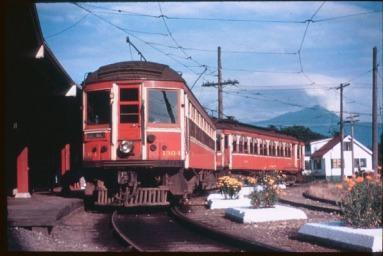
October 3, 1910 – 2010
The monumental first Interurban train trip from New Westminster to Chilliwack occurred on October 3 1910. 100 years later, Rail For The Valley takes a look at some important current issues, and misconceptions standing in the way of a service today.
The Fraser Valley Regional Study
In early 2008 the Province claimed a major study of light rail would soon be released, but almost three years later the public is still waiting. The Province has hyped this simple FVRD report as an in depth examination of the feasibility of light rail. Unfortunately this is not the case. The study has little to do with rail at all and only encompasses the region between Abbotsford and Chilliwack. As John Buker noted:
“Given the public support for passenger rail, it’s hardly surprising the Province would try and pass off an FVRD report on Abbotsford-Chilliwack traffic projections as a meaningful light rail study. It’s very doubtful that the provincial report, when it is finally released, will shed much light at all on the potential for an Interurban light rail service.” “What kind of study examining the feasibility of light rail in the Fraser Valley excludes Vancouver, Surrey, and Langley?”
Realizing that the public deserved an honest accounting of the potential for light rail service on the Interurban corridor, Rail For the Valley concluded that an independent analysis was essential.
The independent Interurban Study is completed
September 2010

One of the major hindrances to any light rail study to date has been both the lack of light rail expertise, and of a light rail industryAi??Ai??Ai??Ai??Ai??Ai?? inAi??Ai??Ai??Ai??Ai??Ai?? theAi??Ai??Ai??Ai?? province. Provincial studies have relied on Heavy Rail consultants who are simply not qualified to do a major study of a light rail system. The Interurban report is British Columbia’s first study done by experts in the field of light rail.
A highly esteemed rail consultancy firm Leewood Projects Ltd, was commissioned by Rail For the Valley to undertake what stands as the most comprehensive and detailed light rail implementation study in the history of the Province. Leewood Projects is a professionally respected firm in Great Britain that has been involved in major transit projects such as the London Underground, and Croydon Tramlink.

The Province’s own lackluster ‘feasibility’ studies when contrasted against this groundbreaking report are embarrassingly inadequate. The Province’s inference that they have access to more accurate facts and figures is no longer just a myth, it is a falsehood. The Interurban report once and for all demolishes the argument against passenger rail service in the Fraser Valley. The findings of the report are clear:
‘This report concludes that the conversion to 21st Century Community Rail/Light Rail of the BCER Lower Fraser Valley Interurban, will bring positive benefits to the communities it will serve in; Economic &Ai??Ai??Ai??Ai??Ai??Ai??Ai??Ai??Ai??Ai?? InwardAi??Ai??Ai??Ai??Ai??Ai??Ai??Ai?? Investment,Ai??Ai??Ai??Ai??Ai??Ai??Ai??Ai??Ai??Ai??Ai??Ai?? Tourism, Environment, Health & Social Cohesion. The early implementation of Phase 1, from Chilliwack to Scott Road in Surrey, will be the beginning of the benefits.’ (page 54)

Ridership potential of the Interurban
Light Rail systems around the world are built to attract ridership. These systems are most cost-effective when they are built in areas with less density, before heavy urban development takes place, such as in the case of the Fraser Valley. Failure to build in advance of density results in astronomical construction costs. Recent examples are the Canada Line, costing over $100 million per km, and the planned Evergreen Line, which will cost over $120 million per km. That trend of building late instead of early has cost BC taxpayers billions of dollars.
Led by the city of Surrey, the Fraser Valley is projected to pass Vancouver in population within the next 10 years. This is why it is imperative that this system be built immediately. Opponents in the Provincial Government have been trying to fool the public into believing that ridership might actually be an issue, simply because they would rather spend money elsewhere.
It is a known fact that comparable regions, even regions with less density, have effective light rail systems. We see this in cities such as Calgary and Edmonton. The recent Interurban study was undertaken by a prestigious light rail firm in England, Leewood Projects. It would be absurd for them to even include ridership data in their study. They have shown us that the system is very workable here in B.C. and can be built economically. If they were in the business of planning systems that didn’t work, they would not be the kind of firm that helped build the Channel Tunnel. This shows the hollowness of the Ridership argument.
Costs
According to Translink figures, the West Coast Express commuter service recovers more than 90% of its operating costs. This is despite the fact that as much as half of its budget goes toward a heavy lease fee to CP Rail. The Interurban corridor, on the other hand, does not require any lease fee. The right to operate passenger trains is already owned by the public. The Interurban would serve a population approaching 3 times that of the West Coast Express, and with no lease fee there is little doubt the service would quickly turn an operating profit.
Light Rail systems are one of the most cost effective systems in the world and one of the few modes of public transportation that can pay for themselves.  Highways and roads on the other hand cost BC taxpayers billions. The Provincial Transit Plan calls for expenditures of $1.6 billion on buses alone over the next few years. Traffic congestion also has tremendous hidden costs: economic costs, health costs, and costs in terms of environmental pollution.
Ultimately, all of the Province’s current transportation proposals for the Fraser Valley will only serve to increase the traffic on our roads. Reducing road traffic reduces all of these costs. It’s estimated that the West Coast Express service is equivalent to taking 4,300 cars off the road and reducing greenhouse gas emissions by 21,502 tonnes a day.
Opponents of the Interurban argue that, with the current Economic hardships, the timing for construction of an Interurban system is poor. In fact, implementing light rail on the existing Interurban Right of Way is incredibly cost-effective ($6 million per km compared to Skytrain $100-140 million per km). A proposed Skytrain extension as far as Langley will further bankrupt the transit system and communities in the Valley have made it clear they prefer more affordable light rail. The system will serve roughly a million people in the Fraser Valley, far more than any multi-billion dollar transit projects under consideration for Vancouver. The alternative to light rail service is to continue pouring millions into expensive government transit projects like Skytrain.
The Future
Today, we still have the opportunity to build a light rail system in the Fraser Valley economically, to all our benefit. The costs of failing to act now are extreme and cannot truly be calculated. A light rail network will help to relieve traffic on our roads, improving our health, our air quality and the environment around us. One day soon this service will connect all the cities of the Fraser Valley and Vancouver in a truly comprehensive transit network. The time to plan that future is today.
The 10,000 PPHPD Question – TransLink is Hoisted on its Own Petard

At the recent streetcar symposium in Vancouver, TransLink officials contend that streetcars have very little capacity, almost less than a busAi??Ai??and that light rail can carry only 10,000 persons per hour per direction. This,Ai??Ai??despite the fact that the Light Rail Transit Association has, since the 1980’s, defined LRT “as a mode that can carry 2,000 to 20,000 pphpd, thus bridging the gap of what can economically be carried by buses and the ridership that would demand a subway“.
Many cities operating LRT or tram, provide capacities of over 20,000 pphpd on portions of their routes during peak hours, including Karlsruhe, Germany; Helsinki, Finland; and Tuen Mun, Hong Kong. Why then does TransLink maintain that LRT can carry only half as much as many LRT operations do in revenue service daily?
The answer lies in the 1994 Broadway – Lougheed CorridorAi??Ai??BC Transit/Delcan study, which has formed the basis for TransLink’s questionable light rail planning since. Instead of involving consultants who have hands-on knowledge about LRT (as RftV did), TransLink continues to refer back toAi??Ai??this questionable study, that was ill prepared and filled with technical error. TransLink wants to keep the door open for SkyTrain and metro construction in the region!
In order to make modern light rail appearAi??Ai??inferior to the much preferred SkyTrain, the B-L Corridor Study used small capacity light rail vehicles, long headways and a small two car station in the middle of the Broadway/Kingsway/Main Street triangle to maintain theAi??Ai??charade LRT comparisons to SkyTrain. The ruse has worked well and TransLink still spews out such dreadful bumf about light rail, that American transit and transportation expert Gerald Fox felt compelled to write a letter condemning the SkyTrain Evergreen Line business case!
If TransLink has been dishonest with LRT planning in the region since its inception, then we must assume that all TransLink planning is dishonest;Ai??Ai?? “the fruitAi??Ai??of theAi??Ai??poisonous tree“.
Regional politicians must now consider that TransLink’s metro planning and their so-called public consultations as a shamAi??Ai??process and must now demand independent studiesAi??Ai??by consultants who have expertise in light rail for regional transit planning. If TransLink’s own vast planning department needs to be reduced to accommodate this, so be it, as the transit planning coming from the ivory towers onAi??Ai??Kingsway are not worth the paper they are printed on.
A primer on modern light railAi??Ai??for Mr. Shiffer and company:
- The difference between LRT and a streetcar is that a streetcar operates-on street in mixed traffic, LRT operates on a reserved rights-of-ways.
- LRT and streetcars can carry 20,000 pphpd, or more,Ai??Ai??if need be.
- LRT can and does operate at 30 second headways.
- LRT is cheaper to operate than SkyTrain.
- Modern light rail has made SkyTrain and the light-metro class of transit obsolete.
It becomesAi??Ai??evident why Vancouver and the Metro region is the only city in North America and Europe that uses SkyTrain and light-metro (Canada Line), exclusively for regional rail transit instead of LRT and its variants.
The taxpayer have grown weary of TransLink and carrying the SkyTrain tax burden.
SkyTrain will be extended to Langley, Premier Campbell announces – Ha, Ha, Ha
SkyTrain is coming to Langley, so says the Premier – Yippee!
I think not.
Premier Campbell is a desperate man, clinging on to his Premiership like a barnacle on a ships hull and this announcement is supposed to rally Liberal forces (and Liberal money) in the Fraser Valley to support the Liberal cause.
Well Mr. Campbell, forgetting the fact that your government can’t find enough money to build the $1.4 billion Evergreen (locally known as the Nevergreen Line), where is the money to come from to fund this almost $2 billion boondoggle?
SkyTrain was never conceived to be a regional railway, rather it was designed to provide cheap inner city transportation by supposedlyAi??Ai??being able to carry more than a (Toronto) streetcar and cheaper to build than a real metro. It has failed at both.
In Vancouver, SkyTrain construction has been strictly political, no other city in North America and Europe builds SkyTrain as a metro; the Detroit ICTS is a mere demonstration Line and the JFK Airport SkyTrain is a niche people airport mover. Toronto’s ICTS Scarborough Line is being dismantled and replaced with either a metro or light rail.
Where SkyTrain goes, property development follows (the density question only applies to SkyTrain) and the Premier announcement probably has more to do telegraphing to property developers that he is open to taking Agriculture land Reserve lands out of the ALR along the SkyTrain route and rezone for high density (read towers) development along its almost $2 billion route.
It is worth noting that for the almost $2 billion 14 km. SkyTrain route to Langley, one can build a a ‘full build’ 136 km. RftV/Leewood TramTrain and a BCIT to UBC/Stanley Park LRT!

SkyTrain will be extended to Langley, Premier Campbell announces
Published: October 01, 2010
SkyTrain is coming to Langley.
Premier Gordon Campbell made the announcement on Friday, while speaking at the Union of B.C. Municipalities conference in Whistler.
In an hour-long address to delegates at the convention, Campbell listed off a series of transportation projects that would be accelerated with the help of unspecified new private investment.
They included extending SkyTrain from Surrey to Langley, RapidBus from Langley to Chilliwack, RapidBus from Kelowna to West Kelowna and also through Greater Victoria.
Langley City Mayor Peter Fassbender said a lot of technical work needs to be done on the Surrey-Langley line before it can proceed.
http://www.bclocalnews.com/surrey_area/langleytimes/news/104186513.html
Transit News – October 3, 2010
Edinburgh
and
http://edinburghnews.scotsman.com/news/City-set-to-rip-up.6562087.jp
Pheonix.
San Jose
Portland
Gold Coast – Queensland
http://www.goldcoast.qld.gov.au/t_standard2.aspx?pid=1327
Sydney
Fraser Valley, BC
and
The Streetcar Symposium – TransLink Doesn’t Get it!
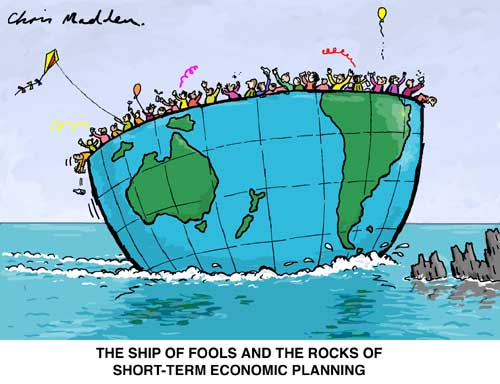
Zwei attended the streetcar symposium on Wednesday and came out with a great sinking feeling – TransLink just doesn’t get it. The event itself was very well put together, with ample food and drink, but there was little discussion about streetcars, but a lot of back-slapping by the various agencies and bureaucrats attending. TheAi??Ai??symposium was derailed and for good reason too, I beleive.
What was it all about? To my well practiced eyes the event was an infomercial for Bombardier Inc. (they were well advertised) to sell Flexity trams to Vancouver for their $90 million tourist streetcar line. Why not purchase much cheaper second hand trams from Europe? No one has ever thought of that in a Bombardier town.
The symposium was mostly a tedious event with most speakers dancing around the topic of streetcars with,Ai??Ai??”oh no, they are not light rail“, responses. What is even more worrisome is that TransLink hasn’t a clue about light rail or even streetcars and continue their well honedAi??Ai??mantra that LRT can’t carry more than 10,000 persons per hour per direction and that streetcar’s capacity is even less! of course this TransLink nonsense is to keep the SkyTrain option alive for Vancouver’s Broadway UBC Line.
Lesson for TransLink – Light Rail can carry over 20,000 pphpd! Of course TransLink knows this, but ignores it and continues to squander millions of dollars on pointless transit studies favouring SkyTrain metro or even a $80 million skyride to SFU!
As for Rail to the Valley and our ground breaking report? Nope, never, Nada; never heard of the group nor read the study; haven’t a clue whatAi??Ai??TramTrain is but; “we’ll have a look in Wikipeada……”.
Professor Patrick Condon summed up the days events; “They are talking about stations and land development, they just don’t get it.“
Zweisystem’s advice for the South Fraser Region, secede from TransLink and the sooner the better as TransLink is incapable of planning for affordable LRT and continues to dream in “SkyTrain”.
Update
Stephen Rees also attended the meeting and even though he said he wasn’t going to post to his blog about it, he has. It is worth while to see his view on the day.
http://stephenrees.wordpress.com/2010/09/30/streetcars-the-missing-link/
The Leewood Projects ‘Full Build Option’ or "Full Meal Deal". Finally a Transit Plan With Vision!

Click here to download the full 84 page report
What is interesting about the Rail for the Valley/Leewood Projects TramTrain or interurban report is the vision shown by the author. Not only does he plan for the ‘politically correct’ (for valley types) Scott Road to Chilliwack TramTrain he also looks to the future with extensions to Vancouver, Richmond and Rosedale, with the ‘Full Build Option’ costing just under one billion dollars!
For a better perspective, the 11 km. SkyTrain Evergreen Line extension will cost over $1.4 billion and service far fewer potential transit customers,Ai??Ai??this hasAi??Ai??lead to demand for more density along the Evergreen Line in the Tri-CitiesAi??Ai??region to try to increase ridership on the metro. The RftV TramTrain doesn’t need such high density as there is plenty of population along the route to provide ridership. The density issue for rail transit has become a SkyTrain only issue as there is sufficient population to ensure economic operation with much cheaper to build light rail.
For the same cost as the Evergreen SkyTrain Line, a Ai??Ai??full build (Full Meal Deal) Valley TramTrain, Vancouver/Richmond to Rosedale couldAi??Ai??be built and with the remaining $400 million, a Vancouver/Richmond to Maple Ridge TramTrain operation could also be funded.
The planned SkyTrain subway to UBC is estimated to cost $3 billion to $4 billion, yet for the same amount of monetary outlay, we could build a BCIT to UBC/Stanley Park LRT/streetcar ($1 billion); a full build RftV TramTrain ($1 billion); a new multi track Fraser River Rail bridge (approx. $500 million); TramTrain to Whiterock (approx. $300 million); and LRT/tram lines in Surrey and Langley ($500 million to $1 billion+)!
For the cost of one SkyTrainAi??Ai??subway line, we could fund a sizable regional LRT network combining light rail, TramTrain and streetcar/tram, with the potential of being able to get on a tram in Rosedale and take the same tram to Stanley Park or UBC or Richmond! This is the vision behind the Rail for the Valley/Leewood Projects Report, it is not just a one politically and bureaucratically prestigious rapid transit line, rather a plan to implement affordable light rail transit in the region, providing affordable ‘rail‘ transit for generations.
The sad fact is, Premier Campbell lacks such vision with his childish, TransLink Speak,Ai??Ai??remarks regarding light rail and his pronouncements are a continuingAi??Ai??embarrassmentAi??Ai??for thoseAi??Ai?? trying to get affordable rail transit built in the Fraser Valley.
The Fraser Valley municipal politicians had better showAi??Ai??transit vision now andAi??Ai??board the valleyAi??Ai??TramTrain, lest they be left waiting at the platform,Ai??Ai??payingAi??Ai??Vancouver’s fare for a new $4 billion SkyTrain subway under Broadway.

A Karlsruhe TramTrain operating on tram tracks. The same LRV can operate on the mainline.
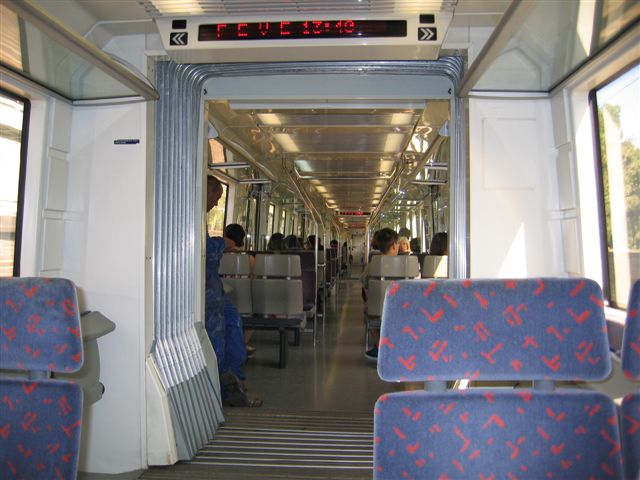
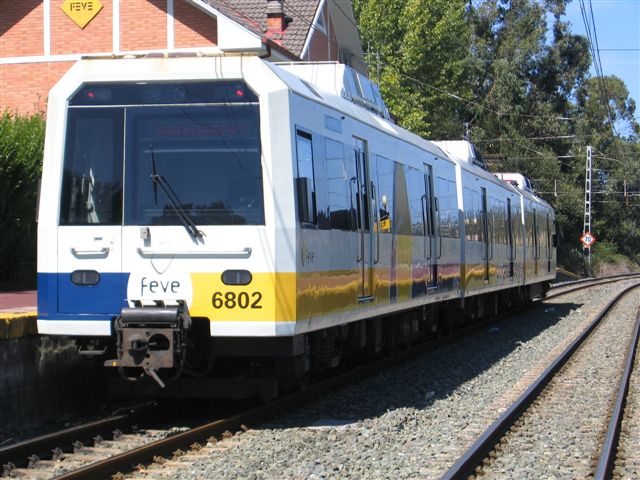
Spain’s FEVE Regional Light Railway – A Model For The Valley TramTrain?
The following came via the Light Rail Transit Association’s members group.
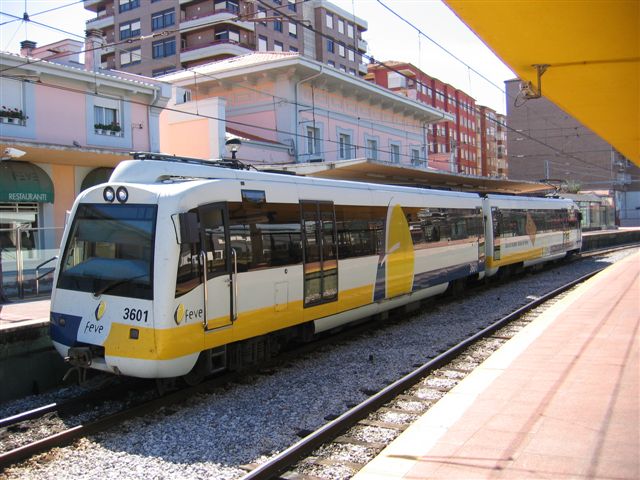
The FEVE is a Spanish narrow or metre gauge railway, what could be termed a ‘light’ railway, operating light rail style articulated electrical multiple units, diesel articulated multiple units as well as freight or goods trains. It is this type of operation that is envisioned for the Rail for the Valley interurban.
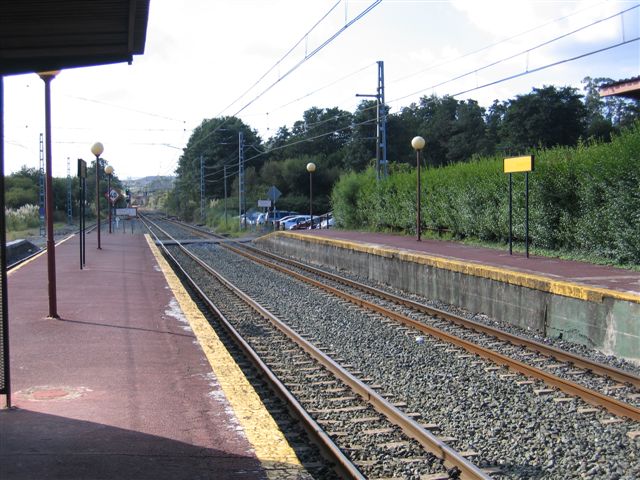
I visited last week the northern Spanish coast around Santander, and had the opportunity to travel frequently on the FEVE metre-gauge semi-light rail system, notably on the electrified bit between Santander and Cabezon de la Sal, which operates a regular service using high-platform tram-like articulated railcars. The stopping service uses double-articulated cars, and the “express” service single-articulated ones, both as single units. Current feed is by pantograph (I think 1500 vdc) to fairly basic but robust catenary, either span-wire or bracket-arm.
The stations are either unstaffed rural halts or else town stations with electronic gates and a “pay on arrival” ticket machine. Sometimes there is a roving conductor selling tickets on the railcar, but more often not. Disabled access is provided, either by new lift installations in the town stations or by using the ramp at the end of the platform in the rural case. There is also wheelchair space at one end of the railcar, and a lavatory at the other end. Bicycles are permitted.
The system is ferociously punctual, with a railcar every half-hour off-peak and more frequently at peak times. Rural halts seem to have spacious (and full ) car parks during the day, and even the off-peak services normally have a half-full load of passengers (in contrast to the competing local buses, which are frequently seen running empty). Fares are cheap, typically 1.90 euros single full fare for a 20 km trip (many concessions are on offer, and if my Spanish had been better I would have been tempted to try my ITSO pass and see if it worked !)
There is also a regular goods service, involving long trains of low wagons loaded with sheet metal hauled by a pair of diesel locos. At the frequent un-barriered rural level crossings these rely on massive air horns to announce their imminent passage (the passenger railcars use a whistle). This is one of the few visible weaknesses of an otherwise excellent system.
Whereas the goods trains go slowly, the railcars certainly don’t. I paced one from the adjacent motorway going at least 80kph, and they don’t slow down for the frequent sharp curves (the Spanish coast has very hilly topography – the new motorways have frequent tunnels, and the FEVE has frequent sharp curves rather like a full-size Hornby Dublo trainset.) Railcar brakes are interesting too: each trailing axle has a centrally-mounted disc brake of considerable size, but there are no track brakes. Despite that, the railcars can stop pretty quickly if required (see item above about “near-misses”)
I couldn’t get any information about the railcars’ build, but I would guess within the last decade and from a Spanish local supplier. The system seems to be subsidised by the “Ministerio de Fomento” (almost impossible to translate ‘Fomento’ – “public works and transport” is probably the closest, though it also means “encouragement”. We could do with that in the UK !)
A good example of European rural Light rail/Metro/Tram-Trains; exactly what we are attempting to achieve in the Fraser Valley.
Ai??Ai??http://maps.google.co.uk/maps?hl=en&tab=wl&q=Cabezon%20de%20la%20Sal
Ai??Ai??Ai??Ai??http://en.wikipedia.org/wiki/FEVE
Following photos by David Orchard
| Ai?? | ||
| Ai?? | ||
| Ai?? | ||
|
||
| Ai?? | ||
|
||
| Ai?? | ||
|
||
| Ai?? | ||
|
Mr. Campbell Responds to the Rail For The Valley/Leewood Report With Deciet

Gordon Campbell has a very bad reputation for not telling the truth, in fact he is a habitual teller of very tall tales.
The Premier’s statement in the following article, ” But you know the operating costs of the SkyTrain are about 50 per cent a year less than with light rail. And the ridership is two and a half times greater with SkyTrain.“Ai??Ai??is a complete falsehood!
A 1996 comparison with Calgary’s C-Train LRT shows that the Expo Line costs 40% more to operate than Calgary’s LRT (both about the same length), yet the C-Train carries more passengers!
http://www.calgarytransit.com/html/technical_information.html
Operating costs, Calgary C-Train (2006).
A 2009 study done by UBC Professor Patrick Condon also showed SkyTrain as being very expensive to operate and inAi??Ai??his study, SkyTrain had the highest cost to operate than any other transit mode in the study, which reflects much higher operating costs.
 http://thetyee.ca/News/2010/09/16/StreetcarToBeDesired/
Mr. Campbell’s other statement that ridership is two times and half a much as LRT’s is pure fiction, both SkyTrain and LRT have the same potential capacities. To remind everyone, capacity is a function of headway & train length. This comment from the Toronto Transit Commissions 1980’s ART Study sums up SkyTrain potential capacity:
Ai??Ai??”ICTS (which SkyTrain was called at the time)Ai??Ai??costs anything up to ten times as much as a conventional light-rail line to install, for about the same capacity; or put another way, ICTS costs more than a heavy-rail subway, with four times its capacity.”
There is no independent study that shows that SkyTrain attracts more ridership than LRT, in fact at-grade/on-street light railAi??Ai??tends to be very goodAi??Ai??for attracting ridership.
There are other erroneous claims being made in the article and they will be dealt with later.
Mr. Campbell demeans himself with such claims, as he continues to demonstrate that truth is not in his lexicon. SkyTrain was built and will be built for reasons of political prestige andAi??Ai??not what is best for the transit customer or the taxpayer. SkyTrain has failed to find a market domestically,in the USA and in Europe because it is both more expensive to build and more expensive to operate than its chief competitor modern LRT.
Mr. Campbell, Rail for the Valley demands honest debate for the future of transit in the region, not your half baked statements based on fiction, to pursue your political aims.
“Oh, what tangled webs we weave, when we first practice to deceive“, Mr. Campbell,Ai??Ai??your tangled webAi??Ai??of anti-LRT propaganda stops here, next time, deal in fact.
Burnaby News leader
By Jeff Nagel – BC Local News
SkyTrain detractors should consider the benefits of the technology and not focus solely on the lower cost of building new rapid transit lines with at-grade light rail, Premier Gordon Campbell said.
“It does cost less in capital A?ai??i??ai???Ai??Ai??it costs about $150 million less,” the premier said in an interview with Black Press, referring to price estimates for the Evergreen Line to Coquitlam.
“But you know the operating costs of the SkyTrain are about 50 per cent a year less than with light rail. And the ridership is two and a half times greater with SkyTrain.”
The decision to make the Evergreen Line a SkyTrain extension rather than a separate light rail line will ultimately move more people, faster at lower long-term costs, he predicted.
Campbell spoke Thursday, two days after the release of a new study from advocates who say a 100-kilometre light rail line from Surrey to Chilliwack can be opened on existing railway tracks for less than $500 million, compared to $1.4 billion for the 11-kilometre Evergreen Line.
Several mayors, including Surrey’s Dianne Watts, have lobbied for light rail for future lines.
Also critical to any transit expansion in the Lower Mainland, the premier said, is to ensure cities concentrate growth along transit corridors to support use of new lines while also making neighbourhoods more livable for walking and cycling.
“You can’t have an urban transit system at rural densities,” he said. “You have to actually give yourself a chance for transit to make ends meet.”
Campbell signed an accord with Metro Vancouver mayors Sept. 23 promising to explore a multitude of methods to raise more cash for transit expansion.
He said mayors are free to put on the table even contentious options like a vehicle levy or forms of road pricing, which the agreement notes can help shape how people choose to travel.
But he cautioned the key is to deliver good transit services that work and not merely try to use tolls or other fees to deter driving.
“You can’t punish people into transit,” he said. “People use the Canada Line because they love it. It meets their needs.”
Asked about public concern over the potential tolling of all three Fraser River bridges out of Surrey, Campbell downplayed the issue, saying the province determined in advance residents supported tolling the new Port Mann Bridge to deliver congestion relief.
“There’s always going to be someone who says ‘I don’t want to do it,'” he said, but cited the time savings for users of the Golden Ears Bridge.
“Think of the opportunities for connecting families, for moving goods.”
He said an “adult conversation” is required on the options to fund TransLink for the future.
Other parts of B.C. need transportation upgrades too, he said, adding the province will be hesitant about steering money to TransLink that deepens B.C.’s deficit or makes it harder to fund health care.
“If there was a simple answer it would have been done a long time ago.”
http://www.bclocalnews.com/greater_vancouver/burnabynewsleader/news/103734279.html
Rail for the Valley In The News
The Rail for the Valley/Leewood TramTrain study has had region wide reporting, with most of the weekly papers featuring this historic news release. Here are some links. (Stay tuned for more!)
CBC News Video: Light rail recommended for Fraser Valley
Chilliwack Times: Report supports light rail: ‘An honest accounting’ of the potential transit system
Abbotsford Times: All aboard: Report reviews Fraser Valley Interurban light rail
North Shore News: Valley residents on track with light rail
Vancouver Province: Valley light rail all go, twin groups claim



Recent Comments