Plans for a New, Six Lane Pattullo Bridge Revealed – TransLink’s Next Fiasco!
Ai??Ai??There is no question that the decrepit PutulloAi??Ai??is in dire need of replacement.Ai??Ai??Like the the Lions Gate Bridge, the Pattullo Bridge was a two lane bridge when it opened in the 1930’s and is ill suited for today’s traffic demands.Ai??Ai??The Pattullo Bridge has not aged well and last years fire on the steal and concrete bridge showed how decrepit the bridge has become.
Ai??Ai??What TransLink forgot, as well as METRO Vancouver bureaucrats have seem to have forgotten as well, that next to the fragile Pattullo Bridge, is an even more fragile and decrepit, single trackedAi??Ai??Fraser River Rail swingAi??Ai??bridge, which case for replacement is even greater that the Pattullo’s! The GVRD in the 70’s recognized that both bridges needed replacing and proposed a twin track, six lane andAi??Ai??two LRT line bridge for the location. Provincial politics took over and the Minister of Transportation of the day did not want anyone playing trains on anyAi??Ai??his bridges, thus the proposal was quietly ignored.
Now with increasing passenger rail service to Seattle and beyond, a possibility of a South Fraser TramTrain, and a general increase in rail traffic over the spindly Fraser River Rail Bridge, one would hope that TransLink would plan for a new road/rail bridge across the Fraser River. It is not to be, as TransLink has seem to quicklyAi??Ai??loose interest in ‘rail‘ transit once it crosses the Fraser river.
Rail for the Valley believes a new combined road/rail bridge would be a far better project, addressing the needs for both road and rail traffic.

Plans for a New, Six Lane Pattullo Bridge Revealed
By Damian Inwood, The ProvinceSurrey and New Westminster residents will soon get a look at TransLinkA?ai??i??ai???s plans for a new, six-lane Pattullo Bridge, slated to cost between $800 million and $1 billion.And the A?ai??i??Ai??preferred optionA?ai??i??A? for the new bridge sees access moving from Royal Avenue to Front Street on the New West side.
A?ai??i??Ai??We have a couple of open houses coming up on Sept. 14 and Sept. 21,A?ai??i??A? said TransLink spokesman Ken Hardie Wednesday. A?ai??i??Ai??What we will have are a couple of options to look at but one of them will be TransLinkA?ai??i??ai???s preferred option. It will show how the bridge will line up, what the road accesses will be and so on.A?ai??i??A?
Hardie said the preferred option is about 100 metres upstream from the current bridge.
The access on the Surrey side would be A?ai??i??Ai??not much of an issue,A?ai??i??A? he said, although it would require changes to Scott Road and 128th Street.
A?ai??i??Ai??In New Westminster right now we connect to the bridge by McBride Boulevard, Columbia Street and Royal Avenue,A?ai??i??A? he said. A?ai??i??Ai??The preferred option that we want to get reaction from the public to changes that a little bit. We would connect via McBride, East Columbia and Front Street but not by Royal Avenue.A?ai??i??A?
He said after hearing from the public at the open houses, TransLink will come up with a plan for approval by Surrey and New Westminster councils and municipal staff.
Hardie said that while work done on the Pattullo, ending in early 2009, A?ai??i??Ai??is good for another 10 years,A?ai??i??A? TransLink wants the new bridge open earlier than 2020.
A?ai??i??Ai??We want to have it in place well before that so, I would say, 2015 to 2016 would be a good target for us to have a new one ready to go,A?ai??i??A? he said.
Hardie said thereA?ai??i??ai???s been no decision on whether or not the bridge will be tolled.
A?ai??i??Ai??If we can find some other way to pay for it that doesnA?ai??i??ai???t involve tolls, weA?ai??i??ai???ll take that route. On the other hand if it will take tolls to build it, we definitely need to build it. So tolls will be considered but no decision has been made.A?ai??i??A?
The open houses are Sept. 14, from 5:30 p.m. to 8:30 p.m. at Chuck Baillie Community Centre at 13458-107A Avenue, Surrey, and Sept 21, from 5:30 p.m. to 8:30 p.m. at the Justice Institute at 715 McBride Boulevard, New Westminster.
Read more: http://www.theprovince.com/Plans+lane+Pattullo+Bridge+unveiled/3470913/story.html#ixzz0yNX31eP5
STREETCARS: THE MISSING LINK? – September 29, 2010
For Immediate Release A?ai??i??ai??? Please circulate!
Ai??Ai??Lawrence Frank, PhD, CIP, ASLA
Bombardier Chair in Sustainable Transportation University of British Columbia
604-822-5387 ph / 604-822-1628 fx
Ai??Ai??Bombardier Active Transportation Lab
http://www.act-trans.ubc.ca/Ai??Ai??
Ai??Ai??——————————————————————————————————————————————————————————————————–
UBC School of Environmental Health and the UBC School of Community and Regional Planning are pleased to inform you of our upcoming symposium:
Ai??Ai??STREETCARS: THE MISSING LINK?
September 29, 2010Ai??Ai??(Wednesday)
Ai??Ai??Program:Ai??Ai?? 8:30 am A?ai??i??ai??? 5:15 pm
Reception: 5:30 pm A?ai??i??ai??? 6:30 pm
Ai??Ai??Renaissance Vancouver Harbourside Hotel, Vancouver BC.
Ai??Ai??OVERVIEW:
Ai??Ai??The Olympic Line – VancouverA?ai??i??ai???s 2010 Streetcar demonstration project held during the Vancouver Winter Olympic Games saw urban streetcars return to Vancouver for the first time in almost half a century. The project proved extremely popular and has ignited the idea of reinvesting in streetcars as part of a broader sustainable transportation system for the City of Vancouver and the entire Metro Vancouver region.
Ai??Ai??KEY TOPICS:
Ai??Ai??Streetcars: The Missing Link?Ai??Ai??brings together decisions makers, academics, and community leaders to explore, discuss and debate the potential role of streetcars as a critical link within the transportation system and the idea of bring streetcars back to Vancouver. Key topics of this symposium include:
- Historical role of streetcars in Vancouver
- Implementation costs
- Streetcar impacts on urban form and mobility
- Urban design and modal integration – lessons learned in other regions
- New data and information from the Olympic Line demonstration project.
Ai??Ai??DETAILED AGENDAAi??Ai?? is available here:Ai??Ai??Ai??Ai??http://www.soeh.ubc.ca/Continuing_Education/Streetcar.htm.Ai??Ai??
Ai??Ai??REGISTER AT:Ai??Ai??Ai??Ai??https://www.eplyevents.com/streetcar_UBC.Ai??Ai??Ai??Ai??Ai??Ai??Please register early as space is limited.
Ai??Ai??A hosted reception will follow the program at the revolving Vistas 360 restaurant/lounge on the 20th floor of the Renaissance Vancouver Hotel Harbourside. Join delegates for complimentary refreshments, appetizers, and additional network opportunities while taking in a 360-degree panoramic view of the city and harbour. Information from UBC students in the Schools of Community and Regional Planning, Architecture and Landscape Architecture, and Environmental Health on streetcar systems and their impacts will be shared at the reception.
Ai??Ai??WHO SHOULD ATTEND:Ai??Ai??Ai??Ai??decision makers, municipal staff, developers, community leaders, media, academics, organizational leaders.
Ai??Ai??This event is sponsored by the J. Armand Bombardier Chair in Sustainable Transportation at UBC.
Ai??Ai??Inquiries:
Lydia Ma
UBC School of Environmental Health
Phone: (604) 822-9599
Email:Ai??Ai??lydia.ma@ubc.ca
Web:Ai??Ai??Ai??Ai??http://www.soeh.ubc.ca/Continuing_Education
"Misguided" Busway Part 2
More news about Cambridge’s “Misguided” bus or BRT. Instead of being simple and cheap alternative to a ‘rail’ solution, the Cambridge BRT is ending up costing Ai??Ai??more than reinstating the rail line for DMU/EMU or tram service.
The real question needed to be answered will be: “For all the cost and delay, will the Cambridge guided (BRT) bus attract its projected customers or will it merely be regarded as a local transit curiosity and not attract the all important motorist from the car?”

The yet to be used Cambridge Guided Busway
Guided Busway to Open Next Spring
http://www.cambridge-news.co.uk/Huntingdon-St-Ives-St-Neots/Guided-busway-to-open-next-spring.htm
Chris ElliottThe guided busway may finally be up and running by next spring, the News can reveal.
Sources close to the project have disclosed that at the current rate of progress, it could take about seven or eight months to finish the concrete track completely and get it ready for the first buses to roll.
That will mean an opening date either in March or April 2011 A?ai??i??ai??? making the busway more than TWO YEARS late.
As the News reported a few days ago, Cambridgeshire county councillors are due to examine a progress report on the troubled scheme at a cabinet meeting on Tuesday, September 7.
The report says that contractor BAM Nuttall has still not fixed six defects in the northern section of the busway, which runs between St Ives and Cambridge.
However, the company is making “good progress” on completing the southern section at Trumpington, and is expected to be finished there by mid-December.
If BAM Nuttall does complete the southern section by mid-December, the council will give the contractor a month to rectify the faults on the northern section A?ai??i??ai??? and if that does not happen, the council will step in to do the job itself.
Together with subsequent checks and bus trials, the News understands that this could stretch out the work until March or April A?ai??i??ai??? although if conAi??Ai??struction of the southern section is completed more quickly, the timetable might be brought forward.
The defects identified by the council include raising the level of parts of the maintenance track alongside the busway, which has been flooded, and remedial work on the viaduct at St Ives, where rainwater has leaked through an unsealed joint.
A county council spokesman said the council could not confirm that the busway would open by the spring.He said: “Whilst the contractor has said they will complete the route by mid-December, we are in their hands until the work has been completed.Ai??Ai??“We are very clear that the defects must be rectified and once the route is handed over we will know exactly what work the council will need to carry out and a more precise idea of how long that will take.Ai??Ai??“It is frustrating that BAM Nuttall have not finished the job as yet and although damages of over Ai??A?7 million have already been deducted from the contractor all we really want is the work to be completed so we can get the route open and passengers can start using it.”Ai??Ai??Mike Mason, South Cambridgeshire district councillor for Histon and Impington, criticised the delays.Ai??Ai??He said: “ItA?ai??i??ai???s a political disaster, and itA?ai??i??ai???s never going to make money. The council have completely failed and there is no credibility in any of their statements because theyA?ai??i??ai???ve made so many predictions that havenA?ai??i??ai???t happened.
“Any of the political parties on the council could have stopped this a long time ago, and all three political parties share equal blame, but the Cambridge taxpayer is going to pay the price.”
Ai??A?76m Leigh Guided Busway on hold over cost fears – From the Manchester Evening News
Postings in other blogs have been painting an all too rosy a picture of BRT (Bus Rapid Transit) and this post should level the playing field somewhat. Just as a note, the Cambridge “Misguided Busway” is built on a former railway formation which greatlyAi??Ai??reduced initial cost estimatesAi??Ai??and as the guided bus project now stands, it would have been cheaper to reinstate the railway instead! Imagine, a modern LRT line with lawned rights-of-ways, rather than this start concrete guide way needed for the BRT.
The yet to be used Cambridge Guided Busway
Ai??A?76m Leigh Guided Busway on hold over cost fears
Alan Salter – August 31, 2010Manchester Evening News
A controversial Ai??A?76m busway plan in Greater Manchester has been put on hold.
A review has been ordered into the Leigh Guided Busway project A?ai??i??ai??? which has been on the drawing board since 1996 A?ai??i??ai??? even though contracts for vital preparatory work worth Ai??A?1.3m have already been awarded.
The move comes after Richard Knowles A?ai??i??ai??? an Oldham councillor and Salford University professor of transport geography A?ai??i??ai??? was sent to Cambridge to see a similar scheme.
The Cambridge busway is infamous in the transport world for spiralling costs and delays. The bill for the 25-mile busway, between Huntingdon and Cambridge, has risen from Ai??A?54m to Ai??A?116m and could even reach Ai??A?160m by the time it opens.
Now, the Conservative-Lib Dem coalition which controls the Greater Manchester Integrated Transport Authority has voted to review the Leigh busway A?ai??i??ai??? despite Labour opposition.
The project A?ai??i??ai??? linking Wigan, Leigh, Salford and Manchester A?ai??i??ai??? would see a special lane built for buses on the East Lancs Road. Four miles of the route A?ai??i??ai??? between Leigh and Ellenbrook A?ai??i??ai??? would see specially-adapted buses using A?ai??i??E?guidedA?ai??i??ai??? concrete tracks along the path of an old railway line.
Keith Whitmore, vice-chairman of the authority, said: A?ai??i??Ai??We are talking about a review which will take weeks rather than months. It would look at the costings and the way it operates in the light of what has happened in Cambridge.
A?ai??i??Ai??I visited Utrecht where they rejected the building of a second busway and decided to build a tram line instead. There is also the question of how the Leigh busway would operate A?ai??i??ai??? who exactly will use it has never really been tackled.
A?ai??i??Ai??If the review shows that everything is fine, then it can go ahead. But there has never been unanimous support for it.A?ai??i??A?
Dubbed the A?ai??i??E?misguided buswayA?ai??i??ai??? by opponents, the project has been seen in some quarters as a sop to Wigan and Leigh A?ai??i??ai??? which are not included in plans to expand the Metrolink.
For more on Cambridge’s ‘Misguided‘ busway:
Ai??
A letter from Oslo

Oslo Tram
This has been forwarded to Rail for the Valley from the Eurotrams e-group.
Now where have you heard similar arguments?
Read RoyA?ai??i??ai???s last two paragraphs, a certain resonance with the situation in the Fraser Valley & Metro Vancouver?
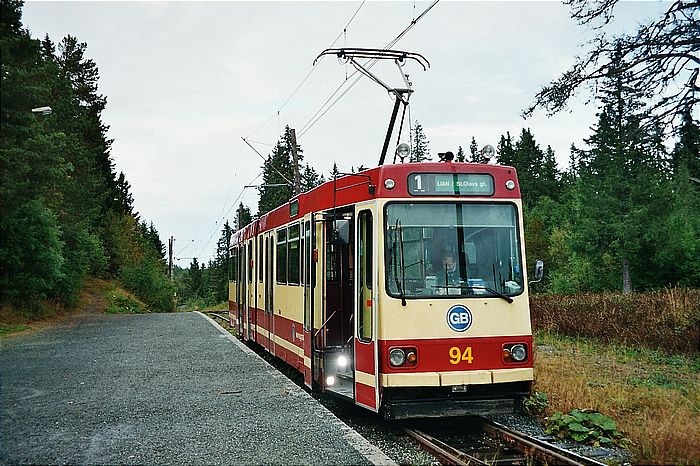
The infrastructure in Trondheim suffers from lack of interest from the city council. The tramway has been threatened with closure for the last half century.
After a kind of compromise back in 1984, when rolling stock was renewed and the network reduced to half the size, costs escalated – which was a cunningly calculated plan to prepare for a total closure, “reduced costs may give you twice as many buses”. But “may give” is not the same as “will give”. After the tramway closure in 1988 the level of bus services was cut back because people were no longer using public transport.
However, what the city council did not know was that there were no potential buyers to the 11 almost new 2.6 metre wide metre gauge trams. Luckily, an attempt to sell them to Cairo was not successful. Meanwhile, the bus substitution service along the still almost intact GrA?A?kallbanen suburban tram line was not working well, so a group of enthusiasts were granted permission to borrow some of the trams and work the line. This proved to be a success, and for some years the reopened tramway was run
without subsidies.The tracks in the city centre had been torn up only a few days after closure in 1988, a phenomenon well known from cities run by people fearing public demand to reopen. For the past twenty years a plan to extend the line through the city centre to the railway station has been promoted – and stalled – and rejected, over and over again.
The city council has over the last years unwillingly been made to take over the responsibility for the surviving tramway line, and the service is now run by private contractor Veolia. However the city council will still have to pay for maintenance and rehabilitation of the now run down infrastructure. So the city council will once again collect all the arguments they can find to close the tramway again. But of course, many people are fighting the city council on this issue.
After the light rail success in Bergen a proposal to either expand the metre gauge tramway or to build a complete new light rail system was launched. The city council ordered a feasibility study, which concluded that a bus rapid transit system would be fully adequate……and so very much less expensive than light rail (allegedly 90% less). So you have heard that one before? Of course, idiots are equally spread all over the world, we’ve got them too.
Why is public transport on rails so much better? The answer is simple, because people want quality, not cheap buses. By 1960 people in Trondheim made an average of 249 rides by public transport annually, Bergen 266 rides and Oslo 223 rides. By the year 2000 public transport rides had fallen to a 100 rides per citizen in almost tram-less Trondheim, a 105 rides in tram-less Bergen, and risen to a 315 rides in tram and metro city Oslo. Bergen has just turned the trend.
Roy Budmiger, Oslo
World wide Transit and Light Rail News

Nanjing.
http://www.railway-technology.com/projects/nanjingmetro/
Lagos.
http://www.railway-technology.com/projects/lagosrailmasstransit/
Ho Chi Minh
http://www.railway-technology.com/news/news94402.html
Phoenix
http://www.valleymetro.org/metro_light_rail/
Keep rail local, says pteg
http://www.railtechnologymagazine.com/dataview/News/News_Article.aspx?KeyValue=2262
Edinburgh
http://news.scotsman.com/news/Tram-shifts-for-Pope.6498683.jp
http://news.scotsman.com/transport-news/Platform-Richard-Jeffrey-defends-the.6497807.jp
News From Portland – Trams and Light Rail

The newly-redesigned Portland Streetcar website is especially informative, and is doing a great job
reporting on the week-by-week progress of our forthcoming east side (of the Willamette River) streetcar line. For example, see
http://portlandstreetcar.org/node/16
for a video visualization of the new line, and also
http://portlandstreetcar.org/node/12
which has a good map and discussion of the current Broadway Bridge closure. The 1913 bridge will connect the existing west side line to the new east side one; the bridge is closed all summer for track laying. The bridge was the world’s largest bascule bridge and is still one of the larger ones. If you like interesting bridges, see
http://en.wikipedia.org/wiki/Broadway_Bridge_
for a good article.
Finally, have a look at
http://www.nextbus.com/predictor/publicMap.shtml?a=portland-sc&r=streetcar
for a realtime map showing the locations of the trams on the west side
Prefab tram track = fast construction! Friends of the Broadway Light Rail/Streetcar Take Note!
The following article from EccoRussia, gives an account of the installation of 670 metres of prefabricated tram track on the Athens (Greece) light rail/tram in just 10 days or about 67 metres of new tram track a day! At this speed of track laying it would take a mere 14 days to lay one kilometre of new track!
What is important, is that new tram/LRT construction would not unduly affect local merchants for a great length of time, as one’s storefront would not see construction in front of it for more than a few day, unlike Susan Heyes, whose business was disrupted for years by subway cut-and-cover construction!
It also means that a 20 km. BCIT to UBC LRT line would take less than 300 days to build! Or having two construction groups, working from BCIT and UBC towards each other, would take about 150 days. Now that is something to think about!
The first extension in the Athens tram, was duly finished and commissioned for circulation, in mid-October.
The extension measuring 670 meters comes as a trial for new technologies rather than a substantial addition to the already operating 22 km network.
One of them and surely the most important is the introduction of prefabricated segments for the substructure.
The segments were used in the crossing of Poseidonos avenue, a high velocity motorway in the south of Athens and gateway to the seaside tourist and nightlife areas.
In order to facilitate the construction of the crossing and the sequential congestion of traffic, given a conventional construction, prefabricated segments came as a natural choice.
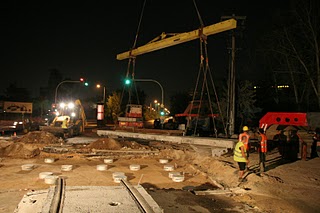
The segments were constructed in a prefab plant in the outskirts of Athens, using Belgian know-how adapted in the local conditions.
The segments incorporating the rails and all major network duct ways were laid in less than ten days, including the soil and substructure preparation, a major advance to the other ways monthly time span.
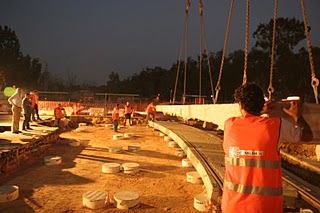
Behavior up to now in the heavy traffic is said to be very smooth, and it is almost certain that prefab segments are to be used in the next extension to Peraeus.

Tram S.A. was founded in March 2001 and is a subsidiary company of ATTIKO METRO S.A.
In 2002, the company begun the construction of the new Athens tram network, while commercial operation started in July 2004, a few weeks before the Athens 2004 Olympic Games.
TRAM S.A. is a public service corporation supervised by the Ministry of Transportation & Communications.
The company’s mission is to design, develop and operate the modern tram network.
http://www.ecorussia.info/en/ecopedia/examples-of-green-transport
TramTrain’s Now Invade Australia

What is good for Karlsruhe, Germany and maybe good for the Vancouver/Fraser Valley region, is now seen as good for Newcastle Australia!
For a transit mode that is yet 20 years old, the simplicityAi??Ai??andAi??Ai??cost effectiveness of TramTrain is being demonstrate not only in Europe and North America, but now also in Australia.
Communities are pressurizing their Governments, Councils and Politicians to instigate Light Rail/Tram-Train systems.
http://www.smh.com.au/national/trams-back-on-the-tracks-after-60-years-20100824-13qg8.html
http://saveourrail.org.au/index.html
http://www.newcastledeservesbetter.com/
Ai??Ai??Save Our Rail NSW Inc. & NEWCASTLE TRANSPORT for BUSINESS DEVELOPMENT, have prepared & commissioned feasibility studies.
From Bus to Light Rail
From
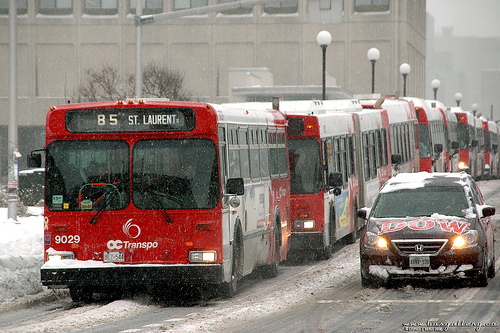
to

Light Rail.
The following Master’s Degree Project – Ottawa’s Transit Busway to Light Rail by David James, is well worth a read.
http://homepages.ucalgary.ca/~dpjames/mdp/david_james-mdp-final.pdf



Recent Comments