Shaw Cable Documentary
An excellent Shaw documentary focussedAi??Ai??entirelyAi??Ai??on the potential of the old BC Electric rail line running through the Fraser Valley will be shown over the next few weeks. The times are shown below. Among other things the documentary features a helicopter ride along the Fraser Valley and interviews with Township of Langley Mayor Rick Green and Surrey Mayor Dianne Watts. Don’t miss it.
Toronto’s Transit Follies – It Must Be Election Time!

Vancouver is not the only Canadian City to suffer political silliness before election time, asAi??Ai??regional councilAi??Ai??candidates are all tabling their transportation plans, if elected. The subway lobby is preaching their gospel of underground railways to everywhere, but come up short on how to pay for such extravagance. It seems like TransLink’s grand SkyTrain plansAi??Ai??most of the candidates subway plans are mere ‘Pixie Dust’. The mostAi??Ai??daft of the political promises doing the roundsAi??Ai??is that ofAi??Ai??Ai??Ai??front-running Etobicoke councilor, Rob Ford, plansAi??Ai??to abandon Toronto’s iconic streetcars andAi??Ai??newly approved light rail lines. In an age where LRT streetcar is making a revival in Canada with new lines announced in Winnipeg and Montreal, Mr. Ford’s anti LRT stance is more thanAi??Ai??troublesome.
If Mr. Ford had read anything about transit at all, he would have found that one Toronto non-articulated streetcar is as efficient as three buses, thus replacing one streetcar (one driver) with three buses (3 bus drivers) would greatly increase the cost of public transit in Toronto! Ridding Toronto of its streetcars would create massive traffic gridlock and chaos with three times as many buses trundling along city streets.
The pro metro/subway plans sounds great, but funding newAi??Ai??metro construction at about $250 million/km. will be hugely problematic. To extend Toronto’s subway lines will be expensive and unlike London and other cities with large metro networks, Toronto’s subway is ‘broad gauge’ (4 ftAi??Ai??10Ai??Ai??7A?A?ai??z8Ai??Ai??inAi??Ai?? or 1,495 mm) and track-sharing with regular railways is impossible, with allAi??Ai??construction therefore must be ‘greenfields‘. Subways may sound nice to the naive, but the financial burdens placed on taxpayers is very large.
As the electoral ‘silly-season’ commences, voters in the Toronto region had better weigh their electoral options as political wannabees may dramatically increase resident’sAi??Ai??tax burdens by their less than well thought out transit plans, including replacing trams with buses.

Marcus Gee – Globe and Mail – Friday, September 10, 2010
Given the seriousness of TorontoA?ai??i??ai???s transportation mess, you might expect some serious proposals from the candidates for mayor. Vain hope.
Consider Rob FordA?ai??i??ai???s plan. Released this week in a YouTube
video by the front-running Etobicoke councillor, it would scrap the Transit City network of light-rapid transit lines scheduled to roll out over the coming years. In its place, he would build new subways, extending the Sheppard subway from Downsview station in the west to Scarborough Town Centre in the east and replacing the aging Scarborough rapid-transit line with a full-fledged subway.
That will appeal to those who think subways, not LRT, are the way to go, but subways are far more expensive. How would this self-proclaimed paragon of fiscal prudence pay for his scheme? Simple, says Mr. Ford. He would get most of the $4-billion cost by taking $3.7-billion already dedicated to Transit City.
The trouble is that, having spent years negotiating, approving and funding Transit City, QueenA?ai??i??ai???s Park is hardly likely just to hand Mr. Ford a cheque. Even if it did, $790-million of the $3.7-billion Mr. Ford has his hungry eyes on is already being used to expand the Viva transit system in York region, not build Transit City.
Mr. Ford says he would raise a further $1-billion for subways and road upgrades by selling developers the right to build around subway stations, but the figure seems wildly optimistic. It often takes years for development around subway lines to arrive. Many stations on the Bloor-Danforth line are still surrounded by old low-rise buildings decades after the line was built.
The really eye-popping part of his scheme is the plan to replace downtown streetcar lines with buses. This, he says, would save drivers from the trauma of getting stuck behind trundling streetcars. But hang on a bit. Streetcars carry more passengers than buses A?ai??i??ai??? many more, once the big new cars ordered by the TTC arrive A?ai??i??ai??? so to carry the same number of passengers you would need a lot more buses. Imagine all those buses trying to pull in and out of traffic on a crowded artery such as Queen Street, spewing exhaust all the way.
The TTC has spent tens of millions of dollars rebuilding and upgrading downtown streetcar tracks in recent years. If Mr. Ford got his way, that time and money would go to waste. So would the $1.22-billion the TTC has spent to order 204 new cars for 11 city streetcar lines. (Disregard Mr. FordA?ai??i??ai???s claim that he would simply sell the cars, specially designed for Toronto, to some other city. It isnA?ai??i??ai???t that easy.)
Though Mr. FordA?ai??i??ai???s plan is typically the worst thought-out of the bunch, many of the other candidatesA?ai??i??ai??? plans are faulty, too. George SmithermanA?ai??i??ai???s ambitious plan for new LRT and subway lines looks great until you ask him how he is going to pay for it. Simply put, he would borrow the money A?ai??i??ai??? about $5-billion in all. How can someone who promises to make A?ai??i??Ai??fiscal credibility job oneA?ai??i??A? at city hall propose saddling an already-indebted city with such a burden?
Rocco RossiA?ai??i??ai???s $4.5-billion plan to build two kilometres of new subway lines a year for the next decade is affordable only if he goes through with his plan to sell Toronto Hydro, and even then itA?ai??i??ai???s not clear the proceeds would cover such a massive expenditure. Similarly, Sarah ThomsonA?ai??i??ai???s plan to pay for 58 kilometres of new subway lines partly by levying tolls on city highways underestimates both the take from tolls and the cost of the lines.
With the exception of Joe Pantalone, who simply proposes to press on with Transit City, all of the candidates seem to have sketched their fantasy transit schemes on the back of a napkin. Anyone can draw lines A?ai??i??ai??? this subway here, this LRT there. The question A?ai??i??ai??? the only question A?ai??i??ai??? is how to pay for it all. As transit advocate Steve Munro points out, none of the candidates has even tackled how to find the extra $70-million it will take to keep the current TTC system operating in 2011.
For a local view of Mr. Ford’s hasty plans –
http://lrt.daxack.ca/blog/?p=147
Off The Rails – From the Abby Times
An interesting tome in the Abbotsford Times.
Anyone wanting to put ‘rail’ transit down the median of the number 1 highway forgets that it would be hugely expensive and the curvature and gradients along the route would mean very expensive engineering would have to be done. Going ‘greenfields’ construction is always an expensive propositionAi??Ai??which knowledgeable transit planners try to avoid.
The problem with ‘rapid bus’ or BRT is that those who propose it do not ride it. The Achilles heel of any bus bases transit system is that it doesn’t attract ridership and BRT is no exception. Despite the hue and cry from the bus lobby, the singular fact remains that many people perceive buses as ‘looser cruisers’ and take the car instead.
The one workable option of course is reinstating the Vancouver to Chilliwack interurban but using the 21st century Tram Train instead. It makes sense in our financially challenging times to use existing railway infrastructure to improve regional transit, as our region badly needs affordable transit solutions for our endemic transportation woes.
The SkyTrain Lobby must grow up and realize there is precious little money for their grand metro solutions and SkyTrain here or there, sometime in the next fifty years is just not good enough!

Off The Rails
We’re all at the mercy of Highway 1.” – David D. Hull, Abbotsford Chamber of Commerce
By Rafe Arnott, The Times – September 7, 2010A commuter train running between Chilliwack and Vancouver along Highway 1 is not feasible, say area rail proponents and infrastructure experts, but one running through higher-density urban areas could be a possibility.Rail for the Valley spokesman John Vissers said a commuter train running down the centre of the Trans-Canada Highway through the Fraser Valley would help traffic volume, but is financially impossible.
Calling it a “pie in the sky” idea, Vissers said the government simply doesn’t have the money to finance such an ambitious transit project.
“Putting something down the middle of the freeway is hugely expensive,” he said.
“Where would the tax money come from to build something like that? That money doesn’t exist anywhere. The costs are staggering.”
B.C. Ministry of Transportation spokesman Dave Crebo said a study to examine transit options and commuter demand in the valley is underway.
“[We’re waiting] on the results of that, so no one would be committing to putting trains out there right now,” he said.
Port Mann Bridge/Highway 1 Improvement Project spokeswoman Pamela Ryan said the new bridge is designed to accommodate a grade rail line.
She said while running a train down the middle of the TransCanada Highway isn’t the best option, exploring other public transit routes through more densely populated areas in the Fraser Valley that could accommodate passenger stations is viable.
“If we’re looking at providing rapid rail along the south side of the Fraser River, the Highway 1 corridor is probably not the best location for it,” Ryan said.
“Whether that be Fraser Highway right-of-way, or whatever, rail systems are more effective when you have them located near high-density areas,” she said.
Vissers thinks the existing rail line in the hands of FVLR would be a good starting point, rather than punching through another line.
“We already own the track, and it’s underused. Why not put a few [rail] cars on it and see what happens?”
Abbotsford Chamber of Commerce Executive Director David D. Hull said long-term planning is key to infrastructure growth, but British Columbia is 15 years behind dealing with traffic issues in the Fraser Valley.
“We’ve neglected the capital infrastructure of the province for far too long,” he said.
According to Hull, delays stemming from traffic issues with Highway 1 cost Lower Mainland businesses.
“It’s in the hundreds of millions of dollars. The B.C. Trucking Association has estimated in their industry alone its in the tens of millions of dollars.
“We’re all at the mercy of Highway 1,” Hull said.
Taking into the consideration the current traffic volumes, Ryan said the new highway and bridge improvements would allow for a rapid bus line in designated HOV lanes to serve commuters, including a new park and ride transit exchange near 202 Street in Langley.
“This Highway 1 rapid bus service will be able to take passengers between [Lougheed Station in] Burnaby and Langley in about 23 minutes,” Ryan said.
“Which provides access not only to the Millennium Line, but the Expo Line as well.”
Describing North America as a “rubber-tire society,” Hull said dedicated lanes for busses on the newly expanded Highway 1 might better serve current commuter demands.
“That’s good enough to get you somewhere, I mean, you don’t have to be on a train.”
Vissers said more roads only means more cars, and whenever capacity in increased, traffic follows, and that’s not a solution.
“A solution is to develop alternatives.
“Building freeway capacity is a 1970’s solution for the 21st Century… it doesn’t work.”
Read more: http://www.abbotsfordtimes.com/news/Rails/3489498/story.html#ixzz0zK9NHh8q
TransLink in the news! SkyTrain Fizzles and the Head Amateur resigns!
Debris on the guideway evidently caused the Expo Line to come to grief during the morning commute. Once again, the automatic (driverless) metro shows its vulnerability when surprises happen along the line.

SkyTrain’s Expo Line problems caused by debris hitting track
ReBy Rhiannon Coppin, Vancouver Sun – September 10, 2010 11:10 AM
METRO VANCOUVER – The SkyTrain system came to a halt this morning at 7:15 a.m. after some of the electrified portions of the Expo Line track were ripped out by debris lodged under some trains.
A?ai??i??Ai??The whole system shut down,A?ai??i??A? TransLink spokesperson Drew Snider later confirmed in e-mail.
A?ai??i??Ai??We segregated the Millennium Line from the Expo Line, so we had trains running between VCC and Columbia Stations. By about 7:50, we had some service restored along the Expo Line, involving single-track trips between certain stations; customers then had to change trains at those stations,A?ai??i??A? Snider said.
Though Expo Line trains were moving again, service was slow.
Trains were arriving at Waterfront Station but were not making the trip eastbound out of downtown Vancouver, a SkyTrain attendant confirmed at 9:15 a.m.
Outside Waterfront Station, a Coast Mountain Bus Transit Supervisor was directing buses over his cell phone to come in and pick up riders going back down the line.
A?ai??i??Ai??I believe the SkyTrain is down, thatA?ai??i??ai???s all I know, and we are trying to set up a bus bridge to get people from here to Joyce Station,A?ai??i??A? said the supervisor, Michael, who would not provide his last name.
He was on his cellphone with the driver of bus 8143 as it came down Seymour Street and got into position outside Waterfront Station. It was not the first in the bridge he said, and certainly not the last.
Snider later confirmed that 18 buses were diverted for the bridge between Metrotown and Waterfront.
A?ai??i??Ai??Since this was at the height of rush hour, CMBC didn’t have many buses (or bus drivers) to pull from regular service and put onto the bus bridge,A?ai??i??A? Snider said.
As a dozen passengers boarded bus 8143, Michael instructed the bus driver to head first to Granville Station: A?ai??i??Ai??Then make a left on Georgia Street. Take the viaduct, and right on Main. Pick up at the Main Station. From Main, youA?ai??i??ai???re going to go up Broadway. At the Broadway Station, dropoff and pickup and then from there, go to Nanaimo Station, then 29th and Joyce, however you can get there.A?ai??i??A?
A?ai??i??Ai??It only stops at the SkyTrain stations?A?ai??i??A? the driver asked.
A?ai??i??Ai??SkyTrain station, SkyTrain stations, this is a SkyTrain bus,A?ai??i??A? the supervisor replied.
A sign posted at the east entrance to the SkyTrain platform at Waterfront told passengers to A?ai??i??Ai??expect lengthy delays.A?ai??i??A?
Phil Goddard, a musical instrument salesman at Long and McQuade near the Main Street station, waited a few minutes on the platform before being told to go back up and get the “bus bridge.”
A?ai??i??Ai??IA?ai??i??ai???m actually in a real rush to get to work,A?ai??i??A? he told a reporter who tried to speak with him.
A?ai??i??Ai??I just got off the SeaBus from North Vancouver,A?ai??i??A? he said.
A?ai??i??Ai??IA?ai??i??ai???m not late for work yet,A?ai??i??A? he said, running for the bus. A?ai??i??Ai??I will be though.A?ai??i??A?
Joe Thomas works at Universal Printing in North Vancouver. His commute was the opposite of GoddardA?ai??i??ai???s: He left from Broadway Station and at about 9:30 a.m. was now running at a good clip from the SkyTrain platform to catch a SeaBus.
A?ai??i??Ai??How long were you delayed?A?ai??i??A? a reporter asked.
A?ai??i??Ai??An hour,A?ai??i??A? Thomas said.
A?ai??i??Ai??Wait a long time.. stuck on the train… wait a long time,A?ai??i??A? he added between breaths as he ran.
TransLink issued a service alert stating that the Expo Line westbound was operating from King George to Joyce only. From there, passengers have to get off and take a single line train between Joyce and Main Street, where they must switch trains again to get into the downtown core.
For the duration of the morning commute, Millenium Line trains would be turning back at Columbia Station.
The electrical problem involved dragged debris reportedly occurred in the downtown area between Broadway and Main Street stations.
Snider couldnA?ai??i??ai???t say when the electrical track infrastructure would be repaired and operational, but said that A?ai??i??Ai??as of right now, our techs are making progress on fixing the situation.A?ai??i??A?
A?ai??i??Ai??TheyA?ai??i??ai???re aware that [afternoon] rush hour is approaching.A?ai??i??A?
The TransLink board of Amateurs says adiA?A?s to Dale Parker, a Campbell favourite selected to steer the bureaucracy the way the premier wanted it steered. As it stands, TransLink is rudderless and wallowing in a sea of debt, without a safe haven in sight. Could it be the start of the ‘rats’ leaving a sinking ship?

TransLink chairman stepping down
By Don Cayo, Vancouver Sun – September 10, 2010
VANCOUVER — TransLink will lose the first chair of its board of appointed professionals that was set up three years ago to replace its former board composed of municipal council members.
Dale Parker, a long-time businessman and a member of many corporate and charitable boards, announced in an exclusive interview with the Vancouver Sun on Friday that he won’t seek a renewed appointment when his term ends Dec. 31. His decision was influenced, he said, by his age A?ai??i??ai??? he’s nearing 75 A?ai??i??ai??? and his view that he’s able to leave TransLink’s governance in relatively good shape.
The appointment of the nine-member board was controversial at the time A?ai??i??ai??? Burnaby Mayor Derek Corrigan called its members “Liberal flunkies” A?ai??i??ai??? and its work has been criticized for taking place largely behind closed doors.
But Parker said he and his colleagues have been able to bring a professional approach to what had long been a highly politicized governance structure, and it has both reigned in operating costs and set the stage for orderly development.
Ai??Ai??Read more: http://www.vancouversun.com/TransLink+chairman+stepping+down/3507301/story.html#ixzz0z9k22jWi
The SkyTrain Lobby – Just The Usual Suspects!
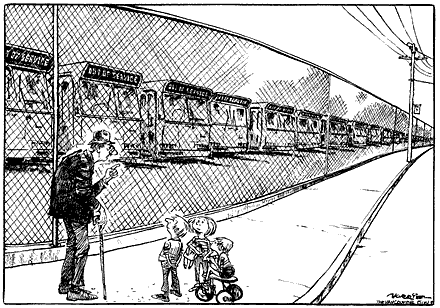
"It used to be something called public transit ... then for reasons you're too young to understand, they did away with the public."
Transit again is making front page news in the dailies and regional newspapers, with TransLink claiming that the next big rapid transit (read SkyTrain) line will be in Surrey, not Broadway. A few international transit blogs have picked up the storyAi??Ai??with the usual suspects singing hosannas about SkyTrain, while in the same breathe libeling anyone who supports light rail, including long time advocates of the worlds most built transit system! What is perverse about the SkyTrain lobby is that they moan on and on about how facts about LRT being distorted or untrue, yet all they have to offer in turn is TransLink’s dubious claims about SkyTrain and the Canada Line, which is a conventional metro and not ART.
What is even more sad is that the old saw, “SkyTrain is cheaper to operate than light rail because it has no drivers” is trundled out ad naseum by the usual suspects and by bloggists who should know better. Automatic or driverless railways were the flavour of the month back in the 70’s and 80’s but have been found expensive to operate. Sure the system has no drivers, but in their stead an automatic metro system must hire a small army of attendants to keep trains and stations safe for the paying public. Not mentioned too, is a rather large squad of signaling experts must be on shift at all times to deal with problems with train operation becauseAi??Ai??with an automatic metro, operating conditions must be at 100% or the system grinds to a halt.
What has been found is that automatic metros are only cost effective if average hourly ridership is above about 15,000 persons per hour per direction, below that threshold, LRT is cheaper to operate and at 15,000 to 20,000 pphpd operating costs of both modes are about the same. Yet, one never hears this from the usual suspects.
We have had now thirty years of SkyTrain only planning in the region and it has left us with a massive transit deficit. Sure, the SkyTrain metro system carries a lot of passengers, but 80% of those passengers have been forced to transfer from bus to metro. Transfers, especially forced transfers not only increase travel time, it deters about 70%of potential customers. There is no evidence that the SkyTrain metro system has caused a modal shift from car to transit and with the multi-billion Gateway highways and bridge project shows that the SkyTrain system is actually fueling new highway construction!
SkyTrain is too expensive to extend and even finding funds to complete the Evergreen Line (Nevergreen Line) are almost impossible to come by, yet the SkyTrain Lobby persists that the proprietary metro is just ‘peachy‘.
To date, SkyTrain has yet to prove in revenue service that it is cheaper to operate than light rail; to date SkyTrain has yet to prove in revenue service that it can carry more passengers than light rail! These twoAi??Ai??factsAi??Ai??accounts for ICTS/ALRT/ALM/ART dismal sales record when compared to light rail andAi??Ai??the once mighty Skytrain has now been relegated as a niche transit system for airports and theme parks. The usual suspects again remain silent about this.
Yet we knew this already. From the 1983 TTC ART Study:
“ICTS costs anything up to ten times as much as a conventional light-rail line to install, for about the same capacity; or put another way, ICTS costs more than a heavy-rail subway, with four timesAi??Ai??ICTS’s capacity.”
Or if one had read Gerald Fox’s A Comparison Between Light Rail And Automated TransitAi??Ai??Systems. (1991), which concluded:
Requiring fully grade separated R-O-W and stations and higher car and equipment costs, total construction costs is higher for AGT than LRT. A city selecting AGT will tend to have a smaller rapid transit network than a city selecting LRT. There is no evidence that automatic operation saves operatingAi??Ai??and maintenance costs compared to modern LRT operating on a comparable quality of alignment. The rigidity imposed on operations by a centralized control system and lack of localized response options have resulted in poor levels of reliability on AGT compared to the more versatile LRT systems. LRT and AGT have similar capacities capabilities if used on the same quality of alignment. LRT also has the option to branch out on less costly R-O-W. Being a product of contemporary technology, AGT systems carry with them the seeds of obsolescence. Transit agencies that buy into proprietary systems should consider their future procurement options, particularly if the original equipment manufacturer were to cease operations.
The SkyTrain Lobby, with the usual suspects, ignore transit studies from experts who have hands on knowledge about light rail and metro and continue to put evangelic faith with those who want ‘pie in the sky’ metro and subway planning. The taxpayer, especially taxpayers who live South of the Fraser are growing weary of paying higher taxes to build just a little more politically prestigious metro in Greater Vancouver, just ask Premier Gordon Campbell and the HST fiasco.
TransLink’s new motto for ‘rail‘ transit should be:
Ai??Ai??”Build it Cheap and Build Lots“.
Streetcars: The Missing Link? Sept. 29, 2010
For Immediate Release A?ai??i??ai??? Please circulate!
Lawrence Frank, PhD, CIP, ASLA
Bombardier Chair in Sustainable Transportation University of British Columbia
604-822-5387 ph / 604-822-1628 fx
Bombardier Active Transportation Lab
——————————————————————————————————————————————————————————————————–
UBC School of Environmental Health and the UBC School of Community and Regional Planning are pleased to inform you of our upcoming symposium:
STREETCARS: THE MISSING LINK?
September 29, 2010 (Wednesday)
Program:Ai??Ai?? 8:30 am A?ai??i??ai??? 5:15 pm
Reception: 5:30 pm A?ai??i??ai??? 6:30 pm
Renaissance Vancouver Harbourside Hotel, Vancouver BC.
OVERVIEW:
The Olympic Line – VancouverA?ai??i??ai???s 2010 Streetcar demonstration project held during the Vancouver Winter Olympic Games saw urban streetcars return to Vancouver for the first time in almost half a century. The project proved extremely popular and has ignited the idea of reinvesting in streetcars as part of a broader sustainable transportation system for the City of Vancouver and the entire Metro Vancouver region.
KEY TOPICS:
Streetcars: The Missing Link?Ai??Ai??brings together decisions makers, academics, and community leaders to explore, discuss and debate the potential role of streetcars as a critical link within the transportation system and the idea of bring streetcars back to Vancouver. Key topics of this symposium include:
- Historical role of streetcars in Vancouver
- Implementation costs
- Streetcar impacts on urban form and mobility
- Urban design and modal integration – lessons learned in other regions
- New data and information from the Olympic Line demonstration project.
DETAILED AGENDA is available here:Ai??Ai??Ai??Ai??http://www.soeh.ubc.ca/Continuing_Education/Streetcar.htm.
REGISTER AT:Ai??Ai??Ai??Ai??https://www.eplyevents.com/streetcar_UBC.Ai??Ai??Ai??Ai??Ai??Ai??Please register early as space is limited.
A hosted reception will follow the program at the revolving Vistas 360 restaurant/lounge on the 20th floor of the Renaissance Vancouver Hotel Harbourside. Join delegates for complimentary refreshments, appetizers, and additional network opportunities while taking in a 360-degree panoramic view of the city and harbour. Information from UBC students in the Schools of Community and Regional Planning, Architecture and Landscape Architecture, and Environmental Health on streetcar systems and their impacts will be shared at the reception.
WHO SHOULD ATTEND:Ai??Ai??Ai??Ai??decision makers, municipal staff, developers, community leaders, media, academics, organizational leaders.
This event is sponsored by the J. Armand Bombardier Chair in Sustainable Transportation at UBC.
Inquiries:
Lydia Ma
UBC School of Environmental Health
Phone: (604) 822-9599
Email:Ai??Ai??lydia.ma@ubc.ca
Web:Ai??Ai??Ai??Ai??http://www.soeh.ubc.ca/Continuing_Education
Surrey mayor calls for transit expansion to be low profile to make sense – From the Vancouver Province

In a few weeks, Rail for the Valley will also join the fray with its plans, which will bolster Mayor Watts demands for light rail.
Ai??Ai??
Surrey mayor calls for transit expansion to be low profile to make sense
By Frank Luba, The Province
When rapid transit expands south of the Fraser River, Surrey Mayor Dianne Watts wants it to be at-grade and light rail A?ai??i??ai??? not overhead or underground or as expensive as SkyTrain.
But whatever happens with rapid transit, she doesnA?ai??i??ai???t want to get into a battle with Vancouver over which area gets the next expansion.
A?ai??i??Ai??YouA?ai??i??ai???ve got to go where the need is,A?ai??i??A? said Watts Monday, reacting to a Metro Vancouver report that put expansion to the University of B.C. low on the priority list.
A?ai??i??Ai??With those scarce dollars you have, we donA?ai??i??ai???t have the luxury of just making political decisions any more.A?ai??i??A? she said. A?ai??i??Ai??It has to make sense.A?ai??i??A?
While provincial plans have called for a SkyTrain expansion south of the Fraser, Watts said that for an area as big as Surrey and Langley A?ai??i??Ai??[SkyTrain] wouldnA?ai??i??ai???t make sense because the costs would just be astronomical.A?ai??i??A?
A?ai??i??Ai??ItA?ai??i??ai???s nice to have a Cadillac like the Canada Line, but the cost is prohibitive,A?ai??i??A? she said. A?ai??i??Ai??If weA?ai??i??ai???re ever to get the connectivity which we need south of the Fraser, then we better be looking at alternatives.A?ai??i??A?
ItA?ai??i??ai???s difficult to argue with the need for transit south of the Fraser River.
The area has close to one million residents already, with another 1,000 people moving into Surrey alone every month,
The draft regional-growth strategy report titled Metro Vancouver 2040, which was released last week, identified the top rapid-transit expansion priority as the $1.4-billion Evergreen Line connecting Coquitlam Regional City Centre to Lougheed Municipal Town Centre.
But the second priority was rapid-transit expansion from Surrey Metro Centre to one or more of the south of Fraser regional town centres A?ai??i??ai??? along with connecting Central Broadway in Vancouver to the existing rapid-transit network.
Presumably, that connection would be an extension of the Millennium Line as far as Arbutus.
A UBC expansion was well down on the list of other needs.
Vancouver councillor Geoff Meggs, the cityA?ai??i??ai???s point man on transportation, thinks a connection to UBC is A?ai??i??Ai??inevitableA?ai??i??A? but knows Central Broadway is a more pressing priority.
A?ai??i??Ai??To meet the greenhouse-gas objectives the province has set, and to ensure economic health, we should try to find the funding to do these all as fast as possible,A?ai??i??A? said Meggs.
A?ai??i??Ai??Evergreen is clearly first,A?ai??i??A? he said,
But TransLink still doesnA?ai??i??ai???t have its $400-million share of the Evergreen project, which is supposed to start construction in 2011 and be complete by 2014.
The LR55 Rail System – Cheap track for trams!
This item first appeared in August 20,2009, but I think it is so important to reprint the article in light of todays interest in streetcars and light rail in Vancouver and Surrey. The LR55 rail, not only provides a cheaper solution to tram track construction, it makes a quick job of construction, making life a lot easier for those living next to the new tramline. A 20 km. BCIT to UBC tramline could be laid in as many as 125 days (two track gangs) or a little more than 4 months!
————————————————————————-
One of the major expenses of conventional tram projects is the track. This is laid on a concrete raft set under the road. In order to accomodate these rafts the underground services, like gas and water, have been diverted out of the way of the tracks. This process took a considerable amount of time and money in schemes like Manchester and Sheffield. In addition it caused disruption to inhabitants while taking place.
To avoid or reduce these problems NET proposes to use the revolutionary LR55 rail system. This is laid in the road structure itself so that there is little or no disturbance to underground services. Instead a slot is cut in the road and the track laid in. The track exploits the strength of existing highway pavements by transmitting the static and dynamic loads from the upper surface, rather than the foot of the rail as in conventional track. This results in the load on the railhead being distributed onto the sub-base of the highway, being of a sufficiently low value not to require a separate foundation. Up to 100m can be laid in a night.
http://www.lr55-rail-road-system.co.uk/testing1.htm

The track system consists of three main components:-
LR55 RailThe rail carries the weight of the tram, steers the tram and is the return conductor for the electric power supply. The LR55 rail has a wide lip compared to conventional tram rail. This is to allow the road structure to carry the weight of the tram. The rail top surface and the trough unit are treated to provide a compatible skid resistance to the adjacent highway surface.Elastomeric GroutThis is a rubber like compound that prevents vibrations from the tram being transfered to the road and surroundings. Old fashioned trams used to rumble along the street as the tracks did not have this feature. Modern trams are very quiet because of features like this grout. It also insulates the electricity returning to the sub station, so that it does not travel through other cables buried in the road.Precast Trough UnitThis forms the base for the rail and connects it to the road structure. It is fitted into a slot cut into the road.
Track installation

Where there is a road base thicker than 225mm the Trough Unit is bedded into the base.

Where the road base is less than 225mm the Trough Unit is bedded onto the sub-base.
The track can also be laid in concrete pavements, older road construction and block paving. These are outlined in the technical specification for the track.
Should it be necessary to work on services crossing the tramway, the track is self-supporting over a distance of one metre. This allows access trenches to be dug without affecting the tram service. Safe methods of working have been developed to ensure the safety of tramway passengers and staff, as well as utility workers. These methods are already established in existing tram schemes.
There are further details of LR55 track at the LR55 web site.
For more information on LR55 for our more technical visitors:
Metro Vancouver pushes rapid transit for Surrey, not UBC – Why Not Build Both?

A Karlsruhe tramtrain operating on tram tracks. The same LRV can operate on the mainline.
It seems that thatAi??Ai??METRO Vancouver’sAi??Ai??chief honcho wants to extend ‘rapid transit’ (read SkyTrain) in Surrey and not on Broadway. But don’t hold your breathe for any action anytime soon. The Tri-Cities have been waiting for their ‘rapid transit’ (read SkyTrain) for over two decades and were pipped at the post by Premier Campbell (and former Vancouver mayor) who used his political will to build the extremely expensive and prestigious Canada Line subway.
The reason that Mr. Carline is mentioning rapid transit to Surrey probably has more to do with the ever growing demand by South FraserAi??Ai??taxpayers to secede from TransLink and if that happens, opens the door to secede from Metro Vancouver altogether. If Metro VancouverAi??Ai??does extend SkyTrain in Surrey, then any public revolt against ponderous and boated bureaucracy on Kingsway (and soon New Westminster) will be near impossible.
The sad fact is, the region can’t afford any moreAi??Ai??SkyTrain lines, which with construction costs of over $100 million/km. has all but castrated TransLink’s ability to provide a useful public transit service!
There is an alternative to the dated SkyTrain metro system and that is light rail transit.
TransLink has always treated light rail and the light rail family as a poorman’s SkyTrain and to this day remain largely ignorant of the world’s most popular ‘rail‘ transit mode. TransLink’s own documents well illustrate their anti-LRT bias.
We do know that we can build TramTrain for under $10 million/km. and simple LRT/tram for under $20 million/km. andAi??Ai??if we deny transit Ai??Ai??bureaucrats from over designing and over building ‘rail‘ transit in the region could have just an efficient light rail transit network at a fraction of the cost of SkyTrain/metroAi??Ai??!
The cost of a usable SkyTrain extension in Surrey would be at leastAi??Ai??$1.5 billion to $2 billion, with no further extensions for many decades, yet for $1.5 billion we could build a Vancouver to Chilliwack TramTrain and a BCIT to UBC/Stanley Park LRT/tram line.
This has always been the choice of transit bureaucrats, cheaper and longer LRT/tram lines or more expensive, shorter metro lines. To date, TransLink bureaucrats have always taken the most expensive route.
In a few short weeks, Rail for the Valley may provide the answer to our expensive ‘rail‘ transit planning with a detailed account how to build affordable ‘rail‘ transit, the problem will be, as it always had been: “Will TransLink, Metro Vancouver, and the Provincial government listen?”

Metro Vancouver pushes rapid transit for Surrey, not UBC
By KELLY SINOSKI, Vancouver SunVANCOUVER — Metro Vancouver’s chief bureaucrat wants TransLink to bump a proposed rapid transit line to the University of B.C. to the bottom of its priority list and instead boost services in the fast-growing area south of the Fraser River.
Metro chief administrative officer Johnny Carline said Friday that Surrey will bear the brunt of the region’s growth in the next 30 years, and more transit is needed to help shape that city’s development.
The recommendation, included in Metro’s new 2040 Shape our Future draft regional growth strategy, suggests TransLink give priority to connecting Surrey city centre to other growth neighbourhoods following completion of the long-awaited Evergreen Line, which will link Port Moody, Coquitlam and Burnaby.
Only after Surrey gets improved transit should TransLink consider extending rapid transit along the Broadway corridor, the draft strategy says.
TransLink is preparing technical reports for both projects: a UBC rapid transit line and extending SkyTrain in Surrey to the Guildford area.
“We don’t think we’ll be able to afford full-scale investments in the Evergreen Line, south of the Fraser and UBC all in the life of this plan,” Carline told members of Metro’s regional planning committee Friday.
“We can’t afford to have investments going out to UBC that take away from investment in the major growth areas.”
Metro Vancouver is expected to be home to 3.4 million people by 2040 – a million more than now – with a third of the new residents expected to live in Surrey and White Rock, raising that area’s population to roughly the same as Vancouver’s.
Under the regional growth strategy, Metro is proposing to develop more “urban centres” with office, retail, community, culture and higher density housing to keep people living and working closer to home or along transit corridors.
Metro has been struggling for years to concentrate development in these centres, and to curb sprawl from extending into rural areas.
Surrey Coun. Judy Villeneuve said her city is in desperate need of more transit, especially as it’s set to become the second largest metropolitan region in the province. The city is developing its town centres to become more transit-dependent, she said, while also looking at alternatives such as light rail, heritage rail and more community buses.
Surrey city council will visit Portland in October to consider that city’s transportation system, Villeneuve said, and will lobby the federal government for more infrastructure funding.
“Our transit network is very poor,” she said, adding that Vancouver already has a better transit system than Surrey. “Vancouver is a place where you don’t need a car. Surrey is a place where you have to have a car.
“[Vancouver] may have to look at waiting [for transit] just like we have.”
Carline said he has no problem with TransLink investigating rapid transit lines for the Broadway-UBC corridor, but it wouldn’t be prudent to spend its limited pot of money in Vancouver when there is a bigger need in Surrey and other areas south of the Fraser.
“That’s where the region is changing the most and that’s where we need transit,” he said, adding: “It shouldn’t be put off. … If we put rapid transit in there, it would put a big impact on the development community on where it wants to go.”
Carline said it’s more difficult to retrofit a community for high-density transit hubs after it has been developed, particularly if a city has decided to turn swaths of cheap land into low-density, sprawling office parks.
The draft regional growth report – the fifth to be released since the 1960s – has been in the works since 2002. Besides developing more urban centres, it calls for protecting industrial land for manufacturing and processing to create jobs, as well as land for rural and conservation uses.
Carline said the report has been revised to make it more flexible for municipalities to make decisions around their urban centres and other neighbourhoods without having to seek approval from the regional district.
Metro Vancouver will receive comments on the draft strategy until Oct. 15 before going to a public hearing, likely in November. The plan must be adopted by all of Metro Vancouver’s 22 member municipalities, the Tsawwassen First Nation and TransLink.
Why is public transit more expensive than it used to be?

LRT and streetcar/tram - Time to get back to basics?
The following article from the American Conservative sums up Rail for the Valley’s long standing worries about the ever escalating cost to build light rail/streetcar.
It is time to get back to basics and build LRT/streetcar cheaply or it will price itself right out of the market! One start, of course, would be to stop planning for LRT on viaduct or in subway as this makes LRT a light metro!
http://railforthevalley.wordpress.com/2009/05/20/is-lrt-becoming-the-new-light-metro/
Why is public transit more expensive than it used to be?
by Glen Bottoms
Rail transitA?ai??i??ai???s great enemy isnA?ai??i??ai???t public support or political will but its enormous price tag.
The expense of heavy-rail subway systems has limited recent growth to extensions of existing lines. The last heavy-rail construction completed in the U.S. was a 3.2 mile extension of Washington MetroA?ai??i??ai???s blue line to Largo Town Center, completed in 2004 at a cost of $695 million ($217 million/mile). Phase I of the MetroA?ai??i??ai???s 11.6 mile extension to Dulles Airport is estimated at a staggering $2.65 billion ($242.1 million/mile). The bite for New York City subway extensions is in another reality.
At first, Light Rail seemed to offer a solution, but its cost is steadily rising. The initial segment of SeattleA?ai??i??ai???s 15.6 mile Central Link Light Rail system, which opened in 2009, cost $2.4 billion ($154 million/mile). Portland, OregonA?ai??i??ai???s proposed 7.3 mile MAX Light Rail extension to Milwaukie is estimated at $1.4 billion ($191.8 million/mile).
Now that streetcars have caught on in many U.S. citiesA?ai??i??ai???over 60 are currently planning streetcar projectsA?ai??i??ai???many fear that the cost-escalation virus could infect this mode as well. The price tag on TucsonA?ai??i??ai???s streetcar project, now under construction, has grown by 20 percent. Costs for proposed streetcar projects across the country range from a reasonable $10 million to an eye-popping $60 million per mile.
What accounts for this dramatic escalation? Three key factors: 1) overdesign, 2) lack of technical expertise at the overseeing transit agency, and 3) external factors like political interference and rising material costs.
Consultants retained to design these systems regularly use plans that they already possess without regard to applicability or functionality, selecting higher-speed overhead wire in rail yards and city streets or specifying certain types of rail without regard for cheaper alternatives. Excessive tunneling is also a critical cost driver. Tucking Light Rail in subways to avoid disturbing traffic not only raises costs, it ignores the fact that dedicating lanes to cost-effective transit increases use. The technical knowledge to recognize these inappropriate designs is a critical element of cost control.
Supervisors often cite rising prices of construction components worldwide as the reason for transit projectsA?ai??i??ai??? blown budgets. But this is not a major part of the story. Consider the case of Norfolk, VirginiaA?ai??i??ai???s 7.4 mile Light Rail project, which suffered dramatic overruns as it was being built. One report indicated that 50 percent of the increase could be attributed to A?ai??i??Ai??softA?ai??i??A? costs caused by poor management decisions, like the arrival of vehicles in a storage yard that hadnA?ai??i??ai???t been built yet.
AmericaA?ai??i??ai???s rail infrastructure wonA?ai??i??ai???t be resurrected overnight. But history shows that we can build rail economically and on time. After all, we have been constructing systems of all sizes and complexities in this country for well over a hundred years. Recalling those past experiences today will give us the tools we need to build the trains of tomorrow.
Glen Bottoms is a former longtime Federal Transit Administration employee. He now serves as executive director of the American Conservative Center for Public Transportation.
http://www.amconmag.com/blog/keep-america-moving/the-real-costs/



Recent Comments