Rail ‘creates more jobs than road transport’
 Ai??Ai??
An interesting article from RailNews UK.
Rail ‘creates more jobs than road transport’
MORE jobs would be created
by reducing car use and encouraging a switch to rail travel, according to a new report.The findings. commissioned by pteg, the Campaign for Better Transport and Sustrans from researchers Ekosgen, show that 100 direct rail jobs support 140 A?ai??i??E?indirect and inducedA?ai??i??ai??? jobs, while 100 direct motor industry jobs support only 48 other jobs.
The conclusion is also supported by evidence from the United States that investing in public transport creates twice as many jobsAi??Ai??than investing in roads.
The report goes on to say: A?ai??i??E?It is widely accepted that sustainable transport is at the heart of tackling congestion, in delivering important internationalAi??Ai?? commitments on climate change and bringing about the change to a low carbon economy.Ai??Ai?? In addition this research firmlyAi??Ai??demonstrates that the sustainable transport sector also employs significant numbers of people (estimated at almost half a millionAi??Ai??jobs) which can make an important contribution to the economic recovery and growth.A?ai??i??ai???
Stephen Joseph,Ai??Ai??who is the director of the Campaign for Better Transport, said:Ai??Ai??A?ai??i??E?This report clearly shows for the first time that sustainable transport industries are major employers and are in fact on some measures moreAi??Ai?? important to the overall economy than the motor industry. Investment in sustainable transport can support the low carbon industries theAi??Ai?? Government says it wants to encourage.Ai??Ai??In deciding its spending priorities, the Government must learn the lessons from other countries,Ai??Ai??where consistent long term investment in rail and bus has supported domestic manufacturing industries providing skilled jobs.A?ai??i??ai???
http://www.railnews.co.uk/news/general/2010/07/19-rail-creates-more-jobs-than.html
A Cost Comparison of Transportation Modes. A study worth looking at.

Inekon/Skoda tram or streetcar.
‘Zwei’ notes that Professor Condon has fallen into the light rail/streetcar trap. The difference between LRT and a streetcar is the quality of rights-of-way, where a streetcar operates on-street in mixed traffic, with little or no signal priority at intersections, while LRT is a streetcar that operates on a ‘reserved rights-of-way’ (RRoW), which is a a route reserved exclusively for a streetcar or tram and with signal priority at intersections. A RRoW can be as simple as a HOV lane with rails or as complex as a lawned boulevard RoW such as the Arbutus corridor. When a streetcar/tram operates on a grade separated RoW such as elevated on a viaduct or in a subway, in fact becomes a metro!
Until academics, transit planners and bureaucrats start understanding that modern LRT/streetcar a independent transit mode that is built to provide different and unique transit solutions different from that ofAi??Ai??a metro and is not a poor-man’s SkyTrain, we will get the same monotonous, expensive and unworkable Ai??Ai??metro only planning that the region has suffered for the past three decades.
Ai??Ai??
A Cost Comparison of Transportation Modes
Ai??Ai??
http://www.sxd.sala.ubc.ca/8_research/sxd_FRB07Transport.pdf
Islanders ignore fiscal realities as they rail to save decrepit E&N – Has anyone planned for TramTrain


Islanders ignore fiscal realities as they rail to save decrepit E&N
By Vaughn Palmer, Vancouver Sun
July 22, 2010
The B.C. Liberal government decision last week not to spend tens of millions of dollars on a rescue of the decrepit E&N railway brought an angry if predictable reaction in the provincial capital region.
An insult. A stark contrast to hefty funding elsewhere in the province. The government doesn’t spend nearly enough on transportation on Vancouver Island.
The previous New Democratic Party government spent $1 billion on a new Island Highway. And as residents of the southern Interior have noted, it was toll-free, unlike the Coquihalla Highway for the first 20 years of its existence.
In its current term, the government has seen a massive expenditure on capital construction for ferries and terminals, plus more than $1 billion in direct subsidies for the ferry service.
But as we say on the Island — I’ve lived here for most of three decades — “what have they done for us lately?”
Still, judging from the series of reports released by the government in support of its decision, it is hard to make the case that an E&N makeover would be the best use of public infrastructure dollars on the Island.
The line, 125 years old and neglected for decades, is in wretched shape. A third of the ties are already defective; many others are rotting their way to imminent ruin. “The bulk of the rail joints are in poor condition and not in compliance with the regulations.”
Some of the signalling equipment is so out of date, spare parts can no longer be purchased. (Rummage sales?) Plus, sad to say, “most frogs need grinding.” (Love that railway jargon).
More serious, from a standpoint of long-term reliability, “some bridges date back before the corridor and were reassembled here after being in service elsewhere in Canada in the 1800s.” (!)
Note that the government-funded stock-taking on the line did not include a seismic review. Maybe there are some instances where it is better not to know the true state of affairs.
Then, too, the line has some 240 level crossings, each a recipe for accidents, service interruptions, lawsuits and soaring insurance premiums. “Injury damage awards have been high, particularly for long-term debilitating injuries.”
In sum, without significant investment in upkeep, “the line will become inoperable.” Figure $70 million to maintain the status quo, between $200 million and $300 million if service is to be expanded. But the prospects for expanded utilization are, at best, iffy.
Freight? Current volumes on the line amount to about three carloads a day. The most likely prospect for growth would necessitate persuading industry, mainly the troubled forest sector, to switch back to rail from trucks.
Tourism? “Major tour group operators often did not view the Victoria-based tourist train as a high-profile enough rail excursion to include in their itineraries.”
Passengers? The line averages fewer than 300 trips per day at peak season, a mere 41,000 paying customers in an entire year. Improved service might reap a three-to fourfold increase in passengers, presuming an investment of at least $100 million, plus an annual subsidy of $1.6 million a year.
One of the reports suggested that at least part of the line could be transformed into something other than a historical artifact, by adapting a 17-kilometre stretch into a commuter rail service linking downtown Victoria to the communities west of the city.
Rebuild with double-tracking in some stretches. Construct four new stations and a maintenance facility. Improve safety at some two dozen level crossings. Invest in new vehicles like those on Ottawa’s O-train.
At an estimated upfront cost as high as $168 million in current dollars plus a subsidy of $3.5 million a year, commuter rail would not qualify as a low-budget option. Still, if you build it, won’t they come?
Maybe not. The E&N corridor is out of whack with regional travel patterns. The service would be oriented toward commuters going to and from work in downtown Victoria. But four out of five regional trips are by people headed elsewhere for other purposes. And even for the one in five headed to and from work, the track runs out annoyingly short of the employment and commercial core of the city.
Plus the one-way travel time, even on the refurbished line, would be 30 minutes. “This is a fairly slow service for a 17-kilometre trip and may cause many potential passengers to continue commuting by automobile.”
Still Victoria’s E&N boosters say transit is a chronic money loser and that hasn’t stopped government from expanding the network on the mainland. Look at the West Coast Express. Look at that nifty new Canada Line.
Okay, let’s look. The projected usage of the E&N commuter line is just over 1,000 riders per working day, fewer than 300,000 in a year.
The West Coast Express hauls the latter tally worth of commuters back and forth in a little over a month. The Canada Line carries that many people in three days.
I love my Island home. But from time to time, I do wonder at the fiscal logic of some of my fellow Islanders.
If You Think Railway Crossings Are Troublesome, How About an Airport Runway Crossing?
For some light summer fun. Gibraltar, as we all know is a very small colony on the bottom tip of Spain and land is at a premium. Instead of an expensive tunnel, the main road into Gibraltar crosses the main airport runway and is protected by railway style crossing gates!

To enter Gibraltar, one must cross the main runway!
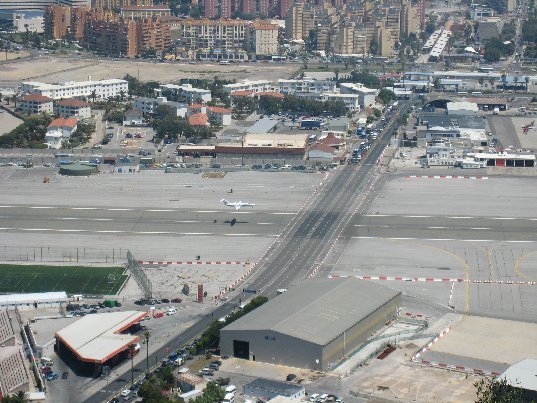
Ai??
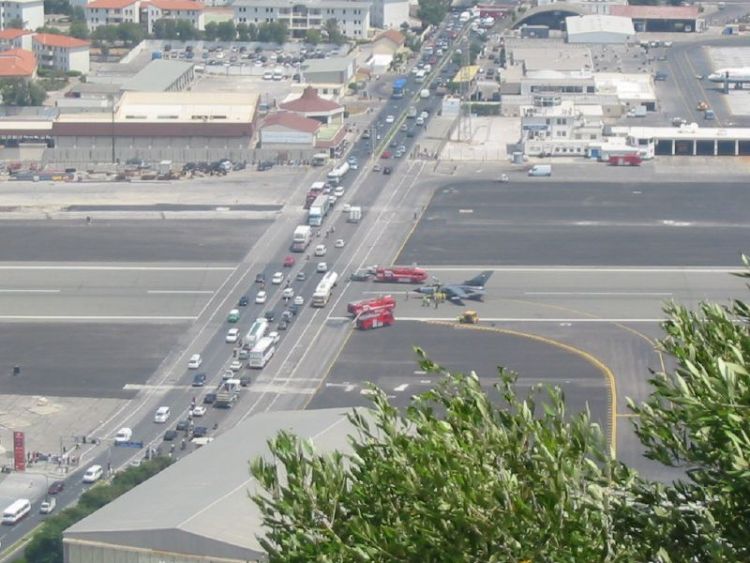
When the runway is in use, railway style barriers come down and stops traffic.
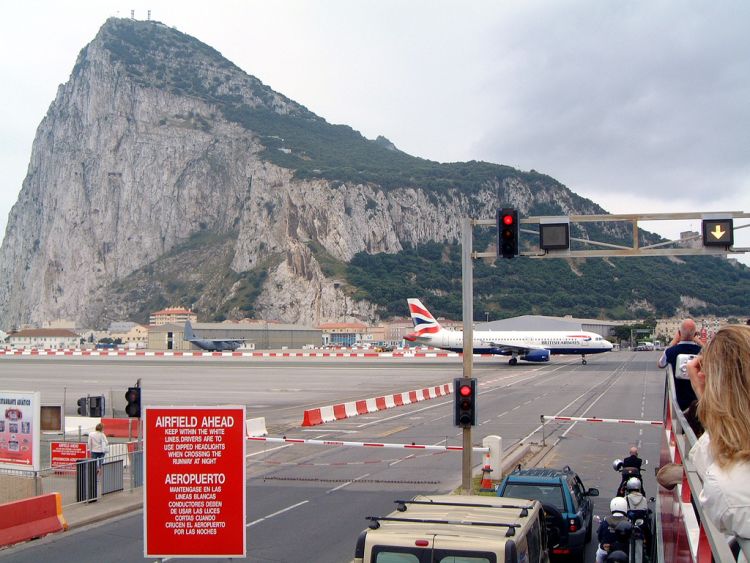
Ai??
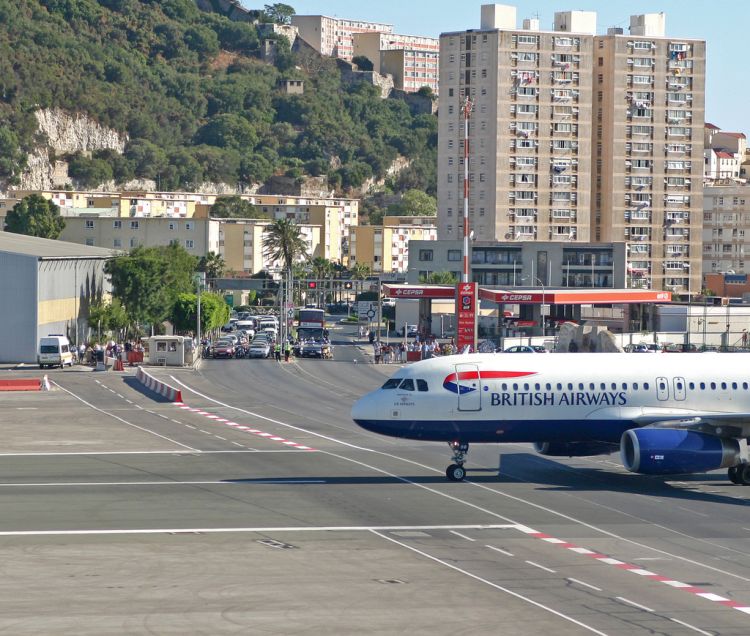
Ai??
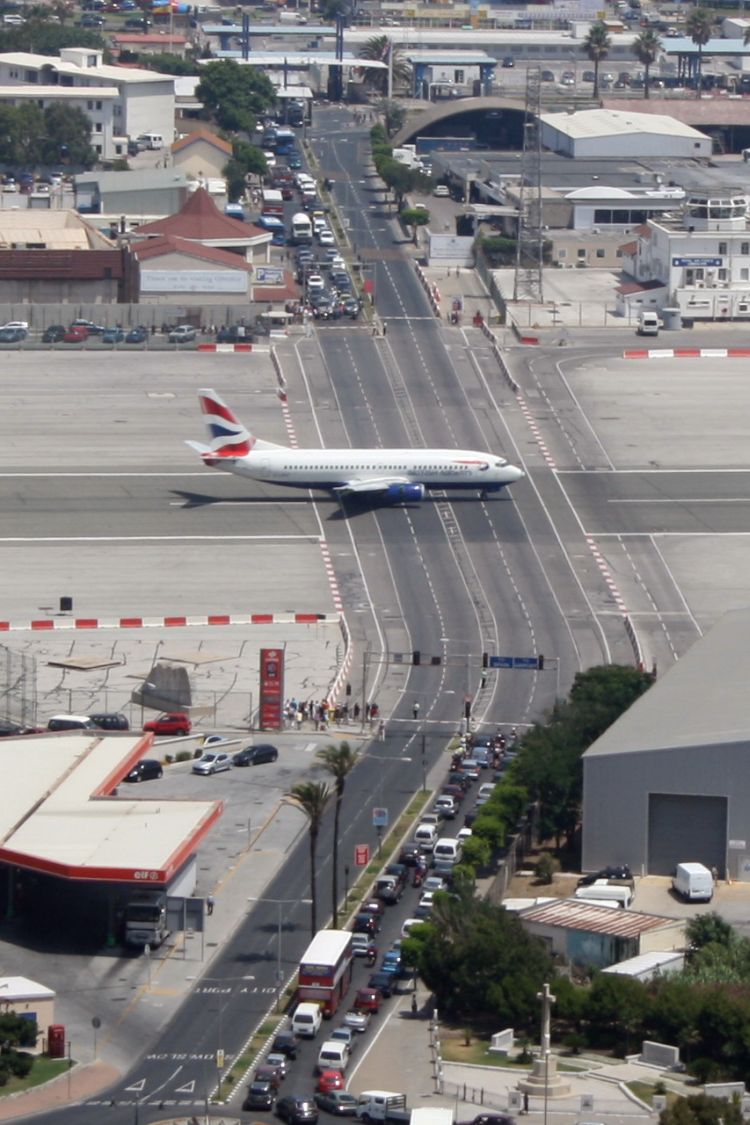
And when the runway is not in use, the barriers rise and the traffic proceeds normally!
Time to put pressure on officials
Time to put pressure on officials
The ChilliwackAi??Ai??Times July 13, 2010Ai??Ai??//
Ai??Ai??Editor:Regarding the remarks of Mayor Sharon Gaetz and Coun. Diane Janzen and those of previous mayors and councils about transit:
They are very parochial and short-sighted. They do not see the big valley picture (which includes Abbotsford, Langley and a large portion of Surrey) that has a need of a future light rail service for the south side our Fraser Valley.
Mayor and council could and should show more positives than negatives to the light rail concept for Chilliwack plus the other areas to be involved.
Yes, it’s not part of the city of Chilliwack’s mandate. Yes, Chilliwack doesn’t have money for light transit. Yes, the provincial and federal governments are broke. Yes, demographics indicate that there aren’t the numbers to support a transit system to-day. So what?
All that does not mean that planning for for a light rail system should be ignored or delayed.
Cooperation with all parties involved should agree on the need and the basic system but not get bogged-down with the details for now. It’s too early for that.
Promote the need of a light rail system for the Fraser Valley. Get with it.
Advise the approximately two million souls west of us who and where we are and the need for valley public transportation that doesn’t exist today. Apply pressure on the public and officials to gain their approval to the need and to the system proposed.
On Oct. 3, 1910 the Vancouver to Chilliwack Interurban arrived–one hundred years ago this October. Who is doing anything about that? Do not wait until Oct.1 to wake up.
View obscured from ivory tower – From the Chilliwack times.

Ai??Ai??View obscured from ivory tower
The Chilliwack Times July 16, 2010Ai??Ai??Editor:This summer, interesting news will be released that will delight supporters of the Return of the Interurban to the Fraser Valley.
In the Metro region, we have placed all our hopes for rail transit on the very expensive light-metro model and philosophy, that forces all bus riders on a light-metro trunk line to their destinations or next transfer. Indeed TransLink admits that 80 per cent of SkyTrain’s customers, first take the bus to the metro. This is not good transit.
TransLink has been signing hosannas that the newly opened Canada Line is carrying 94,000 people a day and nearing capacity. TransLink forgets to mention that nearly 45,000 former bus customers have been cascaded onto the new metro line which translates to about 90,000 trips a day. Only about two to three thousand new transit customers are using the over $2.5 billion metro system.
The sad fact about the Canada Line is that due to escalating construction costs, the scope of the project was cut back so much that a much larger $1.5 billion cheaper LRT network, with much higher capacity, could have been built instead.
The Light Rail Committee and the Rail For the Valley group, in conjunction with several transportation experts will be offering a much cheaper and proven alternative to hugely expensive light-metro, in the form of TramTrain.
TramTrain is simply a light rail vehicle that can operate on existing railways and on its own tracks, greatly reducing rail transit costs while at the same time providing a much larger light rail network.
As an example; for the cost of a SkyTrain Evergreen Line, we could build a Vancouver to Chilliwack TramTrain and a Vancouver to Maple Ridge TramTrain. A larger rail network. servicing more destinations, at a cheaper cost should be number one TransLink’s planning goals.
Sadly, what I see from the Ivory Towers on Kingsway is more of the same, plans for hugely expensive metro lines, with no realistic way to fund them.
Malcolm Johnston
Light Rail Committee
http://www.chilliwacktimes.com/opinion/editorials/View+obscured+from+ivory+tower/3286655/story.html
Seattle’s Light Rail Update – the SkyTrain Lobby Infiltrates Down South
Ai??
The following story from the Seattle Transit Blog clearly illustrates the SkyTrain/metro types still have not read a book on the subject, instead believing that “speed’ and ‘grade separation’ for a transit system are a necessity. What is striking is the anti-LRT attitude of the metro supporting people who post. Like Vancouver, Seattle’s transit authority have done a poor job in educating the public on light rail and in some instances, have done an even poorer job educating themselves!
The Push for East Link on the Westside of 112th Ave
From the Seattle Transit Blog

Last Friday, I explained a potential dilemma between advocates of a 112th Ave west-side alignment for East Link (Option 2), and those of a retained cut on the east-side (Option 4). Ai??Ai??Some construed my post to mean a Surrey Downs vs. Bellevue Club showdown, which I did not intend to be the case. Ai??Ai??On Monday, I spoke with Betina Finley, an early B3 supporter who ran an unsuccessful city council campaign last year, who clarified some of the rationale behind the Bellevue ClubA?ai??i??ai???s letter and subsequent petition.Though the Club has supported B7 in the past, I was told that Bill Thurston, club president, has recognized the wisdom in moving forward on B2M. Ai??Ai??Unlike ThurstonA?ai??i??ai???s rational disposition, Surrey Downs still wants any and every train as far away from them as possible. Ai??Ai??While they are more partial to the east-side retained cut, the prevailing sentiment has still largely been A?ai??i??Ai??B7 or bustA?ai??i??A? as evident by a puzzling new pro-B7 campaign. Ai??Ai??More below the jump.
In addition to the Bellevue ClubA?ai??i??ai???s petition and other support from east-side businesses, another group has signed on to a letter favoring a west-side alignment. Ai??Ai??Interestingly enough, it just so happens that this group is the bulk of the very 46 residences that would be displaced by the line, a collection of condo-owners that would rather move than have the trench in their neighborhood.Ai??Ai?? These homeowners are willing to be displaced and compensated at market-value by Sound Transit. Ai??Ai??This would explain why the west-side running option was so popular at the workshop survey.
Ai??
Unlike the Option 4 trench, the Option 2 west-side running alignment would only be compatible with a Main Street tunnel portal, as opposed to the cheaper and shorter 2nd Street tunnel. Ai??Ai??Entering the tunnel at 2nd Street would require the trains to move away from the 112th west-side alignment to either the east or center of the street, resulting in a kind of A?ai??i??Ai??SA?ai??i??A? curve. Ai??Ai??The turns would be due to avoiding the buildings that are built right up to the sidewalk north of the 112th condos. Ai??Ai??IA?ai??i??ai???ve provided a graphic to the right that explains why this is. Ai??Ai??Touring 112th viaAi??Ai??Google Streetview is also helpful.Despite using the more expensive Main Street tunnel, the entire Option 2 segment would actually incur a greater savings than Option 4, by avoiding the expenses associated with a costly trench. Ai??Ai??Supporters of the west-side alignment have also pointed to the benefits of a new greenbelt buffer that would replace the condos, essentially an extension of the Surrey Downs Park that exists there today. Ai??Ai??Ironically, the alignment would bring trains right up to Surrey Downs doorstep. Ai??Ai??But for a group that has resorted to wild nonsense and desperate attempts to bring back B7, many have grown weary at the obstructionism and just donA?ai??i??ai???t care anymore.
The real issue, of course, is getting the ST Board to recognize these interests. Ai??Ai??What would be most problematic for the Bellevue Club is a misjudged perception by ST that there is a A?ai??i??Ai??holier than thouA?ai??i??A? attitude carried by the rhetoric of preserving tennis courts, patios, and anything deemed A?ai??i??Ai??luxury.A?ai??i??A? Ai??Ai??While I donA?ai??i??ai???t agree that this is the right approach for the Club, emphasizing the commitment of the 112th condo owners to be bought out might make for a more convincing argument for the west-side alignment. Ai??Ai??At any rate, whatever information the Board has will largely shape the decision to pick a preferred option.
Tomorrow, the Sound Transit Capital Committee will meet at Union Station to address the 112th Avenue options and likely make a recommendation to the ST Board to inform a preferred option vote next week. Ai??Ai??Public testimony will be taken at both meetings. Ai??Ai??While there is likely to be a lot of B7 noise present, expect rational-minded residents and stakeholders to testify as well.
Ai??Ai??By the way, if you have interest in seeing Link serve the South Bellevue Park and Ride, there is an Open House tonight at Bellevue City Hall to address that segment of East Link. Ai??Ai??Unlike last weekA?ai??i??ai???s workshop, the meeting will not be interactive and will likely be an open table kind of format.
http://seattletransitblog.com/2010/07/14/the-push-for-east-link-on-the-westside-of-112th-ave/Ai??

More TramTrain news
More TramTrain news (though a wee bit old) from the UK.

Tram plan on track?
Surrey Comet
Friday 16th July 2004
By Simeon Brody
The prospect of electric trams gliding through the streets of Kingston may now be one step closer with the launch of a new lobby group.
South London Trams will campaign for a rapid transit line from the M25 to Kingston town centre, with links to Merton and Sutton.
Although a detailed route has not been decided, it is hoped the tram system, dubbed K-Smart, would start at a proposed park-and-ride site at the M25 in Leatherhead. It would then travel through Chessington and Tolworth, to Kingston.
A second line would travel from the town centre through New Malden and Worcester Park before arriving at Sutton.
The new group, led by the South London Partnership, a coalition of seven south-west London authorities, including Kingston, will also push for an extension of Croydon’s Tramlink to Sutton.
The group believes trams will encourage regeneration, boost the number of shoppers, and help with London’s Olympic bid.
David Cockle, managing director of Leewood Projects Limited, which helped bring trams to Croydon and worked on the Metrolink in Manchester, has been involved in developing the Kingston scheme.
He hopes some sort of system could be up and running by the Olympics in 2012, but admitted it was still a long shot.
The idea of a Kingston tram system was first aired in 2002 with an estimated cost of Ai??A?436million. Most of the money is likely to have to come from Transport for London (TfL).
A TfL spokesman did not appear to offer much encouragement to the scheme, saying Kingston had seen an improvement in its bus and train services.
He said: “TfL also supports Crossrail, which will be a major transport link in London and that will directly serve Kingston, but this is dependent on additional funding by the Government.
“We understand all parts of London have a need for additional transport, but we have limited funds and need to spend them where they will make the most improvement.”
South London Trams is chaired by Kingston Council’s chief executive Bruce McDonald, who spoke at the group’s recent launch.
He said: “Tramlink has brought transport, economic, regenerative and environmental benefits to the whole of the community in the south London area, increasing access, attracting new development and contributing to significant reductions in unemployment in areas that it serves.
“It is a focal point for the community, delivering real benefits. It is important that these benefits are spread to other areas of south London.”
http://www.surreycomet.co.uk/news/510258.tram_plan_on_track/
Budapest trams – an interesting web site!

A Siemens Combino tram in Budapest colours.
A link to Varga Akos aka HamsterA?ai??i??ai???s web site update of trams in Budapest
Ai??Ai??http://hampage.hu/trams/eletkep41/e_index.html
Greenville SC Southern Connector toller files for bankruptcy
From Toll Road News
Greenville SC Southern Connector toller files for bankruptcy
Connector 2000 Association developer and operator of the Greenville Southern Connector tollroad filed for bankruptcy today in US Bankuptcy Court in nearby Spartanburg, South Carolina. The filing done under chapter 9 of the US Bankruptcy code that handles broke government entities has been expected for some time.
The Association defaulted on debt service in January.
Moves in the state legislature to bail out the lenders went nowhere.
Revenues from the Southern Connector are not sufficient to service the debt, the Connector 2000 Association toiler says in its US Court filing because actual traffic and revenues are “substantially less than projected.”
“The debtor is insolvent” their lawyers say bluntly in the Ch 9 filing.Ai??Ai?? $500m was borrowed. Equity was zero of course because the 6320 form allows no equity.
Court papers note Wilbur Smith Associates projected 21k/day in the opening year but fewer than 7.5k showed up. (pro-rated for 10 months we put the number at 8.7k – editor)
Traffic has remained between a third and a half of that forecast by WSA when the association launched the tollroad project in this small South Carolina town in the late 1990s.
Revenue has been even lower and is now under a third of WSA $s.
No purpose
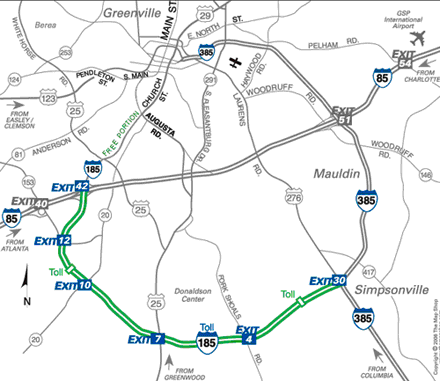
The highway on the southern/southwestern fringe of the city only made sense as an access and development road. The road is too indirect to provide any time savings for long-distance traffic which has stuck to the free interstates. To provide an alternate to I-85 it needed to cross the Saluda River in its western portion to provide a much straighter shot easterly for traffic from Atlanta. It was designed however as an access road to local commercial developments – most of which never happened.
A semi-belt route, 2×2 lanes and 16 miles, 26km long the Southern Connector tollroad gained interstate designation I-185 – totally unwarranted.
Tolls for 2-axle vehicles are $1.00 cash, 75c transponder and 50c at the ramp plazas which are unattended. Tractor trailers pay $3.00/$2.25 sat the mainline plazas and 50c at the ramps.
Trouble is for most trips through the Greenville area the main drag untolled I-85 remains much more direct and quicker. And even for east-west trips traversing the Greenville area to points southAi??Ai?? the old I-85/I-385 combination was quicker than transiting I-185. It swings too far out.
The pike failed also because it was conceived as catering to continued development of Greenville as a light industrial and warehousing hub on the Atlanta-Charlotte corridor in the mid-1990s, just when that particular bubble was bursting. Most of the land on either side of the Connector remains undeveloped.
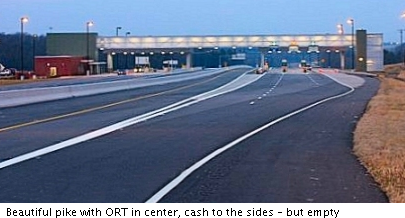
Revenues are running at barely $5.5m/yr and toll transactions 12.5k/day. Tolls are taken at two mainline and two pairs of ramp toll plazas along the road so vehicles on the road are substantially less than the transaction number. The mainline plazas have two lanes of open road electronic tolling and two or three cash lanes alongside each direction – state of the art for the time.
The last annual financial report available is for 2008.
 COMMENT:Ai??Ai??
The road opened Feb 27, 2001. First tolls were collected March 13, 2001.Ai??Ai?? It continues in operation using toll revenues to pay for operational expenses. Traffic at 12k or so vehicles/day would barely justify a 2-lane signalized road, let alone a 4-lane expressway.
No equity investment is involved since this was one of a bunch of not-for-profits that were all the rage as “innovative finance” in the 1990s. They got a special tax advantage and were called 6320s after the tax exemption clause that treated them as a kind of charity.
No-skin-in-the-game ventures encouraged by US tax code
All these unsound no-skin-in-the-game ventures have now crashed.
They were championed by a former federal highway administrator Bob Faris, a former VDOT commissioner Jim Atwell and other prominent officials who came to believe their own salesmanship. ARTBA the DC lobby group were cheerleaders.
And they were eagerly embraced by a road development crew – a motley crew of consultants, engineering firms, financiers and  construction firms – who made their money in the development, design and construction and had no interest in the viability of the roads as ongoing businesses.
The Greenville Southern Connector was ill-conceived as an interstate standard expressway. Designers, engineers, lawyers, consultants and construction companies made their money in the development and construction and left the resulting mess to Connector 2000 Association a phony public-private entity without any real owners. So much for “innovative finance” as touted by ARTBA and other DC lobby groups.
Lehman Bros NY which collapsed in Sept 2008 was the principal promoter of Southern Connector bonds.
see http://www.southernconnector.com/
filings



Recent Comments