This news item explains the huge cost of metro Vancouver’s transit construction. Though the article thinks that $500 million per kilometer, for the Broadway subway is reasonable, it must remembered that the subway it is being built on a transit route that has only a fraction of the ridership deemed necessary for a subway.
Much cheaper transit options have been ignored!
Pre Covid, the Broadway 99-B Line bus had a maximum capacity of only 2,000 pphpd and the entire Broadway route saw maximum traffic flows under 4,000 pphpd, far less that the 15,000 pphpd deemed to be the North American minimum for building a subway.
The per kilometre cost of the Broadway subway may seem reasonable but building a subway on such a route is not.
The SkyTrain light-metro system history is checkered with political meddling.
The initial Expo Line from downtown Vancouver to New Westminster cost as much as the original Vancouver to Richmond, Lougheed Mall and Whalley plan.
The then BC Social Credit party entered into a political deal with the then Ontario Conservative government, to purchase an already obsolete proprietary light-metro system (renamed from ICTS to ALRT) from the Ontario Crown Corporation, the Urban Transit Development Corporation. It later transpired that the Social Credit government acquired the expertise of the Conservative government’s politcal “Blue Machine” to win the next provincial election in BC
The full cost of the 1978 LRT plan, $430 mil. to $550 mil. was much less than the 1982 $890 mil.Vancouver to New West Expo Line.
The SkyTrain Millennium Line was the result of the NDP government being seduced by SNC Lavalin and Bombardier, instead of the original and cheaper Vancouver/Lougheed Light Rail project, connecting LRT to the Tri-Cities. Bombardier acquired ALRT, when they purchased the UTDC at a fire sale price after Lavalin (which purchased the UTDC) went bankrupt trying to build a renamed ALM (formerly ALRT) system in Thailand.
The formerly called Evergreen line was the uncompleted portion of the Millennium Line, which cost far more than the originally planned LRT.
As soon as the Evergreen Line was completed, it was promptly renamed the Millennium Line!
The Canada Line was build hat the behest of the BC Liberal government, resulting with the only heavy-rail metro in the world, built as a light-metro and having less capacity than a simple streetcar line, costing a fraction to build!
The Expo Line extension to Langley is more of the same. The false claim by Surrey mayor Doug McCallum, that the Expo line could be extended to Langley at the same cost of LRT and the subsequent promise by premier Horgan to build the extension to Langley, has been mired with the fact that the 27 km phase 1 & 2, LRT (connecting to Langley), now costs much less than the now 16 km, Expo Line extension, which is currently underfunded by over $1 billion!
Sadly, the taxpayer is not paying for good transit, rather taxpayer is paying a a lot more for politically inspired transit projects.
Why Canada gets less for more when it comes to building transit
By Laura OsmanThe Canadian Press
Sun., Dec. 26, 2021
OTTAWA – In early September, Conservative candidate Jennifer McAndrew stood outside a suburban Ottawa transit hub in the battleground riding of Kanata-Carleton to make a major campaign promise.
“A Conservative government will support and prioritize Phase 3 of the LRT extension right here to Kanata and beyond,” a smiling McAndrew said in a video posted to her Facebook page on Sept. 2, just as the campaign was heating up.
Not a day later, her Liberal opponent, Jenna Sudds, posted her own video to make the very same promise.
While some transit advocates would be overjoyed to see cross-party commitments to build new light-rail infrastructure, it was a disappointment to Toronto transit researcher Stephen Wickens who spent more than a year warning governments against those kind of campaign promises.
The reason is that Canada pays a higher price to build light-rail transit compared to our international counterparts, driven chiefly by the depth of underground tunnels, the grandiosity of the stations and labour costs.
But several experts agree it has just as much to do with something else: politics.
“That’s the heart of it,” said Wickens, who authored an investigative study on the soaring cost of Toronto subway projects commissioned by the Residential and Civil Construction Alliance of Ontario last year.
But in Canada, the costs seem to go off the rails.
By Levy’s calculations, Toronto’s Ontario Line should cost $735-million per kilometre. The Blue Line extension plan in Montreal? About $775-million per kilometre. Vancouver’s Broadway SkyTrain seems almost reasonable at nearly $500-million per kilometre.
Political meddling at all levels of government — by all parties — can cause a knock-on effect on the price tag of projects.
For example, the cheapest tunnelling method is also the most annoying for the neighbours, so local councillors will up the cost to avoid complaints from constituents.
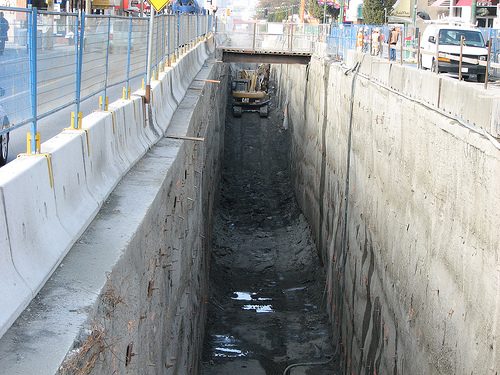
Just over a decade ago, Vancouver opted for a cheaper tunnelling option when it built the 19-kilometre Canada Line by digging a trench at street level and covering the top. The cut-and-cover method, as it’s known, led to big savings, but also disruptions, controversy and even lawsuits.
“The memories apparently remain so unpleasant that city leaders have made clear the Broadway Line will be entirely tunnelled, even with project estimates running at about $500 million per kilometre, or about 4.5 times what was paid for the Canada Line,” Wickens wrote in his report.
Political promises can also lock governments into commitments that may not offer the best value. As a 2019 study by the Institute of Municipal Finance and Governance put it, the best projects based on the available evidence take a back seat to political considerations. Civil servants are forced then to give what researchers dub “decision-based evidence” to justify a political promise.
“Who is a lowly engineer to say ‘we don’t actually need that’ or ‘let’s cut this station,’ or ‘I know you’ve promised this interest group something so you need to break that promise because that’s going to cost us another half a billion dollars,’” said Levy in an interview with The Canadian Press.
It’s not just a Canadian phenomenon.
Levy and other researchers at the Marron Institute of Urban Management at New York University have found Canada, the United Kingdom, Australia and United States overpay compared to peer counties like Spain, Italy and France.
Marco Chitti, a Montreal-based associate researcher on the project, said one domestic factor that may drive up costs is our federal political system that offers significant power to single parties trying to win votes from the public.
He said parliaments of other nations are afforded more power to water down proposals from the ruling party and get more bang for their buck.
Another problem is that Canadian cities and provinces often lack the in-house expertise to offer technical advice and oversee projects, Chitti said. He pointed to Italy where civil servants with technical expertise draw up detailed, costed plans before politicians make any commitments.
Chitti said the path to lowering costs on transit projects starts with admitting there is a problem that needs fixing.
“Most politicians in Canada are not aware that Canada has a huge problem, a huge, tremendous problem on cost,” Chitti said.
“I really hope that in a couple of years there will be much more discussion in Canada about the fact that we have ballooning costs, and that they are really out of control.”
This report by The Canadian Press was first published Dec. 26, 2021.
Alon Levy, a Berlin-based transit researcher and writer, calculated that globally, the median construction cost for an urban subway was less than $300 million per kilometre in 2019.
After three years, the news about rapid transit goes from bad to worse.
The Expo Line extension to Langley is now costing more than the revised cost of $3.95 billion and despite much false information that the line is fully funded, it is not. The claim that Prime minister Trudeau’s Liberal government will fully fund the Expo line Extension, is grossly overstated, as all what the P.M. will fund is 40% of the cost of the less than 16 km extension. This means that TransLink and the provincial government must ante up 60% of the costs.
With the recent massive flooding in the upper Fraser Valley, Merritt and Princeton, combined the biblical deluge that smashed three major highways in southern BC, which rebuilding is going to cost the province an estimated $5 billion (heard on the Radio) or more, I doubt that the province will ante any more money to this now contentious and over budget project.
The provincial government is not going to look kindly on TransLink, when they could have had a 27 km of LRT (phase 1 and 2), up and running by 2027 and a cheaper cost of 16km of SkyTrain that may never be built!
Now there is a new push for the 2030 Olympics, which means completing the Broadway subway to UBC will be a priority. The cost will be a minimum of $5 billion and add the much needed $3 billion mid life rehab for the Expo and Millennium Lines, means the government and TransLink must source $8 billion.
Added to this issue is that Alstom now owns the MALM system and may pull the plug at any time as Vancouver is now the sole customer for the proprietary railway. what this means is that the costs for the SkyTrain light metro system may escalate out of control and new civic and provincial politicians may pull the plug on all expansion.
The sad end is that the glowingly disgraced Mayor of Surrey, by cancelling LRT, may have screwed Surrey’s chances for any sort of rail transit for the foreseeable future and condemned the city to endemic congestion and gridlock.
Well its done, the idiots delight of new politicians in Surrey have voted to stop light rail.
Now they think they can build SkyTrain to Langley for the same cost as light rail.
Laughable.
The HATCH Report, planning to build SkyTrain to Langley put the cost at $2.95 billion, in 2017 dollars.
Well, in 2021, the cost to build the Expo Line extension to Langley has soared past $3.95 billion!
So Surrey’s new batch of Councillors are going to forgo a fully funded light rail line and instead will try to source $1.55 billion in new funding to build SkyTrain to Langley.
Mayor McCallum is on record saying that;” they can build SkyTrain at grade to reduce cost”.
SkyTrain at grade? You must be joking, the Movia Automatic Light Metro, as used on the Expo and Millennium lines is a LIM powered, automatic railway requiring a substantial guideway and if built at grade must be heavily protected by cement walls and chain link fencing to prevent egress.
Really, doesn’t the mayor realize that the guideway for the driverless light metro must be protected by a 10 foot, razor wire topped fence, as it is in Vancouver? Building SkyTrain at-grade is akin to building a Berlin Wall!
Surrey will be now mired in endless congestion and its associated costs.
As for Metro Vancouver, it is fast becoming L.A. North.
Rail transit will not be built in Surrey until 2035 or more; rail transit will never get to Langley.
Officially, the project has been delayed 2028, but with recent events, this delay may continue until the project is abandoned.
This article shows the full breadth of work that needs to be done when expanding a major rapid transit line, above, at or below grade.
This will happen to all stations on the Expo and Millennium lines, when the much needed system $3 billion rehab takes place and must take place if the Expo Line extension to Langley is ever built.
The real question is; “does TransLink have the funding to do it?”
Metrolinx puts out call for teams to work on Finch Station as part of Yonge North Subway Extension
Behind-the-scenes work in areas that aren’t often seen by transit riders is key to getting Finch Station ready for major construction on the Yonge North Subway Extension. Metrolinx is starting the search for experts interested in delivering this work through a ‘Request for Qualifications’ that was issued today (Dec. 14), marking another step forward for the new transit project.
Metrolinx officials announced today (Dec. 14) they are looking for teams who are interested in completing early upgrades at Finch Station before major construction on the Yonge North Subway Extension begins.
The early works include upgrades to portions of the station that will connect existing Line 1 service to the future subway extension. (Metrolinx photo)
The Request for Qualifications asks any interested teams to share their qualifications and construction expertise so they can be included when the bidding process begins next year. This ‘early works’ will create the foundation for major construction set to start in 2023, and help Metrolinx keep the project running smoothly. The Yonge North Subway Extension will extend Line 1 roughly eight kilometres north from Finch Station with four new stops along the way that will serve North York, Markham, Richmond Hill and Vaughan.
“We’re excited to move the Yonge North Subway Extension another step toward major construction.”
Stephen Collins, Metrolinx project sponsor
A lot of the work will happen behind the scenes in parts of Finch Station that are seldom noticed by transit riders – but they’re an important part of the progress being made on this project. The early works include upgrades to portions of the station that will connect existing Line 1 service to the future subway extension.
A train approaches Finch Station. (Metrolinx photo)
What’s Included In This Work?
The most noticeable work will happen at street level, where improvements will be made to the electrical system that powers the rails. Heavy-duty cables that will travel from an existing traction power substation – a building where electricity is converted to a form suitable for providing power to the subway – on Hendon Avenue to Finch Station, will be secured inside a protective casing and installed underground. A new fire department connection will also be installed near the intersection of Yonge Street and Hendon.
The ‘tail tracks’ that support existing Line 1 service provide temporary parking space for subway trains while they’re not taking riders to and from their destinations. The changes Metrolinx is making to the tail track area will prepare it to become part of the main subway line. This involves extending the waterless sprinkler system from the existing service tracks through the tail tracks, along with new cables and other equipment that will link the future subway extension into the existing communications and support systems.
The rooms where transformers and other electrical equipment are housed will get an upgrade, too. The systems inside provide Line 1 with the power it needs to keep the city moving. Minor renovations will be made to these areas to accommodate the additional power cables that will travel underground from the traction power substation.
Metrolinx will collaborate closely with the City of Toronto and the TTC to keep customers and road users up-to-date on the work taking place and to keep people moving.
Construction on the early works at Finch Station is expected to start in the fall of 2022.
“We’re excited to move the Yonge North Subway Extension another step toward major construction,” says Metrolinx project sponsor Stephen Collins.
“Our future project partners will be part of a team that is building a transit legacy in this region for generations to come.”
Visit the Yonge North Subway Extension web page to learn more about the project and sign up to receive the latest updates via email and over social media.
Metrolinx project leaders will answer questions from an online audience as they share a progress update at a virtual open house event on December 16th from 6:30 p.m. to 8:00 p.m.
Some things have changes since this item was posted in 2019. Alstom now owns the proprietary Movia Automatic Light Metro system, when they finalized purchasing Bombardier’s rail division earlier in the year.
The estimated cost for the Langley extension is now over $3.95 billion mark and heading north of $4 billion.
The Langley extension is underfunded by now, over $1 billion.
The province, not TransLink, are in charge of the Langley extension.
A four lane boulevard/highway has been bulldozed through on the extension’s route through the ecologically sensitive Green Timbers Urban forest.
A massive weather fiasco, starting with this summers “heat dome” and continuing “atmospheric rivers” of rain and the associated destruction of the Fraser Canyon Highway, the Coquihalla Highway and the Nicola Highway, plus the massive flooding in the upper Fraser Valley has put a massive strain on the province’s fiances.
The $4 billion+, 16 km Expo Line expansion to Langley has been delayed past 2028, now is costing more than the original Phase 1 & 2, 27 km Surrey LRT, which was due to open in 2027.
The problem with TransLink is that you can never believe what it says; TransLink never produces a report based on the same set of assumptions.”
Former West Vancouver Clr. Victor Durman, Chair of the GVRD (now METRO) Finance Committee.
One hates to keep reminding people of TransLink’s lack of honesty, but dishonesty continues as nauseum.
It is interesting how TransLink has used this cunning method of manipulating analysis to justify SkyTrain in corridor after corridor, and has thus succeeded in keeping its proprietary rail system expanding. In the US, all new transit projects that seek federal support are now subjected to scrutiny by a panel of transit peers, selected and monitored by the federal government, to ensure that projects are analyzed honestly, and the taxpayers interests are protected.
No SkyTrain project has ever passed this scrutiny in the US.”
Gerald Fox, noted American Transit Engineer.
Again, one hates to keep reminding everyone that TransLink is just not honest with transit planning.
To counter the drive to reinstate a Vancouver to Chilliwack passenger rail service, operated as a regional railway, using mostly the former BC Electric interurban tracks, but using 21st century EMU’s, possibly powered by the “made in Canada” Ballard hydrogen fuel cells, TransLink blundered ahead with its own anti interurban plan.
This is the same TransLink who would tell all who listen that Broadway was the “most heavily used transit route in Canada and North America”, but after being caught on this exaggeration, they now claim “This is our region’s most overcrowded bus route.”
After two critiques of TransLink’s “Interurban Passenger Rail”, by UBC Professor Patrick Condon and from Mr. Haveacow (a Canadian transit specialist), TransLink is not being honest with the Mayors Council on Transit and the taxpayer.
I will comment on three important points.
1) The folks currently promoting the “return of the interurban” are not Rail for the Valley, but a separate group promoting this vital transportation link. To date there are at least three separate groups promoting the reinstatement of the former interurban service.
TransLink’s rebuttal seems to be about the letter Zwei sent to the two Langley’s comparing an affordable Vancouver to Langley rail link that could be built far cheaper and far quicker than TransLink’s underfunded ($1.4 billion underfunded) SkyTrain planned extension .
2) Those mandarins sitting in Translink’s expensive digs in Sapperton, haven’t even bothered to tour the interurban line and to see personally the many destinations that the rail service would cater too. Like the “Lotus Eaters”, they live in a pampered taxpayer paid world of their own.
3) TransLink is hugely afraid of publishing the projected costs of SkyTrain to Langley, which using TransLink’s own figures, now will exceed over $200 million per km to build. Nor is TransLink being candid with the operating costs of the extension and the $2 to $3 billion rehab of the Expo Line to cater to somewhat higher ridership.
Today, the cost for a reinstated rail service from Vancouver to Chilliwack, using EMU’s or DMU’s, range for $750,000.00 for an hourly service to $1.5 billion, for a deluxe three train an hour service per direction.
Three trains an hour per direction is more than many bus routes TransLink operates!
This spring’s massive hike in gas prices are due, in part, to SkyTrain’s huge annual subsidies. In 1992, the subsidy for the Expo line from Vancouver to New Westminster was $157 million. TransLink and the Mayor’s Council on Transit, utterly refuse to give a clear figure to operate the light metro network.
A source told Zwei that the annual subsidy, including payments to the SNC Lavalin lead consortium operating the Canada Line, is over $100 million annually!
Why are they so afraid to tell the truth?
The Mayor’s Council on Transit are like rubes at a fair, buying the magic elixir, a cure all, hawked by seasoned con artists.
Parochial politics, seasoned by politcal intrigue, supported by dirty laundered casino money is driving both SkyTrain extensions and it is time to say stop!
Who is in charge of the clattering SkyTrain?
The axles creak and the couplings strain,
and costs are too high, as fiasco nears,
and sloth hath deadened Translink’s ear,
and the warnings flash through the night in vain,
for the Premier’s office is in charge of the clattering SkyTrain.
With the spectre of global warming wreaking havoc on our province, it is time to get serious about doing what we can to alleviate emissions from internal combustion engines. At the same time we must invest in ways other than asphalt solutions to mitigate endemic traffic congestion. Today, only a rail based transit system can achieve this by providing an affordable and user friendly alternative to the car and retaining the ability to carry freight.
In 2009, Rail for theValley engaged Leewood Projects (UK) to do an independent feasibility study about the viability of using the former BC Electric railway route, reinstating the former interurban route from Vancouver to Chilliwack.Released in September 2010, the Leewood Study showed that not only was a passenger service viable, reinstating a passenger rail service was affordable.The Leewood Study can be accessed on the Rail for the Valley website atwww.railforthevalley.comIn 2021, adjusting for inflation, a regional passenger rail service is still very affordable, when compared to extending Metro Vancouver’s SkyTrain light-metro lines, which now has a base cost in excess of $200 million per km to build!
The Leewood Study found that a Scott Road Station to Chilliwack passenger service, adjusted for inflation for 2021 dollars, would be $594,847,133.00) or $6.07m per km).
The service would see a maximum of three trains per hour per direction (20 minute service), with a total journey time of 90 minutes from Chilliwack to Scott Road.
Upon advice from Leewood Projects, the use of modern light diesel multiple units (DMU’s) was envisioned, as there are many suppliers, providing a wide range of product. Modern low-floor DMU’s have wheelchair accessible W.C.’s and some models also offer a “Bistro Car” option, serving light refreshments for longer trips.
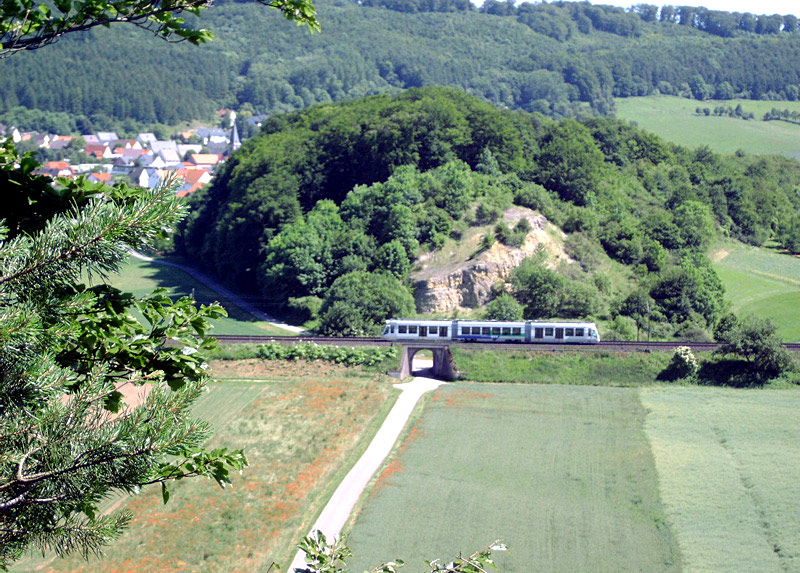
A German DMU .
Today’s modern DMU’s are modular and capacity can be increased by adding a module to the vehicle. Second hand DMU’s can be obtained at very reasonable prices, due to the fact many have been retired early when the lines they operated on have been electrified.
A Victoria to Courtney, via Nanaimo passenger service using the E&N is the affordable approach of providing a user-friendly transportation alternative to the car and the modern DMU has become dominant on regional railways.
The Leewood Study provides the framework for an affordable and proven 21st century transportation solution for Vancouver Island, instead of bigger and wider highways, which will attract more cars, leading to even greater future congestion and pollution.
Using existing railways greatly reduces building rail costs, enabling a larger rail network, providing more destinations, which is a proven winner in attracting new ridership; especially the motorist from the car. In the UK and Europe, abandoned, disused and mothballed railway lines are being reopened for passenger service and this trend of opening long lost passenger railway routes is steadily increasing.
New Jersey’s River Line, operating in the gutter lanes of a roadway.
The estimated cost of the 234 km refurbished to operate a modern DMU service, with a maximum of three trains per hour would be under $1.5 billion from Courtney to Victoria. The Port Alberni rail connection could be reopened soon after.
Put another way, a refurbished E&N would cost less than half of the now $3 billion, plus, 5.8 km Broadway subway or one third of the cost of the potentially $4.5 billion, 16 km Expo Line extension to Langley! A refurbished E&N would also, by its very nature, attract more new customers to transit than both of the proposed Metro Vancouver light-metro lines combined!
In the age of Global warming, where severe weather conditions are becoming the norm, Vancouver Island politicians must demand the provincial government spend the money to provide an affordable and attractive alternative to the car and that can only be a rail based decision. Vancouver Island has been treated as a pauper by the provincial government and it is time to give the Island its fair share of transit investment.
One just cannot blacktop their way out of global warming!
Do not be left at the station, waiting for exotic solutions that will never come or vague politcal promises that are never kept, but jump on board a modern 21st century DMU, calling at all stations to Victoria!
Rail for the Valley
A RegioTram DMU in southern Germany
Addendum
The Stadler Flirt DMU, now being used on Ottawa’s Trillium Line. The modular design allows the DMU to increase capacity affordably, by adding modules as ridership grows.
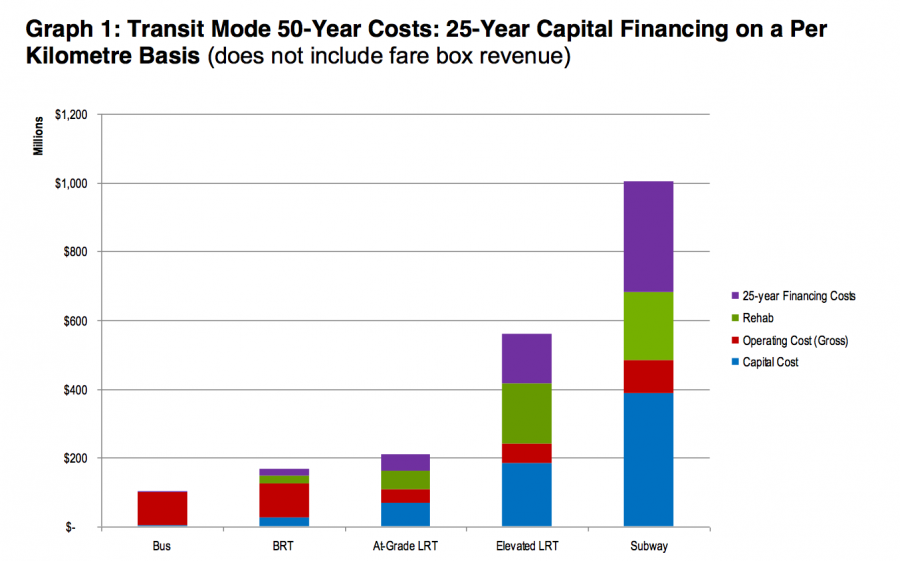
A 2020 50 year cost comparison by Ontario’s Metrolinx showing the 50 year financing on a per kilometre basis. The proposed Valley Rail would be less than that of a bus and the same would be true for a refurbished E&N Railway.
The Comparative cost of BC railway projects.
The 5.8 km Broadway subway – Now over $3 billion
The Expo line Extension to Langley – Now over $4 billion
The mid life rehab of the Expo and Millennium Lines – $3 billion
The Extension of the Broadway subway to UBC – Now over $5 billion
The North shore Rapid Transit Extension – Now over $5 billion
Rail for the Valley, Vancouver to Chilliwack – Under $1.3 billion
The E&N refurbishment with a Victoria to Courtenay DMU service – Under $1.5 billion
With the devastation caused by this years heat dome, wild fires, tornado, atmospheric rivers, flood and of course our modern day plague, Covid, the provincial government must rethink its plans to spend over $10 billion to build less than 22 km of the SkyTrain light metro network.
$10 billion you say? Yes, $10 billion and probably a little more.
The 5.8 km Millennium (Broadway subway) to Arbutus is now said to cost over $3 billion.
The 16 km Expo Line extension to Langley is now topping $4 billion.
The much needed mid life rehab for the (especially for) Expo and Millennium lines, may cost $3 billion.
Added up, that is over $10 billion for a mere 21.8 km of light-metro line. 21.8 km of new line will do very little taking cars off the road or reducing pollution, especially from autos and commercial vehicles.
There must be another way and there is, but our planners, engineers and especially our politicians remain deaf to a proven affordable alternative and that is TramTrain, a modern tram that can quite happily operate on both streetcar tracks and on regular railway tracks.
TramTrain could be built up the Fraser Valley for around $1.3 billion, connecting Vancouver to North Surrey/Delta, Cloverdale, Langley, Abbotsford, Sardis/Vedder and Chilliwack.
On Vancouver island, TramTrain could be the answer for the E&N. An estimated $1.5 billion could see a rehabilitated E&N offering a two train per hour service serving the communities between Victoria and Courtney and with more investment have small tram/streetcar routes in Victoria and Nanaimo, which would attract even more customers to transit.
Global warming is real; catastrophic weather events are becoming more common place; traffic congestion is becoming endemic both on the mainland and on Vancouver Island. The province needs real solutions to solve the growing climate crisis and the pablum of doing the same thing over and over again, ever hoping for different results has long ended.
We cannot blacktop or SkyTrain our way out of global warming, yet this is what the current government is doing, as they sleepwalk from one global warming fiasco, to another.
We must send a clear and concise message to all politicians, we must do a lot more for a lot less money.
TramTrain fits the bill wonderfully.
A Karlsruhe TramTrain on a cross country railway in the Black Forest
From December, 2020.
Zwei has been a member of the Light Rail Transit Association for over 35 years and with membership comes a subscription to the most excellent magazine Tramways & Urban Transit.
The following will be of most interest for those wanting an affordable rail connection from Vancouver to Chilliwack using the existing and former BC Electric passenger line connecting to Chilliwack or reinstating passenger service on the E&N Railway.
Today six years after the this article was published in T&UT much has happened with TramTrain. today there are over 30 TramTrain systems operating around the world, with a further 30 plus systems being planned.
TramTrain is evolving and with newer, Greener propulsion systems and cheaper and safer signalling systems, TramTrain is no longer a niche transit system, but a safe, affordable and user friendly transit mode, that can expand ones transit system into lower population areas, providing an efficient and cost effective public transport service.
There are several candidates for a TramTrain service in BC, yet the provincial government and civic politicians still want massively expensive and financially ruinous extensions to the current light metro system as they love to cut ribbons in front of mega-projects at election time.
The time has come to seriously consider TramTrain in BC, but I am afraid with Horgan and the NDP, the affordable transit train has long left the station.
From Tramways & Urban Transit
Tram-train / JUNE 2014
www.tramnews.net.www.lrta.org
TRAM-TRAIN:A PROMISE UNFULFILLED?
Micheal Taplin
Prologue
“On 25 September 1992 dual-voltage LRVs began running between Karlsruheand Bretten… within a year passenger numbers were up 400%, and today the model works over nearly 500km (310 miles) of track.”
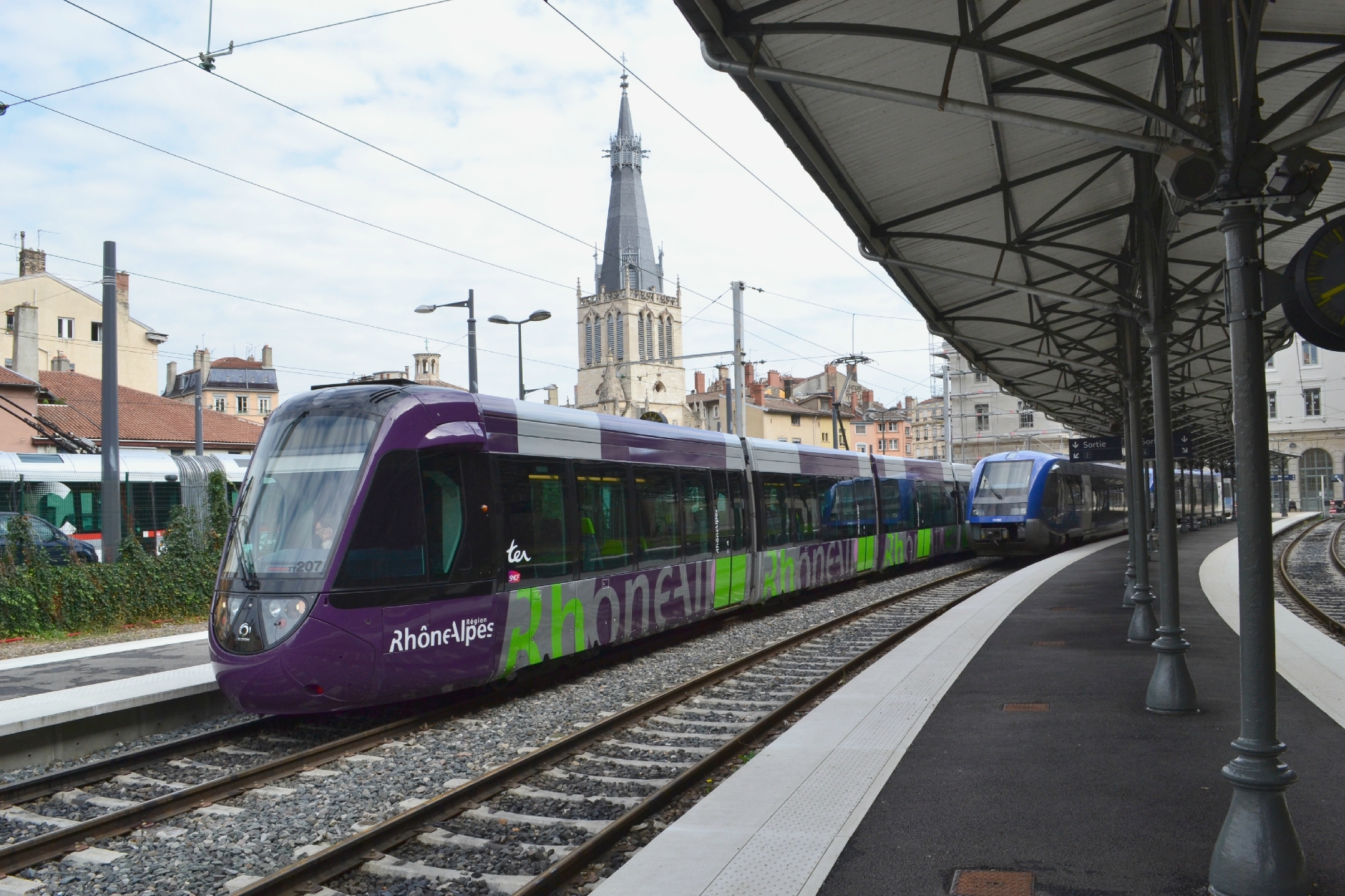
TramTrain and regional passenger train at station.
During 125 years of electric tramways, the tram as we know it has generally been developed as a vehicle suited to alignments on, or based on, city streets. Of course there were interurban lines that ran across country, particularly in North America, where they reached their apogee in 1915, before being decimated by the inexorable rise in motor vehicles. Some of these originated as steam railroads, and others entered cities on the tracks of urban tramways or rapid transit lines. In Europe, particularly Switzerland, such interurbans were called light railways (to distinguish them from their mainline cousins), and again running on to city streets was, and is, quite common. The former NZH in the Netherlands is another example.Japan, with its plethora of private railway companies, followed the US interurban pattern, though the boom there coincided with the decline in North America, and Michael Taplin gives a brief overview of the tram-train concept and asks if political and institutional issues form a greater barrier to its further implementation than technical concerns.
During 125 years of electric tramways, the tram as we know it has generally been developed as a vehicle suited to alignments on, or based on, city streets. Of course there were interurban lines that ran across country, particularly in North America, where they reached their apogee in 1915, before being decimated by the inexorable rise in motor vehicles. Some of these originated as steam railroads, and others entered cities on the tracks of urban tramways or rapid transit lines. In Europe, particularly Switzerland, such interurbans were called light railways (to distinguish them from their mainline cousins), and again running on to city streets was, and is, quite common. The former NZH in the Netherlands is another example.
Japan, with its plethora of private railway companies, followed the US interurban pattern, though the boom there coincided with the decline in North America, and Michael Taplin gives a brief overview of the tram-train concept and asks if political and institutional issues form a greater barrier to its further implementation than technical concerns.most lines survive today as rapid transit operations, with some penetration of city streets or subways. None of the above models were referred to as tram-trains, though the principle is not dissimilar.
Germany The modern tram-train concept, which saw its inauguration at Karlsruhe in Germany, uses a tram-based vehicle capable of operation on both mainline railway tracks and city tram tracks. Track-sharing between trams and trains was not unknown before, but the railways involved could hardly be deemed mainline.Karlsruhe had its own interurban operation, the Albtalbahn, which had track-sharing with Deutsche Bahn (DB) on its northern arm.
The possibility of travelling to the city centre without a change of vehicle was very attractive to passengers. Thanks to the German concept of the Verkehrsverbund joint tariff area, the financial consequences could be uncoupled from the commercial interests of the operators (AVG and DB), and work concentrated on the legal and technical hurdles to be overcome to permit through operation.On 25 September 1992 dual-voltage (750V dc and 15kV ac) light rail vehicles began running between Karlsruhe and Bretten, switching between city tram tracks and DB tracks at Grötzingen.
Within a year passenger numbers were up by 400%, and today the Karlsruhe model works over nearly 500km (310 miles) of track. There are 151 dual-voltage cars, 121 from Siemens, and 30 just being delivered by Bombardier (with options for up to 45 more). The tram-train model was truly a success, and good business for the Karlsruhe-based consultants involved.
Other German examples followed, in Saarbrücken, Chemnitz, Zwickau, Kassel and Nordhausen, though not exact copies. Saarbrücken runs 28 Bombardier Flexity Linkdual-voltage cars through the streets and then on DB tracks south to Sarreguemines,
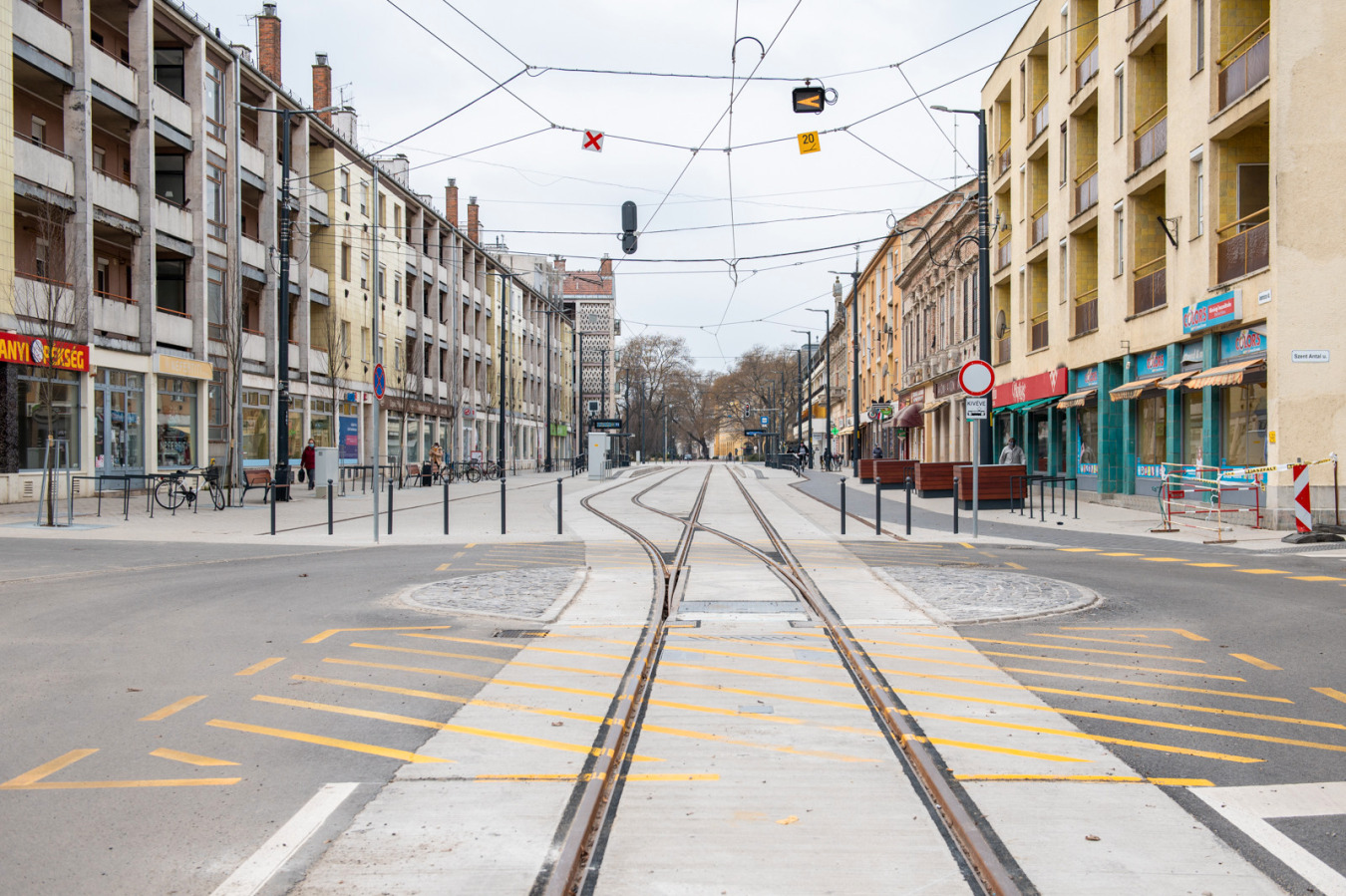
Good news, the opening of the first TramTrain service in Hungary. What is largely of interest is that the TramTrain route is mainly single track with passing loops, using hybrid vehicles, built by Stadler and can operate either by electricity and diesel.There is a lot of scope for TramTrain to operate in the Fraser Valley, and if the provincial government is mindful of Global Warming, as it should be, it should immediately shelve plans for the $4 billion plus, 16 km Expo Line extension to Langley and instead build a $1.3 billion, 130 km Vancouver to Chilliwack TramTrain service.
First Hungarian Tram-train project
9 September 2021 |
In 2018, VAMAV Vasúti Berendezések Kft., a joint subsidiary of MÁV Hungarian State Railways Private Limited Company and voestalpine Railway Systems, was chosen as a turnout supplier of Hungary’s first tram-train project. In 2021, the construction work was completed and the operation is expected to start in September 2021.
The new tram-train line in Southern Hungary will connect Szeged and Hódmezővásárhely. The aim of this project is to create a transportation system using railway infrastructure that helps to maintain and improve the competitiveness of public transport, enables the reduction of road traffic and the environmental impact it causes, and ensures the connection between urban centres by connecting rail and tram transport.
Photo source: Nagy Mihály / magyarepitok.hu
The rail network
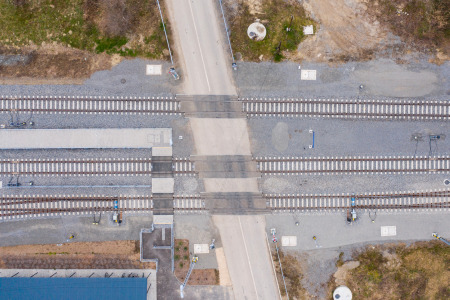
The tram-trains will run in Szeged on tram line 1 from Szeged railway terminal to Szeged-Rókus railway station, where the tram line and the Szeged – Békéscsaba railway line No. 135 will be connected for about 800 m. The connection of the tram line and the railway line was realized with grooved rail turnouts and a crossing manufactured by VAMAV Vasúti Berendezések Kft.
In order to reduce the journey time and increase the frequency of traffic, new second tracks and bypasses were built between the two cities, typically with simple turnouts and double slips with a radius of R=200 m and R=300 m, at a speed of 40 km/h in the diverging route. To speed up train crossings, some stations have been given high-radius turnouts with a radius of R=800 m and a speed of 80 km/h in the diverging route.
Photo source: Nagy Mihály / magyarepitok.hu
The vignoles railturnouts are made of 60E2 rail profile and have concrete sleepers, state-of-the-art SPHEROLOCK locking devices, and HYDROLINK power transmission systems.
Between the Hódmezővásárhelyi Népkert railway station and Hódmezővásárhely railway terminal, a new 3,200 m long tram line was built within the city with two traffic bypasses and a two-track tram-train terminal. In order to maintain the urban character, grooved rail turnouts manufactured by VAMAV Vasúti Berendezések Kft. were installed here.
The project in general
This project also includes the purchase of hybrid vehicles that can run safely on both the urban tram and rail networks. The turnouts supplied by VAMAV Vasúti Berendezések Kft. are structurally and geometrically suitable to meet these special requirements. Following preliminary feasibility studies and design and authority approval, construction work began in 2018 and was completed in 2021. Tram-train vehicles are currently being tested and the operation is expected to start up in September 2021. It is a great success for both MÁV Hungarian State Railways Private Limited Company and voestalpine Railway Systems that all of the vignole (34 pcs) and grooved rail (7 pcs) turnouts for this project have been produced and delivered by VAMAV Vasúti Berendezések Kft.
The new tram-trains, built by Stadler, are able to operate in electric mode under 600 V DC overhead on the tram networks in Szeged and Hódmezővásárhely, and in diesel mode on the mainline connecting both cities. They feature two low-emissions diesel power packs rated at 390 kW. They are also able to negotiate narrow curves of 22m radius providing the benefit of being used in existing curved streets of city centers. Easy access for different platforms types, without modifying the current height of the platforms, is also ensured by doors located at different heights and the use of different type of sliding ramps.
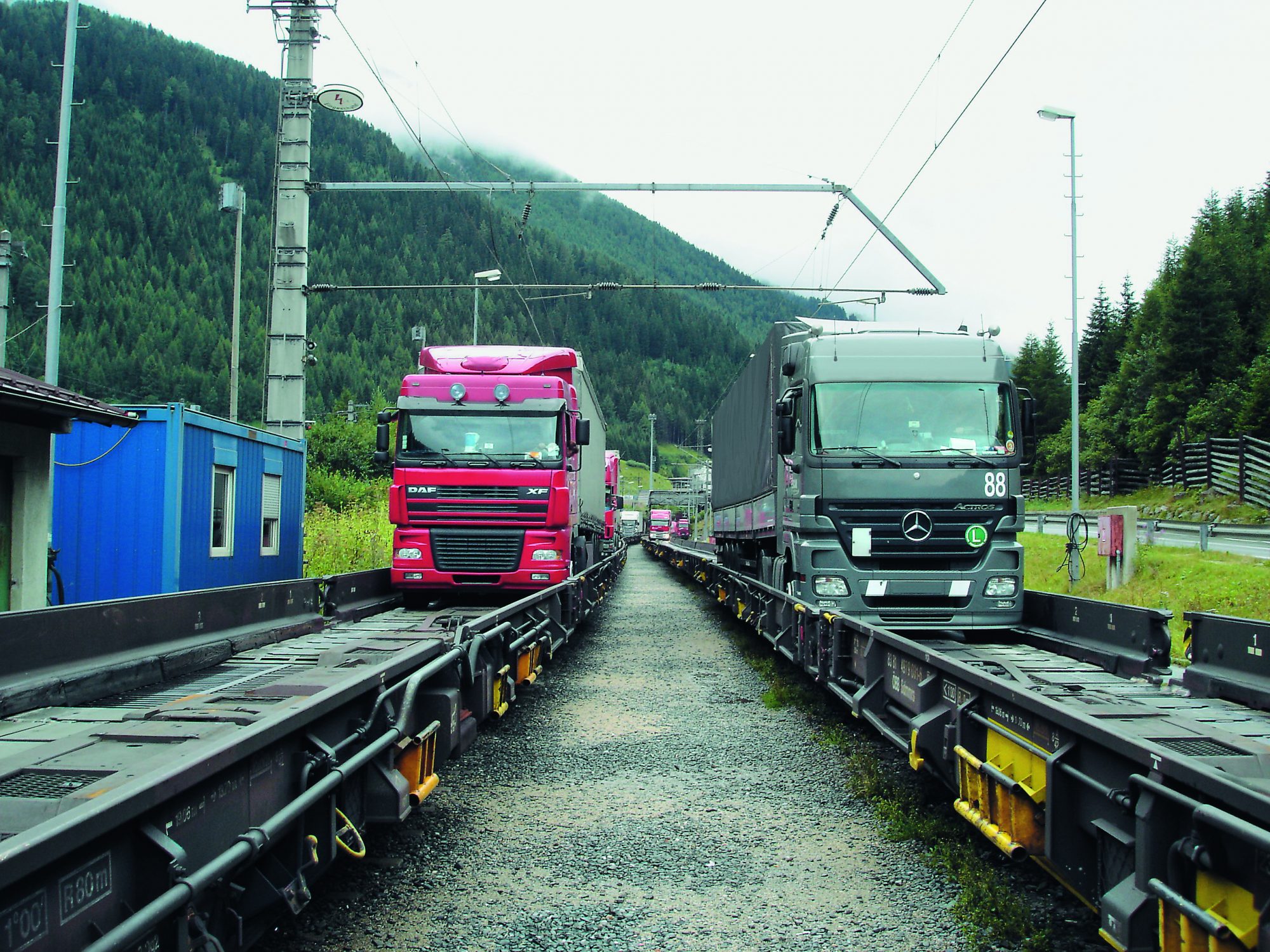
The recent fiasco with our regional highways, due to the “Great Deluge” has again spot lighted the massive amount of freight traffic that is carried on the public highway system.
The trucking industry is highly subsidized by using the existing highways and the motor freight companies undercut the freight rates charged by the railways.
The trucking lobby is huge, well funded and ensure the hidden subsidies for freight carriers continue.
With the spectre of Global Warming and climate change now taking a front seat with our weather patterns, our dated highway system has proven unable to cope with with the challenges of severe weather.
Is it not time to put freight back onto trains and the reopening of abandoned short lines for better freight access?
Instead of the current blah, blah, blah from politicians action must be taken to reduce traffic volumes on the roads/highways and to do this they must provide an affordable alternative to driving. This must include regional passenger railways and a shifting freight back onto the train.
In Europe, this has been happening for decades, but now more strident measures are forcing commercial vehicles onto the trains and the same must happen in Canada.
Until this happens, politicians can say all they want about global warming, but do nothing to mitigate the damage already being done and being done to the environment.
So premier Horgan and Prime Minister Trudeau, stop your blah, blah, blah on the environment; stop your photo-ops feigning sympathy for flood victims and start positive actions to mitigate the effects of climate change.
One needn’t possess a doctorate in economics to understand that when someone obtains something for nothing, another receives nothing for something—akin to parking in a metered space where there is time left on the previous occupant’s nickel.
Operators of pavement-pummeling heavy trucks and bulk-commodities hauling inland waterways barges have been mooching off the public purse for generations, while railroads themselves build, maintain and even police their 140,000 miles of privately owned rights-of-way on which they also pay property taxes. To turn a phrase on Ronald Reagan, “Here they go again”—the “they” being rail competitors poised to receive bundles of billions of dollars in benefits from the $1.2 trillion Infrastructure Investment and Jobs Act (IIJA)bill signed into law this week by President Biden.
As a dining companion conveniently examines a restaurant’s ceiling tiles as the meal check arrives, these rail competitors are proving, yet again, their ability (we can’t resist the pun) to rob St. Petersburg taxpayers to pay St. Paul truck and barge operators. Yet there is no economic, environmental, moral or social rationale that fees paid government by for-profit corporations should not be proportionate to benefits received.
As more than 80% of rail freight is exempt from economic regulation and thus assumed by statute to be competitive, modal equity is of consequence—highway and waterways policy being rail policy and vice versa.
The facts speak loudly. But first, let’s dispose of a fatigued canard that railroads once feasted on federal land grants—endowments to be sold to finance construction of mid-19th century rail lines to connect the Atlantic with Pacific coasts and bridge what map makers then termed the Great American Desert. A 1944 congressionally ordered study concluded that the 130 million acres of federal land earlier granted railroads were paid for in full through an obligation that recipients carry all government freight and passengers at a 50% discount from published tariff rates. Actually, there was overpayment, as even non-land-grant railroads matched those lower rates to remain competitive.
Highway Facts
Although a federal fuels tax of one-cent per gallon was imposed by Congress on highway users in 1932, it was used exclusively to reduce the federal deficit. Highways were constructed, maintained and renewed using general tax revenue until 1956, when a Highway Trust Fund was established, with user fees intended to provide federal aid for construction, resurfacing and reconstruction of some 900,000 miles of federally designated highways. Neither revenue from relatively few toll roads nor receipts from highway user fees ever matched the cost responsibility of rail-competitive heavy trucks.
While those heavy trucks currently pay a diesel fuel tax of 24.4 cents per gallon, it has not increased since 1993. Estimates vary, but agree that heavy trucks underpay significantly their cost responsibility.
The Congressional Budget Office estimates that heavy trucks underpay by 20% the damage they cause to pavement and bridges. The Tax Foundation—an independent non-profit—estimates that the current 24.4 cents per gallon diesel fuel tax should be 46.3 cents per gallon simply to match intervening inflation—the American Association of State Highway and Transportation Officials (AASHTO) estimating a 43% shaving of purchasing power since then. (Note that 2.86 cents per gallon of diesel and gasoline taxes are dedicated not to highways, but to publicly owned mass transit on the theory that mass transit reduces highway congestion and is thus beneficial to highway users.)
The Tax Foundation reported that Highway Trust Fund revenue trails highway expenditures by almost $40 billion annually. The Congressional Research Service reported in 2020 that since 2008, Congress transferred $143.6 billion from the general fund to the Highway Trust Fund to maintain its solvency. The new Infrastructure bill directs more than $50 billion annually in general tax revenue for highways without providing an even modest increase in user fees on those 18-wheelers causing most highway and bridge damage.
With most congressional Republicans pledged in writing to oppose any tax increase, an emerging alternative to increasing the fuels tax is a shift to a Vehicle Miles Traveled (VMT) fee. It is nuance only Congress might embrace with a straight face to satisfy ignoring the “no new taxes” pledge.
In fact, the Infrastructure bill provides $125 million for a four-year pilot project to study a VMT. Yet while the proverbial can is kicked down the road, general taxpayers from St. Petersburg and elsewhere will continue subsidizing truckers from St. Paul and elsewhere—all to the detriment also of railroads, highway safety and the environment. The mismatch between heavy truck cost responsibility and user fees artificially shifts even more traffic from rails to the already congested and bruised highways and highway bridges.
VMT advocates calculate that such a fee more accurately matches the wear and tear cost responsibility of heavy trucks, and, as an alternative to a diesel fuel tax, would capture user fees from soon-to-be operating electric trucks. Moreover, the use of transponders would allow for greater accuracy and transparency in fee collection and facilitate congestion pricing.
Actually, a weight-distance fee would be even more equitable, as gross weight is the dominant factor in bridge damage, with the American Society of Civil Engineers finding 61,000 highway bridges already structurally deficient. Ahead of the VMT pilot project is an existing weight-distance pilot project financed by the Federal Highway Administration in six states (California, Colorado, Delaware, Missouri, Oregon and Washington).
Unlike a fuel tax—actually an excise tax that does not charge for the actual costs imposed—a weight-distance fee, as its name implies, more fully captures pavement and bridge damage caused by gross weight over each mile traveled.
Waterways Facts
The federal government has been subsidizing rail-competitive inland waterways transportation since 1918, when Congress created a Federal Barge Line to operate on the Mississippi River between St. Louis and New Orleans in competition with privately owned railroads. Not until 1953 was it privatized and renamed Federal Barge Lines (note the plural). Until 1978, the federal government subsidized all capital and maintenance costs of the system to the benefit of privately owned barge operators.
Beginning that year, Congress imposed a fuels tax of 4 cents per gallon on commercial barges operating on some 11,000 miles of the most heavily used segments of the domestic inland waterways—the Mississippi River and its tributaries. Although that fuels tax—paid into a Waterways Trust Fund (WTF)—was increased to 29 cents per gallon in 1997, where it remains today, the Congressional Research Service reported in 2018 that the recovery percentage was but 15% of federal outlays. Notably, while the WTF in 2020 provided some $131 million for inland waterways projects, general taxpayers provided a whopping almost 10-times more, or some $1.2 billion, reported the Congressional Research Service. In fact, there is no cost sharing for waterways dredging, lock maintenance or navigation aids.
Notwithstanding this mammoth underpayment of cost responsibility, the Infrastructure bill directs some $2.5 billion toward new inland waterways projects. This free ride for rail-competitive barge operators includes maintaining a nine-foot navigation channel on 750 miles of the Upper Mississippi River (a depth far exceeding what is needed for recreational boating), and the doubling in length of 600-foot locks near St. Louis on the Mississippi River and near Paducah, Ky., on the Ohio River. The result will vastly reduce—to the handicap of competing railroads—the costs of moving lengthy barge tows that currently must be broken in half for passage through the smaller-length locks.
What then-New York Central Railroad President Alfred E. Perlman asked in 1950 remains convincingly on point today: “How would you like to run a business if the government built one alongside you and made it tax free, and then turned it over to a competitor and helped him operate and maintain it?”
“If you’ve done a thing the same way for two years, look it over carefully. After five years, look at it with suspicion. And after 10 years, throw it away and start all over.” – Al Perlman
For those in Congress—on both sides of the aisle, whether the issue is avoiding socialism, trimming America’s federal budget imbalance or providing even more funding for truly public goods such as fighting climate change, expanding broadband access and removing lead water pipes—a demonstrably appropriate bipartisan starting point is to end corporate welfare, benefiting for-profit operators of rail-competitive heavy trucks and inland barges, and level the modal playing field.
November 22, 2022The Hon. David Eby, Q.C. Attorney General, The Province of BC.Dear Sir,
A renewed call for a Judicial Inquiry on TransLink and the Mayor’s Council on Transit with the proposed SkyTrain Broadway subway and the SkyTrain extension in Surrey to Langley.
I am writing to you on the above matter.
The Broadway subway.
On January 28, 2019 I emailed you a letter with my concerns with TransLink and the Mayor’s Council on Transit, with questionable if not dishonest practices for the continued building of SkyTrain and the proposed Broadway subway.
On February 5, 2019 I received a reply from the Mayor’s Council and TransLink , which did nothing more than defend their bias for SkyTrain, with answers that were highly questionable.
It is now late 2021 and with growing environmental concerns, combined with escalating costs, TransLink remains morribound, doing little, except spending the taxpayer’s money with great abandon and achieving very little.
The same argument remains for the now over $3 billion, 5.8 km Broadway subway as there is not the ridership on Broadway to sustain a subway, especially a subway to nowhere!
The Proprietary Movia Automatic Light Metro
What we call SkyTrain, is the name of the regional light-metro system and not the actual trains used.
Metro Vancouver’s SkyTrain light-metro system consists of two different railways; the Canada Line which is a conventional railway and the Expo and Millennium Lines, which are an unconventional railway. This correspondence concerns the Expo and Millennium Lines.
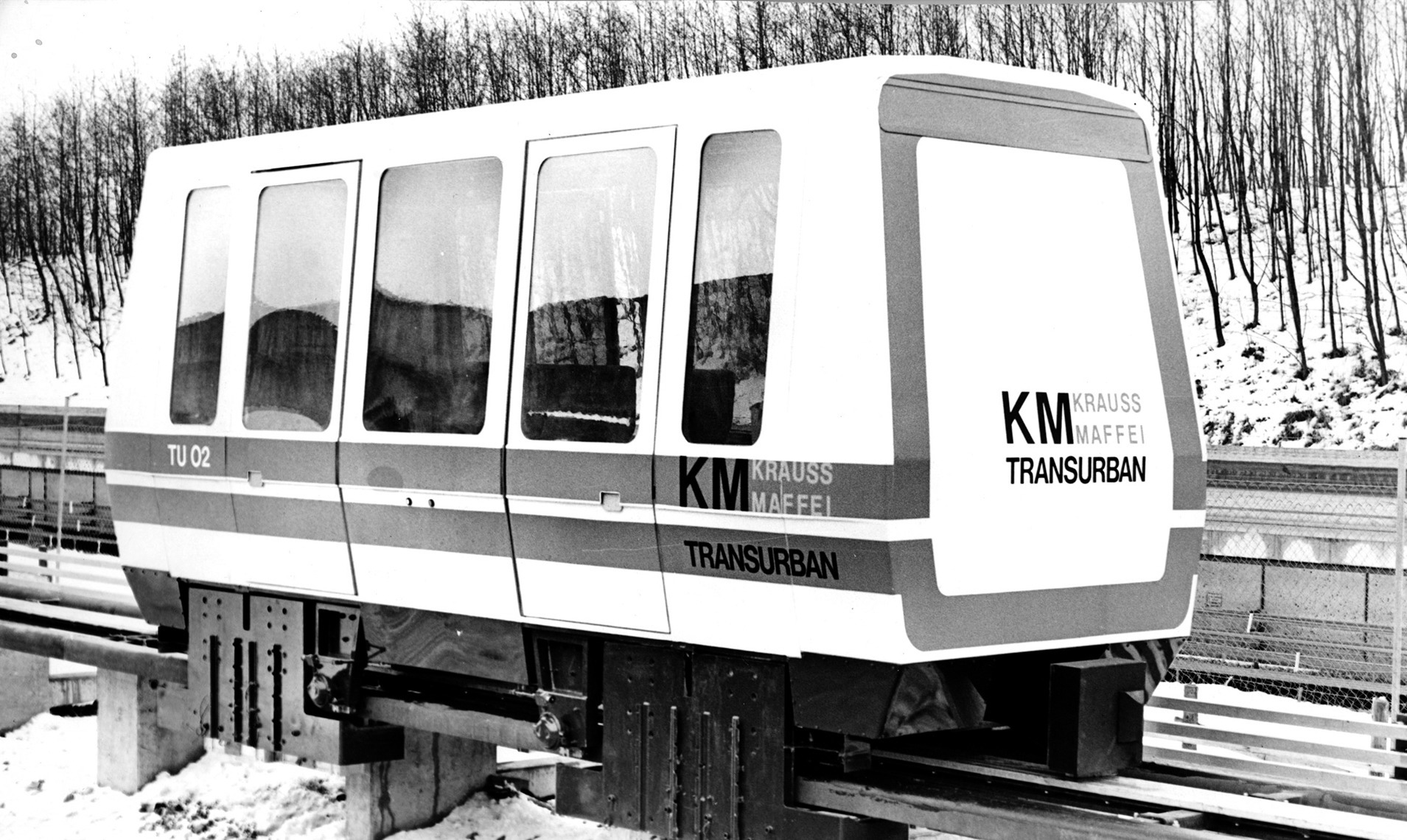
The first trains used on the Expo Line were developed by the then Province of Ontario’s Crown Corporation, the Urban Transit Development Corporation or UTDC to mitigate the high cost of subway construction in Toronto. Called Intermediate Capacity Transportation System or ICTS, the proprietary railway used cast off technology, including the “attractive, Linear Induction Motors (LIM’s)” from the ill fated Krauss Maffei Transurban MAGLEV system. ICTS was designed to bridge the gap of what a Toronto streetcar could carry and the traffic flows that would demand a subway.
Krauss Maffei’s ill-fated Transurban Maglev on a test track in Ontario.
The problem for ICTS was that modern light rail had just come onto the market and proved to have a higher capacity than ICTS at a much cheaper cost. Only two ICTS systems were built in Detroit and Toronto’s Scarborough Rapid Transit line or SRT. There were no other sales.
A political deal between the Province of BC and the Province of Ontario, saw the name changed from ICTS to Advanced Light Rail Transit or ALRT (to take advantage of the popularity of LRT) and the proprietary railway was forced on the Greater Vancouver Regional District and BC Transit for what became the Expo Line, by the former Social Credit government.
Obsolete before it opened, there was no international interest for the proprietary railway.
The UTDC and ALRT was sold to Lavalin, which went bankrupt trying to build the again rebranded Automatic Light Metro or ALM, in Bangkok, Thailand.
Bombardier purchased the remains of the UTDC and ALM and completely rebuilt the proprietary railway, using their Innovia body shells and marketed the proprietary railway as Advanced Rapid Transit or ART. Only four such systems were built, with two now involving Bombardier and SNC Lavalin (SNC amalgamated with the bankrupt Lavalin) in criminal proceedings, including bribery.
Bombardier again rebranded ART to Innovia Light Metro and again with no sales, finally rebranding the proprietary light metro as Movia Automatic Light Metro or MALM.
Despite TransLink’s claims to the contrary, both Bombardier and SNC Lavalin held patents for the proprietary railway. Alstom has now purchased Bombardier’s rail division including MALM (and patents).
The future’s looking bleak as Vancouver is the sole customer for MALM.
Alstom, is the only company with an existing functional design for the train’s propulsion system which they didn’t design as Alstom have two propulsion systems of their own light-metro systems that directly compete with the MALM’s existing LIM Propulsion system.
It now looks certain that Asltom will cease production of MALM in 2025 when Toronto’s SRT and Detroit’s ICTS close for good and that last paid orders for cars will be completed.
Despite misleading statements from TransLink and the Mayor’s Council on Transit, the Movia Automatic Light Metro is an unconventional proprietary railway that has only one supplier. No other company produces an “in production” or off the shelf compatible vehicle.
Translink redacts the names and bids of the underbidders for MALM cars and one wonders if there were competing bids or a proper bidding process took place?
A 1983 advertisement for ALRT, trying to capitalize on the success of classic LRT,
which fooled no one.Only seven such systems were built in total.
As ICTS, ALRT, ALM and ART were the same product, when did MALM cease to be a proprietary railway?
The answer, despite TransLink’s protestations, it did not cease to be a proprietary railway.
The problem with TransLink is that you can never believe what it says; TransLink never produces a report based on the same set of assumptions.”
Former West Vancouver Clr. Victor Durman, Chair of the GVRD (now METRO) Finance Committee.
The Broadway Subway
The North American standard for building a subway is having a transit route with traffic flows in excess of 15,000 pphpd. Current peak hour transit customer flows along Broadway are less than 4,000 pphpd, thus there is no justification for a subway.
In addition, the budgeted cost and funding of $2.83 billion for the subway may escalate past $3 billion as subways are notorious for cost overruns and are not good at attracting new ridership.
From the onset, the Broadway subway was being planned strictly for political prestige and civic pride; not to improve the regional public transit network.
The Expo Line Extension to Langley
There has been a change in scope for the Expo Line Extension Project to Langley, from 2 stages into a single stage project due to escalating costs.
The cost to go 7 km to Fleetwood was around $1.69 Billion to $1.72 Billion, exceeding the $1.63 Billion budget and why it is now combined into a single stage project. According to the second stage of Translink’s 10 year funding plan and the Rapid Transit Funding Agreement for the Surrey LRT Line, roughly $165 Million of that $1.63 Billion was coming from some past but mostly future tax and fee revenues (2018-2028 period).
TransLink’s local fuel taxes, development charges, parking fees, property tax increases as well as targeted amounts of TransLink’s own passenger revenues were to help fund roughly 8.6% of the $7.3 Billion Second Stage of the 10 year funding plan, roughly $627.8 Million in total. This plan included the Broadway Millennium Line Extension to Arbutus, the Surrey LRT Line and many, many other smaller capital programs. So far, the TransLink funding for the Broadway extension is unaffected. However, because of the pandemic, TransLink is short $78.8 Million in planned revenues from 2019 and 2020 (their figures not mine), 2021 is not done yet and it may take years for TransLink revenues to return to pre-pandemic levels. So it’s not $1.63 Billion in existing rapid transit funding, it’s actually around $1.55 Billion and dropping.
A new business case and a new funding plan is needed for the Expo Line extension and it will take 2 to 3 years to redo this process: No business case, no funding plan. TransLink isn’t even involved in the project management anymore, as it is now a provincially run project.
Further; If TransLink does not have the new business plan and business case scenarios completely done by March 2022 at the absolute latest, then expect a 10%-25% cost increase across the board, over last July’s estimate!
This is not good news for the Surrey Extension.
The UBC Millennium Line Extension
TransLink must also begin serious final planning and engineering on the second stage of the Broadway Millennium Line extension from Arbutus to UBC by 2024, if construction is to begin in 2026.
The estimated cost of this extension project is between $4.98 to $5.12 Billion for the planned 7.3 km long tunnel and above grade structure into UBC, that’s right now, 2021.
The actual date of final bidding and procurement will determine its actual final cost, when that is complete the final total will be known. The cost of the Broadway Millennium Line extension from Arbutus to UBC is predicted to be between $4.98 and $5.12 Billion and the cost is growing between $158 to $164 Million every year due to the current estimate of inflation. August’s inflation rate was 4.1% and recent news reports have this figure climbing higher.
This does not include inflationary costs of construction materials, which is usually considerably higher than the basic inflation rate. Structural concrete prices increases alone, could add anywhere from $36 Million to $55 Million per year on top of just the basic inflation.
The question facing TransLink and the province is whether they pay $2.65 Billion, or more, for the Langley project or wait and fund $3.77 Billion for UBC extension,both will not be funded at the same time.
There has been no meaningful public input allowed by Translink and the Mayor’s Council on Transit and the public has all but been shut out of this growing transit debacle.
TransLink’s Anti-LRT Bias
TransLink continues to use the cunning method of manipulating analysis to justify SkyTrain in corridor after corridor, and thus succeeds in keeping its proprietary rail system expanding.
The ongoing anti LRT bias by Translink has cost taxpayers Billions of dollars more for a product that has crippled the region’s ability to provide a user friendly and affordable public transit system. This is extremely important; the continued building of light-metro will greatly hamper the province’s ability to adhere to goals in reducing greenhouse gases in the current climate emergency we are now facing.
Contrary to the many false claims and man of straw arguments presented by TransLink, LRT costs much less to build, costs less to maintain, costs less to operate and has a higher capacity than the present SkyTrain light-metro system in Vancouver! This is the reason that MALM and its predecessors have failed to find a market and internationally the proprietary light metro has been deemed obsolete! Only seven such systems built since the early 1980’s, compares very poorly with the over two hundred new build light rail lines built during the same period.
The claim that LRT can only carry about 7,200 persons per hour per direction on Broadway is laughable, as it is dishonest. In Europe many city tram systems offer peak hour capacity in excess of 20,000 pphpd on portions of their lines. The claim of LRT’s limited capacity is false and because of this, many billions of dollars more is being spent on light-metro due to manufactured information by TransLink.
Comparing a surface LRT line with stations that have half the capacity and length of SkyTrain light-metro stations will not compare favorably. A surface BRT or LRT system that runs at lower frequency than SkyTrain light-metro in a tunnel will also not compare well.
As long as each technology is operated in a different right of way type at different operating frequencies means any result is biased. Unless TransLink actually studies both BRT and LRT running in the same environment and frequency as SkyTrain, those studies will be biased.
Both BRT and LRT do operate in tunnels and LRT can easily operate in any tunnel that SkyTrain operates in because the original body width design for the SkyTrain cars were based on easily available tram body frame and body shell widths. The power collection method of the SkyTrain, 3rd rail, can be easily put on any Light Rail Vehicle design and there have been electric buses operating from 3rd rail, although it’s only been done in a small number of prototype vehicles 3 or 4 decades ago. Modern electric bus technology makes this point meaningless. Both diesel hybrid and electric buses, including trolley buses, can operate in tunnels cheaply and easily.
Alstom, as mentioned above, may abandon MALM production altogether as soon as 2025.
A Judicial Inquiry Is Needed
TransLink quite happily lets people believe that Broadway was the “most heavily used transit route in Canada“, but after being caught out with this exaggeration, they quietly state “This is our region’s most overcrowded bus route.”
Also not mentioned, according to the Toronto Transit Commissions experience with subways; subways tend to “sanitize” businesses along its route, except at stations.
Overcrowding on the Broadway B-Line is a management issue, which has been cunningly manipulated to demand a subway on a transit route with a fraction of the ridership needed to justify building a subway.
It is certain that the Broadway subway to Arbutus will exceed the $2.83 billion budget and the real cost may now exceed $3 Billion.
Like the Canada Line subway going over budget, TransLink and the Mayors Council will have to abandon other transit projects; cannibalize the bus system; or reduce the scope of the project. To reduce the cost of the Broadway subway, cut-and-cover construction may be employed, to the detriment to adjacent businesses as what happened on Cambie Street.
Will escalating costs for the Broadway subway mean that cut and cover construction will be again employed?
The Expo line extension to Surrey is another example of political flim flam, where the current mayor of Surry claimed he could build the Expo Line to Langley for $1.65 billion. Despite major evidence to the contrary, Translink, the Mayor’s Council and silence from the government in Victoria, kow-towed to his wishes .
Today, the cost to extend the Expo Line to Langley has now surpassed $4 billion and has been delayed to 2028 or later.
Is the Langley extension now being planned strictly to meet political needs, due to the Premier’s political promise in the 2020 provincial election?
MALM is far too expensive to extend to Langley, as light-metro is a strictly urban transit system and not a suburban one. The light-metro’s operating costs will greatly escalate, while attracting very few new customers to transit.
By building both the $3 billion and counting Broadway subway, the $4 billion and counting Expo Line extension to Langley, and the never talked about but much needed $3 billion mid life rehab of the Expo and Millennium Lines, which much be done before the Langley extension can be completed, means the province and TransLink must source a minimum of $7.2 billion or 60% of the total cost to complete both projects and 100% of the cost for the much needed rehab.
This does not include any funding for the proposed $5 billion and counting UBC extension of the Millennium Line.
As mentioned above, the Langley extension may be deferred until after the much more politically prestigious Broadway subway is completed to UBC. With Alstom ceasing production of MALM, LRT will be the only choice to connect to Langley,twenty years after the present Mayor of Surrey cancelled the original LRT project!
Building more SkyTrain light-metro, will ensure the province does not meet the government’s lofty global warming targets and instead may force new road and highway construction, creating more congestion, more gridlock and more CO2 emissions!
A Judicial Inquiry of TransLink, the TransLink Board and the Mayor’s Council is needed now. A Judicial Inquiry is needed to bring honest planning and fiscal responsibility back to Metro Vancouver and to bring back public confidence in regional planning and the regional political process.The failure to do so will have dire political, economic, and environmental consequences lasting well into the next century.













Recent Comments