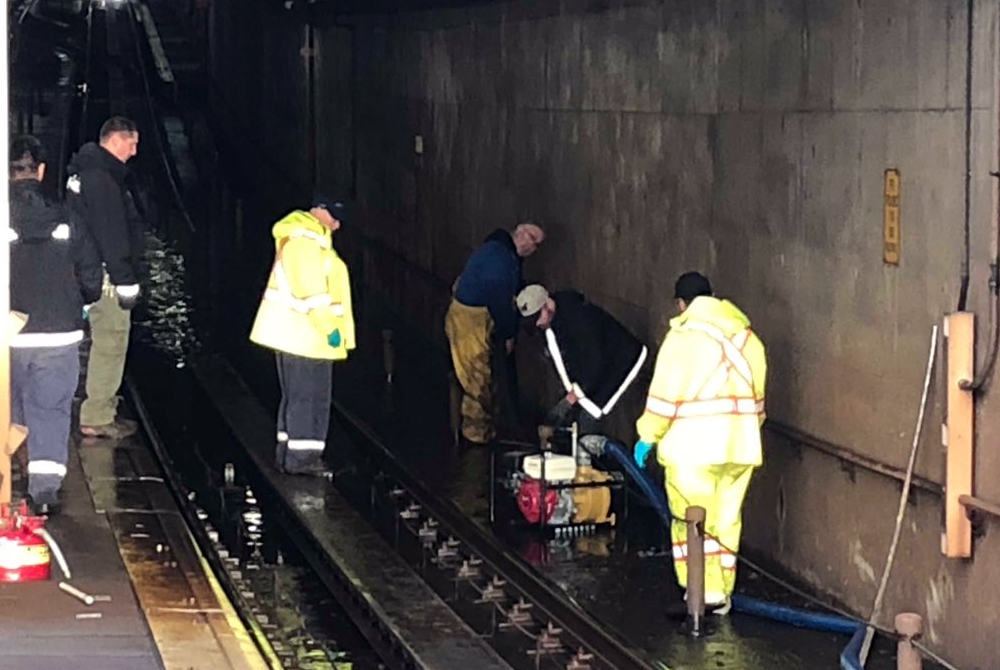
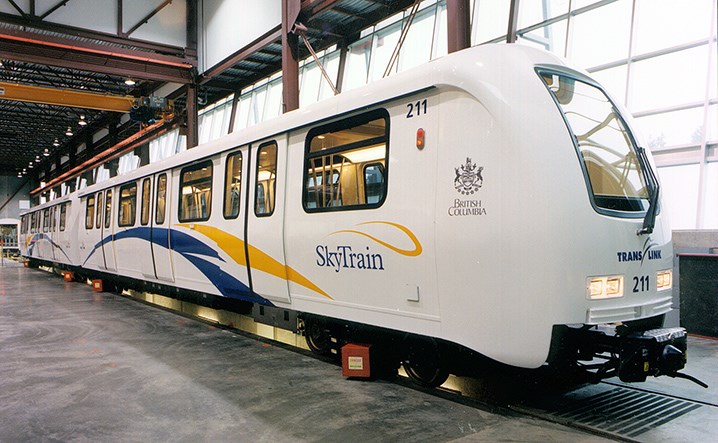
Heavy rainfall throughout Sunday led to the flooding of SkyTrain’s Columbia Station tunnel in downtown New Westminster.
As a result, late this afternoon and into the early evening, Columbia Station was closed, and it forced the cancellation of all train service running through New Westminster, including the cancellation of all train services across the Fraser River to reach Surrey. Bus bridge shuttles were deployed.
As of 6:55 pm, the station reopened and regular service on the Expo Line resumed, but it will take some time for crowding to subside and for trains to return to their normal pacing. The Millennium Line was unaffected by the Expo Line’s issues.
Based on TransLink’s service disruption reports, a decision was made at approximately 5:30 pm to shut down Columbia Station and turn around trains.
But there were also flooding issues at this station earlier in the afternoon that affected train schedules. Regular Expo Line services resumed just before 5 pm, but only briefly, as flooding issues quickly returned.
Columbia Station’s tunnel is susceptible to flooding as the station’s tracks are exposed to the elements, allowing water to pool. As well, water funnels into the station from both ends of the sloping tunnel entrances.
This is not the first time there has been a major flood-related service disruption within the Columbia Station tunnel. On December 11, 2018, heavy rainfall flooding a segment of the tunnel led to hours-long service disruptions.
From October 20, 2018; well its November 2022 and the cost for The Expo Line extension to Langley has now surpassed $4 billion and Zwei’s prediction has come true. SkyTrain construction is not to be started until 2028, if ever and transit for the Fraser Valley has been set back not 20 years, but 40 years!
What is sad, Rail for the Valley was almost alone condemning comments by Surrey Mayor, McCallum stating that SkyTrain would cost $1.65 billion to Langley, when in fact in 2021 the cost more than doubled to over $4 billion!
Sticker shock will soon be the order of the day because a little birdie tweeted in Zwei’s ear that the cost for the Surrey Expo Line extension to Langley will top $4.5 billion.
From the 2017 Steer Davis Gleave – HATCH report, the total cost for SkyTrain, including fifty-Five new cars is $2,914,798,721.00. As 2019 nears, the cost is rising.
Memo to Doug McCallum: we are not building SkyTrain to 1980’s cost of construction.
Memo to Gord Lovegrove: I think you need to join the Light Rail Transit Association and learn about LRT.
Memo to Steer Davis Gleave – HATCH: What we call SkyTrain is now known as ART or Advanced Rapid Transit, which patents are owned by SNC Lavalin and Bombardier Inc.. ALRT was repackaged as ALM the early 1990’s, when the UTDC patents for ALRT were sold to Lavalin, which promptly changed the name to Automated Light Metro. When Lavalin amalgamated with SNC to form SNC Lavalin, they retained the engineering patents and sold the technical patents to Bombardier Inc.
Question for Doug McCallum, how do you calculate that the ART Line to Langley will only cost $1.65 billion?
Let’s see your math sunshine or has that envelope been thrown in the incinerator?
Experts weigh in on the costs of SkyTrain vs. LRT in Surrey
Studies and past projects don’t seem to support mayor-elect’s SkyTrain cost estimates
A decision to ditch light rail transit plans in Surrey in favour of a SkyTrain extension would give up on a vision to grow the city and come with a price tag that is ‘magnitudes higher,’ experts say.
Doug McCallum, that city’s mayor-elect, told Postmedia News this weekend that a SkyTrain extension from King George station to Langley City could be completed for $1.65 billion — the same price as a planned LRT system that would connect Surrey City Centre to Guildford and Newton.
But that figure is far lower than a $2.9 billion estimate engineering firm Steer Davies Gleave & Hatch provided to TransLink in a July 2017 study. That estimate, in 2022 dollars, covered an eight-station, grade-separated, 16-kilometre rail line that would run cars consistent with those designed for the Expo and Millennium Lines.
McCallum has previously stated the project could be done for far less than that $2.9 billion if about half the SkyTrain line was at grade. It is unclear if McCallum’s $1.65 billion SkyTrain figure is supported by any reports, but he cited the roughly $1.4 billion spent on the 11-kilometre Evergreen Line in reaching that number. McCallum did not return a request for comment Monday.
Gord Lovegrove, an associate professor at the University of B.C.’s School of Engineering, said the last time he checked, each kilometre of SkyTrain line could be expected to cost around $150 million to build.
His per-kilometre estimate is not far off the 2011 dollar costs of the Evergreen line once they are adjusted for inflation. It is also consistent with an estimate in 2016 dollars that Steer Davies Gleave & Hatch provided for the Surrey to Langley SkyTrain extension.
“You have order of magnitude differences in costs” between LRT and SkyTrain systems, Lovegrove said.
He said the problem North Americans tend to have with light rail, which is relatively new on the continent, is that “we want to have our own exclusive right-of-way. We’re not willing to take the risk safety-wise, timetable-wise or schedule-wise to have it run with traffic.”
But Lovegrove said exclusive right-of-ways need not be the case any longer, citing Hamburg’s system as proving you can run at grade in traffic.
“I would just recommend maybe take a second longer look. Otherwise, if you’re spending an order of magnitude more, then you’re just not able to do as much with that same taxpayer dollar.”
Anthony Perl, a professor of urban studies and political science at Simon Fraser University with a focus on transportation, said that in every category he could think of, SkyTrain “costs more and does less.” Among other things, the automated system demands separated infrastructure, he said.
For Perl, part of the problem with SkyTrain is that it creates “development deserts” between stations. In contrast, the LRT system would have encouraged more density, he said.
“If the City of Surrey goes ahead and cancels the LRT plan, it’s going to set public transit back by 20 years south of the Fraser River,” Perl said.
Peter Hall, an associate professor in SFU’s Urban Studies Program, said swapping LRT through Surrey for SkyTrain to Langley was not just a change in transportation technology.
“It seemed to me that light rail was an attempt to give something to Newton as a node and give something to Guildford as a node, while at the same time building up the central area,” he said.
“You’re giving up on a vision on how you want to build Surrey as a place with a strong core and a set of well-developed successful sub-centres. I don’t get it. I don’t get why they’re so keen to turn their back on this.”
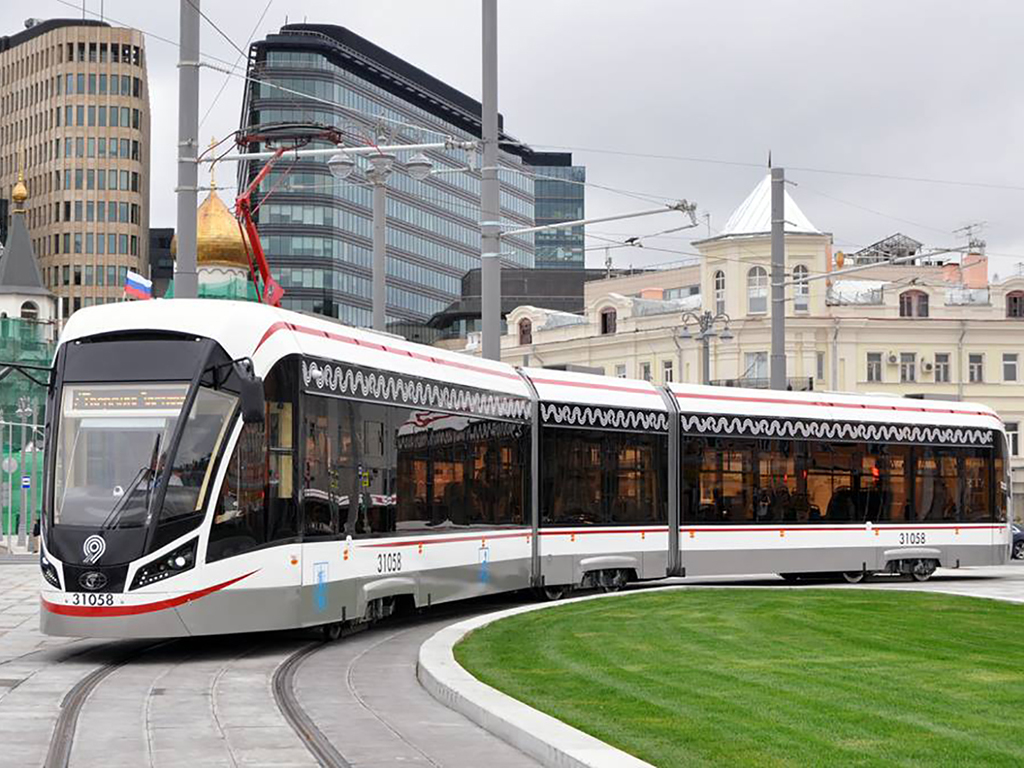
From the LRTA, the modern tram, workhorse of today’s public transit systems in over 600 cities around the world, yet noticeably missing in Metro Vancouver. Indeed, the modern tram is absent in soulless Vancouver and it is time to change this. Let’s put some soul into Vancouver; let’s plan for trams!
For the Fraser Valley Folk, only a Karlsruhe type TramTrain, can be affordably built to meet Fraser Valley transportation needs for today and the future.
TRAMS, SYMBOLS OF CITIES
and so much more . . .
Blending in with scrumptious things,
trams promote exports for the whole of
Portugal, and represent the charms of
Lisbon too.
Like a respected actor stepping down off the stage and mingling with the audience, this tram brings rail services right into the heart of the community in a village near Basel, with no smell, no noise, and no pollution – just supreme accessibility.
With style and a positive image, trams de-stigmatise public transport and persuade people to leave their cars at home in this residential Antwerp street.
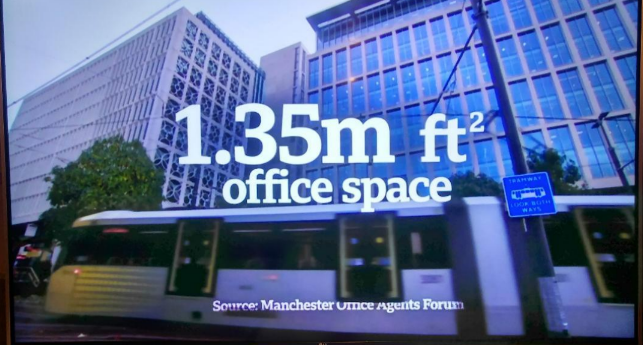
Selling office space, and helping to fill it with skilled workers, trams appear on television to present a positive image of their cities.
Steel, granite and copper deliver a reassuring air of permanence at this major hub in Prague, where multi-accessible trams beat other traffic into submission.
Trams constructively assert their place in the scheme of things in Zurich, calming the less sustainable traffic.
Ecologically impeccable, this Antwerp tram blends in cleanly with its surroundings and can draw its energy from environmentally-sound sources.
This tram in Brussels is so smooth-riding that a young artist can spend the journey busily at work with her sketch-pad.
In cities like Zurich where the unique appeal of trams is understood and celebrated, vintage trams are operated amongst more modern ones.
Trams blend in perfectly with tourist attractions, pedestrians, cyclists and the occasional car in this historic Ghent square, delivering a positive image and affordable mass transit for everyone.
Civic pride in the trams of Brussels was on display at an event celebrating the 150th anniversary of the city’s trams.
Trams blend in well with their surroundings, and they can shift large crowds to and from sporting venues.
Trams need to be on the surface to showcase their positive image. Putting them underground hides them away, and impairs their accessibility.
Trams operate efficiently and accessibly amongst other traffic in this Brussels suburb.
Without any fuss, trams welcome everyone aboard, promoting inclusivity and harmony.
Connectivity in Karlsruhe, where trams spread their positive image all over the conurbation – to outlying villages, busy main line railway stations, former suburban stations, and into the street. Transit presence and flexibility par excellence.
The following article also aptly describes metro Vancouver’s transit planning, which is mostly dictated by the premier’s office and camouflaged in layers of bureaucracy. The result is very expensive, politically inspired rapid transit lines that soon become financial anchors.
As a final note, the then Gordon Campbell BC government rejected LRT from the start, dropping both Siemens and Alstom from the project because both companies wanted to use light rail vehicles instead of light metro cars. The final result was a heavy rail metro, built as a light metro, having less capacity than a modern tram costing a fraction to build.
Montreal’s controversial REM train east is a product of Quebec’s top-down political culture
By Alexander HackettContributor
Tue., Oct. 12, 2021
For Montrealers old enough to remember the ’60s and ’70s, the prospect of yet another massive infrastructure project of questionable value and dubious execution will come as something of a déjà vu.
The REM de l’Est (or Réseau Express Métropolitain), announced by the Legault government and Quebec’s pension fund last December, has all the makings of a classic boondoggle.
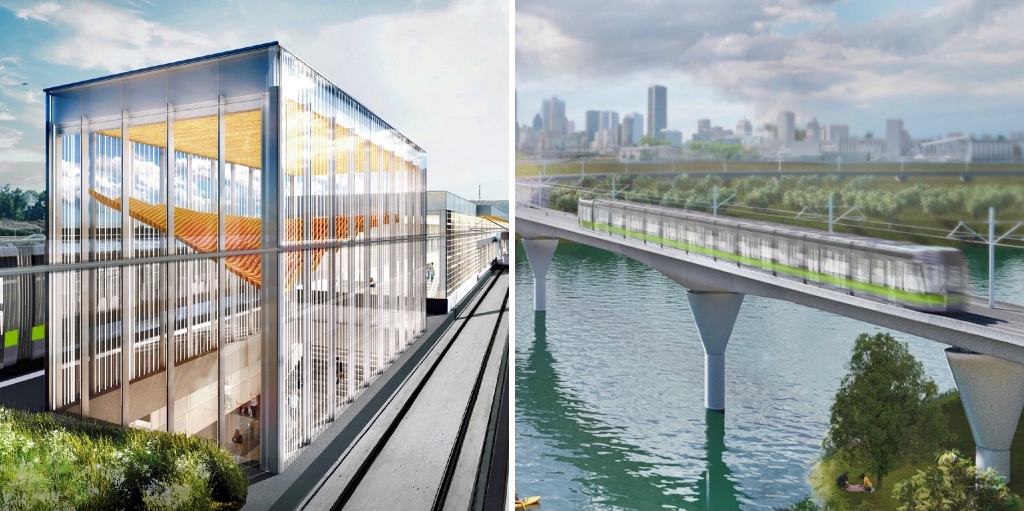
The proposed electric train would roll through the city’s downtown core on a series of raised pylons, linking historically underserved east end neighbourhoods with Central Station at a cost of $10 billion. Twenty-three stations are planned over 32 kms, and it will join western portions of the REM already under construction (and over budget).
While everyone agrees on the need for more public transit, the rushed, take-it-or-leave-it way in which developer CDPQ Infra has rammed the project through has shocked many citizens.
“The special law that created CDPQ Infra in 2015 gave them extraordinary powers,” says Gérard Beaudet, professor of urban planning at the Université de Montréal. “It put them above all the normal consultation procedures for the development of public transit in the Greater Montreal area.”
Questions of esthetic design, the necessity of building above ground and possible alternative routes have all been suppressed by the “political and financial authoritarianism” of the project, he says.
“Instead of responding to the needs of the population, this is about profit. There has been a complete lack of transparency on their behalf, and so we can’t even know why they’re making these decisions.”
Where to begin?
You could start with the fact the government’s awarding of a for-profit, no-bid contract to a branch of its own pension fund looks suspiciously like someone paying their right hand with their left.
Subcontracts go to the usual suspects, including SNC-Lavalin, who were until very recently banned from bidding on World Bank projects due to their own dodgy track record.
CDPQ Infra initially stated that tunnelling beneath the downtown core would be impossible, and could possibly result in the collapse of some skyscrapers. But they didn’t provide any studies to back up these claims, which have since been contested by independent engineers.
After a public outcry, they changed their tune and agreed to build a 500 metre tunnel near the end of the train’s route, thus sparing a central part of downtown from disfigurement. This casual change of tack created a glaring credibility gap for the company.
In Vancouver, by comparison, a proposal to prolong the SkyTrain into the downtown studied some 200 scenarios over many years. The aerial option was overwhelmingly rejected, as officials said it would be disastrous in such a densely populated area.
Total number of CDPQ Infra studies: Two.
In February, two Montreal architecture firms quit the project, saying it was so ugly and problematic they didn’t want to be associated with it.
“CDPQ is making it all up as they go along,” says Beaudet. “There’s no proof that we actually need this train, and no coordination with existing lines in the suburbs. It will render many of those obsolete.”
In a city still healing from such poorly constructed, space-age white elephants as the Turcot interchange, the first Champlain bridge (retired after 57 years), and the Ville-Marie expressway — which razed large swathes of historic buildings — locals are understandably skeptical about the wisdom of erecting another concrete behemoth downtown.
No list of Montreal construction follies would be complete without mentioning the Olympic Stadium and more recently, the LSD-inspired ziggurat that is the McGill University Health Centre (MUHC) — the biggest construction fraud in Canada’s history.
What these projects have in common are the provincial and municipal politicians who put them in motion and let them spin out of control — the likes of bullish ’60s mayor Jean Drapeau, Maurice Duplessis and now François Legault.
It’s big man style of top-down governance that brooks no dissent, doesn’t like consultations, and places the ends above the means.
And it’s especially disheartening when considering that the trend in most major cities — from New York to Sydney and Toronto — is toward a recuperation of urban space for green or public purposes.
Construction on the REM de l’Est is slated to begin in 2023.
Alexander Hackett is a freelance writer from Montreal.
The following was sent to all North Shore mayor and councils.
PLEASE DELIVER TO MAYOR AND COUNCIL AND FIRST NATION COUNCILS
From: Rail for the Valley
For the past 14 years, Rail for the Valley has advocated for the “return of the interurban” for the former Vancouver to Chilliwack BC Electric interurban line that still connects Vancouver to Chilliwack, via Surrey/Cloverdale; Langley; Abbotsford and Vedder/Sardis. Rail for the Valley, do to the soundness of the plan, secured Leewood Projects (UK) to do a study on the viability of such a service, with the result, the Leewood Study done for Rail for the Valley, released in 2010.
The Leewood Study is unique, in that it is a fully independent study, free of political and bureaucratic meddling.
Rail for the Valley, through its blog, tries to present viable and affordable transportation options-and being advised by real transportation experts and engineers who have “hands on experience” with transit projects, not only in Canada, but the USA, the UK and Europe. Having professionals who live outside the Metro Vancouver bubble advising on transit issues, gives a more realistic look at Metro Vancouver’s transit and transportation issues.
In 2010, the Leewood Study concluded that a full build, 138 km electric rail service, using modern articulated railcars, from Vancouver to Chilliwack would cost $998,519,424.00 or $7,235,648.00 per km. Accounting for inflation and updated to 2021 dollars, this would amount to $1.221 billion or $8.85 million/km to install.
In comparison, the current cost of the proposed Expo Line extension to Langley is now over $250 million per km. and the Broadway Subway is now said to surpas $500 million/km. The cost of the combined Expo Line extension and the Broadway subway is now over $7 billion for a mere 21.8 km of light metro and does not include a further $5 billion to complete the Broadway Subway to UBC, nor the much needed $3 billion rehab of the Expo and Millennium Lines, nor the yet unsourced $1 billion still needed to fund the Expo Line extension to Langley
VICTORIA, WE HAVE A PROBLEM
A short recap.
Metro Vancouver’s SkyTrain light-metro system operates two very different railways: the Canada Line which is a conventional railway, built as a light metro and the Expo and Millennium Lines which operate the proprietary and now called Movia Automatic Light Metro (MALM) system, the sixth rebranding of this obsolete mini-metro. Only seven MALM systems have been built in over 40 years, with Alstom now being the fourth owner of the proprietary railway. Previous owners were Bombardier, Lavalin and the Urban Transportation Development Corporation.
Canada Line operation is incompatible with the Expo and Millennium Lines and vice versa.
Only Vancouver continues to build with MALM.
Today, MALM is considered obsolete as it lacks capacity, costs more to operate and maintain than comparative light rail systems and lacks flexibility which is very important in the 21st century.
The $2.4 billion Canada line was the BC Liberals foray into transportation Private Public Partnership or P-3. The Canada Line a capacity-constrained heavy rail metro, built as a light-metro, costing much more to build than a modern tram, with less capacity. Internationally, the Canada line is considered a classic transit “White Elephant”.
The cost to have the Canada Line rehabbed to match the present maximum legal capacity of 15,000 persons per hour per direction (as stated in Transport Canada’s Operating Certificate) for the Expo and Millennium Lines, is now between $1.5 to $2 billion dollars.
This must be done before any extension to the Canada Line can be considered.
A big problem for TransLink is rumblings from Alstom indicate that production of MALM cars may cease when the last production orders have been filled in 2025, which also marks the end of service for the Detroit and Toronto MALM systems. No sales for the past 15 years may speed up the decision to abandon the proprietary railway, which would both drive up the cost of new vehicles as no other company makes MALM compatible cars and the cost of replacement parts.
The cost for light metro, especially MALM extensions, is rapidly increasing, quickly making such extensions not cost effective.
There may be no further extension to the MALM Lines after the completed Broadway subway to Arbutus! Talk of extending rapid transit to the North Shore is nothing more than political posturing, for photo-ops and sound bytes at election time.
“The problem with TransLink is that you can never believe what it says; TransLink never produces a report based on the same set of assumptions.”
Former West Vancouver Clr. Victor Durman, Chair of the GVRD (now METRO) Finance Committee.
DARK CLOUDS
There has been a change in scope for the Expo Line Extension Project to Langley, from 2 stages into a single stage project due to escalating costs.
The cost to go 7 km to Fleetwood was around $1.69 Billion to $1.72 Billion, exceeding the $1.63 Billion budget and why it is now combined into a single stage project. According to the second stage of Translink’s 10 year funding plan and the Rapid Transit Funding Agreement for the Surrey LRT Line, roughly $165 Million of that $1.63 Billion was coming from some past but mostly future tax and fee revenues (2018-2028 period).
Translink’s local fuel taxes, development charges, parking fees, property tax increases as well as targeted amounts of Translink’s own passenger revenues were to help fund roughly 8.6% of the $7.3 Billion Second Stage of the 10 year funding plan, roughly $627.8 Million in total. This plan included the Broadway Millennium Line Extension to Arbutus, the Surrey LRT Line and many, many other smaller capital programs.So far, the Translink funding for the Broadway extension is unaffected. However, because of the pandemic, Translink is short $78.8 Million in planned revenues from 2019 and 2020 (their figures not mine), 2021 is not done yet and it may take years for Translink revenues to return to pre-pandemic levels. So it’s not $1.63 Billion in existing rapid transit funding, it’s actually around $1.55 Billion and dropping.
A new business case and a new funding plan is needed for the Expo Line extension and it will take 2 to 3 years to redo this process: No business case, no funding plan. Translink isn’t even involved in the project management anymore, as it is now a provincially run project. Translink may not be capable of being a full financial partner in this project or any other large capital project for some time, due to its current budget issues. This is not good news for the Surrey Extension and even worse news for the North Shore.
A dark financial cloud on the horizon is beginning to appear larger. Translink had to begin serious final planning and engineering on the second stage of the Broadway Millennium Line extension from Arbutus to UBC by 2024, if construction is to begin in 2026.
They estimate this extension project to cost between $4.98 to $5.12 Billion for the planned 7.3 km long tunnel and above grade structure into UBC, that’s right now, 2021.
The actual date of final bidding and procurement will determine its actual final cost, when that is complete the final total will be known. The cost of the Broadway Millennium Line extension from Arbutus to UBC is predicted to be between $4.98 and $5.12 Billion and the cost is growing between $158 to $164 Million every year due to the current estimate of inflation. August’s inflation rate was 4.1% and recent news reports have this figure climbing higher.
This does not include inflationary costs of construction materials, which is usually considerably higher than the basic inflation rate. Structural concrete prices increases alone, could add anywhere from $36 Million to $55 Million per year on top of just the basic inflation.
The question for TransLink and the province is whether they pay $2.65 Billion for the Langley project or wait and fund $3.77 Billion for UBC extension,both will not be funded at the same time.
Unless something drastically changes soon, the current Langley Skytrain extension project in its present form is dying and may be put off, well into the next decade.
This bodes ill for any SkyTrain light metro connection to the North Shore.
RAIL FOR THE VALLEY’S SOLUTION
It is widely accepted that only a rail solution will attract the motorist from the car; buses have proven disappointing in operation, as they get stuck in traffic and true Bus Rapid Transit costs only a little less to build than LRT with none of the operating or capacity benefits. Only politicians think buses can be rapid transit, yet sadly for the transit customer, a bus is a bus, is a bus.
Rail for the Valley’s Leewood Study provides an affordable alternative, operating a regional passenger service using existing railways. As there is a railway connection from Vancouver to the North Shore, Squamish and beyond to Whistler, a passenger rail service must be considered.
Modern articulated rail cars can travel at higher speeds on curving track, giving realistic travel times and properly signalled with passing loops (double track), trains could operate up to three times an hour per direction.
This is not fanciful thinking, rather it’s what is currently happening in Europe where the huge cost of new metro and highway construction has forced planners to use existing railways for a regional rail service that people will use! In Europe and now even in the USA, disused railways are being refurbished and abandoned railways are being rebuilt as a much cheaper alternative than stand alone metro lines or new highways.
The modern articulated railcar, powered by clean diesel or electricity from by fuel cell or by overhead wires, can obtain commercial speeds acceptable by customers on even the most difficult routes. The modern articulated railcar can contain amenities such as a WC and or a ‘bistro’ offering light refreshments for the longer trips. The modern articulated railcar can also operate in multiple units, thus capacity can be increased when needed.
The modern articulated railcar can also increase vehicle capacity by adding additional modules at a much cheaper cost than buying a new vehicle.
Based on the Leewood Study and taking into consideration that the track is in excellent condition, the cost for the approximately 80km Vancouver to Squamish regional passenger railway, using the Canadian National Railway and the former BC Railway right-of-way, with a maximum of three trains per hour per direction would be in the neighbourhood of $1 billion.
The new regional railway would have stations at the Squamish, Britannia Beach, Lions Bay, Horseshoe Bay, Caulfield, West Bay, Ambleside, Capilano, Lonsdale, Lynn Creek, and Vancouver, Pacific Central Station.
The province and region are now in a climate emergency, combined with worsening regional traffic congestion. The current transit planning based on light metro and the hub and spoke philosophy of transit (where buses bring customers to transit hubs) is failing as pre covid, regional mode share for transit is dropping. Planning and building more SkyTrain light metro lines is akin to doing the same thing over and over again ever hoping for different results.
Metro Vancouver must plan cheaper, user-friendly transit options in order to attract the motorist from the car, as the present light metro system has failed to do so and despite an over $15 billion taxpayer investment.
For less than the cost of a now $3 billion, 5.8 km Broadway subway or just over half the cost of the over $4 billion, 16 km Expo Line extension to Langley, we could build two regional railways, connecting Vancouver to Chilliwack and Vancouver to Squamish, with a possibility of a 210 km regional rail service, with through service from Squamish to Chilliwack, via Vancouver.
There are many obstacles to overcome and all levels of government must be on board but….. the time has come to stop transit planning for politically prestigious projects and plan for the region’s future and the future is an affordable and user friendly transportation network, which the present transit system is definitely not.
North Shore Connects faces a Hobson’s Choice for transit planning, either advocate for what could be affordably built or advocate for ‘pie in the sky’ rapid transit solutions that will not be built.
From Norman Farrell’s In-sights blog, commenting on the NDP’s continuation with the Site “C” dam project despite the fact that Site “C” is a risky $16↑billion energy project that will cause massive ecological damage and produce electricity at 4x the cost of alternative sources..
The same is true with the now $3 billion Broadway subway (BS Line) and the now $4 billion Expo Line extension to Langley. Bot transit projects are hugely expensive for what they can do with little or no benefit for the transit customer.
The planning fallacy stems from an overall bias towards optimism, because people are oriented towards positivity. Politicians are more likely to be biased this way than others.
In Metro Vancouver, local politicians are wonderfully ignorant of transit, transit mode and more, yet they perceive themselves to be transit experts and refuse to consider any alternative, except their own. This leads to extremely expensive, yet questionable transit developments.
We have a tendency to discount pessimistic views or data that challenge our optimistic outlook. This is the flipside of our positivity bias: our preference for affirmative information also makes us reluctant to consider the downsides.
Again, in Metro Vancouver negative news about TransLink and transit is censored. The mainstream media is reluctant to report dissenting news, thus the public remain ignorant of real problems.
When organizations plan projects, too often they focus on imagined successful outcomes not potential pitfalls. They are likely to overestimate their capability of achieving project goals. The result is financial disaster, something that governments will almost never admit.
Local rapid transit projects are expressed in arcane terms like car-trips or the cost of commute time. Most of it is just invented.
Anchoring is the tendency to rely too heavily on early information when making decisions. After the initial plan for a project, managers are biased to continue thinking in terms of initial goals, methods, deadlines, budgets, etc.
This happens with our rapid transit planning, which bases the future operation of light-metro, with very dated statistics about light rail, sometimes 40 years out of date!
Anchoring is especially problematic if original plans were unrealistically optimistic. Even if expectations were massively inaccurate, people feel tethered to original plans and make insufficient adjustments, preferring to make minor tweaks rather than major changes.
The same is true with the SkyTrain light-metro, despite the fact the system is seen as obsolete internationally, it is still perceived as high-tech and world class locally.
Project planners tend to discount pessimistic views or data that challenges their optimistic outlook. Preference for affirmative information also makes organizations reluctant to consider the downsides.
In Metro Vancouver, negative news about SkyTrain is just not printed. Politicians completely ignore problems and pretend they do not exist.
Executives often remain focused on ways of doing business they are most familiar with and fail to embrace new technology or anticipate changing methods proven by others to be successful. As a result, they underestimate project risks.
Local planners are so in-bedded with the obsolete light metro, they absolutely refuse to consider cheaper and just effective transit solutions, such as light-rail.
Managers tend to ascribe positive outcomes to their talents and hard work, but attribute negative outcomes to factors beyond control. They are convinced that external factors leading to failure were unforeseeable.
Much of our transit ills have been predicted decades ago, yet today, managers claim that the problems were unforeseen.
Workplace cultures are competitive and there may be costs for individuals who voice less enthusiastic opinions about a project. Executives favour the most overly optimistic predictions over others, giving individuals an incentive to engage in inaccurate, intuition-based planning.
BC Transit and TransLink effectively fired or had removed anyone supporting light rail, thus TransLink’s planning for LRT is so dated and biased, it is not worth the paper it was printed on.
Well, the first surprise was that this news item came via the Alaska Highway News of all places.
This tells me TransLink is spinning the story to everyone it can to give the good news to!
The big problem that there is no money to fund these grand schemes and the post Covid economy may not support the level of taxation that politicians have deluded themselves that they can shake from taxpayer’s pockets.
Metro Vancouver’s rapid transit system needs to quadruple by 2050 with 300 kilometres of new routes including SkyTrain, subway, light rail, or bus rapid transit, says a TransLink report released today.
So someone please tell me, how much will that cost?
The Expo line extension to Langley is topping $250 million/km and the Broadway subway will surpass the current $500 million/km to build. The city of Vancouver claims a 12 km streetcar will cost over $1 billion, so where is the money coming from?
It also becomes evident why Kevin Quinn was hired to be TransLink’s CEO. Kevin holds a Master’s Degree in Public Policy from Johns Hopkins University. Translation, he is an over paid spin doctor with expertise manipulating facts and truths to be fed to the public.
I sent an email to he Baltimore MTA inquiring about Mr. Quinn and what I got back was less than reassuring.
You are about to get a new CEO of TransLink in the person of Kevin Quinn. this is a good news/bad news situation. Good news is we are rid of him, bad news you are getting him.
Mr Quinn may be the nicest yes man you will ever meet. he is very personable and friendly but have yet to actually see him in 6yrs have an opinion of his own and if he has any use for light rail he has kept it well hidden.
Hopefully you will have better luck than Baltimore, ridership is off (before pandemic) 2% year over year since he took over.
TransLink has serious financial problems; TransLink has not sourced the extra $1 billion dollars to complete the Expo Line expansion to Langley. TransLink does not have the funds to cover cost overruns on the Broadway subway. Covid has cut deep into ridership and ridership revenue. So what does a university trained spin doctor do, smother us with dreams of transit here, there and everywhere, while lurking in financial shadows deflecting the truth.
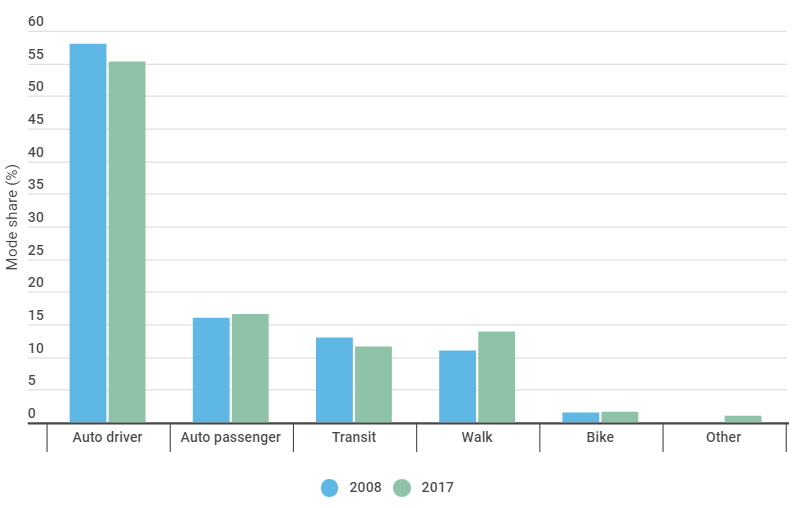
TransLink also has ridership problems, as transit use has been slowly dropping pre Covid as the following table records. The ridership numbers are increasing at a slower rate when compared to rising population numbers.
Let us not forget that transit ridership in Baltimore decreased 2% a year every year, during Mr. Quinn’s tenure there!
Pre Covid, Mode share for transit was declining.
What TransLink is doing is opening the first shot for the 2022 civic campaign giving current politicians platforms to win their reelections. TransLink has no money, revenue is dropping, there is a $1 billion and growing shortfall of money to complete the Expo Line expansion, costs are sure to increase for the Broadway subway, so the big transit lie is offered and…………
when you repeat a transit lie often enough, the people tend to believe it!
300 kilometres of new SkyTrain, subway, light rail, or bus rapid transit routes needed, study finds.
By: Jeremy Hainsworth
TransLink’s draft Transport 2050 strategy has 100 recommendations to improve transportation over the next three decades.translink
Metro Vancouver’s rapid transit system needs to quadruple by 2050 with 300 kilometres of new routes including SkyTrain, subway, light rail, or bus rapid transit, says a TransLink report released today.The draft Transport 2050 strategy lays out a vision for the region’s future with 100 recommendations to improve transportation over the next three decades.
“Transport 2050 will transform the way we move and live, and it’s imperative that the region’s transportation future is guided by the people who call it home,” TransLink CEO Kevin Quinn said.
And, with growth projections showing a huge influx into the region by 2050, transit expansion will be needed.
“Metro Vancouver grew from 2.38 million people in 2011 to 2.59 million people in 2016. Regional Planning’s modelling shows that this growth trend will continue. The region is anticipated to reach about 3.8 million people by 2050,” said an April Metro Vancouver Regional District report.
Other key TransLink recommendations include completing an 850-kilometre traffic-separated major bikeway network to connect communities with greener, healthier transportation options and promoting electric and shared vehicles such as bikes, scooters, and cars.
The report was released as TransLink opens its third and final round of public engagement on Transport 2050 before the strategy becomes final. TransLink wants to gauge public support the overall strategy, and is seeking suggestions for improvement.
“Based on the input, we will update the strategy before sending to the TransLink Board and Mayors’ Council for final approval in early 2022,” TransLink said in a news release.
“Transport 2050 will have wide-reaching benefits on our lifestyles in Metro Vancouver,” said Mayors’ Council chair and New Westminster mayor Jonathan Coté. “Our ability to move around has massive impacts on our quality of life, climate change, and our potential to grow as a region.”
B.C.’s Minister of State for Infrastructure Bowinn Ma said Victoria is committed to reliable, affordable, low-carbon travel options.
“This includes investing in public transit, expanding active transportation networks and facilities for people who walk, bike, and roll, and supporting the development of complete communities that allow people to live close to where they work, study, and play,” Ma said. “Transport 2050 will provide an important roadmap to guide us toward those objectives.”
Minister of Environment and Climate Change Strategy George Heyman said Lower Mainland residents expect affordable transportation options supporting climate change action.
“By aligning priorities – such as increasing the region’s use of transit and active transportation – TransLink and the province will create a bigger, better, cleaner transportation system that will serve generations to come,” Heyman said.
The final phase of engagement begins was to start Oct. 12 and run until Oct. 29. Members of the public are invited to learn more, complete a survey, or register for an online open house by visiting transport2050.ca.
The problem with REM. like the Canada line is that it is more of a financial tool than a public transit line and because of this, the transit customer has been ignored.
A healthy transit system offers multiple ways to get between points A and B — not only does this offer users choice, it helps spread people out and offers alternatives in case of service disruptions.
The Canada Line has never gone under the scrutiny that REM has, as our extremely lazy mainstream media uses rosy news releases from TransLink as actual news.
With the Canada Line, suburban transit customers lost their direct service to downtown Vancouver with the forced transfer from bus to metro at Bridgeport station and because of this the expected increase in suburban ridership never materialized.
As there are many post secondary institutions along the Canada Line, including the downtown campuses of UBC and SFU, Langara College and a many other private schools and colleges and the proliferation of the $1 a day U-Pass, the Canada Line ‘s two car trains tend to be full.
The question TransLink refuses to answer is:
What percentage of the Canada Lines customers are U-Pass holders?
In fact TransLink and the SkyTrain lobby gets touchy when one asks this and one wonders why? How many daily unique uses of the Compass Card/U-pass is there on the light metro system?
TransLink refuses to release this information and instead, continues to use boarding’s, which is hardly helpful.
The REM light metro is nothing more than a financial tool, with the carrot that the politicians do not have to take responsibility for the system, but still can use the the light metro as a backdrop for pre election photo-ops. The problem with this is what is currently happening in metro Vancouver is that the transit customer is abandoning transit for the car. Mode share for transit has dropped to 14% pre Covid and the post Covid recovery is not materializing as fast as TransLink would have wished and the near future looks somewhat bleak.
If this sort of transit planning and construction continues, bodes ill both for quality transit in Vancouver and for the fight against global warming.
What’s wrong with the REM? A feature report on Quebec’s mass transit con
“Just like the construction of the Olympic Stadium, Montrealers can do little but watch billions in public money wasted on a glamour project of dubious necessity.”
Every time there’s an announcement about the Réseau express métropolitain (REM), the pundits, politicians and PR hacks frame it like a late-night infomercial advertising some product you never knew existed but was now available to solve your and all the world’s problems. Finally, they exclaim, Montreal is getting the REM.
Ever since the government of Quebec awarded a no-bid, sole-sourced contract to the provincial pension fund (the Caisse de dépôt et placement du Québec, or CDPQ) to build a new mass transit system, I’ve been concerned this might not be the best idea. I support public transit because I believe it’s the best way to control carbon-dioxide emissions and to make cities far more liveable. Congestion, pollution and emissions all work together in depreciating our quality of life, and I often find myself wondering how we might use our public spaces differently if we only had to contend with a quarter, third or half as many cars.
That aside, the REM is behind schedule, over-budget and bits and pieces of it are being scaled back. It will open later than originally stated, have fewer stations and may not go to all the places we were told it would. Perhaps more disturbingly, both the CDPQ and the political class are now talking about extending it all over the metropolitan region, as though more of this overhyped panacea to all our transit and traffic woes will distract us from the fact that it hasn’t even gotten off the ground yet.
Much like a runaway freight train, there’s little hope of stopping the REM. Indeed, our future REM trains are supposed to be fully automated — no need for pesky unionized transit employees dipping into the profit margin — and so likely won’t have anyone aboard to hit the brakes in case of an emergency. The REM — and this cannot be forgotten — was a decision of the Quebec government in collaboration with the provincial institutional investor, the CDPQ. Neither Denis Coderre nor Valérie Plante had anything to do with it, despite what they may tell you. This was never Montreal’s decision to make, as our transit agency was never initially consulted.
The main reason why the REM won’t be stopped, no matter how many problems it produces, is because there will be incredible financial penalties to pay. Moreover, the work that’s already been done has been so expensive that no government would risk pumping the brakes to re-evaluate just what exactly it is we’re doing, or ask the question whether this is really worth it.
All we can do at this point is complete the project and try to wrestle back some control into the hands of the people who need and use public transit, rather than those who seek to profit off it.
So with all this mind, let’s consider some of the most recent developments.
Anyone who’s not too stoned to recall 2015-16 (when the REM was first announced) will doubtless remember the centrality of the airport connection. Finally — we were told so many times — Montreal would have a quick and efficient connection to the airport. Now it seems that Aeroports de Montréal is unable to come up with the estimated $600-million to build the connection. It’s a neat idea to have direct public transit connections between airports and city centres, but in Montreal’s case the passenger estimate for the new airport stop isn’t terribly impressive. One estimate prepared for the CDPQ back in 2016-2017, and based on data from 2015, put the daily average number of airport REM station boardings between 4,600 in 2021 (what was supposed to be the first year of operation) and 5,600 in 2031 (after a decade-long “ramp-up” in use). This would put the airport REM station in the same range as some of the lesser used metro stations. Some of the more optimistic pre-pandemic projections indicated 10,000 passengers will use the station per day. While it’s true the number of passengers using Trudeau airport has been steadily increasing over the years, it was still just 20 million passengers per annum, and that was before the pandemic. It may not be until the end of this decade that we get back to that level of passengers, and of course, the major reductions in flights also means major reductions in airport workers too, further sapping the number of people who may use a new REM airport station.
The airport station reveals other shortcomings of the REM. The way the system was designed, the only trains that will run directly to the airport are those leaving the McGill/Central Station nexus downtown. If your starting point is on the South Shore, in Deux Montagnes or in the West Island, you’ll have to switch trains, as none of those branches will run trains going directly to the airport.
While the estimated travel time between downtown Montreal and the airport will probably clock-in at 20-25 minutes, passengers coming from other areas can expect much longer commutes. For the majority of West Islanders, Lavalois and people living on the western side of the off-island suburbs, taking a cab or driving will unfortunately still be the most efficient way to get to the airport. And at 20-25 minutes, the REM isn’t that much more competitive on the downtown-airport run than the existing bus service.
Worse, it’s not like Montreal can take the $600-million earmarked for the airport station and use it somewhere else — like buying 600 brand-new electric buses from a local bus manufacturer (NovaBus’s fanciest, fully electric buses cost $1-million apiece). For comparison’s sake, 600 new buses, each carrying 80 passengers, just increased Montreal’s public transit capacity by 48,000 people per minute. This would be a considerable improvement over the few thousand additional passengers handled by the airport stop, but more significantly, the buses, unlike the REM, can go anywhere.
Why are we so caught up with the idea of riding the REM to the airport? It probably stems from the same minds that think a REM monorail over René-Lévesque is also a good idea. In sum, Montreal’s getting transit solutions to problems that don’t really exist, dreamt up by people who may not live here and likely haven’t used public transit in decades.
The people who are calling the shots consistently pitch the REM as a solution both to congestion as well as something that will encourage people to abandon their cars and hop on board the sustainability train. They pitch the REM as something “cool” that people will look forward to trying, and I can’t help but wonder how many of these people marvelled at the various new fangled transit technologies demoed at Expo 67, like hovercrafts (no longer will your boat be confined to water!) or gondolas (they’re not just for Switzerland anymore!).
Yes, people do need to be encouraged to take public transit, but this won’t happen if you spend several years ripping up the existing transit infrastructure. The STM’s ridership numbers were increasing steadily year over year until the Coderre administration made serious service cutbacks in 2014. Consequently, use declined, something REM construction exacerbated.
When it was originally proposed, the REM was supposed to use existing infrastructure. The public was assured that the construction of the REM would have a minimal impact on extant infrastructure. But rather than buying trains to fit extant infrastructure, the CDPQ instead decided to build everything anew, from the trains to the track to the power systems. In so doing, the most-used commuter train line in Greater Montreal was shut down, and the excessively expensive Mascouche Line was cut off from downtown Montreal, rendering it essentially useless. New double-decker trains bought less than a decade ago are no longer needed. It goes on and on like this. Just like the construction of the Olympic Stadium, Montrealers can do little but watch a white elephant get built, billions in public money wasted on glamour projects of dubious necessity.
There’s a common denominator to this mess: Montreal’s transit isn’t planned by Montreal. The REM was always a Quebec government and CDPQ project, and it’s worth pointing out that the CDPQ had no prior experience in the construction or management of mass transit systems, let alone public transit.
Montreal is actually legally prohibited from developing its own public transit systems (see item #151 here). That is to say, if Montreal had $10-billion lying around, it would still not be allowed to expand the metro.
We have no choice but to involve middlemen in our own transit planning decisions. With regards to the REM, the Quebec government handed incredible power over to the CDPQ. They were given exclusive rights to public infrastructure (like the new Champlain Bridge and the Mount Royal Tunnel) and further granted non-compete agreements with other modes and services of public transit. Looping back to the issue of the airport station, the CDPQ actually managed to get the government to agree to force the STM to cancel the 747 airport shuttle to give the REM exclusive airport access (see pp. 10-11 here).
No public transit planner would ever plan transit like this.
Once the REM becomes operational, all other transit modes and systems will be reoriented to serve it. Eliminating duplication may seem like a good idea to the number crunchers, but users and planners understand that operational redundancy is vital. A healthy transit system offers multiple ways to get between points A and B — not only does this offer users choice, it helps spread people out and offers alternatives in case of service disruptions.
What concerns me most of all about the REM — aside from the fact that we’re essentially subsidizing the CDPQ’s real-estate development plans and being used as guinea-pigs for their infrastructure development business — is that we’ve been forced to hand over control of public transit to a for-profit organization. The CDPQ included a clause stating their annual return on investment would be set at 10% irrespective of the REM’s actual revenues. If the REM doesn’t produce this return, taxpayers foot the difference.
There’s nothing really novel about the REM. It’s just another imposition on the city of Montreal by people who claim to have our best interests at heart, but are truly only interested in sucking as much money out of the public purse as they possibly can. The REM is shiny and new, and may or may not reach the airport, but it isn’t the boring old solutions that would likely have the best overall impact. There are experts, but they weren’t consulted. There were consultations, but the people were ignored. There was an environmental assessment that was highly critical of the project, and then-Premier Couillard decided it had exceeded its mandate. We were given the bare minimum opportunity to speak, but no one was really listening.
So what do we do now?
It’s an election year, there’s a good chance Coderre will run, and he’ll likely position himself as the REM king. Mayor Plante, not wanting to be upstaged, will likely match or exceed whatever Coderre’s position is on transit development. Expect a lot of talk about a Blue Line extension to Anjou (finally!), more talk about a Train de l’Est and/or some kind of Pink Line/ Train de l’Est amalgam (finally!!) and monorails over René-Lévesque (finally!!!). They’ll likely each have a position on the airport connection as well, and here Montrealers may have a chance at regaining a degree of control over public transit. We can say no, we can demand the REM be subsumed into the STM and we can insist the citizens and government of Montreal be given the control they deserve over their own transit systems.


 Blending in with scrumptious things,













Recent Comments