Most railway enthusiasts in the UK treat Beeching as a leper. In fact, Beeching predicted the end of local railways altogether, leaving the UK with just three or four trunk lines, connecting major cities by the 21st century.
This is not to argue that rationalization should not have taken place, but to tear up the UK’s newest Railway the Great Central, built to continental standards, is on par with Gordon Campbell’s selling of BC Rail.
BC has several rail lines that could support a service using cheaper rail-cars, such as the E&N; the former BCE interurban from Vancouver to Chilliwack and a few lines in the interior.
The problem is simply “blacktop” politics practiced by dishonest politico’s and enabled by equally dishonest planners and engineers – all to win votes from gullible voters.
What would Dr Beeching say? New generation of ‘no-frills trains’ will open up little-used lines that have been closed since his controversial 1960s reviewai??i??
Train lines closed in 1960s under Dr Beeching report could be reopened
Plans drawn up for new lightweight vehicles in A?4million railway project
Said to cost around A?500,000 each, half the price of standard diesel engines
Train lines closed under the controversial ‘Dr Beeching’ cuts are set to be re-opened and serviced by ‘no-frills’ trains.
It is understood a A?4milion trial will be launched within the next two years using cheap, low-speed trains built from ‘lightweight’ materials.
And the new vehicles could be trialled on the Northern Rail network between Manchester, Leeds and Newcastle.
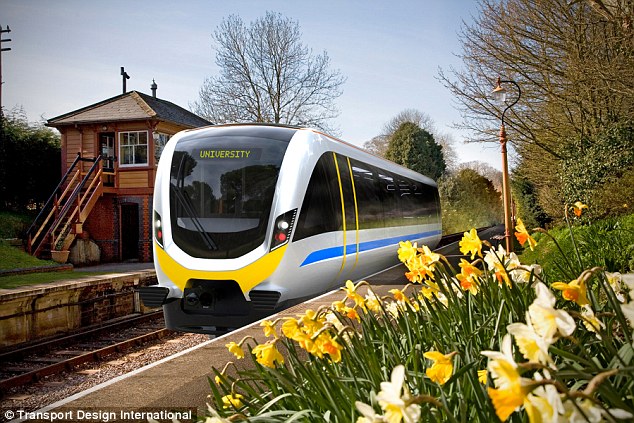
Transport Design International have come up with plans for new lightweight trains that could cut costs and lead to railways closed by Dr Beeching in the 1960s being reopened
The new technology could see some of 5,000 miles of disused track opened again after it was originally closed in Dr Richard Beeching’s review in the 1960s, when he was chairman of British Railways.
According to The Times, rail bosses say the trains will be manufactured at ‘half the cost’ of an existing carriage and be smaller than a standard bus.
The project is set to be funded by both the Department for Transport and the Rail Safety and Standards Board, with the new trains also said to cause less damage to tracks.
It is believed the trains will be constructed out of a mixture of aluminium, steel and carbon fibre and be around 60ft long, although they could be reduced to just 30ft long.
They will weigh around 28tonnes compared to the 50tonne weight of a normal carriage when full.
The Times claims the trains will be powered by 3.8-litre diesel-hybrid engines and reach speeds of between 50mph-70mph. They will cost around A?500,000 each, which is half the price of a regular diesel train.
One of the firms behind the plan is Transport Design International, which is believed to be working alongside the University of Warwick and Unipart Rail.
+2
Dr Richard Beeching, right, recommended shutting thousands of miles of rural train lines in the 1960s, leading to much criticism
A statement on TDI’s website said: ‘The underlying concept is to be able to offer a bespoke design and supply service to customers in potentially ‘one-off’ or niche applications where conventional light rail is inappropriate.
‘It involves providing lighter weight, smaller capacity and consequently lower cost vehicles and infrastructure than would otherwise be affordable and allows rails be laid over existing services if necessary, without the need to relocate them.’
The statement added: ‘Sometimes called ‘ultra light or ‘very light’ rail, these unique trains can be built to narrow or ‘standard gauge’ as required, either as single, bi-directional vehicle (with an option to have a cab at both ends) or as multiple unit consists.
‘Internal layouts and aesthetics can be varied to suit individual needs and the ratio of seated and standing accommodation adjusted.’
A prototype version is expected to be ready within the next 18 months.
But the lightweight design will mean the trains can only operate on lines not used by heavy trains.
According to The Times, the news has been welcomed by passenger groups.
Stephen Joseph, of Campaign for Better Transport, said: ‘One of the things that bedevils plans to reopen old lines is cost so this has potential to really make a positive difference.’
Nick Mallinson, of Warwick Manufacturing Group, told the paper: ‘Lots of lines that Beeching closed could benefit from this. A lot of councils are saying they want to reopen them.’
MailOnline has contacted the Department for Transport for comment.
DR BEECHING: HERO OR VILLAIN OF BRITAIN’S RAILWAYS?
Dr Beeching, pictured, has been branded a villain by many but others have claimed his recommended cuts were necessary
Dr Beeching is synonymous with the mass destruction of Britainai??i??s rail network.
His famous report, Reshaping The British Railways, which led to a massive programme of track and station closures.
Dr Beeching’s report identified 2,363 stations ai??i?? one-third of those in the network ai??i?? and around 6,000 miles of track to be closed.
His proposal sparked outrage from commuters, local councils and the trade unions, who were appalled at the talk of 70,000 job losses.
But others have called DrAi??Beeching was a courageous man who forced the railways to face up to commercial realities.
By 1961, when Beeching launched his commission, the network was losing A?140 million a year.
Battles between management and the unions were rife, and led to a rail strike in 1955 which lasted 17 days and so badly paralysed the country that the Government had to call a state of emergency.
For all the blame heaped on him, he did not take the actual decisions on line closures.
That was done by transport ministers in the Tory and Labour Governments of the Sixties.
Bombardier is taking Metrolinx to court over the transit agencyai??i??s ai???threatai??? to cancel a $770-million contract for light rail vehicles.
According to a statement from Bombardier, the Quebec-based company filed an injunction against Metrolinx with the Ontario Superior Court on Friday.
The statement cited Metrolinxai??i??s ai???unjustified threats to terminate our contract.ai???
ai???Bombardier has taken this action to protect our employees, protect our legal rights and to allow for the on-time delivery of light rail vehicles to the people of Toronto,ai??? it said.
Metrolinx responded in a statement of its own, in which the provincially-owned transit agency said it was ai???disappointedai??? Bombardier had taken legal action.
ai???We have been frank in sharing our reservations about their ability to deliver vehicles on time and to a level of quality we expect,ai??? the statement said.
ai???Bombardierai??i??s focus should be on getting the all the vehicles delivered on schedule and with the quality expected, not on legal proceedings of this nature.ai???
Bombardierai??i??s legal gambit comes three months after Metrolinx issued the company a notice of intention to cancel its contract for up to 182 light rail vehicles.
The two parties reached a deal in 2010 for Metrolinx to purchase the cars, which were to run on the Eglinton Crosstown, Finch West and other Toronto-area light rail lines.
But the order has been plagued by delays.
Bombardier has not yet delivered a pilot vehicle Metrolinx says was scheduled to arrive almost two years ago, and the transit agency has publicly expressed concerns about allowing any problems with the order to affect the opening of the Crosstown, which is scheduled for 2021.
In its statement, Bombardier blamed Metrolinx for the setbacks, asserting that the agency has changed the scope and technical specifications of the project ai???countless times.ai???
The company claimed the pilot vehicle was finished, but Metrolinx has refused to take delivery.
ai???The simple truth is (Bombardier is) fully capable of delivering its trains on time,ai??? the statement said.
Bombardier has been unable to deliver vehicles for another Toronto project on schedule. The TTC has placed a $1-billion order with the company for 204 new streetcars, and the agency was supposed to have more than 100 of the vehicles on its property by now. Bombardier delivered the 31st of these this month.
Earlier this week, the federal government agreed to give Bombardier a $372.5-million interest free loan.
The money is intended to support the companyai??i??s aerospace division, which has struggled with delays and cost overruns on its CSeries passenger jet program.
Since 2013, Partnerships BC and the Ministries of Transportation and Infrastructure, and Finance have been working to implement the seven recommendations from our original report. We reviewed their progress and found that they have fully implemented five of the seven recommendations.
All three organizations have taken steps to better document project reviews and analysis, and the Evergreen Line project team has developed a performance management plan that details how the Line’s performance will be measured against the project’s original goals.
The first outstanding recommendation concerns government’s Capital Asset Management Framework, and recommends that the Ministry of Finance implement a plan to improve guidance for future projects. While the ministry has made updates to the framework, the ones that will address our recommendation are included in its project plan, but have not yet been implemented.
The other outstanding recommendation targets the due diligence around developing and reviewing business cases for projects. Partnerships BC and the Ministry of Transportation and Infrastructure have completed their work, and once the Ministry of Finance reviews project planning and approval guidelines, we will likely consider the recommendation fully completed.
We will continue to monitor the Ministry of Finance’s progress.
There should always be complete information about the costs, benefits and risks to be managed when making decisions about capital projects. This is especially true for high-cost, large-scale projects like the Evergreen Line.
Our original audit looked at the quality of information provided to Treasury Board while planning the Evergreen Line. We expected to find more evidence of due diligence from government agencies, and that Treasury Board received more information given the large scale and the $1.43 billion cost of the project.
Watch our short audio/visual summary of this report.
Twice in three days, the Canada Line has called it quits during Monday’s evenings rush hour. Snow, again is the culprit, but really, that excuse is wearing thin.
By world standards, it isn’t a lot of snow that has fallen (1 cm per hour) and with trains every three to five minutes crossing the bridge over the Fraser River, there should be no large accumulation of snow that would stop the metro.
Why is this $2.2 billion mini-metro not able to cross the bridge over the Fraser River when it snows?
In other jurisdictions, questions would have been asked in Parliament or legislature and demands made on operating authority to answer why this disruption is taking place.
But this is is a BC Liberal built mini-metro and the mainstream media remain mute, no questions are asked and the transit customer is once again treated like crap!
Translink’s total incompetence is breathtaking and again, TransLink CEO Kevin DesmondAi?? must resign or be fired
Canada Line SkyTrain service delays, shuttle buses to come
I wonder if the same thing could happen in Metro Vancouver as well?
The AG’s office did a review of the Evergreen Line and it was fraught with misinformation and professional misconduct, sadly I doubt they could do an honest review of any transit project in BC.
Maybe we should invite Ontario’s AG to do an audit on TransLink’s Broadway SkyTrain subway and Surrey’s LRT?
A city watchdog is recommending referral of a complaint of alleged wrongdoing by staff in the controversial Scarborough subway debate to the auditor generalai??i??s office, calling the allegations it contains ai???very serious.ai???
In a letter dated Jan. 24, Ombudsman Susan Opler told a group of residents their complaint was best submitted to the auditor general, who is responsible for investigating alleged wrongdoing by the public service.
The residents, backed by the transit advocacy group Scarborough Transit Action, filed the complaint Jan. 19 following a Star story over aAi??misleading briefing noteAi??produced by the TTC in the midst of a controversial debate that saw council again approve a more than $3.2 billion one-stop subway extension over the alternative of light rail line fully paid for by the province.
Opler wrote that ai???at its coreai??? the complaint appeared to be allegations against TTC CEO Andy Byford under the Toronto Public Service bylaw, according to the letter provided to the Star by the complainants.
While she said her office did not come to any conclusions about the ai???validityai??? of the allegations, Opler said itai??i??s her opinion the allegations fall under the definition of ai???wrongdoingai??? in the bylaw, which is described as ai???serious actions that are contrary to the public interest,ai??? including fraud and waste but also ai???breach of public trust.ai???
The bylaw makes the auditor general responsible to investigate such alleged wrongdoing.
ai???Those are very serious accusations that are being made there and if in fact those things, occurred would be a very serious matter and it would certainly be very much contrary to the public interest,ai??? she said.
The Star hasAi??reportedAi??the briefing note ai??i?? which was used by Toryai??i??s office and allies to sway the vote ai??i?? raised unanswered questions for which there were available answers.
Auditor General Beverly Romeo-Beehler said legislation gives her the power to evaluate ai???the quality of stewardship over public funds.ai???Ai??Ai??Ai??(DAVID RIDER)
It also importantly presented a revised cost of the LRT, which put it in the same range as a subway. In a response to questions from Councillor Josh Matlow on the floor of council, Byford said he was ai???asked to provideai??? that comparison ai???for the same finish date as a subwayai??? ai??i?? that would seem to have inflated the numbers arbitrarily.
Byford, who has said he stands by what was written in the two-page briefing note, earlier told the Star he ai???cannot recallai??? who asked for that comparison.
The complainants wrote that with the commitment of billions to the subway project there has never been an ai???objective and complete comparison of costs, delivery dates and funding commitments from higher levels of government for the seven-stop LRT option.ai???
ai???At a time when there is increasingly limited funding allocated to basic services in Toronto, solid evidence-based decision-making must be used for all significant infrastructure spending.ai???
The public service bylaw came into force in December 2015.
Opler said she recognizes there is some confusion over the roles of the watchdog offices.
ai???I think many people think of the auditor general in the context of fraud and waste but the public service bylaw is very clear that council has also assigned to that office the responsibility for looking into wrongdoing,ai??? she said, adding her office deals more with systems and processes of service to the public. ai???Itai??i??s not a question of giving anybody the runaround. We gave this complaint very serious consideration as to how it was appropriately and properly dealt with.ai???
She said referring the complaint in no way suggests the allegations are not worth investigating.
ai???In fact, itai??i??s quite the contrary. Because these are very serious complaints that are being raised by members of the public, they need to be carefully and properly addressed.ai???
The group that made the complaint says they are still considering next steps after meeting with the ombudsman this week.
Auditor General Beverly Romeo-Beehler said in an email that she canai??i??t speak to any specific complaint, but said legislation gives her the power to evaluate ai???the quality of stewardship over public funds.ai???
ai???This includes verifying that there is proper governance, management, care and control over the use of public funds.ai???
Snow was predicted in Metro Vancouver 48 hours ago and today, when it snowed TransLink was completely unprepared!
Eighteen buses were involved in collisions on Friday, but that is not the story. It is what happened on the Canada Line in Friday’s afternoon rush that demonstrates total incompetence at TransLink and ultimately TransLink’s CEO Kevin Desmond must take blame.
My wife, who works in Vancouver takes transit daily and with today’s snow she was confident of a secure journey home with minimal delays due to weather.
Not with TransLink!
It took almost an hour for the Canada Line mini-metro to travel from Broadway Station to Marine Drive, with the train creeping along the route.
At Marine Drive Station, the train finally went ka-put and the customers were left on the train for 15 minutes, then forced onto the platform for a further 15 minutes. Ultimately TransLinkAi?? closed the station and forced customers onto the street, to join a now over a thousand passengers already chased from their trains and waiting for promised buses that never came.
Only two buses in 40 minutes arrive, with one being a small shuttle bus and they only went to the airport, no buses to Bridgeport station, the main transit hub! Brilliant!
Minor fights and scuffles were taking place on the buses as passengers crushed forward to escape the cold and snow.
During this time, almost one hour, no one from TransLink was around to control the mob and people were now in a lynching mood.
My wife escaped the ever growing ugly crowd on the small shuttle-bus to the airport to get warm, leaving the chaos and near riot at Marine Drive Station.
This should not have happened and the complete lack of any customer service,certainly indicates Translink’s management are completely out of touch and ultimately, TransLink’s new CEO Kevin Desmond must take full responsibility and he must resign.
Not only must Kevin Desmond resign, the entire senior management at BC Rapid Transit should be fired for sheer incompetence.
Addendum: CKNW Radio is reporting that TransLink is claiming a bus bridge is operating between Marine Drive and Bridgeport. It is a complete lie, there is no bus bridge, as witnessed by my wife. CEO Kevin Desmond must resign!
Quote: “……..scrapping bike lanes to make way for diverted car traffic defeats the purpose of LRT“
Exactly! To reduce congestion, one must reduce road space, but provide an attractive and affordable transit alternative.
LRT has proven to be that attractive and affordable alternative, something that TransLink and the Metro mayors have yet to learn.
LRT advocates torn over ‘extremely frustrating’ plan to eliminate bike lanes
Hamilton urbanists say scrapping bike lanes to make way for diverted car traffic defeats the purpose of LRT
ByAi??Samantha Craggs, CBC News Posted: Jan 30, 2017 5:44 PM ET
It’s a new frustration for Hamilton urbanists. After years of rallying, they’re finally getting their $1 billion light rail transit (LRT) system. But now the project is threatening their other prize ai??i??Ai??some of the lower city’s hard-won bicycle lanes.
‘It doesn’t make sense.’ – Dave Heidebrecht, chair, Cycle HamiltonCycling enthusiasts will speak up this month on a list of proposed bike lane losses to allow for LRT.
The current plan jeopardizes existing bike lanes along Dundurn Street North, and York Boulevard from Queen to Dundurn, as well as proposed bike lanes along Main Street West from Macklin to Cootes.
“It’s frustrating,” says Dave Heidebrecht, chair of Cycle Hamilton. (Courtesy of Dave Heidebrecht)
“It’s frustrating,” said Dave Heidebrecht, LRT supporter and chair of Cycle Hamilton. LRT and bike lanes are supposed to work together to encourage people to leave their cars at home.Ai??So removing bike lanes “doesn’t make sense.”
‘This is not about throwing bike lanes out. What we said was we need to be up front. We need more lanes of traffic.’ – Paul Johnson, the city’s head of the LRT projectEven if some bike lanes disappear, Coun. Jason Farr said the city would try to replace them ai??i?? on parallel side streets.
For Heidebrecht, it depends on how the city does that. The replacements would have to be at least as useful as the bike lanes are now. And he doesn’t want them to take years.
Paul Johnson, the city’s head of the LRT project, said the main portion in question is the York Boulevard and Dundurn area. Hamilton’s B-line LRT plan is primarily modeled on an environmental assessment from 2011, he said. The lanes deviate from that design.
‘We need more lanes for traffic’
“This is not about throwing bike lanes out,” he said. “What we said was we need to be up front. We need more lanes of traffic. We’re saying we need what it was in 2011.”
There are no plans to removeAi??the Cannon bike lanes, implemented to much fanfare in 2014. “The current plan is we’re not recommending they need to come out for any traffic related to the LRT,” Johnson said.
City council’s LRT subcommittee voted Monday to add a stop at Bay Street, which will add about 50 seconds to the B-line route from McMaster University to the Queenston traffic circle.
Johnson isn’t sure what the additional stop will cost, or how it’ll fit into Metrolinx’s $1 billion budget. Construction will cost at least $2.5 million. That’s not including property acquisition.
The Hamilton Chamber of Commerce asked for a Bay Street stop. City council still has to approve the ask, and Metrolinx has to agree to it too.
TransLink once had user friendly transit programs such as a “family free ride”, but friends of the government who act for lobbyists offering fare-gates and expensive fare card take priority.
In fact most transit authorities around the world have some sort of family program or another, especially on weekends when ridership is at its lowest.
The problem is simple, the Compass Card is not what it should be and has problems with bus and metro trips and would probably have a snit and shut down completely with family friendly fares.
And of course there are those pesky fare gates which sometimes force people to pay more than they should to take transit, which again be unable to cope with a user friendly family fare.
It’s the public that is paying the shot for TransLink, should not management ensure some small perks be available, especially for the poorer member of society who have mobility and monetary concerns?
TransLink, yesterday’s transit system, evolving into yesteryear’s transit service.
Factbender on the opening of the user unfriendly fare gates.
TransLink urged to restore family-free ride program
by Lindsay Howe
Posted Jan 23, 2017
The program was cancelled a couple of years ago
If an adult buys a monthly pass, they can bring another adult and up to four kids
NEW WESTMINSTER (NEWS 1130) ai??i?? You may remember a time when if you bought a monthly adult transit pass ai??i?? you could bring another adult and up to four children under the age of 13 along for the ride on Sundays and holidays for free. While that program was cancelled a couple of years ago, the Mayor of New Westminster says he wants to see it brought back.
ai???We want to do everything we can in our region to encourage people to use public transit. But the reality is when youai??i??ve got a young family, and multiple children, transit can actually be quite costly,ai??? says MayorAi??Jonathon Cote. ai???We should be developing our policies to make it more economically feasible for young families to actually use transit.ai???
Cotes says that with TransLink reviewing its fare policies this year, itai??i??s the right time for people to bring up restoring the program.
As Zwei has said before TransLink and its SkyTrain mini-metro system is extremely user unfriendly.
The current fare regimen is fraught with complications and contradictions, people make mistakes, yet TransLink seems unable or unwilling to fix it.
IT IS A HELL OF A WAY TO RUN A TRANSIT SYSTEM.
TransLink may boast of more fares being collected, but it still costs more to operate the fare gate system than money collected, plus it adds a lot of ill will with transit customers.
This sort of nonsense could have been avoided if a simple fare system was used, with regular inspections by a conductor.
As it stands now, like many others, I will take the car, it is much simpler.
SkyTrain riders’ fare errors provide revenue boost for TransLink
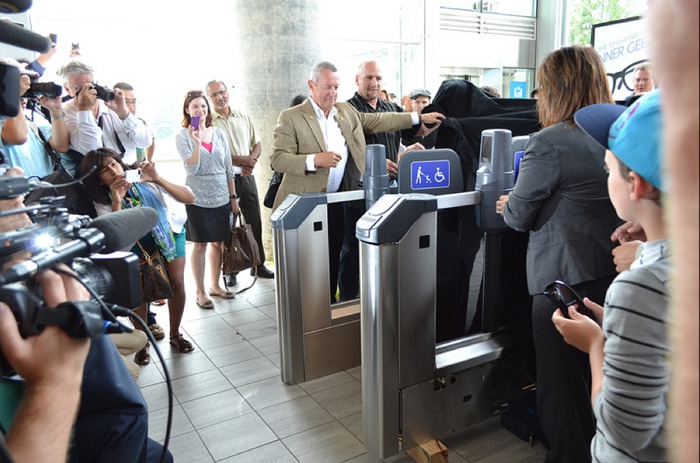
Isabella Daviduk, her brother Corey, right, and friend Scott Martin had to buy ‘exit tickets’ to leave the Waterfront Station in Vancouver on Jan. 18. Mark van Manen / Postmedia News
More than 30,000 SkyTrain riders were forced to purchase ai???exit ticketsai??? during the first five months of the updated fare gates system, netting TransLink as much as $200,000 in extra revenue. Passengers who let tickets expire, lose them, purchase insufficient fare to reach their destination, or fail to buy one at the start of the trip are required to buy a ticket from TransLink machines before they exit SkyTrain stations. During prime time the exit ticket costs the equivalent of a three-zone fare ai??i?? or $5.50 (half that during non-peak hours), no matter how far the rider travelled. Scott Martin and Corey Daviduk of Maple Ridge discovered that the hard way. They boarded at the new Coquitlam station with a one-zone ticket when they should have paid more. As a result they had to purchase an exit ticket before the gates would let them out when they reached Waterfront Station. Her brother and his friend ended up paying $2.75 (for one zone) plus $5.50 (three-zone exit fare), or a total of $8.25 for a one-way trip. ai???I told them it would be cheaper just to buy a day pass,ai??? said Davidukai??i??s sister, Isabella Daviduk, who bought the $9.75 pass that was good for unlimited travel the entire day. ai???Itai??i??s kind of stupid,ai??? said Corey Daviduk. ai???I honestly didnai??i??t know.ai??? Since the new fare gates went into operation, 33,883 riders ai??i?? about 221 a day on average ai??i?? have had to buy exit tickets, according to TransLink. Based on that number of riders, TransLink would have collected between $93,000 and $186,000 in revenue from the tickets, depending on whether those riders travelled in peak or non-peak hours. ai???The number of exit tickets sold has not come as a surprise to us ai??i?? and it is not excessive,ai??? said TransLink spokesman Chris Bryan. There were 6,000 exit tickets purchased in October out of 11.8 million boardings on SkyTrain that month, Bryan said. That works out to .05 per cent of all boardings, or a couple hundred a day out of 450,000 average boardings each weekday, he said. The station with the highest number of exit tickets sold was Waterfront, at 3,194 tickets over the five months, or almost 21 a day. That station also recorded the highest one-month total (August) of 795 exit tickets sold. The least amount of exit tickets sold were at Sea Island station near Vancouver airport on the Canada Line, with a total of 65 for the five months, or about one every two days. At almost all stations, the greatest number of exit tickets were purchased in August, the first full month of the new closed-gate system. The number of exit tickets over five months exceeded the 24,118 tickets issued for fare infractions from January to November 2016, according to TransLink. In 2015, there were about 31,000 fare evasion tickets issued. Tickets with $173 fines are issued to riders who canai??i??t produce a valid fare when checked byAi??Transit Police. Fare evasion tickets dropped 25 per cent after the gates were first closed in early 2016, even before full closure of the gates, compared to the same period in 2015, according to Transit Police. And revenues were up almost eight per cent between April, when the fare gates were first closed or partially closed, and December, over the same period in 2015, said Bryan. That translated into $29 million in additional revenues.
Yes sir, an election is coming and the government is going to spend $70 million dollars to get your vote.
The problem is that the Alex Fraser Bridge sees peak hour congestion in both directions!
Obviously Transportation Minister has not bothered to travel the bridge in peak hours as well, he seems to have snoozed through is math classes as it is just not the Alex Fraser Bridge that has congestion issues, the entire Hwy. 99 and 91A/Richmond connector and Queensborough bridge are heavily congested all through the day and this hair brained scheme will be a complete traffic fiasco! More road space just attracts more cars and more cars add to congestion!
Memo to Todd Stone: Do not make transportation decisions via You Tube, rather hire real experts and do what they say not what you think might get the Liberals reelected.
Memo to Delta Mayor Jackson: Retire now with some dignity (or what you have left of it) as you are well past you “Best before date”.
Alex Fraser Bridge getting counterflow lane as part of $70-million project
The Alex Fraser Bridge will have something in common with San Franciscoai??i??s Golden Gate Bridge after a lane is added to ease congestion.
Federal and provincial officials announced on Thursday that the span across the Fraser River on Highway 91 between Delta and New Westminster will get an additional lane that will be used as a counter flow with the direction of travel changing between morning and afternoon rush hours.
ai???By reconfiguring the Alex Fraser Bridge to seven lanes, weai??i??re able to improve traffic capacity significantly and improve the travel time for commuters and for goods movement,ai??? said Todd Stone, B.C.ai??i??s transportation minister. ai???This is especially important during morning and afternoon peak periods when traffic is the heaviest.ai???
To make the most of the new lane, a moveable barrier will be used, similar to one added two years ago to the Golden Gate Bridge, said Stone.
It consists of steel barriers filled with concrete that are shifted from one side of theAi??lane to the other, like a zipper, by a special vehicle.
According to news reports, the Golden Gate barrier has been a success other than the side effect of more drivers speeding onAi??the bridge. Stone said the posted speed limit on the Alex Fraser will be reduced to 70 km/h from 90 km/h once the new lane is ready.
The seventh lane will normally be a southbound laneAi??but will be turned into a northbound lane during the morning rush by moving the barrier.
The new lane will be created by reducing the width of the six existing lanes and removing the shoulders. The lanes will still be a bit wider than those on the Oak Street and Ironworkers MemorialAi??bridges. The ministry expects some delays as the Alex FraserAi??is reconfigured, but will getAi??as much of the work as possible done inAi??off-peak hours.
The $70-millionAi??project includes adding up to 13 electronic signs atAi??ai???key locationsai??? on highways throughout the Lower MainlandAi??to provide up-to-date information about delays on the four Fraser River crossings.
The ministry proposes to place three signs along Highway 1, five signs along Highway 17 and three signs on Highway 10, andAi??signs on Marine Way and Knight Street. The specific locations for the signs are being finalized.
ai???There are a lot of vehicles on the road and only four Fraser River crossings, so if thereai??i??s a faster route across the river on any given day we want commuters to know where that fastest crossing is,ai??? said Stone.
More than 119,000 vehicles use the bridge daily with half-hour waits and lines more than three kilometres long in rush hour.
ai???The length of rush hour queues is frustrating, to say the least,ai??? said Stone. ai???Thatai??i??s a lot of idling. Thatai??i??s a lot of wasted time.ai???
Delta Mayor Lois Jackson said it took her two hours to get to Burnaby from Delta on Wednesday. She believes the new lane will deal with some of the congestion, but will be a stopgap until a new bridge is built to replace the George Massey tunnel.
ai???Weai??i??re really, really happy,ai??? she said. ai???Itai??i??s going to help out a lot of people until we get these construction projects completed.ai???
The new bridge lane is expected to reduce the morning commute by about six minutes and the afternoon commute by 12 to 16 minutes.
The federal government is putting up almost $34 million and the province just over $36 million.
Stone said the additional laneAi??go to tender this spring and construction will begin as soon as a contractor is chosen. It is expected to be complete in spring 2018. The information signs should be ready by the fall.
A new interchange is also being built at Highway 91 and 72nd Avenue, about six kilometres south of the bridge. Construction is already under way on the $30-million interchange and should be finished by the end of this year.



 Weai??i??ve released a




 Susan Lazaruk More from Susan Lazaruk
 Isabella Daviduk, her brother Corey, right, and friend Scott Martin had to buy ‘exit tickets’ to leave the Waterfront Station in Vancouver on Jan. 18. Mark van Manen / Postmedia News



Recent Comments