TramTrain, one of the fasted growing transit sectors in the world and why not; extending public transit cheaply by using existing infrastructure is a win, win situation.
The cost ofAi?? of a 25.3 km of route including 3.3 km of new single track line is CAD $62 million! The cost of the eight Electro-diesel trains are yet unknown as they have just been put out for tender.
The use of Electro-diesels are envisioned, could prove very positive news for the Rail for the Valley TramTrain.
Hungary begins tendering for Szeged tram-train
Written byAi?? Ferenc Joo
Ferenc Joo
HUNGARYai??i??s National Infrastructure Development Agency (NIF) has published a call for tenders for contracts to plan and build the Szeged – HA?dmezAi??vA?sA?rhely tram-train line.
The project – Hungary’s first tram-train line – involves constructing 3.3km of single-track line with passing loops in HA?dmezAi??vA?sA?rhely and an 800m connection from Szeged-RA?kus station to the nearby tram loop.
Tram-trains will use the 22km unelectrified single-track line between Szeged and HA?dmezAi??vA?sA?rhely.
The project involves building catenary, signalling, stations, connecting roads, and car parks. The project is financed by the EU and the money available is Forints 13.25bn ($US 45.7m). The deadline for submission of tender documents is February 15 and the winning bidder will have 20 months to complete the project.
A few days later national passenger operator MA?V-Start issued an invitation to tender for a contract to supply eight electro-diesel tram-trains.
The tram-trains will be equipped to operate under the 600V dc electrification system used on the Szeged tram network and will operate in diesel mode on the line to HA?dmezAi??vA?sA?rhely.
The contract includes an option for four additional vehicles, reflecting the aspiration to extend the tram-train line from Szeged to MakA?.
The vehicles will have at least 46 seats with standing room for a minimum of 92 passengers. The bi-directional low-flow tram-trains will be equipped with retention toilets, two spaces for wheelchairs, and four sets of passenger doors. The tender specifies a maximum speed of 100km/h, a minimum curve radius of 22m, and multiple operation both with vehicles of the same type and the Tatra trams used in Szeged.
The deadline for submission of tender documents is February 8 and the contract has an estimated value of Forints 10bn.
Unlike the mainstream media, the Georgia Straight always has better reporting on the local transit scene.
This is nothing more than a staged media event featuring two growingly unpopular Mayors, Hepner and Roberts and the ever unpopular TransLink.
With a May election looming the Liberals need to show that they are doing something, while the Federal Liberals want to see some action for the millions they have dumped in Metro Vancouver.
Zwei asks the following question: “Why is there consultation after the plans are revealed?”
I know, it is the TransLink “dog and pony show”, where Monty Python style planning from the Ministry of Silly Walk. results in a massive expenditure on very little that will not reduce congestion.
TransLink’s ten year vision is really no vision at all, rather a ruse to keep those six figured paid bureaucrats busy.
Translink says no plans for Millennium Line to UBC yet, public consultations begin next week
Vancouver mayor Gregor Robertson speaks to the media at a Translink press conference at Waterfront Station on Tuesday, January 17. Amanda Siebert
At a press conference earlier today, Translink CEO Kevin Desmond was joined by Metro Vancouver mayors and members of the provincial and federal government, to announce a list of service improvements that are being rolled out as part of the first phase of the Mayors’ Council’s 10-year vision.
“These service improvements make room for approximately 185,000 more people on a weekly basis,” he said.
Desmond also announced that in April, major improvements to bus services would begin, with more improvements happening every three months for the next three years.
These will include new B-line routes, as well as new services to areas of the region that are not currently serviced by buses.
Surrey mayor Linda Hepner speaks to media at a Translink press conference at Waterfront Station on Tuesday, January 17.
Amanda Siebert
Consultations for the much-anticipated Millennium Broadway extension and Surrey-Newton-Guilford LRT will begin next week, but those improvements are part of the second phase of the council’s 10-year vision, and won’t be rolled out for some time.
Both Vancouver Mayor Gregor Robertson and Surrey Mayor Linda Hepner called on the provincial and federal governments to make a “firm commitment” with regard to capital funding for those projects.
“Phase two is critical to our overall region and to bringing to fruition the real mayors’ vision for the 10-year plan,” said Hepner.
When asked about the planned routes for both lines, with specific regard to the decision to terminate the Broadway extension at Arbutus Street, Desmond told theAi??StraightAi??that the alignment and start and end points were, “a reality.”
The planned route for the Millenium Line extension along Broadway.
Translink
“I wasn’t here when the decision was made to terminate it at Arbutus,” said Desmond. “The real crush of demand on the 99 B-line now, is really to Arbutus. We have plenty of customers, students, faculty, and workers going out to UBC, but for this first phase, that’s where we really need to get our resources….
“Will rail eventually get to UBC? I’d say that’s probably a good chance. When? I don’t know.”
Mayor Robertson added that the planning for extending the line to UBC would begin in the final two years of the council’s 10-year vision.
Robertson added that, with the planned development of the Jericho lands and the anticipated population growth, as well as the continued growth of UBC, improving transit service to that area needed to happen “sooner than later.”
The first phase of the Millennium Line extension is set to include 6 kilometres of track extending from VCC-Clark to Arbutus under Broadway.
The planned route for the Surrey-Guilford-Newton LRT line.
Translink
The first phase of the Surrey-Newton-Guilford Line, heading along 104 Avenue and King George Boulevard, will include 10 kilometres of two-way, street-level track, 11 LRT stops, and a new LRT operation and maintenance facility.
Public consultations for the Millennium Line extension to Arbutus will take place as follows:
Saturday, January 28 at Douglas Park Community Centre from 1 p.m. to 5 p.m.
Tuesday, January 31 at the Croatian Cultural Centre from 4 p.m. to 8 p.m.
Wednesday, February 1 at Holy Trinity Ukrainian Orthodox Cathedral, 4 p.m. to 8 p.m.
Public consultations for the Surrey-Newton-Guilford LRT Project will take place as follows:
Tuesday, January 24 at the Guilford Recreation Centre from 4 p.m. to 8 p.m.
Wednesday, January 25 at Surrey City Hall from 12 p.m. to 5 p.m.
Thursday, January 26 at the Newton Cultural Centre from 4 p.m. to 8 p.m.
Let’s see now……election in May; a provincial Premier who doesn’t give a damn about regional transit; political donors getting restless for payback; yes the BC Liberal BS machine is in full swing.
A $100 million/km LRT that goes nowhere and a $3.2 billion subway that goes nowhere, yes the BC Liberals are hard at it.
The question I would like to ask is, who the hell is TransLink going to consult with?
Stay tuned folks the “Trump” style fake news is just beginning on two extremely poorly conceived transit projects.
Consultations on Surrey light rail and Broadway subway to begin next week
Proposed phase one construction of Surrey light rail (Emily Lazatin/ CKNW)
The wheels are finally in motion for a pair of hotly anticipated Metro Vancouver mass transit projects.
TransLink CEO Kevin Desmond says consultation will begin next week on a light rail system for Surrey, and the Broadway subway.
Desmond made the announcement flanked by Surrey Mayor Linda Hepner and Vancouver Mayor Gregor Robertson, as a part of an update on phase one of the Mayorsai??i?? 10-year transit plan.
Light rail consultation will begin Tuesday, January 24, while Subway consultation kicks off Saturday January 28.
As currently envisioned, phase one of the light rail project would run from 72nd Ave. and King George through Surrey Central, before bending east on 104th Ave. to 152nd Ave. in Guilford.
A future phase two would run southeast along Fraser Highway to Langley.
The proposed subway phase one would extend from VCC station west to Arbutus and Broadway. A future phase two would continue to UBC.
Hepner says design work is now underway for phase two of the 10-year plan, but that funding questions remain critical.
On top of new project announcements, Desmond says TransLink is looking to boost the frequency of service across a number of parts of the existing system, with the equivalent of 185,000 bus, SkyTrain, and SeaBus seats per week being added.
He says it will be doubling daytime SeaBus service on Sundays and holidays so that the vessels run every 15 minutes, and will increase Canada Line service during peak hours.
More frequent Expo, Millennium, and Evergreen line trains are also planned during mid-day, early evenings, and weekends.
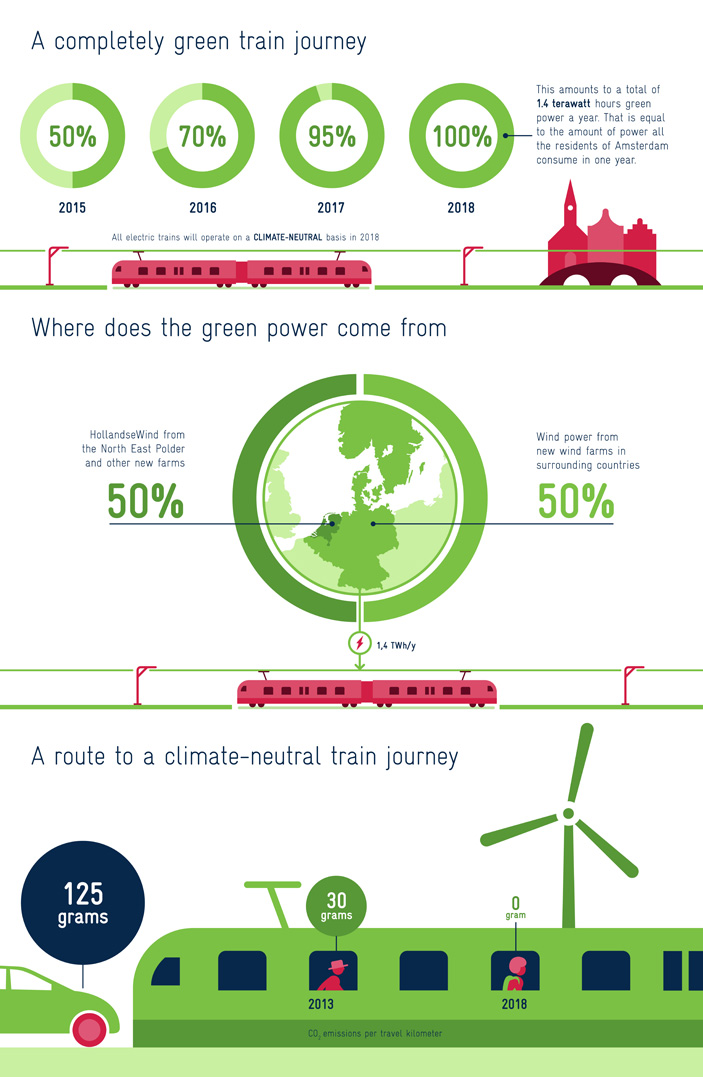
As from 1 January 2017Ai??100% of Dutch electric trains are powered by wind energy. Ai??The Dutch railways company NSAi??is the worldai??i??s first railway company that gets 100% of its energy from wind energy.
Travelling by train has been the most environmentally friendly way of transportation for a long time already. In the Netherlands they have now taken it to the next level using wind turbines to power all of its electric trains.
The Dutch have a long history of using wind energy to advance.Ai??They used windmills to drain land covered by water since the 17th century.
Famous Dutch polders were drained using wind energy
Energy company Eneco provides NS the energy to transport 600.000 people per day.Ai??Thatai??i??s 1.200.000 train trips per day without any CO2 emissions.
NS requires 1.2B kWh of wind-powered energy per year, which is the same amount all households in Amsterdam consume per year. The partnership with NS, allowed Eneco to invest substantially in the expansion of its wind turbine parks.
Eneco and NS Dutch Railways only sealed the partnership in 2015. It shows what can be achieved on the road to a sustainable future when we really put our minds to it.
How Eneco can provide the required capacity to power the Dutch railways Eneco and NS originally planned to reach 100% of all trains to be powered by wind energy by 2018. But they were able to speed up this process and reached their objective one year earlier in January 2017. “If the Dutch railways sourced 100% of the 1.4 tWh of energy they needed each year from within the Netherlands, this would decrease availability and increase prices of green power for other parties,” explains Eneco’s Michel Kerkhof. “That is why half of the demand will be sourced from a number of new wind farms in Belgium and Scandinavia, which have been specifically assigned for this contract. A key objective is to avoid procuring energy from the limited existing number of sustainable energy projects in the Netherlands, thus promoting renewable growth both domestically and Europe-wide. “This partnership ensures that new investments can be made in even newer wind farms, which will increase the share of renewable energy,” confirms Kerkhof. “In this way, the Dutch railways aim to reduce the greatest negative environmental impact caused by CO2 in such a way that its demand actually contributes to the sustainable power generation in the Netherlands and Europe. Source: Eneco
Other Dutch rail carriers participate too
NS is purchasing sustainable energy on behalf of VIVENS, the association of rail carriers, including: ProRail, Arriva, Connexxion, Kombi Rail Europe, DB Schenker, ERS Railways, HSL Logistik, Rotterdam Rail Feeding and Rurtalbahn Benelux.
In the table below you find a breakdown from which windparks VIVENS gets its wind energy.
Breakdown supplied wind energy per wind park Source: NS Dutch Railways
NS CEO Rogier van Boxtel literally turns the transport sector upside down. Watch how the CEO of NS, Rogier van Boxter, gets strapped to a blade of an old Dutch windmill to illustrate the relationship between trains and wind energy. Source: YouTube NS
Wind power makes economic sense
Wind power makes economic sense. Onshore wind is the cheapest form of new power generation in Europe today. Wind in Europe accounts for ai??i??67bn+ annual turnover and 255,000 jobs. Offshore wind is rapidly reducing costs and will play a central role in Europeai??i??s power mix going forward, according to Wind Europe.
How does it actually work?
This video explains how wind turbines work and provide energy into the power grid.Ai??You can find more detailsAi??hereAi??at explainthatstuff.com. And in this interview with Eneco more details are disclosed how the partnership between Eneco and NS leads to real growth in the supply of wind energy.
So, is the Netherlands leading the way when it comes to sustainable energy? The answer is no. As far as we are aware, NS is the first sizable railway company in the world that claims 100% of its energy is directly sourced from wind energy. In that respect the Netherlands is setting the example.
When we look at the bigger picture on how well the Netherlands perform compared to other European countries in fighting climate change, the Netherlands is not doing well. According to Eurostat, in 2014 only 5.5% of its energy consumption came from renewable energy sources. Compared to the European average of 16% in 2014, the Netherlands is way behind its peers and its European target.
That is the main reason why – together with 900 citizens – the Urgenda Foundation filed the Climate Case against the Dutch Government. And they won.Ai??The Urgenda Climate Case is the first case in which regular citizens have managed to hold their government accountable for taking insufficient action to keep them safe from dangerous climate change.
It is clear the Netherlands needs to do much more to transition to sustainable energy sources and help fight climate change. But let the accomplishment of the NS together with Eneco be an example for the Dutch government to switch gear and go full speed ahead with the transformation of its energy policies. And may it inspire many other railway carriers to follow the NS Dutch Railway’s example.
UPDATED ARTICLE 9 JANUARY 2017
We have updated the article with more information on how wind energy actually works. Also we have specified more clearly that all Dutch electric trains now run on wind energy. This does not include the descreasing – and relatively small – number of trains that still run on diesel. Additionally, we have included the Eurostat numbers that show the Netherlands is way behind its European peers when it comes to EU Renewable Energy targets.
As Vancouver’s metro mayor’s dig themselves further into a financial morass, with the proposed now $3.2 billion Broadway subway to Arbutus and the now over $100/km Surrey LRT, which will demand more and more punitive regional taxation, why instead don’t we plan for affordable European style LRT?
The trouble is, our regional mayors think they live in the 1970’s, where upping taxes imposes no problem’s at all. In fact, the Sky is the limit, for many regional politicians, when it comes to the issue of taxes.
BC and regional politico’s are also wedded for the dated and very expensive proprietary ALRT/ART (SkyTrain) light-metro, which today is seen by the world as a curiosity , not quite as interesting as the Wuppertal Schwebebahn monorail.
ALRT/ART SkyTrain costs more to build, maintain and operate than light rail and it is also capacity constricted, but that does not stop the powers that be to squander more money on this relic, because it is their belief that the public has very deep pockets for this sort of thing. Thus the dreaded threat of “road pricing” or “congestion charges” hangs over the heads of over taxed residents.
TransLink and the regional mayors seem ignorant of recent history especially with the results of the 2015 transit plebiscite and that another way must be planned for.
“Tax and spend – tax and spend” is the refrain of most regional mayors, when instead they should be singing in chorus, “getting our best bang for the taxpayer’s buck“.
It seems those who reside in Cambridge UK, understand this.
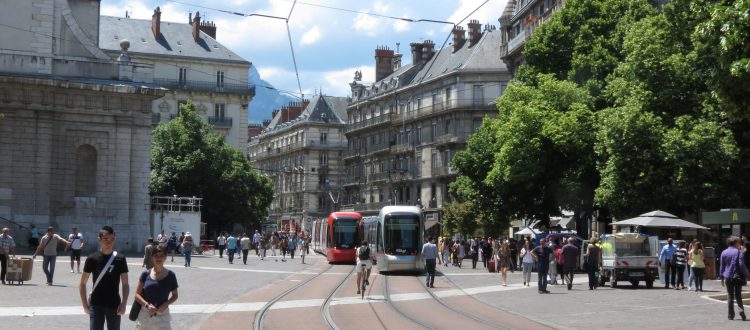
Though not Cambridge, modern LRT fits in quite well in dense and/or historicAi?? city centres
providing affordable quality public transportation.
Readers of “Cambridge News” say a congestion charge is not the answer to the traffic problems of the English city and some suggest light rail is a better answer than buses for CAMBRIDGE 50 miles north of London, according to a post on the “cambridge news dot co dot uk” site. Paris or Dublin, Ireland, could be models for such an LRT service:
Congestion charge is NOT the answer to Cambridge’s traffic problems, News readers say
The idea of a congestion charge for Cambridge has got people talking
By Freya Leng
Ai??3 JAN 2017
Making drivers who are coming into
CambridgeAi??pay a congestion charge is not the answer to beating the city’s jams, according to News readers.
Ai??As reported in the News, Tim Bick, leader of the Lib Dem group on the city council and the man who clinched Cambridgeai??i??s A?500 million (USD $611.6 million) City Deal, says the ai???tabooai??i?? against making motorists pay must finally be shattered.
His comments come ahead of a response due to be published by City Deal leaders on Friday (January 6) to the furore that greeted last yearai??i??s proposals to tackle Cambridgeai??i??s jams, including the scheme for Peak-time Congestion Control Points (PCCPs), which would bar general traffic from some roads at rush-hour.
But most readers on our social media channels and website say a congestion charge is not the answer to the city’s traffic problems.
Writing on the News Facebook page, Alexa Stansall said: “This councillor sounds completely detached and removed from the reality of cost of living, Cambridge wages and housing.
ai???The congestion charge will hit those on lower wages that often car share to work and can’t afford the high bus fares into Cambridge. There isn’t ‘an irrational fear’ of the congestion charge it’s a very real fear based on the reality of costs of living wages and house prices in Cambridge.ai???
Eve Wooldrige said: “Ridiculous idea! The bus service is nowhere near efficient enough, or cheap enough to encourage people to use it. The last time I used park and ride, I vowed never to use it again!
“People will continue to drive, unless park and ride charges are reduced to an affordable and tempting level and by running far more buses!! If a congestion charge is enforced, it will just force people to reconsider living and working in Cambridge.”
Michael Abberton said: “Before there is any talk of a charge, the infrastructure has to be in place. Public transport provision and safety measures for cyclists are nowhere near good enough. This will also penalise those people forced out of the city by out of control housing costs. All these elements are linked and have to be considered holistically.
“The introduction of CC without any viable alternative and without addressing affordable housing and rent controls will not do anything to address our catastrophic congestion and air quality crises, and just bring more revenue to the council.”
Other people commenting on the News website, felt a light rail was an option.
Alek said: “A congestion charge is NOT the answer. Cambridge will suffer long-term if that plan were to occur. After all, for shopping and entertainment – People can travel to nearby Newmarket and Huntingdon.
“The answer lies with a Light- Mono rail system, scrapping the guided bus and introducing Trams.”
SashaM said: “A congestion charge cannot be introduced until a sensible alternative is available, i.e light rail or trams.
ai???Buses are not the answer! It takes me 8 minutes to drive into the Grand Arcade – the C7 bus takes 45 minutes usually, 35 if no traffic at all.”
Cambridge1985 said: “For me to use the bus for work, I’d have to pay A?87.50 per month (USD $107.06), on top of my car costs. And for what? The buses in my village never turn up on time, and regularly don’t show up at allai??i??I think there is a lot of work to be done before you can expect people to use the bus services currently provided.
“Rather than constantly trying to squeeze more money out of drivers, maybe make it worth our time to switch over.”
James H65 wrote: “There needs to be an alternative to using the car. Right now, despite horrendous queues, lengthy travel times and hard to find/expensive parking, people still use their cars.
“Why? Because the alternative is worse. Adding congestion charge costs on top won’t make a difference unless there is actually a viable.”alternative.
Writing on Facebook, Theresa Marshall said: “The centre of the city needs to be a no car zone, the buses should be free, cycle paths should be improved and the whole city rethought for the 21st century, it could be amazing if people had the will and vision.”
However, Gazza Lawrence supported the idea.
“Best idea this city has had,” he said on Facebook.
This reply from Haveacow who is an Engineer, to an earlier post and I think worthy of a post on its own. He is familiar with SkyTrain and worked on the Ottawa LRT and inn other words he knows his stuff.
Despite the ‘huff and puff’ from high paid TransLink spokes people about how the new SkyTrain cars will increase capacity, the system is presently at capacity until ” $500-$800 Million on really upgrading the electrical systems”.
Again, I must remind everyone, despite being on the market for almost 40 years, and with unprecedented hype and hoopla in the local and international media in 1986, only seven systems have been built; no new SkyTrain Line (the evergreen Line is the unfinished portion of the Millennium Line) has been built in ten years and no SkyTrain has ever been allowed to compete against light rail.
A historical note: Intermediate Capacity Transit System or ICTS, was first billed to fill the gap of what a Toronto PCC car could carry (pairs of PCC’s on Toronto’s Danforth-Bloor route were able to obtain a peak hour capacity of 12,000 pphpd or about 2,000 pphpd less than Vancouver’s Expo Line) and the minimum capacity that would require a subway (15,000 pphpd).
The modern articulated car, operating in coupled sets effectively made SkyTrain obsolete overnight; that is, if one wasn’t already operating one.
Toronto’s Danfort -Bloor streetcar route used coupled sets of PCC cars
and able to obtain a peak hour capacity of 12,000 pphpd!
Beyond the power supply issue that will forever haunt Translink until they are ready to drop somewhere between $500-$800 Million on really upgrading the electrical systemai??i??s actual carrying capacity, increasing by somewhere to around 50-60% the number of power blocks or better yet, doubling the number of existing power blocks. Translink has to rethink the basis behind the Skytrain way of doing things.
To make it simple, the basis behind the concept of the Light Metro Systems or Intermediate Capacity Rail based Rapid Transit technology is the basic notion that by decreasing the frequency or increasing the tempo of rail operations you can use smaller vehicles and stations thus, saving money when building infrastructure but still have higher capacity because of the higher levels of service. This basic operating assumption is at the heart of all Skytrainai??i??s troubles. One of the reasons LRT technology has been so easily surpassing the Skytrainai??i??s technology is because it doesnai??i??t make assumptions about the operating system an environment needed to have the it working. It just tries to adapt it to fit as many varieties of operating environments and operating technologies as possible. Automation was added to the Light Metro System to increase the financial savings needed to offset the high cost of high tempo railway operations. The linear Induction Motors used by the Skytrain were chosen because of the lack of moving parts thus its believed, easier maintenance compared to the standard electric motors especially the motors of the time when the system was being designed and tested (70s-to mid 80ai???s).
Although initially the Induction motors saved some money compared to electrical motors on rail systems of the time. Much newer, smaller, more durable, cheaper and more powerful standard ai???Can Motorsai??? generally used now in transit based electric rail operations are significantly easier to work with than Induction based systems. Induction motors still have some advantages when it comes to rail operations that have a greater distance between stops on very high capacity lines but they are very poor accelerators. When station stops are less than 2kmai??i??s apart there is a great deal of time lag compared to standard flywheel based electrical can motors. The flywheels can dump extra power into the motor at start up, to help more quickly overcome inertia. These motors last just as long and sometimes, much longer than Induction based motor components. The positioning of the motors on the side of the bogie or truck eliminates the needs for axels but space can be provided if bigger grades require the need to further arrest ai???Flange Slipai??? or Wheel Slip. The side mounted motors allow for the ai???Uai??? shaped bogie or truck frame needed for 100% Low Floor Vehicles. Maintenance is very cheap because a single person with simple commercially available equipment and hand pump forklift dolly can in about 5 minutes test every electrical motor on a standard LRV and replace all of them if needed in 30 minutes with out assistance.
The Skytrains have a monitoring system which identifies Induction units with failing components. Unfortunately testing of the individual components is difficult unless the whole vehicle is brought in to the maintenance track, where a crew of 2 or 3 is needed to bring in any Skytrain Vehicle detach, separate and lift the frame of the vehicle from the bogie or truck, then test each external component of the induction drive. Then, if replacement of the main drive unit is needed and it usually is, a specially adapted automobile hoist is brought in to lift the drive unit or other non performing part out from the centre of the truck or bogie. A replacement is then lowered slowly back into the frame and reattached. This whole procedure can take over an hour for each unit being replaced with a crew of 2 or about 40 minutes with a crew of 3.
The high tempo of Skytrain operation means time is always short and great emphasis is placed on having to maximize maintenance efficiency thus the costs for these activities become very high. Preventive Maintenance has to be done more often because of the need to constantly have a greater percentage of your train fleet in operation means that, mileage targets get hit faster than with other types of systems like LRT and general maintenance checks have to occur by law much more often. This stresses maintenance staff a lot, when they have to admit that there masters and managers that there arenai??i??t enough trains operating due to the fact that, there is backlog of trains waiting to complete there 1000km or so mileage PM check, which is mandated in your operational certificate for these types of rail vehicles by Transport Canada. I now for a fact that has happened on your system a few times in the past.
(A comment from Zwei: maintenance costs are also higher because the trains need to be at 100% because if a train fails, the entire system stops until a worker walks out to the failed train to drive it to the nearest station and/or siding.)
The Induction motors also require a piece of track infrastructure a 4th rail, or induction rail, that has to be kept debris and ice free for the system to operate. Improperly mounted induction propulsion units caused by damaged frames or improper placement during maintenance increases the distance the unit must be from the induction rail. This distance must be constant or the train wonai??i??t move.
(A comment from Zwei: The ‘air-gap’ or the distance from the reaction or 4th rail and the LIM is 1 cm and if this critical distance is not maintained, power consumption increases dramatically if the distance is increased or scoring of the LIM happens if the distance is less. Also keep in mind that throughout the lifetime of the track, wear by the trains can account for a 1 cm loss of rail height and it is cheaper to replace the rail (which has happened twice now in 30 years) than constantly adjusting the reaction rail.
As Mr. Cow stated, the LIM’s are very expensive piece of kit and the original advertising stated that they should be only used on routes with steep grades, as LIM’s were well suited for the task.)
This extra piece of track is responsible for almost 35% of the track maintenance budget at Translink. The Induction Motor used to be standard part of the Bombardier Innovia Automated Light Metro transportation System (Skytrainai??i??s official marketing name at Bombardier) but is now an option. The latest Innovia System instillation designed for Saudi Arabia doesnai??i??t even use the induction motor but standard electrical ones and a different body type designed by a local Saudi contractors, allow the platform mounting and frame are Bombardier designs.. You wouldnai??i??t even recognize it as a Bombardier product.
Although a 3rd rail does have advantages in high tempo operations, it has very high operational and maintenance costs associated with them compared to overhead wire power collection methods. The use of 3rd rail forever means that, even if the technology greatly changes and future designs of Skytrains allow for low platform boarding and or low floor vehicles, you will never be able to run it on a street level right of way because of the 3rd rail power collection method, thus always having higher build and design costs compared to low platform and low floor operating technology equipment.
The Automation technology used, Bombardierai??i??s CityFlow 650 System (also not being used in Saudi Arabian operation by the way) means that under Transport Canada rules, a street running right of way is illegal and thus a physically segregated and most likely a grade separated right of way must always be used. Yes, here in Ottawa we will have a certain level of automation on our physically segregated rights of way for our LRT as well. However, this is because the right of way was already physically segregated when it was a Bus Transitway, it was designed that way also to be convertible to rail technology in the future. However because our LRVai??i??s will have drivers we can operate and are planning to operate on the median of streets like Carling Ave. for the Stage 3 program deployment in 10-15 years. All the appropriate usable Transit-ways by this time, will be used for LRT and the remaining Transit-ways will still operate buses.
Lastly, the capacity of Light metro is highly effected by many of its component technologies and thus has to operate trapped by the limits of its operating agenda. Where as LRT has no pre decided operation type and thus can be made adaptable for many operation options. The Skytrain was billed as something that was cheaper than a subway and able to move more passengers than LRT. However, the limits put on it by its pre packed operation type means that it hasnai??i??t been that adaptable over time or as it turn out quite ironically, not that scalable either, which was one of its original claims. Edmonton now operate 5 car LRT consists that are almost 125 metres long. Calgaryai??i??s LRT is now operating 4 car consists up to 111 metres long. Ottawaai??i??s LRT will start at 2 car consists that are 98 metres long and can be easily expanded by adding a 5th section to both cars in the consist and increase the length to 120 metres. All these system were able to add capacity without altering the schedule and hiring an extra driver and forcing up its operating tempo, helping keep a lid on costs. Vancouverai??i??s system has no choice but to greatly increase its frequency because the concept behind your Skytrain limits physical expansion as an option by having to operate in very expensive rights of way, unless a truly massive amount of money is spent to scale it up.
There are affordable solutions, but they would embarrass the MoT, the City of Vancouver and academics, especially at SFU.
An ever growing population, means more traffic and until the government ensures an attractive and affordable alternative to the car, which because of SkyTrain will not get in the foreseeable future, gridlock and endemic congestion will remain.
Hint #1: Building more traffic lanes never solves congestion, but it is a political solution, especially around election time.
Hint #2: This will happen in Richmond to Vancouver bridges when the massive $3.5 billion Massey tunnel replacement bridge is built.
North Van the new Port Mann? North Shore bridges at ‘tipping point’
Traffic is bad all over Metro Vancouver, but the worst spot to emerge in the last several years is the bridgehead at the Second Narrows in North Vancouver.
Municipal leaders were told in 2015 that the North Shoreai??i??s woes coincided preciselyAi??with the expansion of the Port Mann Bridge to 10 lanes in 2012.
ai???We noticed a blip since the Port Mann bridge was completed and that really opened up a corridor on the approaches to the Second Narrows ai??i?? Itai??i??s quite significant,ai??? Jason Jardine, of the Parsons consulting firm and a consultant to the provincial ministry of highways, told council.
He suggested a ai???tipping pointai??? may have been reached, when even a small amount of extra traffic causes blockage.
ai???We can get a certain amount of traffic through a bottleneck and then when things fail, they fail very abruptly,ai??? he said. ai???We have been close to that tipping point for many years.ai???
It seems like the daily jams ai??i?? albeit not all the same vehicles ai??i?? at the Port Mann for the last few decades simply moved a few dozen kilometres up Highway 1 to the interchanges by the Ironworkers Memorial Bridge.
Gavin Joyce, North Vancouver Districtai??i??s general manager of engineering, said it is a ai???very awkward time.ai???
ai???You canai??i??t get any more vehicles through,ai??? says Joyce. ai???You can see the congestion.ai???
North Vancouver District Coun. Lisa Muri takes in the traffic moving at a snailai??i??s pace at the bottom of ai???The Cut,ai??i?? heading northwest off the Ironworkers Memorial Second Narrows Crossing. ai???Itai??i??s going to get much worse,ai??i?? she says of increasing congestion ai??i??Ai??and itai??i??s not all due to vehicular traffic. Mark van Manen / PNG
Perhaps we should have seen it coming. Highway 1 was upgraded to eight lanes, while the North Shoreai??i??s section of road is just four. It was like squeezing a big pipe into a smaller one.
Life plans have been altered as a result. Some residents have reduced the number of times they go out. Eric Andersen, who lives in the eastern part of the district on MountAi??Seymour, has given up driving in the afternoons.
ai???Itai??i??s not worth my while. I donai??i??t want to be anywhere near Highway No. 1 after 2 p.m. Chances are Iai??i??m going to sit in traffic and steam,ai??? saysAi??Andersen, president of the Blueridge Community Association. ai???What used to take 20 minutes now takes one-and-a-half hours. Itai??i??s horrible.ai???
Professional drivers ai??i?? truck drivers, couriers and the like ai??i?? withAi??the latest gadgets are daily tracking the flow of traffic.
ai???There is a button in the vehicle for traffic conditions,ai??? saysAi??one courier. ai???It tells me exactly how far traffic is backed up: vehicles are moving at 18 kilometresAi??per hour for 7.3 kilometres. It is that accurate.ai???
Impeded flows have been noted at TransLink, which is responsible for regional transportation planning.
ai???The North Shore is one of the highest incidents of change we have seen,ai??? saysAi??Geoff Cross, vice-president of planning. ai???It doesnai??i??t take a lot of additional cars for that to happenai??? ai??i??Ai??about 3,000 more vehicles a day between 2005 and 2015.
North Vancouver District Coun. Lisa Muri, for one, believes development has outpaced the ability of roads and transit to keep up. A district report notes 10,000 new building units are expected by 2030, and 20,000 additional people.
And itai??i??sAi??not just the district thatAi??is expanding. Towers are slated all over the North Shore, including villages and town centres at Park Royal, Lower Capilano, Lower Lynn, Upper Lynn, Maplewood, Edgemont, Harbourside and Lonsdale.
ai???Itai??i??s going to get much worse,ai??? saysAi??Muri.
The problem is more than just highway expansion and the fact the Lions Gate Bridge is at capacity as well. North Vancouverai??i??s 50-year-old interchanges at the Second Narrows canai??i??t keep pace with the high-speed ones on the south side, built at a cost of $3.3 billion along with the new Port Mann. Some North Van on-ramps are so constricted that vehicles must crawl along to admit newcomers, cloggingAi??the whole system.
The municipality shares responsibility for the mess: Highway 1 has been used as a local road for decades, and secondary routes werenai??i??t developed to the extent needed to shield residents from gridlock.
Those looking for civic politiciansai??i?? excuses need look no farther than the mountains, which offer up road-eating terrain. Rivers and hills constantly get in the way, spoiling plans for a grid system like the ones thatAi??can be found elsewhere in the metropolis. The number of east-west and north-south connections can be counted on a few fingers.
ai???Itai??i??s a real challenge,ai??? Joyce says.
The opening of the new Port Mann Bridge, above, four years ago coincided with more traffic jams at the Second Narrows crossing in North Vancouver. Stuart McCall/North Light / B.C. Ministry of Transportation
North Vancouverai??i??s experience has implications farther south for the proposed $3-billion Massey Tunnel replacement project on the Fraser River, as politicians in Richmond and Vancouver believe traffic jams will be transferred to the Knight and Oak StreetAi??bridges and their surrounding neighbourhoods.
ai???Widening capacity in one area will shift the problem somewhere else,ai??? saysAi??Andrew McCurran, TransLinkai??i??s director of strategic planning.
Help is on the way in North Vancouver from three levels of government: A total of $150 million is earmarked over seven years to upgrade two interchanges and add a third at Mountain Highway.
Longer on-ramps will lead to faster flows, and the Keith Road bridges thatAi??feed the system will be expanded from two lanes to four.
But the fundamental problem will remain: Eight lanes on the south side of Highway 1 and four on the north side. There is no money to expand the traffic-constricting highway bridges over Lynn Creek, saysAi??Joyce; and a much-needed, intra-municipal bridge over lower Lynn Creek is not funded either.
He saysAi??the district is ai???working very hardai??? on funding to provide more substantial upgrades.
ai???I donai??i??t know where itai??i??s going to land,ai??? Joyce says.
Former B.C. highways minister Kevin Falcon saysAi??the Second Narrows was never meant to have ai???this kind of population.ai???
ai???There is a tremendous amount of catching up to do,ai??? he says. ai???The truckers deserve a medal for getting through.ai???
Adding traffic capacity is a bit like enlarging blood vessels as a body growsAi??ai??i?? the additional size is needed to accommodate more traffic. District council was recently told that building nothing should not be an option because an expanding society depends on moving ever more people. There is always congestion, but the difference is more vehicles are getting through.
North Vancouver resident Andersen is not optimistic about current plans to address the problem.
ai???I would stick it out for a year or two, if I knew plans were afoot to fix it. But I donai??i??t see any long-term fixes,ai??? he says.
The remedy is a third crossing, since both the Lions Gate and Second Narrows bridges are at capacity. But there is little support for another crossing on either side of Burrard Inlet.
Gordon Price, former director of Simon Fraser Universityai??i??sAi??city program, saysAi??Vancouver is not willing to admit 4,000 vehicles an hour onto downtown streets; North Van residents fear that bridge-building would mean even more people coming to their forested slopes.
Muri saysAi??development should be held back to give time for road-building and bus routes to catch up. But her views wonai??i??t likely be heeded because sheai??i??s in the minority on council.
Population on the North Shore and Lions Bay is predicted to increase by 35 per cent from 2006 to 2041, adding almost 63,000 residents, and the Sea to Sky corridor will accommodate more people as well.
ai???Itai??i??s too much, too fast,ai??? she says.
I hope so and a developer, no less, is spearheading the drive to move to “rail” transit.
RftV wishes Mr. Mariash well.
If Fraser Valley developers were of the same mind as well?
CTV Vancouver Island
Published Thursday, December 8, 2016
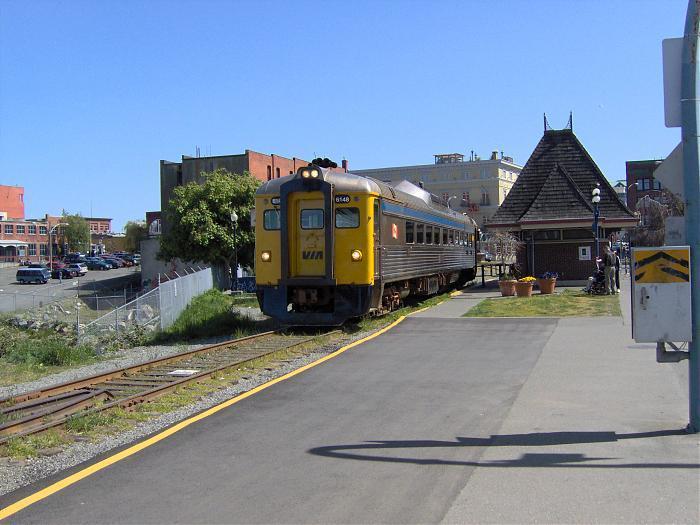
A well-known Victoria developer says heai??i??ll get a proposed railway line between Langford and Victoria up and running within a year.
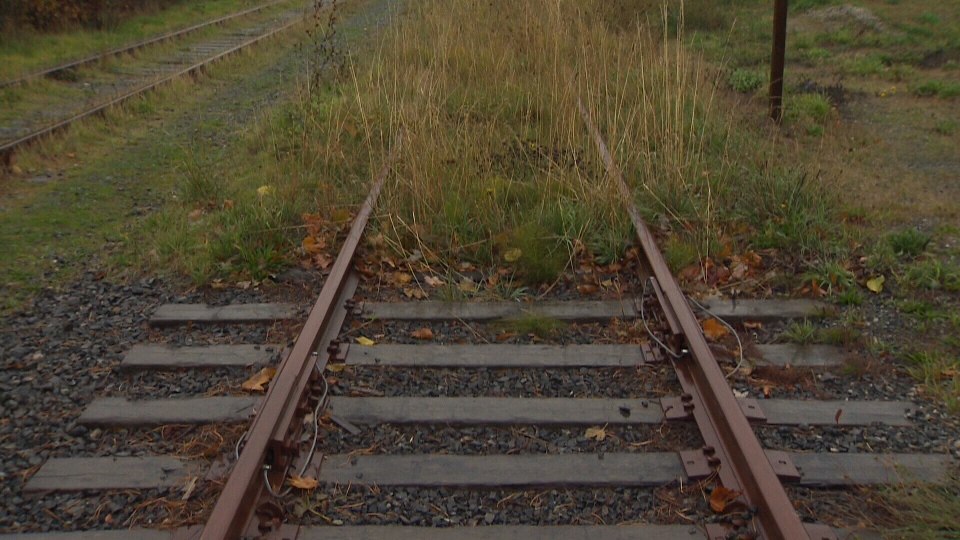
The E&N rail line has sat dormant for more than five years, but Ken Mariash, the developer behind Vic Westai??i??s Roundhouse project, is spearheading efforts to revive it.
Mayors have eyed a commuter rail service between Langford and Victoria as construction kicks into high gear on the McKenzie Interchange, which is expected to create more traffic on an already congested stretch of the Trans-Canada Highway for the next several years.
An overgrown section of the old E&N rail line between Langford and Victoria is shown. Oct. 14, 2016. (CTV Vancouver Island)
ai???Itai??i??s important to get it done, and itai??i??s a bit painful to watch when itai??i??s not getting done,ai??? said Mariash.
Thatai??i??s why Mariash has boldly predicted that one year from Thursday, a commuter rail will ride the rails once more.
Heai??i??s also predicting a price tag for commuters ai??i?? $3 to $4 each way.
For many in Langford, thatai??i??s an option that could beat sitting in the dreaded ai???Colwood Crawlai??? for hours on end.
ai???I think the speed of the Colwood Crawl now has gotten down to below 15 kilometres an hour,ai??? said Mariash.
He said the cost to get the train running could be up to $10-million, money he hopes will come from all levels of government.
Langford Mayor Stew Young said heai??i??s also excited, noting Mariash has already funded reports into getting the track back in action.
ai???Weai??i??ve got to take advantage of that and give it one good shot here, but the business case has to be here,ai??? said Young. ai???The public has to know how much we have to subsidize.ai???
Local mayors are meeting with Mariash on Friday to continue their talks aimed at getting plans for the once-vibrant railway back on track.
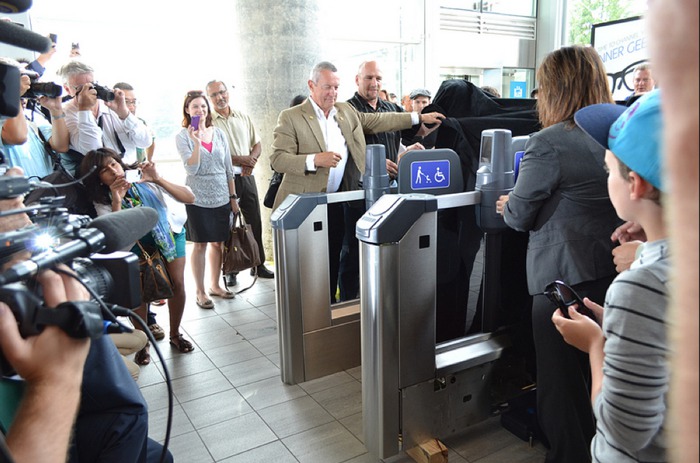
TransLink’s fare-gates and Compass Card system was forced upon TransLink, not to reduce fare evasion, which was well within industry norms, but to ensure then Premier Campbell’s good friend, Ken Dobell, work as aAi?? lobbyist for Cubit Industries who make the fare gates. Lobbyists must be successful with their lobby of government or no one will hire them!
With a propaganda campaign orchestrated by the mainstream media worthy of Herr Goebbels himself, about those terrible fare evaders, the fare gates and Compass Card system is now fact.
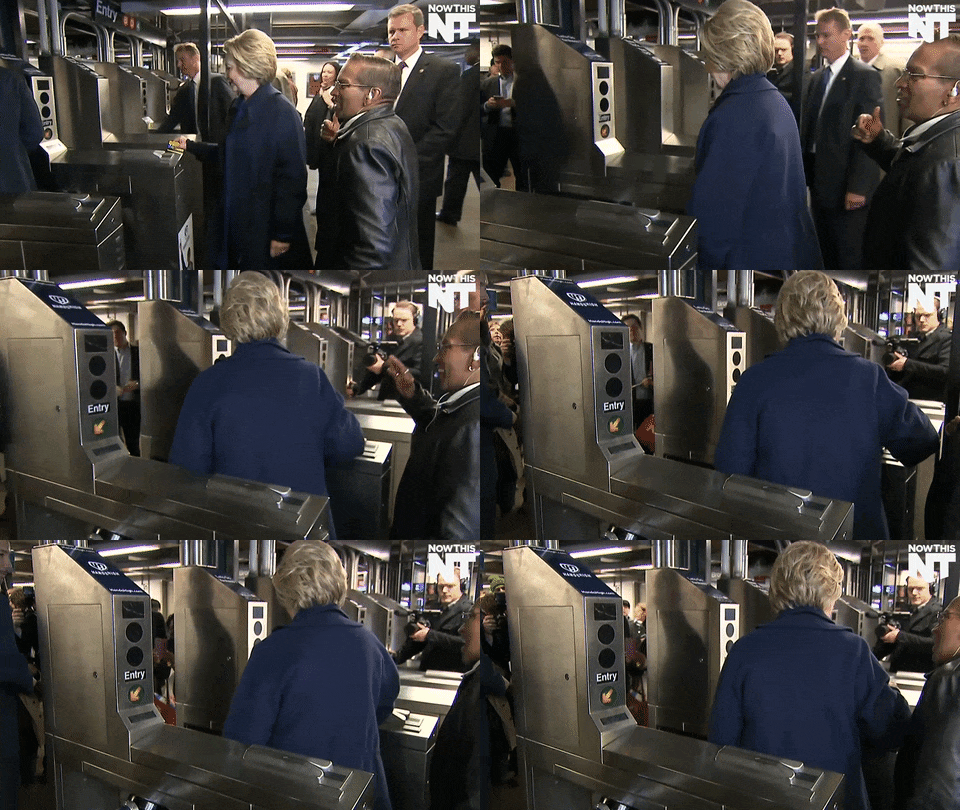
Well, here is another take on fare evasion; no wonder Cubit was so intent to sell fare gates, they are becoming obsolete!
Ignoring Fare Evaders Can Make Mass Transit Fasterai??i??And Richer
In Oslo, it began with a defective gate, the kind of thing that sings ai???lawsuit!ai??? in America. In the Norwegian capitalai??i??s metro system, in 2005, newly installed turnstiles began to trap unsuspecting riders. ai???If you had a carriage or a baby stroller, you could get stuck,ai??? Christian FjAi??r, who oversees the local transit authorityai??i??s payment operations, said at an event hosted by the research group TransitCenter last month.
So the enterprising Norwegians had an idea: Donai??i??t just ditch the malfunctioning hardware. Ditch the turnstiles and gates altogether, along with the idea of physical barriers that demand payment.
Itai??i??s not so radical. By nixing fare gates, public transit agencies emphasize ease of access over making every last rider pay. Europe got intoAi??ai???proof of paymentai??? systemsai??i??where wandering personnel request evidence you paid your wayai??i??in the 1960s. They made it to American shores, mostly in light rail systems, by the 1990s.
Now, 21st century techAi??is making it easier than ever to blow up the turnstile. Modernized, cash-free fare payment methodsai??i??like reloadable tap-and-go cards, or apps that let ridersAi??use smartphones to get tickets, Apple Pay-styleai??i??speed up boarding. Passengers donai??i??t have to struggleAi??past fare gates. They can board through any door, instead ofAi??pushing throughAi??a busai??i??s front entrance toAi??pay the driver.
The result: Faster vehicles, less crowding, and thus more frequent service, leading (hopefully) to more riders overall. Meanwhile, data collected from systems usingAi??modernized proof of payment methodsAi??donai??i??tAi??showAi??fare evasion skyrocketing. People, it turns out, mostly follow the rulesai??i??especially if they know getting caught in a spot check carries a hefty fine.
Today, bus, tram, and rail passengers in Oslo canAi??use a tap card orAi??smartphone app to pay their fares before the trip, without risking the howls of aAi??gate-pinched toddler. The cityai??i??s transit agencyAi??is ai???moving away from trying to keep the non-paying passengers away to catering for the paying passengers,ai??? FjAi??r said last month.
InAi??Oslo and cities trying to update their fare payment systems, the general attitude toward transit scofflaws is, whatevs.
The Great Doors Experiment
San Franciscoai??i??s Muni system is one of the most the recent to fling open the fare gates and make the switch to all-door boarding. After the cityai??i??s light rail started letting people hop into any door in the 1990s, its buses got in on the act in 2012. Helped along by the tap-able Clipper Card, which riders purchase and load in advance, the San Francisco Municipal Transportation Agency installed electronic readers at all doors. It increased the number of trained fare inspectors patrolling the system, too.
ai???Essentially what we were trying to do is keep the honest folks honest,ai??? says Julie Kirschbaum, who oversees the agencyai??i??s modernization efforts. And do just enough to keep the bandits on their toes.
It worked. In tourist-heavy areas, the systemai??i??s bus and streetcar dwell times per stop dropped 13 percent. Before, each person getting on or off needed 6.8 seconds. Now, they take 3. 5 seconds. Multiply those moments of savings by every rider boarding and alighting at every stop on every bus line, and youai??i??ve got hundreds of hours of extra time per year. All from opening up the back doors.
Related VideoThe Art of Designing Public Transit for Anti-Social Commuters
The cheaters are still along for the ride, according to Muniai??i??s latest data. But the agencyai??i??s surveys found fare evasion dropped from nearly 10 percent in 2009 to 7.9 percent in 2014. The resulting estimated loss in revenue fell from $19.2 million to $17.1 million.
That tracks with Osloai??i??s experience, where the public transit system also liberated all metros from fare gates. By making it easier for riders to pay for tickets through their phones, the system halved its fare evasion rates, to five percent. Trains are moving faster, too, which encourages more people to use the service. The agency has calculated the cost of slower operations versus what itai??i??s losing through fare evasion. It makes more financial sense to let the cheaters cheat, it says.
The Tech Hangups
Unfortunately, flinging open every door is not as simple as, well, flinging open every door. The requisite fare modernization efforts donai??i??t come cheap. New Yorkai??i??s been trying to trade in its swipey MetroCard for a tap-and-go, smartphone-friendly system for nearly a decade now, but wonai??i??t really get the ball rolling until 2018ai??i??for a cool $419 million.
Los Angeles, meanwhile, started its Metro with a fare gate-free, proof-of-payment system, but started moving back to gates in 2008. It cited fare evasion, yes, but also public safety and crime deterrence.
Different strokes, man. But cities like Oslo and San Francisco show thereai??i??s a counter intuitive logic to making transit easier to ride for all.

Ferenc Joo


Proposed phase one construction of Surrey light rail (Emily Lazatin/ CKNW)



 Though not Cambridge, modern LRT fits in quite well in dense and/or historicAi?? city centres
 A Budapest Christmas tram lights the way!
 Toronto’s Danfort -Bloor streetcar route used coupled sets of PCC cars
 Kent Spencer






Recent Comments