TransLink’s Ridership Bamboozle Continues
TransLink continues it ongoing program to bamboozle the public and politicians with their patented ridership bumf.
Boarding’s are up 4%, really?
Maybe, but boarding’s do not equate into actual higher actual ridership numbers, especially with the 130,000, $1.00 a day, ride at will U-Passes distributed to post secondary students.
Simply put, those 130,000 U-Pass customers, which TransLink does not keep track of, are making multiple boarding’s daily, skewing ridership numbers.
TransLink has a powerful tool in calculating ridership and it is called the Compass Card and with the compass Card, TransLink knows almost to the person, how many people are using transit on a daily basis. That TransLink doesn’t release these figure, but relies on questionable “boarding’s” numbers of old tells me a different story is at play.
Has real ridership stagnated or dropped or merely kept pace with population growth? Only TransLink knows. Problem is, TransLink has “0” credibility.
With 130,000 deep discount U-Pass fares in the system and many using the the transit system multiple times a day, the higher “boarding’s” climb, the poorer TransLink becomes. One cannot sustain a premium priced transit system on deep discounted fares.
Most Transit customersAi?? transfer from, or transfer to, bus, SkyTrain or Seabus, on a single trip thus a single trip in may see up to three or more boarding’s with a single transit trip in. With the U-Pass, this may increase three fold.
There is also an interesting comment that mode share by bicycle is down 20%, (which, around 2% of trips made, is a very small amount) but no mention of the car, which has about 57% mode share.

What you don’t hear from TransLink is the important story, but the main stream media don’t do investigative reporting on transit because it is a motherhood and apple pie issue and TransLink takes full advantage of this.
There are more hints that TransLink is continuing to bamboozle the public and politicians on ridership, but until more data is compiled, must wait for another day.
TransLink ridership jumps 4% in 2016
Vancouver, BC, Canada / News Talk 980 CKNW | Vancouver’s News. Vancouver’s TalkPosted: December 08, 2016 07:22 pm

TransLink says ridership is up 4% so far this year.
Spokesperson Chris Bryan says numbers were originally on track for a 2% increase, but there was a bump in the fall.
ai???The rainfall we saw in the fall, as miserable as it was, itai??i??s driven people to transit we think. The ridership trend was going upward but it really took off these past three months or so,ai??? he said.
READ MORE: Phase one of 10-year transit and transportation plan for Metro Vancouver approved
Bryan says that has transit operatorsAi??smiling.
ai???Itai??i??s pretty good news to talk about. [In] 2015 we had record ridership,Ai??all-time high of about 364.3-million boardings on the system and weai??i??re on track for exceeding that,ai??? he said.
At the same time, Bryan says that boost in riders has come at the expense of other mode shares, particularly cyclists with trips by bike in Vancouver is down about 20% in October, over the same month last year.
Ottawa News

Big things are happening in Ottawa, as the European light rail Renaissance has arrived in Canada
Ai?? Photos: Courtesy Haveacow.
Vehicle testing marks next big milestone for O-Train Confederation Line
December 2, 2016News Release
Ottawa ai??i?? A major milestone in the O-Train Confederation Line Light Rail Transit (LRT) project was celebrated today as the first light rail vehicle (LRV) assembled in Ottawa began testing on the track between Blair and Cyrville stations. Vehicle testing along the alignment from Blair Station to Tunneyai??i??s Pasture will continue until the launch of the O-Train Confederation Line in 2018.
David McGuinty, Member of Parliament for Ottawa South, on behalf of the Honourable Amarjeet Sohi, Minister of Infrastructure and Communities, the Honourable Steven Del Duca, Ontario Minister of Transportation, and Ottawa Mayor Jim Watson, along with other dignitaries from all levels of government, participated in a photo opportunity with the LRV in celebration of this milestone.
The O-Train Confederation Line is a $2.1-billion project that is jointly funded by the Government of Canada, the Province of Ontario and the City of Ottawa. The Government of Canada is contributing $600 million and the Province of Ontario is contributing up to $600 million. The City of Ottawa will also allocate up to $161.5 million of its federal Gas Tax Fund transfers to this project and $287 million of provincial gas tax transfers. The remaining project funds will come from development charge revenues and transit reserves.
The Rideau Transit Group is the private sector partner responsible for this first stage in Ottawaai??i??s future rail network. The 12.5-kilometre electric light rail line will provide rapid transit between Blair Station in the east and Tunneyai??i??s Pasture Station in the west and will connect to the O-Trainai??i??s Trillium Line at Bayview Station. The route includes 13 stations and a 2.5-kilometre tunnel that will reduce congestion through the downtown core.
Quotes
ai???The Government of Canada is committed to working in partnership with all orders of government to support infrastructure projects that create jobs and help the middle class grow and prosper. The O-Train Confederation Line will transform how people get where they need to go safely and efficiently, and I am pleased to see how well the project is moving ahead thanks to the tremendous effort by all involved.ai???
David McGuinty, Member of Parliament for Ottawa South on behalf of the Honourable Amarjeet Sohi, Federal Minister of Infrastructure and Communities
ai???This is great news for the City of Ottawa ai??i?? we are one step closer to delivering an efficient and world-class transit option for commuters. Construction on the O-Train Confederation Line project supports our objectives of developing an integrated transportation network across Ontario that will help manage congestion, connect people to jobs and improve the economy and our quality of life.ai???
The Honourable Steven Del Duca, Provincial Minister of Transportation
ai???Todayai??i??s milestone is significant as the first light rail vehicle assembled in Ottawa undergoes testing, demonstrating that we are on track to delivering a first-class transit system to our residents in 2018. This is a celebration of all the work that has taken place to date and is a glimpse of the future of transit for our city.ai???
Mayor Jim Watson, City of Ottawa
Quick Facts
- 33 of 34 Alstom CITADIS light rail vehicles (LRVs) are being assembled at the Maintenance and Storage Facility (MSF), located on Belfast Road.
- Vehicle and system testing began this fall and will continue up until the launch of the O-Train Confederation Line in 2018.
- One of the initial tests is related to dynamic envelope testing where foam pads are affixed to the vehicle as it runs along the alignment ai??i?? powered by the Overhead Catenary System (OCS) ai??i?? to ensure that adequate clearances are maintained from overhead wires, OCS poles, tree branches etc.
- Residents will see rail vehicles traveling varying distances for testing purposes with no passengers on board.
- Residents are reminded to stay off the tracks and not to trespass on the alignment, as energized OCS and moving vehicles are hazardous.
- Vehicle movements will continue at low speeds between Blair and Cyrville stations to enable testing of the functions of various components of the vehicle and systems.
- Some of the final panels and markings on vehicles will be added in the later stages of testing.
- Testing will be ongoing as required until 2018, giving residents many opportunities to see the vehicles on the test track (Blair Station to just east of Tremblay Station) initially, and later along the whole alignment.
- Approximately 100 jobs have been created in Ottawa for the assembly of LRVs.
Game Changer for Regional Rail!
What the FRA does, Transport Canada will soon follow.
This news is of great importance to Metro and Victoria’s metro regions, bringing in a transit option that Rail for the Valley has been championing for many years.
Proven European technology combined with proven European transit philosophy (which will come with the technology), just may make huge improvements for better and affordable transit options in North American cities.
Feds Clear the Way for Euro-style Trains in the US
at By Frank Chiachiere
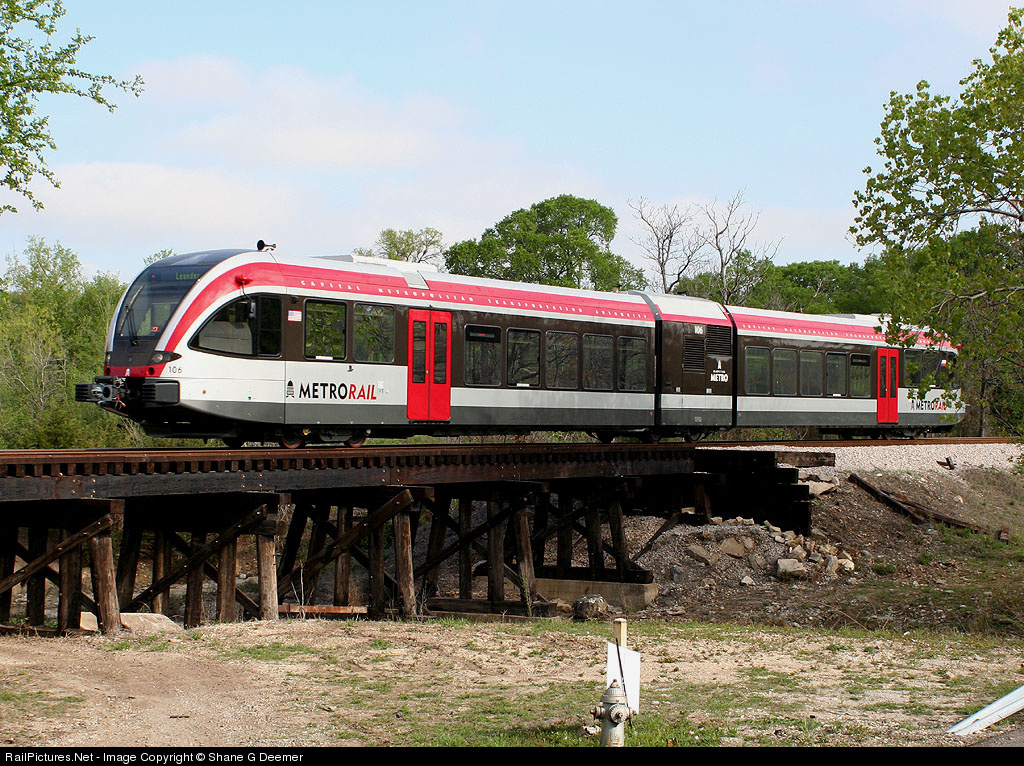
Stadler 2/6 DMU in Austin. Flikr user Paul Kimo McGregor.
New regulations from the Federal Railroad Administration could open up exciting new options for passenger rail in the Northwest. Ai??Ai??TheseAi??updates have been in the pipeline for some time now and are finally ready for public review.
The first of the new rules creates a new ai???Tier IIIai??? for high-speed passenger rail. Tier I covers speeds up to 125mph (i.e. Amtrak Cascades, Sounder), Tier II goes up to 160mph, and the new Tier III (220mph) relates to true high-speed trains such as we might some day see in California.
The second and more interesting rule changeAi??provides an alternative crash safety standard for Tier I (and only Tier I) trains, for tracks that are shared between passenger and freight rail. Ai??Streetsblog has a good summary:
The FRA expects the new rules will enable railroads to use trains that are safer, more energy efficient, and cheaper to operate. The rules will allow American passenger train operators to purchase rolling stock designed to European safety standards (but not Japanese standards), without going through an expensive waiver process.
ai???It was an obstacle for all foreign railway manufacturers to bring any state-of-the-art trains into the country,ai??? said Alois Starlinger, a board member for the Swiss train maker Stadler Rail.
Building trains to unusual U.S. safety standards for the small American passenger rail market made rolling stock purchases needlessly expensive. Opening the door to standardized European train specifications will significantly lower prices.
Running cheaper, lighter Diesel Multiple Unit (DMU) trains on existing freight rail tracks could open up some more options for passenger rail. Ai??As our own Bruce Nourish explained when the regs were first announced:
To get a sense of the economic and environmental cost of Americaai??i??s overbuilt trains, letai??i??s look at a simple number, the weight of the trains, taking Sounder North as an example. To a first order approximation, the environmental and economic cost of building and operating a vehicle (of a certain type of fuel) is proportional to the amount of metal that goes into it. A three-car Sounder North train weighs about 240 metric tons (50 t carriages, 120 t locomotive), while theAi??Stadler 2/8 weighs 79 metric tons. So, roughly speaking, we could comfortably move Sounder Northai??i??s passenger load with a third of the fuel and materials we use today. This would do much to bring down Sounder Northai??i??s painfully high cost per boarding; to boot, a DMU train would almost certainly accelerate faster, ride more smoothly, and be quieter to the neighbors. DMUs on this line could be a huge win.

Ransomware Attack On The Muni Results In Free Travel.
Interesting!
I wonder what TransLink would have done?
If TransLink doesn’t have a computer hack plan, they better get one soon as it seems electronic fare cards are vulnerable.

San Francisco made its public transit free for a day after it was hacked
Nov. 27, 2016
San Francisco residents were able to take the bus and trolley for free on Saturday after the city’s computer systems for taking fares wereAi??apparently hacked.
SF Muni computers displayed the message “You Hacked, ALL Data Encrypted,” the San Francisco Examiner reportedAi??on Saturday.
Machines where riders could fill up their fare cards had signs attached that said “out of service” and “free Muni” on Saturday. Fare gates and ticket machines were working on Sunday morning.
The attack seems to be an example of ransomware, where a computer system is taken over and the users are locked out until a certain amount of money is sent to the attacker. The Muni hack reportedly included an email address where Muni officials could ask for the key to unlock its systems.
Outages started happening on Friday afternoon but the bulk of the delays started on Saturday, according to a local ABC News affiliate. The extent and the identity of the perpetrator of the hack isn’t known yet.
“We are currently working to resolve the situation,” a Muni spokesperson told the Examiner. “There is an ongoing investigation and it wouldn’t be appropriate to provide additional details.”

UBC expert fears Vancouver subway is still far off
Transit improvements coming soon? Don’t hold your breathe because TransLink’s planning is extremely suspect.
Certainly new buses will arrive for new routes and new drivers, mechanics and the rest of the employees needed to operate the new buses will be hired, but will this actually improve transit?
I doubt it because TransLink is fixated on its dated planning where bureaucratic and political prestige comes first and user-friendliness comes a distant last.
For this ever elder citizen, taking public transit today is the very last transportation option I would consider as the Mayors Council on Transit, don’t give a damn about a user-friendly transit system and customer comfort, all they care about is throwing more and more money on a dysfunction transit system all to garner votes from the 85% of the population who do not take transit.

UBC expert fears Vancouver subway is still far off
With funding now secured for $2 billion in transit improvements, the head of UBCai??i??s urban design program thinks other projects could see delays.

Jennifer Gauthier/Metro
The 99 B-Line runs down Broadway in Vancouver, B.C.
By: Matt Kieltyka Metro Published on Fri Nov 25 2016
The head of the University of British Columbiaai??i??s urban design program thinks it may be a while before any of his students are riding a subway to school.
After TransLinkai??i??s board and the regionai??i??s mayors approved $2 billion in transit improvements on Wednesday, Patrick Condon wonders if the other outstanding projects in the mayorsai??i?? 10-year plan will be given the same urgency.
While Minister Responsible for TransLink Peter Fassbender told Metro the province is ready with its share of capital funds for the Broadway subway in Vancouver, light rail in Surrey and the Pattullo Bridge replacement, Condon says government seems to be looking 20 to 30 years into the future in interviews heai??i??s heard.
ai???I think you could say that the signals are there that the funding of the very largest pieces of this 10-year plan is certainly not secured and may not be even likely in the short term, said Condon, of UBCai??i??s School of Architecture and Landscape Architecture. ai???20 years to get out to Arbutus Street with a subway is not going to help the corridor very much and itai??i??s not going to help the students of UBC. I suspect weai??i??re not going to be seeing good news about funding in the spring [when governments announce their budgets].ai???
Vancouver Mayor Gregor Robertson stressed the region needs to move quickly to secure funding for Phase Two of its plan.
TransLink staff hope to have an investment plan for the next phase ready by 2018.
Condon had good things to say about the plan passed this week, especially the five new B-Line bus routes that will service Fraser Highway, Lougheed Highway, Marine Drive on the North Shore, 41st Avenue and Hastings Street.
ai???Those are really important to increase the mobility along these important, and what are largely considered to be suburban, corridors,ai??? he said.
The 99 B-Line along Broadway in Vancouver may be overcrowded and insufficient now, but Condon said it had a great impact on public transit use and development along that stretch of the city.
ai???Itai??i??s been killed by its own success but itai??i??s really changed the way people get around in this part of the city and to get out to UBC, for sure,ai??? he said. ai???I expect to see some of those same benefits to these other parts of the city: more higher-density residential units and less people depending on cars along those important corridors.ai???
The plan, which will be rolled out over five years starting in early 2017, will see a 10 per cent increase in bus service, 20 per cent more SkyTrain service, a new SeaBus, more West Coast Express trains and a 15 per cent increase in HandyDART service.
To pay for it, municipalities will raise their property taxes by an average of $3 per household, raise fares in July by up to 10 cents on a single zone and implement a new development fee, which requires approval from the provincial government.
The Emperor has no Clothes and no Transit
Zwei has decided to reprint this post from 2010, written by someone outside the metro Vancouver bubble, who tried to better the region’s transit.
In the ensuing time nothing has changed; the same oldAi??tired cast of charlatans trundling out the same old tired transit plans,Ai??desperately tryingAi??to convinceAi??the ever increasingly skeptical taxpayerAi??to ante up more and more tax money to fund transit improvements that everyone knows will fail to deliver what is promised.
The regional mayors, act as a collectiveAi??ai???Ship of Foolsai??? pretending they want better transit, when most secretly want miles and miles of new blacktop in their municipalities so their political friends can develop the ever diminishing ALR lands. The mainstream media,Ai?? desperate to retain advertising revenue form those in power and those who wield power, have acquiredAi??collective amnesia regarding transit and transit news and print, what they are told to print.
Herr Goebbels would be soAi??pleased.
The region has no real transit plan and no transit.
The Emperor has no Clothes and no Transit
Posted by Cardinal Fang on Sunday, March 27, 2011
Vancouver is at first glance a beautiful city. It is surrounded by sweeping vistas and a dramatic skyline.
The climate is moderate but spend some time here and scratch the surface and it becomes far less attractive. It is a city that is divided politically; it is parochial, narrow minded and shallow. The people are characterless, flaky and disingenuous. Vancouver is the scam capital of North America, a skill set for which the local population is particularly adept.
There are times when I am certain that Vancouver is something straight out of Conradai??i??s Heart of Darkness.
It is a cold place, people in the same business do not interact of share information they do not network or help each other. There is an almost a Darwinian or Hobbesian social culture ai??i?? Vancouver is an empty void.
The political environment is polarized and doctrinaire. The left adheres to ideas that are at least a generation out of date. Vancouverites think that Naomi Klein is an intellectual when in reality she is a very silly charlatan. To Vancouverites the secret is a serious work of self help. The right is equally foolish in the banality of their free market ideology.
You donai??i??t meet people of substance here. You meet flakes. The press is dominated by yellow journalism. Rarely if ever have I read a real piece of investigative journalism. You do not meet people who form their opinions based upon facts. When you encounter Vancouverites and engage them in the discussion of social issues the argument usually become circular and they end of talking only about themselves. There is a kind of deep insecurity that comes from profound feeling of self loathing that is hard wired into the political culture here. Narcissism is the dominate religion and worshiping at the Temple of Mammon ai??i?? real estate speculation is the Holy Grail.
People here (generally speaking of course) are stuck up, materialistic yuppies. The downtown scene used to have decent variety, now itai??i??s full of ai???cookie-cutterai??? clubs and bars that cater to Armani clones.
Go east of here, or especially south of here, and youai??i??ll find friendlier people that arenai??i??t so consumed with cliques and materialism. If one hails from Harare, Timbuktu, Tripoli, or Darfur then yes, Vancouver appears pretty good, but ai???the most livable city on Earthai????Not only is this pretentious, itai??i??s just plain wrong.
No where is the contrast more apparent, than in Coquitlam and Port Moody; cities like Surrey, Delta and Langley, South of the Fraser River and east along the Valley to Abbotsford and Chilliwack.
Politicians, planners, decision makers, wealthy Vancouver suburbanites and the `movers & shakersai??i?? contemptuously dismiss the communities beyond downtown as the boondocks; the disdain for the citizens of the Greater Vancouver Regional District and the Fraser Valley is illustrated in the attitude of the Ministry of Transportation and Infrastructure, BC Transit and TransLink, to public transport in these areas.
The Emperor has no Clothes and no Transit.
From December 2010;The Rail for the Valley movement has long campaigned against this inequity:
Whereai??i??s The Transit?
http://www.railforthevalley.com/latest-news/zweisystem/wheres-the-transit/
Transit Planning In Metro Vancouver ai??i?? Where Have We Gone Wrong?
Added costs for the Canada Line ai??i?? Has The Taxpayer Assumed Risk?
The truth is now beginning to be realised by the wider community; The Globe & Mail published the two following articles on March 25 & 26th.
Transit a hit-and-miss affair in B.C.ai??i??s Lower Mainland
Transit problems across Canada prompt calls for politicians to address issue
We can only hope that the upcoming May (2017) election will end to the sixteen years of ineptitude, inequality, corruption & nepotism which started in Gordon Campbellai??i??s BC Liberal administration and now continued by premier Chritsy Clark and echoed by the provincial NDP will improve the outlook; I doubt it but, we can but hope and wish.
One should have some basis for comparison before showering such hyperbole on the overpriced, congested, and conceited squalor that is the most livable city in the world. If any city (or province) is presumptuous enough to put ai???the best place on Earthai??? on its license plates; itai??i??d better well be the case, because itai??i??s citizens donai??i??t uphold the credibility.
Vancouver is a poor-manai??i??s version of Seattle that, ironically, costs five times at much. Unlike Seattle, however, Vancouver has a dearth of friendly (and English-speaking) people, good music, and reasonably-priced beer. The self-satisfied smugness Vancouverites have toward their neighbour city to the south (or any metropolis, for that matter) stems from an amalgamation of an inferiority complex coupled with an identity crisis. Canada is like the U.S. in every way, except not quite as good. Nowhere is this exemplified more than in Vancouver.

Phase One To Oblivion
Well, it had to happen, the fools council has approved ‘phase one’ of Translink’s ten year plan.
I doubt that any of the mayors in this old boys/girls club know very much about transit, but they certainly know what gets them votes and transit is a motherhood and apple pie issue.
Buying new SkyTrain cars is a no-brainer as the majority of the MK.1 cars have now operated since 1985 and now are over 30 years old. As well, buying new SkyTrain cars keeps the production line intact and with SkyTrain being a proprietary railway, this is important, lest one day new SkyTrain cars are ordered but no production line to produce them.
The pre-production work on both the Broadway subway and Surrey LRT is a complete waste of money, but TransLink is very good at wasting the public’s money.
What TransLink has not done, is to make the regional transit service more customer friendly, but then to do that, the six figured a year salaried mandarins in TransLink’s expensive ‘ivory towers’ would have face some very unpleasant questions.
The key to a better regional transit service is not more buses, SkyTrain cars and employees, rather it is providing a transit service that naturally attracts customers to transit. Flooding the system with 130,000 deep discounted U-Passes and double and triple counting ‘boarded’ passengers is not the way to run a transit system, but without public scrutiny, TransLink can and deso as it pleases.
The 2015 plebiscite showed that the majority of the public had no confidence in this obtuse bureaucratic empire, called TransLink and the ‘phase one’ spend-a-thon shows that those running TransLink learned nothing and remember nothing.

Phase one of 10-year transit and transportation plan for Metro Vancouver approved
Vancouver, BC, Canada / News Talk 980 CKNW | Vancouver’s News. Vancouver’s TalkPosted: November 23, 2016
The Mayorsai??i?? Council and TransLink Board of Directors have approved Phase One of the 10-year Vision for Metro Vancouver Transit and Transportation.
TransLink will roll out Phase One in January 2017.
The $2 billion-dollar planAi??will ai???bring noticeable improvements to the way residents travel throughout Metro Vancouver, by reducing overcrowding on transit and on HandyDart, providing new services to areas which havenai??i??t had transit before, helping to address bottlenecks on the regionai??i??s major road networks, and creating pedestrian walkways and bike paths.ai???
Map of the proposed improvements:
Funding Phase One
Phase One of the plan will be funded by a $370 million from the Federal Government and $246 million from the Provincial Government. The remaining $1.3 billion will be coming from TransLink.
Phase one will be partially funded by transit fare and property tax increases.
Translink says the fare increase will be 5 to 10 cents on a single fare and $1 to $3 on a monthly pass.
The property tax increase will be based on growth and development in the region.
There will also be a new region-wide development fee for transit and transportation and Translink will sell surplus property.
Unifor, which represents 4,700 transit operators, mechanics, maintenance and SeaBus workers, calls the phase one approval a ai???big winai??? but calls on the province to increase its contribution to capital costs from 33 per cent to 40 per cent.
Unifor says commuters can expect to see a 10% increase in bus service starting in April 2017 and new buses on the road.
With files from Jeremy Lye and Shelby Thom


The 1986 LRTA Study: Bus – LRT – Metro Comparison
Every year I reprint this post to remind everyone of the ability to move large amount of people at an affordable cost.
There is an ongoing debate today that LRT can only carry a limited number of riders and that the magic number for a subway is about 100,000 riders a day on a transit line. This may have been true in the 197’s, but not the 21st century, where modern multi-articulated low-floor light rail vehicles (tram is much easier to say!) are able to easily carry three or four times this number, thus negating the need for expensive subway construction, except on the most heavily used routes. The LRTA shows that modern LRT can carry over 20,000 pphpd in 1986 and in 2010, in Karlsruhe Germany, one tram or LRT line on Kaisserstrasse was seeing traffic flows over 35,000 pphpd.
Karlsruhe also shows what the threshold for traffic flows necessitating subway construction in Germany, after many very expensive lessons with subways built on lesser routes.
Those who demand a SkyTrain Broadway subway should take note.
The 1986 LRTA Study: Bus LRT Metro Comparison

The following is from the Light Rail Transit Associations hand book Light Rail Transit Today, comparing the operating parameters of bus, light rail, and metro on an unimpeded 8 kilometre route with stations every 450 metres. Using real data based on acceleration, deceleration, dwell time, etc., the study gives real time information for the three transit modes.
Please note: This study has been abridged for brevity and clarity.
The study assumes a vehicle capacity for a bus at 90 persons; LRT 240 persons (running in multiple unit doubles capacity); and metro at 1000 persons.
The time to over the 8 km. route would be:
- Bus 22.4 minutes
- LRT 18 .6 minutes
- Metro 16.3 minutes
The Round trip time, including a 5 minute layover:
- Bus 54.8 minutes
- LRT 47.2 minutes
- Metro 42.6 minutes
The comparative frequency of service in relation to passenger flows would be:
At 2,000 persons per hour per direction:
- Bus 2.7 minute headways, with 22 trips.
- LRT 7.5 minute headways, with 8 trips.
- LRT (2-car) 15 minute headways, with 4 trips.
- Metro 30 minute headways, with 2 trips.
At 6,000 pphpd:
- 1 Bus 0.9 minute headways, with 67 trips.
- LRT 2.4 minute headways, with 17 trips.
- LRT (2-car) 4.8 minutes, with 13 trips.
- Metro 10 minute headways with 6 trips.
At 10,000 pphpd:
- Bus 30 second headways, with 111 trips (traffic flows above 10,000 pphpd impractical).
- LRT 1.4 minute headways, with 42 trips.
- LRT (2 car) 2.8 minute headways, 21 trips
- Metro 6 minute headways, 10 trips.
At 20,000 pphpd:
- LRT 0.7 minute headways, with 83 trips.
- LRT (2 car) 1.4 minute headways, with 42 trips.
- Metro 3 minute headways, with 20 trips.
Comparative Staff Requirements on vehicles in relation to passenger flows. Station staff in brackets ().
At 2,000 pphpd:
- Bus 21 (0)
- LRT 7 (0)
- LRT (2 car) 4 (0)
- metro 2 (up to 38)
At 6,000 pphpd:
- Bus 61 (0)
- LRT 20 (0)
- LRT (2 car) 10 (0)
- Metro 5 (up to 38)
At 10,000 pphpd:
- Bus 110 (traffic flows above 10,000 pphpd impractical) (0).
- LRT 34 (0)
- LRT (2 car) 17 (0)
- Metro 8 (up to 38)
At 20,000 pphpd:
- LRT 69 (0)
- LRT (2 car) 34 (0)
- Metro 15 (up to 38)
Though the study is 30 years old and completed before the advent of low-floor trams (which decreased dwell times), it still give a good comparison of employee needs for each mode. Metro, especially automatic metro systems do require a much larger maintenance staff than for bus or LRT and when one factors in the added high cost of subway or viaduct construction plus higher operational costs, Metro only become a viable proposition when traffic flows exceed 16,000 pphpd to 20,000 pphpd on a transit route.
Claims from other blogs that automatic metros can operate more frequent headway’s than LRT are untrue; automatic metros can not operate at higher frequencies than LRT, but if Metro is operated at close headway’s in times of low traffic flows, they do so with a penalty in higher maintenance costs and operational costs.

Taking into account the almost universal use of low-floor trams, operating in reserved rights-of-ways, combined with advances in safe signal priority at intersections; given an identical transit route with equal stations or stops, LRT operating on the surface (on-street) would be just as fast as a metro operating either elevated or in a subway at a fraction of the overall cost grade separated R-o-Wai??i??s. Also, automatic (driverless) metros, though not having drivers have attendants and station staff, which negate any claim that automatic metros use less staff than light rail.
The LRTA study does give good evidence why LRT has made light-metros such a as SkyTrain and VAL obsolete.
http://www.railforthevalley.com/latest-news/zweisystem/the-1986-lrta-study-bus-lrt-metro-comparison/
Sounds of Silence

No surprise here, as Zwei has been sounding alarm bells over this upcoming fiasco for years
Now TransLink has an American out of Seattle as the new CEO and this means the sky is the limit for spending on rail transit.
Seattle’s LRT is LRT in name only as it is actually a light metro with over 90% of its route either in a subway or on a viaduct. The European light rail Renaissance, did reach the shores of North America but “big money” interests prevented much traction and in the USA and Canada, the race is on on how one can spend the most amount of money for the least amount of transit.
As repeated many times, TransLink does not plan transit, rather it implements what the premier’s Office tells it to do and the premier’s office will only invest in transit to satisfy the needs of friends and cronies of the government.
In Vancouver, rapid transit is used to subsidize development and nothing more and the transit customer, as always in Metro Vancouver, is left waiting at a station with no service.
Cone of silence over cost estimates for Broadway subway, Surrey LRT
A week after its Mayorsai??i?? Council endorsed a plan to raise property taxes and hike transit fares to begin its expansion, TransLink is refusing to …By Bob Mackin | Sept. 23, 2016
A week after its Mayorsai??i?? Council endorsed a plan to raise property taxes and hike transit fares to begin its expansion, TransLink is refusing to provide the latest cost estimates for the biggest items on its long-term wish list.
*
The Broadway subway and Surrey light rail were estimated in 2014 to cost $1.98 billion and $2.14 billion, respectively. Last March, City of Surrey rapid transit project manager Paul Lee admitted rising real estate prices had pushed the Surrey proposalai??i??s estimated budget to $2.6 billion.*
The public portion of the Sept. 23 quarterly meeting contained no mention about either project. Business in Vancouver asked TransLink CEO Kevin Desmond at a post-meeting news conference for an update and whether the cost estimates had increased by a billion dollars each.*
ai???Weai??i??re not prepared to talk about what the estimates are,ai??? Desmond said. ai???Itai??i??s during that period of time in the months ahead that we [will] further will pin down the cost estimates going forward. By the time weai??i??re ready to proceed with the investment plan on phase two, weai??i??ll be in a much better position to have more accurate estimates associated.ai???*
On March 30, TransLink CFO Cathy McClay admitted the cost estimates had gone up, but she wouldnai??i??t provide numbers. She said consultants were given extra time, until June 30, to deliver their reports. She blamed the high cost of real estate and the decrease in the loonieai??i??s buying power for materials.*
In early 2015, Steer Davies Gleave and Hatch Mott MacDonald were hired on a $1.56 million conceptual design and cost estimate study for the Surrey proposal. They subcontracted Stantec (TSX:STN), Via Architecture, Anthony Steadman and Associates and the Stewart Group. Stantec is leading the $1.4 million study on the Broadway proposal with subcontractors Jacobs Associates, Golder Associates, Allen Parker Consulting, Site Economics, Westco Consulting, Edward LeFlufy Urban Design & Architecture, Locke & Locke, Dessau, BTY Group and Anthony Steadman and Associates.*
ai???These are both very, very complicated projects and you go thorough a design process that is highly iterative,ai??? Desmond said. ai???During a prolonged design and engineering process for very complicated public works projects you go through eventually value engineering exercise as well, and weai??i??re not there yet.ai???*
Meanwhile, Desmond declined to comment on the impending sale of the Oakridge Transit Centre to Intergulf Development Group. BIV sources say the transaction for the 13.8 acre, mixed-use residential building opportunity could be worth as much as $400 million.*
ai???We have no further information on that property transaction at this point in time,ai??? Desmond said.

Rail for the Valley’s Canada 150th Anniversary Treat!

Passenger train’s operating on the old Vancouver to Chilliwack interurban line may happen for two weeks during Canada’s 150th celebrations and the RftV group needs your help to make it happen!
The West Coast Railway Association, in conjunction with Rail for the Valley and the Southern Railway ofAi?? BC have put together a package, seeing a heritage diesel loco and four passenger cars, tentatively to operate on two weekends in the summer of 2017.
The upfront cost for this to happen is around $90,000.
Expensive yes, but consider this; the cost for just the ‘train’ rental is $25,000 and the cost to bring it from Squamish to Chilliwack is $15,000!
Other costs are buses, $24,000 for bus rentals for those making one way trips the rest of the costs is made up of insurance, advertising, etc.
RftV needs $6,000 now, $6,000 a month before the train leaves and $6,000 the day of departure.
Ticket sales are designed to meet the cost of the event and based on 90% sold tickets, the cost of a one way would be around $43.75, but this has not been finalized.
What is important now is to secure funding for this event and if you or anyone wishes to donate to this event, make inquiries via the rail for the valley web site.
This is an exciting event and please get involved!



Recent Comments