Transit Planning in the Vancouver Region – The Years The Locusts Have Eaten
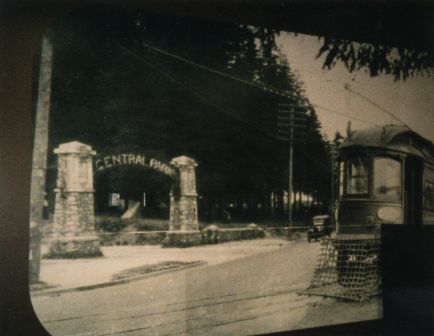 In the beginning, Vancouver was serviced by a sizable streetcar network and several interurban lines, but by 1960 the streetcars were long gone and the last interurban route saw its final service. There was a last ditch attempt to operate a New Westminster to Vancouver interurban service on the Central Park Line using coupled pairs of PCC cars but it failedAi??due toAi??unionAi??demands forAi?? two man staffing (one driver per car) of the car trains.
In the 1960’s and 70’s many new regional highways and bridges were built to contend with the growing population and greatly increased car use.Ai??In the late 1960’s aAi??line is the sand was drawn in Vancouver preventing a US style 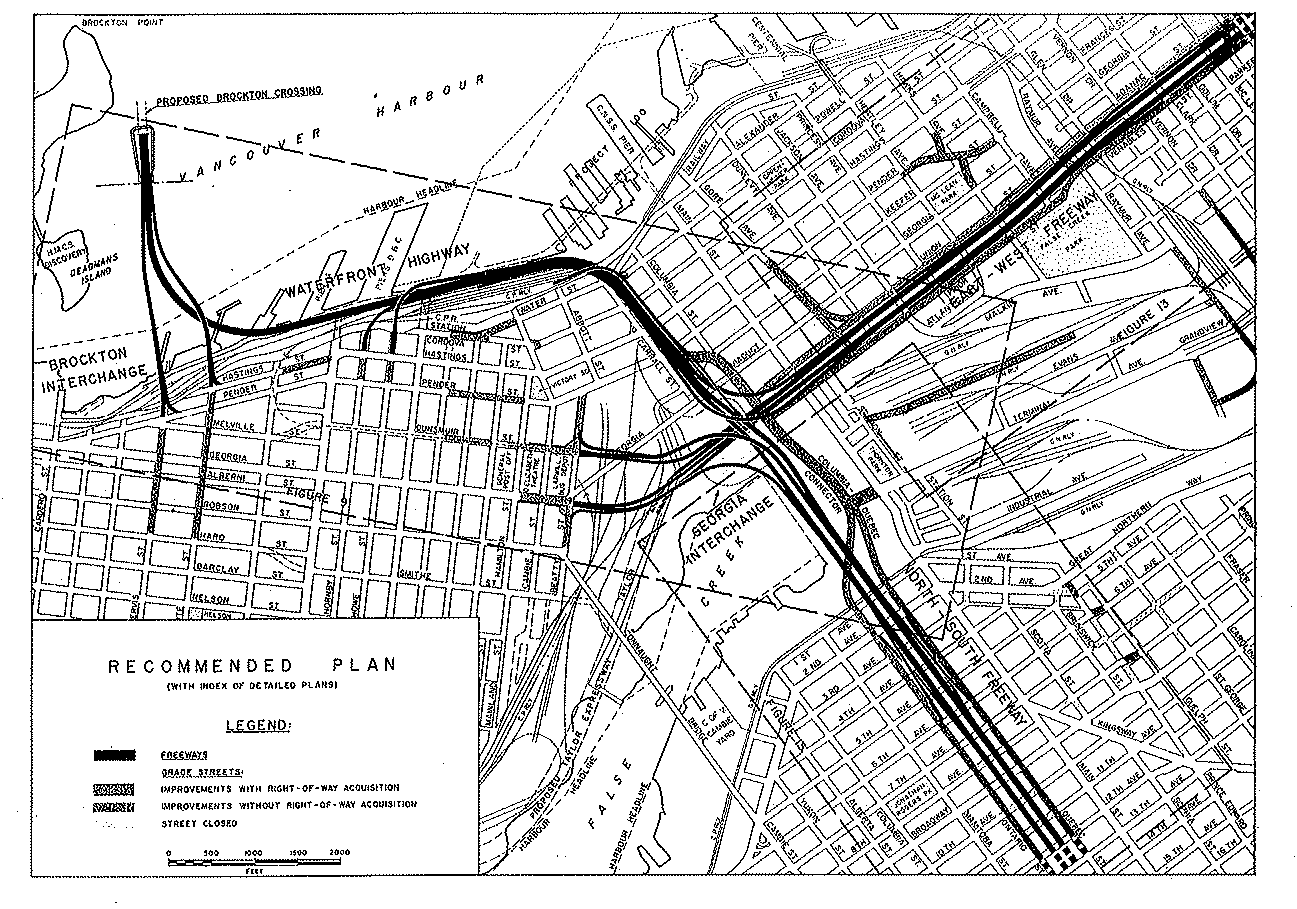 freeway bisecting China Town in Vancouver’s growing seedier East side, and the provincial penchant for new highway construction went elsewhere in the province to build new infrastructure.
Without a highway to cater to increased traffic flows, the Vancouver region started planning for ‘light rail’ and in the late 1970’s a three pronged light rail scheme was almost approved connecting Vancouver to Richmond, Surrey and Lougheed area on the Burnaby/Coquitlam boarder. The LRT plans were to utilize as much of the old interurban rights-of-ways as possible as the ridership potential was very high along these routes.
In a crass political dea,l the then Social Credit Government purchased a proprietary light metro or Advanced Light Rail TransitAi?? (ALRT) from the Ontario government’s crown corporation, the Urban Transportation Development Corporation or UTDC. The automatic (driverless) ALRT light metro system was renamed from the UTDC’s unsuccessfulAi??ICTS or Intermediate CapacityAi??Transportation System, which failed to find  a market in North America. ICTS, being elevated, was to have a greater capacity than a Toronto PCC streetcar, built at a much cheaper cost than a Toronto subway, or in short, a transit system with the benefits of a heavy-rail subway at a fraction of the cost. It wasn’t to be. The Toronto Transit Commission found that ICTS could cost as much as ten times more to built yet have the same capacity as modern LRT or cost about the same as a Toronto subway which had four times the capacity! ICTS was quickly renamed to ALRT and only one system was sold – too Vancouver.
Later Bombardier purchased the rights to ICTS/ALRT and now sell the package as ART or Advanced Rapid Transit.
With ALRT, now renamed SkyTrain for the local market, came all the sales rhetoric for the light-metro and thus began the massive anti-LRT campaign the reverberates still today.
In the 90’s, againAi??saw light rail on the drawing board again for the region, but the then NDP flip-flopped on transit mode, again forcing the SkyTrain light metro system on what was to be the Broadway-Lougheed transit project, now renamed the Millennium Line.
Light Rail for the Canada Line was given the toss, by former City manager and close confident of then Premier Campbell, by Ken Dobell, for reasons of political prestige. The Liberal supporter along the former BC Electric Richmond Interurban Line, raised such a fuss that the public were conned by the BC Liberal government and TransLink that LRT was not viable and only a SkyTrain light metro could be built.
The Canada Line, planned for in the early 2000’s, saw its costs rise dramatically, from $1.3 billion to an estimated cost that now may exceed $2.5 billion. The result, a drastically scaled back mini-metro that, as  designed, has less capacity than if LRT had been built on any route from Vancouver to Richmond. The result of this scaled down design was devastated businesses along Cambie Street, who suffered a design change from bored tunnel toAi??cut-and-cover construction. Even Skytrain was too expensive for the Canada Line and a generic heavy-rail metro was built to a light-metro standard. SkyTrain and the Canada Line are incompatible.
Predicted 30 years ago by the experts of the day, TransLink, the operating authority has run out of funds and needs new extra taxes to build the long waited Evergreen SkyTrain Line. TransLink wanted andAi??received aAi??gas surchargeAi??and still wants further extra taxesAi??to complete the funding for the locally called (N)Evergreen Line. The problem is the regional taxpayer is maxed out and is digging in its heels with ever increasing gas taxes.
Zwei predicted thisAi??over a decade ago in a presentation to the then new TransLink board, but predictions of a funding crunch for a metro system that costs three to four times more to build than a light rail alternative fell on deaf ears, as it still does today.Ai??The taxpayer will always has enough money to fund a new metro line, or does he or she?
Still the SkyTrain Lobby peddle their diatribes as they were fact, yet ignoring the that no one else wants to build with the proprietary SkyTrain system. With this in mind, the slogan todayAi??is SkyTrain is for Vancouver and light rail is OK for Surrey, but of course all of Metro Vancouver’s taxpayers pay for SkyTrain and if it was Vancouver ratepayers fronting the bill for SkyTrain want to pay fo expansion in their city, so be it, butAi??they do not and still want valley taxpayers to subsidize an obsolete metro system in their city.
 It has been now 33 years since SkyTrain was forced upon the regional taxpayer and the bureaucratic, political, and academic prestige that has been invested in SkyTrain and the Canada Line light metros, will ensure that SkyTrain will be built for future transit expansion, but with SkyTrain expansion comes higher and higher taxes and user fees to pay for light metro. 33 years of extremely bad transit planning by both BC Transit and TransLink, to ensure the continuation of SkyTrain expansion has left TransLink on a financial precipice, yet no one will admit to it.
Rail for the Valley has offered TransLink a life-belt with the RftV/Leewood Report a major transit study done by a bona fide transit expert, but it has been rejected by TransLink with excuse they can think of. TransLink is planning, sort of, for light rail in Surrey, but it is the old story, design light rail as a poorman’s SkyTrain and design it to fail. Simply, TransLink does not want a light rail solution for our transit woes in the region and instead plan for pie in the sky SkyTrain expansion such as the $1.4 billion Evergreen Line; an up yo $4.5 billion SkyTrain subway to UBC and another up to $4 billion SkyTrain to Langley.
The $1 billion, 138 km. RftV Vancouver/Richmond to Rosedale tramtrain service certainly looks a better deal than TransLink’s proposed SkyTrain lines,Ai??as there would be nearly $9 billion left over to fund a BCIT to UBC LRT; a Marpole to downtown Vancouver streetcar; a White Rock to Surrey Centre LRT; a Hastings St. to Coquitlam LRT, LRT to SFU, a new Fraser River Rail Bridge; LRT for Langley on 200th; and several other LRT/streetcar lines in the region. Again, TransLink is so blinkered, the bureaucracy would rather bankrupt itself planning for prestigious mini-metro, rather than a consumer driven, user friendly regional light rail network.
When the time comes that TransLink is forced kicking and screaming to plan for modern LRT instead of light metro, future transit and transportation planners will call the SkyTrain years; “The Years The Locusts Have Eaten.“




Thanks for the excellent article on the history of how we got to where we are with the SkyTrain fiasco. SkyTrain by TransLink is a miserable failure. Everyone who has built his or her lucrative career around SkyTrain is just pretending otherwise to keep filling his or her pockets at the expense of taxpayers.
Transit by TransLink is a house of cards nearing collapse. If the Evergreen Line proceeds, it will be the final nail in the coffin for TransLink.
Hooking up another SkyTrain line to the already bottlenecked SkyTrain station at Commercial Drive will make the commute much more unpleasant and crowded for the present transit users. At TransLink, rather than competent engineers, we can clueless accountants and economists who can’t even do the basic modeling to predict this.
It would be much smarter to build a parallel LRT or tram network throughout Metro Vancouver and to stop expanding the SkyTrain network, in my opinion.
Interesting post. While the rest of the world is embracing TramTrain (even the UK is being dragged kicking and screaming to accept the benefits of TramTrain) as an economic way of extending light rail to less populous towns, Vancouver seems to prefer to continue building with the awkward and expensive light metro.
The large costs for light-metro in Vancouver, translates into a smaller transit network for the region and a smaller transit network means that new highways and roads must be built to handle the increased populations.
I feel sorry for the taxpayer, and I am disheartened at the sham transit planning now taking place in Vancouver.
I see that some of the light rail opposition has started a SkyTrain website for Surrey, which I find somewhat poor. If they tried the same arguments for SkyTrain in the UK, they would be laughed out the door!
This article on the Transport Politic will be of interest.
The article details the Light Rail construction boom in France, and looks at why France made the (correct) choice of building simple, functional surface LRT instead of sticking with the VAL mini metro system.
http://www.thetransportpolitic.com/2012/06/24/commitment-to-tramways-makes-france-a-world-model-for-new-urban-rail/
Zweisystem replies: Thank you for this. Zwei has been aware of the reasons why France has opted for the light rail model instead of VAL light-metro. Almost every study done comparing VAL with LRT/tram showed that one got a far bigger bang for one’s buck. Of course TransLink thinks that residents in METRO Vancouver has endless pockets of cash to pay for ever higher taxes to subsidize extremely expensive SkyTrain and light metro.