The Failure To Understand Modern Light Rail = Public Transit Chaos
First published in May, 2010
From, May 25, 2010 – five years later, the song remains the same.
ai???Zweiai??i?? has been taken aback by the viciousness of the SkyTrain Lobby and the great lengths they have taken in discrediting the LRT, while at the same time refusing to acknowledge the marketing failure of the proprietary (ICTS/ALRT/ALM/ART ) light-metro system, known in Vancouver as SkyTrain.
ai???Zweiai??i?? is also taken aback by abject refusal by many supposed experts to take the time to clearly understand modern light rail and/or modern LRT philosophy,Ai?? instead treating it the same as a glorified bus or a poor-manai??i??s metro.Ai?? As well, ai???Zwei is dumbfounded, by many of the same supposed transit experts who do not understand the fundamentals of transit and or rail operation, especially from a customers point of view. In Metro Vancouver, many planning bureaucrats abjectly refuse to acknowledge that Ai??Ai??modern light rail is a very strong tool to mitigate congestion and pollution, which only exacerbates our regional transportation planning ennui.
A good example of not understanding ai???railai??? operation are those who continue to pontificate that automatic transit systems have fewer employees, therefore cheaper to operate than light rail. This simplistic view is wrong and except when traffic flows are in the order of 20,000 pphpd or more, then there are noticeable cost savings in automatic operation. The notion that automatic metros can operate 24/7 is just that, a notion as driverless metro need daily ai???down timeai??i?? to adjust and check the signaling system for if something goes wrong, the driverless metro stops and until a real persons checks the system to see why the metro stopped and if it is safe to continue operation, will operation be started again.
Unlike LRT, with an on-board driver, automatic metros need a full complement of staff to operate at all hours to ensure the safety of passengers, on trains and in stations. Many LRT operations have service 24 hours a day and with the simplicity of the transit mode, very few staff are needed. Contrary to what many ai???bloggistai??i??sai??i?? post, modern light rail is much cheaper to operate than metro and driverless metro.
The hysterical wailing’s of those wishing grade separated transit systems also ignore the fact that modern LRT is one of the safest public transit modes in the world. The fact that SkyTrain has a higher annual death rate than comparable LRT operations is forgotten in their zeal to discredit modern trams. Yes, cars do crash into trams. Yes, car drivers do disobey stop signals and deliberately drive across tram lines in the path of an oncoming trams, with predictable results. Yet tram/LRT/streetcar road intersections are about ten times safer than a road ai??i?? road intersection. In Europe, if a car driver ignores a stop signal and is in an accident with a tram, the car driver is heavily fined and may lose his right to drive. In Europe, autos seldom come to grief with a tram, as the legal consequences colliding with a tram is a strong deterrent.
The speed issue is another ai???man of strawai??i?? argument as those who want SkyTrain. They bang the ai???speedai??? drum loudly proclaiming that SkyTrain is fast and speed trumps all in attracting ridership. Speed of ones journey is just one facet of the many reasons why people opt to take public transit. What is true, it is that the overall ambiance and convenience of a ai???railai??? transit system has proven more important attracting new ridership. Contrary to what many believe, elevated and underground transit stations tend to deter ridership. The speed issue is a non-issue and fact is, if the Vancouver to Chilliwack tramtrain comes into operation, it will have a much faster commercial speed than SkyTrain, yet Zwei would never make the claim that tramtrain would be better because it was faster!
Studies have shown (Hass-Klau Bus or Light Rail, Making The right Choice) that in urban areas the most beneficial distance between transit stops is 450m to 600m and with any greater distances between stops tends to deter ridership and stops closer than 450m tend to be too slow. Those want a fast subway under Broadway are commuting from the far reaches of the SkyTrain and or bus network and one would question why they would live so far away to commute to UBC, if they are at all?
In the real world, transit systems are designed and built to economically move people, not so in Vancouver where transit is built to cater to the needs of land use, thus we continue to build hugely expensive metro lines on low ridership routes (for metro), where selected property owners make windfall profits from up-zoning residential properties to higher density condos and apartments. This is a ai???fools paradiseai??i??, because we are spending up to ten times more to install a metro on transit routes that donai??i??t have the ridership to sustain a metro, while at the same time failing upgrade many bus routes to LRT to cater to higher passenger flows, which now demand greater operational economies. Much needed transit upgrades and improvements in the region go wanting to fulfill the extremely expensive and questionable SkyTrain/land use dream on only a few routes.
Please note Zwei’s prophetic paragraph!
The failure to understand modern light rail is leading the region into a massive financial black hole, by continually building extremely expensive metro while at the same time treating LRT as a yesterdayai??i??s transit mode. Today, Vancouverai??i??s transit fares are some of the highest in North America and fares will continue to rise, largely in part due to SkyTrain and light-metro. TransLink will continue to be in financial peril if planning bureaucrats continues to plan and build with metro on the Evergreen Line and the Broadway subway.
Modern light rail has been crafted, with over 125 years of public transit experience, to fulfillAi?? human transit and transportation needs, unlike our automatic SkyTrain light metro, which original design and selling point was to mitigate the massive costs of heavy-rail metro in an age before modern LRT. To put SkyTrain in a subway is an oxymoron and demonstrates the modes proponents gross ignorance of transit history; to continue to build SkyTrain on routes that do not have the ridership to sustain metro demonstrates complete fiscal irresponsibility.
As Zweisystem has always observed, ai???Those who fail to read public transit history are doomed to make the same very expensive mistakes.ai???
The failure to understand the role of modern LRT, streetcars and trams, will lead the region into transit and transportation chaos, where the much needed ai???railai??? network will be but patches of expensive politically prestigious metro lines linked by buses: impractical, unsustainable, and fool-hardy.
Chaleroi light-metro station – Too expensive to complete and never used!
Eric Chris has done some calculations ascertaining TransLink’s ridership numbers, independent of what the many pundits and instant experts that are pontificating on the YES side of the TransLink congestion plebiscite. A well known pundit stated on the radio that one million people took transit last year, but recanted on Facebook when faced with overwhelming evidence to the contrary.
There is much evidence that TransLink pads ridership figures because lower ridership numbers not only would embarrass management, but their political masters as well. We must remember that the Expo Line (replaced a much larger LRT plan);Ai?? the Millennium Line (again replaced a much larger LRT plan); and the Canada Line were political vanity projects and had little to do with providing an affordable transit network in the region. The region now suffers endemic gridlock, yet current transit plans will not even make a dent in congestion. The current political practice that “rapid transit” is built as a vanity project, pretending to successful by forcing bus riders to transfer to the new rapid transit must end. This sort of pyramid scheme can only last so long until it collapses and our regional transit system is on the verge of collapse, by building more expensive light metros, and subways without having the real ridership to sustain them.
What must now concern TransLink is that ridership is falling, which may have more to do with an aging population and the user unfriendliness of the transit system. Building vanity subways and light rail will only deter more ridership on a disjointed and fragmented transit system.
Eric Chris, by using TransLink’s own statistics, shows that “on average about 315,000 people take transit currently in Metro Vancouver based on all transit users making two trips daily, and the number of people taking transit ranges from about 99,000 to 397,000.”
I had some time on the road and redid the calculations (attached) in Excel based on the latest ridership data reported by TransLink.Ai?? It checks with the 14% of the population taking transit in 2011 and reported by TransLink.Ai?? Many students make more than two trips daily, and I used two trips daily.Ai?? This gives the most optimistic prediction of the number of people taking transit.
Shockingly, transit use is down for all modes of transit in 2013 (2% total drop from 2012 to 2013) and fell further by 1% from 2013 to 2014 according to Global TV.Ai?? I donai??i??t recall TransLink mentioning this anywhere.Ai?? Censorship?
On average about 315,000 people take transit currently in Metro Vancouver based on all transit users making two trips daily, and the number of people taking transit ranges from about 99,000 to 397,000.
Liz James, who pens op-ed pieces in the North Shore news has a very good grasp of our local transit ills.
Liz’s Jan. 7th article is well worth a read as she has a full grasp of the transit situation, which is more than I can say about the Vancouver Sun and many other reporters.
ai???I will never buy the pig in the poke; thereai??i??s many a foul pig hidden behind fair cloak.ai???Ai?? ai??i?? playwright John Heywood, Proverbes and Epigrammes, 1497-1580
Unlike John Heywoodai??i??s pig, the problems in TransLinkai??i??s pre-referendum poke are not well hidden ai??i?? theyai??i??ve been accumulating for 16 years.
But before I launch into the issues surrounding the vote, I need to state my position: Although I wish that, collectively, municipal politicians would stand up to the provincial government, my comments here are not directed at specific individuals but at what West Vancouver Mayor Michael Smith and Burnaby Mayor Derek Corrigan rightly called the ai???dysfunctional, flawed governance modelai??? of TransLink.
I agree we need an efficient, regionwide transit system and that, provided low-income families are protected, a small addition to the sales tax may be the fairest way to provide TransLink with more funding for its $7.5-billion plan.
So what are my beefs?
Firstly, the mayorsai??i?? council made eight commitments in return for additional revenue; Transportation Minister Todd Stoneai??i??s watered-down version had only seven. In blending the mayorsai??i?? references to crowded and/or deficient bus services, Stone removed their specific commitment to 11 new B-Line routes that would be faster and make connections to town centres. Why?
Secondly, the mayors referred to a ai???new earthquake-readyai??? Pattullo Bridge, the minister omitted that descriptor. Why?
Thirdly, Stone also removed the mayorsai??i?? reference to light-rail transit for Surreyai??i??s planned connections to Guildford, Newton and Langley. That leaves the transit mode and routes open to Victoriaai??i??s meddling fingers.
Fourthly, for Vancouver, the mayors talked of extending the Millennium Line in a tunnel along Broadway whereas, Canada Line-style, Stone just said ai???rapid transit along Broadway.ai??? Neither question mentioned UBC. Thatai??i??s because the line will end at Arbutus and students would still need to transfer to B-Line buses if they actually wanted to attend classes.
Lastly, where the mayors said they would improve safety for pedestrians and cyclists, Stone specifically mentioned extending ai???the regionai??i??s cycling and pedestrian walkway networks.ai??? Neither side appears ready to upset the cycling vote-block by suggesting cyclists over age 19 share the cost via annual licences and insurance.
So having read the preamble and because nothinai??i??s done for nothinai??i?? Iai??i??m left with the most important questions of all for the minister: Why did you amend the mayorsai??i?? references to a 0.5 per cent increase to the sales tax to read, ai???A new 0.5% Metro Vancouver Congestion Improvement Tax,ai??? why change ai???referendumai??? to ai???plebisciteai??? and why omit the mayorsai??i?? commitment to independent audits and public reporting?
Were the changes just a thinly disguised marketing ploy or is it that you couldnai??i??t risk any comparison with local government referendums which require dollars approved to be spent only on the projects specifically described in pre-referendum advertising?
The final point concerns the chamber of commerce: We all know efficient transportation is essential to business but it needs to be affordable. Did you survey your regional members before rushing over to the ai???Yesai??? side? If not, why not?
Now for the dysfunctional and flawed governance model: There is no more glaring example to cite than the outright conflict of interest in which the system has placed District of North Vancouver Mayor Richard Walton.
Newly elected members of council swear an oath under the Local Government Act to foster the economic, social and environmental well-being of their (own) communities. Trouble is, any of those members who are named to un-elected Metro Vancouver committees are required to remove their municipal hats when serving on a regional committee, such as the Mayorsai??i?? Council on Regional Transportation (TransLink) that Walton chairs.
I hope youai??i??re keeping track of the conflicts because thereai??i??s a significant one yet to come:
Last September two members of the council were appointed to the TransLink board, one of whom is
also Walton. So what happens to the best interests of the constituents the mayor was elected to serve when they collide with (a) the wishes of a Metro Vancouver board or committee; (b) a TransLink decision; (c) a mayorsai??i?? council decision, or (d) the highly politicized and provincially manipulated TransLink board?
Apart from the five or more fiduciary conflicts created for incumbents in that system, regional taxpayers did not need more politics on the TransLink board. What they do need and have a right to hear are the voices and advice of internationally experienced transportation professionals ai??i?? individuals capable of evaluating the transit needs of the region at arms-length from 16 years of political and corporate interference and influence.
Unless and until that happens and we can read the results of a pre-referendum, independent, value-for-money audit, I will never buy the pig in the poke ai??i?? not as originally drafted by the mayorsai??i?? council, nor the non-binding mail-in ballot written by Transportation Minister Todd Stone.
I just do not know whether to laugh or cry at this one.
Business in Vancouver (who’s co-founder is one Peter Ladner, noted Vancouver politician) has printed the puff piece of puff pieces, regarding TransLink. In Zwei’s timid way and not wanting to get TransLink’s higher purposes persons in a tissy, I have made a few polite comments.
Of course, Zwei’s comments will be in bold italics.
(Oh by the way, the above picture is in keeping with the theme of today’s post, April 1, comes early to Vancouver.)
By the time you read this, the provincial cabinet will have determined the wording of the question for the spring transit and transportation funding mail-in referendum. Full disclosure: Iai??i??m helping organize the Yes coalition.
What most needs to be sorted out at this point is the one topic opponents are exclusively focused on: why give more money to TransLink when its flaws turn people off? Itai??i??s under attack for the CEOai??i??s pay level, recent breakdowns, a failure to implement the Compass Card program as promised, and lack of accountability.
I can agree: the Compass Card rollout should have been smoother and sooner.
Zwei replies: There was no need for the Compass Card. The only reason we have this loser is because ex-premier, Gordon Campbell’s best friend, a one Ken Dobell, was lobbying the government on the behalf of Cubit Industries and look what we have today, old kit that doesn’t work.
Breakdowns? Letai??i??s keep some perspective. In 30 years of operating an aging transit system, there have been a mere handful of breakdowns on the scale of the two SkyTrain shutdowns last summer. Overall in 2013 SkyTrain delivered 95% on-time performance. Congestion-causing delays occur almost every hour every day on major highways and bridges ai??i?? thereai??i??s a radio industry built around reporting them ai??i?? but no one has ever rallied tapped-out taxpayers to tar and feather the minister of transportation because of them. Look at the CEOai??i??s outrageous salary, shout anti-TransLink critics. Itai??i??s $468,000, up 7% in 2013 (they donai??i??t mention it will go down this year). They point out that itai??i??s more than transit CEOs in Seattle, Portland, Toronto or Montreal make, but they rarely mention that itai??i??s less than CEO salaries at the Vancouver Airport Authority, BC Hydro and BC Ferries and just over half of Port Metro Vancouverai??i??s CEOai??i??s $857,000 pay.
Zwei replies: So BC’s CEO’s, who work in quasi government organizations are grossly overpaid, TransLink’s CEO doesn’t need to be, nor should he or she be.
The vein-bulging outrage at TransLinkai??i??s CEOai??i??s pay overlooks three key points. First, executive salaries werenai??i??t mentioned as an issue in the latest independent audit of TransLink. Second, TransLink is almost alone in North America ai??i?? and the envy of regions around the world ai??i?? for the range of its responsibilities, which include financing, planning, operating and maintaining roads, bridges, buses, trains, light rail and cycling infrastructure. That makes comparisons difficult. But most important, TransLink is a political eunuch, with no one person responsible for defending it from the cloud of accusations coming at it from the provincial government, the public, the Mayorsai??i?? Council, anti-tax zealots and its customers because of the unaccountable governance structure forced on it by the provincial government.
No amount of money could hang onto the last two CEOs because of this.
Zwei replies: Actually, Prendergast was forced out by SkyTrain lobby because he dare to question the reasons building with it.
ai???Thereai??i??s really no impediment,ai??? Prendergast responded. ai???Itai??i??s overcoming the cultural embracement of SkyTrain that has existed to date.ai???He said TransLink is seeking to cut through the pro-SkyTrain ai???cultural biasai??? as it embarks on a careful examination of rapid transit technologies for line extensions west along Broadway and south of the Fraser.
TransLinkai??i??s biggest fault is its inability to get the message out about its almost unknown performance successes:
Zwei replies: What success’s? Vancouver has become a poster boy on not how to provide transit. Who has copied SkyTrain and the Canada Line? No one. Speaks volumes doesn’t it!
ai???A mode shift ai??i?? out of cars into transit, walking and cycling ai??i?? that is unmatched in North America. The number of trips by transit is up 80% since 2000.
Zwei replies: Really? This mode share graph shows that from 1994 to 2011, transit use increased by 3% and car use has remained at 57%. Cycling increased by a mere 0.7%. I do not see any 80% increases here, nor do I see a shift from car to transit.
ai???By far the highest per capita transit use among other cities our size in North America ai??i?? three times more than Portland, the next highest city.
Zwei replies: But Portland has a much lower destiny (1,689.2/km2) than Vancouver (5,249/km2) ). Vancouver has about three times the density than Portland.
Yet despite the previous bit of questionable claims, TransLink has a one third higher per revenue passenger cost than cities like Edmonton, Calgary, and Toronto!
ai???The third-highest per capita transit use in North America, after only New York and Toronto.
Zwei replies: Well this is based on TransLink’s own numbers, which, as history has shown, not worth the paper they are printed on.
ai???The lowest-operating-cost light rail network in the world, more than covering operating expenses from fare box revenues.
Zwei replies: Yes, our LRT operating costs re very low, because we don’t operate light rail. We operate a very expensive light metro network, that in 1992 was subsidized by $157 million. The paltry $20.45 million in generated revenue did not come close in paying the operating costs! Today, the mini-metro network is subsidized by over $300 million.
ai???The Canada Line built on time and on budget and beating revenue targets ai??i?? projected to have 100,000 daily riders by 2013 but hitting 120,000 by 2011.
Zwei replies. The Canada Line’s cost went from $1.3 billion to over $2.5 billion. The presiding judge (Pittfield) in the Susan Heyes (failed) lawsuitAi?? against TransLink, called the bidding process for the P-3 “a charade”. As for ridership claims, I do not think so, as the Canada line has very small stations and station platforms and can only accommodate two car trains. As such, the Canada line was at capacity the day it opened; by the way, the Canada line costs about two to three times as much to operate than comparable transit lines.
ai???An overall 7.4 out of 10 customer satisfaction rating in the last quarter.
Zwei replies: Only 7.4 out of 10, Hmmm. I wonder how customer satisfaction was after yesterday’s SkyTrain fiasco?
Focusing on a few faults while ignoring these performance results is like berating someone who consistently wins the biggest races on the continent because they have dirty shorts.
Zwei replies: A few faults, well is TransLink is as faulty as this article, god help us all.
For $0.34 a day per household, we can add to this success, or we can fixate on a few faults and plunge this region into a decade of congestion, pollution, increasing road deaths and injuries, declining public health and vastly higher public spending to accommodate more cars.
Zwei replies: Yes, for $0.34 a day, Vancouver can have a spiffy new subway under Broadway and the rest of the region can go fish!
Peter Ladner (pladner@biv.com) is a co-founder of Business in Vancouver.
The metro Vancouver region is not alone with financial problems with public transit.
Buses are very expensive to operate and U.K. planners and politicians have been very reluctant to fund modern trams which have proven to mitigate the high cost of public transport. Like Metro Vancouver, the transit authorities are finding it very difficult to operate a customer friendly transit service.
There are no easy answers to ease the money woes of public transit, but in Vancouver the Marie Antoinette syndrome has taken effect; “Can’t afford transit, well let them build more SkyTrain”.
From the Guardian
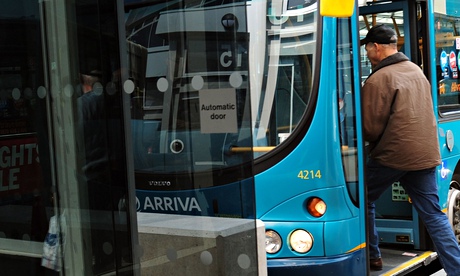
Bus crisis looms as councils cut services ai???at an alarming rateai??i??, campaigners say
Campaign for Better Transport report shows more than 2,000 routes reduced or withdrawn since 2010 as funding has been cu
Bus services are facing a crisis, with many councils cutting bus budgets, according to a report by the CBT. Photograph: Rui Vieira/PA
Half of local authorities in England and Wales are withdrawing or reducing their bus services as a result of funding cuts, according to a report from a public transport campaign group which warns that passengers face a ai???bus crisisai???.
The Campaign for Better Transport (CBT) said that essential local services were being lost ai???at an alarming rateai???, with rural areas worst hit where communities were being cut off as route networks were destroyed by successive cuts.
Its research shows that, since 2010, local authority funding for bus services has been cut by 15% (A?44m) with more than 2,000 routes being reduced or withdrawn. In the present financial year, more than A?9m has been wiped off funding for supported services ai??i?? those subsidised by local authorities because they are not provided by commercial bus companies.
The report, Buses in Crisis, is based on Freedom of Information requests to all 110 local transport authorities in England and Wales. This is the fourth year that the CBT has monitored the impact of cuts to supported bus services in this way.
Martin Abrams, CBT public transport campaigner, said: ai???Across the country, bus services are being lost at an alarming rate. Year on year cuts to budgets mean entire networks have now disappeared, leaving many communities with little public transport and in some cases none at all. We often hear from people with heartbreaking stories, who have been effectively cut off from society following cuts to their bus service.ai???
Half of English local authorities have reduced funding for bus services in 2014/15, with North Yorkshire, Cumbria, Herefordshire, Dorset, Nottinghamshire and Worcestershire making the deepest cuts, the research found.
The overall cut in support for buses in 2014/15 is A?9m, bringing the total reduction since 2010/11 to A?44m ai??i?? a 15% cut. Rural areas have been the worst hit, suffering average budget reductions of 19% this year.
In 2014/15, nearly 500 bus services were cut, altered or withdrawn, bringing the total to more than 2,000 routes since 2010. A total of 22 local authorities slashed more than 10% from their bus funding in 2014/15. Seven local authorities ai??i?? Hartlepool, Stockton-on-Tees, Darlington, Stoke-on-Trent, Luton, Southend-on-Sea and Wrexham ai??i?? now spend nothing on supported bus services.
Among future plans, Derbyshire council is proposing to cut more than A?2.5m from its supported bus funding, which may include bus routes through the Derbyshire Dales constituency of the transport secretary, Patrick McLoughlin.
Protection of local bus services is likely to be a key issue in the general election and Labour recently launched a campaign to improve funding.
Abrams said: ai???Itai??i??s very worrying that further steep cuts in budgets are threatened next year and beyond. The government must wake up to the crisis facing buses and urgently introduce new initiatives which recognize the vital social, economic and environmental role buses play.ai???
The Department for Transport said: ai???We know bus services are vital, including for many older and disabled people. That is why the government provides substantial funding, protected until 2015/16, to bus operators to help more services run and keep ticket prices down. Decisions about bus services are best made locally in partnership between councils and the companies which run the buses.ai???
ai???If you tell a Broadway subway lie big enough and keep repeating it, people will eventually come to believe it. The Broadway subway lie can be maintained only for such time as TransLink, the Board of Trade, the City of Vancouver and the NDP can shield the people from the political, economic and/or negative transit consequences of the Broadway subway lie. It thus becomes vitally important for TransLink, the Board of Trade, the City of Vancouver and the NDP to use all of its powers to repress dissent, for the truth is the mortal enemy of the Broadway subway lie, and thus by extension, the truth is the greatest enemy of TransLink,the Board of Trade, the City of Vancouver and the NDP.ai???
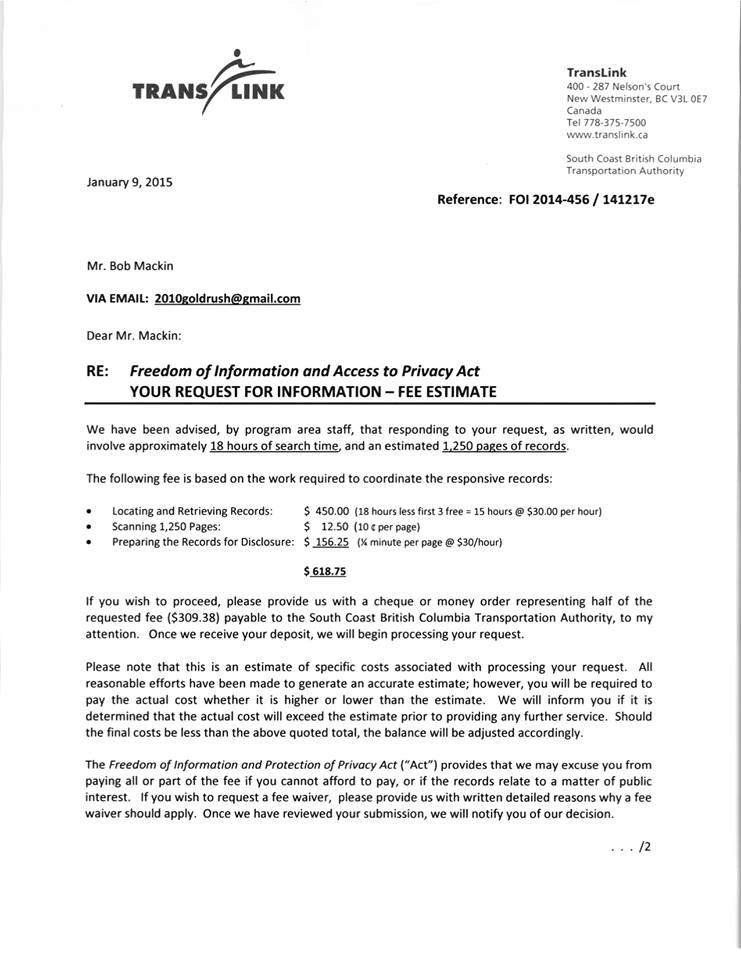
Bob Mackin is a North Vancouver-based journalist who has reported for local, regional, national and international media outlets since he began as a journalist in 199o. On Friday, he posted on Facebook TransLink’s demand for $618.75 for a Freedom of Information request containing 1,250 pages of text regarding planning for the Broadway subway.
But isn’t Broadway subway planning part of a transportation package wish list that is part the proposed $0.05% Provincial Sales Tax increase and that the funding has not been approved as of yet?
Here are some questions that people should ask our regional mayors, for clarity in regards to the TransLink referendum.
Can TransLink show any independent study that shows that subways actually attracts ridership?
Is it true that the Expo Line is currently at capacity carrying 15,000 persons per hour per direction and capacity cannot increase until $2 billion to $3 billion is spent on upgrading the electrics and retrofitting stations including increasing platform length from 80 metres to 120 metres to accommodate longer?
If true, if the current Skytrain is at capacity, then will a Skytrain subway also have the same maximum capacity comparable to the Expo Line?
If true, then would not a SkyTrain subway have less capacity than an at-grade/on-street light rail line?
Is it true that SNC Lavalin is doing transit studies for TransLink?
If true, then is SNC Lavalin in a “conflict of interest” has it holds the engineering patents to the proprietary SkyTrain system?
Is it true, that despite claims to the contrary, TransLink is actively planning for a Broadway subway which will be built, whether the referendum passes or not?
If true, then have the regional mayors have intentionally deceived the electorate over the TransLink referendum?
Then there are the actions of the provincial NDP who are supporting the YES side of the referendum which demand an answer to this question: “Do the provincial NDP condone deception and deceit with the TransLink referendum and in fact are part of the cabal who are secretly planning for a Broadway subway?
The hallmark of the TransLink referendum is deceit and deception by the YES side and a valiant few demanding honest answers on the NO side.
It is sad that at a time where the public needs honest answers and honest debate, they are being bullied by a cabal including big business, property developers, the City of Vancouver and TransLink whose interests are definitely not on the taxpayer’s side.
Slowly, ever slowly, people are beginning to realize that modern LRT is just not a transit mode, but a transit philosophy!
Here lies the difference between LRT and SkyTrain; as SkyTrain or light metro is designed to give fast service between transit hubs forcing transit customers to transfer at least once, if not many more times to complete their journey. LRT is designed to provide cheaper, yet higher quality service on a heavily used transit routes. SkyTrain as a planning oriented accessory for city planning; while light rail is customer oriented and because of this, modern LRT is far more successful in attracting new ridership.
This basic lesson on providing successful transit has not been learned by TransLink and by most mayors and will lead TransLink into a financial morass and one wonders if TransLink can ever do it right.
Ai??Houston new LRT traveling through a water feature.
I’m beginning to see what light rail advocates are talking about.
Last week I was in Portland with my son to see our beloved Toronto Raptors take on the Trail Blazers and although the visitors lost in overtime, I did enjoy the proverbial moral victory when it came to my choice of transportation.
We were staying at a hotel in the northern suburbs, which also happened to be a long block from a TriMet station. I figured rather than fight rush hour traffic on the I-5 and then try to find overpriced parking near the arena, we would take the Yellow Line on Portland’s expansive light rail system. It took 19 minutes, and cost just $3.75 combined, for the train to drop us at the steps of the Moda Center in the city’s Rose Quarter district.
We had a similar experience in San Diego last summer when we rode that city’s light rail network to get to both the USS Midway and to a Padres game at the new downtown ballpark.
The more I see light rail in action, the more it baffles me why transit planners here have been so resistant to embrace this form of transportation.
What struck me about the Portland experience, and what bugs me about the rapid transit situation in Greater Vancouver, is the scope, or lack thereof, of the network. Light rail in the Rose City serves pretty much the entire region, from Hillsboro in the west all the way to Gresham in the east. It stretches from the Columbia River and the airport in the north to Beaverton and Clackamas in the south.
There are four different lines, with a fifth on the way this fall, meaning it doesn’t matter where you live, you’re never too far from a light rail stop.
Contrast that with Greater Vancouver’s SkyTrain network, if you can call it that, which serves a select few areas, leaving all other transit users on buses that must compete with an ever-growing number of single-occupancy vehicles in the region.
SkyTrain is great if you happen to live/work close to a station, but we’re coming up on its 30th anniversary and we’ve only got three lines (a fourth is under construction), which means huge portions of the Lower Mainland, including this one, still don’t have any type of rapid transit.
Given you can build a kilometre of light rail for a fraction of what an elevated train costs, it’s no surprise many cities are turning to at-grade train tracks as a way to move the masses.
In Greater Vancouver, however, we cling to the prohibitively expensive SkyTrain system as we perpetuate a mistake of the past.
An interesting item from China, Beijing’s metro system, despite being one of the world’s busiest, is having funding problems and fares are escalating.
Beijing metro price hike ‘squeezing poor’
7 January 2015
Despite it being one of the biggest and busiest in the world, the Beijing metro is making huge losses and the government is raising fares.
As Martin Patience reports, the move is fuelling concerns about the cost of living in the capital.
http://www.bbc.com/news/world-asia-china-30706228
Is this the shape of things to come with a Broadway subway?
You won’t see the regional mayors commenting on this story, nor will you see the Vancouver Sun publish such a story, but if subways are proving costly to operate in Beijing, will a Broadway subway prove too costly to operate in Vancouver?
As predicted by so many, Seattle’s “Big Dig” to build an auto tunnel to replacing the decrepit stacked Alaskan Way Viaduct, has hit a pipe and stopped.
It seems the entire highway tunnel under Elliot Bay, is sinking into a sinkhole created by political prestige laced with engineering hubris.
Sounds familiar, doesn’t it.
Instead of planning for LRT network that would offer an incentive for drivers to take transit, the road and light-metro lobbies have won and a auto tunnel was born. Well I hope they are happy for their multi-billion dollar ” Big Bertha” tourist attraction under Elliott Bay.
Yikes! It makes the FastFerry fiasco, small potatoes indeed!
Despite a growing number of supporters, such as the business community, the City of Vancouver; most of the regional mayors, the provincial NDP and their combined sundry of shills clamouringAi?? for a SkyTrain Broadway subway, many serious questions remain unanswered. The following op-ed commentary published by The Toronto Star questions whether the concept of building a heavy rail subway to replacing the aging Scarborough light metro amounts to a subway a billion-dollar boondoggle?
The key phrase in the article is; “An expert panel established by city council found an LRT superior to a subway on all counts: funding, economic development, transit service, sustainability and social impact.“
It is strange that the likes of Mayor Greggor Robinson, Geoff Meggs, various business groups and Chamber’s of Commerce have come to an opposite conclusion about a Broadway subway, but then, real transit experts have never been asked.
A no value-for-money case can be made for the Scarborough subway extension, yet Toronto’s Mayor John Tory and Ontario Premier Kathleen Wynne continue to support it.
Back in BC,Ai?? TransLink has not even done such a study for the proposed Broadway SkyTrain subway, yet actual planning is under way.
The Broadway subway could be Vancouver’s billion dollar boondoggle which offers the taxpayer, no value for money, unless the taxpayer is assembling land along Broadway for major development!
By: R. Michael Warren Published on Sat Jan 03 2015
Is the Scarborough subway another billion-dollar boondoggle?
Tory ducks the Scarborough subway controversy by saying the decision has been taken by council. And he doesnai??i??t want to put ai???a stick in the eyeai??? of the Liberal government.
This is political pandering to Scarborough voters and the Wynne Liberals. Tory has neglected to make the case for a three-stop subway link that will cost $3.56 billion (USD $2.02 billion) ai??i?? $1.6 billion (USD $1.35 billion) more than a modern seven-stop light-rail transit line.
Tory chose this political strategy despite knowing that three highly qualified and independent groups had already recommended an LRT.
Metrolinx favoured replacing the aging RT with a modern LRT link that would cost $1.8 billion (USD $1.52 billion).
An expert panel established by city council found an LRT superior to a subway on all counts: funding, economic development, transit service, sustainability and social impact.
The Pembina Institute also supports an LRT for Scarborough. They maintain it would deliver twice as much service for every dollar invested.
By any measure, the subway option shouldnai??i??t even be on the table.
The 30,000 riders per hour subway capacity is overkill.
Peak ridership is expected to grow to only 9,000 by 2031.
The subway option will cost about twice as much and, according to Pembina, attract only 23 million riders a year compared to 31 million for an LRT.
By supporting a subway, Tory is placing a $910-million (USD $772.2 million) tax burden on the shoulders of Toronto taxpayers.
Fully $745 million (USD $632.1 million) of this has to come from a property tax surcharge ai??i?? which amounts to $41 a year (USD $34.79) for 30 years for the average homeowner.
Thatai??i??s on top of the tax hikes that will inevitably flow from the rest of Toryai??i??s election agenda.
But when it comes to Toryai??i??s own SmartTrack plan, he stresses it will not burden local taxpayers and must go through a rigorous examination process.
He said recently, ai???The express purpose of what weai??i??re doing here is to move forward with a fact-based, transparent process.ai???
This begs the question: why does SmartTrack get a comprehensive ai???fact-basedai??? analysis while the Scarborough subway doesnai??i??t?
Part of the answer rests with Wynne, who backed the subway option in an effort to win seats in vote-rich Scarborough.
Tory went along in pursuit of Liberal support for his mayoralty bid and for future favours.
Wynne compromised sound transit planning while chasing the 2013 byelection seat in Scarborough-Guildwood and more recently in the June provincial election.
She committed the $1.4 billion (USD $1.18 billion), originally meant for an LRT, to the subway link, knowing it was not the best financial or operating option.
During the last election Wynne promised all future transit infrastructure investments would be based on ai???rigorous business case analysis.ai???
She still hasnai??i??t explained why this decision-making process isnai??i??t being applied to the Scarborough transit link.
Her political strategy worked.
The Liberals won all five Scarborough seats.
But if the subway link is built, these seats will cost taxpayers an additional $1.6 billion (USD $1.35 billion) and saddle Scarborough with a transit solution thatai??i??s inferior to an LRT.
Does all this have a familiar ring?
Surely by now Wynne has developed the ability to see a billion-dollar boondoggle coming down the track.
Building a subway extension into Scarborough has all the hallmarks of a spending scandal.
Itai??i??s unlikely that Wynne or Tory will still be around for the opening in 2023.
But tax-weary Toronto and provincial voters will be.
And by then theyai??i??ll still be paying for an overbuilt and underused transit white elephant.
Thereai??i??s still time for Wynne and Tory to put the Scarborough transit link through the same rigorous value-for-money analysis they say is being applied to every other transit investment.
It would go a long way toward showing theyai??i??re serious about making transit decisions based on costs and benefits rather than wasting money on parochial politics.
R. Michael Warren is a former corporate director, Ontario deputy minister, TTC chief general manager and Canada Post CEO. r.michael.warren@gmail.com
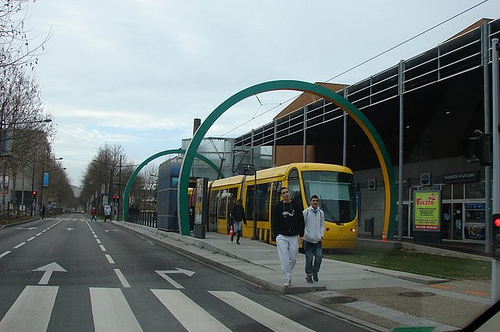
 Chaleroi light-metro station – Too expensive to complete and never used!
I had some time on the road and redid the calculations (attached) in Excel based on the latest ridership data reported by TransLink.Ai?? It checks with the 14% of the population taking transit in 2011 and reported by TransLink.Ai?? Many students make more than two trips daily, and I used two trips daily.Ai?? This gives the most optimistic prediction of the number of people taking transit.


 But isn’t Broadway subway planning part of a transportation package wish list that is part the proposed $0.05% Provincial Sales Tax increase and that the funding has not been approved as of yet?
 Houston new LRT traveling through a water feature.





Recent Comments