Conundrum! A No Means Yes!
 A “YES” vote in the upcoming TransLink referendum will probably increase
the cost per revenue passenger as the transit system seems to have a hard
time attracting new ridership, especially the motorist from the car!
Conundrum!
I am not going to make this blog, home central for a “No” vote in the upcoming TransLink referendum, but it is hard, as the only local transit news will be about the referendum!
The Vancouver Sun’s Don Cayo inked a piece “Hold your nose and vote Yes to the transit tax” which completely misses the mark.
There is something wrong with TransLink and throwing more money at this ponderous beast will not solve regional congestion nor attract much new ridership, what more money will do is increase an already bloated bureaucracy within TransLink and continue planning and building with hugely expensive SkyTrain, mostly in hugely expensive subways.
I am deeply saddened by the NDP’s tacit support for the referendum, as it seems NDP John Horgan has lost control of the party which is now seen taking its direction from likes of Geoff Meggs, Dix, and an assorted number of yesterday’s people. With great distress, it seems that the NDP’s transit and transportation policies are ensnared in the same Bombardier/SNC Lavalin web as the BC Liberals. The support of the referendum will come back to haunt them in 2017.
The Vancouver Sun of course, is fully wedded to the SkyTrain model, will repeat TransLink exaggerations ad nauseum, pretending it to be good journalism.
So, what does the referendum mean for the Rail for the Valley group?
The answer is simple as the referendum is nothing more than TransLink not looking out of the box and continuing with its expensive transit planning, which in the past has done little to alleviate congestion and all of the sundry of associated problems.
In the strange world of BC transit politics, the Rail for the Valley interurban project has a better chance to succeed with a “NO” vote than a “YES” vote!
Some New Year’s Reading – Eric Chris’s Six Facts About Hub to Hub Transport
Eric Chris is an Australian professional engineer with a masterai??i??s degree in chemical engineering and has been living in Vancouver near UBC on the 99 B-Line route for the last 16 years.Ai?? He works in the hydrocarbon industry as a design engineer for his entire career.Ai?? His masterai??i??s thesis was on real time air dispersion modeling of SO2 from coal fired electrical power stations.Ai?? He is also an active supporter of Greenpeace and the Green party.Ai?? It is fair to say that heAi?? understands environmental and technical issues quite well.Ai?? Eric also graduated top in his class in finance in engineering and occasionally looks at transit holistically to see what solution might balance the engineering, financial, social and environmental considerations.Ai??
What is the problem with transport in Metro Vancouver?Ai?? It is hub to hub transport by TransLink, in my opinion.
I think Eric Chris is someone to listen to, unfortunately too many local politicians and bureaucrats remain blind deaf and dumb, with local transit issues and firmly believe that the more money one throws at transit the better it will become.
Preamble
Clean house at Translink.
Remove the entire board and start over…with a different attitude.
And don’t forget…when we talk Translink…we are also talking B.C. government hiding under their desks.December 21, 2014http://metronews.ca/news/
vancouver/1245427/video- canada-line-fire-in-richmond- delays-passengers-prompts- investigation/ Dear Greg Moore et al,Are you refusing to offer an explanation for TransLinkai??i??s fraudulent study claiming that s-train has more passenger capacity than LRT (refer to the trailing email dated November 23, 2014) in order to pursue more funding for TransLink, rather than bring the house of cards crashing down at TransLink?Ai?? This supposed study forms the basis for the subway to UBC.Ai?? It is being used to bilk taxpayers of billions of dollars to drive up the cost of transit for certain firms and individuals, benefiting from hub to hub transport by TransLink.
December 21, 2014TransLink moves forward with Broadway subway design work, cost estimates
ai???Greg Moore, Port Coquitlam mayor and chairman of Metro Vancouver, said in a statement civic authorities will be launching an information campaign to let voters know about the upcoming vote.ai???
http://vancouver.24hrs.ca/
2014/12/18/province-sets-date- for-referendum Your information campaign to educate the mostly brainwashed and unformed public about hub to hub transport by TransLink is an excellent idea.Ai?? I think that it is important to present all the facts to taxpayers for taxpayers and transit users to make informed decisions, too.Ai?? As part of the information packet to go along with the voting card, Iai??i??d like to present the following ai???six factsai??? for you to include with the voting card.
Unfortunately, my time is being squeezing by the holidays and one of the ai???germai??? carrying s-train users at work came in sick, spreading his fleas to make everyone else in the office sick, too.Ai?? I guess that you could say, transit users in the Lower Mainland are an occupational hazard.Ai?? Iai??i??m not able to spend as much time on this email as Iai??i??d like.Ai?? Maybe TransLink can fumigate its germ infested transit buses more in the winter to cut down on the number of bug carrying transit users in the Lower Mainland.Ai?? Here are some facts about transit so that you donai??i??t inadvertently mislead voters in your ai???information campaignai???:
ai???Fact 1 ai??i?? TransLink is drowning in tax revenueai???
As Figure 4-9 shows, TransLink spends at least 33% more per revenue passenger than any other transit organization in Canada. For every dollar collected from transit users, TransLink spends three dollars.Ai??Ai?? Seattle just across the border in Washington State has about twice the population of Vancouver and about one-half the operating budget for transit.Ai?? That is, what we require in Metro Vancouver is to get rid of the cockroaches sliming us at TransLink and not a campaign to fund transit further.Ai?? TransLink is already grossly overfunded and has a stupendous budget for transit.Ai?? Donai??i??t forget to mention that TransLink presently receives too much funding and canai??i??t control spending.Ai?? Okay?
www.caw111.com/
TranslinkEfficiencyReview- Mar2012.pdf ai???Fact 2 ai??i?? Express hub to hub b-line service retards transit growthai???
Starting in about 2007, an inflection point in transit use can be seen in Figure 5-2 for conventional transit (express and regular bus service).Ai?? In other words, as TransLink has added more hub to hub transport (express b-line diesel bus service hours) to regular trolleybus and other transit routes, transit growth has slowed and fallen.Ai?? What this tells me is that the product (express b-line service) increases service hours (transit costs) without adding more transit users and there is currently too much express b-line diesel bus service in Metro Vancouver, particularly during off-peak hours until about 2:30 am to UBC every day of the week, including holidays, for instance.Ai?? TransLink is planning to add 11 more express b-line diesel bus routes with its funding request.Ai?? Express b-line service is not attracting new riders but it does facilitate the transportation of students to the s-train lines to bolster ridership on the s-train network.Ai?? While many commuters avoid the s-train network out of fear for their safety, students traveling in packs are able to tough it out to hold their own against the creeps stalking riders on the s-train network during peak and off-peak hours.
http://translinkharassment.
wordpress.com/2014/12/08/ wandering-hands-32f/ Express b-line diesel bus routes are increasing overall transit costs.Ai?? They are degrading the air quality.Ai?? Nevertheless, TransLink is exempt from doing an environmental and social impact assessment.Ai?? Before TransLink puts another soot blowing and noisy express diesel bus on the roads, Iai??i??d suggest that TransLink be required to perform an environmental and social impact assessment – just as all other major toxic ai???pollutersai??? are required to do.Ai??Ai?? Honesty is the best policy.Ai?? Donai??i??t forget to mention that more express b-line service is going to increase transit costs and retard transit growth.Ai?? Alright?
www.caw111.com/
TranslinkEfficiencyReview- Mar2012.pdf ai???Fact 3 ai??i?? Transit is for losers and executives at TransLink receive a driving allowanceai???
Even the CEO of TransLink, Ian Jarvis drives to his office and hub to hub transit by TransLink is a complete failure.Ai?? According to Colleen Brennan who is VP of Communications (euphemism for VP of Propaganda) at TransLink, Ian Jarvis and the other six executives at TransLink are required to drive.Ai?? TransLink executives need cars to get to their ai???important meetingsai???, says Colleen.Ai?? So, taxpayers are paying each of them up to $1,304 monthly to drive to meetings, according to Colleen of TransLink.Ai?? The response of the transit user being told this at the end of the story in the subsequent video is classic, ai???executives ehai????Ai??
Is the gas guzzling Mercedes Benz SUV in the above picture (license number 184-XHE) Ian Jarvisai??i???Ai??Ai?? Honestly, arenai??i??t the TransLink executives driving at TransLink to avoid hub to hub transit (s-train and b-line)?Ai?? Ian Jarvis could easily ride s-train to veg-out in his office and take a cab to his important meetings in Metro Vancouver, instead, if hub to hub transport were not garbage.Ai?? Colleen is taking us for fools with her lame excuse that executives canai??i??t use transit.Ai?? They can travel on transit but it takes much longer, is riddled with crime and is plagued with creeps.
Maybe we are the fools that Colleen makes us out to be.Ai?? That is, Colleen of TransLink is admitting publically that hub to hub transit (s-train and b-line service) is not an alternative to point to point transport, such as cars or trams approaching point to point transport; yet, many individuals are ready to blindly take the leap to throw away more money to fund hub to hub transit by TransLink based on the incorrect assumption that it is an alternative to driving.Ai?? By the way, TransLink doesnai??i??t seem to know how many people take transit and says that 500,000 people (an astounding one in five people in the Lower Mainland) take transit daily in the video.Ai?? Unless TransLink can bend time, transit users canai??i??t be on transit ai???to and fromai??? home at the same time and only about 250,000 people take transit daily.Ai?? Donai??i??t forget to mention that hub to hub transit by TransLink is for losers who donai??i??t receive a parking allowance and stall to drive.Ai?? Okay?
ai???Fact 4 ai??i?? Road congestion drops without transit buses on the roadsai???
Ever wonder how TransLink has avoided another strike since 2001 despite the animosity that the bus union holds towards the overpaid deadbeats managing TransLink?Ai??Ai?? Well, part of it is that road congestion drops without hub to hub transit (during the transit strike in 2001, road congestion dropped without the diesel buses clogging the roads).Ai?? So, the bus union doesnai??i??t dare go on strike again to remind everyone of this.Ai?? Donai??i??t forget to mention that not having transit reduces road congestion.Ai?? Okay?
ai???Fact 5 ai??i?? Driving is Greener than transit.Ai?? Gulp.ai???
During the 2001 transit strike, without the soot blowing and noisy diesel buses wreaking havoc in neighbourhoods, birds were singing and the air quality in Vancouver improved ai??i?? based on GVRD data.Ai??Ai?? In other words, driving is Greener than hub to hub transit (in the 2001 transit strike without the diesel buses and more people carpooling, carbon emissions dropped, too).Ai?? Donai??i??t forget to mention that funding transit degrades the air quality and increases carbon emissions.Ai?? Okay?
ai???Fact 6 ai??i?? Transit ridership is down and we are going backwards with hub to hub transitai???
Transit ridership is down.Ai?? That is, driving is up.Ai?? Reporters working for the major newspapers (Vancouver Sun, mainly) over the last 16 years have kept repeating the same propaganda from TransLink that hub to hub transport is a success reducing road congestion (it isnai??i??t) and have brainwashed most everyone into thinking that overpriced hub to hub transit by TransLink is actually doing some good.Ai?? TransLink is your typical government organization where incompetence and waste are rewarded with more funding. TransLink spends many times what it has to spend and just passes on its blunders onto taxpayers.Ai?? Nothing that TransLink claims as a success is verifiable and is typically paid for by TransLink.Ai?? Funding for transit is not tied to performance and we are just funding TransLink to keep everyone costing $45 million annually in salaries at TransLink employed.
After the billions of dollars spent over the last 16 years on hub to hub transport by TransLink (Millennium Line and subway on Cambie Street) in Vancouver, transit ridership is no better than if we had not spent all the money wasted by TransLink.Ai?? Only almost free transit passes to students for unlimited travel anywhere in Metro Vancouver has gotten students to make more trips on transit to offset the number of people abandoning transit.Ai?? I have never seen a story on it except by Global TV or by CBC.Ai?? Unless you watch Global TV or rely on the CBC for your news, youai??i??re not getting the whole picture about what hub to hub public transit by TransLink is ai??i?? a flop.Ai?? As the following and current article from the Institution of Engineers Australia relates, smart roads and cars are set to make hub to hub public transit obsolete or extinct.
Weai??i??re being told by TransLink to rush out and build frightfully expensive hub to hub public transport which hasnai??i??t been effective over the last 16 years and has even less promise of being effective in the next 16 years.Ai?? Itai??i??s just crazy and stupid.
We can live with more cars on the roads.Ai?? Smart roads and cars allow us to get more out of the ai???existing road infrastructureai??? without adding very expensive hub to hub public transit infrastructure which doesnai??i??t appeal to most commuters and is an added expense to maintain.
http://globalnews.ca/video/
1733412/translink-ridership- down There is plenty of proof over the last two decades that hub to hub transport by TransLink is merely a ploy for businesses to make money from building the concrete intensive s-train lines and concrete intensive condos along the s-train lines ai??i?? resulting not only in the mining of the oceans for sand used to produce concrete and the destruction of aquatic ecosystems but also the release of massive amounts of CO2 in the production and use of concrete.
Families are fleeing overpriced and undersized condo slums along hub to hub transport in Vancouver for greener pastures in the suburbs to raise families and then drive into Vancouver for work, increasing road congestion, carbon emissions and air pollution. We are being suckered by TransLink controlling the communications.Ai?? Newspapers benefiting from their golden goose (TransLink) bribing them with massive ai???advertising-revenueai??? are complicit in the hoax that transit is being pursued to reduce road congestion, carbon emissions and air pollution. It isnai??i??t.Ai?? Taking transit in cold climate Canada is a hardship and if you donai??i??t have to take transit, you donai??i??t.
Even if TransLink is truly pursuing overly expensive hub to hub transit to curb road congestion, carbon emissions and air pollution rather than to move people who canai??i??t or wonai??i??t take responsibility for their lives and travel, hub to hub transport is simply ineffective in getting drivers to not drive.Ai?? Drivers demand safe and convenient point to point transport.Ai?? Inconvenient and relatively unsafe hub to hub transport (s-train and b-line) by TransLink fails to deliver.Ai?? If enough people do not receive the correct information on the hub to hub transit sham by TransLink – in 10 years after the fraudsters at TransLink have had a good laugh and have spent $7.5 billion on more hub to hub transport, weai??i??ll be no better off than we are today.
Can TransLink offer any proof that its very expensive hub to hub transport (s-train and b-line) is effective in the reduction of road congestion, carbon emissions and air pollution?Ai?? No.
Make sure to mention that funding for more hub to hub transport by TransLink will reduce transit use and increase driving.Ai?? Okay?
If you make voters aware of these six facts, I donai??i??t see TransLink getting any more funding, do you?Ai?? Iai??i??m not against transit.Ai?? Iai??i??m against being swindled by the shady individuals at TransLink.Ai?? Get rid of TransLink and put competent electrical and mechanical engineers in charge of transit with the mandate to provide economical and safe transit reducing pollution.Ai??
Anyhow, thatai??i??s it for 2014.Ai?? Even if what I wrote doesnai??i??t impress you, maybe some of the journalists copied will start to report on the facts for a change in 2015.

An Innsbruck Christmas

Merry Christmas
A very merry Christmas from Rail for the Valley!
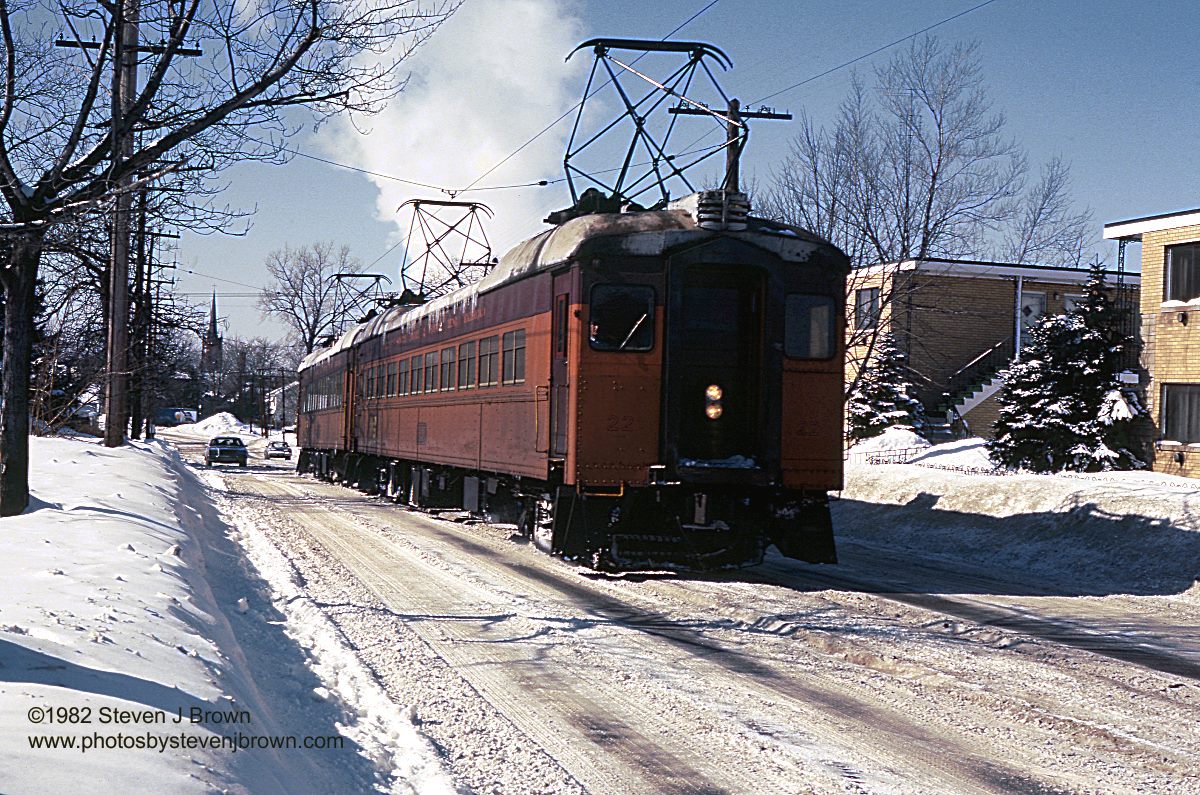
A South Shore Interurban in the snow in Michigan City.
Thirty-two years later, the South Shore Interurban still trundles the route daily.
Complete Street the French Way
Complete Streets: From Policy to Implementation
How the French Blend Light Rail and Complete Streets for Total Accessibility
A PowerPoint presentation from Rail~Volution Minneapolis, 22 September 2014
by Greg Thompson . Tom Larwin . Tom Parkinson
ofAi?? the Transportation Research Board SubcommitteeAi?? on International Light Rail Development
Since 1985 when the first modern tram line opened in France 56 additional lines have opened in 33 provincial cities and various part of the Paris region carrying in aggregate well over three million passengers per day.*Ai?? Almost all of these passengers become pedestrians on at least one end of their daily trips, and most do so on both ends and places where they transfer from one line to another or change modes.
The French approach for accomplishing these results has 2 major steps.Ai?? The first step is schematic.Ai?? Planners conceptualize a multi-modal transit network. The schematicai??i??s conceptual geography must make sense in terms of satisfying peopleai??i??s travel needs.
Complete Streets French Light Rail

After Intense Pressure From the Provincial Government……………..
The following is part of an article, The direction of TTC planning in the 1980’s, by Philip Webb, which appeared in the December 1983 edition of Modern Tramway and Light Rail Transit.
By 1983, the UDTC knew that the ICTS/ALRT system could not offer the capacity as advertised. The ICTS/ALRT proprietary transit system did not have an advantage over the then new LRT mode and was “up to ten times more to install than a conventional LRT line”.
BC Transit, which always claimed that the maximum capacity of a MK.1 car was 100 persons, and now TransLink, which claims a capacity of 80 persons per car, have been accused in the past of inflating ridership numbers by basing their guesstimates on the higher capacity numbers claimed by the UTDC, which were then known to be false!
Oh what tangled webs we weave………………
Also of interest is the claim that Toronto’s Bloor-Dartmouth streetcar line, using coupled sets of PCC cars could carry, “12,000 pphpd at times“, more than ICTS and in a age before the modern articulated tram The Bloor Dartmouth Line was made into a subway, opening in 1966.
 30 second headways or less on the old Bloor tram line!


Modern Trams – from the US Point of View
From a recent issue of the US magazine Trains ai??i?? is an article which is uploaded to the web:
ai???Modern streetcars take back US citiesai???
ai??i?? ai???A Streetcar named Revivalai???.
Modern Streetcars in US cities (2)
andAi?? TheStreetcarRenaissance

Canada Line Train Catches Fire

The fire was on the Canada Line, which isn’t SkyTrain. For those who are not in the know, the SkyTrain system cars are powered by Linear Induction Motors or LIM’s and the Canada Line cars are powered by “squirrel cage” electric motors.
Much of Canada Line down
By DAN FUMANO, The Province December 20, 2014
Much of the Canada Line is down after a SkyTrain caught fire.
Photograph by: Submitted, Robin Leung
Electrical problems on the Canada Line caused sparks, smoke and delays Saturday afternoon in Richmond.
TransLink released a statement around 3:30 p.m., advising there was no train service between Richmond-Brighouse Station and Aberdeen Station due to a ai???problem train.ai???
By the time of the announcement, shuttle buses were in place, running between Brighouse and Bridgeport Stations.
An hour later, an update from TransLink said: ai???An investigation is ongoing. Early findings indicate that there was an electrical fault. We will know more after a full investigation.ai???
Videos and photos taken at the scene showed smoke rising from the train and bright sparks shooting from the track underneath, while it appears passengers move around the train cars.
Canada Line passenger Kevin Snaden said the ai???train smelled like smokeai??? when he and other passengers were told to disembark at Aberdeen Station.
Snaden, a 29-year-old visiting from Calgary, said: ai???Two fire trucks, ambulance and police cars were there very quickly.ai???
Canada Line service was operating as usual between the Airport and Waterfront Stations.
TransLinkai??i??s statement said: ai???We advise customers to plan for extra travel time this afternoon and we thank everyone for their patience.ai???
– Were you aboard this Canada Line train Saturday afternoon? The Province would like to hear from you ai??i?? please reach us at provweb@theprovince.com
(Video courtesy of Twitter user @markrobinsonyvr)

A trip down memory lane
The shape of things that never were; a model of an articulated UTDC ALRT vehicle.

An advert for ALRT, circa 1983. Sadly for Diane Edgecomb, the Detroit ICTS has been nothing more than a curiosity, which quickly earned the name the “Mugger Mover”.
Notice that the gap between the two MK.1’s have been ‘photo shopped’ to make them appear as one car, in order to compete with the emerging articulated light rail vehicles. Already, the management at the UTDC were aware that SkyTrain’s small cars were a disadvantage to sales.

Oh, what fools we mortals be
In charge of our of our Metro band,
Moonbeam is here at hand,
With a higher PST, mistook by me,
While pleading for a congestion fee.
Shall we their fond referendum see?
Lord, what fools these mortals be!

Apologies to the bard!
The regional mayors who support a $0.5% increase to fund TransLink have shown their utter ignorance of transit issues by calling the upcoming Transit referendum the “Metro Vancouver congestion improvement tax.“
Ha, ha, ha, because the fools that coined this phrase are utterly incompetent because the only way to reduce congestion is to reduce road space. The name is an oxymoron but the mayors are too clueless to understand this.
What this tax should be called is the “TransLink Executive Bonus Tax“, or the “Mayor Moonbeam Subway Tax“; because a transitAi?? improvement tax, it is not.



Recent Comments