Arbutus Fail and Other Transit Thoughts
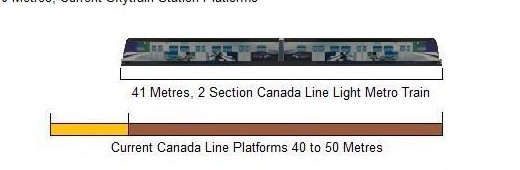 Contrary to TransLink’s claims, the Canada line
has 40m to 50m long station platforms, which severely limits capacity.
In today’s Sun, there is an article by Pete McMartin, bemoaning the current state of the Arbutus Corridor debate.
What the Vancouver Sun and the City of Vancouver are dancing around, yet never mention is that that the Arbutus corridor should be used for transit, particularly light rail transit. $100 million for 11 km of rights-of-way is a steal, when one compares it with the cost of $$200 million plus, for 1 km. of subway construction!
By promoting transit use for the Arbutus corridor, would make the Sun, TransLink and the city of Vancouver admit that the $2.5 billion Canada Line was built with extremely limited capacity 9for a metro) and the cost to upgrade the Canada line so it could carry as many people as a simple streetcar line would be in excess of $1 billion!Metro Vancouver, the formerly named GVRD, should purchase the Arbutus corridor, build LRT from downtown Vancouver to Steveston and Ironwood Mall (the CNR R-o-W in Richmond is up for sale for $65 million) and hire a private operator to operate it and ignore TransLink all together.
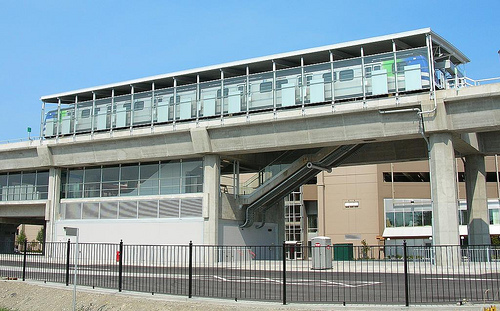 Bridgeport Station, badly located and not designed for customer comport.
The photo clearly shows the small Canada Line stations.
For public transit to be successful, it must be user friendly, but recent experiences using transit have proven otherwise. Taking transit on purpose three times this summer, found the transit service greatly underwhelming. The forced transfer from the Canada line to South Fraser suburban buses, is just plain stupid, especially at weekends, where many services run at 30 minute headway’s. The transfer station at “Casino Junction” (Bridgeport Station) is hard to use and damn cold, in non summer months.
If the current transit operations is the best that TransLink can do, all I can say it is time for regime change.
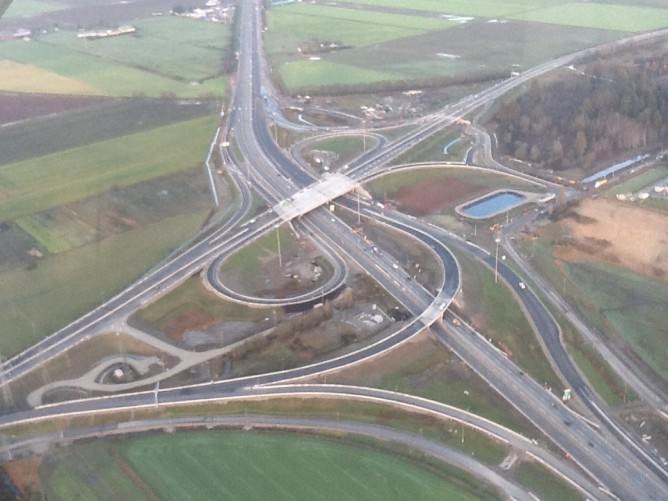 The SFPR (Hwy 17) junction with Hwy 99. Lots of overpasses, but poorly designed
and dangerous for commercial vehicles.
The multi billion dollar South Fraser Perimeter Road is nothing but high farce; poorly designed and poorly sign posted, the SFPR only shows how incompetent our current provincial Ministry of Transportation is. Designed as a speedy truck route from the Delta Super Port, East up the Fraser Valley, the SFPR is largely avoided by truckers by it’s ill design, especially at important junctions where roll-overs are common.
Added to this gross incompetence, getting on or off the SFPR from Hwy. 99 or any major junction by the uninitiated, is akin to a Mensa test; fail and you are off to destinations unknown. More and more, BC’s Ministry of Transportation is nothing more than a repository for people who could not get jobs in the real world.
More and more it seems the SFPR is nothing more than a taxpayer paid sop to the McQuarie group, who owns the South Fraser Docks and wants the province to dredge the Fraser and replace the Massey Tunnel, so it can bring Panama Max bulk carriers up the Fraser to load American coal bound for South Asia.
The World’s Busiest Metro Systems And Then There Is Broadway
The world’s busiest metro’s, mostly operating in subways, in an ascending order.
By comparison, the 68.6 km. SkyTrain mini-metro system carries a mere 361,500 passenger a day and TransLink’s ridership numbers are guesstimates with actual ridership about 10% to 15% lower.
BC’s population is now just over 4.61 million and all the below metro systems, except for Paris and Mexico city carry more than the entire population of BC daily! Seoul’s metro system carries more customers than the combined population of BC, Alberta, and Saskatchewan!
The proposed Broadway subway is a mere pygmy when compared to the great metro systems elsewhere and the small comparative ridership will mean massive subsidies will have to made to operate the subway and the monies for those subsidies will have to come from other areas of TransLink’s fragile transit system; most likely south of the Fraser..
Ai?? Broadway, just does not have the ridership or potential ridership
to justify a $3 billion+ subway.
Paris
Daily ridership: 4.2 million
The oldest metro system to appear on this list, the Paris MAi??tro opened in the year 1900, and has today grown to include more than 300 stations across the great French city. The least expensive single ride ticket for the Paris subway, which allows you to travel one zone of the massive system, costs about $2.43.
Mexico City
Daily ridership: 4.4 million
Only one other North American metro system can claim to be busier than that of Mexico City, where 12 lines service nearly 200 stations across the metropolis of the sprawling town. A single fare ticket onboard the Mexico City Metro costs five pesos, which, for a Canadian rider visiting Mexico, would be a steal. Five pesos equals about 42 cents, making the subway in Mexico City among the world’s least expensive rides.
Hong Kong
Daily ridership: 5.2 million
Hong Kong’s rapid transit system has only been open since 1979 — for reference: the CN Tower was completed in 1976 — yet it has already grown to include some 218 km of track, stretching to more than 150 stations. Hong Kong may be a pricy place to live, but public transit use is reasonably priced. A full day pass aboard the MTR costs less than $8.
New York
Daily ridership: 5.5 million
North America’s busiest subway system is also surely the continent’s most notable. In the Big Apple, 5.5 million riders churn through the famous metro turnstiles each weekday; even on weekends, nearly six million total riders use the subway each Saturday and Sunday in New York City. A single ride ticket on the New York metro costs $2.75 as a base fare.
Guangzhou
Daily ridership: 5.6 million
The first of three Chinese entrants on this list, the Guangzhou Metro is a baby in the metro world. The system opened in 1997 — even in Quebec it couldn’t yet legally order a beer — though despite its young age the transit outfit has ballooned to meet demand. Already busier than the metro systems in major cities like New York, London and Paris, the Guangzhou Metro, where the minimum single ride fare amounts to just 36 cents, accommodates annual ridership in excess of two billion.
Tokyo
Daily ridership: 6.4 million
The oldest of all the Asian metro systems to appear here, Tokyo’s subway opened in 1927 and has undergone countless extensions, the latest in 2008. Now there are some 180 stations in service in the Japanese capital, covering nearly 200 km of track. The minimum single ride fare on the Tokyo Metro comes to about $1.75.
Moscow
Daily ridership: 6.7 million
Europe’s busiest metro is not in Paris, nor is it in London or Berlin. Instead, Moscow reigns subway supreme, boasting 6.7 million daily riders (on one record-setting day in 2012, some 9.3 million riders passed through the system’s turnstiles). A single ride on Moscow’s subway comes cheap; the minimum fare comes to about $1.17 per ticket.
Shanghai
Daily ridership: 6.9 million
The largest metro system on this list by a wide margin, Shanghai’s metro snakes through the Chinese city with an incredible reach. With track length of 538 km, Shanghai’s subway system is more than double that of Paris, and more than 70 km longer than the second-largest metro system in the world. A full day pass on the Shanghai Metro costs just $3.25, nearly the single ride cost of subway fare in Toronto.
Beijing
Daily ridership: 9.75 million
A massive jump in daily ridership from third to second place on this list, Beijing’s metro system boasts nearly 10 million customers per day, a 42 per cent hike over the numbers aboard the Shanghai Metro, featured on the previous slide of this gallery. The Beijing Subway is huge — in total, there are 19 subway lines in its network — and incredibly cheap to ride. The base single ride fare works out to just 36 cents.
Seoul
The world’s busiest metro system is not the largest (that would be the Shanghai Metro, at 538 km of track length), nor does it have the most total stations (that would be New York City, with 421). Yet Seoul’s subway is always packed, featuring nearly 10 million daily riders and annual ridership of some 2.6 billion. A base single ride fare onboard the Seoul Subway costs $1.23.
Four Years Since the Release of the Leewood Study and the Silence is Deafening!

It now has been four years since the historic release of the Leewood/Rail for the Valley report, yet except for sparse political support, very few people actually know that the study exists, let alone that it is “shovel ready”.
The Leewood study is just too simple, too cheap, and too practical compared to other politically inspired transit initiatives now blundering along, such as the ever shrinkingAi?? Broadway subway.
The monies invested in the yet unworkable Compass Card, now exceed $250 million, which is about one half the of a BASIC diesel LRT service from Chilliwack to Scott Road or about one quarter the cost of a Vancouver to Chilliwack interurban!
The $500 million for the leaky retractable roof over BC Place could have funded the entire Scott Road to Chilliwack Diesel LRT or even fund about two thirds the cost of an hourly Vancouver to Chilliwack DMU!
The November civic elections, now going to be held every four years, is a very good time to quiz candidates about their knowledge on urban transit and remedies to the ever increasing traffic congestion in the Fraser Valley, because if we do not get transit savvy politicians elected on the various councils, better transit will be delayed by at least four more years.
Groundbreaking report on Interurban light rail
The Rail for the Valley/Leewood study is indeed historic, for it is the first time in over 30 years that a truly independent transit study, free of political and bureaucratic influence, has been done in the region. The study shows that the region can build a large ai???railai??i?? network cheaply, with an affordable vision for future, cost effective extensions.
SkyTrainai??i??s Achilles heel is cost and when one compares the per kilometer cost of the RftV TramTrain and SkyTrain, a full build TramTrain is less than 10% the cost per km. to build than SkyTrain light metro.
Click here to download the full 84 page report
Being affordable to build, enables TramTrain to penetrate to areas, that would otherwise remain unserved by ai???railai???. The ai???densityai??i?? argument, used successfully by TransLink and the provincial government to deter ai??i??railai??? expansion South of the Fraser, disappears as TramTrain easily uses existing railway lines, without any any need for expensive ai???greenfieldsai??i?? construction (like using the median of the Number 1 Hwy.). If on-street operation is desired in town centres, TramTrain can play the role of a streetcar or LRT, yet retaining the ability of cost effective operation to widely spaced population centres using existing rail lines.
The Evergreen Line has demonstrated that funding for SkyTrain is becoming harder and harder and if we look at the ai???full buildai??i?? RftV/Leewood Study, a Vancouver/Richmond to Rosedale TramTrain would cost less than one billion dollars or put another way, for the over $1.4 billion Evergreen line, we could build the ai???full buildai??i?? TramTrain, plus a Vancouver to Port Moody TramTrain service as well! More rail service, servicing more customer destinations, is the best recipe for achieving a true modal shift from car to transit.
One hopes that the ai???powers that beai??i?? understand that planning for expensive, ai???pie in the skyai??i?? metro is becoming a fools game as there is just not the money to fund such grandiose schemes and in todays economy, TramTrain becomes a most viable option. The RftV/Leewood Study paves the way for a real and cost effective alternative for transit expansion in the METRO and Fraser Valley Regions and one hoped that the politicians will jump on board TramTrain, lest they be left at the station platform, waiting for a SkyTrain that will never come.

The Arbutus Saga Continues
Not much transit news about with the school strike and the lead up to the November civic elections, but old news is still news.
The CPR want $100 million for the land and the City of Vancouver wants to pay only $20 million, yet $100 million is a bargain if one wants the land for a transit corridor, considering the cost per km. for a subway starts at about $200 million.
Metro Vancouver (GVRD) should by the land and put an end to this nonsense once and for all and use it for a tram service.
Memo to the CPR: Why not run a DMU service from New West Minster to Vainer Park on the line. a 30 minute service with a pair of GTW’s or alike would be feasible without doubling the track and you may even get a subsidy from metro Vancouver and/or TransLink.
Memo to gardeners using the Arbutus: If the city or metro Vancouver pay for the Arbutus, kiss goodbye any thought of using he land for truck gardens. You best have a plan B and use it.
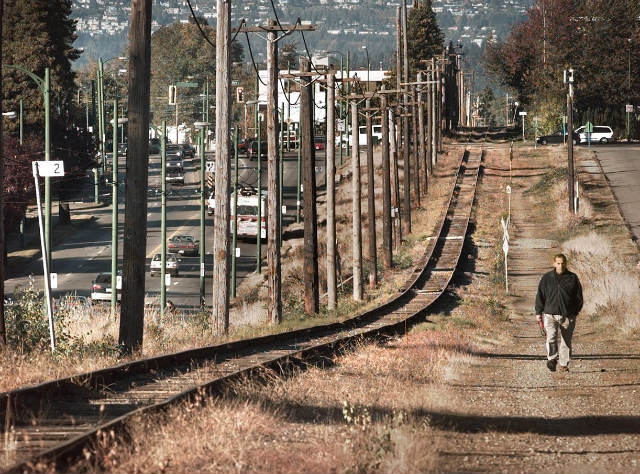
Arbutus Corridor talks break down, CP to resume clearing work on rail line
By Jeff Lee, Vancouver SunSeptember 12, 2014 3:32 PM
Resident Sarah Myambo watches as workers remove her community garden from a stretch of abandoned CP Rail line in Vancouver, B.C., on Thursday August 14, 2014. The once-abandoned 11-kilometre-long Arbutus Corridor has been used by residents for many years as a greenway where community gardens were erected. The removal of the gardens is the culmination of a growing dispute between the rail company and the City of Vancouver over the value of the land.
Photograph by: Darryl Dyck, THE CANADIAN PRESS
VANCOUVER ai??i?? Negotiations between the City of Vancouver and Canadian Pacific over the future of the Arbutus Corridor have broken down, the railway said Friday.
As a result, CP will resume work to return the 11-kilometre line to operating standards.
In a statement CP said it had met with the city earlier Friday to discuss the future of the line and to explore “a number of options to reach a fair market settlement” but was unable to get the city to move significantly on its offer.
It had agreed earlier to suspend line-clearing work, including the removal of gardens encroaching on its right-of-way.
“Despite exploring a number of options to reach a fair market settlement, the parties were unable to arrive at an agreement,” CP said in the statement.
“CP remains extremely disappointed that the City of Vancouver continues to significantly undervalue this corridor.”
Mayor Gregor Robertson’s office said he was unhappy with the breakdown in negotiations and still believes the railway is using the threat of returning the line to operating status as a way to pressure the city to pay more.
Vancouver, which won a Supreme Court of Canada ruling that it had the right to control zoning of the line, had offered CP $20 million for it. The city had previously designated the corridor for transportation and greenways, and had resisted CP’s attempts to have it rezoned for residential and commercial development.
CP has never indicated what it wants for the land but in press releases the mayor has suggested it is upwards of $100 million.

Will TransLink Overly Invest In Subways In Vancouver?
Interesting article from Toronto.
In Germany in the 1960’s and 70’s many cities started building subways and replacing their surface tramways. The first noticeable change was that ridership dropped and for many, journey times increased. This was due to many more km. of tramway being abandoned compared to the very few km. of new subway built. The subways became somewhat user-unfriendly for many and taking the car was just easier. In the 90’s the subways built in 30 or more years ago needed very expensive refurbishment, which for many transit authorities created harsh financial problems, which retarded the operations and any though of expansion became a pipe dream.
The German cities that did not build subways did not have the financial problems associated with subways and in an era of high transit demand were able to refurnish their tramways with modern low-floor articulated trams and expand their transit systems to meet an ever growing demand.
By overly investing in subways, many transit authorities found themselves cash strapped to improve and modernize their transit systems because available funding went to either subway construction and/or maintenance.
TransLink, which is also under great financial stress, is demanding ever new subsidies to fund their grand plans for a $4 billion subway (Broadway/Commercial to UBC) under Broadway, which, if history is anything to go buy, will put massive financial pressure on TransLink, which is already burdened with the large extra costs to operate its mini-metro system.
So here is the question: “Will TransLink’s subway plans retard the growth of the rest of the metro transit system?”
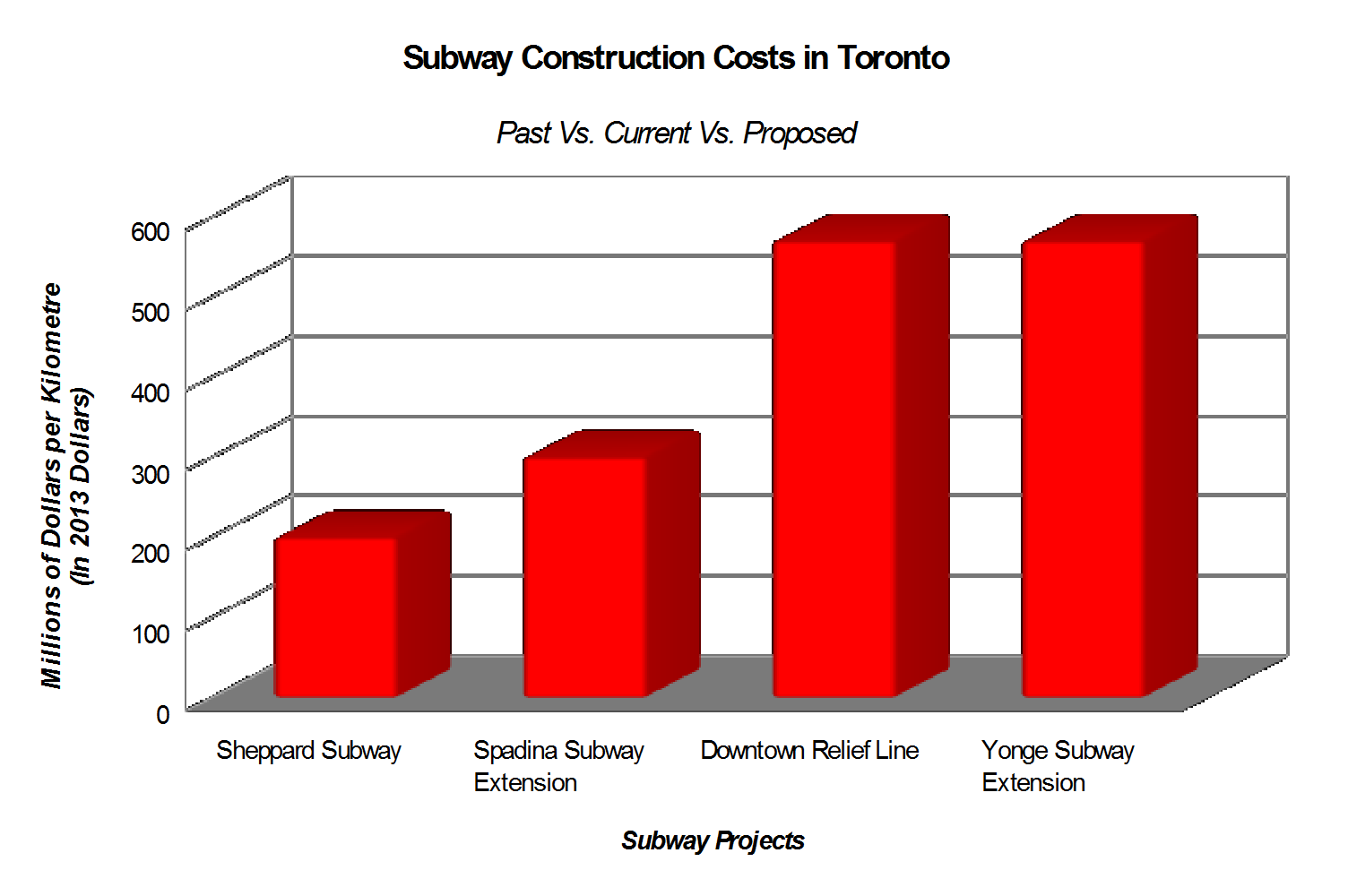
The Toronto Star in an editorial questions whether the city is being overly invested in subways. The issue of subways versus light rail has been one item of contention among mayoral candidates in the upcoming Oct. 27 city election:
<http://tinyurl.com/pdyzp9f>
“Toronto has over-invested in subways at tremendous cost: Editorial
A Pembina Institute study shows Toronto has over-invested in subways at tremendous cost while Vancouver, Calgary and Ottawa created more transit for less money.
Published on Mon Sep 08 2014Bernard Weil / Toronto Star Order this photo
Report by Pembina Institute says Toronto has over-invested in subways at tremendous cost.
Torontoai??i??s decades-long fixation on subways has left it ai???stuck in its tracksai??? compared to cities that are more open to other rapid transit options.
Canadaai??i??s largest city spends far more per kilometre on new rapid transit and gets a lot less for its money.
That depressing verdict comes in a new report comparing transit across Canada by the highly regarded Pembina Institute.
Torontoai??i??s mayoral candidates, and voters, would do well to pay close attention to these findings. Obsessing on subways carries high costs.
Researchers examined commuter systems in five cities: Toronto, Montreal, Calgary, Vancouver and Ottawa. They found the two oldest centres, Toronto and Montreal, lag far behind in launching new rapid transit lines.
The comparison is striking. In the last 20 years Toronto managed to open just 18 kilometres (11 miles) of rapid transit, less than one kilometre a year.
In contrast, over the same period, Vancouver opened 44 kilometres, (27 miles)Ai?? more than twice as much.
Calgary opened 29 (18 miles) and even Ottawa delivered 23 (14 miles).
Thatai??i??s a shamefully poor showing for a city like Toronto which aspires to be a leader in public transit.
Itai??i??s small consolation that Montreal did even worse, opening just 5 kilometres (3 miles) of line in the past two decades.
For the purposes of the study, ai???rapid transitai??? was defined as subways, light-rail lines, Vancouverai??i??s SkyTrain, right-of-way streetcars travelling in their own separated lane, and right-of-way bus routes.
Toronto and Montreal lag because, unlike other cities, theyai??i??ve been slow to invest in ai???quick-to-deploy rapid transit technologies.ai???
Instead, Toronto has focused on slow-to-deliver subways that come at a heavy cost.
Thatai??i??s why itai??i??s stuck paying an average of $236 million (USD $215.8 million) per kilometre for new rapid transit ai??i?? more than any other city in the study.
By failing to deliver effective, low-cost alternatives such as light rail and bus rapid transit Toronto has, for years, shortchanged its riders.
There have been attempts to do better.
Authors of the study note that a 120-kilometre (74.5 mile) network of Transit City light-rail lines was proposed in 2007.
But only one line, the Eglinton Crosstown LRT, is currently under construction and a lot of that involves expensive tunnelling.
In a ruinous flip-flop, underlining this cityai??i??s infatuation with subways, city council killed a seven-stop Scarborough light-rail route and replaced it with a three-stop underground line.
In doing so, it delayed construction for years and raised the cost of this route to $468 million (USD $427.9 million) per kilometre, up from $194 million (USD $177.4 million) for the original LRT.
ai???Toronto is stuck in its tracks,ai??? warned Cherise Burda, Pembinaai??i??s Ontario director. ai???Itai??i??s busy debating transit technology. The other cities debate transit technology, but it doesnai??i??t stop them from actually building.ai???
Furthermore, when they do invest, it isnai??i??t in expensive subways but in light rail and other rapid transit options.
As a result, ai???theyai??i??ve been able to build more transit, more quickly,ai??? Burda said.
All this is utterly lost on incumbent Rob Ford, running to return as mayor.
His dismal transit plan, released this past week, calls for putting even more subways in areas where other rapid transit would make more sense.
ai???You bore, bore, bore until the cows come home,ai??? is his succinct agenda.
The other main candidates are at least open to alternatives.
John Toryai??i??s SmartTrack plan calls for running more commuter trains on existing surface tracks.
\And both Olivia Chow and David Soknacki would kill the ill-judged Scarborough subway extension and return to the original light-rail plan.
This makes eminent sense.
Overinvesting in subways, to the detriment of all else, is not the better way.


The Federal NDP suddenly Discouver Transit
The Federal NDP have never really cared about regional transit and desperately need some sort of policy to try to show the public they care and and have a plan in time for the 2015 election.
Throwing more money at transit won’t solve transportation problems and will drive up transit costs. Canadian cities need a sensible public transportation policy using buses, light rail and even metros, if the ridership supports the investment.
What the region doesn’t need is more SkyTrain of the Canada Line, which has drastically driven up costs, yet have not attracted ridership.
A good start would be funding a new Faculty of Public Transport at major Universities across Canada, so we have people who actually understand the science of public transport and not the cadre of planners and engineers who do not what the difference is between an articulated or a gangwayed vehicle.
How about a “two rooms and a bath” car?
What we do not need in the region is another subway because subway eat up precious transit dollars, yet provide no benefits except when ridership on a transit line exceeds what can be carried on-street. Subways are not a cure all for transit woes, rather they are a hindrance to affordable transit expansion.
I hope followers of this blog, let the NDP know that we need transit funding for projects that will improve the livability of the region and not just be a multi billion dollar project built strictly for political prestige, such as the Broadway Subway.
 Building the politically prestigious SkyTrain has given
Metro Vancouver a much higher cost per revenue passenger than other Canadian cities.
Federal NDP vows to make transit a plank in 2015 platform
By Derrick Penner, Vancouver Sun September 8, 2014
They haven’t attached a dollar figure to it, but the Federal NDP on Monday promised to make a long-term national public transit strategy part of their platform for the 2015 general election.
While not long on specifics about how such a strategy would contribute to TransLink’s 30-year, $7.5-billion capital plan for Metro Vancouver, NDP trade critic Don Davies vowed it would be 15 to 20-year commitment and an improvement on the federal Conservative government’s Build Canada infrastructure plan that has earmarked $2.76 billion of the federal gasoline tax to B.C.
Standing outside the Broadway-City Hall Canada Line station in Vancouver, Davies described the Conservative plan as “an ad hoc (program) on a short-term time frame” that is difficult for municipalities to work with.
“Municipalities and provinces have repeatedly said, and continue to say that they can’t plan long-term, large-scale infrastructure projects unless they have a commitment from the federal government over an extended period,” said Davies, the MP for Vancouver Kingsway.
Infrastructure critic Finn Donnelly added that Canada is the only G8 country without a long-term public transit plan.
Donnelly added that the NDP will reveal a dollar figure for the program closer to the election date, but the NDP would look to see if they can improve upon their promise from the last election campaign to devote $420 million a year of the federal gas tax to transit funding.
In June, the federal government said 53 per cent ai??i?? about $1.5 billion ai??i?? of the $2.76 billion committed to B.C. over the next decade and most of that would go to TransLink for capital projects, such bus replacements, the purchase of new rail cars for the West Coast Express and upgrades of transit centres.
However, at the time, Metro Vancouver vice-chairman Raymond Louie said the region will need more funding for system expansion plans, such as the proposals for a $2 billion subway on the Broadway corridor towards the University of B.C. and $2 billion in light-rail extensions of transit in Surrey.
TransLink unveiled its 30-year plan in mid-June, which included a $980-million replacement of the Pattullo Bridge in its $7.5-billion mix.
The federal NDP’s B.C. caucus staged the announcement along with a canvassing campaign at the station that saw party volunteers circulate a petition in support of better national funding for transit.
The Truth Slowly Ekes Out – Surprise, Surprise

Well, someone is waking up at the Vancouver Sun or are they.
SkyTrain is obsolete.
The philosophy behind the operation of SkyTrain is obsolete.
Obsolete transit mode + obsolete transit philosophy = lagging ridership.
So it should come as no surprise Vancouver spends more for transit, but like fools at a carnival, planners and politicians, pitch more Skytrain, built in subways on routes that to not have the ridership to justify the investment.
Doing the same thing over and over again and expecting different results is a sign of madness; in Metro Vancouver, planners and politicians do the same thing over and over again expecting different results.
Now, only if the Vancouver sun print a honest story about modern light rail……………
Vancouver outspends Toronto, Montreal in transit, but lags in ridership – study
Ai??By Don Cayo, Vancouver SunSeptember 5, 2014
Vancouver has been outspending both Toronto and Montreal on rapid transit for the last two decades, yet it still trails both cities in infrastructure and ridership.
VANCOUVER – Vancouver has been outspending both Toronto and Montreal on rapid transit for the last two decades, yet it still trails both cities in infrastructure and ridership.
A new study by the Pembina Institute notes that Vancouver has built 44 kilometres of new rapid transit lines in the past 20 years, almost half of it ai??i?? the Canada Line ai??i?? in the last 10, while Toronto and Montreal have added very little.
This construction leaves the total length of Vancouverai??i??s rapid transit lines at 68 kilometres. This compares with 83 for Torontoai??i??s aging subway system, which added 18 kilometres in last 20 years, and 69 kilometres for Montreal, which added only five.
When ridership and access are considered, Vancouver is much further behind.
Metro Vancouver residents take an average of 52 rapid transit trips per year, behind not only Toronto with 133 and Montreal with 93, but also Ottawa with 104 and Calgary with 74.
And only 19 per cent of Metro residents live within walking distance of rapid transit, compared to 21 per cent in Calgary, 28 per cent in Ottawa, 34 per cent in Toronto and 37 per cent in Montreal.
The report acknowledges that Vancouverai??i??s rapid transit challenge is magnified by the need to serve several low-density suburbs, and that express buses fill some of the gap.
The completion of the Evergreen Line now under construction to Coquitlam and scheduled to open in 2016 will change the Vancouver numbers, but all of the other cities surveyed have even more construction underway or planned, so Vancouver wonai??i??t catch up.
Ai?? Copyright (c) The Vancouver Sun

Public Meeting Re: The Arbutus Corridor
The Arbutus Corridor: A Way Forward?

You might think that thereai??i??s no solution to the conflict over the Arbutus rail corridor. Canadian Pacific Rail wants $100 million for its right-of-way. The City of Vancouver has offered $20m. Neighbourhood gardens, longstanding although trespassing, have been ripped up just before harvestai??i?? and electionai??i?? time. Trains, moving or stored, are coming.
But maybe there is a solution. Seven years ago, one of Vancouver’s most extensive and inclusive public consultation and design processes produced a report that recognized the railroadai??i??s financial interest, the neighbourhoodsai??i?? recreational interests, the cityai??i??s transportation interests, and a potentially reasonable way to pay the costs without turning the Arbutus Lands into another downtown. That report has been forgotten by almost everyone. On September 4th, City Conversations is bringing it back for public discussion.
To explain the plan, weai??i??ll have Ken Cameron, a member of the distinguished Advisory Panel for the process and report, and Claudia Laroye, Executive Director, Marpole BIA. Weai??i??ve invited other representatives of neighbourhood groups, the City of Vancouver, and CP Rail. Our presenters will briefly frame the topic. Then itai??i??s your turn to question, challenge, opine and be part of the conversation! Youai??i??re welcome to bring your lunch.
When
Where
Room 1600
Harbour Centre
SFU’s Vancouver Campus
515 W. Hastings
The seamless (no transfer) journey – Transit’s Holy Grail!
A repost from 2009 – updated.
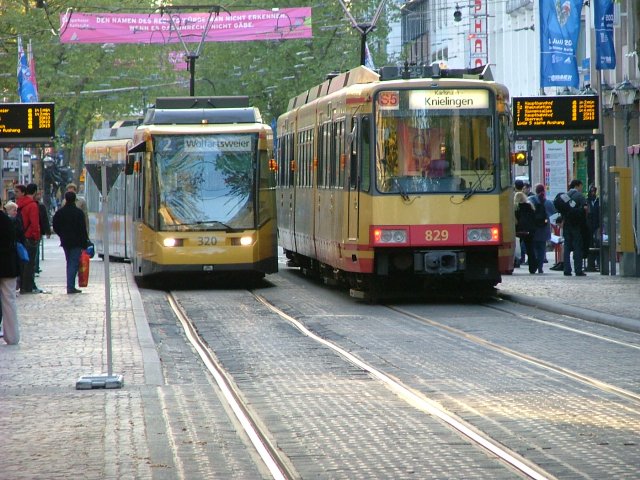 Route 5 (tramtrain) travels from Worth t0 Bietigheim-Bissingen, through downtown Karlsruhe.
It has been long known that the seamless or no transfer journey is the ‘ticket’ to attract customers to public transit as it is well understood that one could lose upwards of 70% of ridership per transfer, even intermodal. On older tramways and streetcar systems, many lines offered more than one service, providing the all important seamless journey to many destinations. Cities that abandoned their streetcar and tramways in favour of subways, forced many customers to first take a bus to the metro and then for many, transfer back to bus again. Many transit customers found that the car provided the seamless journey and with the added advantage being easier and less time consuming to use.
Though transit officials were aware of the problem of loss of ridership due to transfer, little was done to improve the situation until a very dramatic event happened in 1993, in Karlsruhe Germany. When Karlsruhe’s first two-system (Zweisystem) or tram train line opened, replacing one major transfer point (commuter train to tram) at the main train station, ridership surged way beyond expectations! Weekday ridership on the tram train increased 423% in just a few weeks.
Before LRTAi??Ai??Ai??Ai??Ai??Ai??Ai??Ai??Ai??Ai??Ai??Ai??Ai??Ai??Ai??Ai?? Commuter trainAi??Ai??Ai??Ai??Ai??Ai??Ai??Ai??Ai??Ai??Ai??Ai??Ai??Ai??Ai??Ai??Ai??Ai??Ai??Ai??Ai??Ai??Ai??Ai??Ai?? After LRT Ai?? Ai?? Ai?? Ai?? Ai?? Ai?? Ai?? Ai?? Ai?? Ai?? Ai?? Ai?? Ai?? Ai?? Ai?? Ai??Ai?? % increase
Weekdays – Ai?? Ai?? Ai?? Ai?? Ai?? Ai?? Ai?? Ai?? Ai?? Ai?? 488,400 Ai?? Ai?? Ai?? Ai?? Ai?? Ai?? Ai?? Ai?? Ai?? Ai?? Ai?? Ai?? Ai?? Ai?? Ai?? Ai?? Ai?? Ai?? 2,064,370 Ai?? Ai?? Ai?? Ai?? Ai?? Ai?? Ai?? Ai?? Ai?? Ai?? Ai?? Ai?? Ai?? Ai?? Ai?? Ai?? Ai??Ai??Ai?? 423%
SaturdayAi?? -Ai??Ai??Ai??Ai??Ai??Ai??Ai??Ai??Ai??Ai??Ai??Ai??Ai??Ai??Ai??Ai??Ai??Ai??Ai??Ai??Ai??Ai??Ai??Ai?? 39,000Ai??Ai??Ai??Ai??Ai??Ai??Ai??Ai??Ai??Ai??Ai??Ai??Ai??Ai??Ai??Ai??Ai??Ai??Ai??Ai??Ai??Ai??Ai??Ai??Ai??Ai??Ai??Ai??Ai??Ai??Ai??Ai??Ai??Ai??Ai??Ai??Ai??Ai??Ai??Ai?? 263,120Ai??Ai??Ai??Ai??Ai??Ai??Ai??Ai??Ai??Ai??Ai??Ai??Ai??Ai??Ai??Ai??Ai??Ai??Ai??Ai??Ai??Ai??Ai??Ai??Ai??Ai??Ai??Ai??Ai??Ai??Ai??Ai??Ai??Ai??Ai??Ai??Ai?? 675%
Sunday Ai?? – Ai?? Ai?? Ai?? Ai?? Ai?? Ai?? Ai?? Ai?? Ai?? Ai?? Ai?? Ai?? Ai?? Ai?? 6,200Ai??Ai??Ai??Ai??Ai??Ai??Ai??Ai??Ai??Ai??Ai??Ai??Ai??Ai??Ai??Ai??Ai??Ai??Ai??Ai??Ai??Ai??Ai??Ai??Ai??Ai??Ai??Ai??Ai??Ai??Ai??Ai??Ai??Ai??Ai??Ai??Ai??Ai??Ai??Ai?? 227,478Ai??Ai??Ai??Ai??Ai??Ai??Ai??Ai??Ai??Ai??Ai??Ai??Ai??Ai??Ai??Ai??Ai??Ai??Ai??Ai??Ai??Ai??Ai??Ai??Ai??Ai??Ai??Ai??Ai??Ai??Ai??Ai??Ai??Ai??Ai?? 3,669%
Total – Ai?? Ai?? Ai?? Ai?? Ai?? Ai?? Ai?? Ai?? Ai?? Ai?? Ai?? Ai?? Ai?? Ai?? Ai?? 533,600 Ai?? Ai?? Ai?? Ai?? Ai?? Ai?? Ai?? Ai?? Ai?? Ai?? Ai?? Ai?? Ai?? Ai?? Ai?? Ai?? Ai?? Ai??Ai?? 2,554,976 Ai?? Ai?? Ai?? Ai?? Ai?? Ai?? Ai?? Ai?? Ai?? Ai?? Ai?? Ai?? Ai?? Ai?? Ai?? Ai?? Ai?? Ai??Ai?? 479%
(Albtal-Verkengesllschaft Karlsruhe & ABB Henchel)
Since Karlsruhe’s dramatic increase in patronage on their tram train system, European planners have put great emphases on the all important seamless (no-transfer) journey and designed new transit lines, not as feeders to subways or regional railways but as stand alone transit lines servicing major destinations, even in competition with other transit modes.
The lesson of Karlsruhe should not be lost on the advocates for the return of the Valley interurban service, who want the new service to terminate at Scott Road SkyTrain Station and compel those who want to go to Vancouver to transfer to SkyTrain. The all important seamless journey from Vancouver to Langley, Abbotsford and Chilliwack may just provide the ridership to make the new service successful!
Streetcars and LRT, A Quick Primer

First published in the RftV blog in 2011, it is still pertinent today.
Updated to August 2014.
The silly season continues in the Vancouver region, with TransLink desperately trying to persuade regional mayors to levy more taxes to mainly pay for the Evergreen SkyTrain light-metro line and a SkyTrain subway under Broadway.
The following is a quick primer on streetcars, LRT and SkyTrain.
Question: What is the difference between LRT and a Streetcar or tram?
Answer: Today the difference between LRT and a streetcar/tram is the quality of rights-of-way, where a streetcar operates on-street in mixed traffic, light rail operates on a reserved rights-of-way (R-O-W), such a boulevard or a streetcar/tram only HOV lane on-street, which gives LRT an unimpeded transit route and faster commercial speeds. Today, there is little difference between a tram/streetcar and light rail vehicle except for motor size.
Q: What is SkyTrain?
A: SkyTrain is a proprietary unconventional light-metro system system first marketed by the Urban Transit Development Corporation of Ontario, which is now marketed by Bombardier Inc. , with one half of the patents held by SNC Lavalin. SkyTrain is considered an unconventional railway because it is powered by Linear Induction Motors and is incompatible to operate with any other transit system, save itself. The Canada Line metro and SkyTrain are incompatible in operation. There are only 7 “SkyTrain” type systems in operation around the world, despite being first marketed in the late 1970’s and the number will be reduced to 6 when the TTC will soon replace the Scarborough RT, with either LRT or a subway.
Q: What is light metro?
A: Light-metro was originally supposed to bridge the gap of what old streetcars could carry and what ridership would justify a heavy-rail metro. Modern LRT has made light-metro almost obsolete by bridging the bus – metro gap at a far cheaper cost. Automatic (driverless) light-metros, with its higher construction and operating costs just can’t compete against modern LRT.
Q: Is SkyTrain cheaper to operate than LRT?
A: No, SkyTrain costs about 40% to 60% more to operate than comparable LRT operations. Also the provincial government subsidies SkyTrain at about $250 million annually.
Q: How fast can LRT operate?
A: Generally speaking, LRT can operate as fast as its R-O-W will permit. Streetcars or trams, with stops every 300 to 5oo metres generally have smaller motors giving maximum speeds of 60 to 70 kph, while LRT has larger motors, giving speeds of 80 to 110 kph.
Q; TransLink claims that Skytrain is faster than LRT?
A: SkyTrain seems to be faster than LRT because TransLink has designed SkyTrain to be faster by having fewer stations per route km. Fewer station on a transit route attracts fewer customers.
Q: How much does LRT cost to build?
A: Light rail can be built as cheaply as $5 to $7 million/km using TramTrain; $15 to $25 million/km. for a streetcar; $20 million/km + for light rail. TransLink has always gold-plated light rail with all sorts of added costs to drive up the cost of construction to be as close to Skytrain it can.
Q: What is the capacity of a light rail vehicle (LRV)?
A: Today, the capacity of a transit vehicle in North America is put at 5 persons per metre length of vehicle. In the past a transit vehicles capacity was put at all seats filled and 4 persons per metre/sq., but this calculation doesn’t address the fact that in North America people are bigger, that there is a constant movement of people entering and exiting the vehicle and that most customers demand seats.
Q: What is the capacity of LRT and/or streetcar line?
A: The capacity of a tram/streetcar line is dependent on vehicle size and headways. In Karlsruhe Germany, the main tram route through the city was seeing peak hour capacities in excess of 35,000 persons per hour per direction, which is 5,000 more than the maximum theoretical capacity of SkyTrain! The line is now being relocated in a subway, but it does show the threshold that demands a subway today.
Q: What is TramTrain?
A: TramTrain is a tram/LRT vehicle that has the ability to both operate on mainline railways or streetcar track. Since being introduced in 1994, there are now 3 times as many TramsTrains in service that SkyTrain type systems.
Q: What is BRT?
A: BRT or bus rapid transit is a bus that operated on its own guideway or bus way, either guided or not. True BRT costs about 30% less to build than modern LRT, yet has not demonstrated any real advantage over LRT. BRT lines mainly seem the political way of tarting up express bus service and trying to sell it to the public as rapid transit. in most cases, the public are not fooled.

A reserved rights-of-way enables LRT to obtain commercial speeds of that of a metro.



Recent Comments