We Must Welcome The 21st Century
Not really about urban rail, but still important for the planned Chilliwack interurban.
Railways need to emerge from the 19th century into the 21st and the federal government must emerge from its 18thAi?? Laissez faire mentality.
If France, the UK, and Germany can operate trams, in mixed traffic, on mainline railways, Canada can do it too. The lack of political guidance and mandateAi?? with our railways, largely paid for the the government of Canada either by cash or land grants, only hurts the public. Railways, too often operate in an 19th century ennui, which many in the industry and abetted by government, feel that they can freely do so.
Why should the taxpayer, once again fund expensive transit solutions when affordable ones are so many, utilizing existing railway infrastructure.
The Valley interurban transit project and the Island E&N Railway come to mind. Why spend a paltry sums on workhorse transit solutions when prestige mini-metros can be had for ten times the cost.
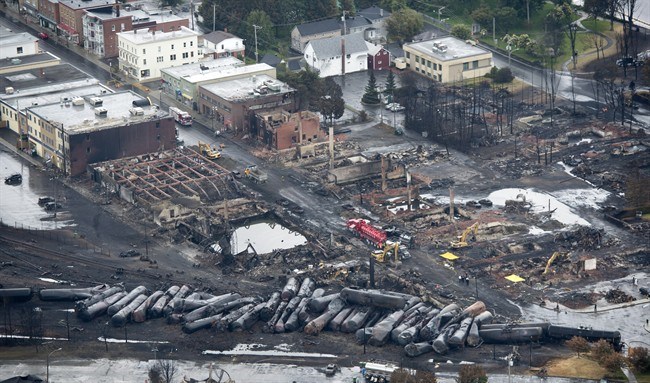 Lac Megantic was a fiasco ready to happen. The government allowed it to happen.
From the Huffington Post.
Oil By Rail Is In Desperate Need of Clean-Up
Railways are transforming North America’s energy sector and are, coincidentally, helping to save Canada’s bacon.
That’s because the train infrastructure has helped bypass the pipeline bottlenecks that threaten to impede the oil booms underway in the U.S. and Canada. The political flashpoint has been the Keystone XL scheme, delayed due to Washington’s green politics for five years, but opposition exists against all pipeline and refinery projects in both countries.
The facts are, by the end of next year, three times the amount of oil (nearly 800,000 barrels per day) that Keystone would have carried will be shipped by train out of Canada and North Dakota’s vibrant shale oil region to refineries everywhere.
In fact, a recent Congressional Research Report noted this and suggested that oil by train may render Keystone unnecessary.
“Increasing cross-border movements of crude oil by rail on existing track does not require State Department approval, so such an approach seeks to avoid regulatory delays. While the potential volumes associated with rail transportation of crude could be lower than pipeline volumes, they could still be significant. Some analysts have suggested that oil-by-rail volumes could be large enough to make a major new pipeline project like Keystone XL unnecessary,” concluded the report.
Train transport is two or three times’ pricier than pipelines, but even so has already travelled way down the track in a handful of years. The result is more spills — not to mention the catastrophic Lac-Megantic derailment in 2013 that destroyed a town and killed 47 people — and dramatically enhanced governmental attention to the issues surrounding rail transport.
(Interestingly, the tragedy illustrated the inter-dependence of the two countries: the train was owned and operated by a third-rate U.S. railway company, partially owned by the Quebec Pension Plan; the oil was from the North Dakota Bakken oil play and the customer was New Brunswick’s Irving Oil.)
At a hearing in Washington, federal figures showed that four times’ as much oil has been spilled as a result of derailments in 2013 as occurred in the previous four decades. This is in part because traffic has increased exponentially.
Years ago little oil travelled by train. But by 2013, they carried one million barrels a day of U.S. oil production, equivalent to the total Bakken output. This year shipments are likely to total 1.5 million barrels per day — an increase that has resulted in insufficient capacity to haul coal and some farm products. Several U.S. utilities in the U.S. have cut back on power because their coal inventories are not being replenished quickly enough.
The story’s similar in Canada. From a standstill in 2008 oil producers moved 200,000 barrels per day by trains in 2013 and are forecasted to ship 700,000 barrels per day by the end of next year. That’s not the limit either. Rail loading capacity for oil tankers in Canada is expected to hit 1 million barrels per day by next year and 1.4 million barrels a day in 2016.
The Congressional report surmised that if Keystone is never built, the railway option will be more needed than ever. “In its ongoing review of the Keystone XL pipeline proposal, the State Department has argued that, if the pipeline is not constructed, additional oil-by-rail capacity will be developed instead.”
The environmentalists are just as opposed to rail as to pipelines or refineries and political battles have sprouted everywhere to prevent the building of smaller versions of Keystone or expansions of existing lines. Another new argument is that oil trains will become major terrorist targets as they travel through populated areas.
The facts are that any infrastructure is a target. The real issue is to clean up both the industry and radicalize government oversight.
The Lac-Megantic firebomb resulted in criminal charges against the railway and several employees as well as a mega-lawsuit against Ottawa for its pathetic supervision and inadequate rules. The culprit railway ran on a shoestring but should have been banned altogether from operations. Instead, it limped along saving money by cutting maintenance and crew.
Worst of all, the train company — now bankrupt — was allowed to operate with virtually no insurance, some $17 million in liability. This was negligence on the part of governments: any railway should be legally required to carry catastrophic insurance. Lac-Megantic has run up a tab of $200 million in just physical damage.
It took a tragedy to get both countries to impose new rules: they must swap out old tank cards for newer, safer ones; must improve trackage; must travel at lower speeds and must be inspected more often.
But additionally, I believe that railways should pay for this extra oversight and that railway unable to afford catastrophic insurance in the hundreds of millions per incident should not be allowed to operate. This will weed out the fly-by-night operators who operate unsafely.
Then the sector must be revamped. The train business has been allowed to remain a 19th-century technology run with 19th-century mentality by workers without credentials. Aviation, by contrast, is heavily supervised and operated by licensed personnel with professional expertise and constant surveillance.
For the moment, the critically important oil industry has been saved, but if governments aren’t as tough as nails in their demands and dealings with the railways, then all bets are off.
Alstom Appitrack – Would Broadway Be A Good Candidate?

Alstomai??i??s fast automated tracklaying technology, Appitrack, was chosen as the Innovation of the Year at the 2011 Light Rail awards held in London on 5th October.
The system allows for limited excavation depths in order to speed up track-laying time with the ability to lay up to 200 metres of track per day, compared with just 50-60 metres using conventional methods, and therefore reduce project costs. Appitrack also as low noise levels and is applicable to all types of track surfaces and with all types of equipment.
Alstom has used Appitrack in the tramway projects recently inaugurated in Jerusalem, Reims, Algiers, and on the second line of the Orleans tramway that is due to enter service in 2012. It was in Orleans in March 2011 that Appitrack set a world track laying 403 metres of single track laid in one day, the equivalent length of almost four football pitches.
Let us see, 200 metres of double track a day translates into 1 kilometre of track a week. In theory, a 20 km line of on-street LRT could be laid in 20 weeks!
Again and not to upset the SkyTrain types, in theory we could reinstate a LRT/streetcar line from Boundary to UBC easily in one year. This means minimal disruptions for adjacent businesses where tram construction would only affect their businesses for a maximum of time and certainly not the three years of hell suffered by Cambie St. Merchants with the construction of the Canada Line cut-and-cover subway.
Memo to TransLink: The LRT future is very friendly.
.

Continued Angst Over The Arbutus Corridor
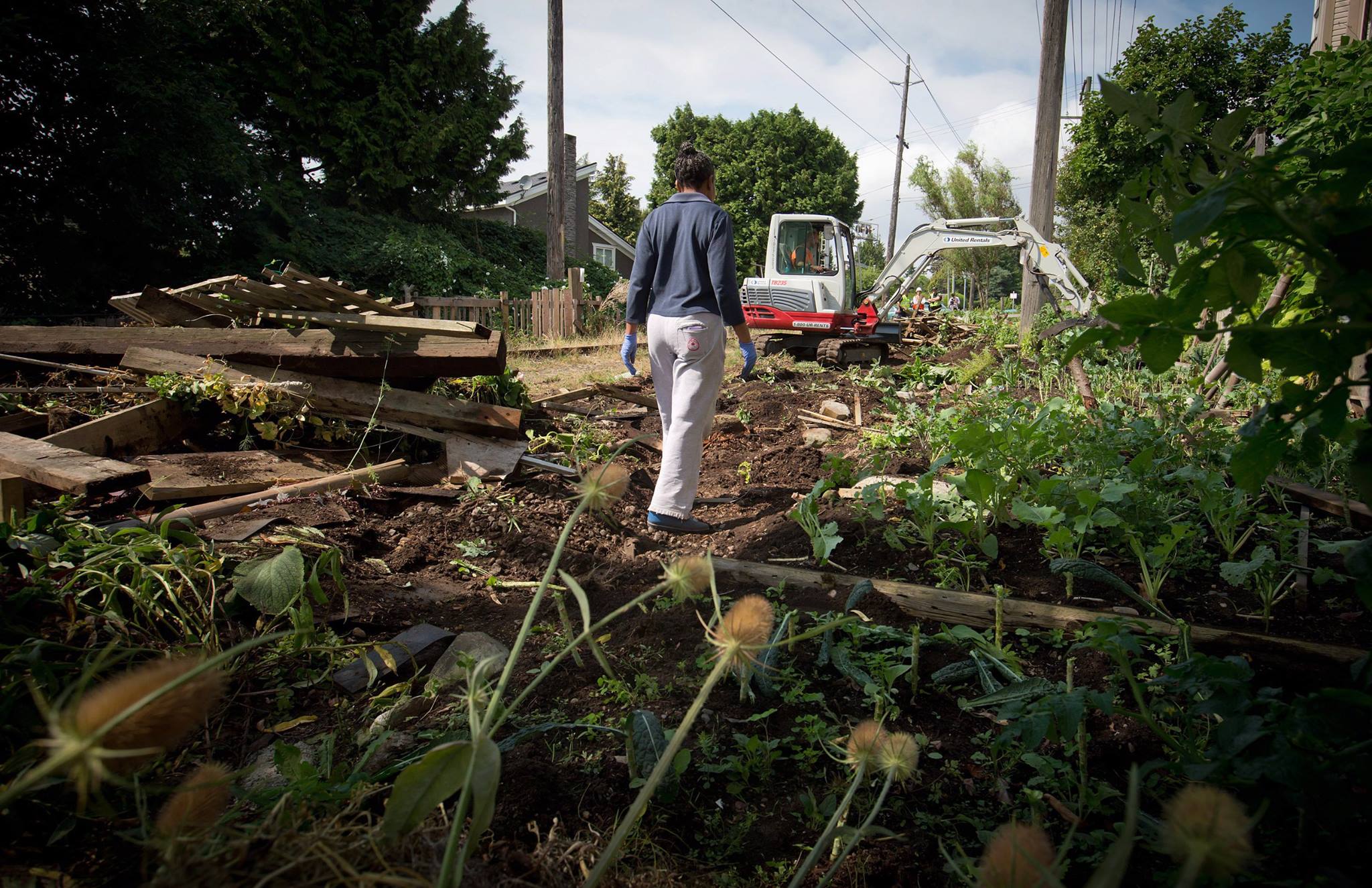
The cries of, “shock and disbelief”, and hand wringing by those trespassing and keeping gardens on the CPR owned Arbutus Corridor is laughable. The media is now showing pictures of teary eyed children who weep for their lost beans and figs.
Enough please.
The Arbutus Corridor debate actually started with this quote at a transit meeting in Vancouver in the 90’s.
We are the people who live in your neighborhood. We are dentists, doctors, lawyers, professionals, CEOs of companies. We are the crA?me de la crA?me in Vancouver. We live in a very expensive neighborhood and weai??i??re well educated and well informed. And thatai??i??s what we intend to be.
The Arbutus Corridor was always earmarked for light rail, but a small and very well politically connected contingent of West side types got then premier Gordon Campbell to fund a now $2.5 billion Canada Line subway in Vancouver, supposedly taking transit off the table for the Arbutus Corridor negotiations.
The CPR did not want to play this game and asks for a reasonable sum of $100 million for the 11 km, 22m wide route that starts in Marpole and ends at Vainer park.
The City of Vancouver has only offered $20 million and refuse to budge.
After the line was mothballed in the early 2000, after the sole customer on the line, Molson’s Brewery ceased using rail, the many people backing onto the Arbutus trespassed regularly and acted as squatters building unlawful gardens.
Flash forward to may 2014 and Molsons brewery is rumoured to greatly increase beer production for export and once again may want to use rail to move its product.
The CPR sent a letter to the Arbutus Line neighbours telling them to dismantle the unlawful gardens or they would be dismantled by the CPR, as survey crews were seeing if rail transport was viable.
Now the wrecking crew has come and its goodbye gardens.
The following is a Facebook post by transit activist Peter Finch probably is closer to the truth than the wailing and moaning by the creme de la creme.
I told them so.
As a gardener, I fully understand and appreciate the emotional energy that went into building these beautiful gardens. However, I have always maintained that as good neighbours, and as part of an inclusive and responsible community, gardeners should always be careful to do it right, do it legally.
Did any of the gardeners ever approach CPR about the use of the land? NO, they didn’t.
Canadian Pacific Railway has really been forced to take action. They were denied the ability to sell off the land, and were directed by the Supreme Court to keep the property as a transportation corridor. While it was certainly the railway’s hope to sell the property. they must have realized at some point that their failure to maintain it as such created a huge potential liability for them.
If not maintained, anybody who is injured while trespassing can obviously sue the CPR for negligence. In order to be insurable, the railway has to re-establish its presence and restore the property to its legal zoned use–just as any property owner would have to do.
Legal gardens within the City of Vancouver have to carry liability insurance of $3 to $5 million, and some of them pay taxes–this is all dependent on where the gardens are located. The gardens along the Arbutus corridor were paying neither insurance, nor rent, nor taxes, and they had no permission to be there at all.
“Mayor Moonbeam” calls the CPR “bullies.” What’s wrong with this picture?
CPR has done a very poor job of public relations, but they are entirely in the right.
Whether CPR has a customer or not, they have a responsibility as a good corporate citizen to maintain their holdings according to City zoning, and according to the regulations set by Transport Canada.
Cut-and-dried simple.
And How Much $1.6-1.9 Billion of Skytrain Will Buy You in Greater Vancouver?
As the title indicates, in the Waterloo region in Eastern Canada $1.6 to $1.9 billion will buy 37 km of modern LRT plus assorted transit technology and at least 10 km of BRT.
One observation made by Haveacow is; ” this LRT system as it begins will not have the carrying capacity of the Skytrain system………”, which I would like to add that capacity can be increased incrementally by adding more modules to the trams, as in done in Europe or purchasing new vehicles.
Here is how the flexibility of modern light rail is exploited; a new transit system can be made cheaper by purchasing smaller cars and as ridership increases, capacity can be affordably increased by adding more modules to the tram, instead of buying more complete trams.
A note from Mr. Cow.
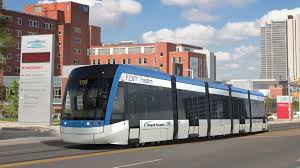
Just a little note from Haveacow in Ottawa. Officially pre constructionAi?? activities start today in the Region of Waterloo. Waterloo’s 3 main lower tier municipalities, The City of Waterloo, The City of Kitchener and The City of Cambridge (Formerly Berlin: due to a name change during the first world war, for obvious reasons), are beginning construction in several places throughout the region. Just a reminder, they are starting Phase 1 which will includes, 19 km of LRT in Waterloo and KitchenerAi??as well as 17 km of Adapted BRT from Kitchener to Cambridge, in an attempt to build up transit use in the southern part of the region to threshold LRT ridership levels. This willAi??mean during phase 2 that, the LRT line can be extended another 17-18 km to downtown Cambridge.

The LRT line known as theAi??ION Line will be in several different types of Right of Way varying from abandoned and underutilizedAi??rail lines,Ai??private off streetAi??rights of way and segregated on street rights of wayAi??to segregated former traffic lanes. Tracks will run in a double track configuration for most of the line and operate in single track configuration on several, one way street couplets in the denser urban cores in Waterloo and Kitchener.

The Adapted BRT Line will be in on street and highway shoulder lanes. It will include no fewer than 6 intersections with que jumping lanes, specialized stationsAi??and signal control at every intersection on the route to favor transit vehicles. This capability is not just for the ABRT vehicles but all of Grand River Transit’s bus fleet. However the majorityAi??of the ABRT line will operate in mixed traffic in a express bus (Lite BRT) configuration. Grand River Transit already has a lite BRT system of express buses known as the I XPRESS BRT System which has been very successful at building up transit use in thisAi??Region of only 500,000 people. They fully intend to continue this system and have several ofAi??the existing routes feed the LRT system. Some new routes are also planned independent of the LRT system.During phase 2 not only will the ABRT system be upgraded to LRT but more BRT infrastructure will be added all over the region to aid the express Bus system and transfers to the LRT line. The Grandlinq Consortium will build, maintain and operate the system for Grand River Transit. Phase 1 will include 14 Bombardier Flexity LRV’s (5 section vehicle, 30 meters long)Ai??operating in single car trains with 60m long platforms.Ten of the LRV’s will be operating at peak. Phase 2 will add a minimum of 10 cars and a supplemental orderAi??of up to 20 LRV’s is being planned if 2 car trainsAi??are needed. The cost of the LRV purchases is being kept down because they are piggy-backing on LRT orders from Toronto for the Eglinton, Sheppard and Finch AvenueAi??LRT Lines. Up to 50 ABRT buses are alsoAi??being purchased for the project as wellAi??by Grand River Transit.The total cost of phase 1 is $818 million and funding from all 3 levels of government has been done and delivered. The expected cost of phase 2 is somewhere between $600-800 million depending on specifics of the design and scope of the project. The Region of Waterloo is raising taxes by 1.2% to cover future costs of operations and supplementalAi?? vehicle and technology purchases. With several tax reductions already on the books the total tax increase region wideAi??is about 0.7 %.

As I have said before, this LRT system as it begins will not have the carrying capacity of the Skytrain system however, it doesn’t need to yet. They will over time more than likely upgrade the system’s capacity and increase the connectivity of the entire transit network. The LRT connection in phase 1 to the Kitchener GO train line to Toronto and the possible connection to the Milton GO Train Line during phase 2 at Delta in Cambridge is part of the province’s connectivityAi??plan for the entire Greater Golden Horseshoe Region, population 8.7 million and growingAi??(the outer commuter region of Toronto). This has been an important plank in the plan trying to keep traffic growth in check in the province of Ontario. Compared to even a decade ago the growth of transit use in this region has been impressive and a good model to follow if you want to grow transit in a mostly suburban location like the area south of the Fraser River in Greater Vancouver. They have done it realistically and carefully and for the most part, cheaply in an area that, has had some very challenging economic ups and downs. They still have a way to go but they are moving forward. By the time phase 2 is complete they will have likely spent upwards of $1.6-1.9 Billion and created 37 km of LRT as well as a great amount of supportive transit technology and no less than 10km of BRT rights of way all across the Region of Waterloo for their express bus network and the transit system as a whole. Compare this to what you are likely to get in area south of the Fraser River during that time (next 25 years)Ai??and how much $1.6-1.9 Billion of Skytrain will buy you in Greater Vancouver.
The Vancouver Province Shills For The Canada Line
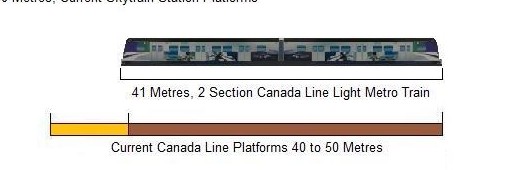 40 metre to 50 metre station platforms limit the Canada line train to
just two cars, severely limiting capacity.
I see TransLink is calling in its markers from the mainstream media and a staff writer (infomercial maybe) has penned a puff piece for the Canada Line.
No mention is made of the tens of thousands of students who use the deep discounted U-pass daily on the mini-metro or the number of actual people (not boardings) who use the Canada Line daily.
Questions like; “how many bus customers are forced to transfer onto the the Canada Line?” or “How many U-Pass students use the Canada Line more than twice a day?”, are avoided.
Also avoided is the discussion of real cost of the Canada Line, which is now pegged at around $2.5 billion or that the Canada line was the only cut-and-cover subway project in North America, Europe and Asia, not to pay compensation to local businesses for disruption during construction.
Not a word how the bus service from South Delta has now reverted back to pre a Canada Line schedule as the new ridership never came and a multimillion dollar ‘Park & Ride lot in South Surrey remains empty because the anticipated increase in transit use did not materialize after it opened.
What is most telling is that in North America, successful transit systems tend to be copied by other cities as transit planners and politicians like to build on success, yet no one in North America or Europe has copied the Canada line and instead it remains an international joke as it is the only heavy-rail metro in the world that has been built as a light-metro and has less capacity than a simple streetcar.
No, you don’t see the mainstream media printing that at all, rather all the public get is a heart warming fairy tale about TransLink and the Canada Line.
Sadly, the Canada Line is a white elephant, limited in capacity and too expensive to expand. No one copies incompetence, except maybe TransLink.
Canada Line turns five years old with all the signs of a success story
By Staff Reporter, The Province August 17, 2014
he Canada Line is celebrating a major milestone.The Richmond-YVR-Vancouver rapid transit line, which opened to great fanfare on Aug. 17, 2009, turned five years old on Sunday.
The well-used line, completed three months ahead of schedule, has drastically changed Richmondai??i??s downtown core and Vancouverai??i??s Cambie Corridor.
The Canada Line has transformed Richmond, with its four stations along car-choked No. 3 Road, into a more walkable city.
It has transported millions of passengers to and from Vancouver International Airport to city centres, and has helped enable the construction of a new designer outlet complex by the airport authority near the Canada Lineai??i??s Templeton Station.
The $2-billion line has also spurred growth along Cambie Street: Construction for the massive Marine Gateway project ai??i?? which will include condos, office towers, restaurants, and a movie theatre complex ai??i?? is currently under way, while further north, future shops, offices, and mixed-used developments are slated to replace blocks of boarded-up single-family homes.
Despite naysayers who doubted TransLinkai??i??s original ridership projections, the Canada Line has been wildly successful.
The 16-station line was expected to hit an average of 100,000 passengers per day by 2013, but surpassed that mark in 2010. By 2011, it cleared 116,000 passengers, reaching 124,000 by 2012.
The figures are a boon to TransLink, which had guaranteed to subsidize ridership shortfalls if the line, built as a public-private partnership, drew fewer than 100,000 riders per day.
Construction of the Canada Line wasnai??i??t without controversy.
The projectai??i??s cheaper yet disruptive ai???cut and coverai??? method crippled many businesses along Cambie.
One retailer, Susan Heyes, who operated a maternity clothes store in Vancouver, sued the consortium that built the Canada Line and was awarded $600,000 in damages. The judgment was overturned by an appeal court.
Speaking of the Arbutus Corridor…………..

A Marpole bound interurban crosses 41st. Please note trolleybus and the overhead.
……. why TransLink will never support LRT on the Arbutus and why the City of Vancouver wants the ‘Arbutus” for a glorified bike lane.
Evergreen Line is said to cost no more than $1.4 billion for just over 11 km of line and the Canada line was to have cost no more than $1.3 billion, but at the last count, the real cost for the 19.2 km line is now said to be approaching $2.5 billion, with evidence from the Susan Heyes lawsuit that the real cost of the Canada Line may have exceeded $2.7 billion!
A $100 million for the 10 km Arbutus corridor or $10 million/km is a bargain! Then add tracks and overhead at $6 million to $10 million/km and cars at about $5 million per copy ( used trams are much cheaper) and we could have a viable LRT line on a route which has more density (that Vancouver holy grail density) than Cambie St., for a cost of less than $500 million!
TransLink and the City of Vancouver are deathly afraid of light rail on the Arbutus because it would have far more capacity than the hugely expensive Canada Line at a fraction of the cost.
How so, you say?
Simply, to reduce costs on the Canada Line, which costs were soaring out of control, the scope of the mini-metro project was greatly reduced. The Canada Line stations have only 40 metre to 50 metre long station platforms and can only accommodate two car trains. This greatly limits the Canada Line’s capacity to about 7,500 persons per hour per direction!
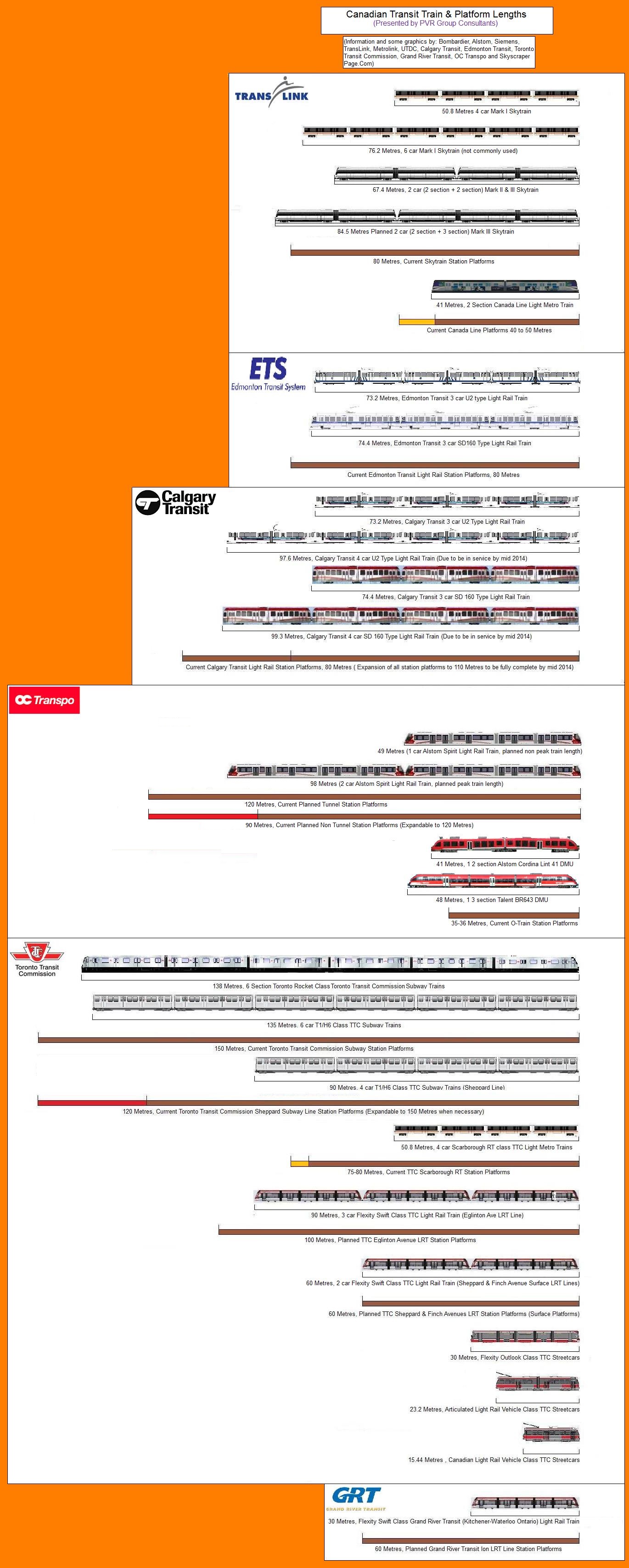 Compare this with Toronto’s proposed LRT station platforms.
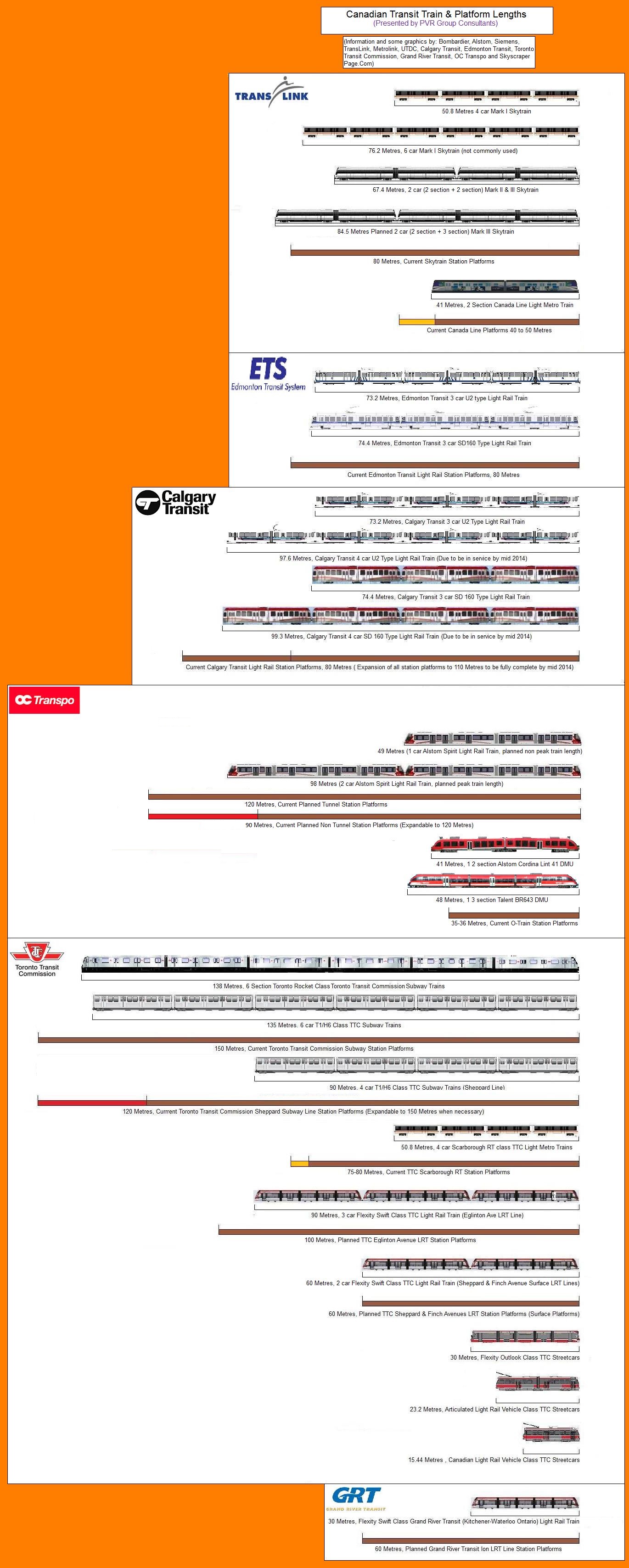 Or Ottawa’s now under construction LRT station platforms.
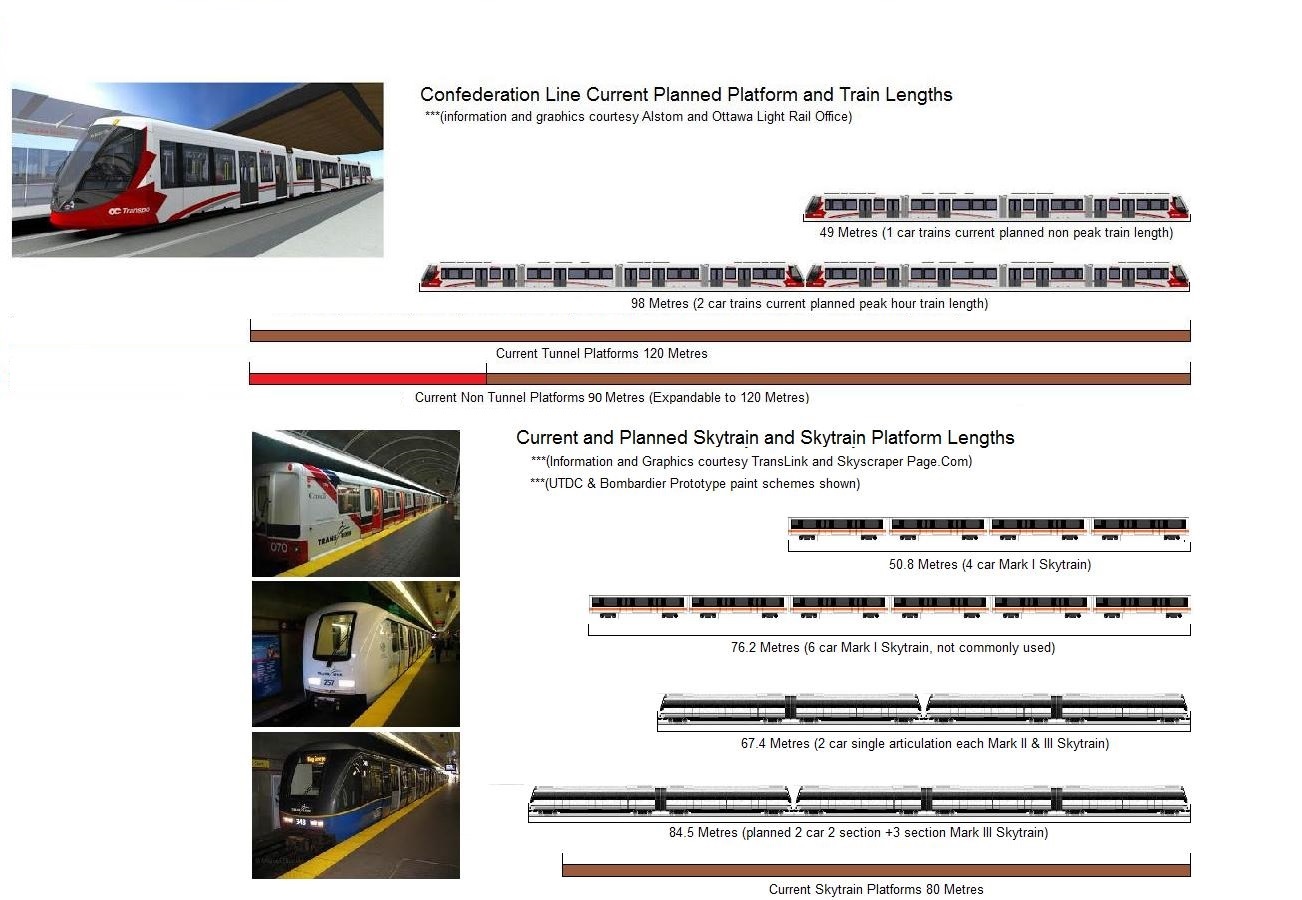
Please note: One Alstom tram for Ottawa is 8 metres longer than a pair of Canada Line EMU’s!
One can easily see that the Canada Line, in spite of all the hype and hoopla in the mainstream media has less capacity than a modern tram or streetcar and this is the big fear of TransLink’s and the City of Vancouver’s transit planners and engineers.
Light Rail, even in the guise of a streetcar or tram, costing at least a fifth to build than the Canada, could offer a much higher capacity.
So here is the real story of the Arbutus Corridor, not gardens or the creme de la creme, rather we could be modern light rial very cheaply and carry more people than the Canada Line subway.
Does anyone at the Vancouver Sun understand this? The Courier? ………………….?
Lotus Land In Shock with the CPR Reactivating The Arbutus Corridor
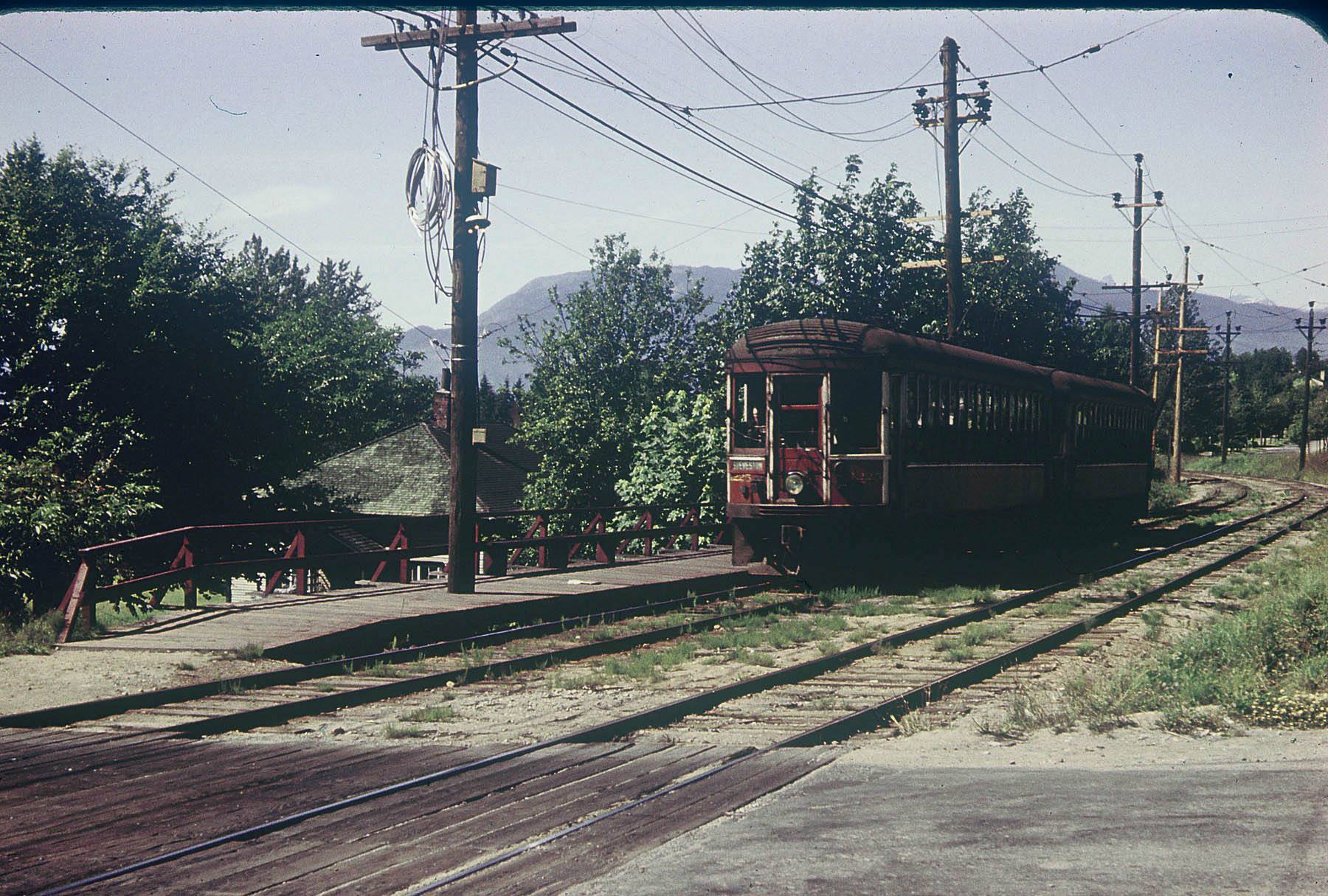 The Arbutus corridor Interurban near 37th
The Arbutus corridor debate continues and Zwei has a made a few observations.
- Has anyone in the media ask Molsons if they want to once again use the railway for both delivery and export?
- Has anyone in the the media reported that the CPR has paid taxes since the rail line was mothballed?
- What liability risk is there for the CPR if someone injures themselves on the line?
- Has the media reported that the Arbutus line was doubled tracked until the late 1950’s, hence no WW II victory gardens were on the right of way?
- $100 million for the 10 km Arbutus Corridor ($10 million/km) is a bargain if a LRT/streetcar/tram line were to use it, considering that a Broadway SkyTrain subway will cost about $200 million/km!
From the Vancouver Sun.
Pete McMartin: Urbanization: Whoai??i??d have guessed? Kerrisdale as a bastion of Marxism
By Pete McMartin, Vancouver Sun August 16, 2014
A Canadian Pacific Rail police officer, right, directs residents Sarah Myambo, left, and Mila Rakhmetouline off the property for their safety as they try to salvage items from their community garden after workers destroyed and removed it on a stretch of abandoned CP Rail line in Vancouver, B.C., on Thursday August 14, 2014. The once-abandoned 11-kilometre-long Arbutus Corridor has been used by residents for many years as a greenway where community gardens were erected. The removal of the gardens is the culmination of a growing dispute between the rail company and the City of Vancouver over the value of the land. THE CANADIAN PRESS/Darryl Dyck
Photograph by: DARRYL DYCK, THE CANADIAN PRESS

The latest tempest in a pea plot emanates from ai??i?? where else? ai??i?? the westside, home of the ever-embattled.
If itai??i??s not one thing with westsiders, itai??i??s everything. While most of Metro Vancouver endures measures of growth that are completely transforming huge swaths of the urban landscape to no outcry whatsoever, westsiders continue to make news with what seems to be their permanent state of apoplexy over the smallest of problems.
In the recent past, they have voiced their displeasure, to much media coverage, over the establishment of a single bike lane, a park pathway, modest densification along an arterial route, the only social housing complex for recovering addicts to be built west of Main, housing demolitions (as if that hasnai??i??t happened in every neighbourhood in the city), the invasion of offshore real estate buyers … and not having a moat to keep the rest of the world at bay, although possibly I made that last one up.
Whether itai??i??s the sense of enclave that privilege engenders, or the unstated but deeply held conviction that money should talk and a lot of money should do the loudest talking, the creme de la creme seem to spend much of their time complaining about how their world is curdling around them.
And that now includes gardening.
Or rather, as I see it, trespassing.
For over a decade, gardeners have appropriated for themselves small parcels of land alongside the CP Rail tracks that traverse the Arbutus Corridor. Westsiders walk their dogs there and park their cars there, too.
Itai??i??s private property, yet those gardeners have paid not a single penny to CP for the privilege of establishing their gardens on it. CP has up until now allowed it, probably out of disinterest more than anything.
This was also property that in the recent past was being considered as one of the candidates for a mass transit corridor through Vancouver, the proposal of which westsiders fought hard to stop. And successfully did so. Instead, the line was built down Cambie.
Yet while they blanched at the idea of a transit line going down the Arbutus Corridor, or, for that matter, anything going down it, the locals were fine with the idea of trespassing on private property so they could grow snap peas or walk their dogs. In effect, they seized the means of production. Who could have guessed that Kerrisdale would emerge as a bastion of Marxism?
So, when CP ordered the clearing of the gardens ai??i?? which I am assuming is its latest move in its high-stakes game of poker with the city government ai??i?? it was cast as the big bad capitalist bully.
Why couldnai??i??t the railway have waited, critics bemoaned, until the gardeners reaped their harvest? Didnai??i??t it realize that one of those gardens it was demolishing was the Vancouver Montessori Schoolai??i??s, planted to educate children about ai??i?? and I quote from the gardenai??i??s press release ai??i?? ai???life-changing processes of the seed-to-table process, the environmental impacts of their food choices and the various cultural celebrations connected to foodai????
And this, too, critics pointed out: The federal government gave that land to CP for free in the 1800s! And now the railway wants the city to pay a kingai??i??s ransom for it? Outrageous!
Well, no, itai??i??s not outrageous. Itai??i??s business. CPai??i??s responsibility is to get as high a rate of return for its stockholders as it can, not to ensure a high yield of tomatoes for the green thumbs of Kerrisdale.
If that means trying to force the city governmentai??i??s hand three months before a civic election ai??i?? a city government that CP has no love for, given their court battles, and the cityai??i??s zoning change that devalued the CP land by tens of millions of dollars ai??i?? I wouldnai??i??t be surprised if it did so.
Digging up the gardens was not a deft public relations move. Corporate backhoes levelling the gardens of retirees and schoolchildren is the kind of stuff that makes newshour producers salivate. So visceral. So easy.
But it isnai??i??t. This is a hard-headed negotiation. The city wants to buy the land from CP for significantly less than what CP wants to sell it for.
Meanwhile, those gardeners have had use of CPai??i??s land for free for over a decade. Thatai??i??s a lot of harvests under their belts. How much would it have cost them, I wonder, if they had had to pay for that privilege?
In 1986………….
In 1986, during the duration of Expo 86 in Vancouver there was a passenger rail service from New Westminster to Abbotsford.
 A British Rail Class 142 Pacer DMU at Abbotsford station in the summer of 1986. If it could be done in 1986, it can certainly be done in 2014.
What is not said is that most of these trains were full!
Political will and nothing more will see the interurban, updated to 21st century standards, in operation again in the Fraser Valley.
Stupid is, as stupid does – TransLink – The faregate fiasco!

This article from Toronto contains some very interesting information.
“………$8 million to hire 100 fare inspectors……..”
…………and TransLink is spending at least $171 million on fare gates, with annual operating costs of $15 million to deter less than $5 million in fare evasion annually!
By the way, there is no proof that fare gates actually reduces fare evasion.
More proof that “if you have idiots running the show, don’t be surprised at the results!”
<http://tinyurl.com/p6jq6k4>
“A welcome way to improve streetcar service: Editorial
Transit CEO plans to let streetcar riders board using the back or centre door on an honour system of payment
Published on Mon Aug 11 2014Andy Byford, who heads the Toronto Transit Commission, wants to move to the fare system used by cities throughout Europe, allowing customers to board streetcars by the back door on an honour basis.
The new model wouldnai??i??t operate entirely on trust.
As part of its plan, the TTC would hire about 100 fare inspectors to catch cheaters. Anyone without a specially stamped transfer, Metropass or other proof of payment, could be fined as much as $400.
This is a welcome reform. It would save passengers time; alleviate bunching at the front door; and, if the TTCai??i??s calculations are correct, pay for itself within a short time.
ai???International experience shows that with proper enforcement fare evasion will actually shrink,ai??? said chief customer officer Chris Upfold.
The proposal still needs the approval of the TTC board and the city.
The idea isnai??i??t new; the 501 streetcar on Queen St. already uses a proof of payment (POP) system between 7 a.m. and 7 p.m.
The cityai??i??s 204 new streetcars ai??i?? which will phased in over the next few years ai??i?? will all use the new fare system. They will be introduced on the Spadina line, starting Aug. 31.
The TTC originally set a 2019 target date to complete the switch-over.
But if Byfordai??i??s plan is accepted, the new fare system will be in place on all streetcars as of Jan. 1, 2015.
He estimates the change will save 5 to 6 minutes per trip on the heavily-used King streetcar.
He canai??i??t promise much relief to rush-hour customers.
That would require more vehicles and storage facilities. But heai??i??s doing as much as he can to modernize the existing system.
He is asking the city for $8 million to hire 100 fare inspectors and to increase the TTCai??i??s capital budget so he can add express buses, with the aim of reducing crowding to the 2012 level, when funding cuts were imposed.
Although money is tight and thereai??i??s no easy fix for Torontoai??i??s overburdened transit system, Byford has been making measureable progress since he took the helm in 2012.
He has improved punctuality on buses and subways (not yet on streetcars, impeded by construction).
He increased the number of subway stations with elevators and cut staff absenteeism. He has given ticket sellers the tools they need to accept debit or credit cards.
He introduced a customer charter with 39 commitments and a firm timetable for achieving them.
He launched ai???meet the managerai??? sessions for riders and quarterly town hall meetings. He has improved cleanliness, upgraded crackly speakers at five subway stations, and introduced easy-to-understand signs to guide travelers at the Yonge-Bloor and St. George hubs.
It would help enormously if the TTC, the third largest transit system in North America, received the same level of government support as its U.S. and European counterparts.
It currently relies on customer fares to provide 70 per cent of operating funds. But that is beyond Byfordai??i??s control.
What he is doing is providing creative leadership to get people moving in a clogged transit system.
If you thought using a toll road was costly, try building one
From down under.
As we are finding out with the $1.3 billion South Fraser Perimeter Road (which is both poorly designed and built) road projects tend to be as expensive or more, than comparable rail projects.

If you thought using a toll road was costly, try building one
The Sydney Morning HeraldMelbourneai??i??s giant East West Link road project is shaping up to cost $1 billion a kilometre and Sydneyai??i??s WestConnex $473 million a kilometre.Brisbaneai??i??s Airport Link cost $747 million a kilometre and Sydneyai??i??s Cross City Tunnel was constructed at a capital cost per kilometre at $476 million.
These and other road project figures have been prepared for Fairfax MediaAi??by actuary Ian Bell. An excellent interactive graphic below shows the capital costs of Australiaai??i??s major road projects.
Direct comparisons are fraught as some projects are still in the planning stage, others were completed some time ago and the more costly projects have high tunnelling costs. Melbourneai??i??s CityLink for instance had a capital cost of $100 million a kilometre (10 per cent of East West estimates) and Sydneyai??i??s Westlink M7 had a capital cost of $58 million.
Nevertheless the estimates are instructive in that they tell taxpayers and motorists what they are up for ai??i?? something their elected leaders are not telling them.
The governments of Victoria and NSW have left the planning and prospective funding of their biggest projects, East West Link and WestConnex, shrouded in secrecy.
The lack of co-ordinated, long-term planning of major transport projects across the nation is even more concerning. There has been little effort even to properly evaluate whether rail networks ai??i?? arguably more effective than roads and a fraction of the cost ai??i?? would be a superior option to big-ticket spending on roads.
The key thing to observe from Bellai??i??s analysis is the significant jump in capital cost for roads once tunnelling is involved. The Hunter Expressway toAi??NewcastleAi??for instance, a superb piece of new dual carriageway, shows a cost per kilometre of just $42.5 million. At the other extreme isAi??Brisbaneai??i??s CLEM7 motorway under the BrisbaneAi??River;Ai??it was 10 times more costly per kilometre.
If the upper band of estimated costs forAi??Melbourneai??i??s East West Link applies, the cost per kilometre more than doubles again.
Due to the various time frames and project types the values are not directly comparable, nor could they be in strictly comparable in 2014 dollar value terms, without inflating the costs of some and deflating the costs of others.
So, if that is the case with most of the large new projects, why would governments expect past methods of public-private partnership financing and toll-setting to work? No other utility inAi??AustraliaAi??expects a utility provider to lock in for fixed pricing formulae over periods of 30 years or more. It is no wonder some large superannuation fund investors are now baulking at such massive greenfields projects.
Looking at one example, Bell did some simple illustrative numbers onAi??Sydneyai??i??s Westlink M7 versus the proposal forAi??WestConnex. Taking the M7ai??i??s original cost, including finance during construction, up to its start in 2006, he inflated that broadly to 2014 terms. Then he took Macquarie Bankai??i??s leaked numbers for WestConnex (the state has not released anything), and deflated roughly back to 2014 terms. He did this while simultaneously adjusting for lane numbers and known lane lengths. Effectively this compared the two in simple terms on the basis of costs per lane kilometre.
The ratio he then found was thatAi??WestConnexAi??was about 2A? to three times more costly than the M7. This implies, importantly (and all other things being equal), that toll rates should be 2A? to three times as high, unless there are going to be heavy subsidies intoAi??WestConnexAi??by the government.
It needs to be asked how this could all work in practice, but as State Parliament has put restrictions on the information flow forAi??WestConnexai??i??s business case, the public cannot even judge what will happen to their taxpayingAi??dollars, or to their motoring budgets.
Without proper release of data from Roads and Maritime Services, Transport for NSW and Treasury, it is impossible to be sure just how many hundreds of millions of dollars of funding or revenue shortfall might arise for this, the largest infrastructure project in the stateai??i??s pipeline.Ai??Will it be a repeat of theAi??QueenslandAi??experience of the failed BrisConnections project ai??i?? soon to be before the courts?
This project, after all, is more than twice the size (and the risk will lie with the governments, not with stock exchange investors).
The accompanying graphic which shows comparative costs of road projects bears some explanation.
Some projects such as Westlink M7 (opened January 2006) were completed years ago. Others (such as parts of the Pacific Highway upgrade and the Hunter Expressway) are recently completed.
Others such as Sydney West Airport road upgrades and Stage 1A of West Connex (due 2017) are to be finished in a few years and a few will not be complete for some years (West Connex Stage 3 in 2023, East West Link, timing not available).
Due to the various timeframes and project types, the values are not directly comparable, nor could they be strictly comparable in 2014 dollar value terms without inflating the costs of some and deflating the costs of others.
The figures should therefore not be used to over-state the multiple for the cost of the new tunneled projects versus the costs for roads built on the surface on relatively flat land, in Western Sydney for instance, even though that multiple is high.
Another factor is that the newer projects listed, starting with Brisbaneai??i??s Airport Link Motorway, have additional lanes and in the case of Sydneyai??i??s West Connex, the lane design, and interchanges and so forth, are still apparently being designed, so the figures involve some guesswork. Same deal for those of the East West Link inMelbourne, whose base case model remains a secret.
However, even with a simple (road engineers might call it crude) method of relating the costs back to those for 2×2 lane dual carriageways, the message is still clear ai??i?? where tunneling is involved the cost factors are blown out by many times those above ground.
To take one example, actuary Ian Bell did some simple illustrative numbers on Sydneyai??i??s Westlink M7 vis-a-vis the proposal for West Connex. Taking the M7ai??i??s original cost, including finance during construction, up to its start in 2006, Bell inflated the cost broadly to 2014 terms.
He then took Macquarie Bankai??i??s leaked numbers for West Connex, deflated roughly back to 2014 terms while at the same time adjusting for lane numbers and known lane lengths. That effectively compared the two in simple terms on the basis of costs per lane per kilometre.
That is how Bell came up with the ratio that West Connex was around 2.5 times to 3 times more costly than the M7.
It is also worth noting that even this multiple of 2.5 to 3 times understates the sheer cost of tunneling. On Ian Bellai??i??s reckonings the 33kms at seven lanes wide on average (giving 231 total lane kilometres) hides the fact that only 134 kilometres are new lane distances. The Government is contributing free to the project some 97kms of lane length from a combination of the existing M4 between Parramatta and Concord and the existing M5 East from King Georges Road to Mascot. Locking up an existing asset such as this with zero return on capital is quite the reverse philosophy of the thrust from new premier Mike Baird on privatization and capital recycling.
Perhaps this was why Mike Bairdai??i??s predecessor Barry Oai??i??Farrell was happy to retire on a bottle of Penfolds Grange, because the former premier of NSW had committed theWest Connex to have the same toll cap as the M7.
It bears inquiring how that could possibly be the case if it would cost so much more. Further, Bell deduced theAi?? theoretical toll caps for the West Connex at roughly double or more the M7 figure (plus or minus a bit to cover for the lack of data from NSW Roads and Maritime Services (RMS). The M7 is now tolled at $7.56 for any trip over 20 kilometres. For residents of far Western Sydney that doubles.
Further, the NSW government has just agreed to allow roads operator Transurban to lift the tolls for heavy vehicles on the upcoming North Connex and its connecting motorways to a multiple of three times that of cars. If it uses such a multiple for West Connex, then the trip tolls for trucks from Parramatta to the Airport or the port will be in the range of $40 or $50.
This is higher than Australia has ever experienced before and even higher than the experience of Canada for its Toronto 407 ETR ai??i?? which reaches a high of about 90c per kilometre for the heaviest vehicles in the peak periods.
How this might all work in practice is still up in the air. As parliament has put restrictions on the information flow for West Connexai??i??s business case, the public cannot tell what might happen to their taxpaying dollars, or their motoring budgets.
In the big picture it is worth contemplating why the expansion of rail networks has taken a back seat in transport planning.
In theory, some transport analysts say heavy rail is four times as cost effective as roads when it comes to capital spending.
Last Saturday we explored in broad terms the reasons for the failure of transport policy in properly considering rail, or at least in squaring it with road spending in the long-term policy outlook.
In simple terms there appears to be a culture of priority for road options fostered by the political classes which may stem from the advice presented to government. In short, the fees to be gained by bankers and other advisers are bigger in road than in rail.
Whatever the case, there is an unacceptable secrecy in government planning – which takes the public out of the debate ai??i?? and is surely to the detriment of the country when it comes to long term public policy planning.
This is evident too in the failure of successive governments to preserve urban corridors, something which had led to the present, egregious billion dollar blow-outs in project costs.



Recent Comments