Zwei goes to town

Zwei had some business to attend to in Vancouver on Friday morning and from casual observation, our transit system is a failure.
Hitting Oak street at 10:30, the traffic going South was gridlocked until Park Ave., yet the two North bound trolley buses I passed were all but empty.
The Broadway B-99 express buses were also lightly patronized, yet I saw a parade of three West bound B-99 buses bunched up at MacDonald, with the third bus empty.
On my whole journey, from Delta to West Broadway and home via Dunbar and South West Marine Dr., I passed no more than five cyclists!
It doesn’t take a rocket scientist to deduce that TransLink’s and Vision Vancouver’s transit cycling strategies are not working and are their to placate small but very politically active pressure groups. Lots of buses, but no customers: and this is the mass of ridership that demands a $3 billion subway?
Lots of people using cars, yet very few taking transit demonstrates not just bad management, but a an extremely dangerous political hubris about public transit.
What is the moral of this little travel log?
Beware of planners, politicians, and self proclaimed transit experts, who are shilling for a Broadway subway; which will be a horrendously expensive transit project that will do more to impair public transit in the region than improve it.
It Ain’t Rocket Science Folks
Really, do the math.
TransLink has 170 full time attendants (part time attendants unknown); TransLink operates 57 trains during peak hours; how hard is it to schedule an attendant to be on a train at all times?
Why doesn’t TransLink force management types to be on the trains, and act as attendants as well? Unless management can see and feel the problems first hand, they haven’t a clue!

SkyTrain executive wonai??i??t push for onboard attendants
by Carlito Pablo on Aug 6, 2014
Putting attendants onboard the SkyTrain would cost a lot of money, says a transit executive.
ai???Fares would likely increase substantially to cover that kind of cost for extra staff,ai??? Fred Cummings, president and general manager of B.C. Rapid Transit Company, which operates SkyTrain, told the Straight.Cummings was on the line Tuesday (August 5) following a recent Straight web report about an independent safety review during the 1990s of trains stranded due to system failure.
The assessment was ordered by B.C. Transit, which ran SkyTrain at that time. In March 1993, the Toronto Transit Commission handed in a report that recommended the introduction of onboard attendants.
A new review is under way in the wake of two major disruptions last month. During a July 21 service stoppage, passengers forced their way out of cars and made their way on service walkways to nearby stations. Former Toronto GO Transit CEO Gary McNeil is expected to provide his report by the end of October.
ai???Iai??i??m not going to put words in the mouth of the reviewer, so weai??i??ll have to see what he comes out with,ai??? Cummings said when asked about the chances that the 1993 recommendation about onboard attenAi??dants will be revived. ai???But one of the advantages of having automated train operations and unattended trains is the cost of operations.ai???
According to Cummings, SkyTrain has 57 vehicles rolling during peak hours. If attendants were going to be hired, he said that the system would need at least 70.
ai???We got an excellent safety record without having attendants on trains, and we would certainly encourage that to continue,ai??? Cummings said.
Ron Stromberg, a transit specialist with the then Crown Corporations Secretariat, pushed for the safety review during the 1990s.
Stromberg noted in an August 5 phone interview with the Straight that onboard train attendants were meant to do more than just drive the SkyTrain to the nearest station
when the automated system fails. Based on the Toronto Transit Commissionai??i??s report, attendants can perform fare checks. Their presence also enhances a passengerai??i??s sense of safety, resulting in increased ridership and revenues.
Zwei Told Ya so!
Sorry folks, I mean the SkyTrain Lobby, Zwei told ya so, SkyTrain should have attendants on board every train………………..
From the Georgia Straight.

SkyTrain disruptions like the July 17 and 21 outages have happened in the past.
Indeed, a report addressed this issue 21 years ago. Thatai??i??s why Ron Stromberg, who was the one who initiated a review back then, wants to know what happened.
In 1992, B.C. Transit ordered an independent safety assessment of SkyTrain cars stranded on the tracks because of a system failure. At that time, it was B.C. Transit that operated transit in Metro Vancouver, which is now run by TransLink.
About seven months later, the Toronto Transit Commission handed in its report.
Whatever happened to that report is a mystery to Stromberg.
ai???Thatai??i??s the question TransLink should be answering,ai??? Stromberg told the Georgia Straight today (July 31) in an interview at his Vancouver home.
Stromberg is familiar with the review commissioned by B.C. Transit. It was he who made a case for it when the transportation agencyai??i??s board met on August 21, 1992.
At that time, Stromberg carried the title ai???Special Projects ai??i?? Transit Specialistai??? with the Crown Corporations Secretariat, which oversaw provincial government corporations.
In his presentation before the B.C. Transit board, Stromberg noted that at ai???various timesai??? during the six years of SkyTrain operations, its computerized Automatic Train Control has ai???failedai???.
According to the minutes of the meeting, Stromberg explained that failures were due to computer malfunctions and ai???other service interruptions leading to the system haltingai???, which are basically the same as those related to this yearai??i??s July 17 and 21 shutdowns.
ai???This normally leaves as many as 26 trains loaded with passengers randomly spread out along the trackway and unable to move,ai??? Stromberg told the board.
Like what happened on July 21, passengers had also opened the doors of stranded SkyTrain cars, and walked to the nearest station on service walkways.
ai???As frustration sets in, passengers have been known to force the doors and exit onto the maintenance walkway,ai??? Stromberg told the B.C. Transit board in 1992. ai???This is a highly dangerous situation and is even worse at night during winter weather conditions, inviting electrocution or impact with a moving train.ai???
Stromberg suggested that the Toronto Transit Commission be hired to do the review because it also operates a SkyTrain system. (He was referring to the Scarborough RT.)
The Toronto Transit Commission, through its wholly owned Toronto Transit Consultants Limited, was asked to assess the safety of passengers exiting stranded trains, and measures to minimize customer delays during a shutdown.
In March 1993, the Toronto agency submitted its report.
According to Stromberg, the consultants made one key recommendation that B.C. Transit, and its successor, TransLink, has ignored: put SkyTrain attendants on board all trains during peak hours, or during all operating hours, if possible, who can drive the cars when the system fails.
ai???What you do is when it goes down, thereai??i??s a man or a woman there that can move the train,ai??? Stromberg said in the interview.
In the report, the Toronto consultants noted that the presence of a SkyTrain attendant on board would not only reduce delays.
According to them, the attendantai??i??s presence would be a ai???major deterrent to unauthorized egressai???.
ai???There is no documented evidence on either the Vancouver SkyTrain or the Toronto SRT [Scarborough RT] during their relatively brief operating life that an On Board Attendant is essential for a life threatening emergency,ai??? the report stated. ai???However, the On Board presence on the SRT has undoubtedly provided better reliability, reduced recovery time and enhanced the perception of security for passengers.
ai???This recommendation is based on both our extensive TTC subway experience since 1954 and our knowledge of high capacity rapid transit systems throughout North America and Europe,ai??? the report continued.
ai???Over the past 39 years on the Toronto system their [sic] have been a number of incidents which had the potential to be life threatening except for the On Board presence of TTC personnel,ai??? the document went on.
The report continued: ai???It is the combination of many years of rapid transit experience and what we consider to be statistical evidence which establishes our conclusion that SkyTrain will not be able to achieve minimum recovery time, together with maximum safety and security without the availability of an On Board Attendant.ai???
Stromberg can only guess why the reportai??i??s recommendation was ignored.
ai???I think they didnai??i??t want to get and have to put money on that,ai??? Stromberg said.
TransLink has hired former Toronto GO Transit CEO Gary McNeil to review the July 17 and 21 Expo and Millennium line disruptions. McNeil will be paid $1,200 a day. He will provide a report by the end of October.
Stromberg doesnai??i??t doubt that the 1990s-era review he initiated remains relevant.
Follow Carlito Pablo on Twitter: @carlitopablo
Oh Please. Once Again The Vancouver Sun Again Shills For SkyTrain
Really! The Vancouver sun continues to unashamedly shill for the SkyTrain mini-metro system.
I know this is tiresome, in fact downright boring, but the folks at the Sun should know better than take TransLink Press Releases as fact.
The old arguments, the apples to oranges comparisons, is none other than editorial BS, from a newspaper that doesn’t research the news.
I wonder how much TransLink will spend in advertising to get the Sun’s Editorial Board to tell SkyTrain “pork pies”.
Questions for the Sun’s Editorial board:
“Why after being on the market for over 35 years, not one SkyTrain system has been allowed to compete directly against LRT, why?”
“Why have only seven SkyTrain systems have been built, during a period of unprecedented investment in public transit?”
“What are the owners of SkyTrain afraid of?”

Editorial: SkyTrain excels but still strives for improvement
Vancouver rail beats competition
Vancouver Sun July 30, 2014
SkyTrain passengers have lately been understandably outraged by a succession of delays and disruptions to their rapid transit service.
However, it is important to put such mishaps into context.
Vehicles crash, airplanes go down. Systems malfunction. There is a reason why the term ai???human errorai??? is used so frequently.
It is in the nature of things to go wrong occasionally, for all manner of reasons. It is simply unrealistic to expect systems to be efficient at all times.
Since being launched into service in 1985, SkyTrain has experienced two derailments, one in 1986 due to an axle coming off, impeding the trainai??i??s movement on the track; and another in 2010, when two axles came off an empty car after an object struck the switch. There have been no collisions and no injures.
Zwei replies: Actually, Skytrain has derailed a few more times, including in a snow storm where the SkyTrain was derailed after hitting a snow bank. Why does the sun make it sound like LRT constantly comes off the track?
Most Metro Vancouverites are grateful to have at their disposal above-grade rapid transit that can travel without intersection delays. For many years they made do with alternative travel options while watching Torontonians enjoy a rapid transit service that was launched in 1954.
Zwei replies: Excuse me, Toronto has a subway, streetcars (LRT) and a Skytrain. Both the streetcar and metro systems are being refurbished and extended, while the SkyTrain is being torn down.
The 29-km Expo Line marked the start of rapid transit in the Lower Mainland, after which the 42-km Millennium Line was added, in 2002, and the 15-km Canada Line, in 2009.
Zwei replies: The 42 km Millennium Line actually uses 22 km of the Expo Line so in reality the Millennium Line is 20 km. long.
The lines have helped shape development in the region, contributing to environmental sustainability by enabling urban densification.
Zwei replies: Er no, development was created by city councils up-zoning properties adjacent to the Skytrain line giving windfall profits to mainly friends of council. SkyTrain is the least sustainable transit mode as it is too expensive to extend and requires a lot more maintenance than compared to LRT.
The service has coaxed people out of their cars with the lure of speed and convenience.
Zwei replies: Again the sun invents facts. There is no evidence of a modal shift from car to SkyTrain, in fact mode share by auto in the metro region has stayed at 57% since 1994! 80% of Skytrain’s passengers first take the bus and buses are notorious for not attracting the motorist from the car.
Ridership per capita is unusually high in Vancouver, trailing only ridership in New York and Toronto. In the Lower Mainland, 157 trips per capita are made annually. In Portland the comparable number is 50 per capita. In Denver, itai??i??s just 33 per capita.
Zwei replies: Vancouver has always had good public transit ridership. Unfortunately, comparisons made in Vancouver must be adjusted to take into account the 110,000 deep discounted U-passes forcibly issued to post secondary students. Also, American cities are notoriously poor in attracting customers to transit and modern LRT has been a proven tool to reverse the trend.
TransLink touts a reliability rate of nearly 95 per cent, as measured by train operations no more than two minutes early or two minutes late.
Such reliability is a point of pride, out-paced in Canada only by Torontoai??i??s subway service with its 96.6-per-cent reliability within three-minute markers.
On North Americaai??i??s west coast, Seattleai??i??s light rail system offers 93.6-per-cent reliability within three minutes either way. Portlandai??i??s light rail line claims 82-per-cent reliability, within a window of one minute early and five minutes late.
Vancouverai??i??s SkyTrain also runs more frequently than most of its counterparts, with a train every three minutes on both the Expo and Canada Lines; every six minutes on the Millennium Line.
Zwei replies: This is really an “Apples to Oranges” comparison as SkyTrain does not have a regular timetabled service , while Toronto, Seattle and Portland do. It is easy to make claims by comparing a non timetabled service with one. Studies have shown that automatic transit systems actually are less reliable than non automatic systems. SkyTrain runs more frequently because its trains have smaller capacities than LRT trains., they must run at higher frequency’s to maintain capacity.
Portlandai??i??s service arrives at intervals from 7-15 minutes long.
Zwei replies: Not necessarily true. Where one, two or three services share the one route, headway’s can be as low as two minutes on that particular section of route.
Computer glitches, switching problems, those who jump on to tracks, or a clumsy electrician ai??i?? who took the blame for the infuriating five-hour disruption on the Expo and Millenium Lines July 21 ai??i?? are all things can cause delays to operations on any line.
The trick is ensuring mishaps are kept to a minimum, and protocols exist to avoid situations where passengers pry open doors and dangerously walk on elevated track near electrified lines.
TransLink CEO Ian Jarvis announced this week a two-month independent review ai??i?? at considerable expense ai??i?? that will seek lessons to be learned from the unfortunate episode.
Irate transit users should take some comfort from TransLinkai??i??s clear determination to do better.
Zwei replies: What the Vancouver Sun did not mention is that SkyTrain’s management were nowhere to be seen during the debacle; so bad was the lack of communication, thousands of transit customers abandoned Skytrain like rats fleeing a sinking ship.
Ai?? Copyright (c) The Vancouver Sun
The Small Minded Anti LRT Conspiracy
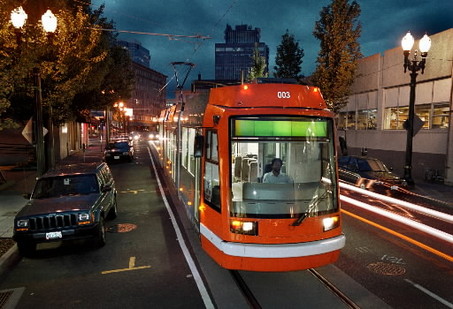
A certain Randall O’Toole, a conspicuous member of the Cato Institute hates LRT and streetcars. A favourite of the roads lobby he is also the darling of the United States rising Libertarian and Tea Party. Much of what O’Toole writes about come from the theory that public anything is bad and individualism reigns. The problem is, as history has shown, is not so cut and dried.
The following study comes from the American right, which by Canadian standards is what the old Progressive Conservative Party was and not the Tea party clones like the current Harper and the BC Liberal governments.
The following is written from an American standpoint, by a Conservative think tank as a rebuttal of the Libertarian AgitProp written by Randall Oai??i??Toole.Ai?? Some of it is USA-specific, but many of the arguments and much of the data are of use to proponents of trams as superior public transport in Canada.
I believe the the following study is well worth the read.
The-Small-Minded-Anti-Streetcar-Conspiracy-FINAL
SkyTrain Whitewash Continues
TransLink can’t help it. It is inbred in them. Honesty is just not in their lexicon. They hire a SkyTrain type, at $1,200 a day to do a review of the two recent embarrassing shutdowns. It is like the police investigating itself.
What should be a truly independent review, will be another SkyTrain “whitewash”, with a SkyTrain type enjoying the TransLink “gravy train“.
There was never any need for a review, especially a $1,200 a day review, but too many politicians glad handing SkyTrain were embarrassed, the supposed ‘wunder system’ wasn’t so wonderful, especially with transit customers abandoning derelict SkyTrain cars in droves, like rats leaving a sinking ship.
The public are tired of TransLink’s ‘Dog and Pony’ shows and the upcoming review will achieve nothing, but another expensive scrap of paper deflecting blame.
Independent review of SkyTrain outages may take until October
Transit expert who helped launch system in the 80’s to head review
He will be paid a daily rate of about $1,200 for his work, said Jarvis.
A handful of interim changes are slated to be made during the three month-period while McNeil is preparing his report. They include putting the train’s public announcement system on a separate breaker and testing the system’s volume levels so people can understand the messages being sent.
The transit authority is also looking at boosting the number of buses and staff at bus-bridge loops and stations and launching a public information campaign to inform riders as to what should be done during future outages.
“When these things happen during rush hour, your fleet is fully booked out and occupied, so what reasonably can be done with the equipment available and staff available is limited. That’s why it’s so important around the communication,” said Jarvis in an interview. “We’re going to start to communicate out as you would in any travel what plans you need to make. People that really rely on SkyTrain, for instance, aren’t familiar with the bus network as much, so getting an understanding of what your local bus services are and what your options are is one example (of how) we could help our customers.”
Along those lines, TransLink has already made a change to its online Trip Planner, allowing customers to design trip plans that don’t rely on the SkyTrain, something that many riders had suggested during this month’s system failures.
The Expo and Millennium lines were shut down for more than four hours during both of the outages. The first was caused by a failure with the computer system that controls the Expo Line and the second happened when the main power control panel was taken out of service by mistake.
TransLinkai??i??s seven ai???deadly sinsai??i??
The reverberations of TransLink’s double SkyTrain fiasco continues to echo in Metro Vancouver.
I think transit customers can understand system wide shutdowns, but when the captain and crew leave the passengers to fend for themselves, then very pointed questions will be asked.
Jordan Bateman has become a serious thorn in the side of regional bureaucrats, exposing waste, but I wish Mr. Batemen dig a little deeper with SkyTrain’s largesse, but that, I think, will expose Mr. Bateman’s Liberal friends. He digs, but doesn’t dig deep.

TransLinkai??i??s seven ai???deadly sinsai??i??: Art installation and Compass Card snafu just a couple of its dubious spending decisions
Ai??By Michael Smyth, The ProvinceJuly 26, 2014
What do stranded commuters trudging wearily along the SkyTrain tracks and a giant porcelain poodle sitting on top of an eight-metre-high pole have in common?
Both are examples of a Metro Vancouver transit system that has lost its way and gone to the dogs.
The commuters who abandoned their crippled SkyTrain cars were among thousands inconvenienced by a rash of SkyTrain breakdowns.
The giant porcelain poodle was part of a recent $100,000 public art project TransLink sponsored.
The point: Maybe if TransLink spent more of your money on an efficient, safe transit system instead of on dog statues, people wouldnai??i??t have to risk their lives to escape broken-down SkyTrain cars.
An unfair comparison? TransLink thinks so. But the uproar over ai???poodles on pogo sticksai??? is just one example of dubious TransLink spending and mismanagement that upsets critics like Jordan Bateman of the Canadian Taxpayers Federation.
ai???There are so many examples ai??i?? I call them the ai???deadly sins of TransLink,ai??i??ai??? said Bateman.
Since no one was accidentally electrocuted during last weekai??i??s train-tracks exodus, maybe ai???deadlyai??? is too strong a word.
But thereai??i??s little doubt TransLinkai??i??s record is a spotty one. Consider:
Compass Card capers: The smart-card fare-gate system was supposed to stop freeloading fare cheats and offer greater convenience for the public.
It still might. But the system is already well behind schedule and $23 million over budget ai??i?? more than the cost of a backup computer system that might have prevented last weekai??i??s SkyTrain snafus.
Executive feeding frenzy: TransLink CEO Ian Jarvis made $394,730 in 2012 ai??i?? more than Premier Christy Clark and even more than Prime Minister Stephen Harper.
More significant, Jarvis made $88,000 more than Torontoai??i??s transit CEO and $97,000 more than Montrealai??i??s. The comparisons get uglier south of the border. Jarvis made $203,000 more than the King County transit boss in Washington state, and $166,000 more than the transit CEO in Portland.
Sunday is payday for SkyTrain cops: The budget for TransLinkai??i??s independent police force was $27 million last year and is set to rise steadily.
Among the cost drivers: a contract that pays officers a 25-per-cent bonus if they work Sundays. Try finding a deal like that in the real world.
Wasted space: TransLink has been paying $60,000 a month to rent a Burnaby warehouse where it planned to restore aging SkyTrain cars.
But the union representing SkyTrain workers complained in March that much of the building is sitting empty.
ai???The top floor is totally vacant and the warehouse is totally vacant,ai??? Bill Magri, president of CUPE Local 7000, told the Burnaby Now newspaper.
ai???What bothers me is the outright waste and the poor financial decisions made by TransLink.ai???
Directors multiplying like rabbits: Why have just one board of directors when you can have six?
TransLink has its own a board of directors, of course. But so does the Transit Police. And the B.C. Rapid Transit Company, which operates the Expo and Millennium SkyTrain lines. And the Coast Mountain Bus Company. And the West Coast Express. And then there are the 23 members of the TransLink Mayors Council.
Salaries for all the members of all those boards in 2012: $751,589.
The too-short sound wall: After years of pressure from Pitt Meadows residents, TransLink decided last year to tear down a sound-blocking wall meant to shield residents from the noisy Golden Ears Bridge.
The problem? The first sound-blocking wall was shorter than the trucks rumbling noisily over the bridge, driving neighbours nuts.
The solution? Rip the wall down and build a new one thatai??i??s one-and-a-half metres taller.
ai???Itai??i??s just, ai???Roll the windows down and throw the money out of the window and weai??i??ll build a new one,ai??i??ai??? lamented Pitt Meadows Mayor Deb Walters.
ai???Itai??i??s very frustrating, especially when we talk about finding funding for TransLink.ai???
The cost of the taller wall: $817,000.
Public art: Which brings us back to those porcelain poodles on pogo sticks. Despite controversy over that Main Street installation, TransLink plans to spend more on public art.
TransLink approved spending $615,000 on public installations at three SkyTrain stations last year, despite complaints the money would be better spent on actual transit improvements.
ai???The TransLink people are always crying for money from local government,ai??? Delta Mayor Lois Jackson told the Burnaby News Leader. ai???But, on the other hand, theyai??i??re spending money as if it comes from a bottomless pit.ai???
Hereai??i??s the biggest problem for TransLink: Public confidence has been eroded by this stuff at the same time that TransLink wants more money from the public.
ai???Why should anyone trust TransLink with $500 million more a year in taxes when they canai??i??t manage the $1.4 billion they already get?ai??? asks Bateman, TransLinkai??i??s fiercest critic.
It brings a fierce response from TransLink.
ai???We do not have the resources to investigate each one of his (Batemanai??i??s) claims, nor is the public purse well served by going down such dirt trails when we have important operations and communications matters to pursue,ai??? said Cheryl Ziola, TransLinkai??i??s manager of media relations.
If we ever get that referendum on TransLink funding, taxpayers may get the last word.
SkyTrain Fizzles Again! Passengers Abandon SkyTrain Like Rats leaving a Sinking Ship!

Oops, SkyTrain fizzles again with scores of passengers abandoning the Skytrain and walking down the tracks to escape the damned thing.
It certainly looks like transit customers are completely fed up with SkyTrain and TransLink wants to build more?
‘Computer glitch’ shuts down SkyTrain again; some passengers walking on tracks to stations
July 21, 2014 2:32 PM
TransLink is warning passengers to make other transportation arrangements after SkyTrain has been shut down on the Expo and Millennium lines, due to a technical problem.
Photograph by: @myzrahi, Twitter
METRO VANCOUVER — TransLink is advising passengers to make alternate arrangements to get home this afternoon following a system-wide shutdown on the Expo and Millennium lines for the second time in a week.
Media spokeswoman Jiana Ling said TransLink has no idea when the system will be up and running again, after a communication glitch shut down all the trains on the system, leaving many passengers stranded in trains on the tracks, starting at 12:30 p.m.
TransLink has added enough buses for about four hours to service the entire SkyTrain system.
“We advise them not to take SkyTrain today,” she said. “They should use the existing bus network to get home.”
TransLink did not provide details on the cause of the shutdown but was evacuating all the stations along the two SkyTrain lines. The problem also means TransLink can’t communicate with passengers in the trains on the platform.
Droves of passengers could be seen carrying everything from babies to boxes walking along the trains near Main and Stadium stations. At 1:30 p.m., TransLink asked “anyone inside the trains to stay put for safety, noting SkyTrain attendants will be driving trains back to stations asap.”
“Due to at the high-voltage tracks and risk of injury or death, passengers should stay in the trains,” said a statement issued by TransLink. “We are still encountering passengers illegally leaving the trains mid-station which compromises the situation.”
Ling said Transit police and security are trying to manage the problem of people forcing the doors open. “We know it’s unfortunate and inconvenient but it’s much safer. It’s life-threatening really.”
This is the second time in a week that service was halted on the Expo and Millennium lines.
Last Thursday, a computer problem caused a similar delay on the system, prompting many passengers to force open the doors of the cars. TransLink warned passengers not to leave the cars without an attendant.
The problem does not affect the Canada Line.
TransLink is asking passengers to use its online trip planner tp.translink.ca and select the drop down menu option “DO NOT USE SKYTRAIN” to get the alternate bus route home.
“We appreciate your patience as our technicians attempt to get the system functional again,” TransLink said. “Further updates will be available as we know more.”

Remembering Edson L. Tennyson, icon of rail public transport advocacy and development
Zwei belongs to the LRPPro blog and soon began to know that a one Ed Tennyson was someone to listen to as he was a walking encyclopedia of transit knowledge.
Probably no one in Metro Vancouver has ever heard of Mr. Tennyson, but his influence has certainly been felt in Canada. In the short time I have been a member of the LRPPro blog, I have respected Mr. Tennyson’s well researched comments, even though I disagreed on some of his thoughts, he was a giant in the industry and a giant promoting light rail.
Remembering Edson L. Tennyson, icon of rail public transport advocacy andAi??development
With profound sorrow we have learned of the loss of our close colleague, the renowned transit industry icon Edson L. Tennyson.
Shortly after his 92nd birthday, Ed, senior technical consultant to the Light Rail Now Project, passed away at his home near Washington, DC on 14 July 2014 following a valiant struggle with cancer. He intrepidly had continued to post his insights and analysis of transit issues on the LRPPro listserve, to the benefit of hundreds of colleagues belonging to younger generations of rail transit advocates and professionals.
Two of Edai??i??s daughters, Marilyn Tennyson and Marjorie Tennyson, were with him in his final days. He is also survived by another daughter, Connie McCarthy, and by his wife of 70 years, Shirley Forward Tennyson.
Services will be held on Tuesday, 22 July 2014 at 2:00 PM at the Vienna Presbyterian Church in Vienna, Virginia.
Ed Tennyson was perhaps the most prominent U.S. public transport expert, still professionally active, who had actually worked for the original interurban and urban electric railway industry, and who also, in the words of Greg Thompson ai??i?? Chair of the Light Rail Transit Committee of the U.S. Transportation Research Board (TRB) ai??i?? ai???understood the fundamentals of successful transit.ai???
In postings on the LRPPro listserve, Ed often cited his youthful experience riding the once-extensive electric trolley system of New Jersey Public Service, mainly in northern New Jersey. He also drew upon lessons from his stint as a station employee for Greyhound.
After completing two management engineering degrees, Ed began his main public transport career at Pittsburgh Railways, subsequently moving to a management position with Milwaukee Rapid Transit. There, as described by Lawrence Lovejoy, a Senior Supervising Engineer for Parsons Brinckerhoff, Ed was particularly involved with developing the Speedrail system, an effort to reorganize remnants of the Milwaukee regionai??i??s once-extensive interurban system into a suburban rapid transit service.
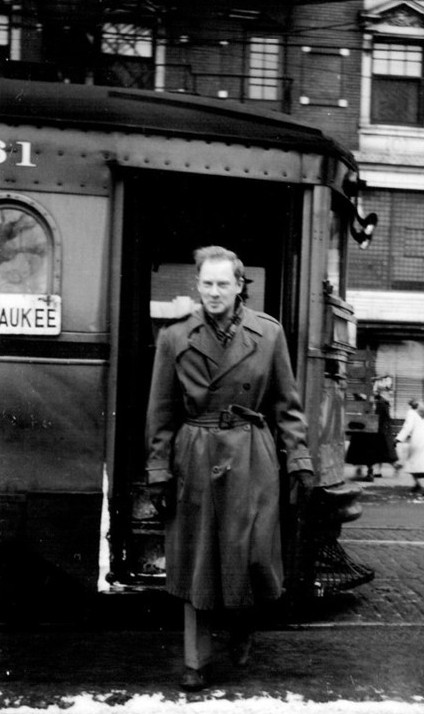
Ed Tennyson stepping from a Speedrail electric interurban car, c. 1950. Photo via Lawrence Lovejoy.
While Edai??i??s formative experience was gained in the course of a largely unsuccessful struggle to retain electric rail and trolleybus operations during the U.S. Transit Devastation era, his understanding and insights have proved invaluable to colleagues, and influential in the revival of electric surface railways over the past four decades.
In 1951 Ed was appointed City Transit Commissioner for Youngstown, Ohio, championing the cityai??i??s electric trolleybus system which remained in operation until 1959. He served Youngstown until 1956, when he became the Chief Transit Engineer and Deputy Commissioner of Transportation in Philadelphia.
According to Tom Hickey, Chief Development Officer of Virginia Railway Express and chairman of the Streetcar and Heritage Trolley Subcommittee for the American Public Transportation Association, Ed helped helped ai???reimagineai??? Philadelphiaai??i??s Center City ai???as we know it todayai???, with ai???Penn Center and Market East and Independence Mall redeveloped into open urban spaces centered around transit, not the automobile.ai???
Tom adds the following about Edai??i??s achievements in this period:
When other cities were ripping up street railways and building urban highways, Ed was key to crafting Philadelphiaai??i??s policy to eschew the temptation of cheap federal dollars for roadways and focus on preserving rail transit through what we today accept as public-private partnerships with the railroads and then-private transit companies. He is one reason ai??i?? that Philadelphia is still by far the largest street railway operation in the US. He extended the light rail ai???Subway-Surfaceai??? tunnels under the Schuylkill River lines and University City to their present portals.
In rail rapid transit, he extended the Market-Frankford El to 46th Street at the same time as the Subway-Surface extension. The ai???Almond Joyai???A? el cars were purchased under his watch as well. He led the extension of the Broad Street Subway to the Sports Complex in South Philadelphia. He was highly influential in the creation of PATCO [Port Authority Transit Corporation] ai??i?? both in extending the predecessor Bridge Line under the streets of Philadelphia from 8th & Market to 16th & Locust and in splitting the Lindenwold High Speed and Broad Street Lines into the configuration we know today.
As for commuter rail, Ed formed the Passenger Service Improvement Corporation in the late 50s with the then-unheard of proposition of giving public money to private corporations (the Pennsy and Reading) as reimbursement for the losses incurred in commuter rail service, as well as providing new rolling stock to do so (Silverliners I, II and IIIs plus RDCs for the Reading diesel lines). He was the force behind linking Philadelphiaai??i??s two commuter rail networks through the Center City Commuter Connection, as well as the Fox Chase electrification, Airport High Speed Line and retention of the PRR Norristown Line as far as the City limits (Ivy Ridge).
Finishing in Philadelphia as Deputy Commissioner of the Department of Public Property for Transit Engineering, in 1972 Ed was appointed by Pennsylvania Governor Milton Shapp to the position of Deputy Secretary for Local and Area Transportation in the stateai??i??s Department of Transportation (PennDOT), where he served for seven years. It was in that position that he helped steer Pittsburgh away from totally eliminating what remained of its former streetcar system and toward converting the most important lines into a modern light rail transit system. As Greg Thompson relates, Ed was influenced by similar developments in Europe:
He grasped immediately the idea that German light rail, which evolved from streetcars in Germany, was a new transit mode faster, higher capacity, and more productive than both buses and traditional streetcars. He understood that for those reasons light rail could be configured as the backbone of regional multimodal transit systems that attracted high ridership and were productive.
Energized by those developments, recalls Greg,
Ed tirelessly advocated the potential of Pittsburghai??i??s streetcar system, fighting not just against its abandonment, but for its reconfiguration into trunk lines. What has remained would not have remained had Ed not carried on the good fight. He also researched the relative performance of busways in that city, revealing the chasm between what they promised and what they actually delivered.
High among Edai??i??s other achievements in his Deputy Secretary position was to improve intercity rail service ai??i?? particularly ai???resuscitating Keystone corridor rail service between Harrisburg and Philadelphiaai???, according to Greg.
When his term with PennDOT expired in 1979, Ed moved on to a role as consultant for the new San Diego Trolley project, helping to guide startup operations there, and with several other transit entities. Then, in 1983 he was appointed Public Works Planning Coordinator for Arlington County, helping to complete the Metro Orange Line to Vienna, Virginia.
Following that, in 1992 he retired ai??i?? nominally. But in reality, Ed stayed very active as an advocate and advisor to others pursuing important public transport projects, especially rail. In 2000, he was one of the original members of the Light Rail Progress Professional (LRPPro) listserve, an online forum where his analysis and advice have been of enormous value to other professionals and advocates striving to develop and improve rail public transportation. In recent years, he served on the Fairfax County Transportation Advisory Commission, and as an emeritus member of the Transportation Research Board of the National Research Council. Until a few weeks before his death, Ed was working with engineering consultant (and LRPPro member) Alan Drake on a proposal for expansion of Washingtonai??i??s Metro system.
Edai??i??s legacy rests not just with his many direct achievements in the physical development, improvement, and operation of public transport systems, but especially with the vast influence he has had within the industry and in the thinking of other professionals. Tom Hickey emphasizes that
Ed was a determined, tireless, and often effective advocate of doing things right. He was eternally generous with his opinions (even when unsolicitedai??i??) and always challenged those around him to extend their reach.
Tom also cites the Biblical passage, ai???You shall know them by their fruits.ai??? (Matthew 7:16.)
A flurry of condolences and eulogies has been posted to the LRPPro listserve, on which Ed had been so active and influential for 14 years. Bob Reuter, a dedicated rail transit advocate in the Baltimore-Washington area and a transportation engineering consultant, posted the following:
My deepest condolences, and he already has left a hole in the fabric of the transit community.
I knew Ed professionally and as a friend for well over 25 years and he was never anything but the consummate gentleman.
I have saved every one the 5459 messages he sent to this list. I hope to be able to bring order to his posts and maybe repost them at a future time. His wit and wisdom will be greatly missed
Again my deepest condolences to the family; you will all be in my prayers.
Expressing profound sadness, Lyndon Henry, founder of the Texas Association for Public Transportation (TAPT), technical consultant to the Light Rail Now Project, and a contributing editor to the Light Rail Now website and blog, noted that
Ed has been my most influential mentor. I will miss his advice, wisdom, and inspiration more than I can express.
In a message of condolence to the Tennyson family, Dave Dobbs, TAPT Executive Director and publisher of Light Rail Now, wrote the following:
Edson Tennyson was a great friend and mentor for the last 23 years. He was foremost among those who sought to bring back a rational transportation system to America, the professor emeritus of public transit, and in that effort he inspired the rest of us to make the world a better place in every way.
I will miss his sage advice, his insights and his careful analysis of the all important numbers that he so enjoyed presenting to the world. LRPPro, started by Lyndon Henry, grew out of our website, LightRailNow! (www.lightrailnow.org), which Ed inspired with his charts, graphs and commentary that he presented at the Dallas Rail-Volution in 1999. I had the honor of converting those incredible materials into electronic format, which, in 2000, became a website that now has thousands of pages and numerous articles by Edson Tennyson and is used by many in the transit industry for information.
Lyndon Henry, Roger Baker and I and others here at TAPT offer our condolences. Please know that while your personal loss is immeasurable, our loss and the loss to the transit industry is shared with you in a very keen way. Ed was one of the greatest generation; a soldier right up to the end, he continued to give to his country and the world. May he rest in peace and may you find peace in knowing how much Ed meant to others.
And Greg Thompsonai??i??s eulogy undoubtedly expresses succinctly the feelings of most of us that knew Ed Tennyson well:
I shall miss him, but I also am comforted in the fact that his work is responsible for the industry being on a plane higher than it would have been without him.

SkyTrain Fizzles Again
The problem with driverless transit systems is that when there is a problem, there is no driver to drive the damn thing if things go wrong.
As SkyTrain ages, stoppages like this will become more common.
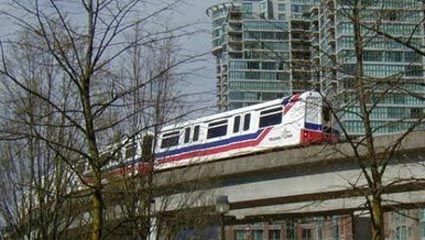
Computer problems cause major SkyTrain disruptions
Crews are working to fix the problem, but it could take a while
News1130 Staff July 17, 2014
BURNABY (NEWS1130) ai??i?? If you know someone taking SkyTrain home this evening, they may be late.
The trains are not running east of Metrotown because of a computer problem.
Commuters are warned to expect major delays, Jiana Ling with Translink says crews are working to fix the problem, but she says there will be delays until at least 9 p.m.
The Millennium line is down between Braid and Sapperton and the Expo line is stopped between Royal Oak and King George. There is limited service from Waterfront to Metrotown station as well as Lougheed to VCC-Clark station.
A bus bridge is in place between Metrotown and King George where there is no service. Ling says they are advising customers to use the existing bus network as the bus bridge might not be as reliable.
She says the company understands the severity of the situation, and are thanking people their patience and are apologizing for the inconvenience.
************************************
Major SkyTrain delays snarl afternoon commute
By Staff Reporter, The Province July 17, 2014The crowd at the Scott Road SkyTrain Station.
Photograph by: Jennifer Saltman , @jensaltman
An apparent computer glitch has prompted a system-wide hold on the Expo and Millennium Line SkyTrains on Thursday, stranding hundreds of passengers for hours and delaying transit service across the region.
Delays first began around 4:45 p.m. with intermittent service on various sections of the Expo and Millenium Lines.
Several trains carrying passengers were stopped on various parts of the system and had to be manually driven into stations to let passengers out.
At least one impatient passenger on board an Expo Line train car, halted between Columbia and Scott Road stations, pried open the trainai??i??s doors in order to walk along the track back toward the station, according to a witness on board.
Two hours after issues first arose, the Expo Line was up and running between Waterfront and Metrotown stations, but did not continue to King George. The Millennium Line was also running between Waterfront and Metrotown, and between VCC-Clarke to Lougheed stations, but not between Royal Oak and Braid.
Just after 6 p.m., SkyTrain attendants at Scott Road station also told some passengers it would be five hours before problems were resolved at the problem sections, while Fred Cumming, president and general manager of B.C. Rapid Transit Company, tweeted that a resolution would take two hours.
Many stations along the problem section appeared out of service for the remainder of the day, with gates closed.
Commuters were advised to make alternate travel plans or to take existing bus routes.
It remains unclear what prompted the initial hold, but passengers reported announcements at stations that said it was an electrical issue of some type and that delays could be long-term.
Ai?? Copyright (c) The Province




Recent Comments