Send in the clowns – Urban Land Instituteai??i??s Governorai??i??s Advisory Panel
Really, one tires of this nonsense that Broadway needs a subway.
If the truth were to be told, the Vancouver city fathers want a subway under Broadway because they feel it would make Vancouver a “world class city” and the current political party in power want to reward its developer friends with windfall profits up-zoning properties to allow densification.
As mentioned many times before on this blog, there isn’t the ridership to justify a subway under Broadway and with current planning not reducing auto capacity on Broadway, transit ridership will increase very little, yet the cost of operating transit on Broadway will greatly increase, with now a subway to maintain and operate on top of the cost of the buses operating above. There are no cost savings with a subway, unless there is a mass of ridership to sustain it and current ridership on Broadway falls way below this mark.
So send in the clowns with the Urban Land Instituteai??i??s Governorai??i??s Advisory Panel, with all the usual talking heads and self proclaimed experts to bleat for a SkyTrain subway.
I think the the Vancouver Sun and the city of Vancouver should realize by now that the public have caught on with your little con game and all the infomercials you print will not change that.

Advisory report suggests building Broadway transit line in phases
Ai??By Kelly Sinoski, Vancouver Sun July 13, 2014
VANCOUVER ai??i?? The City of Vancouver should consider building a new transit line along Broadway in phases, while restricting high density to the busy commercial core to preserve the cityai??i??s character in the neighbourhoods along the route, according to a new report.
Issued by the Urban Land Instituteai??i??s Governorai??i??s Advisory Panel, the report suggests the public should also be consulted, noting Vancouver ai???did not balance zoning changes with economic potential and community livabilityai??? when it built other mass transit projects ai??i?? specifically the SkyTrain ahead of Expo 86 and the Canada Line for the 2010 Winter Olympics.
ai???Invariably, stakeholders perceived that neighbourhood impacts were overlooked or under-represented in order to fast-track major transportation projects. ai???Blanket up-zonesai??i?? were applied at transit hubs, leading to rampant speculation and dislocation of residents and businesses,ai??? said the panel, which included experts from across North America.
ai???Although the panel recognizes that the market may ultimately dictate a lot of development decisions that accompany the growth in population and the increased opportunities that a mass transit line brings, it also recognizes that the local neighbourhoods and districts give Vancouver much of its charm.ai???
Vancouver has long been pushing for a subway line from Commercial-Broadway SkyTrain station to the University of B.C., maintaining it is one of the busiest transportation corridors in North America. TransLink has cited the line, along with light rail in Surrey, among its top priorities, but the projects are stalled as regional mayors attempt to come up with new funding sources, such as a carbon tax or vehicle levy, to pay for them.
The panel noted that ai???existing transit along the Broadway corridor is a failure under current conditions,ai??? with 49 per cent of all westbound rapid bus passengers headed for Central Broadway, including Vancouver General Hospital, and 38 per cent continuing on to UBC, according to the report. Transit on the corridor is at capacity.
Even with conventional bus services running every two to three minutes, more than 2,000 passengers are left behind at the Commercial-Broadway Station every morning.
Zwei comments: These passengers are not left behind, rather they have to wait for another bus. This demonstrates very bad management, but if an extra 3 or 4 B-Line buses were to operate on this route or if the trolley bus line had stops every 400 metres to 500 metres (as in Europe) instead of every 200 metres, offering faster journey times, maybe the pass-ups would disappear. Bad management has more to do with pass-ups, than the need for a subway.
Here is something else to think about.Ai?? If buses were operating at one minute frequencies or less during peak hours, then you have the ridership that would demand LRT. If you have trams operating at one minute frequencies or less (keeping in mind one tram is as efficient as 3 to 5 buses), they you have the ridership that would demand a subway!
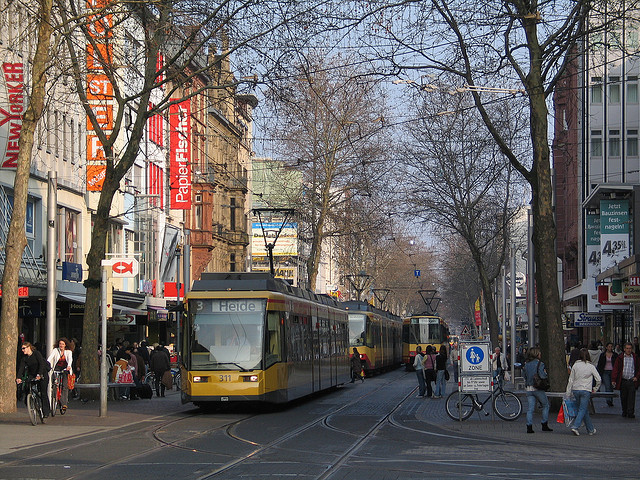 The “Gelbe” or yellow wall of trams in Karlsruhe, Germany
which necessitated the need for a subway.
But the development of the line should be done slowly, the report urges, noting a ai???one size fits allai??? rezoning across the Broadway corridor is not appropriate for economic or residential vitality.
The panel noted new development along the Broadway corridor should be concentrated in existing commercial zones, which are only about 60 per cent built out in the corridorai??i??s central core. It also suggests that institutional entities within the corridor such as the University of B.C. and Vancouver General Hospital participate actively in the planning of station locations and phasing, and ai???if at all possible, would provide financing contributions.ai???
The reportai??i??s recommendations come as many municipalities face public opposition in their quest to densify regional town centres in a bid to contain growth in urban centres and protect agricultural and industrial areas ahead of another one million more people coming here by 2040. Residents in Vancouverai??i??s Marpole, for instance, had complained the city was trying to shove density on them, as part of a pitch to connect two developments along the Cambie corridor, which will each add more than 4,000 people. City council has since revised the plan.

In Search of the Light Rail Renaissance
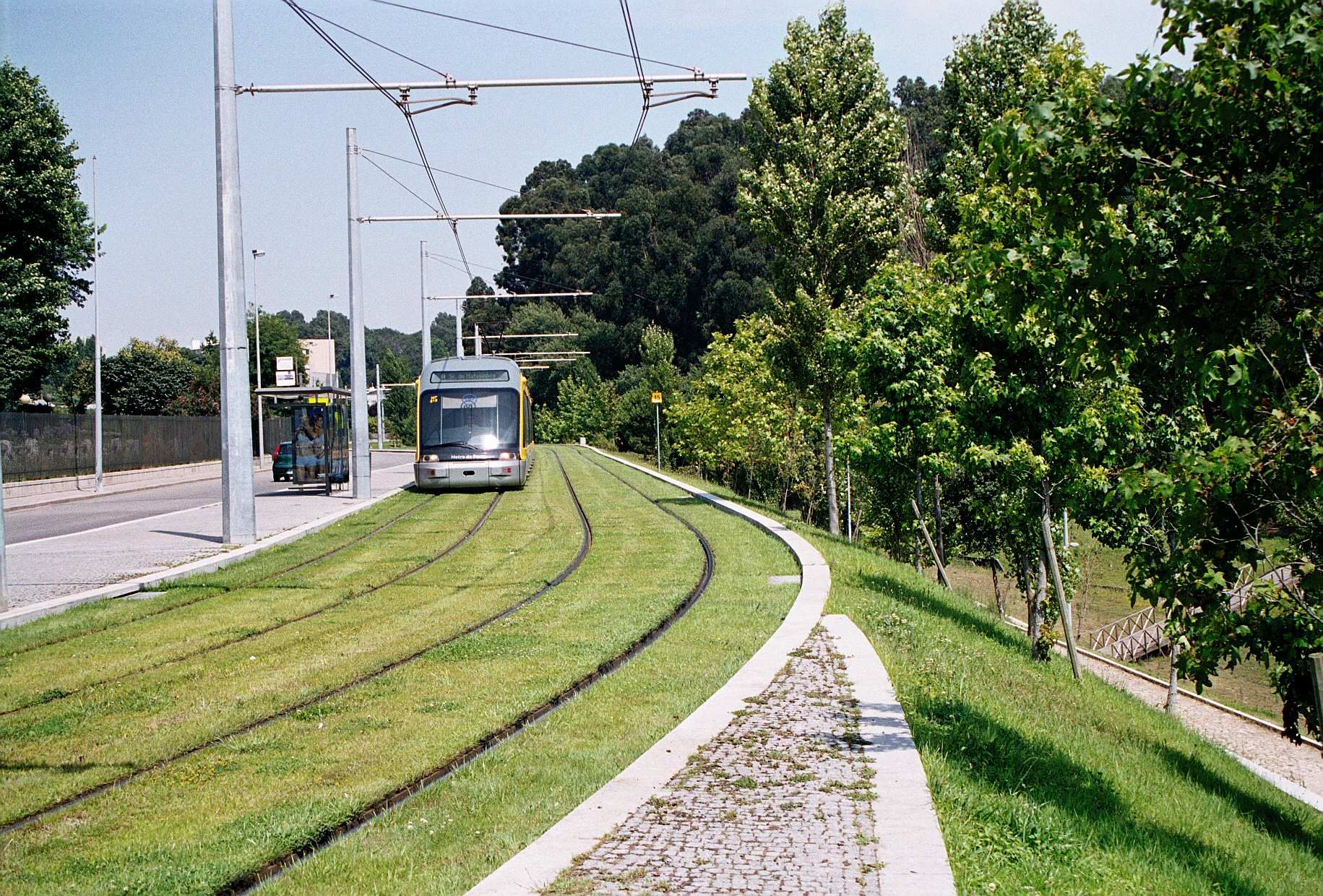
A little history.
On April 22, 1978, the city of Edmonton heraldedAi?? a new era of what we now call light rail transit, with the opening of its first 6.9 km, LRT line.
Using the now venerable Siemens U-2 vehicle, which was designed for the Frankfurt U-Bahn metro system. Edmonton’s new LRT line set the standard for modern LRT in North America.
In Europe, it was a different story, where tramways were being abandoned in the 1960’s and 70’s in favour of subway construction and/or gadgetbahnen, like the VAL mini-metro. Huge construction costs combined with large debt servicing and disappointing ridership, made subways extremely expensive to not only build, but to operate. As the subway costs increased the level of service on non subway services diminished.
The burdensome cost of heavy-rail metros, either in subways or on viaducts, encouraged the mini-metro, like VAL, which were somewhat successful in operation, yet their own high costs and lack of operational flexibility prevented wide spread expansion.
In France, where auto congestion was reaching new heights, the central government was planning major expenditures in public transit, but focused on the VAL mini-metro, then owned and produced by MATRA, France’s chief arms manufacturer.
The first major VAL installation, opened in 1983 in Lille France and today the 45 km. VAL network comprises of two lines, providing quality public transport for almost 100 million customers annually, but there was a problem, the VAL was both expensive to build and expensive to operate.
So expensive was VAL, that it was far cheaper to completely refurbish, with new tracks and cars, a worn out metre gauge interurban line, locally known as the Mongy.
Many French cities contemplating building with the VAL light metro took note.
The French government offered to underwrite the first VAL Line (it was thought that a lack of confidence in VAL, meant a lack of confidence with MATRA, the French arms manufacturer), with the operating authority paying for extensions. Though the offer tempted some cities to build with VAL, prudent city fathers foresaw the ruinous costs to extend the initial small VAL Line and opted to build with modern LRT or the “tram” as light rail is called in Europe.
In France, as of 2013, there are 25 operational tram systems, with three under construction and many more in various stages of planning. Only six VAL mini-metros have been built, including Lille, with two being airport people movers.
The same is true of VAL’s competition in North America, with the Canadian ICTS/ALRT/ART proprietary transit system, locally called SkyTrain, with only two being built in Canada (two SkyTrain’s have been built in the USA, with one being an airport people mover and the other a single track loop demonstration line) despite the federal government trying to force SkyTrain on various operators.
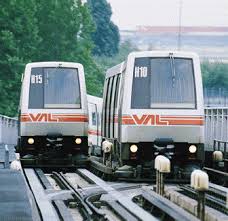 VAL in France
Ai??Low-floor cars and the reserved rights-of-way
In Germany, until the early 80’s, it was thought the city tram would be all but extinct by the year 2000, replaced mainly byAi?? S-Bahn’s and U-Bahns. As U-bahn or subway costs soared and ridership on the new subways were at very disappointing levels and S-Bahns mainly used larger articulated tram stock operating on existing railways, planners in Germany and elsewhere once again looked at the tram.
To make trams faster and carry more people, trams had to be designed to be cheaper and faster.
To make trams faster, tram designers reinvented the low-floor tram, permitting shorter dwell times and reinvented the 1930’s concept of the ‘reserved rights-of way’ (R-R-o-W) or a R-o-W reserved for the exclusive use of the tram. The combination of the two, plus priority signalling at intersections, gave the tram and operating capability that was on par or better than the proprietary mini-metros on the market, at a much cheaper price.
The unintended consequence of the low-floor tram was that it was ideal for the mobility impaired transit customer, giving him or her complete access to the tram system without cumbersome and expensive wheelchair lifts, hoists and ramps. So popular was the low-floor tram that a new category of mobility impairment was created and that was babies in prams and their caregivers. Cities investing in new low-floor trams saw a dramatic rise with mothers and fathers with infants and small children as the low-floor car made travel by public transit that much easier.
It was found that just 40% of a tam line operating on R-R-o-W’s could permit a tram to compete against mini-metros and the more RRoW on a tram line the faster the commercial speed and the ability to compete against all but the largest metro lines.
Today in Europe, the modern tram line operates mostly longer modular cars on mostly R-R-o-W’s many lawned throughout making the tram line a linear park, a vital part of the cityscape.
This is what we call the Light Rail Renaissance.
Ai??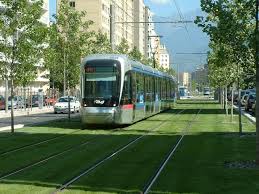 Classic lawned R-o-W in Grenoble, France
North America
LRT construction in North America was and still is strong, but the evolution of LRT has not progressed very far, with light rail seen as a interurban, being completely different than a streetcar, with LRT and streetcar lines being segregated. Propelled by both political intrigue and planning hubris, the positive effects of modern LRT has been retarded. There are exceptions such as Calgary, which carries more customers than any other new build LRT line and Portland, where planners have the foresight (and political backing) to plan for 20 or 30 years from now, giving Portland the LRT network it needs to attract the motorist from the car. Portland was also the first North American city to order low-floor cars.
On the same theme, Toronto will be operating the first modular low-floor cars in North America, soon to be followed by Ottawa, yet the economics of modular cars are poorly understood on the North American continent. In fact, several transit professionals in the USA still cling to the venerable PCC car and remain blind deaf and dumb, with events in Europe. Equally misunderstood is the concept of the R-R-0-W, one of the hallmarks of the light rail Renaissance, where hugely expensive grade separations, either on viaduct or in a subway, hold sway.
The current hubris with the Light Rail Renaissance has made it possible for proprietary mini-metros to compete against LRT, as LRT projects with major grade separations, either in viaduct and or subway has made the cost of light rail almost as dear as subway construction. There are many reasons for this, including the concept that new transit construction not interfere with road capacity; planners who receive in payment a percentage of the cost of a new transit system, thus giving no incentive to build cheaply; politicians who use new transit systems as an election ploy and spare no cost to make the transit look good to encourage voters; and a North American arrogance that they are better in providing good public transit and ignore or pooh-pooh European transit developments.
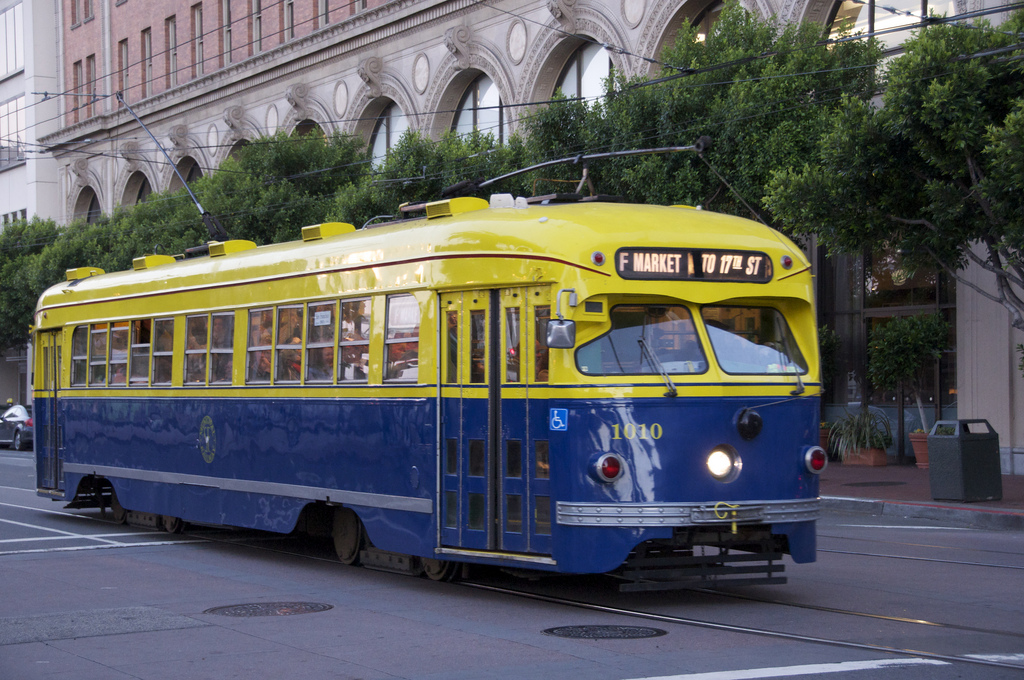 Many US planners pine for the venerable PCC
Canada Again
It is in Canada, where modern LRT was first operated, the Light Rail Renaissance is beginning to take hold.
Toronto is replacing its aging tram fleet with European style low-floor modular cars, greatly increasing capacity and reducing operating costs and in Ottawa, classic low-floor modular cars, built by Alstom are the feature of the city’s new light rail line.
With the low-floor modular cars, also is the concept of the reserved rights-of-way, though many city planners have yet to understand the difference (or lack of difference) of a R-R-o-W and full grade separation, or that a R-R-o-W is much cheaper, yet gives the same effect of a subway or viaduct operation.
The lawned or grassed R-o-W is also a new concept that is greatly misunderstood and in Toronto, the fire department nixed the idea of lawned R-o-W’s for fear their fire appliances would get bogged down on them, despite the fact there are measures in place to prevent this.
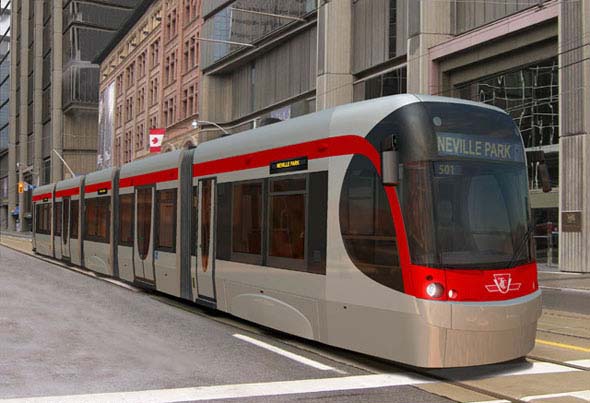 The modern low-floor modular car in Toronto.
Ai??Slowly, ever slowly the Light Rail Renaissance is reaching our shores and more and more planners are embracing what modern LRT can achieve. There are nay-sayers; there are Luddites, who don’t want to change, but as a new generation of public transit planners are taking over, the old ways and the old concepts are slowly becoming a thing of the past and hopefully soon, all transit planners in North America will embrace the Light Rail Renaissance, just like another Renaissance four to five hundred years before.
The future is modern light rail and the future is very friendly!
Trams save operating costs!
Confirming what Zwei has been saying for the past few decades, on modern streetcar or tram is as efficient as four to six buses.
The key statement from TTC Chair Councillor Maria Augimeri; “………for every streetcar removed from the downtown core, they would have to be replaced with 3-5 buses.”, confirms what Zwei has been saying has more thanAi?? shred of truth. Of, for every tram or bus operated, one needs over 4 people to drive, maintain, and manage them. WhatAi??TTC Chair Councillor Maria Augimeri is really saying, to switch from trams to buses will cost a lot more to operate on an annual basis and that on top of the $2 billion lost for the cost of the trams and track refurbishments.

TTC Chair warns of cost of getting rid of streetcars
Augimeri says it would cost the city $2 billion
The head of the TTC says if Rob Ford phases out streetcar service it would put the city in a costly hole – funded by taxpayers.It’s a vow the mayor has made if he’s re-elected in October.TTC Chair Councillor Maria Augimeri says the the city would lose $2 billion dollars – those of the new streetcar fleet and related track renovations.
She says they would have to be sold. Augimeri stresses not only would the new streetcars be considered used vehicles but they would need costly modifications to be sold to other cities, since they were tailor-made for Toronto.
Augimeri says the city can’t afford that.
She adds for every streetcar removed from the downtown core, they would have to be replaced with 3-5 buses. She says that would increase traffic, making life “intolerable” for residents. –
Taking public transit kicking and screaming into the 21st century.

Though Zwei is not a fan of Jarrett Walker, our Ottawa friend, Haveacow, recommended this post from his blog.
http://www.humantransit.org/2014/07/california-topples-a-tyrant.html
It seems that transit improvements, especially light rail, have been hamstrung by ensuring that traffic flows are not reduced, which is the cornerstone of the light rail Renaissance, emanating from Europe.
So, our American friends are waking up to the fact that at-grade transit, which will reduce auto traffic is a good thing and is far cheaper than hideously expensive grade separated transit systems like SkyTrain or subways. The monies one saves by building at-grade, can be spent enlarging the system, attracting more transit customers by serving more destinations.
One wonders how soon this revolutionary thinking will take to reach Vancouver?
Liz James takes on TransLink
Liz James understands the problems that beset TransLink as she is one of the few columnists in the region who has taken the time to study the issue.
More and more, the City of Vancouver sounds like a spoiled child having a temper tantrum, wanting a $2 billion plusAi?? subway under Broadway. Plus because the subway is now another truncated rapid transit project which will stop many kilometres short of UBC at Arbutus, needing many billions more to complete.
There is a lot wrong with TransLink and it is as good as time as any to try to repair the flaws or discard the authority altogether.

TransLink funding model needs closer look
Elizabeth James – North Shore News – July 9, 2014“The purposes and objects of the authority are (a) to plan, acquire, construct or cause to be constructed public passenger transportation systems and rail transit systems that support regional growth strategies, official community plans and the economic development of the transit service areas…” – Chapter 38, Section 3(1) BC Transit Act (1996)
The South Coast Transportation Authority Act (TransLink) was surgically removed from the BC Transit Act (BCT) in 1998 and the two agencies are governed by separate legislation to this day.
Until recently, I had not compared the updated wording of some important sections of the two documents – purpose/responsibilities and funding.
I did so following the June 12 release of the latest Mayors’ Council $7.5-billion 10 Year Plan/30-Year Outlook because, yet again, the report recommends increased SeaBus service – presumably to appease North Shore taxpayers who have received little for the dollars they’ve poured into TransLink.
Now, I was curious to see whether BCT has experienced the same lack of provincial funding as has plagued TransLink for the past 16 years.
Although I still don’t have that answer, my efforts were rewarded by some interesting information.
First, although the BCT legislation is noted to be “Current to May 21, 2014,” it still makes reference to BCT’s responsibilities as “an agent of the government” with respect to “RTP 2000” – a project better known as the SkyTrain Millennium Line which, at a minimum, became the 40 per cent responsibility of TransLink in 1998.
Next, when you compare the tightly drawn responsibilities BCT has for the “purposes and objects” described in the BCTA with those loaded onto TransLink and regional taxpayers, it’s no wonder Burnaby Mayor Derek Corrigan suggested TransLink should be returned to provincial jurisdiction.
Why should the operating budget of TransLink cover development and administration of programs for “certifying motor vehicle compliance with Section 50 of the Motor Vehicle Act”? Why must TransLink “establish exhaust emission standards”; or determine and “specify the maximum levels of air contaminants that motor vehicles may emit into the outside atmosphere”?
Surely, items like those are better managed under the umbrella of ICBC, the agency from which the Liberals suck an annual $250 million in taxes and so-called “excess revenue” that we pay as our everincreasing insurance premiums.
Putting that in perspective for North Shore taxpayers, the 2013 quarterbillion alone could have purchased four SeaBuses and still had $150 million left over for other projects throughout B.C. More importantly, if we want to confine this discussion to transportation needs in the TransLink region, $400 million could buy outright approximately 14 kilometres of modern light-rail trams along the Broadway corridor and still have dollars available for a greenway along the route. Why so cheap? Well, as it happens, much of the necessary infrastructure is already in place for that option. To emphasize – international experience has proven that at-grade, “hop-on-hop-off” transit attracts ridership and thus is also good for business.
But Vancouver Mayor Gregor Robertson knows better. Deaf to the voices of Broadway business-owners and international experts, he wants a vastly more expensive underground tunnelling project. Is he hoping that another disruptive TransLink project would assume the costs of associated upgrades to City of Vancouver utilities? If so, are North Shore taxpayers content to subsidize that?
Meanwhile, District of North Vancouver Mayor Richard Walton and the Mayor’s Council he chairs continue to carry out their mandate.
With little encouragement from Victoria, they have presented years of reports and recommendations to a succession of ministers. Their support for the $7.5-billion recommendations carried with only one dissenting vote.
Corrigan opposed the overwhelming will of his colleagues, not because he thinks the transit options are unnecessary, but because the council has no control over how the projects are to be funded, prioritized or carried out.
So what was the reaction from the Minister of Transportation and Infrastructure, Todd Stone?
Well, after receiving the report from people in the best position to understand the up-to-date knowledge of regional transit issues, Stone wants you to decide how you want your ox to be gored to pay for it all.
He’s tasked the mayors with wording a referendum question that covers a widely disparate bundle of recommendations.
How can you vote Yes/No to a $7.5-billion levy/tax if you support only a few of the 17 “visions” in the bundle?
If we allow Stone to get away with it and we make an uninformed decision, then he can shrug and say, “Wasn’t my idea; you folks wanted it that way, now pay up.”
So, given the profligate history of TransLink, will you stay aboard for the ride? Or, like me, will you say, “Not a penny more for the black hole that is TransLink, until we can see the results of an arms-length evaluation of all major decisions by the entire operation”?
rimco@shaw.ca
Ai?? North Shore News
A Broadway subway: Do the numbers add up?
An interesting read from Toronto.
Two items of interest:
- Contrary to North American thought, 14,000 persons per hour per direction is not near the upper limit of modern LRT. In 2014, the upper limit for LRT is about 25,000 pphpd. Unfortunately, Toronto’s transit gurus still live in the land of non articulated cars.
- “An old ridership projection pegged peak one-direction usage at 9,500 passengers per hour, barely enough to justify a subway extension.” Again, in 2014, the ridership deemed necessary for subway construction is almost double than the Toronto figure, is about 15,000 pphpd.
What is of interest is that in Toronto, the bare minimum ridership needed on a transit route to justify construction is about 10,000 pphpd, which is more than double the present Broadway’s peak hour ridership of around 4,000 pphpd.
Even by Canadian standards, TransLink is planning for a subway on a transit route that in no way has the ridership needed to justify a subway.
The result: Massive subsidies will be needed to keep TransLink afloat. Massive subsidies = huge tax increases.
How many more hospitals must be closed and how much more can we reduce educational spending, to satisfy Vision Vancouver’s SkyTrain subway mania? It seems both the BC Liberals and regional Mayors think not enough by approving spending for a Broadway subway!

transit
A Scarborough subway: Do the numbers add up?
http://www.theglobeandmail.com/news/toronto/14000/article19473790/
The Globe and Mail
Published Friday, Jul. 04 2014
When Toronto dug its first subway, the long lines of streetcars on Yonge were proof of a ready-made ridership.
More recently, though, subway boosters have needed to weigh potential demand when making the case for the expensive form of transit. Which is why the city planning departmentai??i??s new and higher Scarborough ridership projection last year was so pivotal, and so controversial.
An old ridership projection pegged peak one-direction usage at 9,500 passengers per hour, barely enough to justify a subway extension. The new one ai??i?? which appeared as the transit debates rose to their crescendo ai??i?? boosted peak ridership to 14,000, almost beyond the capacity of light rail.
In a stroke, the case for a subway was much stronger.
Amid political squabbles, good projections can help cut through the debate and offer the closest thing to an impartial assessment of a subway lineai??i??s worth. But if theyai??i??re wrong, they can help lumber a city with an expensive white elephant such as the under-used Sheppard subway.
The problems on Sheppard ai??i?? where ridership is about one-third the original projection, forcing heavy subsidies ai??i?? speak to the dilemma with forecasting. Planners looking to the future have to make assumptions that could, with the benefit of hindsight, prove unwise.
In the case of the Scarborough extension, the bulk of the nearly 50-per-cent increase in projected ridership is based on two decisions that raise questions. Planners assumed a train frequency that does not appear budgeted for and they assumed that transit projects that today are unfunded lines on the map will be completed.
But these assumptions are not cast in stone. Although pro-subway politicians like to declare the project irrevocable, the planners who produced the Scarborough projection are the first to stress that their work is preliminary. Even though all three levels of government have committed big dollars to the project, much more analysis needs to be done and a more accurate ridership figure has yet to be determined.
Councillor Josh Matlow, who continues to advocate for a light-rail line in Scarborough, views the latest number with skepticism, He still recalls how frustrated he was at council trying to determine the basis and validity for the increased ridership figure that emerged at such a pivotal moment.
ai???Right now itai??i??s still clear that thereai??i??s different numbers that are competing with each other,ai??? he said recently. ai???Itai??i??s not like we just didnai??i??t happen to have the information. I clearly asked for the informationai??i?? that information never came to the floor of councilai??i?? and council decided nonetheless just to move forward, regardless.ai???
With the debate about Scarborough continuing to reverberate through the mayoral election ai??i?? as recently as late June, Premier Kathleen Wynne had a chance in a press conference to state definitively that the provinceai??i??s funding for transit in that part of Toronto would be for a subway only and chose not to do so ai??i?? The Globe took a close look at the math.
More trains
Although subway boosters have argued for years in favour of more underground transit in Scarborough, the numbers undermined their case.But there were signs of hope in 2013, when the transit debate heated up again and city planning staff produced new data showing peak ridership of 14,000 per direction per hour by 2031. This represented a huge rise over the previous projection, done in 2006, which pegged peak ridership by 2031 at 9,500 people an hour, easily within the capacity of an LRT.
Mike Wehkind, program manager with the Transportation Section of the cityai??i??s Planning Department, said that the ai???lionai??i??s shareai??? of the jump was because the model they were using to project ridership assumed an increased frequency of trains in the subway extension.
The model back in 2006 assumed that half the Bloor-Danforth trains would go only as far as Kennedy and then turn back, with the remainder carrying on to the final station. The new model ai??i?? based on current TTC service levels ai??i?? assumes every train will continue on to the end of the line.Ai??Ai?? …………..continued.
For continued reading: http://www.theglobeandmail.com/news/toronto/14000/article19473790/
New Rail Traffic for the Interurban Line?
 With empty BNSF trains using the SRR of BC Line, to return to the USA via Huntington/Sumas,
the antiquated CPR/SR of BC junction at Clayburn should be modernized and improved. A definite benefit
for a Vancouver to Chilliwack TramTrain service.
It looks like the Southern Railway of BC, is to carry empty coal trains from Roberts Bank, thus increasing capacity for the single track BNSF from the USA to Vancouver.
Zwei looks at it this way, the SRR of BC needs the revenue from the BNSF’s empty coal trains and the track renewals would better support a TramTrain service from Vancouver to Chilliwack.
Two or three empty coal trains a day will not create much difficulty in operating a passenger service and increased track maintenance and signalling improvements would improve operation of a TramTrain or alike service.
Stay tuned, the fun is about to begin.
Coal Train Traffic Cut in Half
With all of the community concern and public opposition here to increased coal shipment through White Rock and along the shoreline of south Surrey, it should be welcome news that the BNSF Railway is looking at detouring some of its coal train traffic away from the Semiahmoo peninsula. The OK the PK railway news website (okthepk.com) carried a news report earlier this week detailing upcoming changes in the BNSF’s train schedules that have been confirmed by BNSF spokesperson Gus Melonas. If you are a train nut (meant in a nice way) and “love the smell of creosote in the morning” the Ok the PK is a great site that allows you to keep an ear to the rail.
Unfortunately the upcoming changes to coal train traffic are not being done because of opposition to coal train traffic here and full loaded coal trains will still head north from the U.S. into Canada carrying Powder River basin thermal coal. What the BNSF are doing is to detour the empty coal trains from the Westshore Terminals at Roberts Bank east into the Fraser Valley through downtown Abbotsford to Sumas and south to Burlington in Washington State. There is construction on sections of track and several bridges south of the border on the regular route and redirecting these trains to the east allows work crews more time on the tracks without stopping for safe passage. The empty trains are also much lighter than the ones full of coal chugging north by the Peace Arch so they are better suited to the Abbotsford lines that currently only see one train a day in rail traffic.
Although Mr. Melonas confirmed that an agreement between the BNSF Railway and Southern Rail Link (SRY) that owns the tracks through Abbotsford has not yet been reached, he is confident that one will soon be signed. In fact a test run of the first empty BNSF coal train leaving Roberts Bank is scheduled for July 3rd with regularly scheduled runs of two to three of the two kilometer long trains a day beginning on July 7th which will run both day and night. This change in coal train routing is expected to last for 65 days when the construction south of the border is scheduled to be completed. While Abbotsford Council has yet to react to these upcoming changes, it is worth remembering that when White Rock called for trains carrying dangerous goods to be rerouted to the Sumas crossing, their Councillor Henry Braum said it would simply be “shifting a problem to a different jurisdiction.”
It will be interesting to see how this coal train detour works out as it is unlikely that residents of downtown Abbotsford are used to the types of delays that were common throughout Langley before the Gateway overpasses were built and which still occur at Crescent Beach for long stretches of time. Because of the low train traffic in Abby, many of the level crossings do not have flashing lights or drop bars with vehicle traffic being halted only by a stop sign. While Mr. Melonas is on record saying that “safety is the number one priority” it might have been a good idea to upgrade the crossings before letting long coal trains pass through the city, even if they are only travelling at a maximum speed of 24 km/h through the downtown core and double that in rural locations. While the Abbotsford Downtown Business Association or their city hall has yet to comment on this change in rail traffic in their community, if there is any pedestrian or vehicle accident involving a BNSF coal train in the next couple of months, there will likely be hell to pay.
When this experiment is over, it might give credence to the concept of the BNSF moving dangerous goods through Sumas instead of Peace Arch. While this may not be needed at all times, it would certainly be worth considering when we experience heavy rains that increase the risk of slides onto the Semiahmoo tracks. I believe that when the BNSF tracks here are off limits to the Amtrak passenger train because of the slide threat, dangerous goods should be rerouted away from the known slide zone that is the Ocean Park bluff. The same can also be said for when we are experiencing high tides and strong storm surge which has damaged the rip-rap boulder defences in the past and once washed out the tracks leaving the rails suspended four feet in the air. With the BNSF tracks running is such a perilous place next to the ecologically sensitive waters of Boundary Bay, steps should be taken to reduce the likelihood of a derailment, chemical spill, or environmental devastation. Think about that the next time you see one of those 120 tanker car unit trains carrying explosive Bakken crude oil rolling north through White Rock or spot tanker cars of deadly chlorine gas from the Canexus chemical plant in North Vancouver heading south to the US.
For those of you who have an interest in rail safety in the Rock, Councillor Grant Meyer and the Rail Task Force are holding a town hall meeting on Monday, July 7 at 7 p.m. at the White Rock Community Centre, 15154 Russell Ave. at the base of the BOSA towers. If you want your chance to say your two bits worth on issues concerning railway relocation, fencing of the rail corridor, rerouting of dangerous goods, beach access, rail safety or any other topic that is train related (did I forget air horns?) this will be a prime opportunity. While White Rock bills itself as “The City By The Sea” it is also the city by the tracks and as recent events have shown, there is nothing like changes to the waterfront involving the BNSF railway to raise the hackles of the community or incur the wrath of the mayor. I hope to see you there as It would take more than a fully loaded freight train to keep me away from this important meeting. Keep an eye out for the members of SmartRail and consider joining this local rail safety group that monitors the tracks, infrastructure and freight movements while advocating for safe railway transportation through our little corner of the world.
Naturally yours,
Don Pitcairn
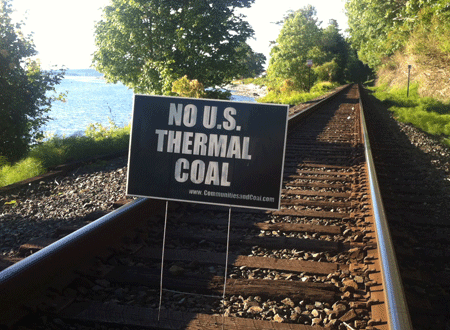
Arbutus corridor told to remove any property on CP land
Just for the record, BC Electric not only ran interurbans on the Arbutus Corridor to Richmond, they also ran inteurbans to New Westminster via the line along the North of the Fraser River. In Theory, the CPR could do the same.
One doubts that the CPR would even contemplate operating some sort of passenger rail service along the lines, but stranger things have happened. Five or six Stadler GTW’s could bring a basic service from New West (maybe Annicis Island) to the foot of the Burrard Bridge.

Arbutus corridor told to remove any property on CP land
CP still contemplating re-activating train line
Simon Druker July 2, 2014
VANCOUVER (NEWS1130) ai??i?? People and businesses along the Arbutus corridor now have until the end of the month to remove any and all property that sits along the train tracks running through there.
This comes as CP continues its review of the line with an eye towards possibly re-activating it.
That review began in April and no decisions have been made yet as engineers continue to determine what kind of shape the line is in since trains last used the track in 2001.
Ed Greenberg with CP says theyai??i??ve run into a bit of a problem.
ai???There are many encroachments along the corridor that lie within CP property including gardens and a small structure. So in order to complete this work, CP employees must be able to work with no encumbrances,ai??? he says.
And that means people need to move their property by July 31st.
ai???Letters went out to residents living along the corridor and also notices are being placed along the line asking residents to please remove or transplant anything that is on CP land,ai??? says Greenberg.
He says CP should know by August how much work is needed and whether theyai??i??ll go ahead with actual repairs to the track bed.
From there, they could attempt to bring it up to federal safety standards, which would need to be done before deciding what if any commercial freight traffic could use the line.
But Greenberg says itai??i??s not a given that trains will start rumbling through the corridor that runs from Marine Drive to Granville Island.
ai???CP remains open to continued discussions with the city to discuss future options.ai???
Happy Canada Day
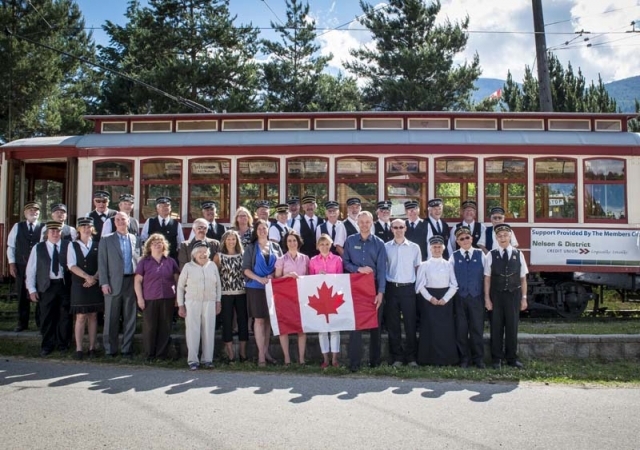 The Nelson heritage streetcar on Canada Day!
Have a safe Canada Day everyone!
An Investigation Into the Economic Impacts on Cities of Investment In Light Rail.

A very interesting study from the UK and well worth a read.
Light Rail can be very good to the economy, especially for adjacent merchants along the line which stores become a billboard for transit customers. Modern LRT is also has many non-user benefits to the community and if designed right contributes to the social fabric of the community.
Most people who have studied modern LRT understand this and those who do not, or have not read much about transit tend to support gadgetbahnen like our proprietary SkyTrain mini-metro system.
Ai??Addendum
Our friend from Ottawa, Havecow has sent us and interesting account of investment due to their new LRT installation.
http://ottawacitizen.com/news/



Recent Comments