The Penny Dreadful – The Transit Referendum Saga
The ongoing saga of the Mayor’s Council, TransLink, the Province, and the referendum reads like a ‘Penny Dreadful’.
The province has no money, the metro mayors have no money, yet the metro mayors have approved a hugely expensive Vancouver centric rapid transit plan focused on a $2 to $3 billion truncated extension of the Millennium Line, via subway to Arbutus.
Surrey gets slops with three poorly planned LRT lines, designed as a poorman’s SkyTrain extensions, with one line going as far as Langley, but no focus if there is the demand for such a line.
Except for Burnaby Mayor Corrigan, who knows something about public transit and its operation, the metro mayors with their blinders fully on, are taking the taxpayer on a dizzying ride into financial oblivion.
Todd Stone, the current Minister of Transportation, being from Kamloops, hasn’t a clue about regional transportation and one wonders if was he was purposely picked for the task by the premier to continue the TransLink charade. From what Zwei has seen, he is embarrassing ignorant about regional transit and regional planning. As it stands, the TransLink referendum will fail because the taxpayer is maxed out and any hint of new taxes, car levies, or congestion fees will be voted down by a huge majority.
Does TransLink have a plan B, like planning for more affordable transit options? Evidently not.
The $1 billion, full build, Leewood/RftV Vancouver/Richmond TramTrain study looks better and better all the time, but don’t look at the metro mayors supporting the shovel ready plan, because real transit experts planned it and not the rank amateurs are behind the metro mayors plan. Regional transit planners just could not let real professionals upstage them with a competent plan.

Province rejects Metroai??i??s transit investment plan
The funding assumptions donai??i??t add up,ai??i?? says transportation minister
By Kelly Sinoski, Vancouver Sun June 24, 2014
B.C.ai??i??s Transportation Minister Todd Stone is sending Metro Vancouver mayors back to the drawing board, saying their proposed funding assumptions in a 10-year investment plan for transit funding donai??i??t add up.
But Stone said the vision could still work if the mayorsai??i?? council is willing to extend the plan over 20 years, scale back their priorities in the short term or increase regional funding sources to pay for it. And if mayors confirm they do want to pursue a regional carbon tax as a preferred funding source for transportation, Stone said, they would first have to get the publicai??i??s support in a referendum.
In that case, Stone said, mayors have been told they must set a referendum date by July 15. A referendum question wouldnai??i??t be required until this fall, unless mayors want to hold the referendum in concert with the municipal elections in November ai??i?? something the mayors have said they donai??i??t want to do. The mayors are slated to meet Thursday.
ai???I will be very clear: the province believes more work is required on funding assumptions to ensure an accurate and realistic plan for paying for this vision,ai??? Stone said Tuesday. ai???The funding assumptions donai??i??t add up.ai???
Metro Vancouver mayors earlier this month unveiled a $7.5-billion transportation investment plan that asked the provincial government to reallocate $250 million it collects in existing carbon taxes from Metro residents and businesses to TransLink, or ai??i?? barring that ai??i?? to increase the carbon tax to Metro Vancouver to fund transit projects in the next five years before moving to some form of mobility pricing, such as tolling every bridge or charging drivers per distance travelled, in the long-term.
The plan, which includes a new four-lane Pattullo Bridge, more buses and rapid transit projects in Surrey and Vancouver, also relies on $1.5 billion funding from both the provincial and federal governments for major capital projects over the 10-year plan.
Mayors argue the plan is desperately needed to handle another million people ai??i?? and potential three million more automobile trips per day ai??i?? in the region by 2041.
But Stone argued that while the province is willing to consider a regional carbon tax, it is not willing to reallocate its carbon neutral carbon tax for Metro transportation projects. And while the province is willing to pay a third of the costs for the Pattullo Bridge and the rapid transit lines ai??i?? as long they fit the provinceai??i??s plans ai??i?? the federal government has not made the same commitment. Indeed, he said, the federal governmentai??i??s Build Canada Fund only provides $1 billion per year for infrastructure projects across all of B.C.
ai???Thereai??i??s a significant gap in funding there,ai??? he said.
Stone insists the province isnai??i??t rejecting the plan, and is still willing to discuss the proposed mobility pricing options Metro mayors want to consider in the long term. But before that happens, he is encouraging the mayors to invite feedback from the public on the proposed vision.
ai???I have been clear that any new source of funding requested by the mayorsai??i?? council must be affordable for families and not impact the provinceai??i??s revenues,ai??? he said.
Follow me: @KSinoski
Ai?? Copyright (c) The Vancouver Sun
Let fools rush in
Metro Mayors are drooling at the prospect of running TransLink, as most think they are transit geniuses. Problem is, most are fiscally irresponsible and only want election winning transit options in their cities and towns.
The Broadway SkyTrain subway is a very good example. The Broadway subway touted by Vancouver’s mayor is a minimum $4 billion project that will not provide the transit improvement that the public wants, instead providing university students, using the deep discounted U-pass a somewhat faster service to UBC. The massive construction, operating and maintenance costs of a Broadway subway will effectively neuter any other regional transitAi?? project, because not only will the public need to ante up over $4 billion for the subway, they need to ante up an additional $3 billion or so to refit and update the present SkyTrain mini-metro system.
At a time where strong leadership is needed, the public get mostly country bumpkins, who are acting like rubes at the annual fair. The public, like always in Metro Vancouver, get weak leadership; political pork; and ignorant politicians who owe massive political favours for those who bought their elections. This a recipe for a transitAi?? financial meltdown.
B.C. tables legislation on transit referendum and TransLink governance
The B.C. government has tabled legislation that will allow Metro Vancouver mayors to determine the timing of a controversial referendum on how to fund transit expansion in the region.
Photograph by: Gerry Kahrmann, Vancouver Sun
VICTORIA – The B.C. government has tabled legislation that will allow Metro Vancouver mayors to determine the timing of a controversial referendum on how to fund transit expansion in the region.
A referendum was to be held in November, during municipal, but Transportation Minister Todd Stone says the vote can take place at another time if local governments can come up with a plan by June.
Stone has also introduced a bill that would give local more control over the TransLink system’s regional
strategies and investment plans.
The bill would allow regional mayors to approve policy decisions as fare increases as well as oversee executive and board of compensation.
The mayors, who represent Vancouver, Surrey, Burnaby and 15 other, have complained they have no say in a transit system operated by an unelected and unaccountable board.
A transit funding referendum was promised by Premier Christy during her election campaign last year.
Ai?? Copyright (c) The Vancouver Sun

From June 20, 2013 – Road pricing
A repost from June 20, 2012. The song remains the same!
Force TransLink to efficiently and affordably operate the transit system – No.
Force the taxpayer to ante up more money through road pricing (another name for a tax) – Yes.
The following 1983 quote is from Norman Thompson; CBE, FCA, ACMA, English transit consultant and builder of the (then) world’s busiest subway on the decision to build with SkyTrain: “Vancouver is adopting a non-commercial approach………..I hope they have lots of money“, sums up TransLink’s financial ills, the problem is our mini-metro system.
What TransLink hasn’t done is reveal the true cost of the SkyTrain and Canada Line, instead have the SkyTrain lobby and their surrogates continually misinform the public through the media about the mode, its operations, and its failure to provide an alternative to the car. So successful has been the SkyTrain propaganda campaign, that it even fooled BC.”s Auditor General’s Department!
TransLink’s bureaucracy thrives off of big ticket mini-metro planning and construction and by planning for more Skytrain, means more bureaucrats must be hired and friends of the government (including the notorious SNC Lavalin) will join the SkyTrain gravy-train, all on the taxpayer’s dime or dime per kilometre is TransLink has it way.
There is an ever growing evidence that TransLink has not been honest with transit ridership figures and SkyTrain and transit ridership in general is less that advertised. Evidence of this has surfaced with the on going fare evasion debate, as fare evasion is at industry norms, while revenue collection indicated mass fare evasion. Revenue collection may also reveal that transit ridership is much lower than advertised and there is no mass fare evasion and no need for expensive turnstiles at stations, which was a reward for more friends of the government and had little to do with fare evasion.
Zwei leaves the reader with this; “Who builds with SkyTrain today?” No one, as evidenced with the Canada Line.
From the Surrey news Leader.
Road pricing logic may extend to transit too
Passengers line up to board a Canada Line train at Bridgeport in Richmond.By Jeff Nagel – Surrey North Delta Leader
Published: June 19, 2013

TransLink is doubling down on the concept of road pricing, arguing it should apply not just to cars to control congestion at the busiest times but also to transit riders to make more efficient use of buses and SkyTrain as well.
A revision of TransLink’s long-range regional transportation strategy is going to public consultation over the next two months and it reinforces the idea of using time-of-use pricing tools to make the most of investments.
The Transportation 2045 plan will argue the number of vehicle trips travelled in the region must climb no higher if Metro Vancouver is to remain a livable region and not end up mired in gridlock.
Capping car travel will be hard.
The overall number of trips taken is projected to climb 50 per cent over the next three decades as a million more Metro Vancouverites arrive, all criss-crossing the region to get to 500,000 more jobs.
So planners say the proportion of trips by transit, cycling and walking must rise at a much faster rate from 27 per cent now to 50 per cent, while the share of trips by car falls.
Building more rapid transit lines is part of the strategy ai??i??Ai??TransLink estimates up to $23 billion is needed to expand the system over 30 years. The first $5 billion would merely maintain what already exists.
But another plank in the document says TransLink should “price roads and transit for fairness, efficiency and revenue.”
TransLink strategic planning vice-president Bob Paddon said road pricing has been in long-range plans for 20 years, but it’s now becoming critical to implement.
Area mayors also want to explore road pricing, where drivers might pay more to drive on major routes depending on the time of day or severity of congestion.
TransLink’s draft document says pricing can cut congestion at peak times while offering users a choice.
“Those who choose to forego a trip, bundle some trips together, travel at a less busy time, use a less busy route or travel by another mode will be rewarded with savings in time and money,” it says.
Paddon said TransLink’s new Compass card system could make it possible to emulate Washington D.C., where subway riders pay based on both the distance travelled and by the time of day.
“The farther you go, the more you pay,” Paddon said. “And if you want to go at the peak of rush hour you pay more.”
He said airlines also make passengers pay more for the last seats as a plane fills up, while offering discounts to sell seats on underused routes or at less popular times.
Drivers will respond to price signals, he suggests, pointing to the success of the #555 bus over the new Port Mann Bridge. Its initial ridership has doubled ai??i??Ai??it now averages 73 per cent full ai??i??Ai??as 1,600 passengers a day ride over the bridge without paying the new toll.
TransLink also wants cities to step up.
Better land use can gradually put more people and their destinations closer to transit routes. With more people able to ride transit, planners reckon, average trip distances can be reduced by one third.
Once the 2045 strategy is approved, TransLink is to develop a 15-year plan of new transportation investments this fall.
The plan is expected to include billions of dollars to build rapid transit lines in Surrey to Guildford, Langley and White Rock, as well as the Broadway line west to UBC.
Once it’s in place, TransLink, mayors and the province will have to draw up a proposal for how to fund the upgrades that would be put to a referendum in the fall of 2014.
The referendum was an election promise of Premier Christy Clark, who also said during the campaign that she opposes making drivers pay to use existing roads or bridges.
Burnaby Mayor Derek Corrigan said TransLink’s intent to raise up to $23 billion, presumably funded in part through road pricing, is “far too ambitious” even for an aspirational plan.
“There is a point where reality has to set in for all of us,” Corrigan said. “We go out to the public with an unrealistic plan, that raises expectations as to what could be accomplished, when in fact none of that is a reasonable possibility in the near future.”
Belcarra Mayor Ralph Drew said TransLink’s time frame for decisions should be reversed ai??i??Ai??the region should first decide how much more residents can afford to pay and then decide the projects that will be built, not the other way around.
He said the other big bills coming to Metro taxpayers, such as for new sewage treatment plants, must also be weighed.
Licence plate cameras in Stockholm detect and bill drivers as they enter or leave the central city. Overhead signs show the amount currently being charged. Rates range from zero to 20 krona ($3.20) depending on the time of day.
Stockholm’s congestion fee offers lessons for Metro
Stockholm is being held up as one example where road pricing is working to control traffic and steer more drivers to public transit.
Mayors Council chair Richard Walton recently visited the Swedish city and said it offers plenty of lessons for planning towards something similar in Metro Vancouver.
Stockholm’s congestion tax charges motorists higher amounts to enter or leave the city core at peak periods, and less or nothing to travel off-peak.
The maximum they pay is the equivalent of $10 a day.
The system was introduced in 2007 and rush-hour traffic volumes promptly fell 20 to 25 per cent, while transit use rose 13 per cent on trains and 18 per cent on express buses.
The congestion tax was put to a vote of residents, but not until one year after it was already in operation.
Walton said politicians concluded it had no chance of passing until drivers saw how it worked and felt the benefits of freer flowing roads.
They agreed they’d simply scrap the $500-million investment in cameras and detectors if it failed.
The referendum was only binding in central Stockholm, where it passed by 53 per cent. All outer suburbs voted against it by margins of up to 70 per cent.
Walton said a congestion charge system wouldn’t work in Metro Vancouver because of our different geography and travel patterns, but road pricing variants will be examined.
Walton remains a strong supporter of the concept based on the Swedish experience, but is leery about winning over voters in a promised referendum.
“This is a tough, tough sell,” he said.
Port Moody Mayor Mike Clay said road pricing could relieve traffic jams in the northeast sector.
“If we can shift people’s transportation mode as a result of a tolling policy like that, you can stretch your road infrastructure another 50 per cent,” Clay said.
“Maybe instead of worrying about building more roads we should be figuring out how to more effectively use them.”

The Whalley, King George, White Rock Light Rail line Revisited – Again

It has has been three years year since I entertained the idea f the Whalley – King George – White Rock LRT Line and in 2014 the WKW Line is still superior to what TransLink is planning for Surrey.
TransLink’s LRT plans for Surrey are three ai???poormanai??i??sai??? SkyTrain type designed light rail lines feeding SkyTrain.
TransLink designs new transit lines to increase density; to increase property values for land developers who are generally friends of the government and not to efficiently and affordably move people.
The same is true for LRT/streetcar planning for Surrey. Having TransLink plan for LRT is a major mistake, as the lumbering bureaucracy has no experience with modern light rail, nor has it shown any desire to gain experience, preferring to plan for much more prestigious SkyTrain and subways. TransLinkai???s desire to build with SkyTrain is clearly evident with the proposed Broadway subway, in Vancouver, where TransLinkai??i??s planners are designing a $? billion subway to only Arbutus, on a route with average traffic flows below 5,000 persons per hour per direction!
What Surrey needs is a bold new vision for modern LRT and I believe the Whalley ai??i?? King George ai??i?? White Rock or KWKAi?? LineAi?? would provide the vision to implement a strategic and affordable light rail network for Surrey and communities south of the Fraser river. Failure to plan and build sustainable light rail and to continue to plan and build with the hugely expensive SkyTrain light-metro, will beggar the region with ever escalating taxes, driving out business and residents alike, leaving Metro Vancouver a ghetto for the wealthy and the poor.
The WKW Line, operating in conjunction with the ‘full build’ Leewood/Rail for the Valley tramtrain and with a new multi-track rail bridge replacing the present Fraser river Rail Bridge would cost no more than the present estimated $2.5 billion light rail lines in Surrey, would be a powerful tool in alleviating congestion in the south Fraser region. Sadly both Metro Vancouver and TransLink do not have the foresight to see this; they can’t even comprehend it.
LIGHT RAIL FOR SURREY ai??i?? The Whalley ai??i?? King George ai??i?? White Rock (WKW) Line
Surrey wants light rail, but where will the first LRT line go and what line would attract the most customers to the new light rail line?
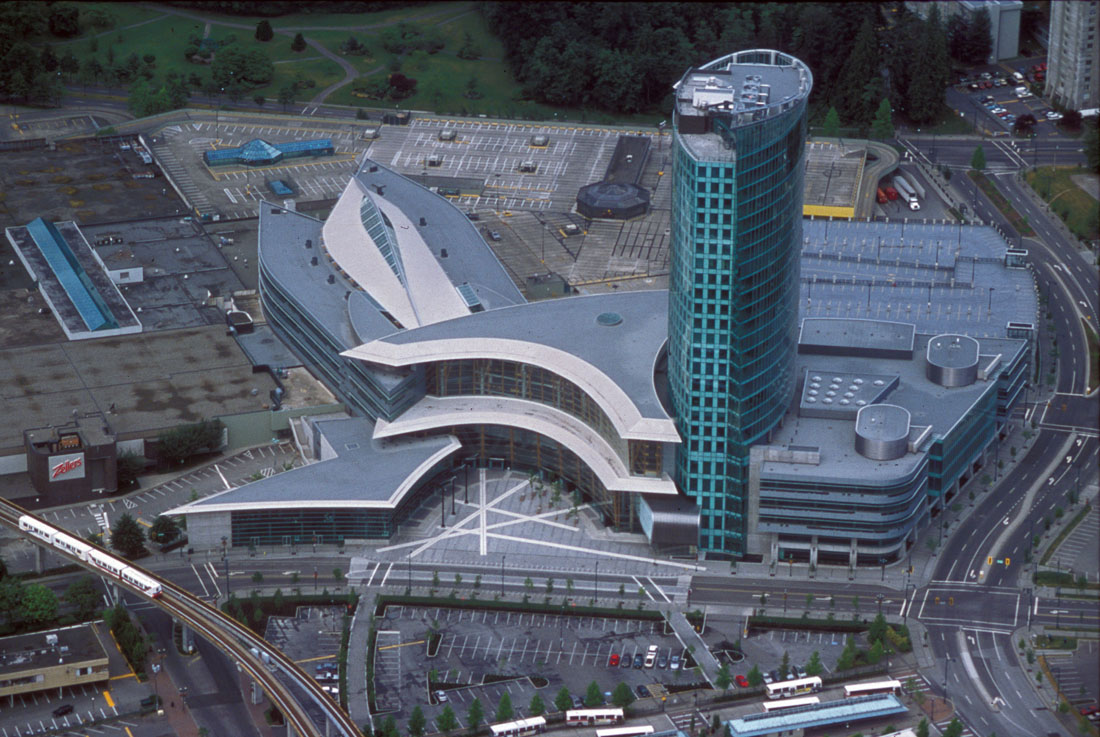
If the goal of the new light rail line is to serve customer needs and offer the ability to provide an attractive alternative to the car, it also must serve a multitude of destinations. Those presently planning for LRT doAi??not much much expertise and tend to treat the mode as a poor manai??i??s SkyTrain. Building LRT as an extension of the SkyTrain light-metro system will fail to meet expectations as LRT will not be designed to its best advantage. It is not ai???rocket scienceai??i?? to design a transit line to be an attractive alternative to the car and the following plan may prove useful.
The Light Rail Line
The 22 to 24 kilometer Whalley ai??i?? King George ai??i?? Rail for the Valley ai??i?? White Rock line (WKW Line for short) would be a solid foundation for an attractive light rail system in Surrey. The proposed light rail would be a classic LRT, operating on a ai???reserved rights-of-wayai??i?? (RoW) in the median of the roads involved.
The route of the WKW Line would start at at 108th Ave. & the King George Hwy. and would continue South to the Southern RR of BC (formerly the BC Hydro R.R.)Ai?? This portion of the route would service the Central City shopping district; Surrey Memorial Hospital; Queen Elizabeth Secondary School; Bear Creek Park; and the Newton shopping district.
The WKW Line would then network south-east along 4 km of the former BCE interurban line and proposed Valley Rail Vancouver to Chilliwack TramTrain route to 152nd. Traveling mainly through industrial lands, which would provide the ideal location for the Light Rail storage and maintenance yards. This portion of track would be double tracked and adequately signaled for safe freight/Interurban/tram operation.
There is the possibility of futureAi??joint operation with the RftV/Leewood interurban, enabling South Surrey and White Rock transit customers the option of a direct or no-transfer service to downtown Vancouver.
From 152nd Street, the KWK Line would go straight south to White Rock crossing the Nicomakle /Serpentine River valley basin. Along here, the line must be raised above flood plain and three new bridges across the Super Port Railway Line, and the Serpentine and Nicomakle rivers must be built. It is this portion of line that will be the most expensive.
Rising out of the small river valley the KWK Line would continue south along 152nd Ave., terminating in downtown White Rock
In the summer, the light rail line would bring congestion relief to White Rock by providing a quality transit alternative for the many thousands of people who come in cars to the popular beaches. Also close to the KWK Line is the South Surrey Athletic fields, which many fields and arenas are constantly busy with hockey, baseball, soccer, rugby, and football games, twelve months of the year. The KWK Line would also provide an excellent transportation access for the burgeoning housing estates, such as Morgan’s Crossing in South Surrey and White Rock.
An approximate map of the WKW route as Google maps do not use existing rail lines.
http://goo.gl/maps/jbOmS
The Cost
The the total cost of the KWK Line, including bridges and/or viaducts should cost no more than $900 million, based on an average of $35 million/km to build (updated 2014) with contingency. The high cost of major engineering in the Nicomakle/Serpentine valley, would be mitigated by simple on-street construction on 152nd and the King George Highway and track sharing for 4 km on the Southern Railway of BC Line bisecting Surrey .
It is interesting to note that the total cost for the 98 km RftV/Leewood Chilliwack to Scott Road Interurban using Diesel LRT and the 23 km KWK Line would be about $1.4 billion or put another way we could build 121 km of modern LRT lines in the Fraser Valley for about the same price as the 11 km Evergreen Line!
Unlike present light rail planning, where development is encouraged to take place along a LRT/SkyTrain route, the KWK Line can pass through sensitive agriculture and ecological areas, without the need for land development. Building the KWK Line would provide a potential capacity of 20,000 persons per hour per direction on the route, well able to handle future passenger demands, yet still can be built much cheaper than its SkyTrain/light-metro competitors. The cost for a SkyTrain along the KWK Line? About $2.3 billion at a conservative cost of $100 million per km to build!
A modern LRT Line in Madrid, Spain ai??i?? A template for the WKW Line?

Using low-floor trams, with convenient stops, ensures an obstacle free journey for all transit customers including the mobility impaired, without the need of expensive stations and equally expensive to maintain elevators and escalators.
The KWK Line can provide traffic calming where needed, yet still supply ample capacity for future transit needs. By providing a regular and efficient transit service from White Rock to Surrey Central and by servicing many destinations along its route the proposed LRT line would attract ample ridership, including the all important motorist from the car. The KWK Line would also easily integrate with the RftV TramTrain interurban service from Vancouver to Chilliwack and could provide in the not too distant future a direct White Rock to Vancouver TramTrain service, faster than the present bus and Canada line service.
The WKW Line would bring 21st century transit solutions to Surrey, transit solutions that are too long overdo.
Metro Vancouver Sleepwalks Into a Financial and Transportation Disaster.

There is so much wrong with this announcement that it boggles the mind, but it is suffice to say, this plan will not go anywhere.
Let’s look at the basics of this announcement.
A SkyTrain subway to Arbutus has nothing to do about transit ridership, it has everything to do about property development and ensuring a return for friends of the politicians who have assembled properties along potential subway stations.
The light rail plans for Surrey are ill conceived and doomed for failure, as they are designed as a ‘poorman’s’ SkyTrain, which role is to feed the SkyTrain system; will not attract ridership.
A four lane Patullo Bridge replacement, with absolutely no thought to replace the decrepit Fraser River Rail Bridge.
More bus hours will only drive up the cost of transit as there is no evidence that TransLink’s transit service has attracted the motorist from the car. In effect we will spend more money moving the same people.
All in all the the Metro mayors are stuck in the 1950’s, when 21 century solutions are needed. Maybe someone should organize a trip to Nottingham England and see how their P-3 built tram is operating……..without subsidy you say? Gobsmacked!
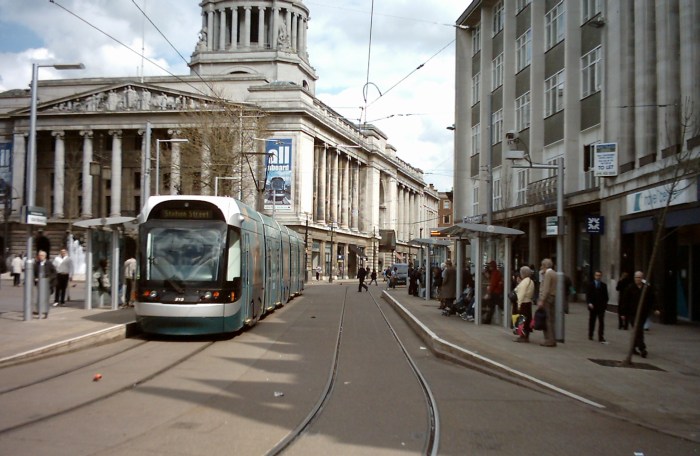 No problems with Nottingham’s new LRT (tram) system. The picture is the tram station in the centre of the city.
Stop Press!
B.C. rejects Metro Vancouver mayors’ plan to use carbon tax to help fund $7.5-billion transit boost
I am not surprised at this at all. The much vaunted Carbon Tax, is not a carbon tax at all but a surcharge on energy consumed that goes into general revenue. This is the Liberals big lie and if the mainstream media don’t get off their collective arses and do some real reporting instead of the current infomercial reporting, maybe we could get some honest transit reporting in the region.
Metro Vancouver mayors propose tolls, carbon tax to fund $7.5-billion transit boost
Major capital projects would include a four-lane Pattullo Bridge, rapid transit in Surrey and Vancouver and more express B-Line bus routes
By Kelly Sinoski, Vancouver Sun
Metro Vancouver mayors are proposing a $7.5-billion investment plan that focuses on a regional carbon tax to to pay for major capital projects, including a four-lane Pattullo Bridge, rapid transit in Surrey and Vancouver and more express B-Line bus routes, over the next 10 years.
The plan, which was devised by mayors ahead of a referendum on transit funding, calls for $250 million of the BC Carbon Tax paid by Metro Vancouver residents and businesses to be reallocated to transportation investment in the near term, while developing some form of mobility pricing, such as bridge tolls or distance-based road pricing.
Mayors approved the plan today.
The plan, which must be approved by the provincial government, would also be supported by property taxes — capped at three per cent — along with new transit fare revenue, tolls on the Pattullo Bridge and $5 million in cost-sharing by the federal and provincial governments on major infrastructure projects, including the two rapid transit lines and the Pattullo.
The mayors’ report notes the $7.5 billion would increase TransLink’s annual budget from $1.4 billion to $2.2 billion. By 2025, an estimated $390 million in funding will be needed each year.
North Vancouver District Mayor Richard Walton said region’s transportation system has been deprived of funding for a number of years and we are “seeing the effects played out in people’s daily commute on transit, and in the system throughout Metro Vancouver.”
Mayors have been scrambling over the past few months to come up with a 30-year vision on priorities and funding options ahead of a referendum on transportation funding and to deal with an additional one million more people in the region by 2045.
The report doesn’t offer a back-up plan should the carbon tax be rejected by the province, nor does it suggest a vehicle levy would be a viable option, saying it would depend on what the provincial government says.
David Stuart, chief administrative officer of North Vancouver District, said mayors believe the carbon tax makes sense and any alternative options would be discussed once mayors hear from the province.
He added the government has not identified any funding sources, but to do nothing would cost more in the end.
Mayors say if the plan goes ahead it would reduce traffic congestion by 10 per cent and drivers and transit users to save 20 to 30 minutes per day on some of the most congested corridors. It would bring walking, cycling and transit mode share from 25 per cent today to 36 per cent by 2045, representing more than one million new trips.
Among the priorities are an underground rapid transit line in Vancouver from Broadway to Arbutus at $1.98 billion, with buses to the University of B.C., and light rail lines in Surrey along King George Boulevard and 104 Avenue and along Fraser Highway to Langley.
The plan also calls for a four-lane $980 million Pattullo Bridge, which can be expanded to six lanes later on. Eleven new B-line buses, improved West Coast Express, 50 per cent more SeaBus service, 400 new buses, upgrades to the Canada Line and Millennium Line with more cars and investments in cycling paths are also included in the plan.
The plan calls for:
– A new tolled four-lane Pattullo Bridge
– New Light Rail Transit lines in Surrey
– Broadway corridor Millennium Line extension to Arbutus in Vancouver to meet capacity needs
– 11 new B-Line routes providing 200 kilometres of bus service
– 50 per cent more SeaBus service: every 10 minutes during peak hours, and 15 minutes the rest of the day
– 30 per cent increase in HandyDart Service: improved service for those who cannot use transit without assistance
– Fleet expansion and system upgrades to meet growing demand: West Coast Express, Canada Line, Expo Line and Millennium Line
– A 25 per cent bus service increase resulting in more frequent service to more areas across the region, and an additional 400 new buses to the existing fleet of 1,830
– Maintaining and upgrading the 2,300 kilometres of Major Road Network to keep vehicles and goods moving
– Investments in cycling routes to make biking a safer and more viable transportation choice
Ai?? Copyright (c) The Vancouver Sun
A Railway Crossing That Means Business
In Russia, to cope with the problems of motorists jumping railway signals on express train routes, the following device is used. The rest is self explanatory.
Rail for the Valley take note!

Light Rail Stops Attracts new Business
This interesting study from down South.
The myth makers who favour SkyTrain make much how SkyTrain attracts new development, yet that development has been allowed by city councils, who have allowed for higher densities, read higher buildings) at SkyTrain stations. At the same time the inference is that LRT does not attract development. The study shows that LRT rail stops attract business.
The question should be; “Do we build transit to cater to developers or to move people?”
In Vancouver, rapid transit seems to have been built to subsidize new developments and not cater to customer needs. There is much ado about major developments along the Canada Line, but those very small station platforms (40m to 50m long), which limits the trains to only be two cars long, means endemic overcrowding on the mini-metro. In short, the Canada Line cannot accommodate the new customers coming and going from the new developments!
A simple modern streetcar line could easily handle the customer traffic thus generated from the intensification along the Canada Line route, but TransLink and the City of Vancouver will never admit to this. All the Canada line will do is create more congestion and gridlock as the mini-metro will not be able to handle the demand from the planned increase in density.
The taxpayer has paid over $2.5 billion for this nonsense.
 Small stations and station platforms will always hamper the Canada lines potential capacity.
The $2.5 billion mini-metro has less capacity than a much cheaper streetcar.
Portland area MAX stops attract new businesses
Friday, 06 June 2014 |
New businesses may be TriMetai??i??s biggest fans.
New firms tend to gather around light rail stations in Portland, according to a recently published study, ai???Transit Access and the Agglomeration of New Firms: A Case Study of Portland and Dallas.ai???
The study, led by Rutgers University professor Robert Noland, compared new- firm births in Portland and Dallas, Texas, between 1991 and 2008. Both cities were chosen because of their relatively new light rail systems. However, while Portland light rail stations act as a magnet to firm agglomeration, Dallasai??i??s firm growth and transit arenai??i??t nearly as highly correlated.
The differences may be explained by each cityai??i??s unique zoning and planning regulations.
“Portland has adopted more stringent policies than Dallas-Ft. Worth in focusing development near rail stations and within the central business district (CBD),” Noland says. “These include restrictions on off-street parking for new development and an urban growth boundary that restricts development on the metropolitan fringe.ai???
The peer-reviewed study was published by Mineta National Transit Research Consortium. To read the report: transweb.sjsu.edu/project/1145.html.
Gridlock Is Endemic In Vancouver and Will Be For Years To Come
Nothing new here.
As the provincial government keeps building new highways and bridges, car use will increase, simple.
As the provincial government, the City of Vancouver, TransLink, and Metro Vancouver, keep planning for and building hugely expensive mini-metro’s like SkyTrain and the Canada Line, for strictly political prestige and not as a convenient transit mode, car use increases.
Instead of using much cheaper to build and operate light rail, to create an affordable transit network that would offer a convenient alternative to the car, the powers that be still plan and build with SkyTrain that has proven not to take one car off the road.
One need not be a genius to predict that as we spend billions on SkyTrain and more billions on a Broadway subway, car use will just increase, creating endemic gridlock in the region.
No city in the world has ever cured gridlock by building more bridges and highways.
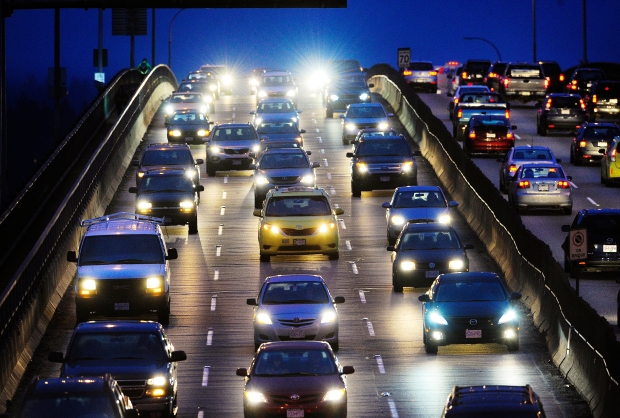
Vancouver is home to worst gridlock in Canada – GPS company study
A new study is out suggesting Vancouver is the worst city in Canada for gridlock.
Photograph by: Ric Ernst, PNG

TORONTO – A new study is out suggesting Vancouver is the worst city in Canada for gridlock.
TomTom – a Dutch-based company which specializes in navigation and mapping products – issued its fourth annual traffic index today.
It says in Vancouver, the average person experiences 87 hours of delay time a year, based on a 30 minute daily commute.
TomTom also says traffic shortcuts drivers take to avoid congestion are actually “long cuts”, adding 50 per cent more travel time to journeys.
The study also suggests gridlock on secondary roads is worse than main roads, and commuters around the world spend an average of eight working days a year stuck in traffic.
After Vancouver, says TomTom, the most congested cities in Canada are Toronto, then Ottawa, Montreal, Calgary, Quebec City and Edmonton.
Moscow tops the international list, followed by Istanbul, Rio de Janeiro, Mexico City, Sao Paulo, Palermo, Warsaw, Rome, Los Angeles and Dublin.
What Could Have Been – Should Have Been – Updated

One of the hardest transit plans to find in the Vancouver Metro Region is the 1978 Rapid Transit Preliminary Design, by the then GVRD. The reason why it is hard to find is that most of the copies were shredded and/or similarly destroyed on orders by the provincial government when they forced the SkyTrain mini-metro on the region instead of the originally planned for LRT. What scared the Social Credit government so, was that a full build implementation of the 1978 light rail plan, connecting downtown Vancouver to Richmond Centre; Whalley (to 104th Ave.); and to Lougheed Mall and beyond (to Como Lake Rd.) was $430 millionAi?? to $558 millionAi?? in 1978 dollars! ($1,419 million to $1,842 million in 2013 dollars)
Note from Zwei: I have updated this post with costs using the Bank of Canada inflation calculator. The time between 1980 and 1990 was an era of high inflation and costs should have been adjusted. With the inflation adjuster the real costs come to light in 2014, that the region could have had a deluxe Vancouver to Richmond/Whalley/Coquitlam LRT for just under $2 billion in 2013 dollars. Compare with the over $9 billion spent today (estimated by the UBC Sauder School of Business), building SkyTrain and the Canada Line light metro to the same locations!
The Vancouver to New Westminster SkyTrain line cost just under $900 million in 1986 dollars (just under $1,622 million in 2013 dollars). SkyTrain cost more to build, for about half the route mileage!
Oops!

Also of note is that the annual operating costs of the ‘full build’ LRT system would have been almost $10 million in 1978 dollars, a far cry of from SkyTrain’s 1988/89 operating costs of almost $28 million dollars. No wonder TransLink finds itself in the finical predicament it is in today.
By building with SkyTrain,Ai?? the Vancouver metro region has now a mini-metro system, which present network costs over ten times more to build, with about double the operating costs than the original planned for LRT.
What is very sad, is that instead of debating the merits of a Broadway subway or three ill planned LRT lines in Surrey, for the same investment of our present mini-metro system, the Vancouver region could have the possibilityAi?? of having a LRT network extending from UBC to Chilliwack, with lines to White Rock; SFU; and possible the North Shore. The region, by building with LRT, could have provided the great transit philosopher’s stone of a LRT network that would have attracted the motorist from the car.
It wasn’t to be and the regional taxpayer has been paying for the mistake for over 30 years!
Better Mousetrap Department
In the summer of 1966, the New York Central Railway experimented with a jet powered train, which reached a maximum speed of 294.5 kph. No passengers were ever carried.


Not about to be outdone by the Americans, the Soviet Government invested in their own jet powered train in the 1970, which obtained a top speed of 290 kph. No passengers were ever carried.

In 2014, all what remains of the Russian jet train is a rusting hulk.
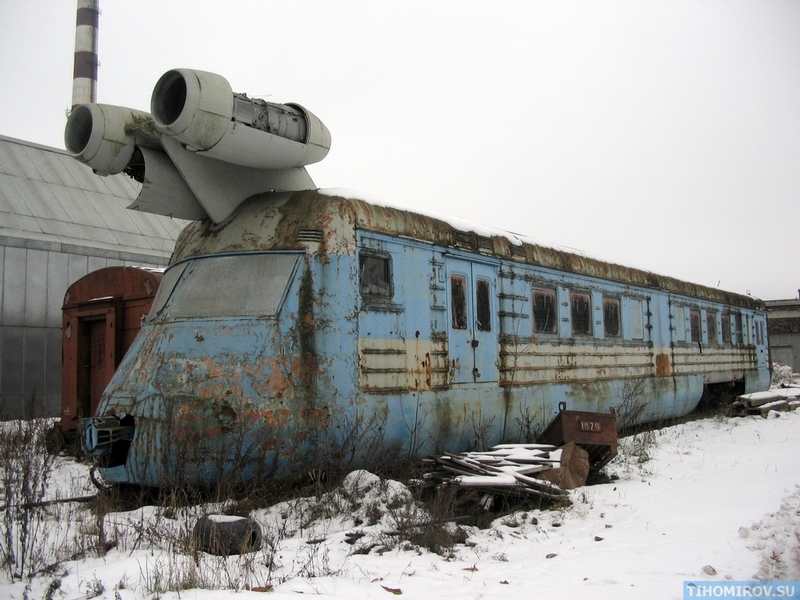
The moral of this post is that instead of experimenting with fancy jet powered trains, would it not have been better just to build customer oriented trains; trains that would provide a convenient and affordable service without fancy jet motors and alike?
Something to think about when TransLink wants to build a subway on a route that has barely the traffic flows to sustain LRT.



Recent Comments