TransLink CEO, Ian Jervis Made Over $394,000 Last Year
Not bad for a career bureaucrat who has no background in public transit. Maybe a little thrift in TransLink’s senior bureaucrats stipends, would translate to a little thrift in operations, resulting in realistic planning, financingAi?? and operation.
From CKWX News 1130 radio.

Simon Druker October 16, 2013
VANCOUVER (NEWS1130) ai??i?? Why do TransLinkai??i??s top executives make so much more than their counterparts?
Jordan Bateman with the Canadian Taxpayers Federation (CTF) says administrative overhead is a major problem across the transit authority.
He also says similar systems heai??i??s looked at donai??i??t have the same problems.
ai???Montreal and TransLink are roughly the same size as far as annual revenue and yet the number-two person there gets paid less than the top five at TransLink,ai??? says Bateman.
TransLink CEO Ian Jarvis made just over $394,000 last year.
Bateman says that works out to $200,000 more than Premier Christy Clark and $75,000 more than Stephen Harper.
He also discounts the argument that high salaries are needed to attract top executives.
ai???For a long time weai??i??ve heard that TransLink has to pay more to compete for the best and the brightest.ai???
But the top executive at the Toronto Transit Commission (TTC), the largest transit system in Canada, took home much less.
Their CEO, Andy Byford walked away with a salary of $294,366, which is $100,000 less than Jarvis.
ai???You can see a 10 or a 15-thousand-dollar gap but youai??i??re talking about someone who is making $90,000 a year more than a counterpart in Toronto or Montreal with a much larger transit system,ai??? says Bateman.
Montreal transit chief Carl Desrosiersai??i??s salary is listed at $297,000.
He says the comparison even extends to the United States.
ai???If you talk to most transit watchers here, they would love to be in Portlandai??i??s shoes with the transportation system Portland has, but Portlandai??i??s CEO makes about a hundred thousand dollars less.ai???
Portlandai??i??s top transit executive Neil McFarlaneai??i??s salary was $228,440 Canadian while King County Metro general manager Kevin Desmond in Seattle made the equivalent of $191,645 Canadian in 2012.
Bateman says TransLinkai??i??s entire executive is paid too much, which takes money away from operations.
Tram looks ahead to avoid collisions
New technology will make trams safer and here is a lesson to be learned. Modern light rail, trams and streetcars are constantly evolving, into a safer and and more convenient transit mode. There is no such evolution with SkyTrain as it is essentially the same mode since 1978, just tarted up every now and again.
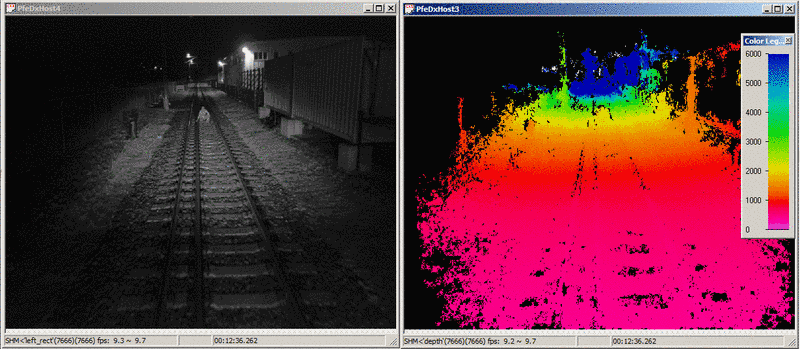
Tram looks ahead to avoid collisions
11 Oct 2013
GERMANY: A Flexity tram operated by Frankfurt transport company VGF is to be fitted with an experimental optical sensor system designed to reduce the risk of collisions with road vehicles, cyclists, pedestrians and small objects such as footballs.
The technology has been developed by Bombardier Transportation and image processing specialists at the Austrian Institute of Technology. Cameras with high spatial resolution monitor the path in front of the tram for more than 60 m ahead, and the system automatically evaluates potential risk and responds accordingly. An initial acoustic warning enables the driver to react before automatic braking is triggered.
AIT says the 3D Stereo Vision Technology is extremely interference-proof, has a large range, high resolution and is cost-effective to implement.
From the Railway Gazette
The Real Costs of Subways – Is The Provincial Government Listening?
There is a misconception by Vancouver politicians and engineers; TransLink’s planners and bureaucrats; Ministry of Transportation bureaucrats; and The Minister of Transportation and the Premier, that subways are rather cheap to build.
TransLink has fortified this perception by deliberately over-engineering light rail to sell the idea that the cost of at-grade and or on-street light rail is near of that of a bored or cut and cover subway. The mainstream media has certainly has been fooled by this ruse.
In reality, the cost of subway construction is massive, as is the cost ofAi?? maintenance as the subway ages. The real cost of a Broadway subway would soon consume any TransLink tax increases and have TransLink crying pauper, yet again, is very short order.
The Metro Vancouver area is facing a grave transportation crisis, which simple minded MoT bureaucrats think they can solve with building more highways and have advised the provincial government of this. The provincial Liberal government (as with the NDP before) see highway and bridge projects, as well as subways, as election gimmicks to get reelected, so they demand great bridge schemes as legacies to their public spending.
The sad fact is that new highways and bridges, increases road traffic, which leads to more traffic chaos and gridlock.
The BC Liberals penchant for subways and , new highways and massive new bridges, is leading the Lower mainland to the highway of hell!
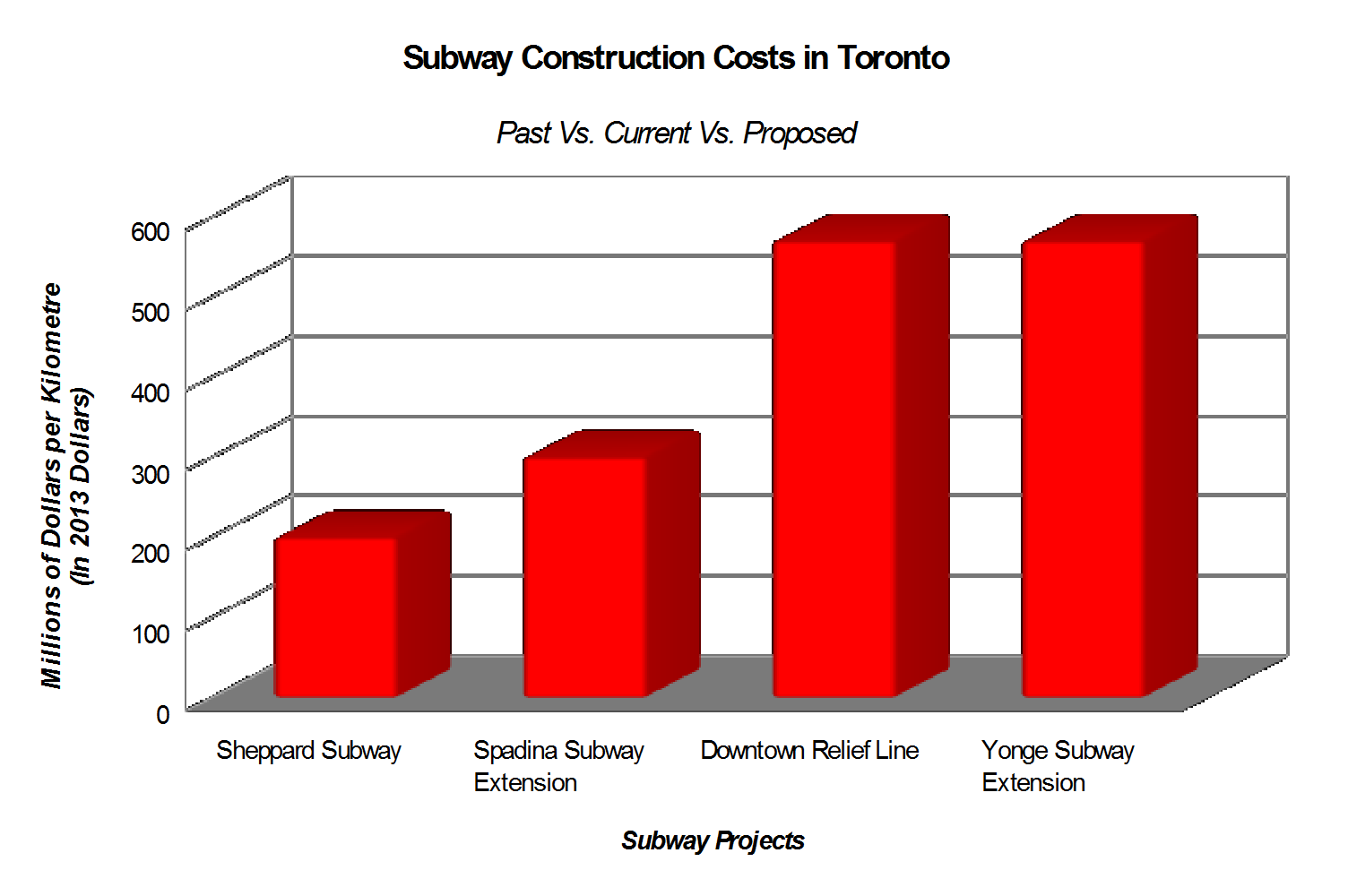
What Scarboroughai??i??s subway means for taxpayers: James
his one project will add more than $40 a year to each property tax bill for 30 years, on top of regular increases, putting the ai???freeai??? subways lie to rest forever. And what of the cityai??i??s other dire transit needs?
GetOnBoard Want’s Valley Tax Money

The pro transit group GetOnBoard BC (well Rail for the Valley is a pro transit group as well) wants a yes vote in the upcoming TransLink referendum, but they seem to be a little naive about public transit in general and firmly believe that the more money you throw at TransLink, the better it will be.
Expensive beliefs.
In a news feature in the Georgia Straight OnBoard BC pleads their case, but refuse to accept that the main problem with TransLink is their extremely dated light-metro planning which is both expensive and unproductive. TransLink has a planning/spending problem, not a funding program.
Until one tackles the endemic problems associated with TransLink, its ponderous bureaucracy will be forever be at the taxpayer’s door begging for new funding for dodgy transit schemes that will do little in creating an affordable and efficient public transit network for the Metro Vancouver region and the Fraser Valley.
OnBoard BC’s naive belief that more taxes and user fees will improve transit, will soon turn to disappointment when TransLink, empowered by new sources of revenue will just do the same things over again, expecting different results.
Fraser Bridge Chaos?
Exactly what Zwei has predicted!
The BC Liberal Fraser River crossing spells the death knell of the BC Agricultural land Reserve, regional transit planning, and metro transportation planning. This bridge is all about satisfying McQuarrie, SNC Lavalin, Enbridge, land speculators, and motorists. LA North is not just coming, it is here.

Planners see problems with bridge proposed to replace Massey Tunnel
Report says new Hwy. 99 crossing could ai???unleash pent-up demandai??? and create even more congestion
A report by senior planner Ray Kan suggests the new bridge may also draw more drivers from other crossings such as the Alex Fraser Bridge, which would counter the regionai??i??s growth plans that aim to see half of all trips by 2030 made by walking, cycling and transit, and to reduce the distances people drive by one-third.
ai???Unfettered access could easily result in a congested facility,ai??? Kan wrote in a report that goes to Metroai??i??s transportation committee Wednesday. ai???Further, an expanded facility may simply move the ai???bottleneckai??i?? further downstream or upstream.ai???
The report notes that while Metro supports better goods movement along the Highway 99 corridor, last monthai??i??s announcement of the bridge was ai???unexpectedai??? given the lack of technical information provided during the consulting process.
The province has also yet to release a business plan on the projectai??i??s scope, design or cost, or announce whether the bridge would be tolled, which could affect the availability of provincial funding for other transportation projects across the Metro region.
ai???We have to move goods and people around the region but there has to be an integrated plan,ai??? said Surrey Mayor Dianne Watts, who chairs the transportation committee. ai???Thatai??i??s the piece thatai??i??s missing in all of this … is there additional opportunity get people out of their cars?
ai???There certainly is a need for upgrades to the tunnel or a new bridge there but thereai??i??s also everything that goes with it. Itai??i??s hard to comment when we havenai??i??t seen the plan.ai???
The uncertainty around the bridge puts into doubt the validity of the technical work being done by TransLink on its regional goods and transportation strategies, as well as on the Pattullo Bridge review, the report says. It also raises the spectre of unplanned growth in the area as a result of replacing the tunnel with a bridge.
ai???It is unclear what basic demographic assumptions the ministry has been using to justify the proposed capacity on the bridge,ai??? the report states. ai???It is also unclear what assumptions have been made about plans by Port Metro Vancouver to expand container throughput capacity at Roberts Bank, and to better utilize available marine terminal capacity at Fraser Surrey Docks.ai???
Transportation Minister Todd Stone on Tuesday refused to provide further details on the bridge project, saying only that an investment is needed in the George Massey tunnel to reduce significant choke points in the Lower Mainland.
The province maintains the tunnel is in need of repair as it does not meet modern seismic standards, and has aging operating systems, narrow lanes and no capacity for cyclists.
About 77 per cent of all vehicles using the tunnel in 2011 were single-occupant vehicles, with 10 per cent multi-occupant vehicles and one per cent buses (which carry about 26 per cent of people through the tunnel).
ai???You talk to people south of the Fraser and they will tell you the George Massey tunnel is overdue. If we want to provide possible rapid bus to serve the communities of the Fraser Valley, we canai??i??t do that with the current tunnel,ai??? Stone said.
ai???Any suggestion weai??i??re out of sync with the regional plan simply is not true. We believe weai??i??re tackling the next bottleneck in the Lower Mainland.ai???
Stone said there would be improvements to the Highway 99 corridor on both sides of the existing tunnel, but itai??i??s unclear whether the project will extend as far as Vancouverai??i??s Oak Street. He was whisked out of Waterfront SkyTrain station by his assistants before he could elaborate.
ai???It would be very similar to the Port Mann (Highway 1 improvement project),ai??? he said.
Richmond Mayor Malcolm Brodie said heai??i??s worried the plan could potentially have an effect on the regional growth strategy as well as on farmland in nearby municipalities.
ai???Iai??i??m very concerned about the effect of this. At the foundation of it all we certainly want that corridor to be decongested, but the implications of this ai??i?? I have no idea what theyai??i??re going to be,ai??? he said. ai???We really donai??i??t know what the ramifications of the bridge, or what the full project is … the details have been so scant.ai???
The Current Vacuum In Regional Transit Planning
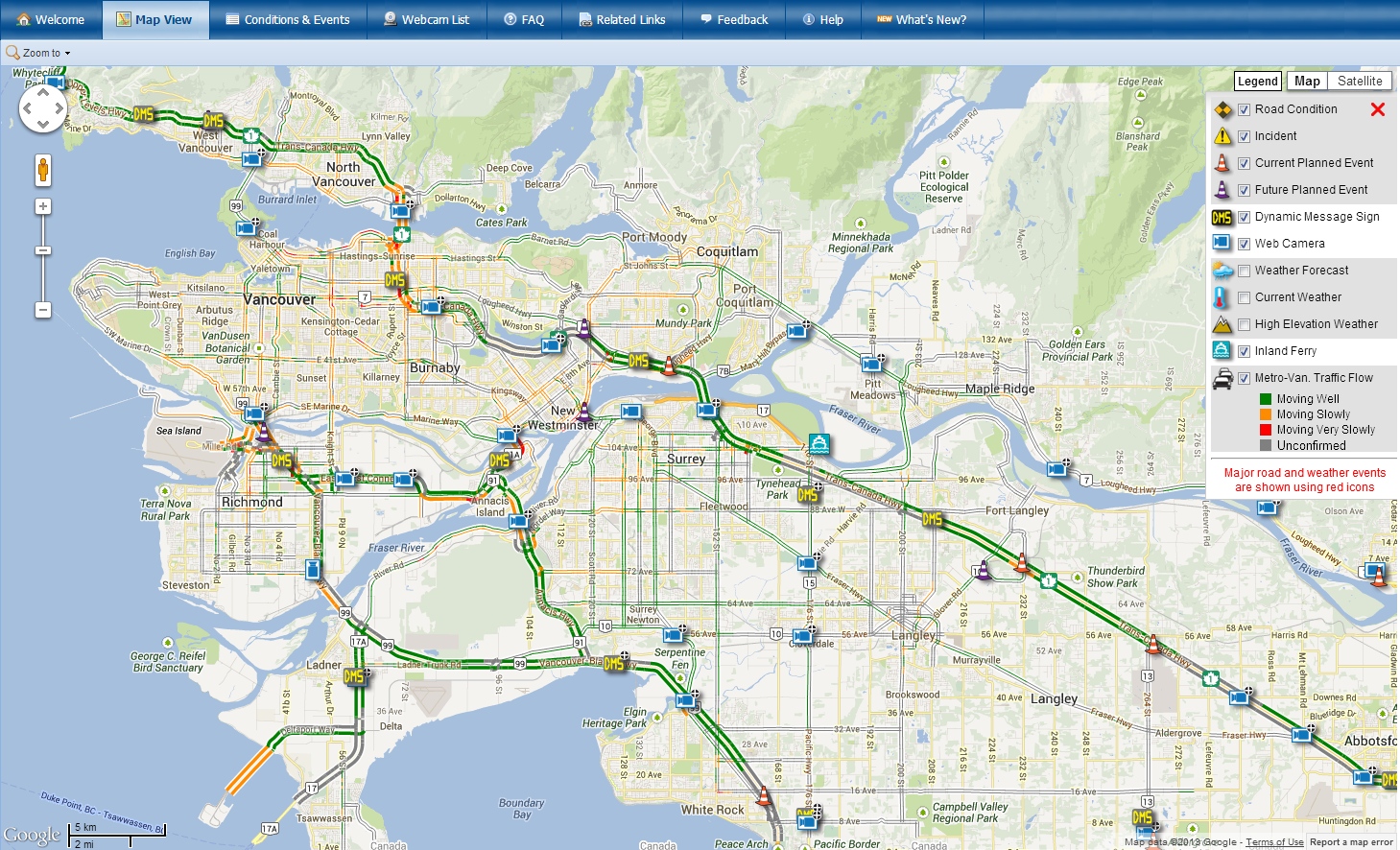
Where’s the transit?
This question is being asked more and more and despite the hype an hoopla from Translink in their quest for more money, there is absolutely no concept of a regional transit strategy. Oh yes, we have SkyTrain for Vancouver; light rail for Surrey; and express buses (BRT is somewhat a fraudulent term) everywhere, but there is no regional vision for transit in the metro Vancouver area.
TransLink’s planning has been Balkanized to suit the politics of the region. Vancouver politicians wants subways, so Broadway must have a $4 billion SkyTrain subway. Surrey wants light rail, so Translink is over engineering light rail to make it comparable in costs with SkyTrain to please both Surrey politicians and the entrenched SkyTrain lobby. The ruling BC Liberals and their acolytes want “rubber on asphalt” solutions, which translates into Bus Rapid Transit or BRT, for their massive new highway and bridge building program.
The result; a massively expensive, disjointed transit plan that favours election dates, rather than building an efficient and affordable transit network for the Metro Vancouver area.
In Europe, transit planning is based on pleasing transit customers with good service and designing transit in such a way to attract the motorist from the car, without bankrupting the taxpayer.
Until the region has a truly ‘Metro” transit authority, Hodge-podge transit planning will continue unabated. To clearly illustrate how political interference has fouled up our regional transit planning, both the Canada Line and the SkyTrain lines are light metro’s, both are fully automated, but because SkyTrain is a unconventional proprietary railway, which trains are power by Linear Induction Motors and the Canada Line is a conventional heavy rail metro, powered by conventional rotary motors, both transit systems are incompatible in operation! This means no through running or no joint procurement of vehicles. The Canada Line has further embarrassed itself by costing far more than TransLink anticipated and the scope of the project was so reduced that the Canada Line as built, has less capacity than a simple streetcar line costing about one fifth the cost! It will cost the taxpayer billions more to increase capacity on the Canada Line, so much so, it would be cheaper to build anew LRT line from Vancouver to Steveston and beyond.
Ai??It costs about $500 each month to put someone onto transit and TransLink only recovers about one-third of this cost from transit users on average; whereas, TransLink only recovers about 6% of the cost of transit from students on the U-Pass program.Ai?? Taxpayers subsidize 70% of the cost of transit on average, and every person on transit is a drain on the economy.Ai?? In addition, the heavy transit buses ruin the roads to increase the cost to municipalities for road maintenance.Ai?? Ironically, the municipalities pay TransLink for transit service to have TransLink destroy their roads in return.Ai?? Transit does not reduce the requirement for roads and leads to increased costs for more roads due the net reduction in road space by transit.
(Courtesy Eric Chris, professional engineer)
Afraid to admit past planning mistakes, including that the U-Pass program is slowly financially strangling transit operations, Translink continues to blunder along with unaffordable and unworkable transit solutions for the region. This has left the Vancouver Metro Region in a ” transit planning” vacuum and as we all know nature abhors a vacuum, so the province is filling the gap with very expensive bridge and highways building program.
L.A. North has arrived.
Zwei Reflects And Makes A Prediction
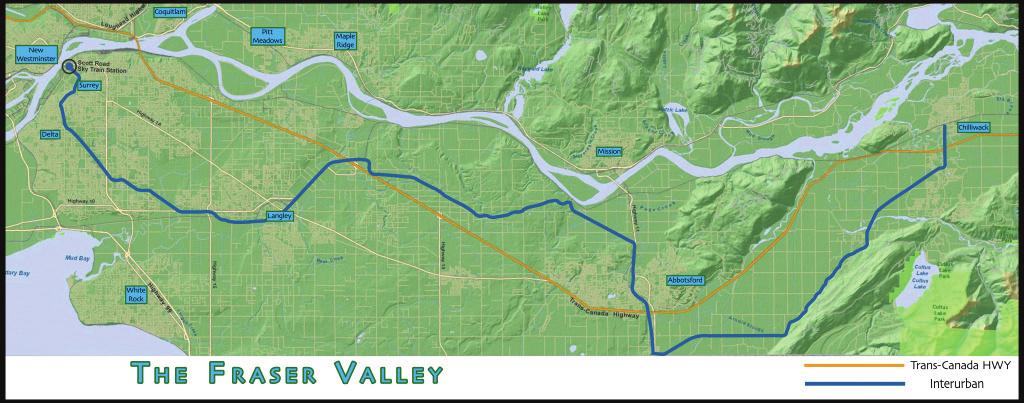 The Rail for the Valley Blog was started on December 8, 2008, to bolster awareness of the then newly formed Rail for the Valley group and the need for an affordable rail service from Vancouver to Chilliwack.
One can only write so much about the Rail for the Valley project and the blog branched out into such subjects as unconventional railways, railway history, railway signalling, local and international news, and the efforts of others trying to establish affordable light rail lines in their towns and cities. Along the way we have picked up a good following including transportation experts Cardinal Fang from the UK and, Haveacow from Ontario and our local professional engineer Eric Chris , whose insight and comments are always very welcome.
Zweisystem (German for two system LRT or TramTrain) has been a transit advocate since the 1980’s and has been long around the political shell game. A 27 year member of the Light Rail Transit Association, Zwei has the general knowledge of transit around the world and how transit mode is applied.
We have picked up detractors from the SkyTrain Lobby, but we have a lot of people who regularly visit the Rail for the Valley blog for their regional transit news. More and more regional politicians are using the blog for transit news and information that is free of TransLink speak.
From time to time Zwei does get it wrong, but the blog is well vetted and mistakes are made, but are corrected.
In the metro Vancouver region the SkyTrain lobby and their surrogates have held sway for for 34 years and during this time a number of SkyTrain myths have been created, including:
- SkyTrain is cheaper to operate than LRT because it has no drivers.
- SkyTrain can achieve a higher capacity than LRT.
- Light rail, as well as all at-grade transit systems are slow.
The answers pertaining to these myths are:
- SkyTrain does not have drivers, but it has attendants (170 full time) and transit police, plus a larger signalling staff means that SkyTrain actually has more employees than comparable light rail operations and more expensive to operate.
- Capacity is a thorny issue at best and in most cases, capacity is based on theoretical calculations and not practical in revenue operation. SkyTrain has been said to be able to achieve 30,000 pphpd, but that is with 8 car trains (MK.1 stock) with 100 metre station platforms, yet the current SkyTrain system can only operate 6 car trains of MK.1 stock on stations with 80 metre platforms. The claim is moot because in Karlsruhe Germany was seeing traffic flows of over 30,000 pphpd on a simple tram line.
- The difference between LRT and a streetcar is the concept of the reserved rights-of-way or a R-o-WAi?? reserved for the exclusive use of the tram. The Reserved R-o-W, plus priority signally, gives LRT the ability to travel much faster; it is the number of stations per route KM that makes LRT slower and with Skytrain stations up to 2 km. apart compared with with LRT stations are 500 to 600 metres apart, makes light rail somewhat slower. Studies have shown that with stations more than 600 metres apart, reduce ridership and make the service user unfriendly. Given the same quality of R-o-W and equal stations, LRT and SkyTrain can obtain the same commercial speeds.
Myths exposed, but it is strange how many people still believe in TransLink speak, but again I ask; “Why is nobody buying SkyTrain?“
I have always said, to get a rail link to Chilliwack, we must put a wooden stake in heart of SkyTrain and expose the Lysenkoist science behind SkyTrain planning.
Lysenkoism is used metaphorically to describe the manipulation or distortion of the scientific process as a way to reach a predetermined conclusion as dictated by an ideological bias, often related to social or political objectives.
There is a shift in planning, TransLink is attempting to plan for LRT in Surrey, but it is being planned on the SkyTrain model, which will doom it to failure and this, I think, is what TransLink wants.
The TransLink referendum is the next ‘big story’ and Zwei thinks that the Premier is setting TransLink up to fail, and why, do you ask?
The answer could be, “Does the Premier and the BC Liberal Party want TransLink referendum to fail so it can privatize it?” From my perspective, the evidence points this way, but time will tell.
Letters

Transit and transportation are on the minds of local residents, which is a good thing because the more people who want real change for transit will demand it of their politicos.
Nothing wrong with Massey Tunnel
Published: September 30, 2013
Re: Massey Tunnel replacement.
At first glance, the premierai??i??s announcement for a new bridge sounds good, but when one studies the offer of a new bridge, a lot of disturbing questions surface.
The Massey Tunnel does not need to be replaced, as it just had a large and expensive seismic upgrade. In fact one could lay another tube next to the tunnel to expand vehicle and transit capacity at a much lower cost.
It seems that lobbyists for the port authority have convinced the premier to get rid of the tunnel so they can deepen the river to allow massive bulk carriers to reach Surrey docks to load coal and oil. But wasnai??i??t the Robertai??i??s Bank super-port created so massive bulk carriers did not need to travel up the Fraser, saving time, large pilotage fees and taxpayer dollars for regular comprehensive dredging?
What about the extra traffic the 10-lane bridge will dump into Richmond? The tunnel, having only four lanes, provided passive traffic calming, regulating the flow of traffic. All the new bridge will do is move gridlock to the next choke points, the Knight and Oak Street bridges.
There is no mention of easing congestion on the lonely Queensborough bridge, which is older than the Massey Tunnel and is at capacity almost all day. Unless there is a new bridge to Vancouver, gridlock will be endemic on the 99 and 91 highways in Richmond and New Westminster.
The proposed bridge makes a farce of improving transit south of the river as the Liberal government is investing in ai???rubber on asphaltai??? with single occupancy cars, leaving transit mainly for the poor, the elderly, and students.
The hypocrisy associated with the bridge knows no bounds, with many mayors wanting a referendum for the bridge, yet decrying one for TransLink funding, but on the whole stating referendums are not really democratic. What are regional mayors and the premier afraid of, an outbreak of true democracy?
The timing of the proposed bridge is designed to give leverage to the South Delta Liberal candidate in the 2017 election.
The proposed crossing, which will be tolled, is all about pleasing political friends, winning elections, and leaving legacies, not improving traffic flows or improving regional transit.
Malcolm Johnston
Delta
Use the tunnel for rail
The Massey Tunnel would be ideal for a commuter rail linking the Richmond SkyTrain with South Surrey and Langley.
A light rail route linking the South Fraser region with Richmond would make the best use of the Massey Tunnel and would utilize the existing infrastructure of the old Interurban commuter railway.
Linking Surrey light rail to Richmond would vastly increase ridership on South Fraser light rail and ensure its success.
Glen Churchman
Transit woes continue in North Surrey
Published: September 30, 2013
I live in Surrey and I take transit to work in Vancouver every day.Ai?? I first catch a bus at 104 Avenue and 146 Street which takes me to the Surrey Central SkyTrain station then I take the train downtown.
Until recently there were four separate buses that regularly travelled westbound along 104 Avenue to the Surrey Central SkyTrain station: the 337 (every 15 minutes); the 509 (every 20 minutes); the 590 (every 20 minutes); and, the 320 (every 15 minutes). Only one of these buses, the 320, stops at all stops on 104 Avenue. The other three are all express buses.
There is a fifth bus that does make all stops on 104 Avenue, the 501, but it does not operate during the morning rush hour.
During rush hour when school is in, the 320 frequently drives right past my stop packed to the rafters with passengers and I and many others find ourselves waiting 15 or 20 minutes for the next bus. Meanwhile the other three express buses roar by with greater frequency and are usually only half full with passengers.
Once I do get on a bus I find that there are often upwards of 30 or more people standing in the aisle. Likewise on the return trip home.
The 320 runs every 15-20 minutes in the evening and is frequently late and at times when I get to the Surrey Central SkyTrain station there are upwards of 80 passengers waiting to catch this bus.
For the past five years I have been asking TransLink to solve this problem of overcrowding on the 320.
I thought the solution was relatively simple and inexpensive.Ai?? All TransLink had to do was tell the drivers of the 337, 509 or 590 that if they see people at any of these affected stops during rush hour to stop and pick them up. But no, TransLinkai??i??s solution was for me to catch the 320 headed in the completely opposite direction of my intended direction, ride it for five or six stops, then get off the bus and cross the road and catch the 320 heading in the direction I want to travel before it fills up. I have also been told repeatedly by TransLink that their long-term plan has been to put articulated buses on the 320 run but first they have to find it in their budget to buy some buses.
TransLink started another new bus route that goes down 104, the 96 B-line. All of the buses on this run are articulated buses and they run every 12 minutes.
I thought the problem was being solved but the B-Line doesnai??i??t stop at our stops. Also, because they have added this new route they have reduced the frequency of the 320 (from every 12 minutes to every 15 minutes) making it even more likely that there will be more drive-bys because those buses will fill up even more and sooner.
Since the new 96 B-line is so under-utilized, why not put all of those articulating buses on to the more heavily used, over-crowded 320 route? Doesnai??i??t that sound reasonable?
Well, it does not seem to resonate with TransLink. The problem continues.
John Werring
Surrey
Transit changes make no sense
Published: September 30, 2013
I am writing to voice my condemnation of the recent changes to the 320 Surrey Central/Fleetwood bus service with the introduction of the 96 B-Line.
For a short while recently, the 320 ran almost every few minutes.Ai?? That was extreme and a waste of money and manpower. Now it has been reduced to every 15 minutes.
Scheduling the 320 runs somewhere between these extremes and closer to what is was before the change ai??i?? i.e. nine- to 10-minute intervals ai??i?? would be prudent at least during morning and evening rush hours.
As I stand in the long line-up at Surrey Central SkyTrain station waiting for the 320 to go home every weekday evening, I see the 96 B-Line buses zooming back and forth every seven minutes with maybe only a couple of dozen people in them. How many transit users benefit from this service?Ai?? Perhaps a small number of people in Newton who want to go shopping at the new Guildford mall?Ai??Ai?? Again, a waste of money and manpower. Maybe the mall should subsidize the B-Line.
I cannot rationalize what TransLink was thinking. How are the ever-growing numbers of us who have abodes along the 320 route from the Surrey Central SkyTrain station to Fleetwood supposed to commute to and from work on a daily basis in reasonable time?Ai?? If TransLink is over their budget, why are they instituting a new service that is not being used to its fullest extent and penalizing the 320 bus service that is?
This further clarifies that TransLink has no comprehension into how to spend their finances wisely.
If however, TransLink is intent on screwing us out of reasonable service on this very busy route, they should use the big B-Line buses on the 320 route ai??i?? at least then the two busloads of people waiting in line during rush hour periods could all get on, and the second busload would not be left behind waiting for the next bus.Ai?? Use the regular-size buses for the B-Line.
J. Jordan
Surrey
Does the Provincial government Want TransLink To Fail?

Like a death dirge, the TransLink referendum drags on and on, yet the provincial Premier is steadfast on the question of a funding referendum for TransLink.
The regional mayors are more and more making fools of themselves wanting one of many tax proposals to fund the TransLink behemoth, yet abhor a “none of the above” selection. What the mayors want to ask the taxpayer is somewhat like a condemned man being asked if he wants death by firing squad; hanging; or electrocution.
Except for mayor Corrigan of Burnaby, a former CEO of TransLink, not one of the lower mainland mayors have a working knowledge on the art of modern public transit.Ai?? The mayors want more money for TransLink, but they fail to realize the many problems that plaque the organization, and seem to think the more money one throws at TransLink, the better it will be. This is scary nonsense; TransLink is broken – unfixable.
Vancouver wants a $4 billion subway, Surrey need $2 billion to implement a mediocre Translink LRT plan; SFU wants a $147 million gondola; the Canada line is like a white elephant, too expensive to expand and needs at least $2 billion more to be useful (the same amount of investment could build a completely new Vancouver to Steveston and Ladner LRT); and the list goes on. Unsustainable, no matter what funding is approved.
Does the Premier realizes this? Maybe.
Three important items should be considered.
- The recent new Fraser Bridge replacement announcement had nothing about transit or improved transit.
- The almost implemented Compass Card program, will do nothing in reducing fare evasion and with the very simple fare regimen Translink has, there was no need for the Compass Card. What the Compass Card is very good at is apportioning fares between transit mode, which would be very important if Translink were sold off or privatized.
- The Minister of Transportation, Todd Stone, is from Northern BC and his seat is safe if unpleasant actions are taken against TransLink.
It could be that the proposed TransLink referendum is so designed to ensure Translink fails. It is clear that the Premier has a plan for TransLink and the regional mayors do not.
TransLink referendum doomed, Metro Vancouver mayors warn minister
Jeff Nagel – Surrey North Delta Leader
Published: September 26, 2013Metro Vancouver mayors emerged from their first meeting with new Transportation Minister Todd Stone with no deal or even the makings of one on how to restructure TransLink or craft a referendum on transit expansion funding slated for next year.
Mayors also expressed frustration Thursday that the province is pushing ahead with a Massey tunnel replacement bridge that they fear could push back transit as a priority.
They object to the premier’s insistence there be a referendum on new taxes for TransLink, fearing it will be defeated at the polls.
And they continue to take a stance that TransLink must be reformed to give them more control over spending priorities as a precondition for their active participation in a referendum, if the province insists it go ahead.
Burnaby Mayor Derek Corrigan said he doesn’t see how the referendum can succeed.
“Despite the mayors saying it’s the stupidest idea imaginable they continue on with the referendum, they’re absolutely determined to hold it,” Corrigan said. “And it’s pretty clear that none of us are going to participate.”
He called it a “ridiculous” way to govern to go to referendum on such a complex issue.
“Why wasn’t there a referendum on the Port Mann Bridge? Why isn’t there a referendum about building a new Delta bridge? Why isn’t there a referendum on the Pattullo? Where they want to spend money there’s no referendum. Where they don’t want to spend money there’s a referendum.”
Corrigan noted the premier’s promise to give the people the final say came after the province concluded voters were wrong and misguided when they defeated the HST in a referendum.
“I don’t know how a referendum will pass,” said Mayors Council chair Richard Walton,Ai?? added he’s hopeful more meetings can hammer out a deal with the province by Christmas that provides some chance of success.
Walton predicted most people will vote against paying more taxes for transit ai??i?? while continuing to demand more be provided ai??i??Ai??unless a very compelling case is presented.
Stone told reporters he shares a common vision with the mayors on the need to raise billions of dollars for additional transit expansion.
There is no decision yet on what exactly voters will be asked in the referendum, who will pay for it and lead it, or when it will be, other than it will take place no later than November of 2014.
Asked if voters might be denied a “none of the above” option ai??i?? that they might be forced to choose from a menu of new taxes for TransLink as suggested in May by former Transportation Minister Mary Polak ai??i??Ai??Stone said he hasn’t ruled it out.
“The question must be about a vision for the expansion of transit and transportation in the Lower Mainland,” Stone said.
“It is therefore likely that wrapped around that vision in the referendum question itself there may be a list of options that voters have to choose from in terms of different funding mechanisms, new funding mechanisms that could come into play to fund that expansion.”
He predicted the referendum can be successful if the question is worded correctly.
Stone also defended the government’s decision to announce plans to replace the Massey Tunnel with a large new bridge.
If there is a referendum, the more probable sources of potential funding include an annual vehicle levy or a small regional sales tax.
Road pricing or regional tolling, while backed my most mayors, would take years longer to flesh out.
TransLink board vice-chair Howard Nemtin also spoke out Thursday when mayors challenged the board to take a public stand on the future of TransLink.
He insisted TransLink is efficiently run but cannot keep pace with the needs of the growing region.
He said the board backs the mayors’ call for new revenue sources.
“We’ve looked at road pricing. We’ve looked at licence fees. We’ve looked at tolling. We have all been on the same page in that regard,” Nemtin said.
“What we do need is some decision at a higher level, at the provincial level, to allow us to move forward and implement those particular initiatives.”
http://www.surreyleader.com/news/225381242.html
Massey Tunnel Fox Trot
More fallout from the Premier’s announcement about the bridge replacement for the Massey tunnel.
Richmond Mayor, Malcolm Brodie, demand for a mini-metro instead of light rail has condemned Richmond of any chance of having “rail” transit extended in his municipality. It has been said that it would be cheaper in building a completely new LRT line from Vancouver to Steveston and Ironwood Mall, that extending the present Canada Line.
The good mayor should also understand that the forced transfer of bus customers from South Delta and South Surrey, deters many from taking transit. In fact, bus service from South Delta has reverted back to pre Canada Line days, due to projected new transit customers not materializing.
It is a sad commentary but hypocrisy reigns with both civic and provincial politicians.
Metro Vancouver mayors question Massey bridge plan, Victoriaai??i??s transit priorities
A proposed bridge over the Fraser River to replace Massey tunnel — shown in this rendering — is proving controversial among Lower Mainland mayors who have been told their funding options must go to referendum.
Several Metro Vancouver mayors say Victoriaai??i??s demand for a referendum on TransLinkai??i??s funding options is hypocritical given the recent announcement of a bridge to replace the Massey tunnel ai??i?? without similar public consultation.
In a meeting this morning, the mayors will ask Transportation Minister Todd Stone to explain why the government has foregone a referendum for the Massey bridge.
The mayorsai??i?? council, which approves TransLink funding and shapes the regionai??i??s long-term transit plans, is opposed to the referendum announced by Premier Christy Clark during the election campaign.
The mayors see the referendum as another example of the provincial government overriding the work of long-term regional transit planning. Successive NDP and Liberal governments have jumped the queue to launch highway improvements and rapid transit lines of their choosing.
Several mayors say Clarkai??i??s Massey bridge announcement last Friday was the latest in a string of unilateral government moves that have hamstrung their municipalities, who are dealing with a regional transit system that is ai???busting at the seams.ai???
The mayors argue the provinceai??i??s proposed referendum for TransLink, slated for the 2014 municipal elections, would not give the public the whole picture of the transit situation or identify appropriate sources of funding, and would be divisive to the region.
ai???You can certainly say the referendum is a hurdle to moving forward and providing the transit people want in the region, whereas the bridge is announced four years from now as a fait accompli without even any discussion as to how itai??i??s going to be financed,ai??? said North Vancouver District Mayor Richard Walton, chairman of TransLinkai??i??s mayorsai??i?? council. ai???Transit is considered much less important and essential to the economy than extending the (Fraser) river crossing.
ai???From our point of view ai???Well, show us the business case and what are the rules?ai??i?? ai???
Metro Vancouver board chairman Greg Moore said the bridge and major improvements to the road network didnai??i??t trump new rapid transit in Surrey and along Vancouverai??i??s Broadway corridor in the boardai??i??s regional growth strategy. The tunnel is one of the regionai??i??s largest choke points for traffic and there is no guarantee that the new bridge would be approved in a referendum involving voters from across Metro Vancouver, he added.
The mayorsai??i?? council has long lobbied for more control over TransLink, saying they have been backed into a corner to raise taxes for bridges, roads and transit, but have no control over transit priorities. Instead, decisions are often made in secret by the appointed board or imposed by the provincial government.
Before their re-election, the Liberals promised Metro Vancouver residents a referendum vote on any major transit projects in their communities.
Stone was unavailable for an interview, but spokeswoman Kate Trotter emailed a statement that said the bridge was a ai???significant election issue and we were very clear about our intent.ai???
The statement said that public consultations clearly showed the public wanted the bridge and that the business case for it, as well as its technical design, is now underway.
Richmond Mayor Malcolm Brodie said the Massey tunnel could be significantly decongested by putting more money into a system of buses that get commuters out of their cars as well as opening Port Metro Vancouverai??i??s facilities 24 hours every day to spread out the commercial truck traffic.
ai???You donai??i??t need to build a new bridge to decongest it,ai??? Brodie said. ai???If all youai??i??re doing is to speed the traffic along, so they can get over this brand new bridge, so they can get to the traffic jam that much earlier, what have you accomplished? Nothing.ai???




Recent Comments