TransLink Is Playing “Financial Chicken” With The Taxpayer.
TransLink is a one trick pony and Bob Paddon, TransLink’sAi??executive vice-president of strategic planning is the ringleader, trundling out the same old tired routine to con the public for more money.
One tires of TransLink’s brinkmanship, but throwing more tax money at this ponderous bureaucracy will do nothing to alleviate the problem and the problem is major. Like an alcoholic, TransLink just cannot deal with the transit problem until it admits what the real problem is and that is simple – SkyTrain. This massively expensive, but now obsolete proprietary mini-metro costs at least three times more than very successful light rail to build and cost more to operate. The result: the taxpayer is anting up farAi??more tax money to subsidize a truncated regional rail system and there is not enough money left over to operate the buses.
Added to the problem is that buses are very poor in attracting the all important motorist from the car, thus a transit system, that is based on buses to be successful, will not perform to its promoters expectations. TransLink’s much ballyhooed “Rapidbus” will be mainly used by the poor, the elderly and students. And on the topic of students, the now almost universal U-Pass, with over 100,000 thousand of these $1.00 a day, ride at will post secondary student passes have flooded TransLink’s services to the point that for many potential transit customers, taking the car is just a better option!
There are so many problems with TransLink, including an almost clueless TransLink board; inept bus scheduling; unrealistic planning, that before the taxpayer is asked to ante up more money, a through and complete housecleaning is in order; but I don’t see that happening as TransLink is the epitome of the “Peter Principle“.
The Peter Principle is a belief that in an organization where promotion is based on achievement, success, and merit, that organization’s members will eventually be promoted beyond their level of ability. The principle is commonly phrased, “employees tend to rise to their level of incompetence.”
TransLinkAi??is playing a game of “Financial Chicken” with regional politicians and it is time for the public to say; “no more games, no more moneyAi??until TransLink is reformed or abolished!”
Ai??
TransLink’s funding plan hinges on raising taxes
TransLink’s newly announced base plan to send a rapid bus over the new Port Mann Bridge and add an express B-Line bus service in Surrey hinges on persuading the region’s mayors to raise property taxes.
By Kelly Sinoski, Vancouver SunSeptember 18, 2012
Bob Paddon, executive vice-president of strategic planning, said Monday TransLink has found $98 million in annual efficiencies over the next three years, which would help fund those projects, as well as the new Evergreen Line, while adding 109,000 new hours of transit service, and upgrading seven SkyTrain stations.
But the plan also depends on using $124 million from TransLink reserves as well as the $30 million annually that TransLink would reap from a two-year, time-limited property tax increase approved by Metro Vancouver mayors last year.
Simon Fraser University political science professor Lindsay Meredith said it appears the players in the transit issue are gearing up to play hardball.
ai???TransLink is saying weai??i??ve got nowhere to go; this is the only card we have left to play and the provincial government have made us do it,ai??? he said. ai???Thereai??i??s a lot of posturing going on. This is not unusual; you see this happen all the time. All sides up the ante.ai???
Mayors voted earlier this year to nix the two-year increase, equivalent to about $23 per homeowner, saying it was only a stopgap measure while they negotiated with the province on potential new funding sources. Discussions are still ongoing.
The mayors voted against the increase because carbon taxes and a vehicle levy were rejected as funding sources.
ai???We went ahead and entered into discussions in good faith and two of those sources of revenue were dismissed outright (by the province),ai??? said Richard Walton, chairman of the mayorsai??i?? council on regional transportation. ai???We werenai??i??t overly thrilled. Weai??i??re not going to continually have property taxes be the fallback position.
ai???We understand additional transportation will cost more money. But weai??i??re saying the meaningful discussion has still not taken place with the province.ai???
The mayors are scheduled to meet with TransLink this week to discuss the base plan, which aims to save $47 million per year and boost revenue by $60 million by shifting bus resources to routes with higher demand, leveraging real estate assets, and increasing or introducing parking rates at TransLink-run park and ride lots. The plan will go to public consultation before being finalized in November.
Walton wouldnai??i??t speculate on whether he thought the mayors would change their minds about a property tax. ai???Obviously itai??i??s a political hot potato,ai??? he said, ai???(especially) for communities south of the Fraser where thereai??i??s a strong need for transit.ai???
TransLink said if mayors continue to balk at the tax increase, a supplementary plan would have to be drawn up later this fall, and service cuts are possible. As it is, Paddon said, TransLink canai??i??t fulfil all of its earlier promises.
The express B-Line bus service in Surrey, for instance, would run on King George Boulevard and 104th Avenue but wonai??i??t extend to White Rock as promised, while the rapid bus service from Langley to New Westminster over Port Mann Bridge, will run every 10 minutes during peak hours and 30 minutes during off-peak hours. It was promised that the service would run every 10 minutes off peak.
ai???There is a gap; we canai??i??t deliver everything we promised,ai??? Paddon said, adding: ai???This is going to have an impact on our customers.ai???
Walton, mayor of North Vancouver District, said he will take the base plan back to his council, noting a promised expanded SeaBus service, which would have provided 15-minute service on Sundays and holidays in fall, winter and spring, isnai??i??t part of the proposed base plan.
Other projects put on hold include a plan to increase bus service by a further 306,000 hours, and restoring original funding promised for cycling programs and the major road network.
Meredith expects lines will be drawn in the sand, especially among mayors south of the Fraser and the more transit-rich cities.
Surrey Mayor Dianne Watts and Langley City Mayor Peter Fassbender insist the mayors should honour the tax commitment they made a year ago.
The two were among seven Metro Vancouver mayors who voted in favour of TransLinkai??i??s 2040 strategic plan last year that called for a two-cents-a-litre boost in the gas tax and the potential interim property tax to pay for the Evergreen Line and regional transit projects.
Mayors in Burnaby and Richmond have never supported the property tax increase.
ai???You canai??i??t all of a sudden pull the plug out when a lot of different municipalities supported [transit] infrastructure going elsewhere,ai??? Watts said. ai???Having a rapid bus across the Port Mann and a B-Line in place along King George is something we want to move forward with.ai???
TransLink chairwoman Nancy Olewiler said the mayors or TransLink werenai??i??t aware of the substantial drop in fuel tax revenue when they voted to nix the tax increase. TransLink said it faces an estimated $30-million drop this year in its gas tax revenue, which is expected to be $145 million less in 2014 than the $380.3 million forecast.
This is blamed on drivers filling up south of the border or in the eastern Fraser Valley, as well as an increase in the number of hybrids and electric vehicles.
ai???None of us knew the magnitude of the fuel tax revenue decline,ai??? she said. ai???The world has evolved. Weai??i??re in close contact with the mayors and weai??i??ll see what unfolds.ai???
The transportation authority was also told earlier by TransLink Commissioner Martin Crilly it could only raise transit fares by 10 per cent next year, rather than the 12 per cent it had proposed.
Meanwhile, TransLink said $30 million in cost savings have already been found by reducing 90 management and professional positions, cutting overtime and labour costs and using more fuel-efficient vehicles.
More savings are expected from the provincial TransLink audit currently underway.
Paddon said less-used bus routes may see reduced service, such as hourly instead of half-hour schedules, with buses reallocated to high-demand areas, while SkyTrain service will be trimmed during non-peak hours. TransLink will also trim its ai???bufferai??? fleet, which means fewer spare buses on standby, and will cut ai???slackai??? time, which had given drivers extra time to make connections if they were caught in traffic, and use smaller, cheaper buses where possible.
Subway Blunders in Europe – Can TransLink Learn From Other’s Mistakes?
More from the LRPPro.
Herr K. is a German transit specialist from Germany and gives wonderful insight to the pitfalls of building new subways for the sake of building new subways. The following post shows theAi??problems and counter productiveAi??resultsAi??of building subways and metros, where ordinary trams would do just fine. There are lessons to be learned, but I’m afraid TransLink is an “old” dog that just can’t be taught new tricks!
Ai?? Nuremberg has both a driverless metro and trams (streetcars).
> We must build lots of light rail, cheap, as cheaply as possible to
> reach those so called transit hostile areas. They seem to be able to
> do it in Europe – pity! MMuenchen and Nuernberg show pretty well how Europeans fail at transit
system design, too. >;-> and X-(In Muenchen, at the beginning of the 60s, experts had recommended to
extend the existing streetcar system out to the periphery on new lines
built on separated row, even with grade-free road crossings where
possible at low expense. Work on this had already been started in the
50s and got pretty far. The result was an excellent, extensive and
dense network, attractive for both passengers and the operator.There are some photographs of some of those extension lines in operation
and after decomissioning onhttp://www.tram-muenchen.de/geschichte/gh-has_hah.html
http://www.tram-muenchen.de/geschichte/gh-suedwest.htmlText in german without translation, sorry. But the images speak for
themselves, I think.Especially these photos imho illustrate the standard to which these
lines were built:http://www.tram-muenchen.de/geschichte/fotos/2448-1993-10-03-rue_750px.jpg
http://www.tram-muenchen.de/geschichte/fotos/2007-1993-09-rue_kef_750px.jpg
http://www.tram-muenchen.de/geschichte/fotos/2032-1986-03-18-obh_750px.jpg
http://www.tram-muenchen.de/geschichte/fotos/2007-1993-09-obh_750px.jpg
http://www.tram-muenchen.de/geschichte/fotos/2044-1993-09-obh_750px.jpg
http://www.tram-muenchen.de/geschichte/fotos/2043-1984-07-due_750px.jpg
http://www.tram-muenchen.de/geschichte/fotos/3021-1983-08-has_750px.jpg
http://www.tram-muenchen.de/geschichte/fotos/2610-1991-02-17-zue_750px.jpg
http://www.tram-muenchen.de/geschichte/fotos/2606-1991-02-17-nrs_750px.jpgFor the city center, the experts had recommended building a few tunnels
under the main choke points and especially under the entire area which
is today pedestrian zone. After municipal authorities had taken over
planning of these tunnels, however, they got more and more extensive,
eventually creeping into a plan to replace the entire streetcar network
by a full-blown subway. This plan was decided nearly 50 years ago.Today, after “investing” a few billion EUR, the subway network does not
cover a larger area than the streetcar network around 1965-1975 and it
doesn’t allow to travel significantly faster, if travel time is mesured
from door to door. In fact on lots of (especially tangent) relations
where the streetcar network offered a direct connection, today you are
forced to make detours and change trains, losing time.Another issue is that the dense surface network was replaced by just
three trunk lines (which are split up into branch lines towards the
ends), which resulted in hopeless overcrowding of some stretches during
rush hours and especially of the connecting stations. Besides, the
subway network offers less stations, so walking distances have been
significantly increased for the passengers. When living in Muenchen, I
almost always preferred to go by bicycle because it was faster than the
subway.In the end, the streetcar network has never been entirely replaced,
some lines that had been closed, but without replacement by subway,
even had to be reopened because busses were inefficient in handling the
volume of passengers who stubbornly refused to take a detour
underground.Today, the streetcar network is slowly being revived and new lines are
being planned. One streetcar extension line that had been planned in the
early 60s and for which the row had already been reserved, eventually
got opened in 2011. One streetcar line that was closed without
replacement by subway in 1983 got reopened the next year after protests
by the citizens flooded the town hall, closed again in 1993 and might
be reopened again in the near future.For the north and the southwest of the city, there are now plans for
the construction of entire new streetcar subnetworks, including some
stretches of extension lines built in the 50s/early 60s which were
closed in the 80s/90s.One important short tangent connection, which was planned as part of a
loop line around the entire city before WW1, never got built due to
WW1, depression and then WW2, and it was the only segment of that loop
line that was never completed. Today, the only thing that prevents it
from finally being built is the county government whose opposition to
the city council’s decision is nominally based on the false pretension
that the streetcar line would wreak havoc to park it has to pass
through. On a row where currently diesel busses operate, the tarmac
would be replaced with grassed tracks. A few hundred meters north of
this row, a six lane “highway” passes through the same park. The real
reason of course is just that the county government is in the hands of a
different political party than the city council and is has been like
this for decades now.The “tunnel mania” of the subway planners gave some “interesting”
results. For example, when the technical university of Muenchen moved
some of the engineering faculties to a new campus outside the city in
the middle of nowhere, it took roughly a decade to built a subway line
there. This line passes underneath a place named Garching, essentially
a tiny village, they have a maypole on their village square with a
subway station underneath. Next to this village, the tunnel passes even
below a potato field (or is it a cow paddock?) before reaching the
campus.During the decades of subway tunnel construction, suburbanisation has
progressed further outward, creating more traffic. With the result that
the suburban commmuter network (“S-Bahn”) got overloaded, especially on
its main trunk line which passes in a tunnel under the city. Plans for
adding two separate tracks for commuter trains and connecting stations
with the urban network to an existing surface bypass line south of the
immediate city center have been put aside by the politicians. They
could have been implemented by now, at comparatively low cost.Instead, a new tunnel parallel to the existing one was planned, with
connection to the existing urban network at stations which are already
hopelessly overcrowded. The cost for the tunnel, as usual, rose during
the planning stage and in the end financing could not be warranted so
the project is stalled.So while a foreigner coming to Muenchen might think this city has an
excellent transit network, as someone who has lived there for a few
years I beg to differ. After decades of tunnel contruction with >10
billion EUR wasted, large areas of the city still have no decent
connection while the subway and the commuter network are overcrowded
and unable to handle more traffic. Besides the fact that tangent
connections are missing and busses (not only on these relations) are
stuck in gridlock during rush hours.In Nuernberg, which mostly imitated the system at Muenchen, they built
a single-track (!) subway tunnel to the airport, which before was
served by 12m busses every hour or so. Right before arriving at the
airport, the tunnel passes underneath paddocks, community gardens and a
small forest.The Nuernberg system is really a “nice” example how to screw up an
outrageously expensive transit system. One false pretense for building
the subway was, among others, that it would provide a higher capacity
than the streetcar. But actually, the subway was built with stations
only for 75m trainsets, very narrow platforms at some stations and few
and narrow staircases.As it happens, one of the most cramped stations is the one that has to
handle the most passengers, during the annual christmas market, which is
*the* touristic event in this city.Sincerely,
W.

New Port Mann Bridge toll for cars is $1.50 – A Pre-election Goody?
In a deliberate attempt to pander for votes in next spring’s election the BC Liberal government has offered a ‘pre full toll special’ for a few months and if you register for a decal, you get a full year at the discounted price – yippee!
Zwei is not against tolling, but the new Port Mann Bridge is all about politics; a new bridge replacing a recently refurbished Port Mann Bridge (why not build a smaller and cheaper bridge, use bothAi??and charge less toll?), which will be torn down. This smells like a political deal to force drivers to pay tolls for forty years to a company that is in bed with the BC Liberals andAi??smacks of crass cronyism and politcal pandering, but then that is the hallmark of the BC Liberal Party.
I also laugh at the proposed express bus service from Langley to the closest SkyTrain station, is being called ‘Rapid Bus’ as transit customers will find the service not so rapid as they first thought, when one considers a forced transfer to SkyTrain and many more transfers later to complete ones journey. The proposed express bus service is definitely not rapid bus or BRT, but that doesn’t stop Langley mayor Fassbender to embarrass himself by talking of ‘transit things’ that he knows little about and one wonders if he is not taking his cue from Victoria?
And finally, former Vancouver NPA councillor Gordon Price, local “legend in his mind“, who has found a comfortable sinecure at SFU, who constantly cheers any new tax on car drivers, yet offers very little else as an alternative, except for walking and cycling. Hey “Trains are toys for boys” Price, how about supportingAi??the affordable and shovel ready RftV/Leewood Vancouver to Chilliwack TramTrain?
No, I thought not, there is not much political or academic mileage to be made on simple and effective transit solutions.
As I have said before, the Port Mann Bridge is BC blacktop politics at its best.

New Port Mann Bridge toll for cars is $1.50
If you register for decal before March, you’ll get a full year discount
Dan BurrittSep 12, 2012
SURREY (NEWS1130) – If you plan to drive a car over the new Port Mann Bridge when eight lanes open in December, you will pay $1.50 per crossing, down from $3.00.
And drivers who register for a free online tolling account and decal by February 28th, 2013 will receive the discounted toll for a full year.
Transportation Minister Mary Polak says drivers won’t see the full benefit from the new span until other work on Highway 1 and the South Fraser Perimeter Road is finished.
“Drivers shouldn’t have to pay the full toll until we provide the full-time savings,” Polak says.
“When this project is complete, drivers will see their commute times reduced by up to 50 percent,” she notes, adding it took her nearly two hours to drive from her home in Langley over the existing Port Mann bridge to Downtown Vancouver today.
Light trucks and cars pulling trailers will be charged $4.50 to cross the new span, $1.00 for motorcycles and $9.00 for semi trailers and large trucks, although that fee is cut in half if truckers cross between 9 p.m. and 5 a.m.
“Currently, the time [semi truck drivers] spend in traffic is time that costs them money, so this already is a significant advantage for them and the opportunity to travel at night and have a 50 percent discount is certainly significant,” Polak contends. “We anticipate and, in fact, have heard support from the trucking industry for the framework that we’ve put in place.”
Polak and Transportation Investment Corporation (TI Corp) — the Crown agency overseeing the new Port Mann project — is encouraging as many drivers as possible to sign up for the free online tolling account and decal.
Drivers who get the new decal can use it across the tolled Golden Ears Bridge as well. Drivers with the Golden Ears Quickpass transponder can use the new Port Mann but won’t receive a discount, so the website suggests you return the transponder after December 1st and sign up for the Treo decal.
Polak says their plan to pay off the bridge is still on track despite the discount. “Tolls will still come off the bridge at 2050 and it will still be paid off then.”
She also expects rapid bus service to travel over the new bridge come December, despite TransLink’s funding challenges.
Langley City Mayor Peter Fassbender is also confident the rapid buses will run and plans to be on board the first coach to cross the bridge
“It may mean reallocating of some resources,” he says. “I don’t have the answers until TransLink brings it forward but I have the commitment from the minister and the government.”
NDP Transportation Critic Harry Bains calls the bridge tolls punishing, but wouldn’t say specifically if his party would raise them if they won power. “Chances are [the] tolls could go up if they are not on target as far bringing in sufficient revenue on tollings,” Bains says.
Short term gain for long term pain?
There are suggestions that the immediate discount on the bridge could mean short term gain for long term pain.
It will take decades to pay this off regardless, but North Vancouver District Mayor Richard Walton say shortening the cost to you on the front end will just extend it further on the back.
“The question is where are those funds going to come from?” he asks. “They have to come from users at some point. Market-force is at play when you are pricing public transportation as well. So you have to take a look at trying to get the optimum amount of revenue and making sure traffic keeps flowing over the bridge.”
Meanwhile, Surrey Mayor Dianne Watts figures people will be pleased to get to test out the bridge for less than they had expected.
Truckers won’t see reduced rates
There’s no toll discount for truckers who want to use the new Port Mann bridge in the day. This has the BC Trucking Association encouraging semi drivers to pass the $9.00 toll onto customers.
President Louise Yako doesn’t want that burden on her members.
“If you look at a $9.00 toll, it doesn’t seem to be very much, but if you add on a series of incremental costs then obviously, it will affect the total cost of transportation,” notes Yako.
The half price overnight rate remains in place, but she doubts a lot of truckers will take advantage of it.
Drivers will keep using the Port Mann Bridge
The head of the City Program at SFU expects drivers will keep using the Port Mann and Highway 1.
“Well, I’m signing up. I’m going to take the deal, it’s actually pretty good,” says Gordon Price. “I think they’ve done a good job with what you call a loss-leader. Get us all signed up, registered, and then we are on our way to not just bridge tolling.”
“I think you’re going to be seeing this rolling out so that all kinds of roads, bridges, gosh-you-name-it, are going to be part of a comprehensive road-pricing system in the future,” he adds.
The City Program studies issues like urban planning, transportation, and development. Price expects the reduced toll for crossing the bridge should be enough of an incentive that drivers will “try it out.”
“[Drivers] will make their trade-offs, I think some will,” he says. “But basically the appeal of Highway 1 and the bridge, I have to say it’s a pretty attractive option.”
Price says his biggest criticism of the Port Mann project is that new transit options for communities south of the Fraser River are not in place for the opening of the new lanes on the bridge.
http://www.news1130.com/news/local/article/400840–new-port-mann-bridge-toll-for-cars-is-1-50
Another View on the High Cost of Expensive Grade Separated Infrastructure
The following post comes from the LRPPro Transit blog and the comments from Herr Wolfgang are extremely pertinent to the situation evolving with Metro Vancouver’s light metro network. Simply, no one; not oneAi??politicianAi??or current transit planner has factored in the high cost of maintenance that will be needed in the coming years for SkyTrain’s and the Canada Line’s deteriorating grade-separated infrastructure.
Subways are extremely expensive to maintain as water seepage does great damage over time and the scouring effect of the dust and debris inside a subway are propelled piston like with each passing train through the tunnelAi??which acts as a sandblaster requiringAi??regular costlyAi??maintenance.
SkyTrain’s cement viaductsAi??are alsoAi??showingAi?? their age with signs of flaking, which in time will lead to more serious problems in the near future, especiallyAi??with the corrosive coastal atmosphere.
There are persistent rumours that over $1 billion dollars must be spent to upgrade justAi??the SkyTrain viaducts in the next 20 years and experience from overseas shows that the subway tunnels will also need expensive renovations, much sooner rather than later.
What all this means is that TransLink must find the money, not just to keep the transit system in operation, but must find more money to keep the present infrastructure in good repair.
What all this indicates is that the SkyTrain and the Canada line are ticking financial time-bombs, which regional taxpayers must ante up more and more tax money to keep TransLink’s financial fiasco from exploding.
Me thinks the South of the Fraser municipalities should seriously think of saying adiA?s to TransLink and go it alone, with much cheaper to build and much cheaper to maintain light rail. TransLink’s financial time bomb is tickingAi??louder andAi??louder!

> Most light-metro systems today were designed in the late 60’s and
> 70’s, to fill a gap between what a non articulated tram or streetcar
> could carry and that of a heavy-rail metro. To add extra panache,
> most new light metro systems were driverless, so the claim of cheaper
> operating costs could help sales. Then the light rail Renaissance
> happened, with new designed articulated LRV’s and the concept of the
> reserved rights-of-way, which meant that at-grade LRT could provide
> the same quality of service as a much more expensive grade-separated
> light-metro at a far cheaper cost. Revenue operation of light metro
> also demonstrated that automated transit systems also cost more to
> operate than LRT. Modern light-rail, with its cheaper construction
> costs and cheaper operating costs, made light-metro obsolete.One thing that struck me with public infrastructure projects is that
the overbloated cost of certain projects is often even exploited for
image promotion by political careerists:“Look at all the good we are doing: We are investing ($XYZ) monies into
public transportation in the next (N) years!”In a book about the construction of the subway in Munich, the director
(long retired, probably deceased by now) of the municipal agency which
was specifically set up for this project openly cited the extreme cost
of tunnels as an actual *benefit* (!) of the project for political
decision makers and as *the* reason to chose a “heavy rail” subway.Cheaper solutions, such as the building of short tunnels on selected
“choke points” of the streetcar network, as recommended by technical
experts at that time, would have offered less opportunities for the
politicsters to make their mark. And since something like 90% of the
construction cost was financed with federal and state subsidies
anyway, they had no reason to care for cost efficiency.< prayer wheel>
The point that everyone deliberately chose to ignore back then was that
all that shining, brandnew infrastructure needs to be maintained, even
though initially it came nearly for free for the municipality. To
camouflage this in the accounts, the infrastructure was symbolically
evaluated at just 1 DM. Result: No asset depreciation had to be “put
aside” from the revenue, faking better cost recovery. But obviously,
asset depreciation originally was made legally mandatory not without a
reason. To cater for maintenance cost. Which cannot be financed now.
Which would have been obvious from the start, if it had not been
deliberately camouflaged by accounting fraud. Oops. Remind me, what were
rules meant to be good for?< /prayer wheel>
> Sadly the LRT Renaissance has not reached the USA as many new LRT
> lines (Seattle) are nothing more than very expensive mini-metros in
> drag. I feel, many new so-called LRT lines in the USA are both badly
> planned and heavily gold plated. Thus for many transit projects the
> cost for LRT is almost the same as a light metro! This ‘metro’ creep
> planning has made LRT almost unsellable and has given rise to BRT! A
> simple 17 km streetcar/LRT line in Victoria BC, is said to cost
> almost $950 million! This is utterly ridiculous, but the outfit hired
> to cost out LRT for Victoria, used costs from Seattle and other
> gold-plated American schemes. “Metro’ creep has affected the ability
> to build LRT across the boarder in Canada! It is safe to say that in
> the USA transit planning is 25 years behind Europe and instead from
> learning from success overseas, many planners are blundering ahead
> with extremely dated and very expensive light rail plans which in
> reality resemble light metro, especially with the costs. I know all
> the excuses on this side of the pond about modern LRT, but things
> have changed and if the effort was made to introduce real European
> LRT/tramway, I think we will win the transit wars; but if we continue
> to build hugely expensive hybrid metro type systems, the door will be
> wide open to all sorts of gadgetbanen and bus based transit systems
> that will do little in reducing traffic congestion and gridlock, but
> are wonderful in increasing taxesI remember reading an article a long time ago about a comparison between
the LRT systems at Edmonton and Calgary. The article concluded that
since Edmonton chose to build their system with complete grade
separation which required lots of tunneling, cost became prohibitive
and the whole “system” essentially remained a torso. Whereas in Calgary,
infrastructure cost was kept much lower by building lines without
complete grade separation, which allowed implementation of a more
extensive network, yielding much higher ridership and better cost
recovery.Judging from Wikipedia, it seems that Calgary has now switched to
planning expensive tunnels as well, at least partially… 🙁Sincerely,
W…….
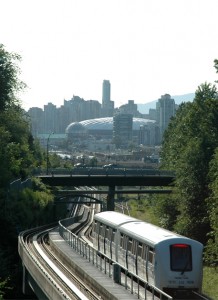 Is the aging SkyTrain a ticking financial time-bomb?
Eric Chris’s letter to New Transportation Minister, Mary Pollack
Dear Mary Polak, Langley MLA,
Congratulations on being appointed to Minister of Transportation and Infrastructure ai??i?? first order of business ai??i?? a moratorium on any further B-line (rapid bus transit) and SkyTrain expansions along with the sacking of everyone associated with the current SkyTrain and B-Lines not only at the Ministry of Transportation and Infrastructure but also at TransLink ai??i?? followed by the elimination of the 99 B-line service in Vancouver.Ai?? You might be wondering, who is this person?Ai?? Iai??i??m a chemical engineer living in Vancouver, am quite serious about it and would be happy to discuss it further.Ai?? You will likely agree after reading and considering the following:
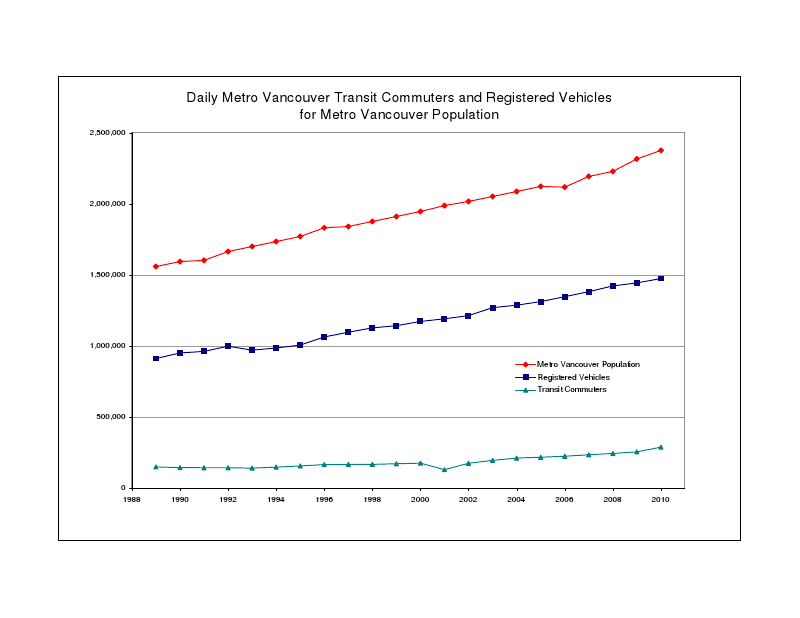
Relative to transit use, the rate of vehicle use has exploded since TransLink started on its relentless expansion of B-Line and SkyTrain transit in 1999 (refer to attached chart showing the trends in population, vehicle registrations and transit use).Ai?? For increased density to succeed in the reduction of the number of cars on the roads, it must lead to more people living closer to work and school.Ai?? In other words, it must pull in residents from satellite communities around downtown Vancouver to make the geographical area where people live smaller in size, to reduce commuting distances.Ai?? Transit by TransLink based on B-Lines and SkyTrains has done the opposite of this.
TransLink has targeted long distance commuters interested in taking B-Lines and SkyTrains having distantly spaced stops.Ai?? However, long distance commuters are only a small segment of commuters, and the median distance traveled by commuters in Metro Vancouver is about seven kilometres.Ai?? You were the director of a research-polling firm and surely understand statistics well.Ai?? The statistical distribution for transit is not a normal distribution and is skewed.Ai?? That is, 50% of commuters travel about seven kilometres or less in distance one-way with three-quarters of the commuters travel under 15 kilometres in distance one-way.Ai?? Only one-quarter of the commuters travel over 15 kilometres in distance, one-way.Ai?? Only about 25% of commuters are good candidates for SkyTrain or B-Line transit, yet, TransLink has based its entire transit network on B-Lines and SkyTrains costing twice as much as conventional light rail and tram lines as well as electric bus (trolley or wireless) routes having closely spaced stops and suited for 75% of the commuters.Ai?? This has been a huge and crippling blunder by TransLink.
TransLink by focusing on long distance commuters has alienated most driving commuters and has put more cars on the roads.Ai?? TransLink has teamed up with greedy developers who appear to be the impetus for SkyTrain (you only have to pick up the ai???New Condo Guideai??? to see the over the top advertising of how life near the future Evergreen Line will be better than good, even though few potential condo owners want to use SkyTrain and most potential condo owners just see SkyTrain as a way to increase their property value).Ai?? Perhaps developers building condos along SkyTrain lines have ties to organized crime and are building condos to launder drug money through condo construction in the Lower Mainland.Ai?? Maybe developers are using SkyTrain expansions to obtain permits from municipalities to rezone single family residential areas into high density housing developments along SkyTrain routes.Ai?? Something is amiss because SkyTrain expansion is being paid for by taxpayers and isnai??i??t having the desired effect of reduced traffic on the roads; however, developers seem to be benefiting from access to land development opportunities that wouldnai??i??t normally exist.
While the condo developments along SkyTrain routes are in the microscopic context increasing density, they are in the macroscopic context reducing overall density in the Lower Mainland by connecting far flung municipalities into one mega region to create urban sprawl.Ai?? Because most commuters only travel a short distance, most commuters moving into the new condo developments along SkyTrain routes choose to drive and traffic congestion has ironically worsened as spending by TransLink on B-Line and SkyTrain has escalated.Ai?? Even if the apparent modal share for transit has increased slightly, the sheer magnitude of cars on the roads has increased sharply, and the number of roads and bridges being built cannot meet the demand for the added cars on the roads.Ai?? TransLink with B-Lines (rapid bus transit) and SkyTrains has put Metro Vancouver taxpayers paying for exorbitantly priced transit by TransLink into a tail spin.Ai?? To reverse it, the focus of transit must shift to satisfy the majority of commuters traveling short distances of less than 15 kilometres and to do this requires a switch to economical and community based tram, light rail and electric bus routes.Ai?? More money spent on SkyTrains and B-Lines would be a disaster.
Therefore, the Evergreen Line for Coquitlam must be cancelled and the planned rapid bus transit for Langley must be shelved.Ai?? Furthermore, the current 99 B-Line service in Vancouver has to be ended due to the health impacts to residents who are being exposed to elevated sound pressure and particulate matter levels described in the attachment.Ai?? It will take courage and integrity to do it.Ai?? Mary, your mission if you choose to accept it, is to save transit; this email will self destruct on May 14, 2013.
cease and desist 99 b-line august 28-2012
Regards,
Eric Chris
Dijon tram network opens six months early
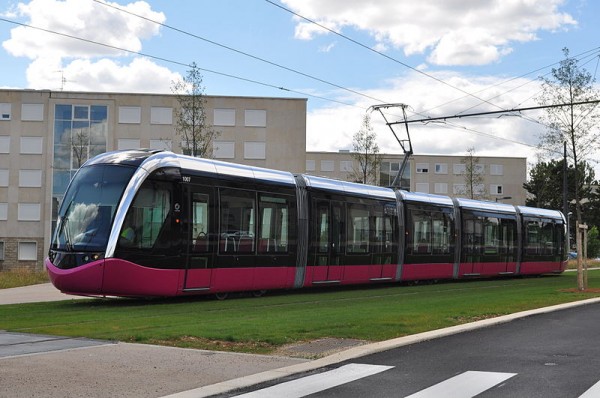
From France, the new Dijon tram (LRT) network has opened 6 months early.
If TransLink was really serious in building LRT in Surrey, the city could see its first tram/LRT line up and running in as little as three years. The foot dragging on designing affordable and efficient LRT for Surrey speaks volumes about TransLink and affordable transit planning.
Dijon tram network opens six months early
03 September 2012
FRANCE: The first line of a two-route tram network opened in Dijon on September 1 with a weekend of celebrations and inaugural rides, before full commercial services started on September 3.
The 8Ai??5 km starter line runs on an east-west alignment from the cityai??i??s main line railway station to the eastern suburb of Quetigny, serving 17 stops. The route passes through the city centre, and other stops are located close to the university of Dijon, the main hospital campus and the football stadium.
According to project manager Egis Rail, the first line has opened ai???within budget and six months earlier than scheduledai??i??. A second line covering 12 km from Valmy to ChenA?ve is due to open on December 8. A fleet of 33 Alstom Citadis low floor trams has been delivered as part of a joint procurement totalling 55 cars with Brest, which opened its starter line in June. The Dijon municipality claims the joint procurement has delivered economies of scale of 25%.
Dijonai??i??s tramway is operated by Keolis, which already runs local bus services under the Divia brand. The company says that 100 000 people have signed up to a contactless smart card ticketing system which is being rolled out across the Divia network.
http://www.railwaygazette.com/news/single-view/view/dijon-tram-network-opens-six-months-early.html
SkyTrain on the Fritz Again – So What Else Is New (Updated)
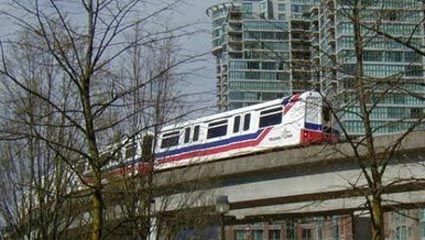
Well once again the automatic SkyTrain underwhelms.
The current trouble must be bad because Translink has made a radio announcement about the trouble.
Interesting to think, that if we had the ‘full build’ RftV/Leewood TramTrain option, with direct service to downtown Vancouver, transit customers would have another option for travel into town. But hey, just remember Translink’s transit policy; “You must use SkyTrain whether you like it or not“.
Skytrain trouble
VANCOUVER/CKNW AM980
Gord MacdonaldTrouble on Skytrain and Translink is telling Surrey commuters to get to the stations early.
Due to a mechanical issue, Skytrain is running reduced service – running single-track, alternating directions, between 22nd St Station and Metrotown.
The Millennium Line is running separately, between VCC-Clark and Columbia and turning back.
Additional trains will be put in service between Commercial-Broadway and Waterfront.
Customers — particularly those using Surrey stations — should expect major delays and should plan on leaving early.
Translink isn’t sure when technicians will get the problem fixed.
http://www.cknw.com/news/vancouver/story.aspx?ID=1767966
Cracked rail blamed for massive Skytrain delays
METRO VANCOUVER/CKNWWe now know the cause of big delays on Skytrain early this morning.
Skytrain spokesperson Jennifer Siddon says you can blame a cracked rail, just east of Metrotown station.
Technicians spotted it during routine maintenance overnight.
“Unfortunately, we weren’t able to finish the work before start of service. So we did have some single tracking in alternating directions.”
Siddon adds cracked rails are a rare problem.
“We had an incident about 10 years ago, and prior to that in 1989. Certainly, it underscores the importance of our crews performing nightly maintenance and inspections on the system.”
Two Years Since the Leewood Report and the Silence is Deafening!

It has been two years since Rail for the Valley released the historic RftV/Leewood study and the silence has been deafening. The RftV/Leewood study is light years ahead of anything that TransLink has produced, yet it has been given the silent treatment; “being sent to Coventry“, while TransLink squanders tens of millions of dollars promoting its pet SkyTrain mini-metro on various routes in Vancouver and Surrey.
In true TransLink form, bureaucrats are being forced to plan for LRT in Surrey at the behest of pro-LRT Surrey mayor, Dianne Watts, but with little enthusiasm and what is being planned for is classic TransLink, an ill-designed LRT, treated as a poor-man’s SkyTrain only costing a little less than SkyTrain to build.
It has all been done before, but from TransLink’s point of view, if you are successful bamboozling regional politicians about light rail and SkyTrain, andAi??why not, most regional politicians are profoundly ignorant of public transit and only support those projects which look good politically.
TransLink has every excuse thinkable to discredit the RftV/Leewood study, with the latest bit of nonsense so pathetic it would be laughable it it were not so sad. “We will not consider any rapid transit line that can’t achieve 10 minute headways or better“, was the latestAi??moan.
RftV has never claimed that the proposed TramTrain service was rapid transit, but a regional railway, that would operate LRT compliant vehicles that could operate as a train (interurban) or as a tram/streetcar. We find the proposed 90 minute schedule from Chilliwack to Scott Road Station (a commercial speed of 90 kph)a viable proposition and considering the almost daily traffic jams on the number 1 highwayAi??between the Port Mann Bridge and Abbotsford, the RftV/Leewood TramTrain service would make a viable alternative for many people. But not for TransLink, who continue to plan for ‘pie in the sky’ SkyTrain service from Langley to UBC!
Fiscal reality is just not in TransLink’s lexicon!
Here we have a ‘shovel ready’ transportation plan, with a starting cost less than one half of that of the Evergreen Line, servicing far more communities, left to molder on a shelf because it can’t run at 10 minute headways. Even the deluxe version of the RftV/Leewood Report hasAi??electric service to downtown Vancouver at less than $1 billion! The truth is easier to fathom, LRT in any form makes highly paid TransLink’s bureaucrats at very nervous.
To completely ignore a study done by a professional transit consultant, without any honest discussion only shows how inept TransLink and its bureaucrats are and the taxpayer and transit customers South of the Fraser deserve much better. “Who is not afraid to bell TransLink?”
Memo to Dianne Watts: Get out of TransLink and fast! The know-nothings at this ponderous bureaucracy have only one goal, to greatly increase their political prestige, while at the same time greatly increasing their pensions, by continually planning for unaffordable and very dated SkyTrain mini-metro. Sadly, TransLink is incapable of doing anything else.
The Leewood Study:
 Is the concept of TramTrain too difficult for TransLink to grasp?
U.S. (And Canada) Taxpayers Are Gouged on Mass Transit Costs
With BC Transit quoting silly prices for LRT in Victoria and TransLink doing the same in Vancouver and Surrey, the following article from Bloomberg should be essential reading. As the previous post has shown, modern LRT/streetcar can be built cheaply, if there is the political and bureaucratic will to do so.
With thank to Justin Bernard.
U.S. Taxpayers Are Gouged on Mass Transit Costs
ByAi??Ai??Ai??Ai??Ai??Ai??Ai?? Stephen SmithAi??Ai??Ai??Ai??Ai?? Aug 26, 2012
Bloomberg
If the first segment of Manhattanai??i??s Second Avenue subway opens on schedule in 2016, New Yorkers will be reminded that it was once ai???the line that time forgotai??? — a project more than 75 years in the making, with no end in sight. It should be remembered for another failing as well: It will be one of the most expensive subways in the world.
Tunneling in any dense urban environment is an expensive proposition, but the $5 billion price tag for just the first two miles of the Second Avenue subway cannot be explained byengineering difficulties. The segment runs mainly beneath a single broad avenue, unimpeded by rivers, super-tall skyscraper foundations or other subway lines.
American taxpayers will shell out many times what their counterparts in developed cities in Europe and Asia would pay. In the case of the Second Avenue line and other new rail infrastructure in New York City, they may have to pay five times as much.
Amtrak is just as bad. Its $151 billion master plan for basic high-speed rail service in the Northeast corridor is more expensive than Japanai??i??s planned magnetic levitating train line between Tokyo and Osaka, most of which is to be buried deep underground, with tunnels through the Japan Alps and beneath its densest cities.
The numbers for Californiaai??i??s proposed high-speed rail system are similarly shocking.
California Bloat
The French rail operator SNCFAi??told the California High-Speed Rail Authority that it could cut $30 billion off the projectai??i??s $68 billion estimated price tag. San Francisco can barely build underground light rail for the price that Tokyo pays for high-capacity subways. Los Angelesai??i??s planned subway to the sea will be a bit cheaper, but is still very expensive considering the areaai??i??s lack of density.
The budgets for other types of urban public-works projects can be just as shocking. Who can forget Bostonai??i??s Big Dig, the$24 billionAi??highway boondoggle? But mass-transit networks stand to lose most from out-of-control infrastructure costs.
A huge part of the problem is that agencies canai??i??t keep their private contractors in check. Starved of funds and expertise for in-house planning, officials contract out the project management and early design concepts to private companies that have little incentive to keep costs down and quality up. And even when they know better, agencies are often forced by legislation, courts and politicians to make decisions that they know arenai??i??t in the public interest.
Comparing American transit-construction practices with those abroad yields a number of lessons. Spain has the most dynamic tunneling industry in the world and the lowest costs. In 2003, Metro de Madrid Chief Executive Officer Manuel Melis Maynar wrote a list describing the practices he used to design the systemai??i??s latest expansion. The donai??i??t-do list, unfortunately, reads like a winning U.S. transit-construction bingo card.
Perhaps the most ostentatious violation of Melisai??i??s manual of best practices is expensive architecture in stations. ai???Design should be focused on the needs of the users,ai??? he wrote, ai???rather than on architectural beauty or exotic materials, and never on the name of the architect.ai???
American politicians have different priorities. The Port Authority of New York and New Jersey is spending $3.8 billion on a single subway station at the World Trade Center designed bySantiago Calatrava, a Spanish architect known for his costly projects. If New York could build subways at the prices that Paris and Tokyo pay, $3.8 billion would be enough to build the entire Second Avenue subway, from Harlem to the Financial District.
Spainai??i??s Model
Melis also warned against ai???consultants who consultant with consultants and advisers who advise advisers,ai??? something American planners would do well to learn. He said he didnai??i??t hire any ai???large firm of consulting engineersai??? as general project managers for his Metro de Madrid expansions, and that designers werenai??i??t allowed to interfere with, or bid for, their own construction contracts.
Not so in the U.S. Parsons Brinckerhoff, perhaps the biggest name in the nationai??i??s transit construction industry, is both the lead-design contractor and project manager for Californiaai??i??s planned high-speed rail line, and the company stands a good chance of winning construction contracts for its own designs.
As if that conflict of interest wasnai??i??t bad enough, the California High-Speed Rail Authorityai??i??s new CEO, Jeff Morales, arrived at the agency after a stint as senior vice present atParsons Brinckerhoff, where he worked on the authorityai??i??s business plan.
Parsons Brinckerhoff, like all the other multinational contractors and construction companies that win bloated contracts in the U.S., can do good work. Its rail projects forHong Kongai??i??s Mass Transit Railway were built at a reasonable cost, and its participation in Turkeyai??i??s Marmaray rail tunnel across the Bosporus in Istanbul shows that it can deliver affordable results in forbidding terrain. But absent the right incentives and oversight, even the best private companies will resort to rent seeking.
Larry Littlefield, who has worked in logistics and as a budget analyst at New York City Transit, also suggests the U.S. legal system is an obstacle to designing and building affordable infrastructure. (The U.K. and India share a common-law legal heritage with the U.S. that is heavy on judicial review, and they also have trouble controlling costs.)
New York government agencies are saddled by procurement rules dating back generations, Littlefield says, when corruption in infrastructure projects was endemic. Reformers demanded objective and easily policeable standards, which often meant lowest-price bidding rules. Bidders compete mostly on price, not quality.
Speed Matters
In Madrid, on the other hand, cost was given only a 30 percent weight when picking designers and builders, according to Melis. Speed was weighted at 20 percent. Melis praised quick execution as necessary for an efficient, affordable project. (Compare this with multigenerational projects, such as Californiaai??i??s high-speed rail and New Yorkai??i??s Second Avenue subway.) The remaining 50 percent was determined by the technical merits of proposals and the staffai??i??s subjective considerations.
Littlefield also argues that judges in New York routinely side with contractors in disputes with the Metropolitan Transportation Authority. ai???In the private sector, if you rob your customer, you will suffer a hit to your reputation and possible losses in the courts,ai??? he said in an interview. ai???Not so if you rob an agency like the MTA. Then itai??i??s all rights and no responsibilities.ai???
The MTA must continue to award contracts to the lowest-price bidder, and without the ability to hold bad contractors accountable, Littlefield said, the agency turns to ai???writing longer and longer and longer contracts, expressly prohibiting every way it has been ripped off in the past.ai??? The byzantine contracts that come out of this process drive entrants away, limiting competition and pushing up costs.
Littlefield holds out hope, however, that transit agencies are capable of building with reasonable costs and timelines –at least when they have to. ai???Remember how fast and how cheap they rebuilt the 1 train after 9/11? Thatai??i??s what theyai??i??re capable of. But it just doesnai??i??t happen otherwise.ai???
(Stephen Smith is a writer based in Brooklyn, New York, who covers land use and transportation. The opinions expressed are his own.)
To contact the writer of this article: Stephen Smith at smithsj@gmail.com.http://www.bloomberg.com/news/2012-08-26/u-s-taxpayers-are-gouged-on-mass-transit-costs.html
Helsinki tram extension gives some insight as to the cost of building LRT.
The following article from the Railway Gazette, givesAi??raw cost of laying track in Helsinki, Finland and give good insight for the cost of laying tram/LRT track on-street. The ai??i??7.5 million (CAD $9.3 million), 4.1 km double track extension on the metre gauge network alsoAi??includes the cost of the overhead.
TheAi??cost of the 4.1 km extension works out to about CAD $2.7 million/km to build!
There is something radically wrong in BC and North America, where simple tram or streetcar lines can cost over $50 million a km. to build, yet in Finland, the cost for new tram construction is under $3 million/km.
I think from Surry’s point of view, TransLink should be fired and then engage Helsinki city transport operator HKL, Stara, Skanska and VR Track, who seem to have the taxpayers best interests at heart.

Helsinki tram extension opens
28 August 2012
FINLAND: Helsinki tram Route 9 services began running to the LAi??nsisatama ferry terminal on August 13, completing a ai??i??7Ai??5m extension project. Trams run every 10 min during the day, with late-night services co-ordinated with ferry times.
The 4Ai??1 km double-track extension has 11 stops. Construction was undertaken by city transport operator HKL, Stara, Skanska and VR Track, with electrical works by HelenService.
http://www.railwaygazette.com/news/urban-rail/single-view/view/helsinki-tram-extension-opens.html



Recent Comments