As Predicted – TransLink’s Gas Tax is Faltering – Higher Taxes Predicted!
As predicted, gas tax revenue has failed to meet expectations as thousands of lower mainland residents fill up their family chariots east of Aldergrove or in the US, where gas is much cheaper. This was predicted by Zwei some years ago (the wife fills up her belch-fire in Point Roberts) and was roundly criticized by politicians and bureaucrats alike. The collected response by our hapless crowd of politicos was something like; “We hope this will not happen.”
Ha, ha, ha it has!
Vice Chair of the Mayors Council on TransLink, Langley’s Mayor Fassbender,Ai??seems surprised at this, well he shouldn’t as the regions taxpayers are paying far to much taxes for far to little transit service. We have a good example in Tsawwassen where preciousAi??transit monies are squandered on three bus services which combined carry fewer than 20 passengers a day! Of course the biggest wastrel of tax dollars is the SkyTrain and Canada Line mini-metro systems, where massive debt servicing costs and large operating costs have creates a terestrial black hole for tax dollars.
Until regional mayors understand the real reasons of the mass exodus of car drivers to the upper Fraser Valley or the USA to fill up their cars with gas, threatening new and higher taxes willAi??do nothing more than enrage taxpayers as they will again feel like hostages to the profligate spending by transit bureaucrats and inept regional politicians takin a back seat on badly planned and poorly transit projects .
Again, its high time that Municipalities south of the Fraser should abandon TransLink and its huge costs and form a leaner and meaner transit authority for transit projects that are both affordable and usable. With TransLink, the end game is SkyTrain and how many bus riders they can recycle on the the mini-metro to pretend that they are doing a good job and to hell with the taxpayer.

Falling gas tax continues to plague Translink: Mayor
VANCOUVER/CKNW AM(980)
Janet Brown |More bad news for Translink: Gas tax revenue continues to freefall.
The latest estimates suggest the transportation authority will end up with millions fewer than it expected from the 15-cent-a-litre fuel tax it charges in Metro Vancouver.
Originally, $30-million was needed to fund projects like a rapid bus service over the new Port Mann Bridge.
But now, Peter Fassbender, Langley city mayor and vice-chair of the mayors’ council to Translink, believes Translink will likely have to find close to $75 million.
A big part of the reason? Gas tax revenue will continue to drop significantly.
More and more people, he says, are purchasing gas in the Fraser Valley where the gas tax isn’t applied, as well as in the U.S.
Fassbender says only a huge raft of savings uncovered by auditors will allow the region to move ahead with transit projects.
A Blast From the Past – Zwei Was Advocating the Stadler GTW in 2009!
I seems Zwei has had it right all along with the Stadler GTW! Here is a repost from October 2009!

The Stadler GTW ai??i?? A new generation of Diesel light rail.
Posted by zweisystem on Wednesday, October 14, 2009
The Stadler GTW Diesel light Rail car
The Stadler GTW, sold by Stadler Rail, Switzerland, is one of the best-selling articulated local transport railcars in Europe. The name GTW stands for Gelenktriebwagen (articulated railcar).
Description
More precisely, Stadler GTW is actually a whole family of vehicles which differ externally, in the various designs of the head of the vehicle (from angular to streamlined), and also in the different designs and power units that drive them. They also come in different gauges and as rack railway vehicles. The basic version is the ai???GTW 2/6ai???, a railcar which conforms to UIC standards. ai???2/6ai??? means ai???two of six axles are poweredai???. The GTW 2/6 is used for example by Deutsche Bahn as ai???Baureihe 646ai??? (Series 646) and by Swiss railways as ai???RABe 526ai???.
The basic concept is rather unconventional: the car is driven by a central ai???power moduleai???, also known as a ai???powerpackai??? or a ai???drive containerai???, powered on both axles. Two light end modules, each with a bogie, rest on the power module, which produces useful traction weight on the driving axles. The end modules also use the space very effectively, although the railcar is divided into two halves by the power module. Some units have a path through the drive container. The end modules can be delivered with standard pulling devices or buffer gears, or with central buffer couplings. They are built with a low-platform design except above the bogies and at the supported ends (more than 65% low-platform). All of the usual comforts to be expected in a modern local network railcar are provided, such as air conditioning, a multi-purpose room, vacuum toilets (in a washroom suitable for the disabled) and a passenger information system. The GTWs can be diesel or electric-powered (via overhead wires or third rail).
Propulsion
There are diesel propulsion modules with 550 kW (since 2003) with 2Ai??375 = 750 kW power available, and electric propulsion modules with 600 kW to 1,100 kW. All drive modules work with IGBT pulse inverters. The converter plant stems from ABB and Turgi manufactured at the site.
By inserting a middle car (also with only one bogie) on one side of the propulsion module, the GTW 2/6 is expanded to GTW 2/8. Instead of the middle car, another drive module can also be inserted. Between the two modules are then either a trailer passenger car (GTW 4/8) or two medium cars and partitions (GTW 4/12). For operational flexibility up to four GTWs of the same pattern can be operated as a multiple unit.
North American application
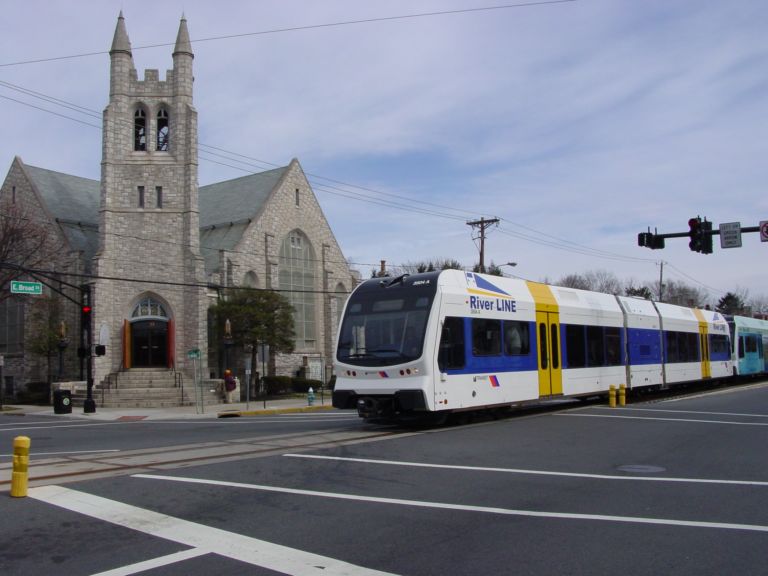
New Jersey Transit uses 20 GTW diesel light rail vehicles on the 34 mile River LINE (New Jersey Transit) service between Trenton and Camden. The diesel LRV offers a tighter turning radius than typical main line light rail vehicles (i.e. Siemens Desiro, Bombardier Talent, etc.) and thus is capable of street running. The basic GTW is the 2/6 which indicates that two of the six axles are powered. The vehicle is more than 65% low floor. The GTW is available in electric and diesel-electric versions. 390 units have been sold to date and are in use in Italy, the Netherlands, and Switzerland. The Austin, Texas Capital Metro is expecting delivery of six vehicles in the fall of 2007 for its new transit rail service. In Texas, the diesel-electric units will provide service on a 32 mile route between Austin and Leander starting in January 2008.
The River LINE in New Jersey was opened in May 2004. The service is operated by the Southern New Jersey Rail Group (SNJRG), a consortium of Bechtel Group and Bombardier. The 20 stations on the line include PATCO SpeedlineA?ai??i??ai???s Broadway Station, which allows for transfers to service to Philadelphia. The River LINE uses a proof of payment system with a flat fare of $1.35. Service is offered on a 15 minute peak headway and 30 minute off peak headway. Much of the line is single track with passing sidings.
FRA Approves First Integrated Use of Stadler GTW Rail Vehicle for DCTA – The RftV/Leewood Study is Shovel Ready!
Good news everyone, in the USA the Federal Railway Administration has approved theAi??first integrated use of the Stadler GTW Rail Vehicle for Denton County Transportation Authority’s new passenger rail line.
Not quite TramTrain and not quite an old Budd RDC or Bombardier O-train, theAi??Stadler Diesel LRTAi??fits the market for light weight diesel rail cars for use on secondary rail lines that now only handle freight service. Well golly gee whiz, doesn’t that sound like the former BC Electric interurban service from Vancouver to Chilliwack. ForAi??under $600 millionAi??(less than half the cost of the 11.5 km SkyTrain Evergreen line) the region could operateAi??a basic hourly passenger service from downtown Vancouver (Central Station) to Chilliwack.
Success is written all over thisAi??project and it this makes the the powers that be in TransLink (and BC Transit for that matter), very worried. Maybe 33 years of hackneyed andAi??badly datedAi??SkyTrain only planning by provincial and regional transit planners would be all too evident if an affordable light rail transit service were to be built connecting the Fraser Valley to downtown Vancouver and more importantly, from downtown Vancouver to the Fraser Valley.
Let us hope that a new provincial government will see the importance of a light railway connecting Vancouver to Chilliwack, through the Fraser Valley, as the public has already recognised the importance of reinstating the former BC Electric interurban service.Ai??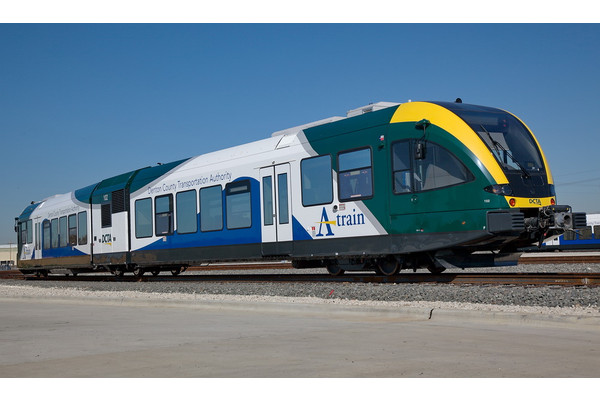
FRA Approves First Integrated Use of Stadler GTW Rail Vehicle for DCTA
Source: Denton County Transportation Authority (DCTA)
On Monday, June 4, 2012, Administrator Joseph Szabo of the Federal Railroad Administration (FRA) in conjunction with the American Public Transportation Association Annual Rail Conference formally announced approval of DCTAai??i??s request to operate the Stadler GTW concurrent with traditional, compliant equipment. This means that for the first time ever; light-weight/fuel efficient, eco-friendly low-floor vehicles will be permitted to operate in rail corridors concurrently with traditionally compliant vehicles. The waiver, a first of its kind, will expand commuter rail options for transportation authorities across the United States.
In 2009, the FRAai??i??s Rail Safety Advisory Committee (RSAC) prepared a set of technical criteria and procedures for evaluating passenger rail train-sets that have been built to alternative designs. The alternative designs enable lighter, more fuel-efficient rail vehicles equipped with a Crash Energy Management system to commingle with traditionally compliant equipment. The DCTA/Stadler alternative design waiver is the first comprehensive submittal that follows the RSAC Engineering Task Force (ETF) procedures for Tier I equipment. The approval of the DCTA/Stadler waiver request demonstrates that the enhanced crashworthiness and passenger protection systems inherent to DCTAai??i??s new rail vehicles meet the latest and most stringent safety standards in the U.S.
ai???Stadler is excited and proud to have the opportunity of announcing this milestone and appreciates the immense joint effort conducted by DCTA and the FRA,ai??? stated Steve Bonina, Stadler USA president. ai???Stadler continues to be hopeful that the FRA codifies the RSAC guidelines into regulatory requirements in order to open the North American Rail Network to this outstanding, safer, eco-friendly rail technology, which will help to make rail systems safer, more efficient, more reliable and less costly.ai???
Stadler, DCTA and DCTAai??i??s vehicle consultant, LTK Engineering Services, have been working closely with the FRA to achieve this waiver since 2009. DCTA partnered with Stadler to make modifications and enhancements to the GTW to comply with the required safety guidelines. Modifications include changes to the fuel tank design, window glazing and passenger and operator seats.
ai???This approval is the result of unprecedented cooperation between DCTA, the FRA LTK and Stadler,ai??? stated Jim Cline, DCTA president. ai???Our efforts to operate the nationai??i??s first alternative compliant vehicle demonstrate not only our commitment to increased safety for our passengers and operators but to improving safety for the commuter rail industry. We are setting the conditions for future success for commuter rail expansion in North Texas and the conditions will allow us to advance the integration of these vehicles onto our system.ai???
DCTA purchased 11 diesel-electric GTW 2/6 articulated rail vehicles from Stadler. The vehicles are compliant with the Americans with Disabilities Act (ADA), and incorporate enhanced air conditioning, passenger information system, video surveillance and numerous FRA compliant elements. The spacious interior has room for wheelchairs, strollers and bicycles. There are 104 seats and standing room for 96 persons in every vehicle along with bright compartments, large windows and comfortable seating. DCTA and Stadler will begin integrating the cars into service this summer.
At Last The Main Stream Media Questions The Transit Police!
For some time now I have questioned why we have the transit police and evidently the main stream media are nowAi??asking questions too.
There was never any need for the transit police and more and more the transit police looked like a sop to the provincial RCMP, enabling recently retired officers to make lucrative incomes byAi??double dipping, being paid asAi??transit police officerAi??and receiving a handsome pension as well.
There was never any need for the transit police and they should be disbanded as soon as possible.
Mulgrew: Costly Transit police force takes taxpayers for a ride
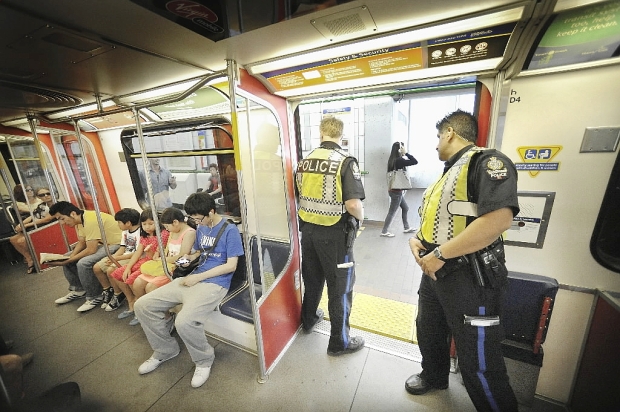
By Ian Mulgrew, Vancouver SunAugust 15, 2012If there is such a good case to be made for TransLinkai??i??s stand-alone police force, why doesnai??i??t BC Ferries have its own armed cops?
I think itai??i??s nonsense that Transit officers authorized to use sidearms ride SkyTrain supposedly catching fare evaders and ai???fighting crimeai??? while enjoying an exorbitant overtime deal and a 25-per-cent bonus for working on Sundays.
On the weekend aboard a Gulf Island ferry, I watched a slightly built female attendant, without backup or a 9-mm, order two thirsty tough-looking truckers to put away the beers they were sucking back.
She didnai??i??t have a problem.
Over decades of travelling up and down the coast on the ferry system, I canai??i??t recall a discussion over coffee much less a public outcry that it was unsafe or lacked an armed security force.
The SkyTrain system is not a qualitatively different public space than our streets, buses, ferries or airports.
There was no good reason to create this unique little force in 2005 and there is no good reason to maintain Chief Neil Dubordai??i??s $27-million-a-year empire of 167 sworn officers and 67 civilians.
In 2010, those officers earned between $75,000 and $226,247 each, with the total salary cost reported at $40.5 million. They billed about $1 million a year in overtime, roughly twice what the much larger Vancouver police department paid.
Listening to chief operating officer Doug Kelsey justify this expensive fiefdom based on the supposed-to-be-opened-by-2016 Evergreen Line rankles.
Whom is he trying to kid that vandalism and fare evasion cannot be curbed equally well by less expensive attendants or ordinary security guards?
As for crime-fighting, where is the civic pantheon of SkyTrain heroes?
Iai??i??m sure the officers probably have been threatened and had to deal with drunks, drug-addled mental patients, testosterone-charged teenagers or menacing individuals.
So have most of us who regularly hang out downtown after 11 p.m.
But murder, kidnapping, human trafficking, prostitution, gambling, extortion, drug dealing, vicious gangsters and the truly dangerous job of real policing?
Thatai??i??s why police officers are well paid and given good benefits-and-retirement packages ai??i?? not for riding the rails during daytime handing out tickets that until recently werenai??i??t worth the paper they were printed on.
We paid on average $158,000 for each sworn transit officer in 2009 compared to the VPDai??i??s average of $160,000 or the RCMPai??i??s $155,000 per officer.
They are not doing equivalent work and the managerial redundancies are self-evident.
Crimes on the transit system are primarily crimes of opportunity and those who commit them are desperate, petty thugs and thieves. They act when no one in authority, armed or not, is around to raise an alarm.
The woman sexually assaulted at the Edmonds station, the disabled woman robbed of her iPad or the women harassed at the Joyce Street station in recent weeks are typical victims.
SkyTrain police did not prevent any of these incidents for the same reasons beat policing doesnai??i??t stop all street crime.
Still, municipal police or the RCMP could as easily have done the followup investigations, checked the surveillance videos and dealt with the cases.
If we want patrols on buses, incorporate them into the mandate of the regular policing agencies.
The most recent audit of the Transit force didnai??i??t bother to address whether a regional force, joint municipal-RCMP patrols on the system or even private security coupled with more staff could be as effective and cheaper.
The attitude is just keep taking taxpayers for a ride.
SkyTrain Obsolete!
One can predict the wailing and gnashing of teeth by the SkyTrain lobby with long time transit advocate, Malcolm Johnston’s recent letter published in the Surrey Now.
One wonders why TransLink, civic and provincial politicians almost worship SkyTrain in Metro Vancouver, as some sort of transit miracle, when the rest of world views it as a rather expensive gadgetbanen and/or a historic curiosity like the Wuppertal Schwebebahn.
What is lost on our local bunch of politico’s, except for Surrey mayor Dianne Watts and recently deposed Langley mayor Jim Green, is that no one, except TransLink,Ai??wants SkyTrain.
Could it be that over 30 years of transit baffle gab, exaggerated truths, and questionable studies have so warped TransLink’s and politican’s understanding of SkyTrain, that they still support this aging light-metro?
I leave you with the following:
ai???If you tell a SkyTrainAi??lie big enough and keep repeating it, people will eventually come to believe it. The SkyTrain lie can be maintained only for such time as theAi??province can shield theAi??taxpayer from the political, economic and/orAi??transportation consequences of the SkyTrainAi??lie. It thus becomes vitally important for theAi??province to useAi?? all of its powers to repress dissent, for the truth is the mortal enemy of the SkyTrain lie, and thus by extension, the truth is the greatest enemy of the province.ai???
Ai??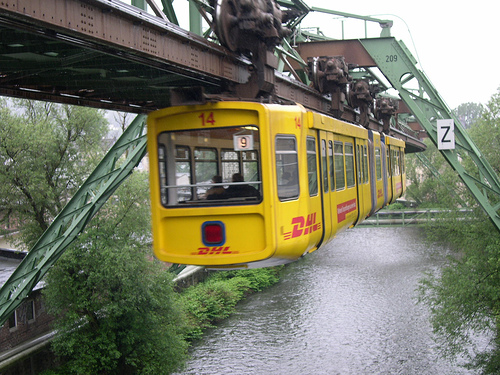 The historic Wuppertal Schwebebahn monorail, the first all electric transit transit
system in the world. Only one was eve built.Ai??
SkyTrain is obsolete
Surrey NowAugust 14, 2012
The Editor,The ongoing SkyTrain vs. light rail debate continues in the Lower Mainland,Ai?? which is curious because elsewhere, modern LRT made SkyTrain obsolete over twoAi?? decades ago.
Has anyone noticed no one builds with SkyTrain anymore? Over 33 years on theAi?? market, only seven have been built. Compare this with more than 150 new lightAi?? rail lines built during the same period.
SkyTrain is driverless and that means it costs more to operate than LRT -Ai?? because instead of drivers, SkyTrain has attendants, more than 250 of them atAi?? last count.
And with more technical employees needed for smooth operation, that makesAi?? SkyTrain more expensive to operate than modern LRT.
Combined with SkyTrain’s huge construction costs, SkyTrain is a badAi?? bargain.
South Korea’s Yongin SkyTrain, the Everline, was completed in 2009 and hasAi?? remained idle due to large projected operating costs.
Embarrassed city officials, who have just signed a contract withAi?? Bombardier Inc. (the owners of the SkyTrain system) in June, to operate theAi?? mini-metro for three years. The city will assume all operating deficits.
Closer to home, the Canada Line, a conventional metro (the only metro in theAi?? world designed to have less capacity than a streetcar) was cheaper to build thanAi?? the proprietary SkyTrain.
The SkyTrain minimetro system has become the pariah of transit systems, yetAi?? TransLink, which is sinking fast in a quicksand of debt, still plans for more ofAi?? the obsolete mini-metro. Can’t any civic or provincial politicians draw aAi?? straight line from SkyTrain to TransLink’s financial chaos?
Evidently not. Today, modern light rail has proven to carry more people at aAi?? far cheaper cost than SkyTrain.
Who wants SkyTrain anymore?
It seems only the rubes in Victoria, Metro Vancouver and TransLink do.
Malcolm Johnston, Delta
Read more: http://www.thenownewspaper.com/opinion/editorials/SkyTrain+obsolete/7086200/story.html#ixzz23dSz7vqI
Faregate Hoopla – In TransLink’s World 1 + 1 =3
Lots of hoopla in the media today about TransLink’s daft $175 million fare-gate program, with the first fare gates being installed at the Marine Drive Canada Line Station. The taxpayer is anteing up over $175 million to retrofit fare-gates to Vancouver’s mini-metro system and with operating costs estimated to exceed $15 million annually, one wonders, with fare evasion pegged at about $10 million annually, where there is any cost benefit to this.
To many familiar names, including ex-premier Gordon Campbell good buddy, Ken Doebel are involved with this nonsense and it seems the taxpayer has been again treated as rubes by the BC Liberal party and TransLink.
What we have is a $175 million photo-op for BC Minister of Transportation, Blair Leckstrom and Langley Mayor Fassbender and assorted federal MP’s and Provincial MLA’s.
Instead ofAi??investing precious transit monies on good transit for the customer, SkyTrain is awarded a $175 million bauble that in the end will cost TransLink more money and reduce bus service as money earmarked for transit will be spent on subsidizing SkyTrain!
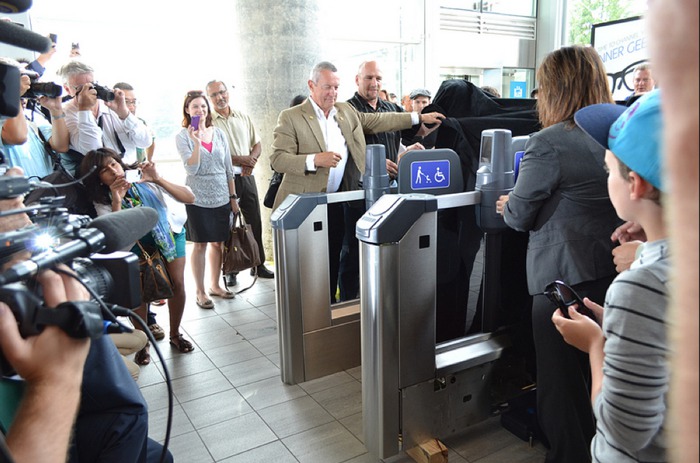
First SkyTrain faregate installed
The first SkyTrain faregate was installed Monday at Marine Drive Station in Vancouver.
Faregates are part of the overall strategy to reduce fare evasion and increase security on Metro Vancouver’s transit system.
Wai Young, Member of Parliament for Vancouver-South, B.C. Minister of Transportation and Infrastructure Blair Lekstrom, and TransLink Chief Operating Officer Doug Kelsey were on hand at Marine Drive Station to commemorate the project milestone.
“The new faregates will make SkyTrain service safer and more secure for commuters,” said Young.
Lekstrom said Metro Vancouver has a world-class transit system and governments at all levels are working together to make the system even better.
“Faregates will modernize the regional transit system by making transit easier and safer for everyone,” he said.
Faregates will be installed at all Canada, Expo and Millennium line stations and SeaBus terminals. Following a testing period, customers will begin transitioning to the faregates system in late spring 2013 with the system in service by fall 2013. All Evergreen Line stations will have faregates when the line opens in summer 2016.
The B.C. government is providing $40 million for the project and the federal government is contributing $30 million from the Building Canada Fund for the up to $100 million costs of faregate equipment and station improvements. TransLink is responsible for the remaining cost.
“We’re bringing a new convenience for customers, while helping to ensure every customer is paying their fare and feels safe on the system,” said Kelsey. “We are grateful to our partners in the federal and provincial governments for providing the funding to do the job.
Myth Busting!

It seems that the same tall tales about modern LRT are being told is Sydney Australia, that are being told in Vancouver and Surrey. Like always. a lie often repeated soon becomes truth, well the following sets the record straight, but will the public remain deaf to the truth all depends on the amount of money spent by the SkyTrain Lobby on printing rumours, half-truths and lies.
Myth Busting
Trams in the City will cause more traffic congestion.
This is a scare story. The Truth is Light Rail will operate in one lane only, and that lane will be the current bus lane, while moving four times the number of people as a bus.Ai?? In comparison, buses will be constrained to operate in all the road lanes.
Trams will always stay in their lane unlike buses which are constantly frog-hopping around each other and taking up 2, 3 or even 4 traffic lanes in the City.
The streets are too narrow.
No theyai??i??re not. The space require to operate a tram is less than a bus, not more.
Witness other cities in Europe that have really narrow streets, and still manage to operate trams eg Lisbon or Amsterdam.
Trams are stuck on one route.
With a carefully planned transport system this is not a problem. Trams are designed for high capacity corridors terminating in major junctions / hubs. They move large numbers of people very well.Ai?? Any system would need to be fully integrated with buses servicing the lower capacity areas and the suburbs.
Trams can run in pedestrian areas and malls, on road and on railway track making them an extremely versatile transport option.
Buses can carry more people than light rail.
This is simply not true. A Light Rail vehicle has three to four times the capacity of a standard bus.
If we could replace four of the buses heading down George St at peak hour with one tram, there would instantly be less traffic congestion. Half empty buses trying to deliver people to Circular Quay contribute to peak hour traffic in the city.
Tram travel is also more friendly to the disabled, elderly and families and it gives a more comfortable, smoother ride.
Trams are slower than buses.
The travel time for a tram is the same as other modes, quicker if given traffic light priority. Such priority for buses is not possible as there are simply too many of them. Trying to move a great number of buses through many intersections is even more difficult, when one bus stopping often blocks other buses travelling shortly behind. Trams are also quicker because you can load and unload in a fraction of the time of a bus.
Buses are cheaper and sufficient.
Buses cannot cope with the high demand of Sydney CBD, adding more buses will accentuate the problem.Ai?? Light Rail is a high capacity, efficient mode perfect for big cities.
People donai??i??t like to interchange between modes.
People donai??i??t like sitting in traffic only minutes from their destination or unreliable journeys either.Ai?? Given the overwhelming benefits Light Rail will deliver, people will interchange.
We have researched this issue with the people of inner Sydney specifically, explained the project and the need to interchange, and asked them what they thought. 85% of those that responded said that they thought the benefits outweighed the inconvenience.
Interchange is a key part of networks in all leading cities ai??i?? in fact some are designed around it. It is OK in Paris, London, New York, Singapore and Hong Kong, why not in Sydney?
Interchange is the only way to cope with high passenger volumes in constrained spaces. And, people do it every day in Sydney. Country trains terminate at Central, and people interchange. Bondi junction has an interchange. If the transport system is reliable, interchange works ai??i?? ask the Swiss people whose train system is designed around interchange.
Light railai??i??s track system and overhead cables make a mess of city streets.
The overhead cables are extremely unobtrusive.Ai?? They currently run through the pedestrian precinct around Haymarket and up to Central Station with little concern. Overhead cables running a clean system are always going to be more aesthetically pleasing than high levels of pollution and noisy traffic jams.Ai?? If this really is a problem, new light rail technology allows trams to run without overhead wires, picking up from an underground feeder, eg Bordeaux.
In many cities, well-designed tram vehicles are seen as adding visual appeal to the urban landscape.
Light rail is NOT cleaner for the environment.
Trams ARE cleaner than petrol or diesel buses. Tram vehicles create no pollution at all in the city, reducing smog and improving air quality, not to mention little or no noise pollution.
Powering a Light Rail vehicle creates one third of the amount of pollution as the worldai??i??s most environmentally friendly bus, and the energy created by the tramai??i??s braking system is fed back into the electricity grid.Ai?? Electricity can easily be sourced from Green supply such as wind and solar.
A tram route can move up to 12,000 people in one hour; thatai??i??s a lot of cars and buses off the road. The simple fact that one tram can take four buses off the road, means that they create less pollution.
We had trams in Sydney and they were removed because they didnai??i??t work.
This is not why they were removed. The Sydney tram system was a victim of its own success. Trams were taken out of Sydney because they were too well patronised with passenger journeys peaking at 405 million per year in 1940s. That is double the current number of passenger trips provided by Sydney Buses. Keeping in mind that most trams had seating for only 45 ai??i?? 80 passengers, trams became very crowded.
Sydney had one of the largest tram systems in the world. It was an extremely busy network with about 1,600 trams in service at any one time at its peak during the 1930s. As a comparison there are about 500 trams in Melbourne today.
Overseas ai???transport expertsai??? were called upon to advise the city and they recommended closure of the system to be replaced by buses. Closure generally went against public opinion. Nevertheless, closure became government policy and the system was wound down in stages, with withdrawal of the last service, to La Perouse, in 1961.Ai?? All the major Sydney bus routes in the inner city are old tram routes.Ai?? The same recommendation was made in Melbourne, but the Cityai??i??s leaders refused to accept it, and they have since moved on to develop and promote their iconic network.
A new integrated Light Rail system cannot be compared with the trams of yesteryear. If the previous network was reinstated it would offer an extremely comprehensive and sensible transport option for Sydney. Given that the new light rail vehicles have a capacity of 200 passengers, 400 million or even 800 million passenger trips a year would be not only feasible but also a practical and efficient way to provide environmentally responsible mass transit.
http://lightrailextension.metrotransport.com.au/myth-busting/
War on Buses? Er…No, Just Very Bad Planning
Is there a war on buses in Vancouver?
Sorry, no.
Instead thereAi??has been an ongoingAi??war on good transit planning and those supporting bad transit planning won decades ago. The real problem is and always has beenAi??SkyTrain and the massive costs associated with the mini-metro.
The taxpayer has paid about three to five times more for the proprietary SkyTrain light-metro than originally planned light rail without any added benefit. Today, we have spent over $8 billion (those pesky debt servicing charges and retrofitting costs do add up) on a SkyTrain network that has taken over 25 years to build just three lines of which one, the Canada Line, isn’t SkyTrain at all.Ai??TheAi??present mini-metroAi??networkAi??almost mirrors the original 1978, $800 million Vancouver to Richmond, Surrey and Lougheed Mall LRT scheme! The extra large sums of money spent on SkyTrain could have been spent on extending the LRT to include at least two North South and two East West LRT corridors in Vancouver; LRT to Steveston and Ironwood Mall; and LRT to the Tri-Cities, bringing quality public transit to a much larger audience. The larger the transit customer base, the more people that will use public transit.
It is SkyTrain light metro that has bankrupted TransLink and piling tax uponAi??user feesAi??to fund transit will simply fail to stop the rot!
TransLink’s funding has not been kneecapped, as claimed by Mr. Ladner,Ai??rather the porcine TransLink is dying of financial obesity andAi??no matter how much money we pour into the transit agency, it will never be enough money to pay for bloated transit proposals put forward by equally bloated planning bureaucracies!
Notice Mr. Ladner, no one buys SkyTrain anymore?
One also tires of SFU City Program Director Gordon Priceai??i??s continuedAi??hype and hooplaAi??on transit, as he is no more a transit expert than Zwei! Mr. Price has had decades to understand how a public transit system works, but he hasn’t bothered to and has joined the ‘tax and spend’ crowd that continually demand more money for TransLink, hoping the more money one throws at TransLink, the better it will become. Sadly, hell will freeze over first!
If Mr. Ladner wants to improve transit without breaking the bank, he must think out of the box andAi??demand TransLink to plan for what the customer wants and can afford and not what the bureaucrat’s want. TransLink must abandon SkyTrain light-metro planning in favour of modern light rail, if these conditions are not met, TransLink will impale itself on huge debt.
There never was a war on buses, instead the transit battle in Vancouver was lost when the first kilometre of SkyTrain was built!
Toronto transit on the right road; Vancouverai??i??s hits dead end
The war against the bus has been won
By Peter Ladner Tue Jul 31, 2012
Why are leaders in Toronto smarter than leaders in Metro Vancouver?
Both cities have a remarkably similar problem: the local transportation authority ai???has an approved plan to build the system we need, but we have nowhere near the funds to pay for it. We have to be open to ways to raise money that are dedicated to getting this done … We need to move people and goods quickly and easily for our region to be a great place to live, work, play and invest, and yet weai??i??re decades behind in making that happen ai??i?? Everyone agrees we have a crisis on our hands. We want to give residents a way to say, ai???we need a better system, and we need to find sustainable ways to pay for itai??i??.ai???
In Vancouver, thatai??i??s the message coming from a group of UBC students whose frustration over getting passed up by 99-B-line buses is spilling over into a wider campaign headed into the public domain in September. While every word of that quote rings true in Metro Vancouver, it comes from the mouth of business and political leader John Tory, chairman of the Greater Toronto CivicAction Alliance (GTCAA), a formidable blue-chip organization that is launching a major community campaign for transportation funding in Metro Toronto this fall.
The GTCAA announced its 27 Regional Transportation Champions ai??i??representing more than two million employees, students, customers and members across Metro Toronto and Hamilton ai??i?? almost to the day that Vancouver was tagged as the most congested city in Canada, and the second-most congested in North America after Los Angeles. That dubious title (based on dubious methodology, it must be said) was won without even counting the real congestion zones east of Burnaby and south of the Fraser.
Two days earlier, a two-year-old group of frustrated volunteers known as the Sustainable Transportation Coalition (STC) was meeting downtown in a boardroom donated by the Fraser Basin Council, over our brown bag lunches, with no budget, no staff and faint hope.
SFU City Program Director Gordon Priceai??i??s blunt assessment from his July 3 BIV column (ai???Transit integral to building transportation bridges ai??i?? issue 1184; July 3-9) hung in the air: ai???TransLink has no more money. Gas-tax revenue is down, thereai??i??s no new source of funding from the province, no more property tax from the municipalities and not even approval for an anticipated fare increase. Expansion plans for already-promised transit are all off the table.ai???
Bizarrely, signs on Highway 1 still proudly announce what is not going to happen: ai???New RapidBus BC Service, Park and Rideai??? on the new Port Mann Bridge. There will soon be 30 vehicle lanes across the Fraser and not one lane of transit.
Richard Walton, Mayorsai??i?? Council chairman and North Vancouver District mayor, told us at the STC meeting nothing will break the impasse until a regional road pricing strategy can be approved that has political support in Surrey. So we took what comfort we could in enlisting our coalition members to support the student-led ai???Get On Boardai??? campaign for the fall, with a rally, social media and MLA campaigning.
Meanwhile in Toronto, the GTCAAai??i??s first wave of Regional Transportation Champions rolled out: a former federal cabinet minister, senior bankers and insurance executives, trade union leaders, president of the airport authority, religious leaders, president of the World Wildlife Fund, presidents of Oxford Properties and Cadillac Fairview, president of the University of Toronto, the CEO of YWCA Canada, president of the board of trade and many others.
It is astounding that so few people at that level here have grasped the impact of TransLinkai??i??s kneecapped funding for our region. The war against the bus has been won. The surrender to car-dependency and congestion and economic distress is complete. We are all casualties.
While Toronto mobilizes, Vancouver business leaders shrug and slip away to the beach.
Detroit’s “Mugger Mover” celebrates 25 years of ‘sort of’ operation
We don’t hear much about SkyTrain elsewhere and I wonder why? Well I know the answer, SkyTrain reign of operation elsewhere has not been as successful as the SkyTrain lobby would have us believe. Please take note of the serious issues regarding the Detroit’s ICTS’s guideway, as previous discussion on the RftV commnets has been about future costly problems with the Vancouver’s aging SkyTrain guideway.
The locally knownAi??‘Mugger-Mover’ was the first incarnation of the SkyTrain family of mini metros, with the concept being several cells of roughly 4 km looped single track loops, built in urban centres. The concept was soon proven unworkable and the Detroit ICTS/Skytrain system is the result, a lone 4.5 km single track loop, that doesn’t really offer much advantages to transit customers. Managers at Ontario’s UTDC, quickly redefined Skytrain as an urban mini-metro, but as history has shown, the proprietary railway has met with little success.
The Detroit “Mugger Mover” is on life support and its time is ever coming closer to being a historical footnote, just like Toronto’s Scarbough ICTS.
When will the Skytrain lobby admit that SkyTrain is obsolete, made obsolete by LRT, which Skytrain was suppoed to make obsolete.

The Detroit People Mover celebrates its silver anniversary today with discounts at local businesses.
(Elizabeth Conley / The Detroit News)
The Detroit People Mover turns 25 today, marking a proud quarter-century of occasionally carrying me to lunch.
It also once took me to the Renaissance Center for a charity event on what happened to be the night of a Red Wings playoff game. Given that everyone else aboard was in red or white and I was wearing a tuxedo, I stood out a bit, so I told them I was singing the national anthems and led everyone in a rendition of “O Canada.”
In celebration of the anniversary, the People Mover people have rustled up discounts from some of the 380 businesses and venues close enough to the track that you can hear the wheels squeal. You’ll find the list at
http://www.thepeoplemover.comYou’ll also find a DJ at Campus Martius from noon-2 p.m. and a People Mover photo exhibit in the Compuware atrium.
The record-spinner is known as DJ Invisible, which coincidentally is what the People Mover became after one of my favorite people-moving moments.
Conceived as lab rat
We’re talking about a rail system that’s loopy in every way, from its 2.9-mile route to the general lack of usage to the overruns that pushed a $137 million project to a final reported tally of $210 million.
The People Mover was conceived as a sort of lab rat for federal urban transit projects ai??i?? “Let’s try it in Detroit, so if it doesn’t work nobody will notice!” ai??i?? and was supposed to carry tens of thousands of daily passengers who had arrived on our shiny new light-rail system.
Unfortunately, the light-rail system was never built, so we wound up with a hole and no doughnut.
It’s a nice hole, mind you, clean and safe and quite handy when you need it. But it’s been luckless from the start, and was an unwitting victim of the Hudson’s implosion on Oct. 24, 1998.
I’d let myself into the abandoned department store a year before with a demolition expert. Looks like an enjoyable project, he’d said, but it’s complicated and unpredictable. If you don’t use wrecking balls, you’ll need to build a steel cage to protect the People Mover track.
Naturally, the city opted not to shell out for the cage, even though the route ran only 12 feet behind the store. A chunk of the 439-foot-tall building took a wrong turn and punched out a 350-foot length of track, and the People Mover was out of commission for a year.
Problems big and small
Even during construction, the poor People Mover had issues. In 1985, the Los Angeles Times pointed out that it had “lost its central purpose and tends to fall apart.”
Sixteen of the 183 support beams had already cracked, and two-thirds of the 173 guideway beams needed maintenance or outright replacement ai??i?? 18 months before the first passenger dropped a token into a slot.
One of the beams didn’t even make it into position before it required first aid. There was a minor hiccup with a crane, and a 100-ton mass of concrete and steel bars went crashing to the street.
A police officer happened to be standing nearby. “The last thing I heard,” he said, “was, ‘Oops.'”
That’s become the word I most associate with the People Mover. The train stalls for no apparent reason? Oops. The turnstile eats a token and stays shut? Oops.
The good rides have far outnumbered the rocky ones, though, so happy silver anniversary to the very best transit system between here and Greektown ai??i?? and may the oopses be outnumbered by the opas.
Could TramTrain be the solution for the E&N?
The following article about the rebuilding of the E&N passenger station in Nanaimo and the hint of a commuter train service causes ‘Zwei’ to speculate that; could TramTrain be the best solution for a passenger or commuter rail serviceAi??using the E&N railway in both Victoria and the Nanaimo regions.
Using the Rail for the Valley/Leewood Study as a basis…….
……… a TramTrain service connecting approximately 110 km from Victoria to Nanaimo is affordable, with a cost around $7 million/km. and with a few km. of on-street operation would cost less than $900 million. An approximately 70 km TramTrain route from Port Alberni to Nanaimo with no on-street operation, via Parksville could cost as little as $350 million! Put another way, an extensive 180 km. diesel TramTrain line connecting Victoria to Duncan, Chemainus, Nanaimo, Parksville and Port Alberni could cost a little as $1,250 billion or about $150 million less than the $1.4 billion, 11km. Evergreen Line in Coquitlam!
By using TramTrain and the concept of one-stop travel, we could even connect the TramTrain service from the E&N spur to the Nanaimo docks and travel just under 5 km., on-street, to Departure Bay with the TramTrain serving just not the very busy Horseshoe Bay ferry service, but the ferry service to Gabriola Island as well.
Properly built, an island TramTrain service, with scheduledAi??TramTrains connecting Victoria, Nanaimo, Parksville and Port Alberni, would not only vastly improve regional transportation, it would spur much needed economic development, especially tourism, in the region. With good public transit, in the guise of TramTrain, a tourist would not need a car to see the beauty of Vancouver Island.
The question is, do island politicians and transportation advocates have the foresight to see the benefits of a modern TramTrain service?
 A venerable ‘Budd Car’ on the E&N
http://tinyurl.com/cb4yrqx
“Trains are still important transportation
The Daily News
Published: Saturday, July 28, 2012The historical E&N Railway Station on Selby Street marked its official reopening this week in Nanaimo, nearly 126 years after it was first opened.
An arsonist torched the original heritage building five years ago, leaving it empty of both business and trains.
It was quite the celebration, as politicians, local dignitaries and members of the railway community crowded Fibber Magees Station, an Irish-style pub occupying the rebuilt building.
Rebuilding the station cost roughly $2.4 million, with insurance covering $870,000.
Local groups, such as the Young Professionals of Nanaimo, came together with a yeoman effort to raise the remaining funds. That effort must not go unrecognized.
Though the station may have re-opened without a passenger-rail service in operation at the present time, it remains an important project to the community.
The beautiful station is part of the continued revitalization of the Old City Quarter area.
The work done by groups in that area has been nothing short of outstanding.
In addition, the city of Nanaimo also announced the development of a new E&N trail that will run alongside the tracks, ending at the southern city limits.
The trail will be created with the help of Southern Rail and the Regional District of Nanaimo.
To top things off, the Island Corridor Foundation announced the return of a three-car passenger service to Nanaimo, hopefully by May of 2013.
“It would be a great thing and the tourist aspect alone would be huge,” said Mayor John Ruttan.
“The big plan is to have it run to Port Alberni.”
A commuter train service will run from Nanaimo to Victoria, leaving at 6 a.m., offering passengers a respite from driving the Malahat Highway.
As we’ve said previously, this is about much more than upgrading an old rail line.
This is about adding to the transportation infrastructure of the mid-Island, putting in place yet another piece that will be of economic benefit to the region and providing an important legacy for future generations.
While many details for the entire rail project remain to be pieced together, what we do know is that when passenger trains resume, Nanaimo will be – suitable to its nickname – the hub of the line.
The overarching idea has been to start daily trips from Nanaimo to Victoria, back to Courtenay, return to Victoria and ending the day in Nanaimo.
Rail travel is neither dead nor outmoded.
There is, in fact, a compelling argument that it is soon to return to being an important and viable means of transportation.
With gas now at $1.35 a litre and fossil fuels identified both as significant pollutants and a factor in global warming, the trend away from reliance on gas-dependant vehicles is already underway.
We may be closer than we think to seeing our reliance on fossil fuels becoming as expensive, if not more so, as rail.
Restoring the E&N line means that future Island residents will have a reliable means of travelling or commuting up and down the Island.
There is also increased tourism potential.
As Mayor Ruttan points out, that alone is significant.
It to easy to say that trains are outdated in our instant-everything world.
Easy to say – but wrong.
Rail remains viable and important for both passengers and freight. The opening of the station is an excellent step in what remains a vital project

A diesel TramTrain in Kassel Germany.



Recent Comments