The Incident At 152nd Street in Surrey

A week or so ago I was traveling on 152nd Street in Surrey, when I encountered a traffic light turning to amber then to red. I promptly stopped of course, but not the car in the right lane, which continued on at speed through the intersection and causing a collision.
The accident looked somewhat nasty and I called 911, but soon both drivers were exchanging information and in very quick time the emergency services arrived and the RCMP. I gave a statement and the offending driver fully admitted that he went through a red light, causing the accident.
What struck me was the “matter of fact” attitude by all concerned and it seemed I was the most disturbed of the lot, by witnessing the accident. Later, no mention of the ‘fender bender’ (yes the fender was bent and lying some 20 metres from the car) on the radio or later in local newspapers. It seems car accidents that cause no injury don’t get media attention.
But, what if it were a car jumping a red light and crashing into a tram or streetcar, well that is very completely different. For many, it is the tram’s fault for being there and the accident is blown all out of proportion, with some news reaching the national and international news!
Why then are car/tram accidents so newsworthy? The only answers that I can come up with are is that the anti-tram or streetcar crowd love to foster this myth that streetcars are dangerous and secondly tram or streetcar crashes are somewhat rare.
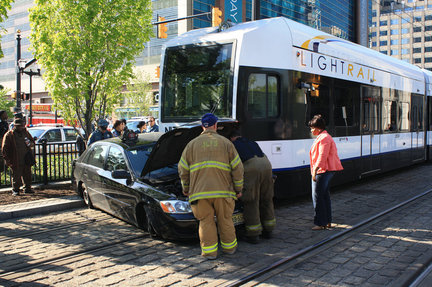
There is much hoopla from the SkyTrain/metro lobby about tram or streetcar crashes at intersections, yet what makes a light controlled intersection any different for a tram or car? It is the driver’s responsibility to stop at red lights and it is my firm belief that if a driver runs a red light and causes an accident, he or she should be banned from driving for one year. A tram or streetcar driverAi??passing a red light, will face disciplinary action, suspension or maybe even fired from his or her job. It is about time that the car and truck drivers learn to obey the most basic of road laws, that a red light means stop and if they don’t dire consequences will happen.
Chilliwack council candidates views on passenger rail
As most of you are aware, there is only one candidate running for Mayor – our current mayor Sharon Gaetz.
Dick Harrington – "…I am in favour of looking seriously at a "light-rail" transit system between Chilliwack and the greater Vancouver area- perhaps to the Surrey Interurban terminal. There is a committee made up of local politicos from most communities south of the Fraser River. However, it saddens me that the city council of Chilliwack does not have representation on this committee. This is a must. How can you really know what is going on when you don't have representation? It may be true that the cost of repairing and upgrading the old light-rail lines may be prohibitive; but, let's get involved and find out for ourselves."
Mitchell Nosko – "…We will need to come together to create an innovative plan for a transit system that makes sense. In the interim, I think we can take a look at some of the inefficient routes and make changes to reduce costs. I believe there is an immediate requirement for an intra-regional express bus service connecting Chilliwack with Abbotsford and Mission where connections to the West Coast Express can be made. Ultimately, I believe that a rapid rail system should be the long term goal for the Fraser Valley."
Roger Myers – "…Using existing rail lines and utilizing a light rapid transit system on a pre-existing rail line seems to be the way to go. At a time when many highways are being ‘upgraded’ to accommodate traffic estimations for the next 20 years, placing tolls on what was once free passage into Vancouver, the idea becomes more clear. A light rapid transit into Vancouver would make economic sense. Too bad millions of taxpayers dollars have already been spent on Highway ‘improvements’. These monies could have been used to implement the LRT system at the same cost with upgrades to the existing infrastructure. At a time when pollution is at an all time high, and gas prices soaring, the time is now for a system that makes sense and gives us a green alternative to our all ready congested highways."
All Candidates Meetings happening now – go to one in your community
When: Tuesday Nov. 8 at 7 p.m.
Where: Langley Events Centre gym
A Tale of Two Letters
The SkyTrain lobby has entered the Surrey political arena with the all so predictable misinformation that is so common with the "metro lobby". Sadly much of their anti-LRT rhetoric is thirty years out of date.
Light rail system may be the wrong choice
Published: October 31, 2011 1:00 PM
I have a few important points to share about Surrey’s transportation future.
Currently dominating the “vibrant” future of the City of Surrey is a cataclysmic light rail transit scheme that may make transit service worse instead of better.
Surrey’s primary transportation corridors need to be serviced with high-capacity, reliable and expandable rapid transit service. The city’s push for LRT (light rail transit) over SkyTrain RRT (rapid rail transit) may be a mistake.
Firstly, LRT will not improve service. In fact, LRT may even end up reducing (not increasing) the overall transit capacity of a corridor. Congestion increases associated with the removal of traffic lanes will not only disrupt parallel bus service, but also disrupt communities and stall economic development.
LRT’s slower speed (approximately 10-15 km/h slower than RRT) also renders it uncompetitive with the automobile, which may result in lower service popularity.
LRT is not “future-proof.” Due to frequency limitations caused by communication restrictions, the only way to expand LRT service once having reached frequency capacity would be to lengthen trains, requiring costly station extensions and street-scaping.
Misinformation from LRT advocates is responsible for deceptive claims that SkyTrain RRT will cost “billions” to build versus just “millions” with LRT.
Several refer to rough ballparks of about $110 million/km to describe the costs of RRT, derived from the Evergreen Line and Canada Line. These lines contained many special provisions (including underground bored tunnels) and the cost per kilometre cannot be reasonably compared to the cost of expanding SkyTrain in Surrey. The 1994 extension of SkyTrain in Surrey to King
George from Scott Road Station was, in fact, the cheapest per kilometre to construct at just $66 million/km (and that’s in 2011 dollars).
To adopt a LRT system would be challenging; LRT would require many special provisions of its own. Aside from new rolling stock, a new maintenance centre and yard would have to be built and employees would have to be trained.
It is likely that after factoring in the capital cost to start up the system as well as the possible need to upgrade several roads parallel to LRT corridors, LRT in Surrey will cost not significantly less to implement than RRT expansion.
It is widely accepted that transportation is one of the most pressing issues in Surrey. The right choice for the City of Surrey’s transportation future needs to be made.
Daryl Dela Cruz
skytrainforsurrey.org
http://www.surreyleader.com/opinion/letters/132949678.html

Rail for the Valley member Malcolm Johnston certainly corrects some of the SkyTrain hype and hoopla with his reply.
SkyTrain design full of limitations
Published: November 03, 2011 7:00 AM
A recent letter from Mr. Cruz, (skytrainforsurrey.org) is full of dated and misleading misinformation, so common with the SkyTrain lobby.
Only seven SkyTrain-type systems have been built since it was first marketed in the late 1970s, compared with well over 100 new light rail systems built during the same period. Why?
Modern light rapid transit (LRT) improves service on routes which it operates, bringing a quality transit service to former bus routes.
SkyTrain is a proprietary mini-metro system and if Bombardier Inc. (the present owner) decides to cease production, we would lose our only supplier. No one else builds SkyTrain, unlike modern LRT, which has many suppliers – including Bombardier Inc.
What many people do not realize is that SkyTrain was too expensive for the Canada Line and a cheaper, generic, grade-separated, electric multiple unit transit system was built instead. The
Canada Line is not compatible to operate with the rest of the SkyTrain system.
Speed of LRT is dependent on the quality of rights-of-ways it operates on and the number of stations per route kilometre. LRT operating on a reserved right-of-ways (which can be a simple as a HOV lane with rails) can obtain commercial speeds equal of that of SkyTrain; LRT operating as a TramTrain on railway lines can obtain higher commercial speeds than SkyTrain.
Mr. Cruz, quoting “raw” construction costs, which excludes the cost of cars, signaling and power supplies for the Expo Line in Surrey, is again misleading as the same “raw” costs for LRT operating on-street is about $6 million/km.
The Rail for the Valley group, which engaged Leewood Projects from the UK to plan for a Fraser Valley TramTrain service using the old interurban route, found that the full build, 138 kms from Vancouver/Richmond to Rosedale worked out to $7.2 million/km. Modern LRT is affordable if it is designed to be affordable.
It sad to see the same old dated rhetoric trundled out by the SkyTrain lobby, especially today when there is such overwhelming evidence that modern LRT is faster than, attracts more ridership than, and is cheaper to build than SkyTrain.
Malcolm Johnston
Rail for the Valley
The SkyTrain/LRT debate – 20 Years Too Late!
On Sunday, November 13, will be a civic election debate in the Fleetwood Library in Surrey (BC) on the topic SkyTrain versus LRT, the sad fact is, the SkyTrain versus LRT debate has been dealt with over twenty years ago and light rail won! That local political wannabees are still trying to turn SkyTrain lead into light rail gold is testament to the general ignorance by many on the topic or urban 'rail' transit.
The following is an excerpt on the general questions regarding light rail and SkyTrain.
. Light Rail/Street Car vs SkyTrain
· Light Rail/Street Car is less expensive than SkyTrain to build (track and stations)· SkyTrain?s operating expenses maybe lower than Light Rail/Street Car (automated vs drivers)· In areas where travel distances are lengthy and passenger volume is less than highly urbanized locations Light Rail would seem the better choice, Surrey is such a location· At level track for Light Rail/Street Car can impede the flow of cars and trucks at intersections· TransLink is under financial pressure now and probably through enactment of its 40 year plan so opting for a very expensive rapid transit mode would not be wise· Light Rail can be run on existing railway right of ways (eg. Cloverdale to Newton to Scott Road ) saving property acquisition costs (ie. to provide for dedicated space for an elevated track along major roads)· Street Cars integrated with Light Rail is more compatible with Surrey ?s ?City Centres? plan, a key component of Surrey ?s Transportation Strategic Plan (Oct.20, 2008)· An expanded SkyTrain network in Surrey might be more compatible with the current SkyTrain system (smother passenger flow)Question: Assuming there will be an ongoing financial challenge for TransLink what would you advocate for a) including SkyTrain in the mix and a system of smaller scope, b) Light Rail/Street Car and the exclusion of SkyTrain?
· Light Rail/Street Car is less expensive than SkyTrain to build (track and stations)
The Selling of the Evergreen Line

From the Bill good Show on CKNW radio……..
9:00 -9:30
EVERGREEN LINE OPENS UP A WORLD OF BUSINESS POSSIBILITIES
Transportation minister Blair Lekstrom recently announced that construction for the Evergreen Line is expected to start at the end of next summer. And there is a lot of planning that will go on between now and then. The $1.2 billion project will connect Lougheed Town Centre with Coquitlam Central Station. Regional transportation commissioner Martin Crilly has said ridership depends on a municipality’s ability to encourage development along a line. How is the business community preparing for the Evergreen Line? How will they entice new businesses to set up shop along the route? And what about existing businesses? How are they going to make sure another Canada Line fiasco doesn't’t happen during the construction of the Evergreen Line?RICHARD STEWART, COQUITLAM MAYOR
MICHAEL HIND, EXECUTIVE DIRECTOR, TRI-CITIES CHAMBER OF COMMERCE
The Selling of the Evergreen Line is in full swing as politicians & their cronies, bureaucrats, city engineers, and planners are trying to justify the the Evergreen SkyTrain Line because it is good for their pocketbooks. The Goebbels gambit is in play with the mainstream media singing hosannas about the mini-metro and like every mini-metro built before, the Millennium Line will be claimed a wondrous tool to make the region more livable, reduce congestion and pollution and so on. We have heard it all before.
The cost for the once $1.4 billion Evergreen Line is now advertised at $1.2 billion and on it goes, the selling of the Millennium Line. I would wonder that the same questionable accounting practices uncovered by BC's Auditor General with BC Hydro are being used by TransLink to mitigate the sticker shock of the new metro line. The mainstream media will never investigate that because rapid transit is a motherhood and apple pie story.
As stated before, we build hugely expensive metro lines in the Vancouver region as a mega project, to throw taxpayers money at political friends including land developers, not to efficiently and affordable move people. The Millennium Line, like the Canada line will be like a White Elephant, attracting very few new customers to transit and instead claim transit success by carrying recycled bus riders and $1.00 a day U-pass holding students.
What is conveniently forgotten is that the Evergreen Line is the uncompleted portion of the Millennium Line; uncompleted because the costs to build the SkyTrain extension to the TRI-Cities was grossly underestimated and there was no money to complete it. Sounds familiar, well it should because the costs of every metro line in Metro Vancouver has has been grossly underestimated (the Expo Line was built in three stages), but then if politicians and the taxpayer knew the real costs involved, they would not build with SkyTrain.
Bait and switch and political flim-flam is the hallmark of the two SkyTrain Lines and the elevated EMU Canada line – the Evergreen Line is just more of the same.
STOP PRESS! A SNEAK PREVIEW OF TRANSlINK’S LIGHT RAIL PLANS FOR SURREY AND BROADWAY

TransLink has announced its vision for light rail in Surrey and along the Broadway Corridor. After months of searching. TransLink officials have jumped on board "green transit" with their Eco-friendly LRV and released a picture of a Dutch "green" tram.
"Now we have carbon neutral transit for the 21st century"; stated by a TransLink spokesperson at a photo-op earlier today, "The trolley jolly boys up the valley can't not complain we are anti LRT!"
On a local talk radio station, an official from TransLink pooh-poohed the idea that TransLink's idea of LRT was very mid 19th century, but they did admit that their new light rail vehicles are much slower and have much less capacity than the SkyTrain metro system.
"We are planning what the people want in the Fraser Valley", later opined a transit official.
Malcolm Johnston, noted light rail advocate said, "At least if the tram breaks down, like SkyTrain's recent record, one can ride the horse to their destination."
The final decision will be made in the first week of April, 2012.
The Novice’s Guide to “Rail” Transit Or…………
…………..cutting through the BS about light rail, SkyTrain and BRT.
The following is a guide plus definitions about “rail” transit for the November civic elections.
ALM: Automatic Light metro, the fourthAi??marketing name given for the SkyTrain family of light-metros, when Lavalin briefly ownedAi??SkyTrain before gong bankrupt.
ALRT (1): Advanced Light Rail Transit, the secondAi??marketing name for SkyTrain.
ALRT (2): Advanced Light Rapid Transit, the third marketing name for SkyTrain, when Advanced Light Rail Transit failed to find a market.
ART: Advanced Rapid Transit, the fifth marketing name for SkyTrain, used by its current owners, Bombardier Inc.
Automatic (Driverless) Operation: A signaling system that permits train operation without drivers. Contrary to popular myth, automatic operation does not reduce operating costs because there are no drivers, because attendants must be hired insteadAi??to permit safe operation. Automatic signaling was signed to reduce signaling staff, not operation staff.
 Bus Rapid Transit (BRT): Generally means “Express Buses”, a true BRT needs a very expensive and land consuming busway or highway or be guided.
Busway: A route needed for BRT. Busways can be conventional HOV lanes or exclusive roads for buses. Busways can be equipped with raised curbs or rails for bus guidance.
Canada Line: Vancouver’s third metro line which is a grade separated EMU operation and is not compatible with the rest of the SkyTrain systemAi??in operation.
Capacity: A function of headway multiplied by vehicle capacity, measured in persons per hour per direction.
Consultation: To sell a transit decision to the public after the decision has been made.
Expo Line: The first SkyTrain line built, completed in late 1985. The ExpoAi??was built inAi??in three sections. The Waterfront to New Westminster section (cost a much as LRT from Vancouver to Whalley, Lougheed Mall and Richmond Centre), theAi??SkybridgeAi??section across the Fraser river to Scott road Station, and the final section to Whalley in Surrey.
 Grade: The vertical rise of a railway track, normally given in a percentage (1% grade = a 1 metre rise in 100 metres). Industry standard grade for LRT is 8%; Sheffield’s LRTAi??operates onAi??10% grades; the maximum grade for a tramway is located in Lisbon, where the streetcars operate, unassisted, on 13.8% grades.
Goebbels Gambit: The fine art of repeating a lie often enough that it is perceived as the truth.
Guided Bus: A BRT that is physically guided by either a raised curb or a central rail. Some guided buses are considered monorails.
Headway: The time interval between trains on a transit route.
Hybrid: A transit system that is designed operated asAi??a LRT/light metro mix. Generally very expensive as it uses the most expensive features of both modes.
 ICTS: Intermediate Capacity Transit system, the first name SkyTrain was marketed by.
Interurban: An early streetcar which operated at speed on its own R-o-W connecting urban centres.
Light RailAi?? (LRT): A steel wheel on steel rail transit system that can operate economically on transit routes with traffic flows between 2,000 pphpd to over 20,000 pphpd, thus bridging the gap on what buses can carry and that which needs a metro. A streetcar is considered LRT when it operates on reserved rights-of-ways or R-o-W’s for the exclusive use of the streetcar/tram. Number of LRT/tramways in operation around the world 461; light railways (many use LRV’s) – 119; heritage lines – 60.
Light Metro: A transit mode, generally a proprietary transit system, that has the capacity of LRT,Ai??at the cost of a heavy-rail metro.
Light Rail Vehicle (LRV): A vehicle that operates on a LRT or streetcar line. Also called a streetcar, tram, TramTrain or interurban.
Mass Transit: A generic term for heavy-rail metro. See rapid transit.
Metro: An urban/suburban railway that operates on a segregated R-o-W, either in a subway or on a viaduct, due to long trains (8 cars+) and close headways. There are 174 heavy/light metros in operation around the world.
Millennium Line:Ai?? The second SkyTrain Line built, using the new Bombardier ART cars.
 Monorail: A transit mode that operates on one rail. There are two general types of monorail: 1) hanging monorail and 2) straddle beam monorail (not a true monorail). Some proprietary BRT systems are also classed as monorail.
Priority Signaling: A signaling system that gives priority to transit vehicles at intersections.
Proprietary Transit System: A transit system who rights are exclusively owned by one company. Transit operations who operate proprietary transit systems must deal with only one supplier.
Rapid Transit: A generic term for metro. See mass transit.
Reserved Rights of Way: An exclusive R-o-w for use of transit vehicles, can be as simple as a HOV lane (with rails for LRT) or as elaborate a a lawned boulevard or a linear park complete with shrubs.
 SkyTrain: An unconventional proprietary light-metro, powered by Linear Induction motors, marketed by Bombardier Inc. Currently there are 7 SkyTrain type transit systems in operation around the world. ICTS – 2; ALRT (1 & 2) – 1; ART 4.
 Streetcar: A steel wheel, on steel rail electric (also can be diesel powered) vehicle that operates in mixed traffic, with little or no priority at intersections. Also known as a tram in Europe. Streetcars become LRT when operating on reserved R-o-W’s.
Tram: European term for streetcar, as the Europeans do not use the term LRT.
 TramTrain: A streetcar that can operate on the mainline railways, operating as a passenger train.
TransLink Speak: The lexicon used by TransLink to mask problems. Example: medial emergency on SkyTrain means a suicide.
 Viaduct: A viaduct isAi??a bridgeAi??composed of several small spans.
Those living in glass houses………….
On another blog, the author was ranting on and on about the various accidents that befell light rail operations around the world, while at the same time pretending that SkyTrain was accident free.
Yes accidents to happen on light rail/streetcar systems, but they also happen on SkyTrain. The SkyTrain lobby should do well remembering the old proverb; “Those who live in glass houses should not throw stones”
Elderly woman struck by SkyTrain at Nanaimo station
Vancouver Sun
Velo Rail – Touring France by bicycle on rail!
A new way to use old railway lines in FranceAi??- Velo Rail. I wonder if RftV could get one in operation, from Chilliwack to Yarrow, on the days the freight train doesn’t operate.
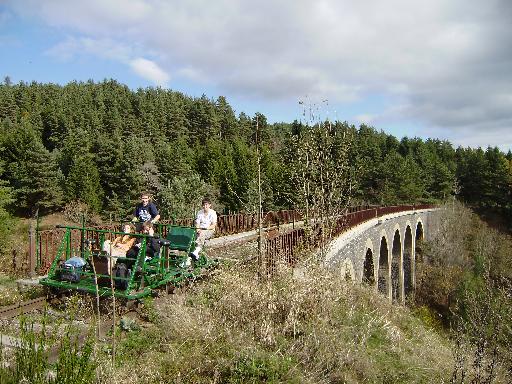
For more information on a Velo Rail holiday, please visit……..
http://www.veloraildularzac.com/UK/Velorail_du_larzac_accueil.awp



Recent Comments