Adios the Detroit “Mugger mover”?
It seems while the locals try to reinvent the SkyTrain light-metroAi??in Vancouver,Ai??the Detroit ICTS system is close to shutting its doors. If the Detroit “Mugger Mover” and the Toronto Scarborough go into the history books, it will mean the end of the firstAi??generation of the SkyTrain ICTS/ALRT light metro system,Ai??leaving only five SkyTrain type systems left in operation.
The financially-troubled automated downtown Detroit people mover which operates a loop service may be closed, WDIV reports. A reprieve might come if an alternative funding source is found.
Ai??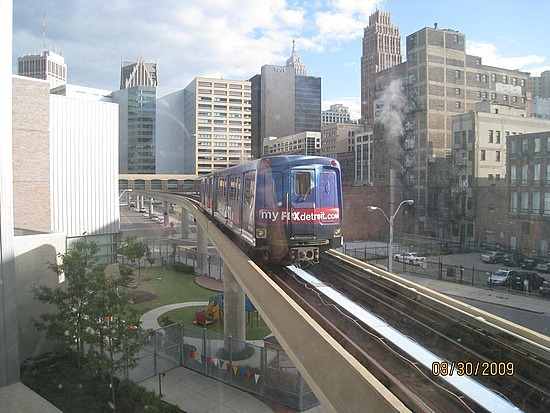
The Detroit ICTS/SkyTrain people mover.
DETROIT — Unless an alternative source of money is found within the next few weeks, the Detroit People Mover will shut down at the end of December.
The light rail’s ridership has been down and Detroit was forced to pull millions of dollars out of the subsidy because of the ongoing budget crisis.
The city has been seeking an alternative source for funding the People Mover, but that source has not been found. The city has been selling some of the 13 stops’ naming rights, but it hasn’t been enough to cover operation costs.
To help cover costs, the operations staff has been cut and the ticket price was raised from 50 cents to 75 cents.
Mayor Dave Bing’s office said the administration is hoping the state will release escrow funds to operate the system.
City Council President Charles Pugh insists the People Mover will not completely cease operations.
“Our goal is to not let it shut down, or severely decrease it to the point where it’s insignificant,” Pugh said. “The People Mover does serve a function, and we have to keep that in mind — that it serves an important function.”
Regardless of the system’s importance as a mode of transportation downtown, Pugh said the People Mover does take a backseat to the Police Department, EMS and Fire Department. He said the City Council’s subsidy for the system was $4 million and that they recently removed $1 million from that.
He said the operating staff was working to become more efficient and that he was confident the system would not close, but the city may need to cut back on the system’s operating hours and make it event-based.
The People Mover began operating in 1987. The track runs a three-mile loop around Detroit’s downtown. There are 13 stops.
http://www.clickondetroit.com/community/29545475/detail.html
Do you want to sit down on the Overground during rush hour or Rules for snagging a seat on SkyTrain.
It's Friday and it is a Pro-D Day (means the kids are home from school, while the teachers sup coffee and tell stories how horrible the children are)!
From brelson.com
Do you want to sit down on the Overground during rush hour? Then prepare for war!
A few days ago, on an Overground train from Highbury to Kensington, I had a shocking experience – I failed to get a seat.
If you know how crowded the Overground can get at rush hour, this might not sound all that surprising. Believe me, though, I was good at getting seats. I’d learnt the ropes and tend to overanalyse behaviour on public transport, so it had never been a problem. But I’d been away for a few weeks and my seat-acquisition skills had gone beyond rusty – they were useless.

Overground trains never look like this during rush hour
So, as a form of therapy, I decided to try to work out the “rules” of the seat-acquisition game on the Overground. Here they are, in illustrated form.
The theatre of conflict
The Overground train arrives and dazed commuters spill on to the platform. Everyone stands aside to let them pass. But this act of kindness is the exception, not the rule. Once you all step into the carriage the competition for seats begins. You are now in a theatre of war.

The strategic theatre where war is waged
Know your enemies
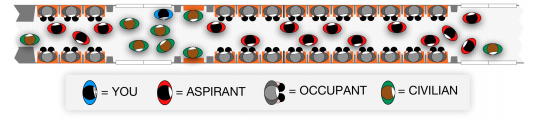
You share the strategic space of the carriage with many other players. Here’s a brief rundown of who they are:
- Aspirants – People standing who want to sit down. This includes you.
- Civilians – People standing who don’t want to sit down, maybe because they’re not going far.
- Occupants – People currently sitting down. Don’t be fooled though: they’re still in the game.
In a typical combat situation (or “rush hour”) here’s how the players might be distributed across the theatre of conflict.
Stepping into the arena
Civilians linger near the doors while Aspirants occupy strategic positions nearer the seats. I’ll come to these later. First, here’s an ill-advised opening move that could undermine your whole campaign.
Don’t take the wrong turn
When you first get on the train you might turn towards the divide in between two carriages. Don’t! This is an unforgiving quagmire. Much like Napoleon in Russia, your campaign will come to a crushing, drawn-out end if you venture here.
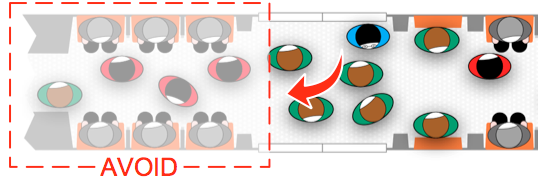
There are few seats here so chances of victory are slim. On one side you’re bordered by the crowded doorway, on the other you’re hemmed in by the barren, seatless inter-carriage zone, so withdrawing to another region could prove impossible. Stay well away.
Get into position – but act casual
Get yourself into the long aisle, where the seats are most abundant. This is the fertile valley of the Overground carriage.
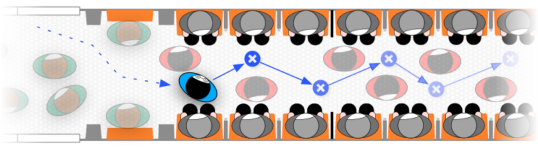
But don’t push past people to get here. Try to act casual, like you don’t really want to sit down anyway. As Sun Tzu said, “All warfare is based on deception“. Seem too predatory and you’ll raise the suspicions of other Aspirants, losing the element of surprise. Let them think you’re a disinterested Civilian.
Find a good place to lurk, but don't appear too keen
A well-chosen spot gives you a tactical advantage over three, maybe four, seats. Take care when picking your spot, and check for things like:
- Have the seat occupants only just sat down? If so it might be a while before they get off.
- Can you guess where their occupants might be heading to? For example you can spot BBC people easily (branded building passes, reading Ariel, cooking up ways to irritate the Daily Mail). They’re going all the way to Shepherd’s Bush, so find a new spot.
- Who else lurks in the same area? If there are pregnant or infirm Aspirants you should move elsewhere – unless, of course, the Overground has completely erased your sense of ethics.
- Are the Occupants checking the station name or folding up their newspaper? If so then they may be close to departure.
Having found your spot you’re now engaged in a tactical skirmish with other nearby Aspirants. This will play out in a smaller and more manageable space.
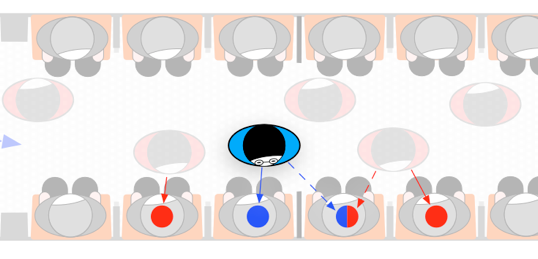
What it all comes down to – hold your position to capture the flag
Things might seem straightforward from now on – someone will get up, you’ll sit down, mission accomplished. But it’s still too soon for complacency.
Entering end game
This might be the end of your campaign if earlier strategic decisions were sound and luck’s on your side. Other passengers, however, play by their own rules, so there could be some surprises ahead. Here are some end-game scenarios and how to handle them.
1. The Occupant’s Deceit
The Occupant of a contested seat puts their book away. Suddenly you’re interested in nothing else, watching them like a hawk to be sure you’ll bag their seat.

Don't be misled by someone putting their book in their bag. They're not leaving the train – they're just messing with your mind
Distracted, you fail to notice a seat that is legitimately yours becoming empty. An opportunistic Aspirant sneaks in to grab it. Then, to compound your error, the Occupant you’re eyeballing just sits there looking like butter wouldn’t melt in their mouth and you’re stuck on your feet. You lose this round.
Don’t let any single Occupant claim your undivided attention – sometimes people put their books away because they’re bored of reading, they want to sleep, or they simply enjoy messing with your mind.
2. 360-degree Combat
It’s easy to get a kind of tunnel vision when staring at the same three or four people for so long. You can easily forget that there’s a whole other row of seats immediately behind you.
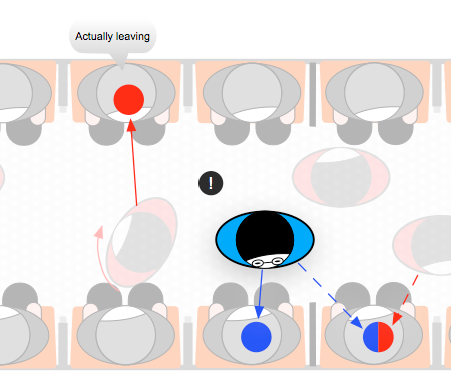
Overground veterans develop 360-degree perception of their surroundings, much like chameleons
So when a seat behind you becomes vacant, will you be quick to notice? If not then it’s a lost opportunity. The trick here is to somehow know what’s going on behind you without overtly gawping – remember your Sun Tzu. As always on the Overground, subtlety is essential.
Edit: A few people commenting after this was posted mentioned that they look in the window to see the reflections of people behind them. I didn’t know this trick. No wonder I’ve been spending so much time standing
3. The Art of Misdirection
Imagine two Aspirants have equal claim to a seat and the Occupant gets up. Who wins? Sometimes it’s about who acts smartest, not who acts first.
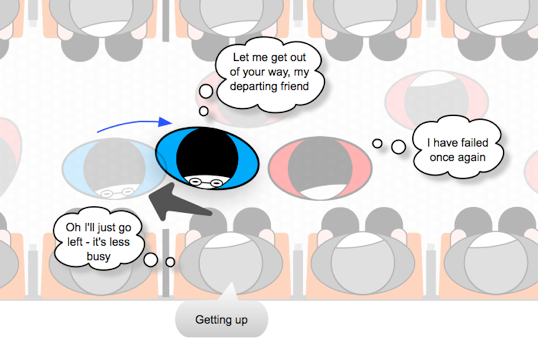
The Occupant's direction of departure can be influenced to your advantage
The departing Occupant decides which door to head towards. Sometimes it’s the nearest door, but on a crowded Overground carriage they’ll usually choose the path of least resistance.
Exploit this to your advantage by shifting your position to create an easy route for them. As they move past, do that “orbiting” kind of motion that people do in busy spaces, spinning around them so you switch places while gracefully intruding between the seat and your thwarted enemy.
Get it right and you’ll effortlessly drop into their seat while looking like a helpful and polite person, and not the scheming and conniving seat-fancier you are.
A final note – and a confession
This guide should help you achieve comfort on the Overground, but I must confess that my last few journeys have been spent standing up, so maybe I’m not the best teacher. Maybe I’ve lost the hunger, the brutality, the sharpness of wit that’s needed to compete on these trains. The truth is that I don’t need that hunger any more – my company is moving next weekend, to an office 20 minutes’ walk from my house. I’m pretty happy about this.
So while my days as an Overground commuter are over, yours may be only just beginning. If so, be careful out there – and don’t let the war for seats escalate any more than it has to. Enough blood has been shed.
Edit: There’s now a follow-up to this post, about the Geneva Convention of public transport – the sacrosanct, unspoken rules that we all must obey
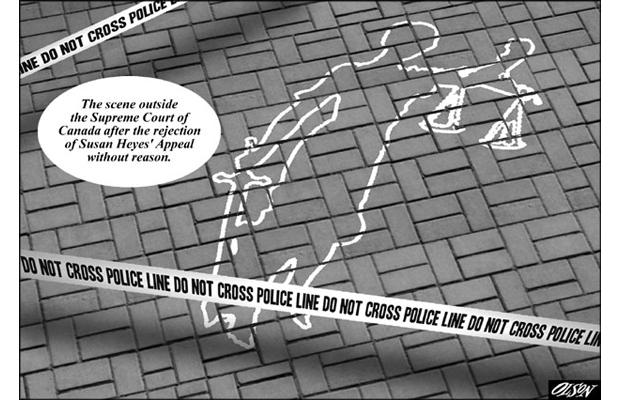
BRT Buffoonery and a word about Susan Heyes
Some interesting costs associated with BRT. If the following is to be believed, then BRT is more expensive to build and operate than light rail. Maybe that’s why TransLink wants to build BRT in the Fraser Valley. With TransLink, if it costs more to build and operate than light rail, they build it!

Pittsburg BRT, costs more to build and operate than light rail.
From the LRPPro blog.Ripping out railroad tracks to build a BRT is a total waste of moneywe are very short on. Pittsburgh did that on their terribly inefficientWest BusWay in about 2000AD. The BusWay was to run fromGolden Triangle (downtown) to Carnegie, PA., about 8 milesbut they called it the Airport BusWay to get support for it. It wasnot to go anywhere near the airport but the AIrport buses woulduse part of it even though they already had an interstate highway279 to run on. It was to cost $ 325 million to build = $ 40 millionper mile over ten years ago. A crooked Senator got Congress towaive the law and the agreement that required Allegheny Countyto ante up the $ 200 million shortfall when the bids came in at$ 525 million, $ 65 million per mile, far more than Light Rail butthe rotten government let the Port Authority allege that the BusWay was only one-third the cost of Light Rail. They supportedthat lie by using the cost of the Buffalo full subway when theyshould have used the cost of Salt Lake City which was built onRR tracks.I was so mad I wrote the FTA about it and I got a lying letterback explaining that if they built half of the BusWay fofr $ 285million it would be a better deal than building it all for $ 525million. NOT TRUE AT ALL. They now attract only 9,000 ofthe promised 50,000 weekday passengers.Or abstractly, Light rail now costs $ 240 average per car hour for 125 passengers in the rush hour = $ 1.92 per passenger.Buses now cost $ 120 per hour for 57 peak passengers= $ 2.11 per passenger PLUS 12 % for BusWay and stationmaintenance, ploughing and 6 % for proof of payment farecollection which cost is included in Light Rail basic data.Sure, a Bus Way would probably use articulated buses with87 peak capacity but Operations Research study of actualarticulated bus operation in Los Angeles found they cost moreper passenger than 40-foot buses because of complexity andslower movement.The TRB has that data. The BusWay bus cost will be $ 2.50 perpassenger, THIRTY PERCENT MORE THAN LRT.
“If the law supposes that,’ said Mr. Bumble, squeezing his hat emphatically in both hands, “the law is a ass–a idiot. If that’s the eye of the law, the law is a bachelor; and the worst I wish the law is, that his eye may be opened by experience–by experience.”
Occupy TransLink and rid ourselves of the SkyTrain cult!
TransLink and SkyTrain in the news again.
I find it strange that the mainstream media has failed to tackle the ‘SkyTrain’ question and continue to blather on about the benefits of SkyTrain, when the rest of the world have found none!
The 34 year old proprietary SkyTrainAi??light-metro system has created it own operating philosophy in Vancouver, which rezoning and densifying properties along the line is more important than affordably moving people. This “faux” transit philosophy has been now taken up by local academics, who have made careers preaching densification to the masses, like ministers, preaching the gospel. The problem is, SkyTrain and light-metro are now a false religion, based on dated precepts and equally dated technology. Only Vancouver seems to have been seduced by the SkyTrain/light-metro cult.
Why?
When SkyTrain was first marketed in the late 70’s as ICTS or asAi??Intermediate Capacity Transit System, it was compared to the old Toronto PCC style streetcars, not modern LRT. When compared to modern LRT, SkyTrain ICTS was not faster than LRT, nor had a higher capacity than LRT, but it certainly cost more to build and operate than modern LRT! There was noAi??market for SkyTrain and ICTS.
Rebranding as ALRT or Advanced Light Rail Transit, fooled no one, except BC provincial politicians were were sols a ‘bill of goods’ when they forced SkyTrain on the region.
The NDP’s flip-flop from LRT to SkyTrain was another crass political deal done between the new owners of SkyTrain, Bombardier Inc. and their new tarted up version called ART or Advanced Rapid Transit.
With only seven SkyTrain type operations in revenue service sinceAi?? the late 1970’s and all but two, Vancouver and Kuala Lumpor (which also has a conventional light-metro line and a monorail line), use SkyTrain ALRT/ART has urban transit systems, the rest are demonstration lines and specialty lines servicing airports or fun fairs.
As SkyTrain light-metro was an inferior product to modern light rail, the promoters of the system reinvented the transit system and created the SkyTrain myth. The myth included:
- SkyTrain was an automatic light metro and thus being driverless, was cheaper to operate.
- SkyTrain was faster than LRT, which will attract more ridership.
- SkyTrain has a higher capacity than LRT
- SkyTrain creates density, needed for the modern city.
- Light rail is dangerous because it operates on-street/at-grade.
- SkyTrain pays it operational costs.
The truth is a little different.
- Automatic operation doesn’t reduce operating costs of a transit system, except when traffic flows exceed about 20,000 persons per hour per direction. Instead of drivers on a transit system, the automatic metro has attendants. Automatic operation was designed to reduce signaling costs and increase signal reliabilityAi??on heavily used metro routes.
- There is absolutely no proof that the actual speed of a transit system influences ridership, rather it is the speed ofAi??one’s door to door journey time. As light metro networks are generallyAi??smaller than LRT, many customers must take a bus or other transit mode as part of their journey which increases transit time. A recent study dome in Copenhagen found that overall journey times on metro were 1% faster than light rail, but you got over six times more LRT for the cost of one metro line.
- The old saw that SkyTrain has a higher capacity than LRT should be finally put to rest, as a simple streetcar line in Karlsruhe Germany is on record having a capacity in excess than 40,000 pphpd or 10,000 pphpd more than the maximum theoretical capacity of the SkyTrain light metro system.
- Transit Oriented Development (TOD) follows every new transit line and it doesn’t matter if it is SkyTrain or LRT. Our local mania for massive high densities along our metro linesAi??tend to beAi??counter productive and seems more as a sop to developers to make huge profits by rezoning lands to higher densities and academics who seem to “not to get it”.
- Modern LRT is one of the safest transit modes today, to say it is dangerous is just pure folly.
- If we used the same accounting methods as TransLink does for SkyTrain, just about all light rail lines pay their operating costs, but TransLink doesn’t incl use debt servicing charges with their accounting methodsAi??and ignores the provinces now $250 million annual subsidy paid to SkyTrain.
In todays world, there is no financial or operational niche for SkyTrain as it costs more to build and more to operate than LRT, that TransLink still plans for SkyTrain and politicians still approve new SkyTrain lines only demonstrates how ignorant and unsuited regional, provincial and federal politicians are when involved in transit planning.
The occupy Vancouver types should occupy TransLink’s ‘Ivory towers’ on Kingsway, to try to bring about sane and affordable transit planning for the region.

Ai??Pricey SkyTrain love affair began in Ottawa
Ai??By Elizabeth James, Special to North Shore News
“Of course, taxing everyone a little bit is like putting the frog in the pot before turning up the heat – the mayors must hope the overtaxed and underserved don’t notice the slight increase in pain.”George Pajari,
VANCOUVER SUN, OCT. 14,
WEST Vancouver resident, high-tech entrepreneur and thorn in the side of council, George Pajari is not too pleased with the TransLink Mayors’ Council vote to approve a two-cents-a-litre gas tax.
Nor is he chuckling at the prospect of an annual $23 property tax hike which, of course, said mayors “hope to avoid.”
Wait till Pajari hears the numbers crunched by fellow thorn, North Vancouver’s Corrie Kost, namely that “the long-term debt of TransLink is about $1,000 per [Metro] resident.”
To emphasize, that is $1,000 over and above the costs of an Evergreen Line and the latest commitments made by your representatives.
Pajari suggests that “people who choose not to use transit” should be “penalized” with road and congestion taxes.
That is where he and I part company, because my position with respect to pouring more dollars down the black hole that is TransLink is this: Not a penny more until we are given two things: a new board of directors and an arms-length, pre-project, value-for-money audit.
Members of the new board must have professional transportation/transit experience, preferably untainted by ties to the federal and provincial governments, and have no current or past connections to companies like Bombardier and SNC-Lavalin.
Next, the audit must be performed by transit-savvy staff from the B.C. auditor general’s office, or similar professionals from the U.K. or Germany.
Why those caveats? Some of the most straightforward email conversations I have had about TransLink in recent months have been with Bowen Island councillor Peter Frinton, a member of the Mayors’ Council. Although he and I differ on some points – along with 15 others he voted for the recent gas tax package – never once has he given me political spin in answer to my questions. Some of his revelations about what passes for democratic process in this region are enough to send you to the drugstore for anti-nauseants.
Last July, after I suggested that if only TransLink would build at-grade systems instead of SkyTrain, most of its funding problems would disappear, Frinton replied, “Most of the mayors/councillors feel the same way, but have made no headway with the province or feds . . . I have no idea why senior government has been so married to [SkyTrain] technology. . . .”
Well, having asked myself the same question every time TransLink held its hand out, I am ready to take the gloves off on a possible answer: Someone somewhere has found it advantageous to choose proprietary SkyTrain over more affordable alternatives – and the beneficiary cannot be Bombardier alone because, as Frinton observed, the company also manufactures light-rail cars.
Nor, despite their recent vote, does it appear to be the yeasayers on the Mayors’ Council. The worst they are guilty of is not telling transportation minister Blair Lekstrom to take his dictates and pay for them.
No, although I have little doubt that some of the advantages have trickled down to a sequence of provincial governments, the TransLink buck stops in Ottawa. Also, because the question being asked has spanned at least 15 years of both Liberal and Conservative governments, whatever the advantages might be, they have been common to both.
Can it be that we pay through the nose merely to keep Quebec happy, or is the situation more sinister than that?
That there is an Ottawa connection seems obvious because, although the questions had their genesis in the mid-1980s when SkyTrain was chosen for the Expo Line, they gathered speed when former NDP premier Glen Clark abruptly changed his mind about using light-rail for the Millennium Line project.
The switch (pressure?) began after he visited Ottawa with Ken Dobell, a former Vancouver City manager under then-mayor Gordon Campbell. The rest is our very expensive TransLink history.
But no matter where the SkyTrain advantages originate, regional taxpayers are left paying for the mess because, as Frinton told me last March, “The provincial government has long attested that Lower Mainland municipalities have ‘property tax room’ as a result of lifting the hospital tax in our area.”
There is much more to tell and sooner or later that will happen. For now, and in support of the relatively few people who try to keep this issue in the public eye, all I will add is this: Rather than trying to Occupy Vancouver without really knowing why, what the protestors could do is start small – Occupy TransLink, deal with that well documented billion-dollar problem and, if that succeeds, move on from there. rimco@shaw.ca
Ai?? Copyright (c) North Shore News
Will Toronto’s Transit City Return?
In Toronto, it seems politicians are having a lot of fun with transit. New mayor and anti-tram and tea-bag type Rob Ford received a backhand from the voters when they did not give the Ontario Conservatives a mandate to in the recent election. In fact, the brutish antics of Mayor Ford helped in the defeat of the Hudak conservative party in a classic "snatching defeat from the jaws of victory" election..
Could light rail return to the transit table in Toronto or will Toronto Mayor Ford huffs and bluffs his way along, desperately trying to get multi billion dollars subways built instead, while at the same time transportation crumbles under his reign.
Who is not afraid to bell the Ford cat?

The results of last week's provincial government election in Ontario are encouraging to Toronto supporters of "Transit City," who now believe the surface light rail plan killed by Mayor Rob Ford during his first day in office could be revived, the "now toronto dot com" site reports:
http://www.nowtoronto.com/daily/news/story.cfm?content=183135"Transit City's minority report – For some, last week's provincial election has reopened door on reviving light rail project
By Ben Spurr
The results of the provincial election have encouraged progressives still holding out hope for the resurrection of Transit City.
Councillor Adam Vaughan is among the devotees waiting for the transit plan's second coming, and lately he's seeing good omens. One of them is that the mayor's replacement for Transit City has stalled, for the time being at least. The province agreed to fund part of it (the underground LRT along Eglinton), but so far Ford has been unable to secure enough private funds for an extension of the Sheppard Avenue subway.
Another encouraging sign for Vaughan is the results of last week's provincial election, which saw the pro-Transit City NDP gain more power in a minority government, and confirmed that "Ford Nation" no longer has the ear of the province. The political playing field is looking rather different than when Dalton McGuinty acquiesced to a newly-elected and still popular Ford on Transit City.
"You've got a group of councillors who support Transit City, and you've got a significant group of provincial legislators from the GTA who want light rapid transit," says Vaughan. "Meanwhile you've got a mayor who's still dreaming in Technicolor when it comes to Sheppard avenue. The mayor's just one voice in a sea of people with a lot more power than him."
On the transit file, Ford is looking increasingly desperate. The morning after the provincial election, the first thing he did was venture out of his cocoon of protective right-wing media for an interview on the liberal CBC in which he publicly aired his demand for more provincial funding for Toronto transit.
A spokesperson for transportation minister Kathleen Wynne says the province has no plans to give the city more transit money at this time, but if that changes, NDP transit critic Cheri DiNovo says any provincial funding should come with strings attached.
"If the province is going to be paying huge amounts for more transit, the province should have a say in what it's used for," DiNovo says. "And Transit City is the best way of spending it. I'm sure Ford would rather see something built than nothing built. If we're paying the piper we get to call the tune."
Ford's allies at city hall see it differently. As far as TTC chair Karen Stintz is concerned, Transit City, which would have seen a network of light rail branching out across the city, is as dead as ever. The very question of revisiting it exasperates her. "It's not on the table," she says. "I don't even know how to answer the question."
Councillor John Parker, who sits on the TTC board but is on record voicing reservations about Ford's subway plans, doesn't think the provincial election changed anything.
"The proposal that's currently being pursued is one that the mayor worked out with the premier and the minister of transportation," Parker said. "I don't notice changes in any of those offices after the provincial election. So I would expect that the current plan is what those three kingpins are committed to and want to pursue."
Parker admits that if the province forks over more transit money, Queen's Park would have leverage to alter current plans, but he doesn't think it's likely the Liberal minority would make significant changes.
"If you go to somebody else and ask them for money, it would be reasonable for them to tie conditions to it," he said. "But those strings already seem to have been identified. They resulted in the announcement that the mayor's office and Queen's Park made jointly this year," which committed funding for burying the Eglinton crosstown, and scuttled Transit City.
There remains one development that could alter the political equation. When Ford decided to cancel Transit City, he made Toronto liable for the costs associated with work already underway.
That bill from the province is expected to be upwards of $49 million, but mercifully for Ford, who is in the middle of a crusade to stop waste at city hall, it has yet to arrive. Once it does, Transit City may start looking a lot more attractive, says Vaughan.
"There is no $49-million bill to repay if Transit City gets back on track," he said. "For a city and a province looking to save money, the easiest way to save money is to stop canceling things and to start building things."
A spokesperson for Metrolinx, the provincial transit agency, refused to confirm if the entire $49 million would be wiped out if Transit City were rebooted. He also declined to say when Ford can expect the bill.
A Toronto City Council member who formerly served as vice chair of Toronto Transit Commission [TTC] wants to know whether his council colleagues favor a heavy rail subway for Sheppard Avenue or if they wish to return to surface light rail. Mayor Rob Ford declared the surface LRT "Transit City" plan dead on his first day in office. The "inside toronto dot com" site has a report:
http://tinyurl.com/3fjqj8l
"DAVID NICKLE
Oct 17, 2011 – 7:30 AM
Subway or LRT along Sheppard, councillor seeks answers from city
Mihevc to make motion at next city council meetingFormer TTC vice chair Joe Mihevc will be asking a few questions about transit along Sheppard Avenue at the upcoming council meeting – in an effort to start debate over whether the city should go ahead with Mayor Rob Ford's plan to build a subway into Scarborough, or to go back to the light rail transit plan that the mayor declared "dead" after his election last year.
Mihevc, who represents St. Pauls on Toronto Council, is submitting an administrative inquiry at the Oct. 24 council meeting that will be seeking answers on the sudden shift in direction on transit policy last year.
In the wake of the provincial election last week and events of this past year, Mihevc said the time is right to start a debate on the $4.2 billion transit plan that Ford embarked upon.
"These are absolutely critical questions related to the future of this city, given all the mobility problems that are only exacerbating themselves," he said.
"So the ground has shifted and obviously the events of the summer – mainly the mayor's declining fortunes and then the provincial election, where from the mayor's point of view a tripartite agreement on the funding of the Sheppard subway didn't materialize… that also plays into this."
Mihevc is asking under what authority the mayor cancelled Transit City; for a status report on the Toronto Transit Infrastructure Company, which was formed earlier this year to devise a plan to have the private sector help pay for the subway; and for a proper assessment of what the city is exposed to in terms of cancellation costs for the Sheppard LRT, which was underway when Ford declared the program dead.
The questions will require an immediate response at the next council meeting. But Mihevc and other councillors are hoping the answers will just be a jumping-off point to a discussion overall of re-instituting the Transit City plan that had been underway when Ford took over as mayor from David Miller.
Over the past year, the mayor entered into talks with Premier Dalton McGuinty to shift the $8 billion in funding that was to have paid for surface light rail transit on Sheppard Avenue and on Eglinton Avenue, entirely over to the Eglinton Scarborough Crosstown LRT.
The city said it would cover the cost of a subway – $4.2 billion – to replace the Sheppard light rail line, through partnerships with the private sector. The premier and the mayor signed a memorandum of understanding and the province set to work on a new, entirely underground Eglinton line.
But council must still debate the memorandum for it to have any force. Although the memorandum was signed in the spring, Ford has yet to bring it before council.
[end text]
SkyTrain – increasing rents, but at what cost?
The following item is nothing more than a ‘hard sell’ for the Evergreen Line and for the proposed Broadway subway. Granted that office space near one of Vancouver’s three metro lines have lower vacancy rates and higher rents, but what has not been taken into account is that offices next to the present metro lines are much newer than their neighbours. Also new office buildings are being built on newly rezoned land and thus being new, and being new, command higher prices.
As for the lower vacancy rate, new office space tends to be filled more quickly as it is modern and contains up to date wiring, essential for theAi??modern electronicAi??business office.
What is missing in this study is comparing the age of the offices next to a metro line with offices elsewhere, which I think, would tell its own story.
As Vancouver population rises in the downtown core, due to massive condominium construction, the population has to travel out of the downtown core toAi??go toAi??work and with many families living in the downtown having no car or are one car families, using public transit is a necessity. Here we have a transit dichotomy:
The region is building hugely expensive metro/subway lines out from the city, which residents can commute to workAi??to new offices located near metro stations, in the suburbs;Ai??while residents living in the suburbs areAi??being taxed more to pay for expensive metro lines in Vancouver andAi??are more or less abandoned transit wise, with only skeleton bus services andAi??mostly to the closest metro station and in the end must rely on the car for personal transport.
So here is TransLink’s transit plans, build expensive metro/subway lines in Vancouver/Burnaby, to subsidies property developers in erecting new highrise office towers charging premium rents, paid for by suburban residents payingAi??ever higher gas taxes, property taxesAi??and bridge tolls. And I thought building ‘rail’Ai??transit was to affordable move people, silly me.
Suburban Vancouver office market driven by rapid transit: report
Jones Lang LaSalle notes that offices near SkyTrain and Canada Line have lower vacancies, higher rents
In Richmond, the commercial vacancy rate near the Canada Line is well below half that in the rest of the municipality.
Photograph by: Ric Ernst, Vancouver Sun
METRO VANCOUVER – Proximity to rapid transit is increasingly a key factor in where new offices locate in the suburbs and Vancouverai??i??s outlying areas, according to a report by commercial real estate services firm Jones Lang LaSalle.
ai???The closer, the better,ai??? the companyai??i??s executive vice-president Ray Ahrens said in an interview after Mondayai??i??s release of the Rapid Transit Office Index. ai???The office buildings close to SkyTrain stations are enjoying much lower vacancies. While [it makes sense that] they [are] better occupied, we didnai??i??t know the extent of this until we did the study.ai???
Ahrens said that transit is becoming increasingly popular in Metro Vancouver and ai???our [report] shows clear evidence that office developments located within walking distance of rapid transit have a significant advantage with less vacancy and higher rents.ai??? More people are now commuting from downtown Vancouver to the suburbs for work, he noted.
According to the report, which addressed both suburban municipalities and the city of Vancouverai??i??s outlying area, the direct vacancy rate for buildings within 0.5 kilometres of a rapid transit station is 4.8 per cent compared to 12.3 per cent for the rest of the market, while the average asking rents are approximately eight per cent higher.
The report noted that with a vacancy rate about one-third of areas not served by rapid transit, developers are increasingly looking to build more transit-oriented suburban office complexes.
ai???As downtown and Broadway corridor availability decreases and rents increase, our landlord and tenant clients are becoming more interested in transit-oriented suburban locations,ai??? added Ahrens.
The report cited new office developments taking advantage of the trend, including in New Westminster, where three buildings are scheduled to be ready for occupancy in 2013.
The buildings, which include the new TransLink headquarters, will more than double the areaai??i??s existing ai???Aai??i?? class inventory and be adjacent to the New Westminster and Sapperton SkyTrain stations.
ai???We expect to see continued interest in these [suburban] developments, particularly from employers with back-office operations that do not need to be located downtown,ai??? Ahrens said.
The report noted that a preference for rapid-transit-oriented office space is more muted in the downtown core and Broadway corridor.
ai???Although these markets are serviced by rapid transit, they also benefit from their central location and convenient access to other modes of public transportation such as frequent bus service and the SeaBus. Rapid-transit access, therefore, is not deemed to be a determining factor for tenants in these two regions.ai???
The report cited several benefits of having rapid transit near an office in the suburbs, including the ability for employees to save money on travel costs, and the ability to live in a more affordable suburban neighbourhood.
The report looked at several suburban municipalities, including Surrey, Burnaby, New Westminster and Richmond.
It concluded that the importance of having office space close to SkyTrain appears to be most pronounced in Surrey, where the vacancy rate for office space without rapid transit is 25 per cent, ai???yet buildings near the SkyTrain are a hot commodity, with a direct vacancy rate of just 0.4 per cent.ai???
The index noted that Central City, with 572,778 square feet of office space, is fully occupied.
ai???Gross occupancy costs for buildings with access to the SkyTrain are 33.3 per cent higher than the rest of the Surrey market,ai??? the report added. ai???The combination of high occupancy costs and limited vacancy in buildings with rapid-transit access allows these landlords to negotiate aggressively by seeking high net rental rates and offering modest inducement packages.ai???
For New Westminster, the report said, the direct vacancy rate of buildings along SkyTrain is less than half the rate of the rest of the cityai??i??s office space.
However, the index noted that in Burnaby, there is a much lower discrepancy between vacancy rates of office buildings with SkyTrain access and those located more than half a kilometre away, although vacancies are still lower for buildings near SkyTrain.
In Richmond, the report said, the vacancy rate near Canada Line is well below half the rate of the rest of the municipality.
bmorton@vancouversun.com
The Ultimate BRT
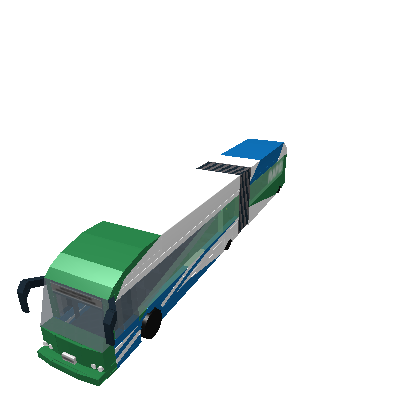
Here we have the next generation of rapid bus. I understand Translink is sending stakeholders (first class) to see the new BRT in Action.
Rumour has that the first trials will take place the first day of April, 2012.
The following is a preview of the new BRT.
I think I'll take a tram instead!
Contrasting Canadian News Posts
Freedom takes Flexity to the North American tram market
NORTH AMERICA: Bombardier Transportation President & CEO AndrAi?? Navarri launched the ai???Flexity Freedomai??i?? as the company’s tram platform for North America at APTA Expo 2011 in New Orleans on October 4. The 100% low-floor car is a parallel development to the Flexity 2, launched in Blackpool last month and targeted at the rest of the world.
Flexity Freedom will meet all major US and Canadian standards for crashworthiness, fire safety and accessability, which Bombardier feels are sufficiently different from European standards to justify a separate product line, albeit at a higher cost to the end user than an ai???off the shelfai??i?? European design. Production will be undertaken in Canada or the USA as appropriate to meet government requirements for work to be undertaken domestically.
The first Flexity Freedom cars will be supplied to Toronto, which placed an order in July 2009 for 204 vehicles to replace the CLRV fleet operating its 1Ai??495Ai??mm gauge street tram network in the city centre and subsequently exercised an option for up to 182 additional cars to a slightly different design as part of its Transit City light rail expansion programme.

Political gridlock on transportation
http://www.thestar.com/opinion/editorialopinion/article/1064580–political-gridlock-on-transportation

Ontario has long needed an overhaul of the way our publicly owned transportation system is governed and operated. The current election campaign proves it.
On vital transportation issues, all weai??i??re getting are stump speeches promising whatever the candidates believe voters want to hear, but without professional research and planning, let alone funding. Itai??i??s typically shabby treatment of an issue that consistently ranks as one of the publicai??i??s top five concerns.
The Progressive Conservatives will invest $35 billion in infrastructure, ai???much of it in transit and transportation.ai??? They go on to talk almost exclusively about highways and fuel taxes, which wonai??i??t warm transit usersai??i?? hearts.
The NDP will pick up half the operating subsidy for transit, freeze fares and commit to ai???new transit projects and upgrades.ai??? They then pull a U-turn by saying theyai??i??d also make driving more affordable by taking the HST off gasoline and regulating its price.
The Liberals have a shopping list of projects from ai???the next phaseai??? of their transportation strategy. This implies there was an earlier phase that was part of a strategy. All theyai??i??ve served up in eight years is a series of photo-ops to announce the same projects over and over again.
Of these skimpy, politically motivated offerings, the only one with any traction is the Liberal promise of two-way, all-day service on GO Transitai??i??s rail routes, which theyai??i??ve announced twice before. It remains appealing. But a pre-election promise is one thing and post-election delivery is another.
If GO expansion is going to happen this time around in these straitened economic times, whereai??i??s the funding? Never fear, say the Liberals. Thanks to their repeated promises to roll it out, the required $6.8 billion is allegedly covered in future unapproved budgets, so itai??i??s not a new cost at all.
Other details suggesting this is a real plan are similarly lacking. Will this be hourly or half-hourly service? Is there an agreement with Canadian Pacific and Canadian National, over whose lines many of these trains will operate? Will the new trains be electric or will hordes of noisy, emission-producing diesels thunder through neighbourhoods across the GO network? The Liberals are mute.
This is obviously another back-of-the-napkin scheme to grease a re-election bandwagonai??i??s wheels. Thatai??i??s one hell of a way to run a publicly owned railroad. Worse, this politicization of the decision-making process isnai??i??t unique to the provincial Liberals. The mayoral quashing of Torontoai??i??s affordable light rail plan for an unaffordable subway dream is but one recent example of what has been the norm for all parties at all levels of government since the 1970s. The result is todayai??i??s gridlock and transit stagnation.
The only candidate who appears to recognize this is Frank Klees, the current MPP for Newmarket-Aurora. He says itai??i??s time to put transportation out of the reach of politics, protected from the endless cycle of campaign promises made and broken.
For a start, Klees wants appointments to provincial agencies such as Metrolinx based on real-world experience. The politicians would hire the most qualified leaders ai??i?? not the most politically connected ai??i?? and empower these transportation professionals to act in the best interests of taxpayers and users within approved budgetary limits.
This may seem like wishful thinking, but history proves it can be done. To cite but one example, the municipally appointed commissioners of the TTC operated one of the worldai??i??s finest and fairest transit systems for more than 50 years after its inception in 1921. The politicians kept their hands off, allowing the commissioners and their qualified staff to operate the TTC without interference. It all came to a crashing halt when the provincial government insinuated itself into the decision-making process by virtue of the funding it began supplying in the early 1970s. He who pays the piper calls the tune.
Prior to the arrival of the uninvited, behind-the-scenes provincial management team, the public interest was protected through deputations at TTC commission meetings, where the usersai??i?? views were dealt with attentively and respectfully. It was this genuine, community-minded safeguard that enabled a group of Torontonians to intervene to save our streetcars 39 years ago this November.
Properly implemented, there is no reason such an approach wouldnai??i??t work again. It desperately needs to be tested because todayai??i??s politicized approach isnai??i??t. More than constrained funding, this is the reason Ontarioai??i??s transportation system is shockingly inadequate and growing worse.
Knocking partisan game-playing out of transportation is what Ontario needs, not more empty campaign promises. The question remains whether any candidate other than Klees will have the courage and intelligence to say so before Oct. 6.
From The Heart Of The Evergreen Line
The Tri-City news is ground zero with the Evergreen Line projects, but news coming from Northeast sector of Metro Vancouver is not at all comforting, as it seems things are not what they seem. With TransLink, nothing is as it seems, as they have become circus conjurers, rather than transit planners.
Commissioner casts doubt on Evergreen Line ridership numbers
By Diane Strandberg – The Tri-City New
Published: October 07, 2011 11:00 AM
http://www.bclocalnews.com/tri_city_maple_ridge/tricitynews/news/131343183.html
As Metro Vancouver mayors get down to voting today on a plan to boost gas taxes and possibly bump property taxes to pay for transit improvements, a new report is suggesting Evergreen Line revenue projections may be overly optimistic.
The analysis by transportation commissioner Martin Crilly says ridership projections of increases between 65% and 70% in six years after opening are “somewhat optimistic,” although “not impossible.”
He says in the report (available at www.translinkcommission.org under What’s New) that he didn’t have enough data from TransLink to provide a thorough analysis but he’s doubtful such a ridership boost could be accomplished so soon along what he called a low-density corridor.
“This appears optimistic given that it is recognized that the primary role of the Evergreen Line is to shape land use in a relatively low-density sector of the region,” he wrote.
And if ridership numbers don’t meet projections, revenue could fall ai??i?? and even a 25% drop in projected “new” ridership could result in a loss of $28 million in fare revenue over six years.
Meanwhile, the city of Coquitlam is in negotiations with the province over a proposed Lincoln station near Town Centre that would have the desired effect of boosting density to support ridership.
“The whole idea is to densify the Tri-Cities and to build in the Tri-Cities so we increase the ridership,” said Maurice Gravelle, Coquitlam’s general manager of strategic initiatives. He said he couldn’t be more detailed about negotiations because they are confidential.
Current funding provides for six stations: Lougheed Town Centre in Burnaby(at the current Millennium Line SkyTrain station), Burquitlam in Coquitlam, the West Coast ExpressA?ai??i??ai??? and Ioco Road in Port Moody, Coquitlam Central station (the transit exchange near Barnet and Lougheed highways) and Douglas College (adjacent to the Evergreen Cultural Centre at the northwest corner of Guildford and Pinetree ways). All have been chosen because they are close to homes, workplaces and transit.
In addition to a station at Lincoln, two more stations have yet to be confirmed: West Port Moody and Falcon Drive in Coquitlam.

A letter in the same paper, underscores the desirability of modern LRT on the Evergreen line, but don’t hold your breathe, what is good for the transit customer or the taxpayer, is certainly not good for regional politicians and bureaucrats. Mediocrity reigns in Metro Vancouver.
SkyTrain is a bad choice for Evergreen Line
The Editor,
http://www.bclocalnews.com/tri_city_maple_ridge/tricitynews/opinion/letters/131290724.html
Re. “Mayors set to hike gas tax” (The Tri-City News, Oct. 5).
No one doubts sustainable mass transit is long overdue in the Lower Mainland but there’s something seriously wrong with the choice to use SkyTrain for the Evergreen Line, and never has it been more obvious than now, with funding becoming such an issue.
Up until 2008, the line was planned to be a light rail project. Since then, TransLink proposed using SkyTrain-type technology instead, hence the need for an additional $574 million. And we’ll need a lot more than the two-cent-a-litre gas tax increase to fund it. Besides, if you’ve been following the news, it’s clear the SkyTrain proposal was a boondoggle all along and that it wouldn’t benefit the communities here at all. Let’s look at the numbers:
ai??? TransLink’s proposed light rail project was set at $900 million ai??i?? $500 million less than SkyTrain, which means we wouldn’t have needed tax hikes of any kind.
ai??? With SkyTrain, there will be only six stations, as opposed to 11 with TransLink’s proposed light rail project.
ai??? We won’t be able to extend SkyTrain once it’s built. Light rail costs an average of about $30 million per kilometre, as opposed to SkyTrain’s $133 million per kilometre.
ai??? Light rail is used in hundreds of other cities around the world, SkyTrain only in a few, and those cities run much higher capacity than our SkyTrains do.
ai??? Environmental, financial, and social disruption is much less with light rail construction.
The proposed gas tax increase will net $40 million a year, which means that to fund the $574 million gap, without even more tax increases, it’ll take over 12 years. This gas tax is just the tip of the iceberg. We’re either going to have to pay way, way more taxes or we’re going to end up with defunct concrete pillars all over the place. Do you want to be taxed even more for a service that’ll do less and threaten the communities in the process?
Regiona (Liberal) Mayors Vote To Increase Gas And Property Taxes
It seems, the provincial Liberals called in its markers as Liberal mayors in the Vancouver metro region voted to support gas and property tax increases to further fund TransLink. TransLink was holding a dud poker hand but bluffed regional politicians who were holding all the aces. Such weak tax and spend politicians should be defeated in the next round of civic elections.
While ignoring the real reason TransLink is coming begging for more money, which is building hugely expensive SkyTrain and or metro on routes that do not have the ridership to sustain them, Metro mayors voted for new SkyTrain construction, even when transit watchdog, Martin Crilly, is now sounding alarm bells over the Evergreen Line.
 Not tackling the real issues that embroils TransLink will continue to cause financial chaos, and regional mayors have now created an massive tax monster, where TransLink will come begging at the door with sad stories of doom and gloom, expecting regional politicians to cave in and shake the regional taxpayer down for more cash to feed this insatiable monster.
As Derek Corrigan says, those who voted for more taxes are nothing more than sheep, who care nothing about the taxpayer, obeying orders from their handlers in Victoria.
As it stands, regional mayors (who no absolutely know nothing about regional transit) approved tax increases demanded by TransLink (who know very little about transit and will only plan for hugely expensive SkyTrain or a SkyTrain clone), which the minister responsible for TransLink (who resides in northern BC and knows absolutely nothing about regional transit), which will be approved by the BC Liberal party and supported by the NDP (who have vested interests in building more SkyTrain) in Parliament, without any questions asked.
John Cummins, are you listening?
From the Georgia Straight
Burnaby’s Derek Corrigan calls other mayors “sheep” as TransLink gas tax passes
The gas tax will help fund the building of the long-promised Evergreen Line.
Stop being sheep.
Outspoken Burnaby mayor Derek Corrigan issued a challenge today (October 7) to fellow mayors of Metro Vancouver. It came as elected local politicians prepared to vote for a new public transportation plan that will again pick the pockets of residents in the region.
“Have courage,” Corrigan urged. “Stand up for your communities.”
The plan, which was approved, involves increasing the gas tax by two cents a litre effective April 1, 2012. It will also require municipalities to raise again property taxes in 2013 and 2014 if the province doesn’t give TransLink the means to raise funds in a sustainable manner.
Addressing his colleagues at the Mayors’ Council on Regional Transportation, Corrigan mused that members have limited powers over TransLink. He also said they needed a history lesson on how transportation planning and funding have been controlled by the provincial government.
Using the sheep analogy, Corrigan noted that the provincial government has treated mayors like docile beings to “herd” and “shear”.
The Burnaby politician recalled that it was not too long ago when the mayors’ council passed a resolution on April 22, 2009, stating categorically that mayors will no longer support any increases in property taxes to fund regional transportation expansion.
According to the plan approved today, the two cents per litre increase in the gas tax will generate $33 million in 2012. It is expected to grow to $45 million in 2014.
The remaining funding requirements of the 2012-2014 plan will supposedly come from new long-term sources to be implemented before the end of 2012.
However, the plan provides that if no new funding sources are tapped at this time, there will be property tax increases in 2013 and 2014.
In his address at the mayors’ council, Corrigan also recalled how mayors approved light rail as the rapid transportation model for the northeast sector of the region. However, according to him, the province later came in and imposed its preference for SkyTrain technology that will be used for the still pending Evergreen Line.
The new plan approved today will fund the construction of the Evergreen Line and other expansion projects in the region.
Corrigan wasn’t alone in his criticism of transportation planning and management.
Delta mayor Lois Jackson said at the meeting that transportation funding should no longer be made at the expense of property-tax payers.
While other mayors declared that they are taking a leap of faith, Jackson said that she doesn’t have much confidence over the “vagaries of the future”.
Richmond mayor Malcolm Brodie suggested that the motion brought to the meeting should be severed into two proposals: one for the two cent gas tax increase, and another for the property tax hikes.
According to Brodie, mayors have time and time again been told to hike property taxes with the promise that a sustainable source of transportation funding will be made available by the province. He has had enough of this.
“I don’t want to take a leap of faith anymore,” Brodie said.
Corrigan, Jackson, Brodie, New Westminster mayor Wayne Wright, Langley Township mayor Rick Green, and Pitt Meadows mayor Don MacLean voted against the plan.