UK: Following a review which has brought a 14% reduction in the total cost, on February 4 the Department for Transport confirmed the allocation of funding that will enable nine rail and other local transport projects to go ahead. Additional schemes have been invited to bid for funding which is to be allocated by the end of the year.
The schemes which are now funded are worth more than £365m, with an overall DfT contribution of £275m. The rail projects are:
Midland Metro light rail extension through central Birmingham to New Street station and replacement of the existing tram fleet, plus a new depot (£75·4m DfT contribution towards a total cost of £129·2m).
Leeds Station Southern Access new station entrance (£12·4m DfT contribution towards a total cost of £14·4m)
Schemes in DfT's 'development pool' include the £19m Coventry – Nuneaton Rail Upgrade with new stations at Ricoh Arena and Bermuda, the Croxley Rail Link project to divert London Underground's Metropolitan Line into Watford Junction, the Leeds Rail Growth package, additional vehicles for Sheffield Supertram, and the Leeds New Generation Transport trolleybus scheme.
A 60-day review will occur prior to execution, when the agreement would commit the federal government to half of the project cost. The project, which would be the largest public works project in Minnesota history, has cost $145 million to date for design, property and construction.
"FTA execution expected in April would allow the realization of 30 years of planning to unite St. Paul and Minneapolis by light rail," said Metropolitan Council Chair Susan Haigh in a prepared statement.
The Central Corridor project would come 10 years after the FFGA was executed on the area’s first light-rail line, the Hiawatha LRT. Central Corridor's ridership is projected to reach 41,000 average weekday boardings by 2030.
Construction began on the 11-mile line in 2010, with completion slated for 2014. The line is designed to connect with Hiawatha at the Metrodome station in Minneapolis and the Northstar commuter-rail line at the new Target Field station.
Communities south of the Fraser River are not getting their money’s worth in transit service, Delta and Surrey mayors say.
By Kevin Diakiw – Surrey North Delta Leader
Published: February 03, 2011 2:00 PM
Updated: February 03, 2011 2:10 PM
Delta is now talking about leaving TransLink unless better transit service is provided South of the Fraser.
The move comes as Surrey continues to voice its dissatisfaction with transit service here.
While itA?ai??i??ai???s unclear whether either cities could actually cut ties with TransLink, itA?ai??i??ai???s hoped the threat of the possibility will cause the province to review the situation.
Delta Mayor Lois Jackson said Tuesday the municipality gives $12 million annually in taxes to TransLink, and she believes that money could be better spent elsewhere.
A?ai??i??Ai??ItA?ai??i??ai???s not the TransLink board that has to go to the polls and answer to everybody,A?ai??i??A? Jackson said. A?ai??i??Ai??ItA?ai??i??ai???s the local council and mayors.A?ai??i??A?
Delta is considering supporting a South-of-Fraser transit option.
A?ai??i??Ai??The message I got from our staff particularly is that weA?ai??i??ai???re not being that well served, and itA?ai??i??ai???s going to be a long time before weA?ai??i??ai???re that well served,A?ai??i??A? Jackson said. A?ai??i??Ai??So we said, A?ai??i??E?letA?ai??i??ai???s take a look at how (secession from TransLink) would look for us South of the FraserA?ai??i??ai???.A?ai??i??A?
Surrey Mayor Dianne Watts is equally frustrated with the lack of service being provided by TransLink.
Surrey pays the transportation authority $164 million annually, she said, adding this city has very little to show for it.
She said TransLink is A?ai??i??Ai??like the mafia. Once youA?ai??i??ai???re in, youA?ai??i??ai???re in, and you keep paying and paying and paying.A?ai??i??A?
She believes the notion of leaving TransLink is a non-starter, because legislation makes cities a part of it.
A?ai??i??Ai??As appealing as (secession) is A?ai??i??ai??? and I find it appealing A?ai??i??ai??? because $164 million a year could go a long way to building the transportation here,A?ai??i??A? cities are obligated to stay, Watts said.
She noted over the last decade, Surrey has funded huge projects north of the Fraser River.
While Surrey has had incremental increases to the bus system, rapid transit hasnA?ai??i??ai???t had any improvements since the SkyTrain was completed in 1986.
That was when the population in Surrey was 240,000. That number is now double that, with no rapid transit expansion.
Ideas coming from the province are to add fees to property taxes and toll bridges to and from Surrey, which are extremely unpalatable here.
Watts continues to lobby the province for at-grade rail, which is cheaper and would go farther for the money than SkyTrain.
She says there has to be a complete analysis of the entire transit system.
Only then will areas South of the Fraser get the recognition they sorely deserve, Watts said.
Vancouver canai??i??t hold a candle to New Orleans when it comes to food or music. And now the Terminal City is trailing the Big Easy in the Greenest City category as well.
Buildings and transportation each account for roughly half of community greenhouse gas emissions. The Lower Ninth Ward is already on track to displace the Olympic Village as the largest neighbourhood of LEED Platinum Homes in the world. And now the Crescent City is rebuilding its streetcar lines.
New Orleans announced plans last week to spend up to $90 million rebuilding its historic streetcar lines. The new lines will reconnect Canal Street, the city’s main boulevard, with the working-class and Creole neighbourhoods such as Bywater, Marigny and Treme.
The city will build 2 1/2 miles of streetcar lines by the end of 2013. One will run from the French Quarter eastward down Rampart Street and St. Claude Avenue. A spur track would go down Elysian Fields Avenue, the street where Stanley and Stella Kowalski live in Tennessee Williams’ 1947 play, “A Streetcar Named Desire”
As was the case in Vancouver, New Orleans’ streetcars once stretched into every corner of the city. And like Vancouver, New Orleans ripped up its tracks in the middle of the 20th Century. By the 1960s, the Big Easy was left with only a single line running past the mansions of St. Charles Avenue. That line remains and its olive-green cars carry school children, commuters and tourists through the city’s Garden District.
Unlike Vancouver, New Orleans’ streetcar comeback is gaining momentum.
A short line used almost exclusively by tourists was constructed along the Mississippi River in the French Quarter in 1988. Then, the city restored its first major streetcar line in 2004 when a residential line was added along Canal Street. Last year, transportation officials announced plans to build a one-mile line in the city’s Central Business District.
Tuesday’s announcement was considered a major breakthrough. For years, officials have talked about bringing back a line on the Downtown side.
“We fully expect the presence of this rail line will have a catalytic effect,” said Mayor Mitch Landrieu. “It doesn’t just move people, it also creates economic development. It fits with our culture, it fits with our history.”
New Orleans leaders hope this isn’t the end of the line for streetcar expansions. They are seeking federal help to expand lines down St. Claude Avenue — crossing Desire Street — and loop back to the French Quarter along the Mississippi River.
Monte Paulsenresearches sustainability for the nonprofit Tyee Solutions Society. This article includes a report from The Canadian Press.
More than 20 years after transit officials began exploring the idea of bringing streetcar service to Faubourg Marigny, Treme and St. Roch via the North Rampart Street and St. Claude Avenue corridor, the project is getting the green light.
Regional Transit Authority Chairwoman Barbara Major said Monday that she expects to win board approval today to complete design work on the proposal in the hopes of debuting the new line three years from now.
With more than $90 million in hand to build it, RTA executives are optimistic they can begin construction by midsummer of next year.
Plans call for the so-called French Quarter loop to travel along North Rampart and then St. Claude between Canal Street and Press Street, with a 1.2-mile spur on Elysian Fields Avenue that would connect with the Riverfront streetcar line at Esplanade Avenue.
Plans call for the tracks to run in the street on both sides of the neutral ground.
A second phase, which the RTA has no money for right now, would extend the line to Poland Avenue in the Upper 9th Ward.
That addition calls for streetcar tracks to cross the railroad tracks at ground level at the intersection of St. Claude and Press Street. Norfolk Southern Railway, which has final say in the matter, vehemently opposes the approach, citing safety concerns.
City Councilwoman Kristin Gisleson Palmer, who represents the neighborhoods that would be served by the streetcar line, said she fully supports extending service to Poland Avenue and plans to lead discussions with the railroad.
Times-Picayune archive The new streetcar line along North Rampart Street would use the red streetcars, officials said.
Major said she is committed to the extension and thinks that with Mayor Mitch Landrieu's administration and the City Council on board, the money will be found and the railroad will acquiesce.
"My thing is they (the railroad) run through my city,'' Major said. "I would think the city has some negotiating power with them.''
Economic incubator
As the RTA prepares to break ground on a new streetcar line along Loyola Avenue from the Union Passenger Terminal to Canal Street, Major said commercial development, including renovation of the shuttered Hyatt Hotel, is already under way along the route, and more is on the way.
She said she is confident the RTA and City Hall can persuade the railroad to partner with the city to spark similar activity along the Rampart Street corridor.
"It's definitely going to spur economic development in that community,'' Major said, "particularly for small businesses. We're not looking at big box stores or any of that. But I can imagine everything from coffee shops to ice cream parlors.''
About a year ago, the Obama administration awarded the RTA a $45 million grant that will pay the full cost for the Loyola Avenue streetcar line. The agency plans to begin construction in June and complete the project by April 2012.
Recently, the White House denied the RTA's application for an additional $50 million that would have bridged the gap in a proposed budget for the Rampart Street plan and a third new streetcar line along Convention Center Boulevard.
On Tuesday, the RTA board will effectively put the Convention Center project on the back burner and commit all available money to the French Quarter loop.
The bulk of the money will come from a bond sale last fall that netted the agency $79.4 million. The RTA also has about $13 million in a reserve account.
That total would fall short based on an estimate prepared several years that put the price tag for the French Quarter loop at $115 million. But RTA General Manager Justin Augustine said with construction firms hungry for work, the old projection might be too high.
"The price of steel and materials has come down significantly,'' Augustine said. "And if we move now, hopefully we'll get an even better price break as a result of the slow economy.''
Other routes envisioned
Even though a Republican-controlled House is demanding widespread cuts in federal spending, transit officials are optimistic that Washington could be a source of more aid in the near future.
Typically, the Federal Transit Administration awards grants at the start of a project. But if the RTA can demonstrate its ability to bankroll the French Quarter loop alone, Augustine said the agency might be in a position to secure federal dollars for the second phase.
Major said her wish list doesn't end there.
She also would like to eventually extend the Loyola Avenue line from the Union Passenger Terminal along Howard Avenue, where it could tie in with the St. Charles Avenue line at Carondelet Street.
Down the road, other possibilities include an extension along Poland Avenue to Dauphine Street, the site of a proposed cruise ship terminal, and another one that would provide streetcar service on Elysian Fields all the way to the Lakefront.
While streetcar ridership has been very healthy on the newest line on Canal Street, which services business areas, Major said it is time for the RTA to shift its attention to neighborhoods where people live.
"From what I've learned being here, streetcars bring with them a sense of safety, a sense of culture and fun,'' she said. "It's public transportation at its best."
Upset they’ve become a funding source for projects elsewhere, south of Fraser officials could form own entity
BY SANDOR GYARMATI, THE DELTA OPTIMIST JANUARY 29, 2011
Lack of transit services for the money has Delta politicians looking at their options.
Photograph by: Delta Optimist, file photo
It might be time for the communities south of the Fraser River to consider splitting from TransLink and forming their own transit authority.
That suggestion came up during Delta council’s discussion this week on TransLink’s funding proposals, which have drawn the ire of local politicians and bureaucrats who say they provide nothing for the community other than taking even more money out of taxpayers’ pockets.
“This isn’t a plan, it’s a way to finance major construction projects, and bear in mind there’s no improvements for south of the Fraser,” said CAO George Harvie.
“There is no hope on the horizon for TransLink to improve our bus service and it’s very sad.”
Harvie pointed out that in the last couple of months service hours in Delta and other communities south of the Fraser were trimmed.
Metro Vancouver’s board of directors last December was to have voted on TransLink’s request to raise property taxes to fund the $1.4-billion SkyTrain line into Coquitlam, but provincial Transportation Minister Shirley Bond granted an extension.
The Evergreen Line is part of two options TransLink put forward for the regional district to consider, but both rely on increasing property taxes, which drew an immediate negative response from mayors.
“The mayors’ committee has not approved any money from property taxes. There must be a better formula,” said Mayor Lois Jackson, who chairs the Metro board.
Her council colleague Robert Campbell said he finds it astounding TransLink doesn’t seem to bother exploring transit financing models around the world that appear to be successful.
According to Delta staff, one of the TransLink packages would result in an average property tax increase of $36, while the second would see an increase of $62. Neither is acceptable to council, which voted not to support TransLink’s supplemental plans.
“It’s obvious to the other city administrators the south of the Fraser is being used to finance the debt of the north,” said Harvie.
He said communities in the south might have enough in place to start their own transit system, which could be integrated to TransLink.
Jackson agreed, saying TransLink could then focus on its own territory in the north.
Harvie said it’s especially frustrating that TransLink immediately dismisses the notion of light rail south of the Fraser River.
Coun. Bruce McDonald, who sits on the South Fraser Community Rail Task Force, said it doesn’t make sense why the transportation authority doesn’t want to even look at reusing the old interurban line, which was discontinued for passengers in the early 1950s, even though no costly property expropriations would be required.
“In my view, the TransLink board is so Vancouver and Burnaby/New Westminster-centric that everything they do is focused there. Surrey is actually putting the interurban line in their official community plan but they (TransLink) are ignoring it,” he said.
Coun. Anne Peterson received concurrence for her suggestion governments in the south need to band together for a coordinated voice on transit issues.
In a letter to the mayors last November, TransLink board chair Dale Parker noted the recommended funding option for a supplemental increase would add over 425,000 hours of annual transit service to bus routes. Parker stated the South of the Fraser region would receive half of the additional bus service hours.
A Delta staff report, though, found TransLink is not planning any major changes to transit networks in Delta as it expects minimal future development.
Ai??USA: A 1Ai??6 km extension of the Hudson-Bergen light rail line south from the former terminus at 22nd Street to a new stop at Eighth Street in Bayonne opened on January 31. The ribbon-cutting was attended by US Senator Robert Menendez, Bayonne Mayor Mark Smith and New Jersey Transit Executive Director James Weinstein and other officials.
The project, which cost nearly $100m, includes a new brick station building which resembles an 1892 Central Railroad of New Jersey facility that once stood near the site but was knocked down in the 1970s. Construction began in October 2008 and was funded from federal and state sources.
Trains will run at 10 min headways during weekday peak hours and every 20 min at most other times. The Hudson-Bergen light rail network serves 24 stops and carries more than 40 000 passengers on weekdays.
As expected, New Jersey Governor Chris Christie has refused to repay $271m to the Federal Transit Administration for the now-cancelled trans-Hudson commuter rail tunnel.
The FTA wanted a refund of the money it had advanced to begin construction of the project, formally known as Access to the Regionai??i??s Core, after Christie decided that the state could not afford its share and ordered that the work be stopped. In a response to the FTAai??i??s letter, lawyers hired by New Jersey Transit contend that ai???there is no legal basis to require NJT to repay any of the funds in questionai??i?? because the stoppage was due to conditions beyond the stateai??i??s control, referring to the projected cost over-runs.
UK: Transport for London subsidiary Tramtrack Croydon Ltd is seeking bids for the lease of 10 new or second-hand trams to increase capacity on the light rail network in south London from the end of summer 2011.
A new service is planned to run between Therapia Lane and Elmers End via central Croydon, and this will require five trams in service for a minimum of 12 h a day, Monday to Saturday. According to the OJEU notice published on January 29 the additional trams will operate approximately 75 000 km per year, and will be needed for 'at least 10, but not more than 20 years'.
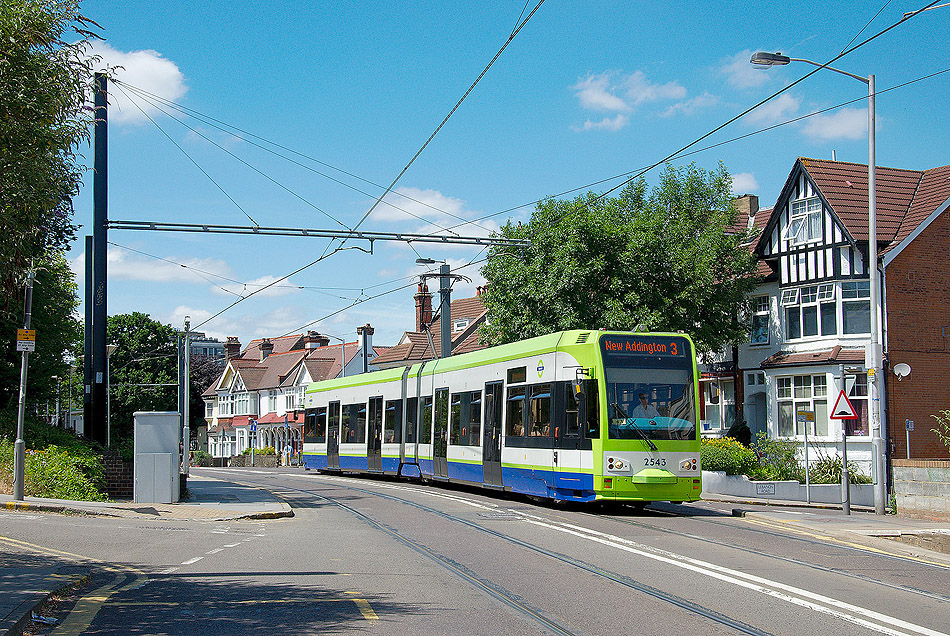
Tramlink currently has a fleet of 24 Bombardier CR4000 trams supplied for the opening of the 28 km network in 2000, of which 22 are required in traffic each day. These cars are maintained under contract by the supplier, which also has the right to bid to maintain any extra vehicles. However the supplier of the additional cars may be invited to submit a proposal for the provision of maintenance.
The contract will be awarded through a negotiated procedure. Applications to pre-qualify are due to be submitted by mid-day on February 21. A final deal is subject to funding, with the London Borough of Croydon intending to contribute to the cost.
Tramlink services have remained relatively static at between 2·4 and 2·7 million km per year since the opening, however annual passenger journeys have increased by 45% and are predicted to reach 27·8 million by the end of 2010-11.
As predicted, the South Fraser municipality of Delta is mulling over the proposal to leave TransLink. Delta is the first, but if TransLink doesn't change its current very expensive metro only policy, then providing second rate transit services for customers, then more South Fraser municipalities will contemplate leaving.
If TransLink stopped being devious and actually told the truth about transit planning like; "don't blame us, we were forced to build the RAV/Canada Line by the provincial Liberal government and they are also forcing us to say it is successful."
Speaking to the RAV/Canada Line, the truncated metro line's maximum capacity is less than modern light rail, so what does TransLink do…..admit the truth? No, no, telling the truth would be too embarrassing, so what TransLink has done has arbitrarily lowered the the capacity of light rail to 10,000 persons per hour per direction……….one half the internationally accepted capacity of 20,000 pphpd for LRT!
TransLink can't last much longer, the bureaucratically top-heavy organization is slowly suffocating under massive debt, which translates into ever higher taxes to fund it. It's time for the municipality of Delta to say adiós to TransLink, in fact it time the entire South Fraser region says adiós to to TransLink!
TransLink is like the Titanic, steaming full speed into a (financial) iceberg.
Politicians talking about a split from TransLink
Upset they've become a funding source for projects elsewhere, south of Fraser officials could form own entity
By Sandor Gyarmati, The Delta Optimist
January 29, 2011
It might be time for the communities south of the Fraser River to consider splitting from TransLink and forming their own transit authority.
That suggestion came up during Delta council's discussion this week on TransLink's funding proposals, which have drawn the ire of local politicians and bureaucrats who say they provide nothing for the community other than taking even more money out of taxpayers' pockets.
"This isn't a plan, it's a way to finance major construction projects, and bear in mind there's no improvements for south of the Fraser," said CAO George Harvie.
"There is no hope on the horizon for TransLink to improve our bus service and it's very sad."
Harvie pointed out that in the last couple of months service hours in Delta and other communities south of the Fraser were trimmed.
Metro Vancouver's board of directors last December was to have voted on TransLink's request to raise property taxes to fund the $1.4-billion SkyTrain line into Coquitlam, but provincial Transportation Minister Shirley Bond granted an extension.
The Evergreen Line is part of two options TransLink put forward for the regional district to consider, but both rely on increasing property taxes, which drew an immediate negative response from mayors.
"The mayors' committee has not approved any money from property taxes. There must be a better formula," said Mayor Lois Jackson, who chairs the Metro board.
Her council colleague Robert Campbell said he finds it astounding TransLink doesn't seem to bother exploring transit financing models around the world that appear to be successful.
According to Delta staff, one of the TransLink packages would result in an average property tax increase of $36, while the second would see an increase of $62. Neither is acceptable to council, which voted not to support TransLink's supplemental plans.
"It's obvious to the other city administrators the south of the Fraser is being used to finance the debt of the north," said Harvie.
He said communities in the south might have enough in place to start their own transit system, which could be integrated to TransLink.
Jackson agreed, saying TransLink could then focus on its own territory in the north.
Harvie said it's especially frustrating that TransLink immediately dismisses the notion of light rail south of the Fraser River.
Coun. Bruce McDonald, who sits on the South Fraser Community Rail Task Force, said it doesn't make sense why the transportation authority doesn't want to even look at reusing the old interurban line, which was discontinued for passengers in the early 1950s, even though no costly property expropriations would be required.
"In my view, the TransLink board is so Vancouver and Burnaby/New Westminster-centric that everything they do is focused there. Surrey is actually putting the interurban line in their official community plan but they (TransLink) are ignoring it," he said.
Coun. Anne Peterson received concurrence for her suggestion governments in the south need to band together for a coordinated voice on transit issues.
In a letter to the mayors last November, TransLink board chair Dale Parker noted the recommended funding option for a supplemental increase would add over 425,000 hours of annual transit service to bus routes. Parker stated the South of the Fraser region would receive half of the additional bus service hours.
A Delta staff report, though, found TransLink is not planning any major changes to transit networks in Delta as it expects minimal future development.






Recent Comments