The Light Rail Committee Sends a Message
The Light Rail Committee sent the following letter to all municipal governments in the lower mainland, to inform municipal politicians about upcoming transit funding discussions by the mayors council, with Transportation Minister Shirley Bond for the Evergreen Line. One wishes that Mayor Walton tell Minister Bond to "take a powder", and "if the provincial government wants more SkyTrain construction, let the provincial government pay for it!"
Mayor and Council;
In late January, the regional mayors council chair Richard Walton will meet transportation minister Shirley Bond in late January to try to determine how Metro Vancouver's should pay their share of the Evergreen Line and broader transit expansion. It is now time to rethink how we plan transit and what kind of transit should be built.
The Evergreen Line is a $1.4 billion plus, 11 kilometre extension to the Millennium Line, that has more than funding problems, the entire plan for the Millennium Line is nothing more than a sham as TransLink has deliberately skewed planning to favour the dated SkyTrain light-metro system. Vancouver is the only city in North America and Europe uses the proprietary SkyTrain light-metro system for regional transportation, while at the same time rejecting LRT, which is the transit mode of choice by international transit experts.
In 2008, noted American transit expert Gerald Fox in a letter to a Victoria transportation group, shredded TransLink's Evergreen Line business case, stating; "I found several instances where the analysis had made assumptions that were inaccurate, or had been manipulated to make the case for SkyTrain. If the underlying assumptions are inaccurate, the conclusions may be so too." Fox later said; It is interesting how TransLink has used this cunning method of manipulating analysis to justify SkyTrain in corridor after corridor, and has thus succeeded in keeping its proprietary rail system expanding. In the US, all new transit projects that seek federal support are now subjected to scrutiny by a panel of transit peers, selected and monitored by the federal government, to ensure that projects are analyzed honestly, and the taxpayers’ interests are protected. No SkyTrain project has ever passed this scrutiny in the US."
This is hardly reassuring for the taxpayer who will be soon asked to ante up more money for the Evergreen Line.
The following is a brief and internationally accepted descriptions of transit mode:
- Light-metro – A small metro system, mostly automated (driverless), and operating on segregated rights-of-ways that found flavour with transit planners in the 1970's and early 80's. Largely made obsolete by modern light rail; light metro was supposed to bridge the gap from what old streetcars could carry and that of a heavy-rail metro.
- Streetcar or tram – A steel wheel on steel rail vehicle that operates on-street, in mixed traffic with little or no priority signaling at intersections. Somewhat faster than a bus, a modern tram or streetcar has vehicle capacities as large as 350 persons per car and can easily handle passenger traffic flows up to 20,000 persons per hour per direction.
- Light Rail or LRT – Is a streetcar or tram, that operates articulated vehicles on a reserved rights-of-ways or routes that are for the exclusive use for the tram. Modern LRT has a practical capacity of between 2,000 persons per hour per direction and 20,000 pphpd, thus at a stroke made light-metro obsolete by providing the same quality of service at a far lower costs. The adaptability of LRT is such that some European tram/LRT operations now carry over 30,000 pphpd on selected routes including simple streetcar routes!
- TramTrain – A streetcar or tram that is able to operate safely on mainline railway tracks, track-sharing with regular trains.
- BRT or bus rapid transit – A limited stop express bus service, that is guided by rail or curb or has the exclusive use of a busway.
It is clear that regional politicians and the public have been mislead by TransLink about the capabilities of modern light rail as regional transit bureaucrats continually plan for much more expensive SkyTrain light-metro, while at the same time deliberately planning LRT to be inferior to SkyTrain. This is tantamount to professional misconduct on the part of TransLink and the TransLink Board!
In 2009, the Rail for the Valley group, engaged Leewood Projects from the UK, for an unbiased report for a TramTrain operation on the BC Electric (now Southern Railway of BC) old interurban route, which carries two to three freight trains a day. TramTrain was selected because the geometry of the track was designed for short wheelbase interurbans and not longer and more unstable (on curves) commuter train cars such as the West Coast Express.
The result of the RftV/Leewood report were several options in providing TramTrain service to the Fraser Valley.
- Option 1: Diesel LRT from Scott Road to Chilliwack – $491,819, 424.00 or $5.02 million/km.
- Option 2: Electrification of Scott Road to Chilliwack – $114, 700,000.00 or $6.2 million/km.
- Option 3: Richmond/Vancouver to Rosedale – $998,519, 424.00 or $7.2 million/km.
It must be noted that the cost of a 'full build', 138 km. Vancouver/Richmond to Rosedale TramTrain costs $400 million less than the proposed $1.4 billion, 11 km., Evergreen Line. Thus it can be said for the cost of the $1.4 billion Evergreen Line, the region could build a Vancouver/Richmond to Rosedale TramTrain service, plus a Vancouver to Maple ridge TramTrain service that would include the Port Moody and the two Coquitlams.
It is strange indeed that TransLink strictly adheres to the SkyTrain and light-metro operating philosophies, despite the fact that to date, modern LRT in its various forms is cheaper to build than SkyTrain; cheaper to operate than SkyTrain; safer to operate than SkyTrain; can carry more customers than SkyTrain.
I strongly urge council members to reject forcing the taxpayer to spend any more money on TransLink's pie in the sky metro planning and compel TransLink to plan for proven and affordable transit for the 21st century, as citizens have grown weary paying ever escalating taxes for politically prestigious transit mega-projects that have done little to reduce auto congestion, pollution and/or provide an adequate transportation alternative to the car.
Who is not afraid to bell the cat?
Addendum
Light Rail Transit Association
www.lrta.org
RftV/Leewood Study
http://www.railforthevalley.com/studies/
The Gerald fox Letter
http://railforthevalley.wordpress.com/2008/12/26/can-translinks-business-cases-be-trusted/

Light rail that works
CALGARYai??i?? From Saturday’s Globe and Mail
by Marcus Gee
Mayor Rob Ford has left no confusion about how he feels about light-rail transit. One of his first acts as mayor was to declare the death of Transit City, a multibillion-dollar plan for a network of above-ground transit lines.
Listening to Mr. Ford, you might get the impression that LRT is a crazy scheme cooked up by his predecessor, David Miller, to frustrate motorists. In fact, light-rail systems operate in dozens of cities, from Portland and Phoenix to Salzburg and Toulouse. One of the more successful is right here in Canada.
Calgaryai??i??s C-Train, which celebrates its 30th anniversary this year, is the second busiest LRT in North America, outdone only by a system in Monterrey, Mexico. It carries 270,000 people on the average weekday, half of all Calgary transit riders.
Since the first line opened in May, 1981, it has grown to three lines with 38 stations. A fourth line heading west from downtown is under construction, and two more are planned for the future. The expansion would eventually add 45 stations, creating a network of six spokes from the downtown hub. The annual number of riders has more than doubled over the past decade to 75.8 million, far outpacing the growth in the cityai??i??s population. The C-Train is so heavily used that the city is rebuilding stations to accommodate longer trains.
To get the most track for the money in hand, Calgary built a no-frills system with simple station platforms, cheap cars, no air-conditioning and station-arrival announcements recorded on cassette tape. Without the cost of tunnelling and building underground stations, the city managed to reach far into the cityai??i??s south, northeast and northwest.
Even the relatively extravagant West Line, which will include elevated track and the cityai??i??s first subway station, is projected to cost $1-billion for eight kilometres of track. By comparison, Mr. Fordai??i??s plan to extend Torontoai??i??s Sheppard subway eight kilometres to Scarborough is projected at $3.6-billion, not including $500-million for a new train yard.
ai???Our experience out here in Calgary is that it actually works very, very well,ai??? says Calgary Mayor Naheed Nenshi when asked about Mr. Fordai??i??s plan to kill LRT. ai???I think sometimes people are a bit scared of it because they think itai??i??s like streetcars running in traffic. But if itai??i??s done well it can work brilliantly at a fraction of the cost of going underground.ai???
Critics such as Mr. Ford like to say that in a cold winter like Torontoai??i??s, underground rail makes much more sense than LRT lines exposed to the snow and cold. Calgary has snow and cold. The LRT still runs. So does the LRT in still-colder Edmonton.
Critics also say itai??i??s folly to build rail lines on low-density suburban routes like Sheppard, Finch and Eglinton, as envisioned in the Transit City plan. Calgaryai??i??s C-train goes through even less-dense terrain, passing sprawling subdivisions and malls. People take the bus or drive their cars to LRT stations, then ride it to jobs in downtown office towers. Nearly half of all downtown workers arrive by C-Train.Ai??
To be fair, Calgaryai??i??s LRT differs from what was planned under Transit City. Unlike Toronto, with its scandalously haphazard, stop-and-start approach to transit expansion, Calgary planned its LRT rollout years, even decades, in advance. It restricted the number of parking spots downtown, driving up parking rates and encouraging people to take transit. It reserved segregated corridors for LRT lines so they could be kept apart from traffic. C-train routes follow railway rights-of-way or broad highway medians, with trains given priority whenever road and track intersect. Toronto would have to carve out new medians on streets such as Sheppard, leaving less space for traffic.
Mr. Nenshi himself says that LRT is not the be all and end all. In some parts of Calgary, he argues, it might make more sense to put in segregated bus ways than to lay down expensive LRT track. In the same way, though, in some parts of Toronto it might be better to put in light rail than to spend a fortune on underground subway track.
It depends on the situation. What is wrong is to dismiss any mode of transit out of hand without considering how it actually works elsewhere. Before the mayor buries Torontoai??i??s light-rail plans and splurges on a subway, he might want to look at Calgaryai??i??s C-Train success story.

Proposal for Light Rail in Copenhagen
The Danish Minister of Transport Hans Christian Schmidt will promote a light rail system using the bypass road Ring 3 west to Copenhagen:Ai??Ai??
http://www.dr.dk/Nyheder/Indland/2011/01/20/220647.htm
Ai??
The Light Rail line will pass through ten municipalities, and is estimated to cost DEK 1,5Ai??billion [CAD$273 million]. From Lundtofte, south to IshA?j by the coast and then via Kgs, Lyngby, Buddinge, Gladsaxe and Glostrup.
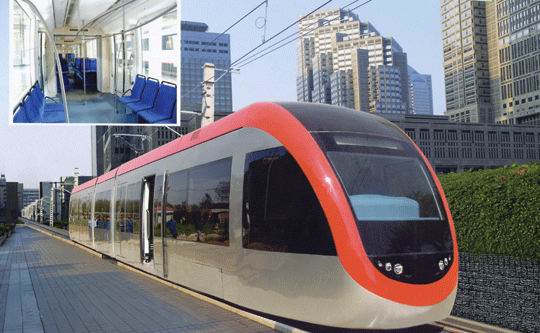
Detailed proposals:-
http://www.letbaner.dk/docs/Radiallinie-folder3.3-uk.pdf
and
http://orbit.dtu.dk/getResource?recordId=190793&objectId=1&versionId=1
virtual tram ride
Grand plan to bring tram system to Chester
ChesterFirstAi??
MAJOR plans to extend a tram network from Manchester to Chester will be presented to the government tomorrow.
Think tank Trams UK will recommend at the House of Commons that the Greater Manchester Passenger Transport Executive (GMPTE) light rail system, the Manchester Metrolink, should reach all the way to the city.

Manchester Metrolink Bombardier M500 Flexity Swift
http://www.metrolink.co.uk/pdf/future_metrolink/latest_news_publicatios/New-Trams-Factsheet.pdf
The organisation hope that the government will give the green light to local plans to extend the light rail network throughout Cheshire and Warrington, creating a web to link between businesses and residents.
The Leader announced on Thursday that Cheshire East Council had aspirations for light rail links, which were supported by Cheshire West and Chester Council.
The light rails, which are different to trams, can run across both light rail and existing heavy rail lines and are powered by and also generate electricity.
James Harkins, managing director of Light Rail UK, said that the ai???greener more efficientai??? mode of transport would be of ai???huge benefitai??? to both the environment and peopleai??i??s pockets.
He added that light rail would cut the fastest train time from Manchester to Chester from an hour an seven minutes on Northern Rail, by about 10 minutes.
Mr Harkins said: ai???It is a lot greener than heavy rail and it certainly ticks all the boxes environmentally. The prices depend on policy set by the operator and the local authority. But like tram and light rail systems across Europe, passengers can have one card to use across all networks. In theory it should be a lot cheaper and quicker.”
The proposals have been backed by the All Party Parliamentary Light Rail Group, who aim to push for sustainable transport.
In the House of Commons tomorrow, MPs who help to form the group will give their representations on the plans, which have been created after a study by think tank UK trams.
Mr Harkins said: ai???The main aim is to target car users who travel between the areas. We hope that by putting in a light rail network we can get about 30 to 35 per cent of people out of their cars. We are not competing with heavy rail trains, we see it as a service enhancement.”
If given the go-ahead a light rail system could be implemented across western Cheshire and run as far as Daresbury, St Helens, Stockport and Warrington.
Like other parts of the network, the trams would run on a railway line between Altrincham and Chester.
Outline plans to transform the Runcorn Bus Way into a light rail line, running over a double deck underneath the Runcorn Bridge across the Mersey, will also be presented.
Following in the footsteps of European cities such as Vienna, Stockholm and Dresden, the system could eventually be used for cargo trams.
Hybrid tram goes live in US city
http://www.independent.co.uk/travel/news-and-advice/hybrid-tram-goes-live-in-us-city-2191448.html
The world has hybrid cars, hybrid buses and even hybrid boats – and now it has a hybrid tram (streetcar), unveiled this week in a US city.
The patriotically-named “ameriTRAM” was actually built by a subsidiary of Japanese firm The Kinki Sharyo Co and began trundling along the streets of Charlotte, North Carolina January 20, powered by electricity and a rechargeable lithium-ion battery.Ai??
It’s the first prototype of a design that Kinkisharyo International believes could help widen the appeal of electric trams, which normally need overhead power (known as “catenary”) cables constructed along the route to power them.Ai??

Thanks to its lithium-ion batteries and regenerative braking, the ameriTRAM can manage around eight kilometres of catenary-free operation before it needs to be charged again, making it suitable for areas where cables would be unsightly or unpopular.
Kinkisharyo estimates that authorities can save themselves $1 – $2 million for every mile of cabling avoided, as well as the associated savings gained through reducing energy usage.Ai??
Finding a green way to power trams without adding the “visual pollution” of powerlines has proved tricky for local authorities and transportation manufacturers, both keen to reduce dependence on fossil fuels.
In 2009, transportation firm Bombardier unveiled its first catenary-free tram, which used inducted energy (similar to that used in electric toothbrushes) to power trams wirelessly.Ai??
The German city of Augsburg was selected host a pilot project last year, with 0.8 km of track being fitted with the new system.
TRAMTRAIN: THE 2ND GENERATION
NEW CRITERIA FOR THE 'IDEAL TRAMTRAIN CITY'
http://www.lightrail.nl/TramTrain/tramtrain.htm

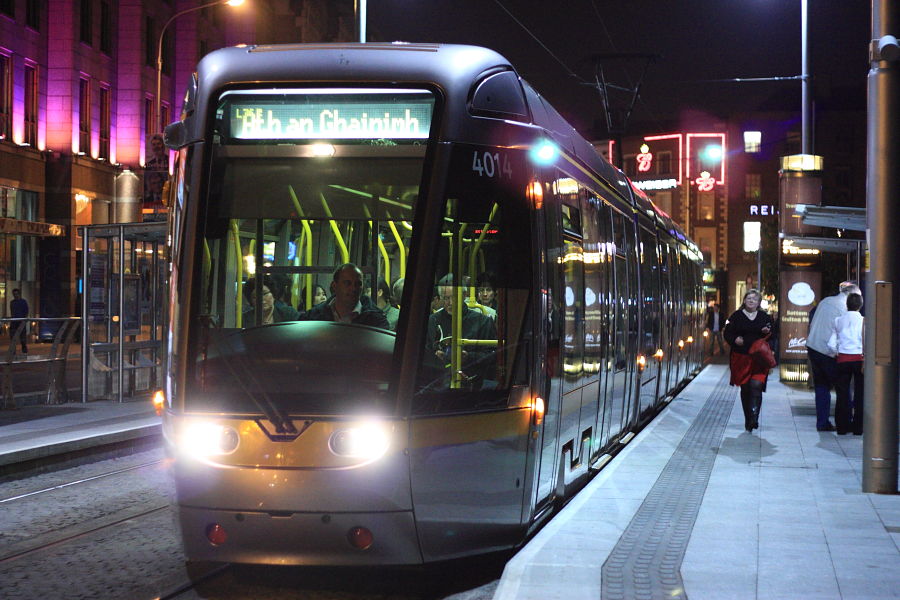
Irish Light Rail [LUAS] update
Luas Citywest Construction Update No.6
Work Progress
http://www.rpa.ie/en/projects/luas_citywest/construction/Pages/default.aspx
Luas Citywest (Luas A1) Extension
http://www.rpa.ie/en/projects/luas_citywest/Pages/default.aspx
Luas Cherrywood (Luas B1) Extension
http://www.rpa.ie/en/projects/luas_cherrywood/Pages/default.aspx
Hudson-Bergen Light Rail Extension
BAYONNE AND BEYOND
Background
 |
Hudson-Bergen Light Rail (HBLR) is a vital light rail connection that links the growing cities of the Hudson River waterfront. HBLR serves the high-density commercial and residential centers in Jersey City and Hoboken and connects to ferries, PATH, and commuter rail. Beginning in Bayonne, the operating corridor extends through some of the nation’s most densely populated municipalities, a region noted for significant dependence on transit. New, 70 percent low-floor, electric-powered light rail vehicles are already serving the waterfront towns of Jersey City, Hoboken, Bayonne and Weehawken and will soon reach North Bergen and Union City. Traveling both on city streets and along separate rights of way, HBLR is the first public transit project in the nation to use the Design, Build, Operate and Maintain (DBOM) construction methodology. In September 2000, NJ TRANSIT was awarded the American Public Transportation Association’s prestigious “Innovation Award” for use of the DBOM methodology. Click here to view a map of the system . |
Project Scope
HBLR is being realized in distinct segments. The first Minimum Operating Segment (MOS1) runs from 34th Street, Bayonne, to Hoboken Terminal. MOS2 runs from Hoboken Terminal to Tonnelle Avenue Park-N-Ride in North Bergen and also extends to 22nd St. in Bayonne.

Project Cost
MOS1: $992 million;
MOS2: $1.2 billion;
The project is funded by the FTA and the State of New Jersey. NJ TRANSIT has secured Full Funding Grant Agreements with FTA to fund 61 percent of the cost of MOS1 and 41 percent of the cost of MOS2.
Current Status
The first portion of MOS1 from Bayonne opened to Exchange Place in April 2000, and to Newport Mall in November 2000. Construction of MOS1 to Hoboken was completed in September 2002. Bayonne’s 22nd Street Station, the first of seven MOS2 stations, opened in November 2003. Service to Lincoln Harbor in Weehawken opened in September of 2004. MOS 2 was completed to Tonnelle Avenue on February 25, 2006.
Benefits
Hudson-Bergen Light Rail provides public transit service to the towns along the Hudson waterfront. The project supports the significant economic development that has taken place in this region of the state.
http://world.nycsubway.org/us/hudson-bergen/
Streetcar Named Swing:Object of Desire
The Warsaw Voice
http://www.warsawvoice.pl/WVpageTest/pages/article.php/22661/article#
Swing trams manufactured by the PESA rolling stock company in the northern city of Bydgoszcz have a chance to become a flagship Polish export. The trams stole the show at the recent InnoTrans trade fair for rail transport technology in Berlin, according to Polish free daily newspaper Metro. The trams attracted huge interest not only from experts and transport companies but also local governments responsible for buying means of public transportation for their cities.

PESA has signed its first foreign contractai??i??for the delivery of nine trams to the Hungarian city of Szeged. The trams, to be called Csardas, will be delivered by September next year. There is every indication that another Hungarian city will order Swing trams from PESA. Two Turkish cities are also seriously interested in buying them.
The Swing is a wheelchair-accessible air-conditioned tram with many modern features for higher travel comfort and easier maintenance work. Travel comfort is ensured by a two-level spring suspension system. The driverai??i??s cabin is ergonomic and ensures comfortable working conditions while the online diagnostics system makes it possible to monitor the fleetai??i??s work in real time. Thanks to its modular design, the tram may be configured to meet the customerai??i??s specific requirements. Depending on the operatorai??i??s transport needs, PESA offers trams composed of three, five or seven sections, including a bi-directional version. The trams can run on tracks with a gauge of 1,435 and 1,000 millimeters.
The Swings have already gained popularity on the Polish market. Last year, PESA won the largest contract on the European tram marketai??i??for the delivery of 186 trams for Warsaw. Thirty-three Swing trams are expected to be delivered to the city by the end of the year. Their number will rise to 120 by the time the Euro 2012 soccer tournament begins in Poland. The coastal city of GdaAi??ai??zsk has also ordered 35 Swing trams.
Braunschweig Tram-Train Scheme, Germany
railway-technology.com
The website for the railway industry
http://www.railway-technology.com/projects/braunschweig/
RSB interest groups signed a letter of intent in September 2008, with construction to start during 2009. The current main rail interests are DB’s regional train operations (DB Regio) and infrastructure (DB Netz) arms, and the city transport organisation Braunschweiger Verkehrs AG.
Project aims include upgrading the present facilities, improving accessibility and increasing the number of services. The main roads around Braunschweig are known for their traffic congestion, and the RSB could offset this by making rail journeys more feasible.
The RSB will be formed mainly on a north-south axis, with the northern limit at Uelzen – 80km (50 miles) north of Braunschweig – providing an interchange with the Hamburg-Hannover main line.
The southwards line will branch at WolfenbA?ttel; southwestwards, the line will stop at several stations on the way to Salzgitter, while the southeastern arm will connect Goslar, Bad Harzburg and SchAi??ppenstedt.
Funding for the project was finalised in July 2009. Planning and construction is estimated at ai??i??232.5m, of which ai??i??197.4m was allocated to modernisation and the construction of railway tracks, stations and planned stops. The contributors are the federal (60%) and Niedersachsen (22.5%) governments, administration union (7.5%) and the affected municipalities, cities and counties (10%).
Project planning costs amounted to ai??i??35.1m. This was chiefly financed by Greater Brunswick Zweckverband ($30.1m), with the remainder coming from the affected cities and municipalities.
Infrastructure
Braunschweig trams use an unusual 1,100mm gauge, while the national rail network uses the standard 1,435mm gauge.
Three rail sections have been created as part of other works, well in advance of the commitment being made to start work on this project. These include the large combined bus and tram stop at Berliner Platz in front of Braunschweig Hauptbahnhof (the central station). This stop will have much higher frequency levels than at present, being on the core section which would accommodate all four RSB routes in the initial scheme.
South of Braunschweig city centre, a link between heavy rail and tram tracks will be installed just to the west of the main station. The other will involve use of an industrial siding for Braunschweig Nordbahnhof, a through station that will also be a terminus for two routes extending south of the city. New trackwork will also be needed in western Salzgitter.
The majority of the proposed 185km (116-mile), four-route RSB will service 63 stations (some new) and would mainly use existing DB Netz heavy rail tracks, currently covered by a mix of regional train types.
The first stage involves construction of the four lines – S1, S2, S3 and S10:
- Line S1 will connect Uelzen to Bad Harzburg via Braunschweig (city centre).
- Line S2 will connect Braunschweig north station to SchAi??ppenstedt via Braunschweig (city centre).
- Line S3 starts from Braunschweig north station, connecting Braunschweig (city centre), Salzgitter Thiede, Salzgitter town centre gate and Salzgitter-Fredenberg.
- Line S10 will start from Sitting Castle Triangle and connects GIF horn (city centre), Braunschweig (city centre), Wolfenbuttel-Vienenburg and Goslar.
Rolling stock
Dual-system vehicles capable of operating on main lines and tram tracks as well as under their respective control systems will be required. Unlike the fully electrified pioneer among German tram-train operations at Karlsruhe that began two-system track sharing in September 1992, as unwired DB tracks would be involved for the RSB, units with diesel power will be needed.
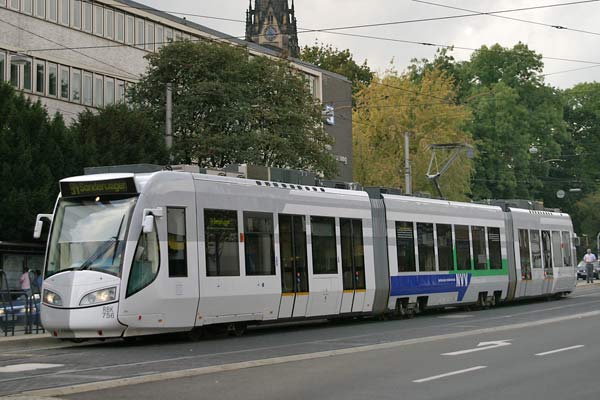
The Alstom Regio Citadis appears to be a strong candidate
Featuring in promotional materials for the RSB project, a strong candidate appears to be the Alstom Regio Citadis, an Alstom Deutschland product from Salzgitter (also on the proposed RSB network), location of the former Linke-Hoffman-Busch plant. An established specialist in regional and urban rail vehicles, Linke-Hoffman-Busch has previously supplied trams to Braunschweig.
Two variants of the three-section Alstom Regio Citadis ai??i?? the 15kV DC/750V AC and diesel/750V AC – are the basis of the Kassel tram-train system in the neighbouring state of Hessen that became fully operational in 2007. Procurement of vehicles for the RSB was not part of the late 2008 announcement.
Signalling and communications
Tram signals and light-of-sight principles apply on the Braunschweig tramway, but elsewhere they run under DB Netz signalling. The RSB would become part of the integrated ticketing arrangements of the individual communities and the region.
The future
Construction was expected to begin during late 2009 with a target start of services in 2012, but due to political reasons, the start of services has now been postponed to 2014.
The construction schedule is also yet to be announced. The potential exists for more of the Braunschweig region’s lines to be incorporated in the RSB. Supporters of the scheme in Wolfsburg, 33km (21 miles) north-east of Braunschweig are seeking to have the project extended to their city at an early stage.



Recent Comments