Bergen Bybanen extension blasts off
11 January 2011
Railway Gazette
http://www.railwaygazette.com/nc/news/single-view/view/bergen-bybanen-extension-blasts-off.html

Bergen Stadler Variobahn Tram
NORWAY: A blast of dynamite at midday on January 7 triggered the official start of work on a NKr1·4bn project to expand Bergen’s Bybanen light rail line. The ceremony was attended by the chairman of Hordaland County Council Torill Selsvold Nyborg, Commissioner Lisbeth Iversen, local politicians and dignitaries.
Construction of the 3·6 km extension from Nesttun to Lagunen via Fanavegen and Skjold is expected to take two years. Contracts worth NKr360m were awarded to Norwegian contracting group Mesta in December for work on two sections of route totalling 3·1 km. Testing is due to start in late 2012 with opening envisaged in summer 2013.
The project is being financed with funds from Hordaland Council and revenue from the local road toll. The extension will serve residential and business areas south of the city as well as Lagunen shopping centre, where car parking facilities will be provided.
The initial 9·8 km line between Bergen city centre and Nesttun was opened by Queen Sonja on June 22 2010. A further extension to Flesland is also planned.
Long-awaited tram system for Tampere (Finland) is under consideration
Residents are now being polled on their route preferences
|
|
||
|


The construction of a light rail system for Tampere has been discussed for decades.
It has finally been decided that the construction of tracks could commence in 2015, provided that the city can reach a binding political decision on the necessity of the system.
On the other hand, the City of Tampere is also calling for a state subsidy for the project.
The tram system that will possibly be set up in Tampere in the next few years would in some places run through very narrow streets, including the city centre and for example Pispalanharju, the residential district on the Pispala ridge.
The construction of the planned tram system would call for a reduction in the number of cars particularly on Hämeenkatu, the main street of Tampere.
On Thursday, the City of Tampere presented preliminary route alternatives for a tram system that would run between the districts of Hervanta and Lentävänniemi, asking all potential passengers to give their opinions online about the alternative routes.
The residents may say along which roads and streets and through which districts they would like the planned trams to run.
The civil servants even promised that the results of the survey would weigh a great deal in the final decision-making.
”The results of the survey will be significant, even if this is not an actual referendum. We are just asking advice for our planning”, says Manager Mika Periviita of Tampere City Public Transport.
If the project materialises and Tampere does get its own tram system, it would be a little longer and faster than that in Helsinki. The stops would be further apart and the trams would run at a frequency of every five minutes.
”The targeted speed would be more than 20 km/h, compared with Helsinki’s 13 km/h”, Periviita notes.
In Helsinki, the tram network is in some places more than 100 years old.
In Tampere, most of the network could be built in more open areas, meaning for instance that tight curves and hills could be avoided. The plan is to get some expertise for example from Switzerland.
Quite a lot of details in the tram project still remain open. Moreover, the project has also been opposed, as some people have regarded buses as an adequate mode of public transport in proportion to Tampere’s size.
For the route survey, see Tampereen kaupunkiraitiotie (only in Finnish) at http://www.tampere.fi/liikennejakadut/projektit/kaupunkiraitiotie.html.
At present, only Helsinki has a working tram network.
Previously there were trams in Turku (horsedrawn from 1890-1902, and an electric tram service that was terminated in 1972) and in the city of Vyborg, formerly Viipuri in Finnish, where the Soviets eventually pulled up the tracks in 1957.
Turku has also considered a return to a light rail system for local transport.
"Sinners always have a future, saints always have a past." – Oscar Wilde
European Light Rail news
Light Rail/Tramways in France.
Four new Light Rail/Tramways are currently under contruction in France and are scheduled to be opened between 2011 and 2013.
The 11.2 km Reims Tramway – 2011
http://www.tramwaydereims.fr/start.html
A 12 km Tramway in Angers – 2012
http://tramway.angersloiremetropole.fr/
A 14.3 km Tramway in Brest – 2012
A two line, 20 km Tramway in Dijon – 2013
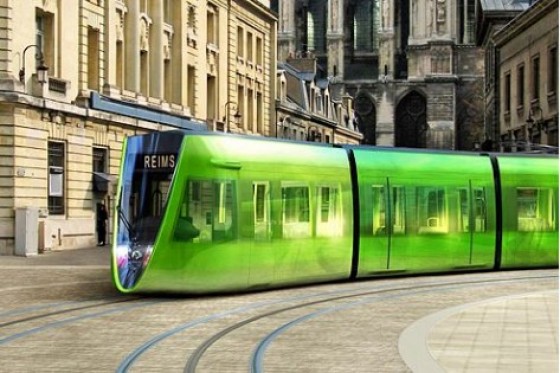
Reims Citadis 302
The four new systems along with the extensions opened in late 2010:-
Mulhouse Tram-Train Line 3
Toulouse Line T1
Strasbourg F Line
will bring the total number of Light Rail/Trams systems in France to 37
US Light Rail news
Summary from Trains News Wire:
Feds fund more streetcars and light rail
Published: January 21, 2011
WASHINGTON, D.C.
The Federal Transit Authority, a part of the U.S. Department of Transportation, announced that it had signed agreements to fund five rail transit projects on Friday. The grant includes funds for a unique light rail project in Detroit.
The projects include refinements and expansions of streetcar lines in Portland, Ore., and New Orleans; new modern streetcar services in Dallas and in Tucson, Ariz.; and a new light rail line for Detroit. Funds came from the Transportation Investment Generating Economic Recovery (TIGER) fund, part of the American Recovery & Reinvestment Act of 2009.
The project in Detroit is unique for its public-private partnership. Local and regional businesses have formed a consortium called M1 Rail, Inc., which will help fund and construct the line. The route consists of an initial 3.4 mile line with twelve stations located along Woodward Avenue. The street is notable in transportation history, being the first to be paved in concrete and the first street to utilize modern traffic signals. Eventually, the line is planned to reach 9.3 miles in length, connecting downtown Detroit to the Michigan State Fairgrounds.
Detroit
http://money.cnn.com/2010/02/15/smallbusiness/detroit_m1_light_rail/index.htm
New Orleans http://www.fta.dot.gov/news/news_events_12292.html
Tucson http://www.fta.dot.gov/news/news_events_12291.html
Dallas http://www.fta.dot.gov/news/news_events_12290.html
Portland http://www.fta.dot.gov/news/news_events_12289.html
Portland LRV
Last Weeks Snowfall Stalls The Canada Line Again!
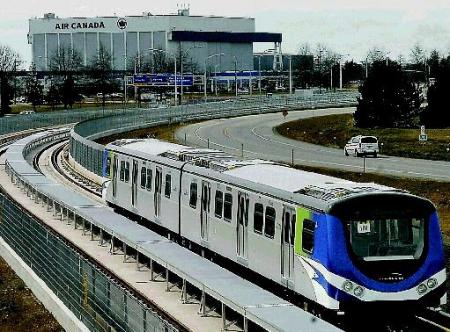
Not reported in the mainstream media is that a Canada Line Train stalled again during last weeks snow storm!
The timed out explanation, given by officials doesn't make sense, as we have a near new metro systems, operating on a totally segregated rights-of-way – what could possibly go wrong?
I'm sorry, but there seems to be a lot of gremlins affecting the Canada Line and one wonders, like the rest of the Canada Line which design was greatly truncated to reduce costs, that smaller motors were installed on the trains to again reduce costs?
Small motors + heavy traffic loads due to lengthy headways + snow = taking too long to respond to propulsion!
Snow crews focus on flood
Canada Line's late-night stall not weather related
By Alan Campbell, Richmond News – Jan. 14, 2011
The City of Richmond didn't wait until it was too late to react to Tuesday night's heavy snowfall.
Around 15 centimetres of snow fell over Tuesday into Wednesday, quickly turning into heavy slush as the mercury rose and drizzle kicked in.
But in a measured proactive effort, city teams were out in force early on Tuesday evening to prepare roads and access points for the expected conditions come the Wednesday morning commute.
The city declared a "stage 3" snow response at 1:30 p.m. on Tuesday, with more than five centimetres of snow forecast at the time.
City crews were out on Tuesday afternoon pre-treating first priority routes, community centres, fire halls and city hall. The pre-treatment was complete by 3 p.m. that day.
The city's snow removal fleet of 11 trucks, four backhoes, two bobcats and a holder (which is used to attend to pathways) was then prepared and on standby.
And the entire fleet was on the roads by 8 p.m. and worked throughout the evening, plowing first and second priority routes using 200-250 tonnes of salt.
By Wednesday morning, snow removal trucks were cleaning up some remaining areas and starting on third priority routes. At that point, the city turned its attention to preparing for the rain, melting snow and the potential for flooding.
At 7 a.m. Wednesday, the transition from snow removal to flood prevention began as 15 to 18 crews started clearing catch basins, gutters and storm inlets at pump stations.
A city press release said, "All efforts will be continued throughout the day and the situation will be reassessed this afternoon."
Unlike during the last heavy snowfall in November, the Canada Line experienced only one minor service interruption Wednesday morning, unrelated to the weather.
However, around midnight on Tuesday, passengers en route from Waterfront to Richmond had to be bussed over the river from Marine Drive station after a train stalled just before getting onto the Fraser River bridge.
Jason Chan, spokesman for the line's operators Protrans BC, said a train had "timed out" just before it entered the bridge.
"When a train takes too long to respond to propulsion, it times out and is unable to move," said Chan.
"There were a few people on board for a period of time." Chan added that the "timing out" was a rare occurrence.
The wife of a passenger trying to get home from work, said her husband was forced to get off the train at Marine Drive with no explanation of what was going on.
"There was no staff directing people, nothing," said Lisa Forrster.
Chan said that passengers on the stalled train were stranded for half an hour before a crew pulled the train back to a station.
Canada Line workers take a strike vote – Is The Driverless Myth About To Be Exposed? (Updated)

Well, well, well, the 180 control room workers, maintenance personnel and attendants for the Canada Line are taking a strike vote and TransLink is very worried. Since the SkyTrain light-metro was built over 30 years ago, the mainstream media and politicians sang in chorus that automatic metros were good because they did not need drivers and therefore were cheap to operate and impervious to strikes.
Ha, ha, ha!
What of course is true is that the automatic metro needs large control room with lots of operators and large maintenance staff to keep the 19 km., 16 station metro running. What happens if they go on strike?
The answer is simple, if there is a strike, there will be very limited management operation and the Canada Line would operate, but at reduced speed and capacity, for safety reasons. Then there is the question of liability for TransLink if an accident causing injury or death due to the strike and management only operation. The fact is, automatic transit systems are just as susceptible as light rail systems to strikes and if the Canada Line employees go on strike, it will explode another driverless metro myth, which seem all to common in Vancouver.
It is also interesting that this news article gives a hint to the number of people needed to operate the Canada Line, more than a comparable light rail line; you just do not flip a switch and the trains run by themselves.
Cardinal Fang comment if you wish!
Canada Line workers take a strike vote
By Frank Luba, The Province
A Fix for Fraser Valley Transit, or is the Fix In?
By Daniel van der Kroon, UFV Students for Sustainability
Original article can be viewed here:Ai??http://www.footprintpress.ca/2011/01/winter-2011-issue-of-the-footprint-press/


Light rail advocates take aim at province’s transit plan for Fraser Valley
Light rail advocates take aim at province’s transit plan for Fraser Valley
BY FRANK LUBA, THE PROVINCE JANUARY 11, 2011
A citizensA?ai??i??ai??? group from the Fraser Valley believe the provincial government is off track with its plan to provide public transit in the region with a rapid bus model.
Rail for the Valley recently completed a review of the provinceA?ai??i??ai???s analysis of the situation and came out with some stinging criticism Monday.
A?ai??i??Ai??The many errors in the data and conclusions of this report are simply too numerous to list,A?ai??i??A? said a release from the group, which nonetheless listed a few.
The group drew its criticisms from a pro-bono report provided by light rail builders Leewood Projects of Great Britain.
Leewood concluded a light rail service could be implemented from Chilliwack to the Scott Road SkyTrain station using the 98 kilometres of track that already exists.
While the provincial study looked at heavy rail similar to the West Coast Express, consultant David Cockle of Leewood looked at a less-costly light rail service.
Some double-tracking is required but the Leewood study indicated it wasnA?ai??i??ai???t required for the entire route.
The result was that the province estimated the rough cost of a train for the valley to be $18.6 million per kilometre compared to the Leewood total of $5 million per kilometre A?ai??i??ai??? including vehicles.
An earlier study by the city of Surrey pegged the cost at $6 million per kilometre.
Rail for the ValleyA?ai??i??ai???s release is also skeptical of the provinceA?ai??i??ai???s belief a bus service could attract three times the number of riders that would take a train A?ai??i??ai??? even if they were to run at the same frequency.
Group spokesman John Vissers is passionate about getting rail for the 250,000 people that live from Chilliwack to Langley.
A?ai??i??Ai??Light rail can serve far more people for far less money than any other system thatA?ai??i??ai???s been suggested to date,A?ai??i??A? said Vissers.
A?ai??i??Ai??IA?ai??i??ai???m not frustrated, IA?ai??i??ai???m disappointed that our provincial government didnA?ai??i??ai???t try a little bit hard to find out what are the needs and desires of the Fraser Valley,A?ai??i??A? he said.
VissersA?ai??i??ai??? group is going to try to poll Liberal leadership hopefuls for their opinion on the situation.
The full Leewood study is available on the Internet at www.railforthevalley.com.
fluba@theprovince.com
twitter.com/frankluba
Ai??Ai?? Copyright (c) The Province
via Light rail advocates take aim at province’s transit plan for Fraser Valley.
Rail folks find study biased in favour of rapid bus
Rail folks find study biased in favour of rapid bus
BY PAUL J. HENDERSON, THE TIMES JANUARY 11, 2011
The provincial government’s shelving of light rail from Chilliwack to Surrey in the long-awaited Fraser Valley Transit Study (FVTS) is “biased,” “misleading,” and full of “flaws and errors,” according to the Rail for the Valley advocacy group.
Proponents of the inter-urban rail line from Chilliwack to Surrey released an in-depth analysis of the FVTS on Monday. The FVTS was a long-awaited study by the Ministry of Transportation and Infrastructure to plan transit for the Fraser Valley for the next 25.
The FVTS, which was released in December, found that commuter rail services from Chilliwack to Surrey would cost too much to implement and operate and would not have the ridership needed.
Instead, the province has proposed an express bus services between Chilliwack and Abbotsford.
But John Buker, spokesperson for Rail for the Valley, said the FVTS puts projected boardings per day for daily interurban services between Chilliwack and Abbotsford at a maximum of 250 passengers. However, for equivalent express bus services 800 boardings is projected.
“By digging a little under the surface, one discovers shockingly that the report is actually assuming a regional bus service would attract more than triple the number of passengers of an equivalent light rail service,” Buker said.
Rail for the Valley (RFTV) hired a British light rail form, Leewood Projects, which concluded in a September 2010 report that “an Interurban passenger service could be achieved in the Fraser Valley at relatively low cost due to the already existing track, and recommended early implementation.”
The group said the ministry’s calculation of $18.6 million per kilometre for track repairs is based on heavy rail, not light rail, which would be closer to $5 million per kilometre.
“The ministry study is reactive ‘rubber tire’ planning that in fact promotes urban sprawl, while light rail encourages sustainable growth along the corridor and attracts new riders who choose to leave their cars at home or at a station,” RFTV said in a press release.
“The many errors in the data and conclusions of this report are simply too numerous to list. For the most part, the new study is exactly what was always expected, highly polished and designed simply to discredit light rail, and push Victoria’s agenda for rapid bus implementation for the Fraser Valley.”
Ai??Ai?? Copyright (c) Chilliwack Times
via Rail folks find study biased in favour of rapid bus.
Surrey Leader – Bus-boosting study stacked deck against Valley trains: critic
Bus-boosting study stacked deck against Valley trains: critic
Critics with Rail For The Valley say the province’s transit review concentrated on heavy rail service like the West Coast Express, rather than accurately costing out a modern light rail option.
By Jeff Nagel – BC Local News
Published: January 10, 2011 12:00 PM
Updated: January 10, 2011 1:00 PM
Advocates of a modern light rail line connecting the Fraser Valley from Surrey to Chilliwack say the province’s new study recommending expanded bus service never gave trains an honest chance.
Rail For The Valley founder Jon Buker accuses the transportation ministry-led study of “extreme bias” by using “grossly inflated” cost estimates to undermine the case for a light rail service running on the old Interurban corridor.
He said the study is what he expected A?ai??i??ai???Ai??Ai??one “designed simply to discredit light rail and push Victoria’s agenda for rapid bus implementation for the Fraser Valley.”
The Strategic Review of Transit in the Fraser Valley estimated it would cost $112 million a year to launch a 98-kilometre heavy rail commuter line A?ai??i??ai???Ai??Ai??akin to the West Coast Express A?ai??i??ai??? from Surrey to Chilliwack or $176 million annually for a light rail line that could serve more passengers.
It said the region instead needs a $90-million-a-year investment in local and regional buses that would promise frequent service every 15 minutes or less over a wide area and include express buses to haul people longer distances.
That would be a big jump from the $11 million a year currently spent on transit service in the Fraser Valley Regional District.
Buker said a key flaw in the study is it based all its rail costs on a West Coast Express-type heavy rail service, which requires significant double-tracking and other rail infrastructure upgrades, particularly in Surrey.
Consultants extrapolated the higher costs in that area throughout the route, he said, and then also used them in preparing the estimates for light rail, which wouldn’t require nearly as much upgrading.
The review found track upgrading costs would add up to $18.6 million per kilometre.
A study commissioned last year by Rail For The Valley and an earlier consultant’s report for the City of Surrey had both found a light rail service could be launched for much less A?ai??i??ai??? $5 to $6 million per kilometre A?ai??i??ai???Ai??Ai??on the existing tracks that once carried Interurban trams until the 1950s.
“A far more affordable system achieving the same basic level of service can be built,” he said.
Buker also contends the provincial study low-balled the number of passengers who would take trains and predicted three times as many people would use the proposed enhanced bus transit system.
“If the Fraser Valley can support hourly bus service, or even half-hourly bus service, it can also support light rail, whose operating costs over the lifetime of the vehicles tend to actually be lower, when all costs are taken into account,” he said.
Better bus service is a good idea, Buker said, but he noted just one per cent of Valley residents now take buses and improving ridership will require a “light rail backbone” across the region.
Critics of heavier West Coast Express-type trains say they tend to mainly serve commuters going to downtown Vancouver and fail to provide all-day regular service connecting local centres.
That’s an important distinction because 80 per cent of all Valley trips are by residents travelling in their own community, not making long commutes across the Lower Mainland.
Another key to usability is the number of stations on a rail line.
The province’s study analyzing the Interurban corridor assumed nine stations A?ai??i??ai???Ai??Ai??four in Surrey, three in Langley and just one each in Abbotsford and Chilliwack. Making more stops than that would increase trip times and deter passengers, consultants said.
Any improved transit study will need to be funded, it said, suggesting a local gas tax in the Fraser Valley Regional District as one option. Each cent of gas tax levied in the FVRD would generate $4.1 million per year, it said.
Metro Vancouverites pay 12 cents per litre to TransLink as well as a much higher level of property tax.
The FVRD population is projected to climb 70 per cent to more than 450,000 over the next two decades.
The report aims to quadruple Valley transit use from one to 4.1 per cent of trips by 2040.
via Surrey Leader – Bus-boosting study stacked deck against Valley trains: critic.



Recent Comments