Posted by zweisystem on January 12, 2011 · Leave a Comment
Answer: They can't plan for $1.4 Million a mile rail transit schemes, like what their European friends are doing!
The Valley Rail naysayers abound, but when faced with undisputable facts that light rail and/or its many variants can be built very cheaply indeed; much cheaper than $125 million/km SkyTrain or even $20 million/km highways, they resort to name calling and continue spreading tall tales about LRT.
The failure of regional, provincial, and federal politicians to grasp the fact that rail transit need not be that expensive to build and can be operated quite cheaply when it is built has cost the taxpayer dearly. One tires of their "driverless transit systems are cheaper to operate than LRT" rhetoric espoused by the SkyTrain Lobby and its many adherents, yet to date not one person from the SkyTrain Lobby has offered any comparison between SkyTrain and/or Canada Line operating costs and that of a comparable light rail line.
With the Peak Oil and Global Warming Crisis looming very large, the failure by politicos to invest in inexpensive rail transportation alternatives is nothing short than economic suicide!

"Haller Willem": Rail transit for 1.4 million $ per mile
In addition to a mainline connection, the German cities Bielefeld and Osnabrück are connected by a rural singletrack line, parts of which are quite curvy and steep. Reason for the unfavourable alignment are cost cutting attempts of the 19th century. The line touches the town of Halle, known to tennis fans for the Gerry Weber Open. It is named "Haller Willem", after an operator of team and coach, Wilhelm Struckemeyer, who had his business on this line before inauguration of the railroad in 1886, and was widely known for his humour and ~200 kg weight.
The line was built to lower standards than the mainlines around, and did not receive similar improvements towards higher speed and less labour. Until closure, barriers at level crossings were still cranked mechanically, using technology of the early 20th century. Due to the crewing requirements, the railroad tried to get rid of the line. The number of passenger trains was reduced below usefulness. In 1984, the rest of the passenger traffic was bustituted.
More precisely: one half of the "Haller Willem" was bustituted. Within the former West Germany, the state of Niedersachsen has the worst public transport system off the main routes. The abandonment of one half of the "Haller Willem", the part located in Niedersachsen, followed common traffic policy standards within that state.
Reopening day at Kloster Oesede station.
The other half of the route, Bielefeld – Dissen/Bad Rothenfelde, located in the state of Nordrhein-Westfalen, limped along with low amounts of traffic, but closure wasn't accepted. Instead, a contract protecting the line was signed by state and railroad, and in the late 1990s, a modernization project improved that part of the route to modern standards. Success followed quickly: While the passenger figure used to be 1500 per day, this changed to 3400 in 2004, and is increasing further.
Looking at the success of the neighbours, even the state of Niedersachsen finally decided in favour of reactivation – at a time, when small trees started to grow in the track. The reactivation project, Dissen/Bad Rothenfelde – Osnabrück, closed the gap between the state border and Osnabrück-Hörne, where this secondary track joins into a mainline. Part of the reactivation was modern, remote controlled or train operated signal and level crossing equipment, bringing the infrastructure operating costs down to modern standards as well.
As it is normal in Germany and several other EU countries, the trains aren't operated by the infrastructure owner. After bidding, and until 2013, the subsidy for operation was contracted to the Nordwestbahn, an operator owned by Connex and the cities of Osnabrück and Oldenburg. Unlike USA practice, the operator gets a fixed amount of money, unless penalized for not fulfilling the contracted quality standards. Subsidized operation does not outrule high profit or bankruptcy – despite the subsidy, success depends on performance.
Dissen/Bad Rothenfelde – Osnabrück-Hörne infrastructure project
| Length of reactivated track |
22.848 km |
| Line opened |
August 15th, 1886 |
| Closed for passenger traffic |
June 2nd, 1984 |
| Passenger train average speed, 1983 |
43 km/h |
| Trains per direction per day, 1983 |
4, 3 on weekends1 |
| Passengers per day, 1983 |
|
| Closed for freight traffic |
1991 |
| Track leased by VLO2 |
January 1st, 2000 |
| Lease timeframe |
30 years |
| Yearly lease |
1 DM (€ 0.51) |
| Total reactivation cost |
€ 16.3 million3 |
| Cost/km |
€ 0.71 million |
| State/federal funds |
80% |
| VLO funds, recovered from track access price |
20% |
| New rails + ties, ballast cleaning, some subgrade repairs |
€ 9.7 million |
| Cost/km |
€ 0.42 million |
| Max. axleload |
20t4 (44092 lbs) |
| Level crossings eliminated |
8 |
| Pedestrian crossings, set of railings |
4 |
| Level crossings upgraded |
23 |
| Level crossing improvements |
€ 3.4 million |
| Cost/crossing |
€ 148000 |
| Signal system/box, automatic train stop |
€ 0.9 million |
| Stations built, at old or new location |
5 |
| Of these, with passing track |
1 |
| Platform length |
110 m |
| Platform width |
3.5 m |
| Platform height |
76 cm |
| Average cost per station5 |
€ 100000 |
| Train timing Dissen – Osnabrück Hbf |
31 – 32 minutes |
| Bus timing Dissen – Osnabrück |
50 minutes |
| Line speed |
80 km/h |
| Average stop distance |
4.4 km |
| Average speed |
50 km/h |
| Weekday memory schedule |
Hourly, 18 train pairs |
| Saturday |
17 train pairs |
| Sunday |
11 train pairs |
| Forecast: Max. ridership with halfhourly traffic |
3600 / day |
| First weeks of operation |
800–900 / day |
| 4 months later |
1700 / day |
Posted by John Buker on January 11, 2011 · 2 Comments
Here is our media release:
Rail For the Valley completes Analysis of Fraser Valley Transit Study
After years of delays the B.C. Ministry of Transportation (MoT) recently released itsAi??Ai??
Fraser Valley Transit Study, which examined future transit options for the Fraser Valley. The study is the second major study to be released this fall, the first being theAi??Ai??
Leewood-Interurban Report. That study, performed by an experienced light rail firm, found an Interurban passenger service could be achieved in the Fraser Valley at relatively low cost due to the already existing track, and recommended early implementation.
Rail For the Valley founderAi??Ai??Dr. John Buker was outspoken about the new study:
“The Ministry of Transportation may have thought they could fool the media and public, but they still haven’t provided the promised study of a light rail system for the Fraser Valley. They have looked at a heavy rail model and excluded the critical regions of Surrey and Langley. As a result, most of their data on the Interurban is highly inaccurate and of little value. The Leewood-Interurban Report remains the only study of a Valley-wide light rail system, and the ministry’s dressed up report really doesn’t compare to it.”
The most critical flaw in the new Ministry report is that it draws largely on an older 2006 DRL Heavy Rail Commuter study for the majority of its rail data, including cost estimates. This is not at all surprising since BC lacks a light rail industry, and Provincial studies have relied on Heavy Rail consultants who are simply not qualified to undertake a major study of a light rail system. Rail For the Valley recently contacted the independent Light Rail FirmAi??Ai??
Leewood Projects of Great Britain for their professional opinion, and to quote:
“The 2006 DRL report has not considered light rail in its evidence, the rail option is very firmly based on the Heavy Rail/Heavy DMU mode.” -David Cockle, Leewood Projects Ltd.
The Ministry report extrapolates costs from the 2006 DRL Commuter Rail report to arrive at a rough capital cost estimate of $18.6 million/km for track repairs and upgrades needed for a light rail service.
- The DRL analysis on which these capital costs are based include extensive re-working, double-tracking and other elaborate expenditures on a small section of Interurban track in Surrey to make it suitable for a West Coast Express-style Heavy Rail service. The study crudely extrapolates this cost to the entire 98 km length of track, without any actual analysis of the track, and assumes falsely the light rail cost to be the same as the DRL estimate, resulting in a grossly inflated cost. The independentAi??Ai??Leewood-Interurban report of September 2010 in factAi??Ai??did perform a track analysis, and made it very clear the DRL options were unncessary for light rail and that a far more affordable system achieving the same basic level of service can be built. The Leewood report found capital costs for an Interurban light rail service would be about $5 million/km including vehicles, a quarter the cost assumed in the Ministry report. This is similar to an earlierAi??Ai??UMA Report by the City of Surrey estimate of $6 million/km.
- The capital cost of initially building the system was included in the annual cost analysis for Rail options as a yearly repayment amortized over 30 years. In contrast, road construction and maintenance costs are not included in the analysis of bus options, resulting in a completely misleading comparison between the two modes of transport.
- The total Capital cost of the entire project would be cost-shared by all three levels of government, with about a third of the cost shared by the affected municipalities (Delta, Surrey, Langley, Abbotsford, & Chilliwack). It is extremely misleading to compare theAi??Ai??total capital cost of the project without cost sharing to the annual Abbotsford-Chilliwack FVRD transit budget.
The report exhibits an extreme bias in making the case for ‘Express’ Buses over Light Rail.
A stark example of this bias: Projected boardings per day for daily Interurban service betweenAi??Ai??Abbotsford andAi??Ai??Chilliwack is put at a maximum ofAi??Ai??250 passengers. [6800 daily boardings for a hypothetical Chilliwack-Surrey Interurban service, minus 6550 boardings for the same shorter Abbotsford-Surrey service, gives an upper bound on the number of passengers travelling between Abbotsford and Chilliwack, Table 3.17, Foundation Paper #4]
However, when the report looks at the equivalent “Express Bus” service betweenAi??Ai??Abbotsford andAi??Ai??Chilliwack, with the same travel time (30 minutes) and the same frequency of service as the Rail service (30/60 minutes peak/off-peak), a very different number is arrived at:Ai??Ai??800 boardings. [Table 3.6, Foundation Paper #4]
Buker summed up the comparison:Ai??Ai??““By digging a little under the surface, one discovers shockingly that the report is actually assuming a regional bus service would attract more than triple the number of passengers of an equivalent light rail service. That’s more than a little hard to believe given that there are few cases where buses attract equal let alone greater ridership. If the Fraser Valley can support hourly bus service, or even half-hourly bus service, it can also support light rail, whose operating costs over the lifetime of the vehicles tend to actually be lower, when all costs are taken into account.”
While there are positive ideas presented of enhanced local bus service within the study, the hard truth is ridership will not be high enough to sustain these types of services without a light rail backbone,Ai??Ai??particularly in places where just 1% of the population uses bus transit. The Ministry study is reactive “rubber tire” planning that in fact promotes urban sprawl, while light rail encourages sustainable growth along the corridor and attracts new riders who choose to leave their cars at home or at a station.
The many errors in the data and conclusions of this report are simply too numerous to list. For the most part, the new study is exactly what was always expected, highly polished and designed simply to discredit light rail, and push Victoria’s agenda for rapid bus implementation for the Fraser Valley.
Although the study claims to look at the long-term plans of municipalities in the Valley, these long term plans will naturally be adjusted when Interurban rail is implemented.Ai??Ai??Surrey Council has already passed a resolution (Dec. 13 Council meeting, Section C.5.b) adding the Interurban to their Official Community Plan as a long-term growth corridor in anticipation of a passenger service. Other Councils are expected to follow, but the study crucially does not take any of this into account.
“Despite the findings of this report, the momentum toward Interurban light rail continues to build.”
-Dr. John Buker, Rail For the Valley
Posted by Cardinal Fang on January 9, 2011 · Leave a Comment
Transit, LRT, Tram & Public Transport deniers come in many forms; from libertarians, petrol heads & asphalt warriors to right wing neocons.

..the Cardinal has compiled a list of thirty eight most commonly used arguments by opponents to at-grade LRT:-
Excuses Ignorance Criticism Opposition Hostility
1. Trams are inflexible.
a. If the road becomes closed, due to an accident or emergency road or utility repairs, is there any way a tram service can be maintained?
2. Trams are noisy.
3. The construction of a tram system, causes disruption to towns & city’s; noise, dust, road closures, utility diversions.
4. Why do the electricity cables, gas & water mains, have to be dug up & moved to accommodate the building of a tram system?
5. We have a perfectly good bus system/service, why do we need a tram system?
6. Will the tram system mean that a number of our existing bus routes will be shut down?
7. Who will operate a new tram system?
a. Will the trams run 24/7?
b. Can trams continue to run if it snows, unlike many buses & trains?
8. Are tram drivers trained, to the same high level of competence as:
a. Bus drivers?
b. Train drivers?
9. Will there be conductors on the trams to collect fares?
10. Will the trams be as safe or safer for vulnerable people travelling on their own late at night than other public transport modes?
11. Are trams accessible to seniors, disabled people & parents with prams?
12. Do tram systems operate on signals like the main line railways?
13. How is the location of the tram stops decided?
14. How fast do trams travel along the road?
a. Do trams have to obey the roads speed limit?
15. How long will tram rails last, before the road has to be dug up to repair or replace them?
16. Trams represent an old fashioned & outmoded 19th century form of transport.
17. Who pays for new tram systems, the Government, the City/town council or the local Transport Authority?
18. Who decides, if a new tram system represents value for public money?
19. Is private investment used to pay for tram systems to be built?
20. Tram systems are expensive.
21. Will public transport ticket prices rise, to pay for the tram system?
a. Nobody will use the trams, when they are introduced because the fares will be too expensive.
22. A tram system will bring crime & more undesirables into our town/city centers.
23. Trams cause congestion on the roads, to other users; private cars, buses.
24. Trams will cause delays at road junctions for private cars & buses.
a. How will the designers phase junction traffic lights, to meet the needs of the trams & other road users?
b. Will trams get priority at road junctions, over other road users?
25. Why don’t they, the city/government, build a metro/underground system instead?
26. The trams should run in tunnels under the town and not down the streets. This will free up more road space for private cars.
27. We need less public transport, not more.
28. Public transport & particularly trams slow down the speed of traffic.
29. Trams are dangerous for:
a. Pedestrians.
b. Cyclists.
c. Car drivers.
30. The overhead electric tram wires & masts are an eyesore.
a. The tram line will pass through a conservation area, overhead poles & wires will be an aberration.
d. The overhead poles & wires will spoil the attractiveness of the town/city.
e. The overhead electricity wires will reduce the value of my house/property.
f. The overhead electrical cables are a cause of cancer in children.
h. How do tram system designers ensure that the return current passing through the tram rails does not corrode buried utilities?
i. How do tram system designers ensure that the current in the overhead wires, does not cause interference with business computer, data & hospital life support equipment?
31. Trams cause accidents in towns & city’s.
32. Government accident statistics prove that trains & trams have a poorer safety record, per passenger miles travelled than other forms of transport.
a. The statistics prove that more pedestrian accidents are caused by public transport, than by private cars.
b. Buses have a better safety record than trams.
c. How quickly, can a tram stop if a child runs out in front of it?
33. A tram line past my house/property will cause the value to fall.
34. My shop/business will suffer if a tram line is built on this street.
a. Where will my customers park, if they cannot stop outside my shop/business?
b. Where will my suppliers park, to deliver to my shop/business?
c. The city council will raise my taxes to pay for the tram system.
d. If a tram line/system is built, all my customers will ride/take the tram to the out of town shopping malls.
35. Trams are a European form of public transport.
36. Can it be proved that trams are successful in reducing the number of journeys made by private cars, in towns & cities?
37.At-grade LRT/trams/street cars are only economical in low density European cities.
38. Building the tram system, will mean that lots of houses & shops/businesses will be demolished to make room for it.
a. The proposed tram system will result in a reduction of open spaces, trees and children’s play areas.
Anymore? the Cardinal will post the monikers of respondents who can come up with any others or those that demonstrate their prejudice.
Posted by Cardinal Fang on January 8, 2011 · 2 Comments
TheAi??Globe & Mail article by Marcus Gee;
Ford’s condemnation of St. Clair streetcar is off-track
http://www.theglobeandmail.com/news/national/toronto/marcus-gee/fords-condemnation-of-st-clair-streetcar-is-off-track/article1859391/
published on January 5th, shows how the successful St. Clair streetcar line speaks against mayor Rob Ford’s plans to cancel Transit City and most LRT projects.
It is depressing to see that the same dunderheaded opposition to light rail in protected lands is advanced in Toronto as in Vancouver, the Fraser Valley in BCAi??andAi??other city’sAi??in English speaking countries. The Globe and Mail article sets out the arguments quite well and shows that a properly laid out street with light rail, works.
It is worth pointing out that a streetcar line with a car every 3 minutes will be offering a capacity of over 4000 passengers per hour, per direction when the new Bombardier low floor cars are delivered, whereas a single automobile lane has a capacity of 1000 – 2000 vehicles per hour, at normal urban loadings of 1.2 passengers per automobile that is 1200 – 2400 passengers. So the streetcar increases lane PASSENGER CARRYING capacity and leaves what appears to be an ’empty’ lane whereas 1000 motor cars an hour is a solid wall of steel……..and then one has to think about where all these automobiles will be parked.
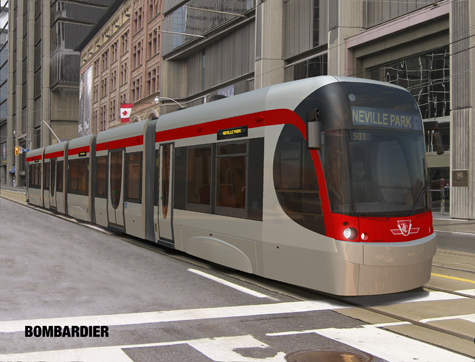
new Bombardier LRV for Toronto
This publication by the Pembina Institute
Making Tracks to Torontonians
examines the costs and benefits of the subway extension proposed by Toronto Mayor Rob Ford in December 2010, compared to the light rail transit plan that is already underway with funding on the table.
The subway extension would provide less service per dollar invested than the existing light rail rapid transit plan for Toronto, and wouldn’t deliver transit service to the communities that need it most.http://pubs.pembina.org/reports/making-tracks-toronto.pdf
Posted by Cardinal Fang on January 6, 2011 · 2 Comments
Is there really a “war on cars” in Seattle?
Politics Northwest
The Seattle Times political team explores national, state and local politics.
Posted by Jim Brunner
Has Seattle Mayor Mike McGinn really declared a “war on cars?” Or is that just a manufactured right-wing talking point?
http://tinyurl.com/34thhyo
At the blog of the green think tank, the Sightline Institute, Eric De Place has a fascinating blog post today investigating the origin of the term “war on cars.”
De Place traces the popularization of the phrase to the conservative Heritage Foundation, suggesting the term has been parroted by a network of conservative bloggers, who borrowed some of their ideas from a transportation controversy in Toronto.
“So thatai??i??s the origin of Seattleai??i??s ai???war on carsai??? tempest in a teapot: it was a low-level ai???memeai??? that circulated for a decade or so; bubbled up in Toronto; was then picked up by a few right-leaning national pundits in the US; and was then parroted by the Seattle-area noise machine.”

Of course, if there were a “war on cars,” you can bet Sightline Institute wouldn’t enlist on the side of General Motors.
Still, De Place thinks it’s silly to cite proposals to increase parking rates as evidence of a Seattle “war on cars” when most local leaders are supporting two car-centric mega projects: the new waterfront tunnel and 520 bridge.
He concludes:
“There’s something almost laughably overheated about the “war on cars” rhetoric. It’s almost as if the purveyors of the phrase have either lost their cool entirely, or else they’re trying desperately to avoid a level-headed discussion of transportation policy.”
It’s worth a read, whichever side of the war-or-not-war you are on.
Posted by Cardinal Fang on January 5, 2011 · Leave a Comment
Units not crucial for good public transport, study finds
Andrew West, January 5, 2011
RESIDENTS of Australia's outer suburbs do not have to wait for higher housing densities before getting better public transport, according to new research, which could defuse one of urban planning's biggest controversies.
In a paper for the journal Australian Planner, Dr John Stone of the University of Melbourne and Dr Paul Mees of Royal Melbourne Institute of Technology say many city dwellers have been presented with a false choice: live in apartments and enjoy good public transport or retain the house and land and rely on cars.
''Many planners, and other commentators on urban issues, appear to believe that getting significantly more people on public transport will not be possible until massive changes in suburban densities are achieved,'' they write. ''The evidence challenges this view.''
http://www.smh.com.au/national/units-not-crucial-for-good-public-transport-study-finds-20110104-19f5h.html

Sydney Adtranz Variotram
The issue of suburban density v public transport has challenged the simple minds of Vancouver's transport & urban planners, politicians, skyscraper advocates & transit providers – TransLink & BC Transit, as much as understanding the differences between: Commuter Rail, Metro, LRT, ART, MRT, BRT, Light Rail, Trams, Tram-Train & Streetcars
Dr Stone concludes his paper:
''The proven effectiveness of modern approaches to public transport service design in low-density suburbs offers a way to break the politicised stand-off between supporters of urban consolidation and residents who choose to live in a detached house on a suburban block.''
Would the architects of the FVRD/FVTS report, now admit that their tome was as about as useful as a one-legged man at an arse kicking contest and acknowledge that the Fraser Valley communities deserve better than a sub-standard bus service?
Posted by Cardinal Fang on January 4, 2011 · 1 Comment
Itai??i??s traditional for the media and bloggers alike to wrap up the retreating year or welcome in the New Year with a retrospective of all that was bad, depressing, frustrating, good, humorous, irritating, scandalous or just plain bizarre in the twelve months that finished on the stroke of midnight on 31st December.
Stephen Reesai??i??s blog did just that with a 2010 in review post, entitled Crunchy numbers. The review gives the blog statistics and goes on to list the top five referring sites and the yearai??i??s postings that received the most views. At number three with 19 comments was a September 2006 post entitled Group lobbies for SkyTrain rather than lightAi??rail.
The comments from one respondent are interesting to say the least or should I qualify that statement and say depressing; they argue `A functional rapid transit system must co-exist with cars not penalize them, we must deal in reality with the factai??i??
Ai??
Unfortunately unrestricted town & city access for cars, come with traffic jams, congestion and pollution.
Politicians, like Rob Ford in Toronto argue that the `War on cars must be ended’ Transit must be expensively burried underground and surface transport left to the bus.
In Europe as well as Canada & the US, Planners, Engineers and public officials, know that city & town transport must be a balance of modes;Ai??the difference is that the European ones care and invest in transport that attracts riders out of their cars – S-bahn, Metro, LRT, Tram and trolleybus, it does not ignore it and leave it mostly to inefficient, unintegrated bus operations. The FVTS Report published before Christmas offered the Fraser Valley communitiesAi??little more than a bus, the authors would appear to have also learnt very little over the past four years.
As for MrAi??Ford – one must remember that he is a politician – and a modern politician at that – so he is very, very stupid.
A Happy New Year
Posted by John Buker on January 4, 2011 · Leave a Comment
Study calls for major transit boost
The long-awaited Fraser Valley Transit study quietly appeared online Thursday, with a clear focus on local transit improvements.
The study by the province and FVRD with partners BC Transit and TransLink, looked at local, regional and inter-regional transit needs of Fraser Valley communities from Abbotsford to Hope.
Chilliwack Mayor Sharon Gaetz was relieved the $400,000 transit report was finally released so the community can move forward.
A?ai??i??Ai??It gives us a long range vision for local transit in each Fraser Valley community, as well as a vision for regional service.
A?ai??i??Ai??The main part that jumped out for me was the crucial need for new funding sources to be found,A?ai??i??A? she said.
The study pointed out Chilliwack spends $9 annually per capita on transit through property taxes, which is among the lowest in B.C., compared to other mid-sized communities.
Kamloops spends $26 per capita, while Victoria spends $40, as examples.
A?ai??i??Ai??ItA?ai??i??ai???s tough right now,A?ai??i??A? said Gaetz. A?ai??i??Ai??WeA?ai??i??ai???re under pressure to keep taxes low, and we know transit is highly subsidized so we have to look if a share of costs can be borne in other areas. ItA?ai??i??ai???s about finding a new funding mechanism.A?ai??i??A?
More than tripling local bus service is called for under the studyA?ai??i??ai???s vision, going from the current total of 40 buses to 135 by 2040, and the annual costs would then jump from about $10 million to $80 million, contingent on new revenue sources being found.
ThatA?ai??i??ai???s a 600 per cent projected increase in local bus services for Chilliwack according to the study, and about 450 per cent for Abbotsford to support A?ai??i??Ai??primary travel marketsA?ai??i??A? in the valley.
Transit advocate Jennifer Bigham, who called herself the Chill-activist, was impressed by the studyA?ai??i??ai???s recommendations for major increases to local bus service across the valley.
A?ai??i??Ai??ItA?ai??i??ai???s long overdue. My initial reaction is that itA?ai??i??ai???s going to be good for us,A?ai??i??A? she said.
A new transit governance structure A?ai??i??Ai??is exactly what we needA?ai??i??A? to amalgamate services from neighbouring communities, Bigham said.
A?ai??i??Ai??The fact that theyA?ai??i??ai???re ready to do anything is good, but itA?ai??i??ai???s going to take a lot just to catch up.A?ai??i??A?
Finding new funding sources and a new structure is key, agreed Gaetz.
A?ai??i??Ai??No matter what kind of transit service we choose, it underscores that the current model is unsustainable,A?ai??i??A? said the mayor. A?ai??i??Ai??So weA?ai??i??ai???re looking forward to working with BC Transit in the new year to figure out the best options for Chilliwack.A?ai??i??A?
A new governance model, something akin to a Trans Link, might be a good place to start, said Gaetz.
But hands-down the biggest priority for all valley communities is A?ai??i??Ai??growing local ridership,A?ai??i??A? especially since most riders donA?ai??i??ai???t go beyond the city borders, said the mayor.
A?ai??i??Ai??What the study pointed out was the need to expand our local ridership, to make it grow from one per cent to four per centA?ai??i??A? over the next 20 years, said Gaetz.
A?ai??i??Ai??There are some who have said we could do that by putting in an inter-urban rail line from Chilliwack to Vancouver, but what the report indicates is that itA?ai??i??ai???s highly desirable, but cost prohibitive.A?ai??i??A?
The study estimated the rail option would cost $70 million.
So although Gaetz said she agrees with preserving the rail line for future service potential, itA?ai??i??ai???s A?ai??i??Ai??too expensiveA?ai??i??A? right now.
The rationale for rail isnA?ai??i??ai???t supported by the numbers since 80 per cent of trips in the Fraser Valley begin and end in that community.
A?ai??i??Ai??And for the City of Chilliwack it was even more dramatic, with only 10 per cent of daily riders leaving Chilliwack for other communities.A?ai??i??A?
But Rail for the Valley spokesman John Vissers disputes the expensive price tag for rail.
A?ai??i??Ai??I get a sense that they missed the obvious and that is that we have a system available to us at little real cost that would connect communities. Connectivity is absolutely essential,A?ai??i??A? he said.
To continue to ignore rail as a transportation option is actually 20th century thinking, he said.
The problem with the transit vision contained in the study is that it doesnA?ai??i??ai???t offer true sustainability, despite its lofty goals.
A?ai??i??Ai??It doesnA?ai??i??ai???t recognize sustainable growth and how growth will be shaped by affordable and accessible transit,A?ai??i??A? said Vissers.
A?ai??i??Ai??Sprawl canA?ai??i??ai???t be served by buses or trains, theyA?ai??i??ai???re too low density. If we build attractive transportation options it will attract more sustainable growth. So weA?ai??i??ai???re doing things backward by building communities and then trying to serve them with transportation.A?ai??i??A?
The just released study by Urban Systems, Strategic Review of Transit in the Fraser Valley, compared different scenarios for local, and inter-regional transit, as well as urban rail and expanded West Coast Express options in a 20- to 25-year framework.
The recommendations lean toward A?ai??i??Ai??optimizing and enhancingA?ai??i??A? local transit in the short term, given that the vast majority of transit trips start and end in the same community.
Within Chilliwack a A?ai??i??Ai??rapid busA?ai??i??A? service would cover the Yale/Vedder corridor with interconnected frequent transit corridors, conventional services and connections with community transit services. It also envisions an express coach bus for inter-regional travel.
Rail did not cut it.
A?ai??i??Ai??Commuter rail may be a long-term option in the future,A?ai??i??A? reads the study summary.
An inter-urban rail service is singled out as A?ai??i??Ai??significantly more than other transit options available.A?ai??i??A?
Either extending the WCE to Abbotsford or creating an inter-urban route A?ai??i??Ai??would require significant investment and both have lower projected ridership than other transit options in the study.A?ai??i??A?
Hence the need to focus on expanding local transit. With population numbers expected to spike in the coming years, the study points out that transit funding and service levels have been A?ai??i??Ai??woefully inadequateA?ai??i??A? in the region.
Gaetz said in order to get ridership up substantially in Chilliwack from the current one per cent up to four per cent, leaves regional transit, such as Chilliwack to Abbotsford of secondary importance to some degree.
A?ai??i??Ai??But having said that, it should not set off alarm bells because regional links are still a priority. So weA?ai??i??ai???ll be looking at that and more in the new year as we continue to analyze the data.A?ai??i??A?
For more on the study, go to www.srtfv.ca or www.th.gov.bc.ca/FraserValleyTransit/
BCLocalNews.com – Study calls for major transit boost.
Posted by John Buker on January 4, 2011 · 1 Comment
Buses, not rail, laid out in Valley transit vision
Published:Ai??Ai??December 20, 2010 12:00 PM
Updated:Ai??Ai??December 20, 2010 4:21 PM
The Fraser Valley needs to get A?ai??i??ai???Ai??Ai??and pay for A?ai??i??ai???Ai??Ai??a much higher level of bus service, but a rail transit service that would wind its way along the old Interurban line is not among the recommended options.
A long-awaited provincial government review of Fraser Valley transit concludes a new commuter rail service on the Interurban corridor from Abbotsford to Surrey would cost $70 million a year A?ai??i??ai???Ai??Ai??almost as much as a much more urgently needed expansion in local, regional and inter-regional bus service that would take the current system from $11 million a year to $90 million.
Providing premium express bus service on Highway 1 in dedicated lanes would be much cheaper than rail, it says, freeing up more money for the improved bus service, which is estimated to serve 20 times as many passengers.
“Although an inter-regional railway service between the Fraser Valley and Metro Vancouver may be part of a long-term future, a strong foundation of local, regional and inter-regional services as presented in the Vision is an essential starting point.”
A rail service all the way from Chilliwack to Surrey would cost $112 million a year, it says.
That rail option cost is based on a peak-only service using heavy diesel trains like the West Coast Express A?ai??i??ai???Ai??Ai??not the light-rail modern trams that Rail For the Valley fans contend could provide an all-day community-oriented service at modest cost.
More passengers would likely be served using light-rail trains, the analysis shows, but at a higher cost of $108 million per year to Abbotsford and $176 million to Chilliwack.
Rail For The Valley spokesman John Buker said the analysis is flawed and the results are “strongly biased” against light rail, particularly in terms of its ridership estimates.
The report recommends a five-fold increase in local bus service in the Valley to 420,000 service hours over the next 20 years, up from 85,000 today.
Bus Rapid Transit (BRT) lines would let passengers board every 10 minutes or less on the high-traffic South Fraser Way and Yale Road corridors.
Express bus routes using more comfortable highway coaches would link Abbotsford west through Langley along both the Highway 1 and Fraser Highway corridors to SkyTrain in Surrey or else Burnaby via the new Port Mann Bridge.
Another express route would go north from Abbotsford to Mission and then west through Maple Ridge and on to the Tri-Cities. Others would connect Abbotsford to Chilliwack and Chilliwack to both Agassiz and Hope.
The highway buses would range from service as often as every 10 minutes to hourly (to Agassiz) and five trips per day to Hope.
Also envisioned are grids of interconnected frequent transit corridors A?ai??i??ai??? guaranteeing buses every 15 minutes, 15 hours a day.
Those plans recognize the fact 80 per cent of all trips in the Valley are by residents traveling in their home community, so future service must be largely geared to local destinations, not commuting long distances across the Lower Mainland.
Local transit service should increase from 350 per cent in Abbotsford to more than 600 per cent in Chilliwack, it says, much of it concentrated on the urban areas.
Consultants also looked at extending West Coast Express 11 kilometres across the Fraser River into downtown Abbotsford.
Various upgrades would be required, including new Abbotsford and Silverdale stations, new or expanded park-and-rides and a relocation of the Mission WCE station, along with transit tie-ins.
But the $11.6-million annual cost of the Abbotsford WCE extension would be far greater than the proposed new express bus service to Mission, which would operate much more frequently (every 10 minutes at peak times, 20 minutes off-peak versus 30 minutes for WCE at peak times only, no service at off-peak times.)
Ten per cent of West Coast Express traffic already comes from the Fraser Valley. About 6,000 daily passengers board at Mission A?ai??i??ai???Ai??Ai??10 per cent of total WCE traffic A?ai??i??ai???Ai??Ai??with about 56 per cent of them from Mission and 38 per cent from Abbotsford.
The Interurban assessment assumed nine stations A?ai??i??ai???Ai??Ai??four in Surrey, three in Langley and just one each in Abbotsford and Chilliwack. Adding more, consultants said, would increase trip time and deter passengers.
Since expanded rail isn’t discarded forever, the reports say rail corridors should be retained for a possible future service.
Buker said rail lines shouldn’t be shelved.
“There are some nice ideas presented of enhanced local bus service which deserve a closer look, but the hard truth is it is extremely doubtful that ridership will be high enough to sustain these levels of services without a light rail backbone,” he said.
“If the Fraser Valley can support hourly, or even half-hourly, regional bus service, it can also support light rail, whose operating costs over the lifetime of the vehicles tend to actually be lower, when all costs are taken into account.”
The Strategic Review of Transit in the Fraser Valley was conducted by the transportation ministry in partnership with TransLink, the Fraser Valley Regional District and B.C. Transit and analyzed travel patterns across the region.
It warns a paradigm shift in how local communities work together is needed as well as “dramatically different land-use plans” from what community plans now envision, with denser development along transit routes and more mixed uses.
The vision requires “fundamental shifts” that may take up to 30 years to achieve, but it calls on all agencies to work to accelerate the implementation.
Also needed are dedicated bus lanes, queue jumper ramps, and coordinated traffic lights to help speed buses through congestion on key corridors, such as South Fraser Way, Yale Road, Highway 1 and Fraser Highway.
Local cities and BC Transit are to work on shorter-term plans in the next few years to start delivering the 20-year strategy.
‘Modest’ gas tax could revenue to improve dismal transit service
Just one per cent of trips made in the Fraser Valley Regional District are on transit, compared to three per cent in Kelowna and Kamloops, eight per cent in Victoria and 11 per cent in Metro Vancouver.
The findings of the province’s Strategic Review of Transit in the Fraser Valley show the region is woefully underserved by transit relative to other areas.
The Valley gets less than 0.5 annual transit service hours per resident A?ai??i??ai??? one-third as much as Kamloops and Kelowna and one-fifth as much per capita transit service as Metro Vancouver.
Even Alberta communities like Strathcona and St. Albert get more than twice as much transit service as the Valley.
Valley residents also pay less in property taxes for transit A?ai??i??ai???Ai??Ai??just $4 to $14 per person compared to $26 in the Okanagan cities and $130 in Metro Vancouver.
The existing transit system in the Valley needs steady revenue increases of 7.6 per cent per year from local, regional and provincial sources.
Higher property taxes, fares, provincial contributions and “new revenue sources” will all be needed to deliver the needed cash.
Adding a one-cent per litre gas tax in the FVRD A?ai??i??ai???Ai??Ai??much less than the 12 cents charged in Metro Vancouver A?ai??i??ai???Ai??Ai??would generate $4.1 million a year, the report shows, by way of example.
The report notes TransLink’s fees and taxes could simply be extended to the Valley.
Or, it says, a Valley transit commission could be set up like one in the Capital Regional District that charges a 3.5 cent per litre gas tax.
“If the FVRD remains outside TransLinkA?ai??i??ai???s service area, a relatively modest fuel tax would be able to provide an adequate funding stream to allow significant improvements to be implemented,” it says.
“Without increased funding which is also more stable and predictable, the needs of the valley residents cannot be planned or developed in an optimum way.”
The FVRD population is projected to climb 70 per cent to more than 450,000 over the next two decades.
The reports target an increase in transit mode share to 4.1 per cent by 2040, up from one per cent in the Valley today.
Summary: Strategic Review of Transit in the Fraser Valley
Posted by John Buker on January 4, 2011 · Leave a Comment
Light rail: SkyTrain most costly route
LANGLEY ADVANCE DECEMBER 31, 2010
Dear Editor,
While local mayors bicker with TransLink over the funding of yet another grossly expensive metro line for the region, Rail for the Valley, in association with Leewood Projects in the UK, has provided the region with a far cheaper alternative: a TramTrain transit plan for the South Fraser region.
The 84-page RftV/Leewood report found that a basic service (three trains an hour each direction), 98 km Scott road Station to Chilliwack LRT TramTrain could be implemented for as little as $492 million, while a full build 138 km Vancouver/Richmond to Rosedale service could be had for as little as $998.5 million.
Compare that with the $1.4-billion 11 km Evergreen line.
The RftV/Leewood Report has been very well received overseas, with articles on the Valley Interurban in Railway Strategies and the internationally acclaimed Tramways & Urban Transit, yet locally, this very important study has been all but ignored.
TransLink has treated the RftV/Leewood Report with disdain as they continue to plan for multi billion dollar metro lines that the taxpayer just canA?ai??i??ai???t afford.
Gerald Fox, an American transit expert commenting on the Evergreen Line observed that; A?ai??i??Ai??……Vancouver will need to adopt lower-cost LRT in its lesser corridors, or else limit the extent of its rail system. And that seems to make some TransLink people very nervous.A?ai??i??A?
For the cost of the 11 km $1.4 billion Evergreen SkyTrain mini-metro, we could build 138 km of TramTrain From Vancouver, past Chilliwack to Rosedale and have enough money left over to build a 50 km Vancouver to Maple Ridge TramTrain service.
Who builds with SkyTrain today? No one. Yet more than 20 cities, including Paris, France, are building and/or extending TramTrain lines.
In an age of global warming and peak oil, is it not best to get the biggest transit bang for your transit buck, rather than continuing to build with the extremely expensive and now obsolete proprietary SkyTrain light-metro system?
Malcolm Johnston, Rail for the Valley/Light Rail Committee
Ai??Ai?? Copyright (c) Langley Advance
via Light rail: SkyTrain most costly route.




Recent Comments