BCLocalNews.com – Fraser Valley Transit Study shows dated thinking about rail
Fraser Valley Transit Study shows dated thinking about rail
Published: December 29, 2010 2:00 PM
Updated: December 29, 2010 2:21 PM
The long awaited $400,000 Fraser Valley Transit StudyAi??Ai??has stale-dated by the September release of the independent Rail for The Valley/Leewood Interurban Report.
The RftV/Leewood gives actual costs forAi??Ai??a 21st centuryAi??Ai??Fraser Valley interurban and the building of an affordable TramTrain in three phases, costing less than $1 billion in total.
The RftV/Leewood Report showed that a phase oneAi??Ai??Scott Road Station to Chilliwack diesel LRT service could be had for under $500 million or just over $5 million per km, much cheaper than new highway construction.
Using established railAi??Ai??operations with similar characteristics, theAi??Ai??phase one diesel LRTAi??Ai??could be operated for under $10 million per annum.
The provincial study, with no foundationAi??Ai??of an actual rail line, was said to cost over $70 million per year to operate.
Really? Why is the cost of operating a rail service so high? Could it be that the author of the report wanted to please his paymasters, the provincial government in order to secure future work?
If the author of the study has got it so wrong with the annual operation costs (were they a mere guess?) for a rail service, then what else has he got wrong with the study?
The timing of the release of the study is key. Releasing the study a little over one week before Christmas, means the the provincial government wants to hide public comment of this anti-interurban report, while giving a foundation for Liberal premier wannabees to quote from, rejecting the Fraser Valley Interurban project.
It is simple old school politics.
Dated studies, combined with dated thinking and anti-LRT/interurban politicians equals transit paralysis in the Fraser Valley, for decades to come.
Malcolm Johnston
Rail For The Valley/Light Rail Committee
via BCLocalNews.com – Fraser Valley Transit Study shows dated thinking about rail.
Rail tracks should be built instead of roads
Rail tracks should be built instead of roads
BY HEIDI GRECO, VANCOUVER SUN DECEMBER 29, 2010
Re: Urgent upgrade pushed for Fraser Valley transit to deal with huge population growth, Dec. 21
It was good to see front-page coverage on the transit overhaul needed for the Fraser Valley. For the most part, I can only agree.
But what I don’t understand is why, in the course of twinning the Port Mann Bridge, the additional lanes are being paved for vehicles rather than being used to construct rail of some sort. Such a link, even if it only went as far east as 200th Street, would be a good beginning. For commuters travelling west, once over the Port Mann, it doesn’t seem it would be all that hard to connect with the Expo Line and even with the proposed new Evergreen Line.
The median between the lanes of Highway One is currently torn up — from the bridge nearly out to 200th. Why not take this opportunity to lay tracks rather than road?
Considering rising fuel costs, air quality, carbon emissions and traffic congestion, it seems to make sense to be looking for ways to get cars off the road, not to encourage more single-passenger trips into the city.
And really, has anyone figured out yet where all the cars streaming over those extra lanes of the Port Mann configuration will go, especially when they arrive at Grandview Highway?
Heidi Greco
South Surrey
Ai??Ai?? Copyright (c) The Vancouver Sun
via Rail tracks should be built instead of roads.
The cost of improved transit
The cost of improved transit
THE TIMES DECEMBER 24, 2010
Editor, the Times:
“Now we know what we should focus on and what it will cost. It’s a given we have to improve the system,” as quoted from your article (Dec. 21 Times).
This study and many like it seem to be focused on the wrong aspects of travel in the Fraser Valley area. What is the purpose of transit systems? Isn’t it to move people from one location to another in a timely and comfortable manner? What about those people at the other end of the line who want to travel to the valley for Tradex, Heat games, shopping, air flights and other attractions.
Did you know that if I miss the WCE train I could take a bus from Mission to Vancouver? The train would get me downtown in one hour and 18 minutes and the bus would take two hours and 43 minutes.
How much time would it take a bus to travel to the Kingsway or future Evergreen line to make connections? Is time part of the study? Trains keep a timely schedule, buses cannot. Has council ridden one of our buses when it is cold and miserable outside and inside as well. No comfort there.
Would I vote for a bus service? Hardly. Why is council concerned about the cost of light rail. Did cost stop the building of the Abbotsford Entertainment and Sports Centre?
Tax increase you say? There are many ways to decrease costs if you study them.
How much would the city save by having automatic pedestrian cross lights? When the traffic light turns green the walk light comes on also. Get rid of the crosswalk buttons and eliminate the need to repair them when damaged.
Wouldn’t that make it a bit safer for the pedestrian?
John Eby,
Abbotsford
Ai??Ai?? Copyright (c) Abbotsford Times
via The cost of improved transit.
Study goes off the rails
Study goes off the rails
BY PAUL J. HENDERSON, THE TIMES DECEMBER 21, 2010
Proponents of the inter-urban rail line from Chilliwack to Surrey are critical of some of the assumptions underlying the provincial government’s Fraser Valley Transit Study (FVTS) released last week.
Based on economic and demographic projections, the long-awaited report concludes that light rail on the old inter-urban line would cost “significantly more than the other transit options available.”
But Dr. John Buker of the Rail for the Valley group said those doing the calculations aren’t telling the whole story.
The FVTS found that the interurban line from Chilliwack to Surrey would have annual costs in 2031 from approximately $110 million to $175 million for operating, vehicle and capital.
“However, the projected 2031 ridership does not grow to the same degree, resulting in a higher system cost of $100 to $110 per ride,” the report said.
“By digging a little under the surface, one discovers shockingly that the report is actually assuming a regional bus service would attract more than triple the number of passengers of an equivalent light rail service,” Buker said in a press release issued Monday. “That’s more than a little hard to believe given that there are few cases where buses attract equal, let alone greater, ridership.”
The report finds that rapid bus service between Chilliwack and Abbotsford would be the more economical alternative, but Buker said the ridership predictions that allow for this conclusion are doubtful.
“There are some nice ideas presented of enhanced local bus service which deserve a closer look, but the hard truth is it is extremely doubtful that ridership will be high enough to sustain these levels of services without a light rail backbone,” Buker said.
“If the Fraser Valley can support hourly, or even half-hourly, regional bus service, it can also support light rail, whose operating costs over the lifetime of the vehicles tend to actually be lower, when all costs are taken into account.”
For Mayor Sharon Gaetz, she is just happy the FVTS has finally been released by the province so the city can begin to work on its “vision.”
“The main thing is it reinforces the need for new funding sources,” she told the Times. “The way we
are doing things is unsustainable.”
Currently, 47 per cent of transit funding comes from the province, 30 per cent comes from fares and the rest from local property taxes.
Given the fact that 87 per cent of Chilliwack transit rides stay in Chilliwack, Gaetz said the focus needs to be on improving local transit.
“Hourly service is not going to cut it,” she said.
One request Gaetz has heard lately is to add bus service to the new Eagle Landing retail development, something that will require new money.
Rail For the Valley said the organization will present a detailed reaction to the FVTS in the New Year.
Ai??Ai?? Copyright (c) Chilliwack Times
Bus vs trains
Bus vs trains
Transit study favours buses over rail
BY ROCHELLE BAKER, THE TIMES DECEMBER 21, 2010
A much anticipated study about the future of transit in the Fraser Valley has been released, and it favours expanding bus routes over re-establishing the Interurban rail service.
“We’ve been waiting for it for a while and are thrilled it’s out,” said Abbotsford Counc. Patricia Ross and chair of the Fraser Valley Regional District.
“Now we know what we should focus on and what it will cost. It’s a given we have to improve the system, and this is a guide to help us do that.”
The Strategic Review of Transit in the Fraser Valley, which covers the FVRD communities of Abbotsford, Mission, Chilliwack, Kent, Harrison Hot Springs, and Hope, was initiated by the Ministry of Transportation and Infrastructure in November 2008.
It set out to determine the best options for transit services within the region and to link up with Metro Vancouver.
One of the more interesting facts to come out of the study was that 80 per cent of all trips in the Fraser Valley end in the region itself, said Ross.
“It clearly shows us we have to improve the system within the Fraser Valley Regional District significantly,” she said.
“We obviously need linkages with communities within the Fraser Valley itself.”
The estimated cost of improving the system is a “staggering,” said Ross.
That new system highlights the development of new regional and inter-regional bus routes over the next 20 year, and would see yearly costs go from approximately $10 million up to $80 million.
The strategy includes increased service at 10-minute intervals during peak periods along Highway 11 between Abbotsford and Mission.
An hourly service between Abbotsford and Chilliwack as well as service from Abbotsford along Highway 1 to Langley and Surrey, and the available RapidBus connections to the SkyTrain and Vancouver.
Mission would also be connected along Highway 7 to Maple Ridge, and its connections to the proposed Evergreen SkyTrain line.
The system would see an increase from approximately 40 buses to more than 75 buses over the next two decades.
Light rail was evaluated but was determined to be too expensive.
“The 2031 annual operating and debt service cost for a commuter rail service along the inter-urban line between Abbotsford and Surrey of approximately $68.9 million would almost equal that of the entire investment required to achieve the [transit] Vision,” stated the report.
John Vissers, spokesman with Rail for the Valley, a group advocating the establishment of light rail in the region, said the provincial numbers are inflated.
“Sure, for a deluxe WestCoast Express style commuter train, if you include all capital costs up front and serve free caviar in the dining car,” said Vissers. “We calculate annual operating costs for a full service light rail tram/train system on the Inter-urban track at less than $3 million.”
Residents in Abbotsford and Chilliwack are among the nations lowest per capita users of public transportation, he said, and buses, while a good thing, primarily attract “captured” riders.
“Trams and Trains attract new riders who choose to leave their cars at home or at a station . . . and add a whole new rider base,” he said.
The provincial study is reactive planning that in fact promotes urban sprawl while light rail encourages sustainable growth along the corridor, he added.
Ross noted all the stakeholders in the process will now set about looking at the information and looking to the community for input before proceeding.
“We [all] still have to discuss it. We’ll have to sit down and evaluate both [the transit strategy and light rail.]”
Ai??Ai?? Copyright (c) Abbotsford Times
via Bus vs trains.
Buses may patch Fraser Valley transit gap, but will they fix it? – Cayo
Buses may patch Fraser Valley transit gap, but will they fix it?
By DON CAYO 21 DEC 2010
Filed under: transit, TransLink
More buses A?ai??i??ai??? a lot more A?ai??i??ai??? are the best bet for commuters in the fast-growing Fraser Valley, according to to a joint report from the Fraser Valley Regional District, TransLink, the Ministry of Transportation, and BC Transit
Sorry, but colour me skeptical.
A story by my Vancouver Sun colleague Tiffany Crawford (accessible here) underlines a few numbers of interest.
A?ai??i??ai??? The population of the region is expected to grow 70 per cent over the next 25 years.
A?ai??i??ai??? Just one per cent of the trips in the region today are undertaken are by transit.
A?ai??i??ai??? In Vancouver, with its much better bus network as well as SkyTrain and SeaBus, 11 per cent of trips are by transit.
A?ai??i??ai??? The increase in bus service hours envisaged by the report is roughly five-fold.
So do the math. Even if a five-fold increase in bus service is able to yield an 11-fold increase in the number of trips taken by transit, I canA?ai??i??ai???t see how this could compensate for the projected population growth. Or the inevitable increase in traffic. Because if the number of trips grows to 1.7 times greater than todayA?ai??i??ai???s volume, this will still create 1.5 times more non-transit traffic than weA?ai??i??ai???re seeing today.
Crawford notes that the report didnA?ai??i??ai???t rule out an eventual expansion of the rail network, and even suggested preserving rail corridors.
And she quotes it as saying, “Although an inter-regional railway service between the Fraser Valley and Metro Vancouver may be part of a long-term future, a strong foundation of local, regional and inter-regional services … is an essential starting point.”
Given the amount of both money and lead time involved in providing rail, this may well be true. But it seems to me the time to start crafting a long-term solution A?ai??i??ai??? what I would call an essential ending point A?ai??i??ai??? is now, and this report merely postpones a serious attempt to grapple with it.
Follow me on Twitter @DonCayo
via Buses may patch Fraser Valley transit gap, but will they fix it? – Cayo.
Study: not enough demand for rail service to Fraser Valley – News1130
Study: not enough demand for rail service to Fraser Valley
The province will use this information to plan transit projects to the Fraser Valley over the next 25 years
Jesse Johnston Dec 17, 2010 13:24:22 PM
VANCOUVER (NEWS1130) – The province says new research shows there isn’t enough demand for commuter rail service between Greater Vancouver and the Fraser Valley in the short term, but at least some people in the Valley disagree.
The study says people in the Valley make about 800,000 trips every day, one per cent of them are by transit. It also says 80 per cent of people stay close to home when they travel, so at best, rail service is a long term possibility. That’s why the province is suggesting coach bus service instead of rail as the best way to connect the Valley and Metro Vancouver, at least for now.
But John Vissers with the group Rail for the Valley says more people would take transit if it was an option. “The reason numbers are low is because there’s no service. To use low ridership numbers as an argument against a system that doesn’t exist doesn’t make a lot of sense.”
Vissers also says rail service would cost much less than the $70 million a year that the study suggests.
via Study: not enough demand for rail service to Fraser Valley – News1130.
Transit Planning In Metro Vancouver – Where Have We Gone Wrong?

The release of TransLink’s $400,000.00 Fraser Valley Transit Study continues over three decades of transit denial by politicians and bureaucrats alike. The SkyTrain driverless light metro system has brought with it, the seeds of a regional transportation debacle, where the invented claims by the SkyTrain lobby has infected all regional planning, including the universities with the automatic metro myth. With this voodoo transit planning so entrenched in the region, Vancouver has become alone in the world pursuing a strictly automatic metro transit philosophy.
Recent postings from so-called ‘professional engineers’ (whichAi??I only have their word for it) not only shows an ignorance about modern public transit philosophy, but a desire to spend the taxpayers money with wanton abandon, which I belive insults the profession.
A question which I have always asked; “when did UBC or other local universities, include urban transportation in their syllabus?” In Europe of course there are whole faculties devoted to urban transit, granting degrees, but not in BC.
The planning faculties at those very same universities also must accept part of the blame as they also do not give courses in urban transportation, and what isAi??taught is so dated it is next to useless. The recent UBC inspired Streetcar Symposium in Vancouver a few month back was a good example, where those supporting streetcars or light rail, could not define the mode. This was most singular, having a symposium on streetcars but failing toAi??define what a streetcar is!
What must change?
First, a new degree granting facultyAi??of Urban Transportation must be created,Ai??independent ofAi??the Engineering and the Planning Faculties. StudentsAi??would beAi??taught the modern aspects of urban transportation, combined with a good historical base of various transportation modesAi??that have been used for public transport.Ai??This would give an independent view of urban transport problems and viable solutions to curb gridlock and transit chaos, so common in cities around the world. Graduates would have a working knowledge of LRT in its various forms (streetcar/tram/LRT) as well as heavy rail metro, light-metro,Ai??mainline commuter trains; buses (BRT/GLT); ferries and even the private auto.
Secondly, we must consider transit customer wants, with the ability of the taxpayer to pay for it. In simple terms, the transit customer wants to be taken from where he lives to where he wants to go efficiently and affordably and the taxpayer doesn’t want to feel like a ‘Milch cow’ to fund outrageously expensive transit projects. In most cases the transit customer wants his/her transit on the pavement and ready to use and the ability taking it in a seamless (no-transfer) journey.
Thirdly, politicians must approve new transit schemes that are good for the transit customer and not what he/she thinks will win an election, or use transit monies to enrich political friends and land developers.
To date, building hugely expensive SkyTrain light-metro has skewed our regional planning to such a point that it is all but worthless and has created the SkyTrain myth that rapid transit (SkyTrian) is built solely to increase density and one must have massive density to sustain rapid transit.
If the region does not change its present course, the region will bankrupt itself building hugely expensive SkyTrain style light-metro linesAi??which in the pastAi??have done little in providing an affordable alternative to the car.
Light Rail Transforming Cities, Guiding Development
December 27, 2010
JJ Sutherland, National Public Radio http://www.npr.org/
It’s hard to find a city in America that isn’t planning, proposing, studying or actually building a light rail system. Cities as diverse as Dallas, Seattle and Washington, D.C., all see light rail as part of their future — a way to reshape their development.
There are 35 light rail systems operating in the U.S. today. At least 13 metro areas are currently building others. Many more are being planned.
read the story here:-
http://www.npr.org/2010/12/27/132283143/light-rail-transforming-cities-guiding-development
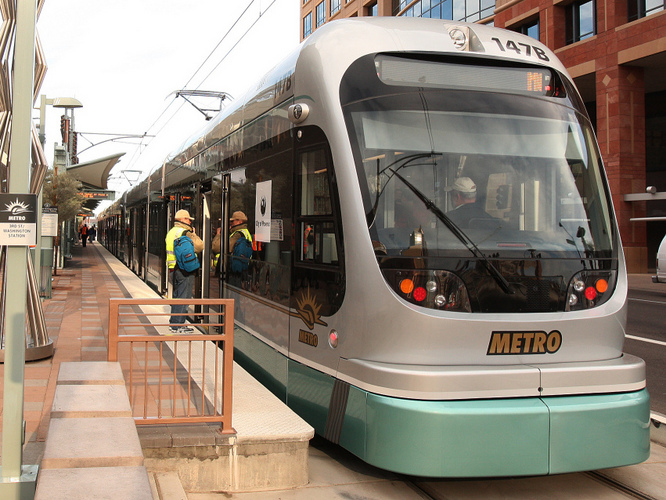
The first light rail car prepares to leave a station stop at the official opening of Metro Light Rail on Dec. 27, 2008, in Phoenix. The 20-mile, $1.4 billion line runs from north-central Phoenix through downtown, and then east through suburban Tempe and Mesa.
Have a Happy 2011 Toronto, love from Rob Ford
Rob Ford ready to let transit projects hold in favour of Sheppard subway
Globe & Mail December 21st

Mr. Ford has criticized light-rail transit as too similar to the streetcars he believes causes congestion in Toronto’s gridlocked roadways. He scoffed at the idea that monorails or a similar above-grade technology, which in theory would allow cars to continue unimpeded, could replace light rail. Similar projects have been tried in Vancouver’s Canada Line, which opened this year.
“There’s no more above ground,” he said. “No, everything’s going underground. I want to do subways. Every poll you see, over 80 per cent of people in the city want subways compared to LRT or streetcars. So I’m going to do what I campaigned on.”
hmmm, our Rob is clearly not impressed with the Canada Lines' ability to give cars unimpeded access to Vancouvers streets… how long before we see a Vancouver Mayor following Rob (Super Size Me) Ford's doctrine?
….politicos in the Fraser Valley are nearly there, their support for TransLinks FVRD report condemns residents to ever more highways & ever more congestion…
No intention of toning down in 2011, Ford says
Globe & Mail December 22nd



Recent Comments