This report merely postpones a serious attempt to grapple with crafting a long-term solution – Articles About TransLink’s Valley Transit Plans
It seems TransLink and the provincial government got what they wanted – nothing, for this is what their recently released transportation plan is really about, doing nothing.
The estimated annual cost of $90 million to operate rail transit in the Fraser Valley is laughable, as well as the contention that buses would attract more ridership than LRT. If these two items are incorrect, then how much else about the study is incorrect?
The current Liberal Government's transit planning is all about "rubber on asphalt" and how to funnel money to their political friends in the Road Builders Association by building super highways in the Fraser Valley.
What is most laughable is that the mainstream media still picture Gordon Campbell as environmentally friendly, where the opposite is true.
In an age of 'peak oil' and global warming, not considering a 'rail' transit plan for the Fraser Valley, especially when RftV has presented a realistic and affordable plan to do so, shows just how backward our current government is with regional transportation. I'm afraid that we may be just to late to save the situation.

Chilliwack Times: (Paul Henderson)
SimCity4 Tramway, why politicians dislike streetcars and other matters
the Cardinal is enjoying playing with an early Christmas present; TRAM NETWORK SET for Simcity 4 Rush Hour http://www.eclatami.org/simcity/tram_mod/readme_english.htm

The WORLDnews web site http://wn.com/simcity_tram
allows you to view YouTube videos of different tram options.
all that is missing is the cantankerous politician
Steve Munroe http://stevemunro.ca/?p=4537 has written a blog, which makes sense of the definitions and clears the fug of the Toronto Mayoral elections, clarifying the the deliberate fudging of the streetcar/LRT differences in the campaign.
This YouTube video is a hoot!!
http://www.youtube.com/watch?v=D4DRtpO-r5U
A Letter To Zweisystem

From time to time, Zwei gets letters that actually do not libel, nor threaten me and they deserved to be printed.
Much thought has been put into this letter by the author and though I agree with him on many points, there are some slight quibbles or additions which I would like to make and they will be in italics and highlighted.
Letter for zweisystem
I've been meaning to comment on your postings for quite sometime now, and my thoughts are now too long for a comment on the blog. Let me start by saying I agree with you for the need for a TramTrain or similar service into the Fraser Valley, I agree we've wasted far too much money on SkyTrain, and I agree that TransLink is often completely incompetent. This is just a bit of a rant on who should be most commonly be in the cross hairs of your blog posts.
First, how did we end up with SkyTrain to begin with? Well, as you know, it was the province's choice (mostly) to build it in 1986 (we can blame the feds too). At the time it might have seemed like 'the way of the future', so whatever, we'll let that one go. Some of the early extensions might have also made sense, at the time. One thing that was really stupid was building it down the old interurban corridor, which for one was nicely separated from traffic already and was much more suited to an LRT type system. The other problem with this corridor is a lot of it is in sketchy industrial areas in Burnaby, so we got off to a nice start by building poorly lit stations in the middle of nowhere requiring passengers to bus to convenient crime hotspots. But, as I say, we'll let this one slide.
The main reason for the then Social Credit Government for buying SkyTrain was that it also got access the then famous Ontario governments' "Blue Machine", in the deal. The Blue Machine successfully used computer tracking during elections and was deemed the main reason for the Ontario Conservatives gaining power.
Then came the millennium line. I'm not sure who was supporting what in the case of early talks of the BCIT / UBC transit line, a Hastings line, or a Lougheed LRT, but all these plans ended when the NDP decided to build the millennium line instead. They basically built an incredibly expensive line through half empty industrial lots and suburban sprawl – an area that wouldn't even have had enough ridership to support an express bus. Then, to make good and sure an NDP project wouldn't succeed, the BC liberals canceled the extensions at both ends of the line when they came into power, making it the line 'from nowhere to nowhere). This appears to have begun the province's favourite habit of messing with TransLink, and to me shows who should shoulder most of the blame for our SkyTrain obsession.
The NDP built SkyTrain for the Evergreen Line when Bombardier Inc. promised to build a fabrication plant in Burnaby to assemble Mk.2 cars. The spin was more tech jobs for BC and the plant would build SkyTrain cars for Asia.
This may be a good spot for me to do an aside and talk about SkyTrain ridership. The millennium line has remarkable ridership given where it goes. It's amazing how the City of Burnaby and TransLink (yes, TransLink) have managed to get a line that was never extended to either of it's original endpoints and that runs through almost entirely low density sprawl to be so busy. I used the millennium line to go to SFU and 4-car (mark II) and 6-car (mark 1) trains were arriving every 5 minutes completely FULL. While they're not the capacity of most metro systems, it's still impressive. Yes, TransLink was forced to make commuters transfer from buses onto the line to boost ridership, but what else could they do given that, thanks to the province, they had a 'gold-plated metro' in the middle of nowhere? The U-pass also helped a lot too (more on that later). Burnaby allowed high-rises all along the line. While, not the best form of housing in my opinion, they made a huge difference in boosting ridership. To me it looks like most of the unfavourable things you list of about SkyTrain are examples of work done to make what could have been a completely disastrous project be almost a success – it was all a response to a problem created by the province.
It gets even better… I remember when the TransLink board rejected the RAV line – twice! They weren't sold on Cambie and they weren't sold on SkyTrain. It was then that the province stepped in and said 'build SkyTrain (or more accurately a cheaper knock-off) as a P3 under Cambie or you loose your funding'. On the third vote RAV passed. It was Gordon Campbell and Kevin Falcon who wanted a shiny new line to the airport for the Olympics. Ridership is high on the 'poor mans metro', but I don't think it's entirely false numbers. See it is Vancouver's only somewhat 'urban' line. I think for the Broadway – Waterfront area we can actually support a 'metro-like' system – it just shouldn't have been a priority. There is a lot of legit users commuting to downtown on the Canada Line, we could have just gotten a lot more bang for our buck if the province hadn't crammed the most expensive option down our thoughts. To me it's not that the Canada line wasn't needed, its more that it would have better to get it, as an LRT, and have a bunch of money for LRT lines elsewhere leftover.
We have a general agreement but I have been told by a source within TransLink that because of having several Universities and colleges along the line, a large number of U-Pass holding students are using the metro several times a day (up to 8 times), this gives the appearance of heavy use but at the same time the metro is not generating income. As TransLink has no way of determining how many U-Pass holders are using the metro thus the monies earmarked for the buses are paid to the Canada Line, as TransLink uses each boarding as a new passenger. What the high U-Pass usage on the Canada Line is doing is robbing monies from the bus system. We also have to contend with the large amount of free ridership on Sea Island where employees drive to YVR, park their cars in the large parking lots and take the Canada Line for free one or two stations down the line. Indeed, they are counted as boardings and used in TransLink's ridership/funding formula for the Canada Line.
Added to the U-Pass woes is that it has been reported that many unused U-Passes are being sold to other parties, thus creating more funding chaos for TransLink.
Back to U-pass users. They ride SkyTrain a lot. You call it 'highly subsidized'. Well it wasn't, initially, at least not by tax-payers. The initial price for the U-pass was calculated to be revenue neutral. Because it is mandatory the subsidy would come from those paying for the U-pass, but not using it. TransLink would only cover the cost of running the extra transit, most of which was at the time expected to be just filling excess capacity. Of course, the program proved so popular TransLink ended up needing to increase service more than expected, but if you look at the numbers, it wasn't actually costing them that much (given how they cram students into buses). The pass was mostly paid for as it was about half the price ($34/month) of a normal pass ($69 month – one OR TWO zones for students with a transit sticker) and only half the students were expected to actually use it. Again, it was the province that came in and demanded universal $30/month U-passes at all schools, regardless of how expensive it is to service them. Transit costs less per person the more people use it, so the U-pass was intended to increase the efficiency of the system, it's just now unafforadble to TransLink.
Just a note: The U-Pass was conceived to put student "bums" on empty seats on mandated bus services in the USA, I don't think there has been an empty seat on Broadway bus for years!
Back to SkyTrain. The Evergreen line was supposed to be an LRT. TransLink planned that and sometimes the oblivious media still uses drawings of the Evergreen Line as an LRT. Kevin Falcon wanted SkyTrain and thus, we're now (supposedly) building SkyTrain. The LRT was going to be expensive for light rail, but the need for a tunnel to avoid the steep hill was real. Other routes were off the table mostly because of stupid decisions made in the past. It was entirely the province that forced SkyTrain for the Evergreen line, there is enough money available that the LRT plan is actually funded. Kind of seems like Falcon hates transit. I feel Falcon is a bit like Rob Ford (from Toronto). He likes cars, and his concession for transit users is a few expensive subway lines (instead of many LRT lines) because it keeps transit users out of his way. I feel it is mostly those heavy into car-culture that push subway and SkyTrain type projects.
Now, the UBC and Surrey extensions. TransLink planned for light rail, the province said 'no, you're building SkyTrain'. TransLink planners seem to be trying to at least partially avoid this with their 'alternatives' featuring light rail in public consultation. Gordon Campbell then, cluelessly, said they needed to get started 'building SkyTrain to Langley'. Campbell showed he was unaware of the actual plan, and that he didn't really care what people were saying, it was going to be SkyTrain.
So, in summary, while I often like to blame TransLink for stuff, I really thing it is the province that should be blamed for forcing SkyTrain on the region. While TransLink consistently demonstrates its incompetence, I think there may be a few good planners buried down in the organization somewhere, they just aren't allowed to actually plan anything sensible.
I agree, I just wished that some senior planners had the backbone to resign because of Provincial Government meddling with transit!
Moving forward, we have SkyTrain now. We paid way too much for what we got, but it's there. As is outlined on Human Transit there are some benefits to the automated system, such as the high frequencies we get at night (up to every 2-3 minutes on the combined section of service, unlike the 15 minute service on LRT lines in Calgary and Edmonton at night). The benefits of SkyTrain, to me, don't out weigh the insane cost, but now it's built we might as well take advantage of it. Instead of just ripping apart SkyTrain, I think it makes sense to think of it as a 'backbone' of our system. We should move forward planning light rail extensions from the end of SkyTrain lines (like the TramTrain to Chilliwack). We can continue with other light rail lines, such as from the Canada Line to the ferry, from the Millennium line to Maple Ridge, etc. We can then 'fill-in' the gaps in urban areas with streetcar lines running on corridors not served by SkyTrain. We should take advantage of the high-frequency backbone of SkyTrain we already have for future transit projects.
First, modern LRT can too, operate at 2 to 3 minute headways, in fact in Europe trams operate on 30 second headways on many routes during rush hour, something that the chap from Human Transit, will not acknowledge. LRT extensions from SkyTrain is a very bad mistake as it will not generate ridership, in fact forced transfers hamstrings public transit development. If LRT is built, it must be independent from SkyTrain and operate as a mode unto itself. Of course we will have transfer points, but to operate LRT as a poor cousin of SkyTrain is a very bad mistake and is why it is so important that we cut the SkyTrain apron strings now and go with light rail. If the Valley TramTrain connected directly to downtown Vancouver, ridership could be 4 to 5 times higher than a TramTrain stopping at Scott Road! Please remember the lessons of Karlsruhe, take away one transfer and ridership increases over 450%!
It is a mistake to depend on one line as a backbone, for if the bone breaks, the transit system is in chaos. It is better having a network of lines operating in a city to give the customer options and if a delay happens, there are other alternatives to continue ones journey. With our "SkyTrain is the backbone" philosophy, when SkyTrain goes down, a major transit crisis looms; bus bridges are made; spreading the inconvenience system wide. This is not a good way to operate the transit product.
That being said, I feel I have to admit there might be one place where a 'last SkyTrain ever' should be built. I think the millennium like needs to be extended from VCC-clark to Cambie. This big 'gap' should be closed and forcing an extra transfer to LRT doesn't make sense (see Human Transit). Just something that shows sometimes we're stuck following through on bad ideas from the past.
For the cost of this little subway, we can build a BCIT to UBC LRT/tram line, providing much better transportation alternatives for customers.
Hope my little rant leads to some interesting postings in the future.
H.
P.S. human transit articles I referenced.
http://www.humantransit.org/2010/04/vancouvers-broadway-corridor-options-announced.html
http://www.humantransit.org/2010/04/vancouver-a-cheap-fix-for-the-network-gap.html
http://www.humantransit.org/2010/02/vancouver-the-broadway-debate-and-the-dangers-of-interrupted-grids.html
The $400,000.00 Fraser Valley Transit Study – Much Ado About Nothing
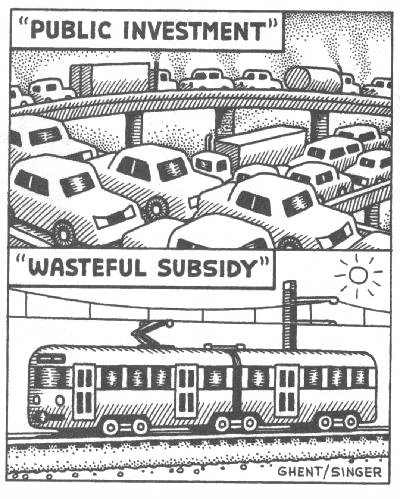
TwoAi??weeks before Christmas and the provincial Liberal Government releases its long awaited Fraser Valley Transit Study and one can see why; it is badly stale-dated by the Rail For The Valley/Leewood Report. By releasing the report before Christmas, the government hoped to bury this stinker under Christmas cheer, hiding the the fact that the Fraser Valley has again received lump of coal inAi??its Christmas stocking.
Rail For The Valley, quite rightly is going to study this document and do an in depth report in the new Year, but Zwei wants to make a general observation; “Why don’t the BC Liberal partyAi??find the moral fortitudeAi??and tell the Valley taxpayers that they just do not want to build affordable rail transportation in the Fraser Valley and instead want to build highways for the Fraser Valley transportation needs. What really makes this report look silly is the estimated $70 million operational costs for a yet to be planned for “interurban commuter rail service.”
Really?
$70 million to operate what?
TheAi??phase 1Ai??RftV/Leewood Report ( http://www.railforthevalley.com/studies/Ai??), diesel LRT Scott Road to Chilliwack option, costing just under $500 million or slightly more than $5 million/km. to build, would have annual operating costs under $10 million per year! Already the government report has been discredited and as many have observed in the past, if the author has got this wrong, then what else has he got wrong in the report?
Oh yes, buses will attract more ridership than rail!
The report seems full of this nonsense.
No matter,the report will give Liberal candidates an opportunity to once again ignore implementing ‘rail’ transit for the Fraser Valley, citing this report, while at the same time, hiding it in the Christmas rush, hoping that no one really looks or heavens forbid, vet the report for its accuracy.
The latest Transit Study – initial reaction from Rail For the Valley

2nd Swiss Tramway opening in the week – Berne
Tram Berne West opens
http://www.railwaygazette.com/nc/news/single-view/view/tram-bern-west-opens.html

SWITZERLAND: Trams now serve the business and residential areas of Bümpliz and Brünnen in the western suburbs of Bern, replacing two former trolleybus routes.
On December 12 public transport operator Bernmobil inaugurated its Tram Bern West project, a 6·8 km Y-shaped extension of the city’s light rail network from Kaufmännischer Verband to Bümpliz and Brünnen-Westside.
Two new tram routes have been introduced. The Bümpliz branch forms part of Line 7, with its eastern terminus in Ostring, while the Brünnen route operates as Line 8 which runs from the Westside shopping centre via Bethlehem and the main railway station to Saali. The two branches meet at Unterführung and share a 2 km section of new track as far as Kaufmännischer Verband, where they join the existing network serving central and eastern Bern.
In November 2007 Bernmobil awarded Siemens a €65m order to supply 21 Combino Classic 100% low-floor trams for use on Line 9 to Wabern and Tram Bern West. The air-conditioned cars are 42 m long and 2 300 mm wide.
ZA?A?rich celebrates the opening of the final Auzelg A?ai??i??ai??? Stettbach section of the Glattalbahn light rail project
Glattfest celebrates Glattalbahn completion
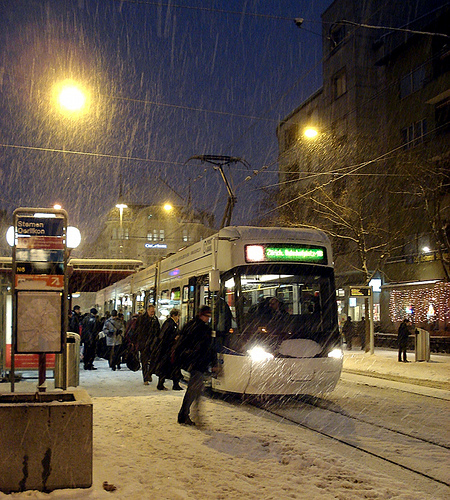
SWITZERLAND: Project promoter Zürcher Verkehrsverbund and concessionaire Verkehrsbetriebe Glattal organised a day of festivities to celebrate the opening of the final Auzelg — Stettbach section of the Glattalbahn light rail project north of Zürich on December 11.
The completed route runs from Stettbach to Zürich Airport via Wallisellen, Auzelg and Glattpark and is operated by VBZ as Line 12.
On December 11, following official inauguration ceremonies attended by local dignitaries, the line was opened to the public. A fleet of 13 vehicles ran at 5 min intervals between 11.00 and 18.30, carrying more than 70 000 visitors who came to try out the new airport connection and enjoy the entertainment provided at several stations as part of the Glattfest celebrations. Commercial service began on December 12.
Work on the 12·7 km network started in September 2004 and was divided into three stages. The first 3 km between Messe/Hallenstadion and Auzelg with five stops entered service in December 2006, as an extension of Route 11, followed by Phase II from Glattpark to Zürich airport in December 2009 operating as an extension of Line 10. Completion of the final section enables Line 12 passengers to transfer to S-Bahn services at Wallisellen and Stettbach.
Line 12 operates daily between 05.00 and midnight at 15 min intervals; journey time is 26 min and capacity is 960 passengers/h per direction. The route is worked by Bombardier Cobra low-floor trams.
TransLink Did Not Bark?

In the Sherlock Holmes story Silver Blaze, by Sir Author Conan Doyle, Holmes was able to deduce that the killer of Colonel Ross's racehorse was the owner of the stable dog. As the fictional Holmes chronicler Dr. John Watson explains:
Colonel Ross still wore an expression which showed the poor opinion which he had formed of my companion's ability, but I saw by the inspector's face that his attention had been keenly aroused
"You consider that to be important?" he asked.
"Exceedingly so."
"Is there any point to which you would wish to draw my attention?"
"To the curious incident of the dog in the night-time."
"The dog did nothing in the night-time."
"That was the curious incident," remarked Sherlock Holmes.
The only person at whom the stable dog would not bark warnings was the dog's owner. Hence, the dog's silence indicated that the only one who could have entered the stable and lamed the horse, was the dog's owner.
Since then, the metaphor of the "dog that didn't bark" characterizes the import of any conspicuous silence.
TransLink has been conspicuously silent with the Rail for the Valley Leewood Projects Fraser Valley Rail report and one wonders why?
For the first time in TransLink's short history a competitive regional transportation plan has been presented by a credible transportation expert, with emphasis on a variant of modern light rail – TramTrain, yet TransLink has remained silent.
Could it be that TransLink's highly paid bureaucrats think that the RftV/Leewood Report is a superior document and that bringing any attention to it will show how inept and dated their own 'house' product is? Are TransLink's transit planners so embarrassed by their inferior product that any mention of the competing transit plan may instill the notion that the taxpayer has paid ten years worth of taxes into TransLink for nothing?
Think about it; TransLink is demanding new taxes to fund new transit projects (read new taxes to fund the bureaucracy to plan and install those transit projects), yet RftV has provided, at no cost to the taxpayer, released a credible and affordable transit plan providing much more 'rail' route mileage than TransLink's product, at a far cheaper cost. A smart politician may start to ask questions such as; "Why do we need TransLink's expensive planning staff at all?"
TransLink's silence is telling, they are scared of the RftV/Leewood report.
The Evergreen Line – Will Finacial Reality Take Hold?

The problem with the Evergreen Line has always been about expense, what kind of bang will you get out of $1.4 Billion? Not much by all accounts and the lack lustre performance by the Canada Line is now sending financial shivers up TransLink’s spine as bureacratsAi??need oodles of property tax monies to subsidise the Evergreen Line because the ridership prospects are poor indeed.
Contrary to the hype and hoopla by the SkyTrain lobby about the Canada Line (which isn’t really SkyTrain at all), ridership is made up mainly of former bus riders, heavily subsidized students using U-Passes; pensioners using cheap concession tickets and YVR employees riding free on Sea Island, with many riding the line several times a day, inflating boarding numbers! The actual number of people using the Canada line amounts to just over 30,000 to 35,000 a day or about the same number of people that would be needed to justify a much cheaper, at least $1.5 billion cheaperAi??light rail line! Short trains and long headways give the illusion of overcrowding, sadly though there is no financial illusion and TransLink is now canceling rush hour buses that service South DeltaAi??and South SurreyAi??as the expected throngs of new ridership did not materialize.
Beware of those who keep repeating the mantra that the Canada line is a success. A lie repeated many times tends to be viewed as fact.
BC’s Transportation Minister, Shirley Bond, like her many predecessors, is absolutely clueless about public transit, transit modes, and just about everything else concerning regional transportation and the TransLink Board of experts, is nothing more than a bunch of amateurs who do not have the where to understand the concept of affordable public transportation, as they are nothing more than political toadies feeding off the public trough. This sad state of affairs has brought us a largely disfunctional public transit system, which far too expensive to operate and has done little in providing an attractive alternative to the car.
What to do; what must be done?
Let the Evergreen line die a natural death and at the same time, let TransLink follow the Evergreen line to the grave and start afresh. What the region needs is an independent review of ‘rail‘ transportation in the region and the role of public transit. For too long has the mini-metro system has been built to promote high rise densification along its routes and not providing an affordable public transit mode. Our transit modal is based solely on this densification mantra!Ai??Nowhere else in North America isAi??SkyTrain built for regional rail transportation; nowhere else is ‘rail‘ transportation built solely to inflate property values by allowing massive high rise style of densification!
Why does TransLink continue planning with expensive SkyTrain? Gerald Fox, American transit expert gives us a hint; “Vancouver will need to adopt lower-cost LRT in its lesser corridors, or limit theAi??extent ofAi??its rail system. And that makes some TransLink people very nervous.” Could it be that TransLink doesn’t want cheaper LRT or very much cheaper TramTrain, because they just do not have the expertise or the desire to buildAi??with cheaper light-rail? It seems with Translink, cou can’t teach an old dog new tricks and it is time to put it out of its misery.
Ai??
Editorial ai??i?? Time for second act
Arrogant, uninformed or disinterested? Which is it for Transportation Minister Shirley Bond, who is now blaming Metro Vancouver mayors for Evergreen Line delays and funding troubles?
Her ministry has complete control over the project and has known for more than a year that the mayors oppose using property taxes to fund it, and yet she and her government have failed to come up with any solutions more creative than simply extending the deadline for TransLink to ante up its share of the $1.4 billion project.
Sheai??i??s quick to criticize but she bears some responsibility for the current impasse. Why, for example, has there been no progress on the memorandum of agreement signed this fall by regional mayors and the ministry? That was supposed to be the forum in which to discuss alternative funding, such as taxing rising property values around SkyTrain stations or giving some carbon tax revenues to TransLink.
Instead, there is nothing on the table but property taxes. But that well has run dry. It would be better to initiate a vehicle levy ai??i?? which is also unpopular ai??i?? but at least it ties car use to transportation infrastructure. Where is Bondai??i??s commitment to providing a mechanism for collecting a vehicle levy? That was an olive branch that would have got the mayors to the table and solved the funding impasse.
The provincial government canai??i??t have it both ways. It created TransLink and decided a professional board and a mayorsai??i?? council were the way to balance regional politics with objective decision-making. If the province made sure it was funded adequately, there would be less criticism.
The province also ran roughshod over TransLink when it chose to build the Canada Line ahead of the Evergreen Line, which was a TransLink priority. It canai??i??t now simply throw in the towel and walk away.
Having hired the actors and written the play, itai??i??s time for Bond and the province to lift the curtain on the second act of the Evergreen Line.
ai??i??Tri-City News
(Black Press)
http://www.bclocalnews.com/surrey_area/langleytimes/opinion/111859519.html
From the Light Rail Transit Association – Mulhouse tram train ready

Mulhouse tram train ready : On December 12, 2010, ai???the first inter-connected tram-train of Franceai??? will enter into service. The public will be able to preview the new line from the afternoon Saturday 11th when there will be free travel on the trams, tram train and buses as far as Lutterbach on both the Saturday and Sunday.
The tram-train provides a third tram line in the city and connects Mulhouse railway station to Lutterbach.
10 December

The Mulhouse TramTrain new route, via a lawned rights-of-way and bicycle route, from the railway main line to the city centre.



Recent Comments