Victoria City Council Backs Light Rail
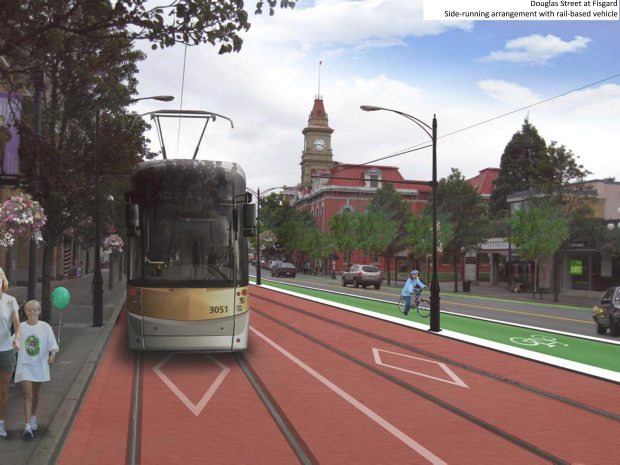
Unlike Vancouver City Council, Victoria City Council is not afraid to say the word Light Rail. In Europe, modern trams have proven affordable to operate in smaller towns and cities, while at the same time bringing the benefits of modern public transit that has made the mode so successful.
A TramTrain service, using the E&N route could connect directly to the proposed LRT lines, providing even greater benefits for those wishing for an alternative way to commute or travel to the downtown.
Having BC Transit doing the planning is worrisome though, as BC Transit has been hostile to LRT in the past and with their anti-light rail cousins on the other side of the pond (TransLink) to advise them bode ill for honest planning.
Rail for the Valley suggests hiring an independant consultant with up to date knowledge on modern LRT and TramTrain to do proper transit planning and just leave the construction of LRT up to BC Transit. Dare we suggest Leewood Projects in the UK as a contender for such a task…………………..
A Tram for All Seasons
Now is the winter of our discontent made glorious summer
Praise for our ice-beating tram staff from the people of Croydon
Tramlink avoided cancellations, lengthy delays and the avalanche of criticism which, rightly or wrongly, fell on those in charge of the borough’s roads and train lines.
The service received dozens of e-mails thanking staff for their commitment and determination, with one passenger, Shirley Thring, nearly “moved to tears”.
http://www.thisiscroydontoday.co.uk/news/Undefined-Headline/article-2985211-detail/article.html

From Croydon, Basle, Brussels, Budapest, Den Haag, Dusseldorf, Frankfurt & Hanover toAi??Helsinki, Ai??Manchester, Moscow, Nottingham, Paris, Portland, Stockholm, Toronto, Warsaw & Zurich. Light Rail & Tram systems in Europe & North AmericaAi??Ai??have been running faultlessly in the recent arctic conditions, unlike Vancouver’s Canada Line which embarrasingly failed on November 25th after only 10cm of snow fell.
The following image was taken yesterday in Finland’s capital Helsinki.

“… the weather’s bad, the roads are blocked and only the Trams are running….”
TransLink Stuff and Nonsense!
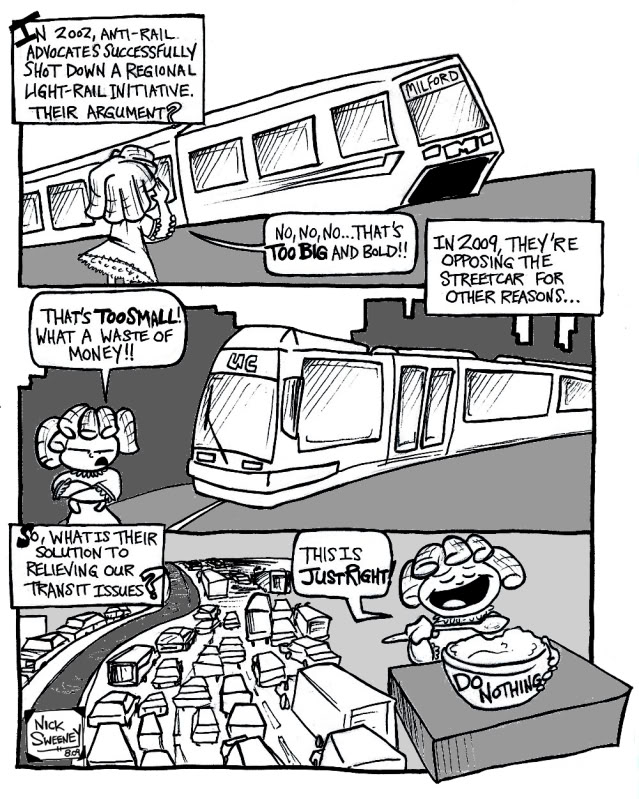
It seems that the regional mayors got tired of Langley City Mayor Fassbender support for the Evergreen line and changed the Chair ofAi??the Metro Vancouver Mayorsai??i?? Council on Transportation and voted District of North Vancouver Mayor Richard Walton as the new chair. No real change, as the Metro Vancouver Mayorsai??i?? Council on Transportation is as about as influential as a wet squib.
http://www.theprovince.com/news/Leadership+changes+TransLink+oversight+board/3954600/story.html
Until regional mayors understand the building new metro lines on routes that do not have the ridership to sustain them will require new taxes which translate into new and more onerous taxes.
The Georgia Straight has a story which confirms that the hype and hoopla from TransLink on the year and a half old Canada Line isn’t whatAi??it seems to be.Ai??TransLink has announced that the South Delta 602 & 603 buses (formerly BRT to downtown Vancouver) did not attract any new ridership and are now cut back to pre RAV days frequencies (about every 30 minutes). Zwei predicted this would happen almost a decade ago!
Also in the Straight are two other interesting items about transit. Simon Fraser University Proffessor Nancy Olewiler has been selected to the Translink Board of Ameteurs, and one doubts very much she  knows her TramTrain from a PCC! The TransLink Board is nothing more than a huge Liberal pork barrel, for already over paid Liberal cronies to gorge on. The Proffessor of Ecconomics label may look nice but in reality just another passenger on the TransLink Ship of Fools.
http://www.straight.com/article-363943/vancouver/sfu-economics-prof-chair-translink-board
And now from TransLink’s other ‘pork barrel’, TransLink have given Cubit Industries the $180 million Smart Card and Turnstile contract. No surprize there! Funny though that former City of Vancouver City Manager (during Premier Campbell’s time as mayor); former TransLink Chair (Appointed by newly elected Premier Campbell) and now Lobbiest,Ai??Ken Dobell, was also the chief lobbiest for Cubit Industries steering them to the right people. In BC, you get what you pay for!
How would Montreal’s tramways have fared in this week’s snow storm?
How would tramways have fared in this week’s Montreal snowstorm?
By Andy Riga
Whenever the topic of returning tramways to Montreal streets comes up, someone mentions our city’s rough winters.
The issue came up a couple of weeks ago when IAi??wrote abouta Board of Trade of Metropolitan Montreal study (PDF here). At a press conference about the study, Board of Trade chief executive Michel Leblanc questioned whether streetcars are a good idea for Montreal, considering the snow, ice and cold weather we get.
That story prompted readerAi??Avrom Shtern, the transportation spokesperson at the GreenAi??Coalition,Ai??to write to me.Ai??
“What planet are they from?Ai??All too often, I see reports by high-priced consultants who would like us to believe that they know what they are talking about.
The Montreal Board of Trade study discredits itself by saying that streetcars & related light rail may not be suited to Montreal’s winters.
They have ignored history…Ai?? Montreal’s tramways had operated in the harshest of conditions and were much more reliable in snow and ice than buses, (that incidentally were unavailable in [the Nov. 26] Montreal morning rush hour because of a little bit of freezing drizzle… )”
I asked Shtern to write something in more detail about streetcars in winter.
Here it is:
The Board of Trade of Metropolitan Montreal discredits itself by saying that streetcars and related light rail may not be suited to Montreal’s Winters.
They have ignored history… Ai??Montreal’s tramways had operated in the harshest of conditions and were much more reliable in snow and ice than busses. Ai??Ai??
Opponents of tramways often repeat the fallacy that streetcars are not suited in winter cities because snow, ice, freezing rain, slush, wind, condensation, etc., can be a problem and can impact on the reliability of operations.
Winter conditions are a challenge in the Snow Belt for all forms of transport butAi??electric trains can and have run in the snow as long as transit management worries about the consequences of shutting down the system.
The AMT’s electric Deux Montagnes commuter line was the last train standing/operating during the 1998 IceAi??Storm. Although it is a heavy rail commuter line it is typical of electric traction systems that are able to sustain operations during winter storms unless the overhead conductor fails.
Quite often, modern transit operators do not want to cope. This recently happened when STM buses did not show up because of a little bit of freezing drizzle and ice on the roads.
According to railway and mass transit expert Ai??Edson Tennyson:Ai??
“…about 1942, a big snow storm caught [Pittsburgh’s streetcar system ] off guard. Car house personnel had gotten fat, happy and careless soAi?? the snow sweepers in the back of the barn were hemmed in by bad order cars. Many sweepers had not been serviced for years and were not working reliably.” But this is a result of bad management not the inherent value of streetcar service. Ai??
Tennyson adds: “Electric traction can work well in snow. In 1949-’51 I worked in Milwaukee on the Rapid Transit. It ALWAYS ran in the ice and snow. Ice on the wire did cause trouble. The motormen had to get out and bang the trolley pole on the wire to knock the ice off but they eventually got where they were going. There were days that nothing moved in Milwaukee but electric traction.
“Some of the motormen, expecting a big storm would sleep in the cars at night so they would be there on time for their run. Shaker Heights Rapid Transit [Cleveland, OH] was more sophisticated.Ai??They sent the Line Car, [Catenary Car], out with two men on the roof with baseball bats. They banged away at the live wire as the car moved slowly Ai??to get the ice off. Ai??Line Cars had wooden roofs and the men had rubber gloves and boots. Deep snow was ploughed.”Ai??
Hydro Quebec now has a melting techniqueAi?? that heats the conductor.
Years past, motorists would switch over to streetcars and trains during winter storms. Many urban electric traction railways added service during stormy periods to carry the “Snow Bird” motorists. The intrinsic efficiencies of the streetcar in snowy conditions is well known in winter cities that host tramway networks such as:
Helsinki, Finland, St. Petersburg Russia, Moscow, Russia, Oslo, Norway, Geneva, Switzerland, Basle, Bern and ZA?rich Switzerland, Gdansk, Poland, (Danzig),Ai??Ulan Bator, Mongolia, Minsk, Belarus, and P’yAi??A?ngyang, North Korea.
P’yAi??A?ngyang has a hard time running the system because of financial difficulties, not because of winter snow. Likewise, Moscow and the new Toronto mayoral administration are currently hostile towards the tramway because of ideology that favours the car above else.Ai??Ai??Ai??
St. Petersburg, Zurich and Helsinki have extensive systems.
The Helsinki tram network is one of the oldest electrified tram networks in the world.
St. Petersburg, Russia claims to be the most extensive network in the world.
Winter cities like Milwaukee, WI, Burlington, VT and Montreal also had streetcar systems which did not cease operations during stormy conditions.
The streetcar has also gotten a bad reputation regarding street congestion.
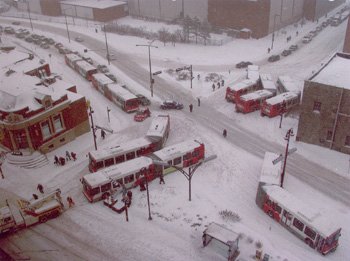
Buses hinder traffic flow more than the streetcar, as more are required to carry the same passenger load. Below is an image accounting a winter mess associated with articulated buses in Ottawa in 2005. The image below was taken by Harry Gow of Friends of the O-Train.
The following link is to:a photo of one of STM’s predecessor Montreal Street Railway’s snow sweepers.Ai??
this YouTube video of a tramway in snow in Oslo, is on the Projet MontrAi??al Facebook page:
Ai??
The Vancouver Sun Again Embarrasses Itself With a Pro SkyTrain – Pro TransLink Editorial!
In one of the most self serving pro-TransLink, pro-SkyTrain editorials yet, the Vancouver Sun printed a "puff' editorial authored by former Premier Mike Harcourt, who championed the Canada Line, and Dale Parker, Chair of TransLink, whose planning bureaucrats still squander millions of dollars on unachievable metro plans. The aim of the editorial, of course is to try to embarrass the regional mayors to get onside with more tax monies so TransLink can squander millions more on 'pie in the sky' transit planning.
According to Harcourt (please remember this is the chap who built a house on a cliff and with a complete lack of foresight built a sundeck on the cliff without a railing and promptly slipped off and almost killed himself) the Canada Line is a great success and we live in the "…….world’s most livable region……..". Me thinks Mr. Harcourt still suffers from his most avoidable accident.
The Canada Line, a $2.5 billion plus truncated metro line carries less than 40,000 actual riders (some estimates could be as low as 30,000) a day, with many riders traveling free, such as the YVR workers who park at the massive employee parking lots on the periphery of the airport and travel free on the Canada Line (all travel on the Canada Line is free on Sea Island) to complete their journey to work! U-Pass enabled students are using the Canada line multiple times a day, which like a ponzi scheme, drives up the number of boardings, while at the same time not adding new actual ridership.
In South Delta, TransLink is cutting back on rush hour buses because transit customers did not flock to the new metro and former transit customers, who used to have a direct service to Vancouver but now are forced to transfer to the Canada Line, are slowly returning to the car.
If this is the great success as espoused by Harcourt, then please, we can't afford any more TransLink success.
The financial problem facing TransLink is simple: Three decades of planning for the extremely expensive SkyTrain light-metro has blinkered transit planners at TransLink to plan for only SkyTrain. Much cheaper light rail has been rejected outright with a litany of invented excuses, which boarder on being out right lies. TransLink's inbred and self serving SkyTrain light-metro doctrine rejects light rail and treats it as a poorman's SkyTrain, despite the fact the modern LRT is the predominant urban 'rail' transit mode in the world, while at the same, the same planning mandarins quietly plan for massive new highway expansion because SkyTrain is just too expensive to extend into regions where new transit is so desperately needed.
No thanks Mr. Harcourt and Mr. Parker, your sordid spin is not believed. TransLink has utterly failed in providing an affordable and efficient transit system for the region. Planning for affordable transit options such as the Rail for the Valley/Leewood Report TramTrain for the Fraser Valley is rejected outright. TransLink is built on a foundation of moral and financial quicksand. Regional mayors are quite right in rejecting increasing property taxes to pay for more expensive TransLink bureaucrats needed to plan for more costly and largely unaffordable metro projects in Vancouver, which in turn will require even more tax increases in the future to fund.
Gerald Fox, an American transit expert concisely sums up TransLink's financial woes; "……Vancouver will need to adopt lower-cost LRT in its lesser corridors, or else limit the extent of its rail system. And that seems to make some TransLink people very nervous."
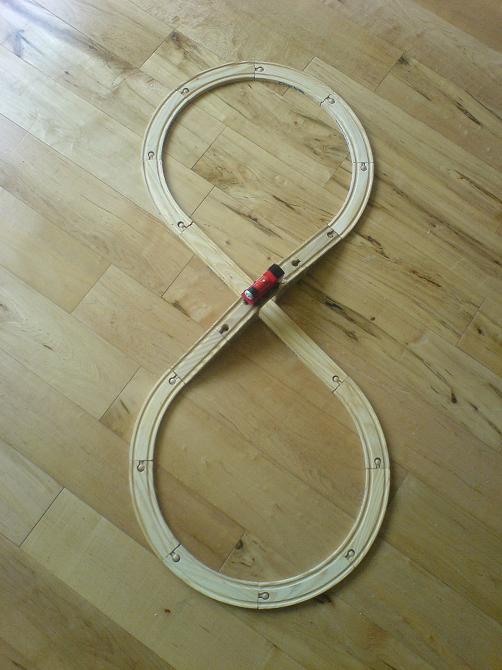
TransLink's planning just goes around in expensive circles, achieving very little.
Opportunity for Metro Vancouver transit foundation is now
Rail for the Valley simply makes sense
Rail for the Valley simply makes sense
THE TIMES DECEMBER 7, 2010
Editor, the Times:
While local mayors bicker with TransLink over the funding of yet another grossly expensive metro line for the region, Rail for the Valley, in association with Leewood Projects in the UK, have provided the region with a far cheaper alternative; a TramTrain transit plan for the South Fraser region. The 84 page RftV/Leewood report found that a basic service (three trains an hour each direction), 98 km Scott Road Station to Chilliwack LRT TramTrain could be implemented for as little as $492 million, while a full build, 138 km Vancouver/Richmond to Rosedale service could be had for as little as $998.5 million. Compare this with the $1.4 billion, 11 km Evergreen line. The RftV/Leewood Report has been very well received overseas, with articles on the Valley Interurban in Railway Strategies and the internationally acclaimed Tramways & Urban Transit, yet locally, this very important study has been all but ignored.
TransLink has treated the RftV/Leewood Report with disdain as they continue to plan for multi billion dollar metro lines that the taxpayer just can’t afford.
For the cost of the 11 km $1.4 billion Evergreen SkyTrain mini-metro, we could build 138 km of TramTrain From Vancouver, past Chilliwack to Rosedale and have enough money left over to build a 50 km Vancouver to Maple Ridge TramTrain service. Who builds with SkyTrain today? No one, yet over 20 cities, including Paris are building and or extending TramTrain lines.
In an age of global warming and peak oil, is it not best to get the biggest bang for your transit buck?
Malcolm Johnston,
Delta
Ai??Ai?? Copyright (c) Abbotsford Times
via Rail for the Valley simply makes sense.
Good News Story
Croydon residents praise Tramlink heroes for keeping service running through snow
Croydon Guardian http://www.croydonguardian.co.uk/news/8721876.Residents_praise_Tramlink_/
As trains were cancelled throughout last week and buses struggled to get around due to icy roads, Croydonai??i??s Tramlink managed to run a regular service.
A heroic effort from the Tramlink team mean the service was, at times, the only reliable public transport operating in the borough. The trams usually carry an average of 89,000 people a day, during the worst of the snow fall, this rose to 108,000 residents.
Dedicated staff put in hours of overtime, managers and admin staff trekked to Croydon from Central London and set to work shovelling snow off platforms and gritting them to keep them ice free, as well as clearing fallen tree branches and snow from the tracks.
Tramlink ran ghost trams throughout the night to keep the rails clear and when tram drivers were unable to get to work, their colleagues worked overtime and ticket inspectors – who are also trained drivers – volunteered to help.

Has The “War On The Car” Gone To Far?

There is a growing problem concerning public and regional transportation that has become very worrisome and that is the so called "war on the car". This simple phrase has been used with great effect in Toronto, where anti-transit politicians have been elected in the Toronto metro region, whose sole goal is to dismantle Toronto's public transit system. The slogan used was to "end the war on the car" and voters agreed.
In the Vancouver Metro region, there has been great debate between TransLink and regional mayors on how to close the $400 million TransLink funding gap for the SkyTrain Evergreen Line project. The regional mayors, quite rightly, are rejecting increasing property taxes and instead advocating new sources of revenue which include auto levies and road pricing to increase transit funding and in effect, creating a war on the car to fund expensive metro projects.
In Vancouver, the Vision dominated city council has already been at war with the car, by implementing cumbersome new bike lanes and restrictive car parking measures in the city.
Now gas prices are rising, with the price of gas reaching $1.20 a litre this weekend; the car driver feels taxed out.
A transportation expert, some years ago, once told Zwei; "For road pricing to work, the region with road pricing must have an attractive alternative to the car in order for the motorist to favourably comply with the new tax, if not, there will be repercussions at the next civic elections." "And, oh by the way, buses are not seen by the motorist as a viable alternative to driving."
The war on the car is a two way street and may become the war on transit, as we have recently witnessed in Toronto. Could it be that onerous new car taxes that well paid politicians and bureaucrats so glibly propose, could spawn a HST style tax revolt against everyone connected to implementing new restrictive car taxes and rules?
Could it be that TransLink, in order to provide good public transit, must start providing economic public transit solutions which must include much less costly light rail instead of very expensive SkyTrain mini-metro and operate the buses cost effectively which means stop operating politically inspired bus servcies on routes with very little custom (South Delta has three bus routes that operate a hourly or better schedule, yet carry fewer than 20 people a day!) and are heavily subsidized.
When politicians and bureaucrats begin to think that the taxpayer is nothing more than a rube that can be constantly 'shaken down' for more taxes, then I think the seeds for war on the car have been sown and as the Bible states; "As yea sows, so shall yea reap!"
Transit News From Around The World – December 3rd 2010
Light rail train derails in Seattle
Komonews
http://www.komonews.com/news/local/70237837.html
Business leaders: Build light-rail leg to Tampa airport
Tampa Bay Online
Manchester passengers consulted over closure of Metrolink stop
Rail Technology Magazine
Light Rail news
Rail Technology Magazine Pages 46 – 53 inclusive; Manchester, Sheffield,
Edinburgh, Tyne & Wear and Liepaja
Fraser Valley Interurban Tram-Train
Railway Strategies
The Tram, French Tramways
French Property.com
http://www.french-property.com/reference/french_transport/tramways/
and
http://www.beyond.fr/villages/nice-tramway-provence-france.html
Tramways in France – born again for urbanism
http://connectedcities.eu/downloads/magazines/nt_2007_feb_eivp.pdf
http://www.trams-in-france.net/reload.htm?lyon.htm
Tram-trains Citadis Dualis and Regio Citadis
Combining the best of trains and tramways
What Fools We Mortals Be – Toronto’s New mayor, Rob Ford.
American style Tea Party politician andAi??Toronto’s new mayor Rob Ford, is taking the TTC back 50 years or more by forcing the TTC to build new subways, instead of much cheaper light rail. Ford is just mimicking the same bleat that AmericanAi??politicos use, the “war on the car” andAi??has used itAi??with great effectiveness, but what Mr. Ford has done, is toAi??declare warAi??on the taxpayer, with massive new taxes and probably new car taxes, levies and feesAi??needed to pay for hugely expensive new subway construction.
Rob Ford has all the traits of a political buffoonAi??who has rode the wave of public discontent, combinedAi??with generous financial help,Ai??into public office. It is apparent thatAi??Ford’s financial backers are rubber on asphalt types who do not want affordable public transit, especially when said transit competes directly with the car. Modern light rail, when built right,Ai??has a proven ability in providing an affordable alternative to the car, something that much more expensive subways do not. With LRT a much larger transit network can be created, providing the customer easier access. With subways and metros in general, longer spacing between stations and limited routes, tend to deter new ridership. Subways or elevated metros are only built if ridership on a transit route warrants such a costly expenditure.
Enter Rob Ford, who believes he is a transit expert, as all politicians seem to doAi??and proclaims that no LRT for Toronto and promises the abandonment of the famous Toronto streetcar system and for what reason for his politicalAi??castration of public transport?

ai???War on the car is overai??i??: Ford moves transit underground
December 01, 2010
Paul Moloney
The $8 billion Transit City light rail plan championed by the former mayor David Miller ai??i?? years in the making and with construction underway ai??i?? is ai???overai???, Mayor Rob Ford declared on his first morning on the job.
Ford made the remarks while being mobbed by reporters Wednesday morning as he emerged from his new office to go downstairs to the cafeteria.
Ford said he met at around 7 a.m. with Toronto Transit Commission chief general manager Gary Webster to emphasize that subways are preferable to the 120-kilometres of streetcar routes laid out by Miller.
ai???We just had a meeting about subways,ai??? Ford said regarding his chat with Webster.
ai???I just wanted to make it quite clear that he understood that Transit Cityai??i??s over and the war on the car is over, and all new subway expansion is going underground. And thatai??i??s pretty well it,ai??? Ford said.
ai???I just told him that everything moving forward is underground. And he accepted that. And I look forward to working with him.ai???
Ford, who wants to build a subway to the Scarborough Town Centre, said he didnai??i??t specifically insist that ongoing work on the new Sheppard light rail line be stopped.
ai???No, I just told him whatever weai??i??re doing is going underground, so weai??i??re going to build subways. I was elected on that mandate, and Iai??i??m going to deliver my promises to the taxpayers that subways will be built in the city.ai???
Ford said he has yet to speak to Premier Dalton McGuinty, whose provincial government has put up most of the money for Transit City.
The new mayor did indicate he would like to see light rail money diverted underground.
ai???I look forward to meeting with Mr. McGuinty about the funding with respect to subways,ai??? he said. ai???Again, Iai??i??m going to talk to Mr. McGuinty and weai??i??ll take it from there. Iai??i??m trying to set something up as soon as possible.
Ford was non-committal when asked who will be responsible for the money already spent if the light rail plan is scrapped. The Ontario government says it has so far spent about $130 million and signed contracts worth $1.3 billion.
Ottawa is contributing $330 million for the Sheppard line, about one-third of its cost. The province has said it will cover the rest of Transit Cityai??i??s $8.15 billion bill ai??i?? for Sheppard, a Finch light rail line, an Eglinton crosstown route, and conversion of Scarboroughai??i??s aging rapid transit line to light rail.
ai???Again, Iai??i??m going to deal with the province with respect to that and take it from there,ai??? Ford said.
The mayorai??i??s power to act unilaterally was, however, quickly questioned. City council as a whole approved Transit City and council as a whole would have to agree to kill it.
ai???I think itai??i??s premature,ai??? rookie Councillor Josh Matlow said of Fordai??i??s pronouncement. ai???I believe that council should have an opportunity for discussion about public transit in this city ai??i?? transit affects everyone in every corner of the city and there are millions of tax dollars at stake.ai??? There are several council meetings scheduled for next week but traditionally they are just ceremonial. It is not clear if any motions will be introduced.
Matlow (Ward 22, St. Paulai??i??s) acknowledged Ford was elected with a large mandate promising a subway plan, rather than Transit City, and wants to people to know ai???thereai??i??s a new sheriff in town.
ai???But many councillors were elected with large mandates supporting Transit City ai??i?? letai??i??s not invalidate those elections. We need a responsible, thoughtful discussion.ai???
Webster, after emerging from his early-morning meeting with Ford, told reporters: ai???The plan we have in place was put together with a lot of thought and we supported it and we do support the plan as a good transportation plan.
ai???The mayor is saying ai???Fine, but Iai??i??m looking at a new plan.ai??i??ai???
Webster said provincially funded work by the TTC will continue on a Sheppard Ave. underpass at the Agincourt GO Station, noting it would happen whether a subway or light rail line goes there.
Webster said he was directed to go back to Ford with a new plan, which could take up to six weeks.
At noon in Nathan Phillips Square, a few dozen protesters from groups including the Ontario Coalition Against Poverty huddled in cold drizzle in front of a banner stating: ai???Rob Fordai??i??s gravy train will just feed the pigs.ai???
Lisa Schofield of OCAP said the protesters are demanding changes to the way welfare is administered, the elimination of the waiting list for subsidized housing and better public transit for the poor.
ai???As (Ford) is cutting Transit City, heai??i??s also going to be cutting services to poor and working-class people,ai??? Schofield told reporters.
ai???Our biggest fear is a (former premier Mike) Harris-style era in this city, which we can all be terrified of, quite frankly.ai???



Recent Comments