From the Vancouver Province – TransLink looks to crack down on fare evasion. Are Turnstiles Really Needed?

The following article gives good reason for not installing turnstiles or using smartcards. First, turnstiles and smartcards do not deter fare evasion; secondly, the estimated $5 million revenue loss due to fare evasion is less than the estimated $12 million to $15 million annual operating costs of the turnstile/smartcard operation.
Paying $15 million annually to recover $5 million in evaded faresAi??is just plain stupid!
If anyone needs see why TransLink is in continual Ai??economic chaos, it is the government forced $180 million implementation of turnstiles and smartcards on the SkyTrain/RAV mini-metro system – an expensive ticketing system that TransLink can not afford nor needs.
It is also interesting to note that there is a push by metro operators to do away with turnstiles altogether, as they are seen as a hindrance to transit customers.
ThereAi??could beAi??another reason for TransLink’s 8% estimated loss in revenue: phantom riders or transit customers that never were. TransLink’s method of calculating ridership is an alchemist’s mixture of spot boarding counts, spot loading counts, ticket sales, and more. TransLink’s ridership is based on a computer model, which doesn’t take into account multiple trips per fare paid, like what is happening with the extensive U-Pass program, or monthly passes. Real ridership could be off by as much as 5% to 10%!
Yes, there is fare evasion on our metro transit system, but until TransLink uses meticulous boarding counts and have annual independent audits of ridership, there can be no real claim of massive fare evasion. If there is no massive fare evasion to counter, then there is no need of a $180 million farecard/turnstile system for the metro and the money being better spent on more buses or even, for heavens sake, a Fraser Valley TramTrain service.
TransLink looks to crack down on fare evasion
Bus Rapid Transit Vs. Light Rail
Too often theAi??Bus versus Light Rail debate omits to mention the operational costs associated with public transport.Ai?? This is the great weakness of the bus when there are significant numbers of passengers to be carried.
Official American cost comparisons show that the cost of carrying a passenger on light rail is approximately 2/3rds that of carrying a passenger by bus.Ai?? Large numbers of passengers means substantially higher operating costs if buses are the only available mode.Ai?? At the upper bands of passenger numbers heavy rail is the cheapest.
The higher cost of bus operation is due to driver wages.Ai?? Compare the capacity of a bus with that of a modern LRV and then further consider that these LRVs are often operated in multiple units with only one operator.Ai?? Now work out the productivity of the bus driver compared with the LRV operator!Ai?? And remember “platform costs” of public transport comprise some 80% of total operating costs.
Considerations such as these are of course usually lost on theAi??financial bean counters of the English speaking countries who fixate on Capital Costs rather than Lifetime Costs of a service.
Brisbane, Australia (BRT) Bus Rapid Transit
If there could be any doubt, of the cost effectiveness and the capability to relieve urban congestion of Bus Rapid Transit [BRT], study the following image of Brisbaneai??i??s system.
http://www.translink.com.au/about-translink/what-we-do/infrastructure-projects/busways

TransLink in BC are actively promoting BRT as the answer for transit in the Fraser Valley, they & the City mayors & councillors who are being pushed into accepting BRT as the only available option would be as well to study Professor Graham Currieai??i??s (Monash University) report:
Bus Rapid Transit in Australasia: Performance, Lessons Learned and Futures
http://www.nctr.usf.edu/jpt/pdf/JPT%209-3S%20Currie.pdf Ai??
The Silence of TransLink Speaks Volumes

Since Rail for the Valley released the RftV/Leewood TramTrain report in September, there has been a silence from TransLink and the government's two favoured media outlets, the Vancouver Sun and CKNW radio on the valley rail project. All the TV stations did reports, as did all the regional (semi)weekly newspapers, which is credit to their profession; but from TransLink – silence.
This was not unexpected as RftV has done what TransLink cannot or will not do, which is to produce a modern transportation plan based on light rail. It is no secret that TransLink treats LRT as a 'poorman's' SkyTrain and all the light rail planning done by TransLink has made LRT look inferior to SkyTrain, both in service and ability. TransLink's well paid mandarins just can't accept the fact that modern LRT had made SkyTrain obsolete before the first ALRT train operated on the Expo Line. The evidence is plain as one's face; no one builds with SkyTrain – well virtually no one as there are only seven such systems operating around the world (soon to be six when Toronto's Scarbough Line is dismantled and replaced by light rail).
Since SkyTrain was first marketed in the late 1970's, over 150 mew light rail lines have been built or are under construction, with many more in various stages of planning, yet listen to TransLink or BC's various Minister's of Transportation, one would think the opposite was true!
TransLink still claims and advises the Minister of Transportation and Metro Vancouver Board, that LRT can't carry more than 10,000 persons per hour per direction, yet in the real world, modern LRT can carry more, over double the capacity claimed by TransLink. This alone should bring charges of professional misconduct against TransLink's planning bureaucrats and managers, yet the mainstream media, because of a lack of transit savvy reporters, ignores TransLink's grand economies of the truth. If TransLink is fibbing about light rail's potential capacity, one wonders what else they are fibbing about.
Of course, this why TransLink is silent on the RftV/Leewood report, for if they admitted what is stated in the report about light rail was true, then they would have to admit that their claims about modern light rail are not true and it seems that TransLink's planning mandarins would rather collect six figure annual salaries and generous car allowances, rather than admit that their transit planning was based on a foundation of misinformation and pixie dust.
In BC and especially the Metro Vancouver region, misinformation and pixie dust planning are the hallmark of regional 'rail' transit planning.
Mayors face tax dilemma

More thoughts on the TransLink/regional mayors funding debate.
What I do not see is any hint of fiscal responsibility from TransLink, just demands for more money with dire threats on what will happen if funding doesn't come through.
In South Delta, three bus routes, the C-84, C-89 and the 609, which operate at 60 minute headways or better, during the weekday, carry fewer than 25 passengers a day between them! One must ask the question; "How many bus routes are carrying fewer than 25 passengers a day?" Is this the example of TransLink's definition of an economic service? if so, maybe we can do without TransLink's extravagance with our tax monies.
Public transit is not a social service, though many transit advocates and politicians believe that it is, with the result of a very expensive transit service that in the end, does not provide the service levels that would provide an attractive alternative to the car.
What TransLink wants funding for is a dated metro system, which its passengers are supplied (in many cases by a forced transfer) from an unattractive (from the customers view) bus service. Pre loading ridership with students with U-Passes and various other concession fares has made the regional transit service appealing only to the poor, the elderly and students; a sure sign that the transit system is not just broke financially, but broken completely.
Regional mayors should put an end to TransLink's misery and let the provincial government take it back so the Premier and MLA's can once again play trains on their own.
A Letter From Jacob de Raadt
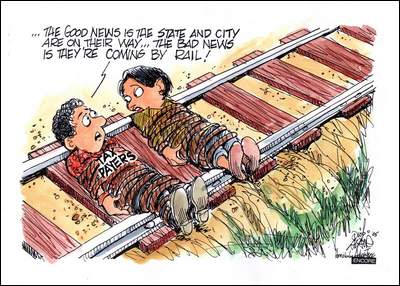
There is a growing realization from Fraser Valley taxpayers that the South Fraser region should secede from TransLink and even the GVRD. For far too long, the North Fraser cities have used the South Fraser as a 'Milch cow' for taxes to fund politically prestigious light-metro projects such as SkyTrain.
Valley taxpayers are waking up to the fact that there is no money for 'rail' transit South of the Fraser and no one at TransLink seems to be capable to plan for affordable light rail solutions for the region. The Rail for the Valley/Leewood report has shown TransLink's Achilles heel with their Vancouver to Chilliwack TramTrain plan. The RftV/Leewood report shows that light rail can be built for about $6 million/km, versus over $125 million/km for SkyTrain.
Fraser Valley civic politicians had better test the wind, so to speak, with local voters and taxpayers before next years elections, who are growing far more educated on regional transit issues than the bureaucrats in their expensive ivory towers on Kingsway would like. In fact, for South Fraser politicians, voting in favour of increasing or adding new taxes to fund the Evergreen Line might be treated like the soon to be former Premier, Gordon Campbell, with the HST debacle!
The only way that the region will get modern light rail is to secede from TransLink and go it on their own.
Dear Editor, Langley Advance,
The phrase “Moving Forward plan” was mentioned in your article “TransLink tax appears doomed” (Langley Advance, November 19). I believe that in order to be “Moving Forward”, one needs to “go back” a little bit, to see where one has been. With your indulgence, I would like to do this in some pre-TransLink time frames of 21 years each, gong back to 1947 – 1968 – 1989 and then 2010.
In 1947, oil was discovered at Leduc, Alberta. The huge impact of that gusher (and those that followed) on Western Canada was likely the main reason for the short-sighted decision to abandon passenger services on the BC Electric Railway in the Fraser Valley in 1950. The Trans-Canada Highway Act was promulgated in 1948, and the system was in the planning stages. Diesel fuel was going to be abundant and dirt cheap, eh? This passenger service abandonment followed the provisions of the 1907 Langley Rail, Power and Light Bylaw – the “charter” of this railway line – and soon after that, it was forgotten, also when the City of Langley separated from the Township of 1955. We heard last year (2009) that the 1907 Bylaw is still valid in the Township. Was the City of Langley ever advised of its existence, and that it may also still be valid there? This affects the construction costs of railway crossings, likely also the one that is now being proposed at 196th Street. Perhaps both municipalities should pay nothing for it. And the similar Bylaw that the City of Surrey has, might suggest that they pay nothing.
In 1968, a substantial part of the BC Electric Railway was relocated through the District of Surrey, City of Langley and Township of Langley. To my knowledge, it was only Mayor Poppy of the Township of Langley who had the foresight to schedule a meeting with BC Hydro, in which a promise was obtained for a railway overpass at the Langley Bypass (although that was located within the City of Langley) “to be built whenever traffic would warrant”. I guess that as only a few trains per day were envisaged, vehicular traffic was meant. To date, after 42 years, nothing has come of this promise. Methinks traffic warrants it.
I am not sure if those Township Council minutes are still enforceable on BC Hydro, in terms of the 1907 Bylaw. I can only guess that if the City of Langley had known about that promise, and had been aware of the 1907 Bylaw, they would also have been able to solicit a similar promise for a railway overpass on 200th Street. That would have been their obvious “due diligence” for the long term view and good of the City. Perhaps at that time, the City fathers still had post-partum depression, or they were still navel gazing about streetlights……
In 1989, the Socred provincial government of the day launched the “Freedom to Move” program, with many colourful glossy brochures. The promise of lots of work for consulting engineers in fact brought my family to BC from Yukon that summer. Under the Hon. Rita Johnstone, Minister of Transportation, this was to solve future traffic congestion in the Lower Mainland, continuing the Flying Phil Gagliardi highway building booms that were so typical of that party.
Under the “Freedom to Move” program, the Surrey-Langley Transportation Study was launched. It recommended quite a number of highway improvements, including a railway overpass on the Langley Bypass. Instead of a railway overpass on 200th Street, (not possible due to the short-sighted build-up around it, which was acknowledged), one was proposed on 196th Street, with the complete closure of the Fraser Highway railway crossing. We all remember that the Socreds imploded soon thereafter, and that the second NDP regime started a decade of general decline in construction activity, except for some vibrating aluminium hulls. Also, the Greater Vancouver Regional District was handed down various transportation responsibilities that the provincial government did not want to have any more, hence GVTA / TransLink. And of course, the BC Transportation Financing Authority, a para-government agency that handled Design-Build-Develop projects that e.g. sold off the highway right-of-way of Highway 1 to a developer called Grosvenor International, to build a “fiasco”. (The BC Liberals, when they came into office in June 2001, and the Township of Langley, both had a chance to stop it, but did not.)
Now, in 2010, we have new new buzz word – the “Moving Forward plan”. TransLink now acts, through its CEO, as if it calls all the shots, while the Ministry that is now known as MOTI (instead of MOTH) – Highways has now become Infrastructure – is not even mentioned in your article, as if there are no provincial highways through our municipalities. You may remember that at one time in the early 1990’s, the Township of Langley almost seceded from the GVRD (now called Metro) and thought about joining the regional district comprised of Abbotsford and others to the east. Only “water” kept the Township in the GVRD. It is surely no wonder that all mayors south of the Fraser River are now baulking at the request for more tax or fees or tolls into a gaping sinkhole, with a stated purpose to build a “Nevergreen Line” with outdated technology, way over there in Coquitlam and Port Moody, on the other side of the Fraser River, where many of us never go or want to go.
Someone else called TransLink a virus the other day on your pages. Because TransLink remains to be an unelected body, while the Provincial Government with all its shortcomings still remains to be one, I would like to give that virus a name – the North Fraser Virus. What medicines are helpful to combat viruses? Isolation is perhaps one of them. Perhaps the GVRD (now called Metro) should split in two, so that those of us on the south side of the Fraser River could pursue out own transportation future.
The South of the Fraser Rail Task Force has already brought these municipal councillors closer to each other. I guess they now have a better and broader view of each other’s real needs, which are different from what the North Fraser Virus dishes up. I would therefore encourage all of them, from Delta, White Rock, Surrey and the two Langleys) to stand together more, and to think seriously about such a split – and to make it a reality in 2011. Now, there’s an early New Years Resolution! This split would be more logical than the Langley split of 1955, which in my view, should be undone. We all have streetlights.
Jacob de Raadt, Langley City
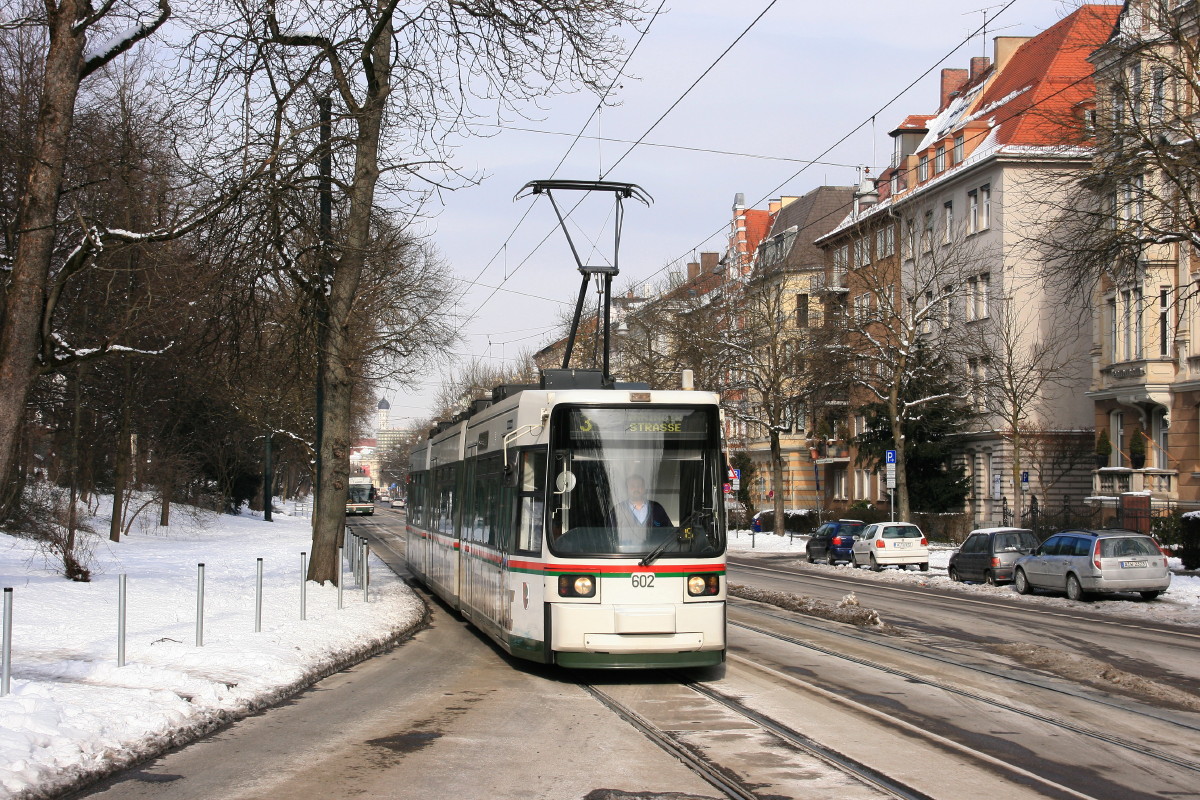
Light Rail & Tram systems do not stop for snow!
From Thursday 17 December 2009 to Friday 15 January 2010 the United Kingdom experienced a spell of very low temperatures and significant snowfalls which affected almost the whole country. This was the most widespread and prolonged spell of this type across the UK since December 1981/January 1982. Large areas of England, Wales and Northern Ireland regularly saw night-time temperatures falling well below freezing, and on occasion below -10 °C, while in Scotland night-time temperatures in the Highland glens regularly fell to -15 °C or lower. Daytime temperatures in many areas frequently struggled to rise above freezing, often remaining several degrees below.
The freezing temperatures were accompanied by widespread snowfalls on many days throughout the period. With daytime temperatures often failing to rise above freezing, little thawing occurred so fresh snowfalls added to previous accumulations. Depths of 10 to 20 cm were widespread across England and Wales, whilst across upland areas of northern England and in the Scottish Highlands, depths exceeded 30 cm in many areas.
The snowfalls and widespread freezing conditions caused very significant disruption across the United Kingdom through this period. Transport was particularly badly affected with snowfalls causing numerous road closures, and train and flight cancellations.
The British transport system, is not usually noted for coping with winter snowfall and with that in mind the Light Rapid Transit Forum [LRTF] recorded UK Light Rail systems operating faultlessly over the month:-

Nottingham Express Transit

Manchester Metrolink

Sheffield Supertram
There are many lessons that Transit advocates and planners in BC could learn from Europe; the challenges of designing and planning systems that will operate in reliably in all conditions. The imperative is for implementing solutions to reduce human-caused additions to greenhouse gases and slow down the rate of climate change.
Croydon Tramlink in the Snow
The bad weather of January 2010 presented an excellent opportunity to photograph Britains premier Tram system coping with the adverse weather conditions. Despite huge amounts of chaos on the roads and railways throughout the south east of England, the trams were running normally and were very well used .

http://www.simplonpc.co.uk/Photoblog_20100106_Croydon.html
The Canada Line Fizzles In The Snow
Ai??
| The $2.5 billion Canada line fizzled today in the 10 cm of snow that fell in the Richmond area. Unlike the SkyTrain proprietary light-metro system, which had a small army of attendants stationed on trains and station platforms to prevent the snow shy SkyTrain from stopping, TransLink seemed unprepared with the weather related problems on the Canada Line.
SkyTrain’s problems in the snow range from snow accumulation on the anti-intrusion strips at stations, setting off alarms, to snow egress into the Linear Induction Motors which hang a mereAi??one centimetreAi??above the reaction rail located between the running rails. The problem with snow shorting out the LIMs have plagued not only Vancouver’s SkyTrain but SkyTrain operations in Toronto Detroit and New York. The RAV/Canada line is a standard subway line, powered by conventional “squirrel cage” style of motors and should not have posed a problem in todays rather light dusting of snow. The claims that snow and ice on the Skybridge over the Fraser River just doesn’t make sense at all as the icy arctic weather has been around for a week and only 10 cm of snow fell. Obviously there is a more serious problem afoot and probably akin to the lost traction problem plaguing the RAV Line in Richmond. What today’s problem as shown is the silliness of TransLink policy forcing all bus customersAi??from South Surrey and South Delta to transfer to the metro, because if the metro goes down, there is no public transit alternative to Vancouver and everyone must use a time consuming and inconvenient bus bridge to cross the river. It is this type of bad planning that makes TransLink unfit to plan for regional transportation. Canada Line update 11/25/2010
It’s been a messy morning on the Canada Line. Trains on that line have been struggling in the snow and ice. The latest from Translink is the Canada Line is still running only as far as Marine Drive station and Bridgeport Station with a bus bridge in-between. That’s because of a weather-related problem with the power rail on the bridge over the Fraser River. The train that had been stuck on the bridge for about an hour was recovered and brought into Bridgeport just before 10:30. A de-icing train has been dispatched: no indication yet when that job will be finished and service across the bridge restored. http://www.news1130.com/news/local/article/148567–canada-line-fails-to-stand-up-to-snow UPDATED at 1:12 p.m.: Canada Line service is running across the Fraser River Bridge again. Service is running normally to YVR-Airport, but is “limited” between Bridgeport and Richmond-Brighouse.Ai?? Jason Chan with Protrans BC, the company that operates the line, says there wasn’t much they could do. “Basically, it’s just snow and ice build-up.” The big problem was on the bridge that runs over the Fraser from Richmond-Brighouse to the Marine Drive station. Chan says they ran trains all night hoping to prevent stoppages like this morning’s, but it was something that was unexpected. Chan promises they’ll be reviewing their policies but has no promises for commuters. “We’re working hard to find a reliable solution to make sure this doesn’t happen again.” However, that might not go far enough for the people who were stuck. One woman tells us, “I’m not impressed. I just don’t know what they would do if we were in Toronto or Montreal… if we had real snow.” Another man says, “This is the first time I’ve taken transit to work. I’m not impressed.” |
Peak Travel on SkyTrain
Ai??Ai??http://www.youtube.com/watch?v=qUKa_NnFQHA



Recent Comments