Vancouver politicians want to pull a fast one on regional taxpayers.
What seems to be pure politcal theatre from a city council which has not one clue about public transport nor the financial implications of “rapid transit”, want to plan for another rapid transit line.
The ruling Alphabetical Party of Convenience has to be seen doing something while they do nothing, but still maintain the need for a subway.
This is a city that can’t even operate and maintain Stanley Park’s miniature railway.
In BC, Rapid Transit is a nebulous term that can mean anything from a heavy rail metro to a express bus that operates every 15 minutes.
Rapid Transit, a Wiki definition:
Rapid transit or mass rapid transit (MRT), also known as heavy rail or metro, is a type of high-capacity public transport that is generally built in urban areas. A rapid transit system that primarily or traditionally runs below the surface may be called a subway, tube, or underground. Unlike buses or trams, rapid transit systems are railways, usually electric, that operate on an exclusive right-of-way, which cannot be accessed by pedestrians or other vehicles. They are often grade-separated in tunnels or on elevated railways.
Vancouver wants another subway (they have a by-law forbidding elevated construction) and that will be costly!
The sad fact is, no one really cares, simply because so few use transit, 12% to 14% of the regional population use transit and that expanding Highway one is now the provincial governments number one transportation concern. Then add the Broadway subway to UBC, rapid transit to the North Shore, old Zwei will long be dust before any rapid transit happens on Hastings.
The CoV wants a Hastings St. subway!
Vancouver City Council endorses rapid transit for Hastings corridor
The Hastings Street corridor in Vancouver could soon be home to a new rapid transit system.
East Hastings Street, between downtown Vancouver and the PNE, could be targeted next for a TransLink rapid system as Vancouver City Council passed a motion that will prioritize transit in the area.
Council will also be asking TransLink’s Mayors’ Council to consider the new system, as well.
“Anybody that travels along (East) Hastings Street … it doesn’t matter what your mode of transportation is, (everyone) knows how busy and how congested that route is,” Counc. Sarah Kirby-Yung said.
The council is requesting that TransLink also study the feasibility of a rapid transit connection on Hastings.
However, the project remains low on the city’s list of priorities with the primary focus on completing the Millennium Line extension to UBC.
Council is shifting its planning emphasis away from considering another east-west transit link from Metrotown to UBC and is instead proposing improvements to the rapid bus service on 49th Avenue.
“That does include prioritizing 49th as well as Granville Street, Kingsway, and looking towards a new corridor in South Vancouver to support service along Southwest Marine Drive,” Kirby-Yung said.
Vancouver’s motion aligns with TransLink’s long-term vision for the region. The Access For All Plan includes rapid transit on Hastings but the 10-year, $20-billion plan remains unfunded.
TransLink will need funding for construction, with a significant portion allocated to doubling the region’s bus service, establishing nine new rapid bus routes, implementing a gondola to SFU, and introducing rapid transit to the North Shore — potentially connecting to a Hastings Street line.
This ambitious plan will require substantial funding from senior levels of government.
TransLink provided a statement regarding the Hastings Street rapid transit.
“The ten-year Access for Everyone Plan includes rapid transit along Hastings Street which would stop at Hastings Park,” TransLink staff said.
“TransLink will continue working closely with all levels of government to secure funding for the Access for Everyone Plan.”
TransLink’s Mayors’ Council will convene at the end of October to discuss the region’s goals and growth.
When this issue arose a year ago, it was mentioned to Zwei that the Parks Board wanted the Stanley Park Train to be gone!
A year later, the issue lingers like chicken manure.
Well, a bureaucracy cannot be that incompetent or can it? With today’s announcement, it seems it can!
Then there is the utterly dishonest half truths, which is so common for the City of Vancouver, on why the train is not running.
Look folks, the train is from Chance Rides and is still in production. The train is not live steam, rather powered by a gas or Diesel motor. As it has been designed as a carnival ride, spare parts are plentiful and track maintenance somewhat easy.
I would say the public should demand the resignation of the entire Parks Board.
By the way, Zwei has a Plate Layer’s Guide ( a book giving all the information needed for laying track for track gauges from 15 inch to broad gauge) and the parks board are welcome to borrow it anytime!
Stanley Park Ghost Train cancelled for fourth straight year
The Vancouver Park Board says the Stanley Park Ghost Train will not run for the fourth straight Halloween due to mechanical issues. (Courtesy: City of Vancouver)
A fall fixture in Vancouver will be out of commission for a fourth consecutive year.
The city’s Board of Parks and Recreation has announced the Stanley Park Ghost Train will not operate again this Halloween season as “restoration work continues to ensure its safe and optimal performance.”
In a news release Wednesday, the board says there has been “steadfast commitment” to get the train running again after four years of it being sidelined.
It says some of the vintage train equipment is more than 60 years old and requires specialized parts that are hard to procure.
The board notes that “all necessary parts” have been acquired and repairs are expected to be completed by November. The agency, however, did not say if the train would be ready by the holiday season, saying more details will be shared “in the coming weeks.”
The Halloween train was cancelled in 2020 due to the COVID-19 pandemic, then again in 2021 due to the threat of coyotes in the park. The same mechanical issues caused its cancellation in 2022.
People hoping to attend the Ghost Train are being encouraged by the city to attend VanDusen Garden’s Harvest Days in October.
This question has been asked over and over again by those who only know our MALM (SkyTrain) light-metro system. After 40 years of non stop rah-rah, propaganda by the federal and provincial governments, civic governments and bureaucracies; and the various groups made up of, what I call, the “SkyTrain Lobby”, Light-Rail, locally has been given an extremely bad rap.
Today, over 550 transit systems operating around the world can be called light rail; an almost universal transit system that can carry customer flows greatly exceeding 20,000 persons per hour per direction, yet economically carry customer flows under 2,000 pphpd on lightly used routes.
Light Rail is not a streetcar, rather it is a streetcar or tram that can operate as:
1. A streetcar, operating in mixed traffic.
A Toronto streetcar operating on-street.
2. As light rail, operating on a dedicated or reserved rights-of-way.
A Paris tram operating on a lawned dedicated R-o-W.
3. As a light-metro, operating on a segregated viaduct and/or subway.
Over 90% of Seattle’s LRT operates as a light metro, either in a subway or on viaducts.
4. As a passenger rail train (TramTrain), operating on the mainline railways.
5. Trams can carry freight.
A freight tram in Dresden.
6. Can operate popular tourist services.
Restaurant trams have proven very popular
7. Bistro trams offer light refreshments on longer journeys.
Bistro trams improves the customers experience.
8. Can be festive.
A Christmas tram in Prague.
And all this can operate on one light rail route!
The following is from the Light Rail Transit Association.
Light rail helps fight congestion
•A proven ability to attract drivers from their cars.Typically 20 percent of the peak-hour passengers on a light railsystem transferred from car. •Light rail reduces congestion on the routes it serves.In Manchester, traffic flows on key routes into centralManchester reduced by up to 10 per cent at peak times. •Introducing light rail increases overall patronageof public transport.In Nottingham there were “Initial indications that thepublic transport market has increased by over 20 per cent.” •Measures to control car use are simplified when people have a high-quality alternative. •Light rail systems lead to less traffic pollution and fewer road accidents. •Light rail frees up road space for walking or cycling, and reduces the need for towncentre car parking. •{Source PTEG report “What Light Rail can do for cities.”
I will send the following letter to all municipal and provincial politicians in November and it will be ignored, as usual.
This does not surprise me because our current lot don’t want to acknowledge the truth, lest they be embarrassed by past politically inspired decisions. Six figured salaried planners and engineers are merely telling politicians what they want to hear, more transit, billions of dollars more to try to patch up the system and extend it a few more kilometres.
The problem still remains, TransLink is largely held in high odor by the taxpayer.
Translated, this means huge new taxes on an already beleaguered taxpayer who has been hit hard by inflation, rents and taxes.
This is why TransLink’s CEO is a high priced American “spin doctor“whose job is to massage the truth so new tax hikes will be accepted by the taxpayer.
As with the previous post, most politicians haven’t a clue about transit and transit mode and are only concerned for photo-op ready projects which look good at election time.
A recent tilt with former politcal types on Facebook, extolling the virtues of SkyTrain and the need to build more ran square into an information wall, about SkyTrain, which good old Zwei dealt with every issue, calling out “man of straw” arguments and correcting TransLink’s favourite bits of fake news.
To say they were not happy was an understatement.
Last year, Zwei sent a letter to now premier Eby, asking for a judicial inquiry with transit and transit planning, which a reply stated “all further communication must go through a provincial barrister.” A cowards way out from dealing with reality.
This begs the question; “What was Eby afraid of?”
If you have the time, send or cut and paste the following to your city council, provincial MLA or Federal MP. It is time they face up to the reality of current transit planning, which is spending billions of dollars for politcal monuments and photo ops at election time and not much more.
I have been involved with transit issues in the lower mainland for over four decades. I have been a forty year member of the Light Rail Transit Association and through my long membership, I have been advised by transit experts, in Canada, the USA and Europe.
I am the person responsible for the Leewood Study, an independent study by Leewood Projects UK, about the viability of reinstating the former Vancouver to Chilliwack interurban service with modern TramTrain or light diesel multiple units, on behalf of the Rail for the Valley group.
The Lower mainland has a glaringly expensive transit problem; Metro Vancouver mayors, the province and TransLink have approved spending around $11 billion dollars, extending the Expo and Millennium Light-Metro lines 21.7 km.
Is this a good investment of tax dollars or are the regional civic and provincial politicians condemning the region to a very expensive, yet obsolete regional rail system by doing the same thing over and over again, hoping for different results.
This massive expenditure, extending the Millennium and Expo Lines a mere 21.7 km will attract little new ridership because there will be little or no improvement for the transit customer, despite the promises of TransLink and the bellicose claims by regional mayors and politicians.
The $2.8 billion, 5.7 km Broadway subway, is literally a subway to nowhere. The terminus for the subway at Arbutus can be traced to the early 1990’s Broadway – Lougheed Light Rail Project, where the Arbutus Corridor was seen to connect to future LRT operating on the former interurban route. Subways have proven to be little incentive for attracting transit customers and a major inconvenience from forced transfers, bus to subway, means many former transit customers may opt for the car instead.
Subways are very poor in attracting new ridership, especially subways to nowhere.
In Surrey, the NDP political promise to extend the Expo Line to Langley, has grave financial implications, akin to the FastFerry fiasco, which has followed the provincial NDP as an Albatross around its political neck. Simply, the Millennium Line extension to Langley, like the FastFerries, has become far too costly, for what good it will do.
This possible $5 billion investment for 16 km of new line, confirms Bent Flyvberg’s Iron Law of Mega-projects specifically addresses why politicians are obsessed with infrastructure at any cost.
…the “political sublime,” which here is understood as the rapture politicians get from building monuments to themselves and their causes. Mega-projects garner attention, and lend an air of proactiveness to their promoters. Moreover, they are media magnets, which appeals to politicians who seem to enjoy few things better than the visibility they get from starting mega-projects. Except maybe cutting the ribbon of one in the company of royals or presidents, who are likely to be lured by the unique monumental and historical import of many mega-projects. This is the type of public exposure that helps get politicians re-elected. They therefore actively seek it out.
It is time TransLink stops its deliberate game of confusion with Metro Vancouver’s light-metro system, which has led to decades ill-advised investments, which has cost the taxpayer many times more for the present light-metro system, than it should have.
Metro Vancouver’s regional light-metro system, is called SkyTrain and the SkyTrain light-metro system is made up of two distinct railways:
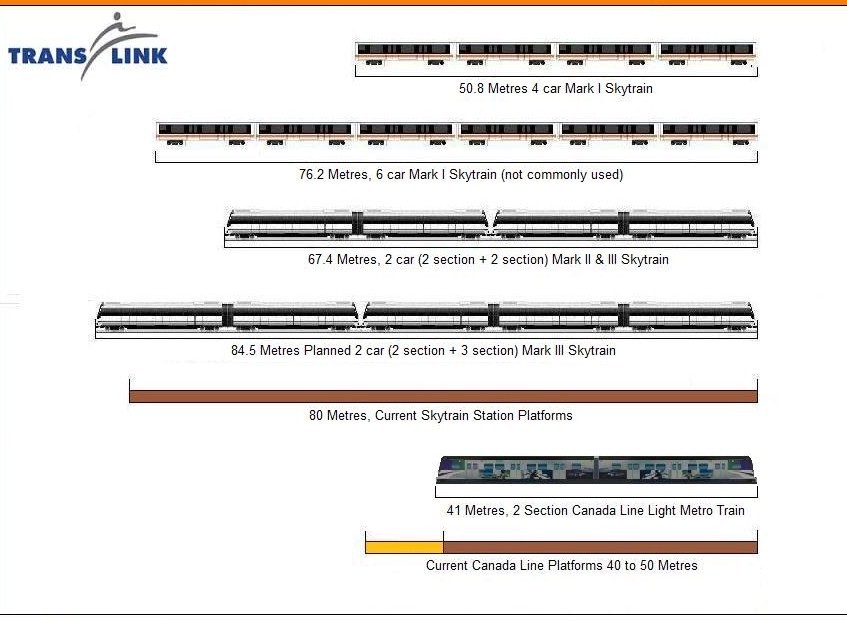
The Canada Line, a conventional railway, built as a light metro and uses ‘off the shelf’ Electrical Multiple Units (EMU’s) currently supplied by ROTEM of Korea. As built, the Canada Line, with 40 metre to 50 metre long station platforms, has limited its maximum capacity to around 9,000 persons per hour per direction, as it can only operate two car train-sets, 41 metres long.
The Expo and Millennium Lines operate an unconventional, proprietary and often renamed light-metro system, now called Movia Automatic Light Metro (MALM), whose cars are only supplied by Alstom. Alstom purchased Bombardier’s rail division, which includes the MALM system and no other car manufacturer has an “off the shelf” operating vehicle, let alone a production line for such a vehicle, thus the transit system is deemed proprietary as there is only one supplier.
The SkyTrain Light-metro System to scale, including station platform lengths.
The MALM system uses linear induction motors (LIM’s) and is not compatible in operation with any other railway except its small family of six (Toronto has now ceased operation) systems.
The five previous names for MALM are, in descending order (owner of the proprietary railway in parenthesis):
Innovia Light Metro (Bombardier)
Advanced Rapid Transit (Bombardier)
Advanced Light Metro (Lavalin)
Advanced Light Rail Transit (the Urban Transportation Development Company)
Intermediate Capacity Transit System (the Urban Transportation Development Company)
The five other transportation authorities, operating MALM systems will either abandon operation when the cars and guideways become “life expired” or have signaled they are not going to expand their systems, leaving Vancouver the sole customer for MALM.
A technology bias exists at TransLink. Internationally the MALM system is considered long obsolete as it costs more to build, operate, and maintain than conventional light rail or even a heavy rail metro. Cities that built light-metro, such as Ottawa and Seattle, use light rail vehicles, as they are much cheaper to operate and far more flexible in operation, especially for future expansion.
TransLink continues to use this cunning method of manipulating analysis to justify SkyTrain in corridor after corridor, and thus succeeds in keeping its proprietary rail system expanding.
Gerald Fox, Noted American engineer, retired.
TransLink’s well oiled propaganda machine, churning out ”fake news” and “alternative facts” has created the local SkyTrain myth. The SkyTrain myth has fueled the SkyTrain Lobby, which repeats TransLink’s fake news so much that politicians and the public have come to believe the SkyTrain myth.
The Broadway subway is nothing more than an old style “politcal” gravy-train, inflating property values along its route.
The Broadway subway is testament to the power of the SkyTrain myth. Funding for the $2.83 billion Broadway subway has been approved, yet its foundation is one of half truths and questionable planning.
The North American Standard for building a subway is a transit route with traffic flows in excess of 15,000 persons per hour per direction (pphpd), yet peak traffic flows on the 99B Line is about 2,000 pphpd, based on 3 minute, peak hour headway’s. Maximum transit flows on Broadway are less than 4,000 persons per hour per direction!
TransLink’s two top planners were fired for their opposition to the subway, by publicly stating the obvious; that there wasn’t the ridership on Broadway to justify an almost $3 billion subway.
TransLink quite happily lets people believe that Broadway is the “most heavily used transit route in Canada“, but instead claims “This is our region’s most overcrowded bus route.”, when there is a threat of professional or legal accountability.
“The problem with TransLink is that you can never believe what it says; TransLink never produces a report based on the same set of assumptions.”
Former West Vancouver Clr. Victor Durman, Chair of the GVRD (now METRO) Finance Committee.
The former Mayor of Surrey’s flip flop from LRT to SkyTrain was also predictable, as the bureaucrats at TransLink did their best to ensure this would happen.
The well oiled SkyTrain Lobby was in full force with every bit of classic fake news and alternative facts they could muster, yet ignored the fact that MALM is now unsalable internationally and only seven such systems (with only six in operation) have been built in over forty years and no sales for the past 18 years!
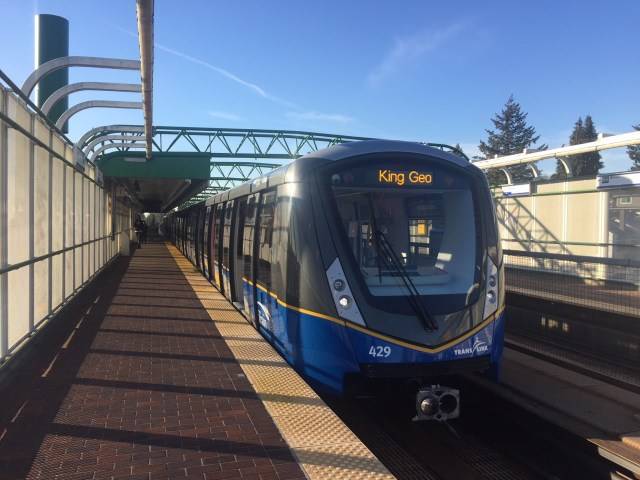
The former Mayor of Surrey’s election claim that a SkyTrain extension from King George station to Langley City could be completed for $1.65 billion, was later exposed to be false, yet the Mayor’s Council on Transit, the Minister of Transportation took no action!
The fix was in!
The $1.65 billion figure pales when compared to the present estimate of $4.6 billion to $5.1 billion.
The cost of the Surrey/Langley/Line is so expensive that the provincial government has broken the one project into two projects in an attempt to hide the true cost.
The guideway project, with a cost estimate now of $4.1 billion.
The Operations and Maintenance Centre #5 project, which must be completed before the line can enter into revenue operation, is now estimated to cost $500 million to $1 billion on top of the now estimated $4.1 billion for the guideway! The stated costs do not include the costs for new vehicles.
TransLink, the provincial and federal governments stay mute on the true costs of extending the SkyTrain light-metro system.
With the NDP promising to complete the proprietary MALM railway to Langley, a very costly issue arises.
The aging Expo line is desperately in need of a major rehab. This rehab includes a major overhaul and expanded electrical supply; a new automatic train control system, all the switches being replaced on both the Expo and Millennium Lines to permit faster operation and all stations must be rebuilt to deal with the higher customer flows which come with a higher capacity. The rehab is said to cost between $3 billion to $4 billion and must be done before any extension to Langley is built.
TransLink has already signed a $1.47 billion resignalling contract with Thales, leaving the necessary and much needed electrical rehab and upgrades waiting for future funding.
The following quote from Thales’s news release should be of some interest
When the programme is fully implemented, the Expo Line will be able to accommodate 17,500 passengers per hour per direction, and the Millennium Line will be able to handle 7500 passengers per hour per direction, a 32% and 96% increase respectively.
The combined annual operating costs for the Broadway subway and the full Expo Line to Langley will exceed $70 million annually. Will this cost be taken from the regional bus system, to pay for two very questionable and politically frivolous transit projects?
If taxes are not greatly increased, this will certainly happen.
How is this to be funded?
Is a $4.6 to $5.1 billion expanding MALM 16km a good investment, especially when ridership on opening day, according to Translink, will be less than what the Broadway 99 B Line bus carried pre Covid?
By comparison, 2023 cost for The Rail for the Valley’s Leewood Study, for a 130 km, Vancouver (Marpole) to Chilliwack passenger service, using the former BC Electric Interurban Lines, servicing South Vancouver, South Burnaby, New Westminster, North Delta, Cloverdale, Langley, Abbotsford, Sardis and Chilliwack and connecting the many business parks, universities and colleges along the route, would cost under $1.7 billion.
TransLink does not support the Leewood Study’s Vancouver to Chilliwack rail service because it would outperform their $4.6 to $5.1 billion, 16 km extension to the Expo and Millennium Lines and very embarrassing questions would be asked.
“But, eventually, Vancouver will need to adopt lower-cost LRT in its lesser corridors, or else limit the extent of its rail system. And that seems to make some TransLink people very nervous.”
Gerald Fox
With major demographic changes taking place, a major rethink must be done on how we provide an affordable regional rail system. Metro Vancouver’s light-metro system has been well studied, yet those cities who have done so, have invested in light rail instead!
Why, after four decades of unprecedented investment in regional rail transit, has no one copied Vancouver’s light metro system, including the exclusive use of the proprietary MALM system?
Two of the Advanced Rapid Transit (ART) systems built in Malaysia and Korea have embroiled both the patent holders, SNC Lavalin and Bombardier in legal proceedings, including charges of bribery. For added insult, the American government refused to subsidize any ART system because it is overly expensive to build and operate and was poorly designed
Korea’s EverLine can only operate 1 car trains.
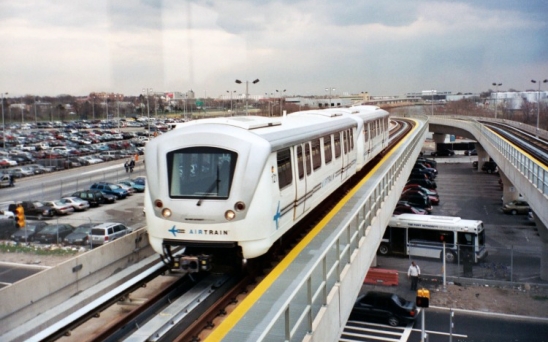
Because of this, the Canadian Overseas Development Bank funded the New York Port Authorities “Airtrain” (known as SkyTrain in Vancouver) to save embarrassment to Bombardier Inc., which have been good friends with the federal government.
New York’s AirTrain
It is time to put an end to MALM expansion or the provincial government and current mayors, will become like Marley’s ghost, dragging an ever longer chain made of empty cash-boxes, IOU’s, red ink, bare pursesand increased taxes wrought in union made steel, election, after election for decades to come.
Remember the FastFerries?
Today, TransLink continues to be toxic with taxpayers and extending MALM to Langley or continuing the Broadway subway to UBC will make TransLink and all who supported the gold-plated extensions radioactive politically, on a Chernobyl scale.
For forty years regional and civic transportation planners and engineers have got it wrong. But, because of very good, publicly funded PR machines in Victoria, and local cities and municipalities, plus the lack of any honest reporting by the mainstream media, regional politicians keep building with the obsolete light metro. Metro Vancouver’s SkyTrain light-metro system has convinced other cities to build with light rail because there is no advantage building the much more expensive light metro system.
It is time regional politicians rethink present regional rail transit planning, where today’s hugely expensive planning will exacerbate growing congestion and gridlock in the region and certainly greatly increase already high taxes. The SkyTrain light-metro system has become a politcal “tar-baby” and continues to be a showcase how Metro Vancouver’s regional transit planning has continued to get it wrong!
In the US, all new transit projects that seek federal support are now subjected to scrutiny by a panel of transit peers, selected and monitored by the federal government, to ensure that projects are analyzed honestly, and the taxpayer interests are protected. No SkyTrain project has ever passed this scrutiny in the US.
Regional mayors think themselves somewhat of transit experts.
They are not, not even close.
What needs to be done before another nickle is spent on transit is a full independent review of TransLink and its operations.
That is not going to happen as there are far too many skeletons in TransLink’s closet and best keep the lid shut.
Taking TransLink’s or Metro Vancouver’s word on transit and transit planning is like buying shares in a penny stock: a lot of hype but little in return.
Not one of Metro Vancouver’s mayors understand what rapid transit is or what it can achieve if built properly.
The mayor’s council on Transit is indeed a classic “Ship of fools”.
Instead we keep building “rapid transit” in the guise of SkyTrain which has achieved little except start criminal investigations in countries where it has been built; notably Korea and Malaysia. So badly designed and so expensive that the Americans refuse to build with it.
Cheaper and more effective options need not apply!
Metro mayors vote for transit for what is good for them at the polls; needless expensive subways for Vancouver; a light metro line in Surrey/Langley on a route with little ridership and a next to useless gondola for Burnaby. They also do not care that what SkyTrain is, which in fact a dated proprietary light metro system that has long seen better days. With only seven such systems sold in the past 45 years and now only six in operation, it is doubtful that the new owner, Alstom, will continue production for much longer.
SkyTrain is the Edsel of rapid transit.
Sadly, the Mayor’s Council on Transit is utterly incompetent; so incompetent they could not even operate a Christmas tree train set.
Rapid Transit a.k.a. SkyTrain is TransLink’s only vision.
Transit funding needed to meet housing goals, prevent crowding, say Metro Vancouver mayors
Metro Vancouver’s mayors are calling on senior levels of government for more transit funding they say is critical to support the region’s housing goals and prevent serious overcrowding on buses.
Speaking at the Union of B.C. Municipalities annual convention, the mayors touted their new 10-year, $21 billion plan, dubbed ‘Access for Everyone,’ which aims to double bus service across the region and add nine new bus rapid transit lines. The plan would also see a gondola built to SFU’s Burnaby Mountain campus, extend the Broadway subway to UBC, and start long-term planning for a rapid transit link to the North Shore.
Port Coquitlam Mayor and TransLink Mayor’s Council Chair Brad West said the provincial and federal government have both leaned on municipalities to expand housing, but that those efforts will fail without the transit to support them.
“I want to be clear, if we do not expand transit we will not be able to reach the targets that are being set for the development of new housing over the coming years,” West said.
“We know that delaying transit expansion will be a disaster for our region.”
According to TransLink, Metro Vancouver has seen the fastest growth of transit ridership in North America, with the region as a whole now at 87 per cent of pre-pandemic levels.
However, some areas have seen explosive growth far surpassing pre-COVID ridership.
Transit use in Surrey and Langley is at 120 per cent of pre-pandemic levels, and some routes, like the #310 serving Surrey to Ladner, have seen ridership more than double 2019 levels.
System-wide, TransLink saw boardings climb by 16 per cent between 2022 and 2023.
With Metro Vancouver expected to add 50,000 new residents per year overcrowding and bus pass ups are expected to worsen.
The transit and transportation agency estimates that by 2025 nearly 40 per cent of hour hour bus trips will be overcrowded.
“During the afternoon rush hour one third of bus trips in Vancouver rand one-quarter of bus trips in Surrey are overcrowded in the busiest direction, and this will get worse as our population grows,” TransLink CEO Kevin Quinn said.
“We have to get ahead of this growth.”
Quinn said people choose to live where transit is accessible, particularly if they rent or have a lower income, making expanding the network critical in the housing equation.
“It is really hampering our ability to build in our city, it is starting to impact our ability to produce housing,” Surrey Mayor Brenda Locke said.
“This is a no brainer. We’re going to have to do this at some point in time. And if we defer this, all we do is make the challenge harder to overcome,” Vancouver Mayor Ken Sim added.
The mayors say their new 10-year plan will need senior government funding commitments by June 2024 to meet the goal of starting on service expansion by the end of next year.
Some of the detractors of Rail for the Valley’s TramTrain or light DMU line from Marpole to Chilliwack cite that only one train can operate on the line at one time. With properly placed passing loops, preferably at stations, trains can be safely operated going in both directions on a single line. this due to modern signalling and passing loops.
Up to three trains per hour per direction can operate quite safely with modern signalling and strategically laid passing loops or double tracking.
Another man-of-straw argument is that the many level crossings will slow the trains.
Not so, as the video’s of the Dutch railways will show.
A modern regional railway will be very safe and if our transit planners are unable or unwilling to plan for such a rail line, then, maybe, we import some Dutch rail planners with ample experience in planning and operating regional rail lines with plenty of level crossings.
Dutch road crossings.
Dutch Urban rail crossing protected by gates for both cars n cyclists and pedestrians.
It has been too quiet, too long, on the transit front and with a provincial election looming, unpleasant news is being quietly whitewashed.
Hear no cost increase; speak no cost increase; see no cost increase of the Broadway subway seems the order of the day.
The pre inflation estimates just will not stand up today.
Also, TransLink has no great hopes for the Broadway subway, a subway that terminates nowhere, which planning is based on the original light rail planning terminating at Arbutus to use the Arbutus corridor for LRT.
Let us revisit Thales News Release which appeared in the rail transportation press last year.
7,500 pphpd is half the accepted capacity needed to justify building a subway!
Really, really?
A far cheaper surface operating tram or LRT could do the same job just as efficiently and being much cheaper to build and operated the City of Vancouver could have had up to ten times more light rail offering real transit alternative for Vancouver.
By the way, that $1.47 billion investment to increase capacity on the Millennium Line has not been apportioned to the cost of the Broadway subway as it would increase TransLink’s earlier estimated costs.
Broadway Subway’s revised service date disappears from project reports
Bob Mackin
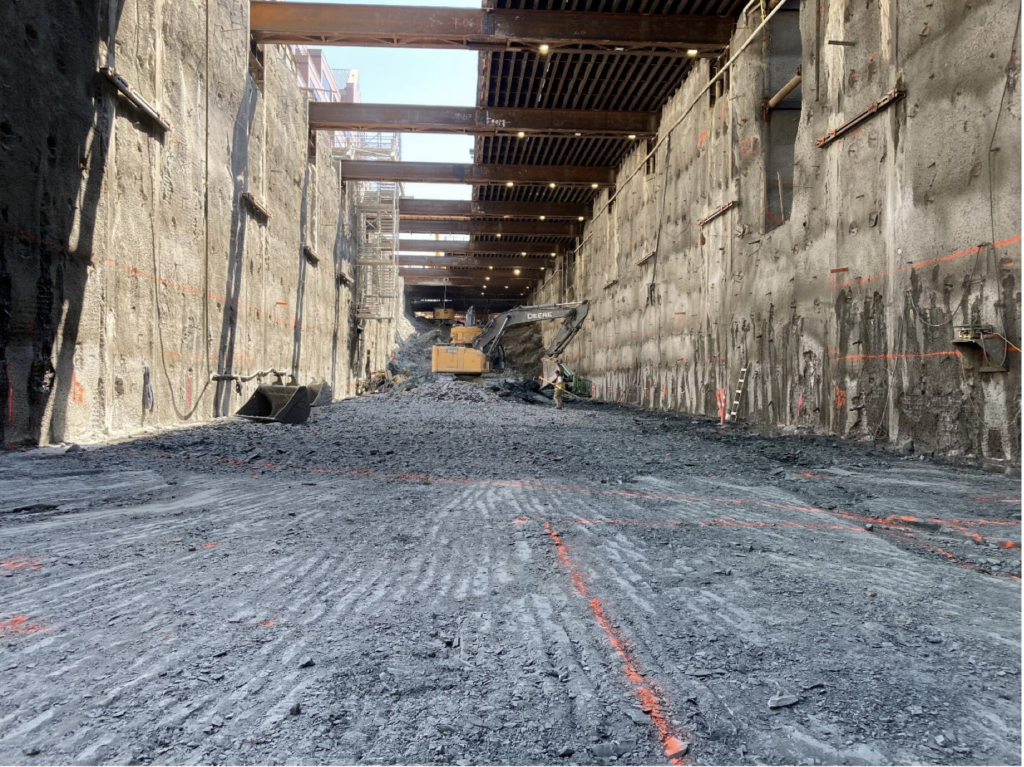
The Broadway Subway project continues to forecast that it will stay within the $2.83 billion budget, but the revised completion and service dates were quietly omitted from monthly reports.
In the June project status report from the Transportation Investment Corporation, schedule topped the list of five “yellow light” items on the project delivery dashboard, requiring near-term action. The extension of SkyTrain’s Millennium Line already announced a delay last November from late 2025 to early 2026.
“The start of piling activities was delayed at some construction locations. Recovery measures have been implemented by Broadway Subway Project Corporation (BSPC) and are being monitored closely,” said the most-recently released report. “A five-week concrete supplier strike in June 2022 delayed the completion of the base slab at Great Northern Way, which impacted the start of tunnel boring. As a result, project completion has moved from late 2025 to early 2026.”
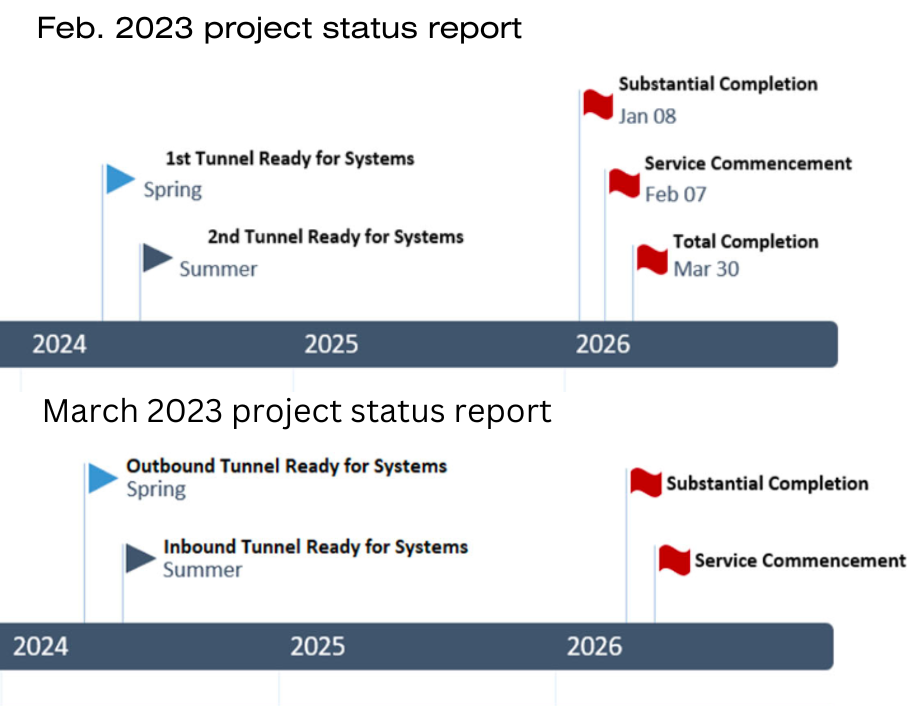
The report for last October included the previous schedule, which targeted substantial completion for Nov. 27, 2025, service commencement on Dec. 27, 2025 and total completion Feb. 28, 2026. The reports from November through February showed the target for substantial completion had been postponed until Jan. 8, 2026, service commencement to Feb. 7, 2026 and total completion to March 30, 2026.
Beginning with the April status report, the dates were omitted and the red flag project schedule icons moved slightly to the right.
The project reported spending $32.5 million in June for a total to date of $1.18 billion, including $382.7 million from the federal government so far and $100.3 million from the City of Vancouver.
The 5 kilometre subway and 700 metre elevated guideway will connect six underground stations from Great Northern Way-Emily Carr to Arbutus.
The report said there were six non-conformity reports in June about health and safety issues and construction quality processes. Of the 319 such reports during the project, 291 files were closed and 28 remained open.
The project reported a lost time injury frequency rate of 0.21 to date, less than the 2021 WorkSafeBC rate of 0.90 for heavy construction.
Schedule was one of the five project dashboard items assigned a yellow light ranking. The remaining six were all green lights. None was red, which would have denoted requiring immediate action to resolve.
Notes within the dashboard said discussions were progressing with B.C. Infrastructure Benefits, the Crown corporation in charge of hiring and supplying unionized workers, about workforce and permitting requirements. Discussions were also ongoing with TransLink and Canada Line about integration with their systems and developer PCI. Targets had been achieved for Indigenous contracting, but discussions continued about project agreements and Indigenous art and cultural recognition at stations.
The second tunnel boring machine, nicknamed Phyllis, for Girl Guides of B.C. founder Phyllis Munday, broke through at Broadway-City Hall Station in late May. The June report said both tunnel boring machines were at the site under Cambie and Broadway.
BSPC is the design/build joint venture between Acciona of Spain and Ghella of Italy. Acciona is also working on the Site C dam and Pattullo Bridge projects.
In early 2022, Metro Vancouver fired Acciona from the $1.058 billion North Shore Wastewater Treatment Plant in North Vancouver over project delays, sparking duelling lawsuits filed in B.C. Supreme Court.
The Mayor of Vancouver discussing the bennefits the Broadway Subway. What could go wrong?
It takes a lot of money to operate a transit system and subways tend to be a financial black hole and are avoided unless ridership on a transit line demands the multi billion dollar investment of a subway.
Just the MALM (SkyTrain) subway to Arbutus will cost TransLink an additional $40 million in annual operating costs, but that estimate was pre inflation!
There is worse to come.
A Subway needs a lot of intensive preventative maintenance or service deteriorates over time.
TransLink is well known for doing the bare minimum of maintenance needed to keep the mini-metro in operation.
The following is from Wolfgang Keller who now works as a safety engineer in Germany and before the SkyTrain Lobby sneer at this, in Europe, safety is taken much more seriously than TransLink would ever do!
Especially since full grade separation requires loads of technical
equipment, especially in the stations; escalators, elevators, lighting,
ventilation, etc. which all require maintenance and thus, staff.
Besides the fact that for a typical european grade-separated mass
transit system, the energy consumption of elevators, lifts, lighting
etc. is already higher than the energy consumption of the rolling
stock.
Not to mention cost for cleaning of all those vast surfaces in the access tunnels, pedestrian levels, station platforms, etc. and so
on. Another topic that has also been misjudged by many operators is the requirement to clean the tunnels themselves regularly, because
accumulated dust and garbage of all kinds can easily catch fire and then fill up the tunnels with smoke and toxic gases, interrupting
operation. Some operators have purchased “vacuum cleaner” trains to solve this issue.
Line B at Rennes cost 1744.6 MIL/EUR (CAD $2,555 Mil.) for 12.7km. For a line that can only operate 52m*2m (length*width) train-sets. That’s not more capacity than any of the modern streetcar lines in France, at a much higher cost.
The Canada line can operate only 41 metre long train-sets, thus has less capacity than Rennes!
Over here in Germany where they had this tunnel-building mania from the 60,s to the early 90s, at least they’ve stopped now. Simply because the municipalities ran into the fact that while building those tunnels is cheap (for them, not for the taxpayer), since 90% of the cost is financed with state and federal subsidies, they cannot finance maintenance of the fully grade-separated lines at all, so the expensive infrastructure they have built since the early 60’s is slowly rotting into a state of near-inoperability.
No one is asking about the long term operating costs associated with subways. No one is countering dishonest claims about LRT.
This gross dishonesty by elected officials is badly affecting any real and affordable transit planning in the region!
How will the $40 to $50 million in additional operating fees affect TransLink’s finances?
The provincial NDP and the Mayors Council on Transit is leading the taxpayer on a one way ride that will end in a financial fiasco.
A new TTC report is sounding the alarm about what the agency says is billions of dollars worth of unfunded work required to keep Toronto’s transit system functional over the next 15 years, a finding that could raise the stakes for the provincial government’s contentious plan to take ownership of the subway system.
The TTC capital plan was released Friday along with the agency’s proposed 2019 operating budget, which recommended a 10-cent fare increase. Both documents were reported by the Star Thursday before they were made public.
The capital plan says the agency will require $33.5 billion of capital investment over the next decade and a half in order keep the system in a state of good repair and meet expected ridership growth. A staggering $23.7 billion of those costs, which don’t include the expense of building new transit lines, is currently unfunded, according to the TTC.
Projects it says are required include increasing capacity on subway lines, replacing the bus fleet, building a new bus garage, buying up to 100 new streetcars, and replacing streetcar track and power systems.
“Without the investments outlined in this plan, service reliability and crowding will worsen,” warns the report, which is signed by TTC CEO Rick Leary.
“This is the fate now faced by some other major transit systems in North America that allowed their assets to badly deteriorate. Our customers, our city, our province and our nation can’t afford to let that happen.”
TTC board member Councillor Shelley Carroll said the new capital plan marks the first time in memory the city has had a clear accounting of the transit system’s infrastructure needs. She said it should be a wake-up call for government to “start having a real conversation about the system” and find ways to fund the existing network instead of focusing on building new lines.
Of the $33.5 billion in costs the report identifies, about $22 billion worth is related to subways and stations. That includes $8 billion for Line 1 and Line 2 capacity improvements, $650 million for a new automatic train control signalling system, $1 billion to expand Bloor-Yonge station, and $1.26 billion for platform edge doors.
A little more than $16 billion of the subway investments are unfunded.
The subway costs in the report are far greater than the $160 million a year the Ontario Progressive Conservatives have pledged to spend on the network if they execute their plan to upload ownership of the lines and stations to the province.
Carroll said she’s concerned that if Queen’s Park follows through on that plan, the province will deem much of the capital work unnecessary.
“Oh it’s necessary all right, and we need to be honest about it and make sure that this system can keep running,” she said.
When asked Friday if the province would commit to funding the capital backlog if it takes over the subway, Ontario Transportation Minister Jeff Yurek replied with a statement that said only: “The government is working with its special adviser Michael Lindsay on the details of the upload, including the financing.”
On the operating side, the TTC budget requests the city increase the subsidy it provides the transit agency and its Wheel Trans service this year to $763 million, a 3-per-cent increase over 2018 that would buck a city directive for all departments to freeze their net budgets.
Among the major drivers behind the increase is $14.4 million in additional costs for the new two-hour transfer policy, and $8.5 million for capacity improvements. There’s also $18.5 million associated with the Presto fare card system.
The agency is predicting 526.3 million riders this year. That’s up from 521.4 million in 2018, but a decrease from the 533.2 million in 2017.
The budget proposes raising $25.8 million in additional revenue by instituting a 10-cent fare increase that would apply across the board to adult, senior, and student rides. An adult fare using a token or Presto fare card would rise to $3.10, while an adult monthly pass would cost $151.15, up from $146.25. The fare hike would go into effect April 1.
“The TTC is still deeply unaffordable for many people in our city. We already pay more than our fair share,” she said.
In a statement Friday, TTC Chair Jaye Robinson, who told the Star earlier this month she wouldn’t support a fare hike, stressed the need to “balance the cost of capital and service improvements with affordability,” but didn’t say if she would back the increase now that it’s been recommended by transit staff.
“What I can say is that I will be listening very closely at next week’s meeting to transit users, to TTC staff and to board members,” she said.
Don Peat, a spokesperson for Mayor John Tory, said the mayor wouldn’t pre-empt the TTC board’s decision on the fare increase. But he asserted Tory’s administration has “made additional and record-setting investments” in the transit agency, including in popular initiatives such as the two-hour transfer.
The TTC board will consider its 2019 budget at a meeting Thursday.
By the numbers
$3.10 — cost of adult tokens and Presto fares after proposed 10-cent increase
$2.15 — cost of student and senior tickets and Presto fares after proposed 10-cent increase
4 — number of years in which fares will have gone up since John Tory took office in 2014, if the 2019 increase is approved
$1.47 billion — annual capital work subways and stations will require over 15 years, according to TTC
$160 million — annual amount Ontario PCs pledged to spend on capital work if the province takes over the subway system
Ben Spurr is a Toronto-based reporter covering transportation. Reach him by email at bspurr@thestar.ca or follow him on Twitter: @BenSpurr
Five car trains, is the current clarion call by TransLink. With lots of hype and hoopla by the mainstream media, the public is made to believe this is some sort of technical break through.
It is the old Goebbels Gambit at play; “repeat a lie often enough and the public are bound to believe it.
What is laughable as the “trailer” sections, gangwayed at both ends have been around for for a long time. The MK.2/3/5 car trains uses the old Bombardier universal “Innovia” body shell, which comes with “driver’s”, with one vestibule and “trailers” with vestibules at both ends for through communication. TransLink purchased the former and only purchased a few of the latter.
What TransLink has done is taken over twenty-five year old designs, tarted them up with new front ends; new paint job; and market the hell out of them.
What TransLink doesn’t tell you is that this sort of metro car, gangwayed throughout, has been around for thirty years and there is nothing new at all, just TransLink being decades behind the times, which is the real story the mainstream media will not report on.
Why the hype and hoopla?
Operating five car trains (with three trailers) means a 5-car train can fit the current station platforms without major and very expensive refurbishment; something to think about with cash strapped TransLink.
Sadly all the hype, all the hoopla, all the media splash cannot make a silk purse out of a sows ear because the problem with the SkyTrain light metro system is that the massive demographic change, post Covid means a lot of potential transit customers are now going to destinations ill served by transit, means at best, ridership will stagnate or at worse, decline.
It is very difficult for a light metro system to adapt to change, unlike the much cheaper tram where a proven ability to adapt has kept in the forefront of urban transport.
In true Orwellian fashion, TransLink “TransLink wants to hear from you“; but in reality they do not.
In TransLink Speak, almost everything is opposite to the questions asked.
TransLink and all the hangers-on certainly did not want to hear from the taxpayer in 2015 when over 60% did not want TransLink to proceed with their SkyTrain expansion plans and TransLink just went ahead and did it.
Part of the fallout over this PR fiasco is that TransLink send Emails to to take part in a survey to pretend the listen.
Of course TransLink does not listen, they never have and never will as its bureaucracy refuse to accept they are doing a ban job; no a terrible job in providing user friendly public transit in the region.
In short, TransLink does not give a damn.
The latest survey Zwei received in an Email, started with a list about taking transit, with one selection, “I do not take transit”, which I selected and the poll ended. My option not needed.
What has happened is TransLink has turned this into a “push poll” (a Push Poll is an ostensible opinion poll in which the true objective is to sway voters by using loaded questions), with only transit users allowed to complete it.
For many, they do not see a problem, but for the 80% of people in the region who do not use transit, they have no input.
TransLink does not want meaningful input because of the billions and billions of dollars spent on rapid transit and buses, 80% of the population in the region do not use transit and that 80% has remained constant for over two decades.
Would it not it be better for TransLink to find out why 80% of the people in Metro Vancouver do not take transit? Would it not be better to take measures to entice people to take transit?
Not TransLink because the truth would be very embarrassing an ossified bureaucracy that has carved a very lucrative niche that the taxpayer cannot remove, which policies have proven largely failures.
TransLink is left doing “Push Polls”, to get predetermined answers to survey questions, to the delight of politicians, pretending that TransLink listens, when it clearly does not.
The problem with TransLink is that you can never believe what it says; TransLink never produces a report based on the same set of assumptions.”
Former West Vancouver Clr. Victor Durman, Chair of the GVRD (now METRO) Finance Committee.



 East Hastings Street, between downtown Vancouver and the PNE, could be targeted next for a TransLink rapid system as














Recent Comments