From The Infrastructurist – 36 Reasons Streetcars Are Better Than Buses

Just an interesting article that came Zweisystem’s way. If you have a complaint or comment, please register with the Infrastructurist’s web site:
http://www.infrastructurist.com/2009/06/03/36-reasons-that-streetcars-are-better-than-buses/
The Infrastructurist
Wednesday, June 3rd, 200936 Reasons Streetcars Are Better Than Buses
Posted on Wednesday June 3rd by The Infrastructurist
If you want a system that really attracts riders and investment, many transit experts will attest that streetcars are the best dollar-for-dollar investment a city can make.
Of course, there are plenty of situations where old-fashioned bus service or newfangled bus rapid transit (which usually has dedicated lanes) are just the thing. But for cities facing a choice between building a streetcar system or high-end BRT and the cost difference can be smaller than might think it’s handy to know that transit riders overwhelming prefer
streetcars. Well, overwhelmingly if the comments section from a recent story on this site can be taken as a fair sample. One reader posed the question, “buses or streetcars?” and the responses from laypeople and transportation experts alike came fast and furious. In the end, we were left with dozens of reasons why streetcars are superior, ranging from the
obvious to the wonderfully creative.As the comments added up, we became more and more intrigued. So we’ve edited the various reasons into a proper list. Did we miss anything? Do any of these not hold up? Disagree entirely? Let us know in the comments section and we’ll update the story and the headline as worthwhile additions come in.
New streetcar lines always, always, get more passengers than the bus routes they replace.
Buses, are susceptible to every pothole and height irregularity in the pavement (and in Chicago we have plenty). Streetcars ride on smooth, jointless steel rails that rarely develop bumps.
Streetcars don’t feel low status to transit riders. Buses often do.
Mapmakers almost always include streetcar lines on their city maps, and almost never put any bus route in ink. New investment follows the lines on the map.
The upfront costs are higher for streetcars than buses but that is more than made up over time in lower operating and maintenance costs. In
transit you get what you pay for.There is a compellingAi??Ai?? ‘coolness’ and ‘newness’ factor attached to streetcars.
Streetcars feel safer from a crime point of view.
Steel wheel on steel rail is inherently more efficient than rubber tire on pavement.
Electric streetcars can accelerate more quickly than buses.
Streetcars don’t smell like diesel.
Streetcars accelerate and decelerate smoothly because they’re electrically propelled. Internal-combustion engines acting through a transmission
simply cannot surge with the same smoothness.The current length limit for a bus is 60 feet, but streetcars can go longer, since they are locked into the rails and won’t be swinging all around the streets, smashing into cars.
Streetcars have an air of nostalgia.
New streetcar and light rail lines usually come with an upgraded street experience from better stops, landscaping, new roadbeds, and better sidewalks, to name a few. Of course, your federal transit dollar is paying for these modernizations, so why wouldn’t cities try to get them!
Perhaps the most over looked and significant difference between street cars and buses is permanence. You’ll notice that development will follow a train station, but rarely a bus stop.
Rails don’t pick up and move any time soon. Once a trolley system is in place, business and investors can count on them for decades. Buses come and go.
Streetcars are light and potentially 100% green. Potentially they could be powered by 100% solar and/or wind power. Even powered with regular power plant-derived electricity, they are still 95% cleaner than diesel buses. [Source? -Ed.]
Streetcars stop less. Because of the increased infrastructure for stops, transit planners don’t place stops at EVERY BLOCK, like they do with buses (SEPTA in Philly is terrible for this). Instead, blocks are a quarter to a half mile apart, so any point is no more than an eighth to a quarter mile from a stop.
People will travel longer distances on streetcars. At one point, in the 1930s, a person could travel to Boston from Washington solely on trolleys, with only two short gaps in the routes.
Buses are noisy. I ride them every day in Chicago, and I am constantly amazed at how loud a diesel bus engine is even on our latest-model buses [and] the valve chatter is an irritant to the nervous system. By comparison, streetcars are virtually silent.
Technological advances already make the current generation definitely NOT your grandfather’s streetcar. Low floors are standard, for easy-on easy-off curbside boarding. Wide doors allow passengers to enter or exit quickly. So streetcar stops take less time than buses.
Passengers can take comfort from seeing the rails stretching out far ahead of them, while ever fearing that the bus could take a wrong turn at the next corner and divert them off course.
Once purchased (albeit at high cost) streetcars are cheaper to maintain and last way the hell longer (case in point, streetcars discarded in the US in the 40’s, snapped up by the Yugoslavs, which are still running).
Streetcar tracks are cheaper to maintain than the roadways they displace.
People get notably more excited about the proposed extension of the streetcar system and expect revitalization of the neighborhoods around the planned stops.
Streetcars create more walkable streets. This is because streetcars, as mentioned above, are more attractive to riders than buses, which in turns prompt to more mass transit usage in general, which in turns prompts to more walking; a virtuous cycle that creates more attractive city streets.
Most European cities and countries kept investing in public transit during the decades when America was DISinvesting. Now I look across the pond and see dozens of European cities extending or building new rail transit systems, including many streetcar lines, and conclude: They probably know what they are doing; we should do some of that too.
You know exactly where a streetcar is going, but have you ever tried looking at a bus route map?
Streetcars are faster than buses or trackless trolleys (aside from 2 lines in Philly, do any other cities run trackless trolleys, or trolley buses anymore?) because trams tend to have dedicated lanes. Even if they don’t, if they operate on streets with multiple lanes, people stay out of the tram lane, because it’s harder to drive a car along tram tracks (the wheels pull to one side or the other as they fall into the groove) {Zweisystem replies: This may have been true in the 20’s when cars has narrow tires, but with a girder railAi??Ai??flangeway a mere 2 cm to 3 cm wide thisAi??Ai??is hardly a problem}.
In buses you’re still jostled by every pothole and sway at every bus stop. I thought bus rapid transit would be a significant improvement – there’s still a bit of sway and they concrete was not installed as smoothly as line of steel rail.
With buses transit planners are pushed by funding formulas to capture every pocket of riders thus you can get a very wiggly route; something that’s less practical on a fixed rail system.
Buses lurch unpredictably from side to side as they weave in and out of traffic and as they move from the traffic lane to the curb lane to pick up passengers. In streetcars turns occur at the same location on every trip, so that even standees can more or less relax knowing the car is not going to perform any unpredictable lateral maneuvers.
Most streetcar riders don’t consciously think about the differences between a bus ride and a streetcar ride. But their unconscious minds the spinal cord, the solar plexus, the inner ear and the seat of the pants, quickly tally the differences and deliver an impressionistic conclusion: The streetcar ride is physiologically less stressful.
An internal-combustion engine is constantly engaged in hammering itself to death and buses tend to vibrate themselves into a sort of metallurgical dishevelment. Interior fittings, window frames, handrails, floor coverings; seats tend to work loose and make the interior look frowzy and uncared- for.
By age 12 the bus is a piece of junk and has to be retired. A streetcar the same age is barely into its adolescence.
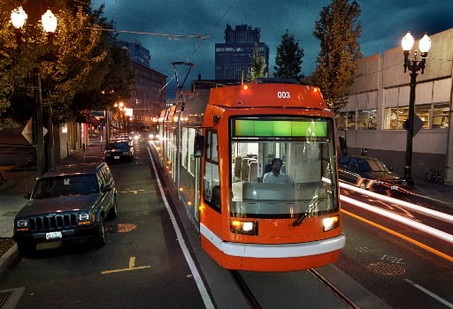
Streetcar stops are typically given more attention than most bus routes and the information system is more advanced. In Portland, the shelters even have VMS displays that tell you the times of the next two streetcar arrivals. This valuable information gives people the option to wait, do something else to pass the time, or walk to their destination.
One great advantage of streetcars is that the infrastructure serves as an orienting and way-finding device. The track alerts folks to the route and leads them to stops. Because they are a permanent feature of the streetscape, the routing is predictable and stable (unlike bus routes). So unlike a bus, a streetcar informs and helps citizens to formulate an image of their city, even if folks don’t ride it. It is a feature of their public realm. Because of this, these streets get greater public attention.
When you ride one of the remaining historic cars in Toronto or San Francisco you can tell they’reAi??Ai?? ‘old’ Ai??Ai??in the sense ofAi??Ai?? ‘out of style’, Ai??Ai??but when you look around the interior everything still seems shipshape, nothing rattles, the windows open and close without binding. The rider experiences a sense of solid quality associated with Grandma’s solid-oak dining table and 1847 Rodgers Brothers silver. And that makes everybody feel good.Ai??Ai?? Unlike, say, an aging bus.
For those of you who cannot see the difference between a bus and a streetcar, I suggest riding a streetcar when you get the chance. Then, if you can locate a bus that more or less follows the same route, give that a try. Compare the two experiences.
To UBC, from BCIT and Picinics in the Park, by tram – The Light Rail Committee’s Broadway Light Rail Project
A Wee Bit Of Local History
InAi??Ai??early 1996, during BC Transit’s meaningless public consultation period for the Broadway Lougheed Rapid Transit Project which later morphed into the Millennium Line,Ai??Ai??Zweisystem received a phone call from an European Transit specialist, who worked for Asea Brown Boverai (later absorbed by Bombardier Inc.)Ai??Ai??regarding the project.
The European transit specialist, wanting to make contact with those planning for light-rail,Ai??Ai??had phoned BC Transit to arrange a meeting regarding the then proposed Broadway/Lougheed Ai??Ai??LRT project and was given Zweisystem’s phone number! After his initial shock and displeasure being fobbed-off by BC Transit, the transit specialist entered into a long conversation with me on transit issues in the region and how modern light rail could help solve them. To make a long story short, he proposed a classic Broadway tram, with stops every 500m to 600m, going to UBC, replacing all Broadway bus services and a second line via Main Street, Hastings St. to Stanley Park, that, he claimed would double present bus ridership on the two routes, providing enough fare revenue for the tram to operate without any subsidy, with fares covering not only operating costs but debt servicing costs as well. By doing so, a private company could build and operate the light rail line at no cost to the taxpayer. The rest is history as they say and the SkyTrain Millennium Line was built instead and is subsidized by over $80 million annually!
The Light Rail Committee Proposes the BCIT to UBC and Stanley Park Light Rail Project.
In late 1996 the LRC proposed a boldAi??Ai??Broadway light rail plan: a tram/light rail line from BCIT to UBC via the Lougheed Hwy., Broadway, 10th Ave. and University Blvd.Ai??Ai??with a second line via Main street to Hastings Street to the Aquarium in Stanley Park. The plan consisted of lawned reserved rights-of-ways and on-street running; priority signalingAi??Ai??on traffic calmed Broadway and Hastings Streets; tram/streetcar stops every 500 metres; a single track Vancouver General Hospital Loop via Fraser St., 10th Ave. and Cambie St.,Ai??Ai??providing front door service to the hospital, and operating modern modular low-floor cars. Commercial speed would have been about 20 kph to 25 kph (depending on the number or tram-stops) and the construction costs in the region of $20 million/km to $25 million/km; maximum hourly capacity 18,000 to 20,000 persons per hour per direction (depending on the number of vehicles operated), signaling would be line of sight with intersections and switches protected by local signaling. Headways could be as low as 30 seconds in peak hours.
What the LRC’s plan would do is service many important transit destinations (UBC, BCIT, downtown Vancouver, Stanley Park, etc.), while providing economy of operation by replacing all bus services on Broadway and many in Vancouver, thus reducing operating costs. Further economies can be made by using existing masts and span wires along the proposed transit routes. The new LRT would be merely seen as the reinstatement of ‘rail’ service by modern streetcars, operating on 21st century rights-of-ways. The bonus of a private operator, securing financingAi??Ai?? to build the line at no or little cost to the taxpayer is a concept that must be looked at by politicians.
The planAi??Ai??would reduce Broadway to one lane of traffic in each directionAi??Ai??(passive traffic calming) except in areas of mixed operation, while keeping the all important on-street parking for local merchants. The plan would have offered a minimum of four transit routes: BCIT to UBC; BCIT to Stanley Park; UBC to Stanley Park; UBCAi??Ai??or BCITAi??Ai??to VGH loop and local services if need be. The plan incorporated modern European light rail and tram philosophy of the day; lawned reserved rights-of-ways, modular cars, high capacity, passenger comfort, and affordable cost. It was not to be, as the Glen Clark NDP government, for reasons that can only be speculated, dismissed LRT out-of-hand and went for a truncated SkyTrain light metro line, the only metro in the world that went nowhere to nowhere.
In 2009 there are again rumours of a SkyTrain subway to UBC and it maybe time to again to consider a BCIT – UBC – Stanley Park light-rail network.

From the ‘Other’ Vancouver – The Vancouver Columbian "All aboard!’ in Dallas, Seattle, Portland"

ItAi??Ai??seems light-rail is very well spoken of in the other ‘Vancouver‘ (Vancouver Washington State) and one wishes that our local media types would write a few positive things about the worlds most built public transit mode. One would also hope that the mainstream media would entertain a few investigative reports on our light-metro system instead of taking TransLink’s spin-doctors news releases as real news. The dichotomy between Vancouver BC and Portland, Seattle, Dallas is clear; in the USA, Light Rail implementation goes through a rigorous public debate, while here in ‘Lotus Land’ it is “you will get SkyTrain (or RAV) whether you like it or not and please don’t try to confuse us with facts“.
The Columbian – Vancouver, WA
Sunday, September 20 [2009]John Laird, Sept. 20: Ai??ai???All aboard!’ in Dallas, Seattle, Portland
Light-rail critics might have difficulty answering this question: If light rail is such a wasteful boondoggle, shouldn’t the systems around the nation be contracting and even closing?
Instead, the reverse has been happening for more than 25 years, and the pace of growth is even accelerating. Last week in Dallas, a 28-mile light-rail line opened and A?ai??i??ai??? as Texans are wont to brag A?ai??i??ai??? they’re calling it the longest light rail project on the continent.
Up in Seattle, light rail has taken many years to develop, but its recent launch and imminent growth are remarkable. A 14-mile line from Seattle to Tukwila opened in July. In December the line will extend 2 miles to the SeaTac Airport, offering a 36-minute ride from downtown to the airport. In the next seven years, a north extension to the University of Washington is planned, and voters have already approved new lines to Lynnwood, Federal Way and Redmond.
Last Saturday in Portland, TriMet opened the 8.3-mile MAX Green Line to Clackamas Town Center. About 40,000 people showed up for free rides on Saturday. Paid ridership on Monday was light, as is typical on new lines, but weekday Green Line ridership is projected to reach 25,000 in a year. Just since 2000, MAX has added 20 miles of service with 34 stations, expanding one of the nation’s top light-rail systems to 52 miles and 84 stations. A seven-mile light-rail line into Milwaukie is next on the drawing board.
So the question persists: How could governments and transportation planners nationwide have been so incredibly stupid A?ai??i??ai??? or worse, so duplicitous and corrupt A?ai??i??ai??? for the past quarter of a century? If light rail is the expensive flimflam that critics claim, then Americans have been victimized by the most egregious and expensive public works rip-off in U.S. history. Sounds like it’s time for some orange jump suits and perp walks, right?
The distant visionThe truth, of course, is that light rail is a viable transportation alternative for the long-range future. And “long-range” is where a lot of people get divided on this issue.
Light-rail detractors are rooted in the past and entrenched in the status quo. Their ancestors back in 1916 probably grumbled that a bridge across the Columbia River would cost too much and would only bring crime and rampant growth into Clark County. That bridge was built anyway, because it was the right thing to do. And some horse owners probably went ballistic back when America started paving roads, but it was necessary for the future.
Light-rail supporters, on the other hand, are enthralled by the future and committed to planning for the next century. These folks are not trying to “take away our cars.” They’re not trying to “force light rail down our throats.” They’re simply trying to keep our grandchildren from charging us with inadequate planning and myopia. Light rail is meant to supplement A?ai??i??ai??? not supplant A?ai??i??ai??? automobiles.
This debate will rage into perpetuity, fueled by experts on both sides who insist that light rail is too expensive (or a good deal), superfluous (or visionary), and forced-down-our-throats (or sanctioned-by-conventional-wisdom).
In Vancouver, the debate takes on the added component of the Columbia River Crossing project. Some people here see light rail as a sinister snake coiled to inject its poison into our community. Others see it as the next logical step in building a transportation system that will last 50 to 100 years.
To that debate, lets add these facts from a Sept. 12 Oregonian story by Dylan Rivera and Steve Mayes: “Crime on the MAX light rail system dropped 18 percent in 2008, a stunning contrast from the public perception of a crime-riddled conveyance” a couple of years ago. At the Beaverton and Hillsboro light-rail stations, incidents of crime have been reduced by about half in the past two years.
Of course, that trend won’t keep the “Crime Train” bellyachers from spreading their message. But for people who see beyond tomorrow and don’t have an umbilical connection to their cars, that trend bolsters the belief that light-rail systems A?ai??i??ai??? just like those dastardly paved roads a century ago A?ai??i??ai??? belong in our transportation future.
John Laird is The Columbian’s editorial page editor. His column of personal opinion appears each Sundayhttp://www.columbian.com/article/20090920/OPINION03/709209983/-1/OPINION
From the North Shore News – No light at end of TransLink funding tunnel
Well Zweisystem isn’t the only oneAi??Ai??waving a red flag about TransLink and transit funding in the region. It seems the transit alarm bells are sounding on the North Shore, as more and more taxpayers are saying no to increased funding to TransLink. This is tragic, but predictable, where senior politicians with out any meaningful public consultation forced, not once, not two times, but three times light metro on routes that do not have the ridership to justify construction. It doesn’t matter if one lives in BC, France, the USA or wherever – large subsidies must be made to sustain the expensive light metros, built on routes that do not have the ridership to sustain them.

No light at end of TransLink funding tunnel
Elizabeth James, North Shore News
Published:Ai??Ai??Wednesday, October 07, 2009
“Public accountability means the obligation of authorities to explain publicly, fully and fairly, before and after the fact, how they are carrying out responsibilities that affect the public in important ways.”
Henry E. McCandless, former principal in the Office of the Auditor General of Canada
By Oct. 30, the regional mayors’ council must decide if it will approve TransLink plans to raise $450 million annually in new funding.
In casting his vote as the North Shore’s representative, city councillor Craig Keating is on the horns of a dilemma.
Keating usually supports green initiatives, and public transit fits the bill. This time, however, he might decide to proceed with caution.
TransLink’s insatiable appetite for regional dollars poses a serious threat to Metro municipalities who need to raise taxes for all of the other services in their mandate. Furthermore, taxpayers sense that if they agree to half a billion this year, it’s only a matter of time before TransLink comes back for more.
Unacceptable. And the community shouts grow louder: What is happening to the B.C. millions we send to Ottawa in gasoline taxes? If green is green, why has Gordon Campbell refused to earmark the carbon tax for transit? What happens to the levies we pay on vehicle-related products and services?
Most of all, taxpayers ask: Over the past 10 years, we have paid billions in taxes, so how in blazes did TransLink end up where it is today — up to its ears in debt?
Well now . . .
Ever since Bill 36 the Greater Vancouver Transportation Authority Act was proclaimed in 1998, TransLink has suffered from two life-threatening flaws — underfunding and political interference from Victoria. Together, those flaws guaranteed the agency could never come close to the McCandless bar for public accountability.
Successive provincial governments have interfered in the decision-making process to such an extent as to suggest that TransLink was established to buffer public complaints, vote on multi-billion-dollar projects until it got the answer right, and otherwise to be what Surrey Mayor Diane Watts recently called a “toothless tiger.”
Elected or appointed, boards have lacked a clean, transparent process. Constrained by pressures from Victoria, regional decisions on billion-dollar transit projects have been dictated by political expediency, rather than financial acuity and appropriateness of the technology.
As taxpayers now know, Campbell’s privatized board has hit the wall of fiscal reality, forced to admit that 11 years of dysfunctional operation have driven the agency into near bankruptcy.
The 1998 legislation laid out a formula for constitution of the original board. Twelve members were to be nominated from an annual roster of mayors and councillors from the 21 municipalities.
Most importantly, Section 8(4) of the act stated that “The Lieutenant Governor in Council must appoint three of the members of the board . . . each of whom must be an MLA who represents a constituency located in the region . . . or a minister with responsibility for municipal affairs or transportation. . . .”
To this day, no provincial representative has ever been appointed. Conveniently, this means no MLA or minister can be held publicly accountable for decisions made at the TransLink table — specifically, the decisions about ongoing funding for transit capital projects and services.
In the three-year run-up to the makeover of TransLink, systems and route analyses had been ongoing between BC Transit, the GVRD and the Glen Clark government, about an expansion of regional rapid transit.
Clark’s preference at that time was for an affordable light-rail system — LRT.
Suddenly, however, amid rampant rumours that a deal had been struck behind closed doors, Clark and then minister of finance Joy MacPhail announced that Rapid Transit Project 2000 — the Millennium Line — would be built using gold-plated, proprietary, Bombardier SkyTrain.
At the time, Delta’s Malcolm Johnston of the Light-Rail Transit Association, said, “If the province insists on building SkyTrain in this region, instead of the internationally popular and far less expensive light-rail, TransLink will be bankrupt in 10 years.” He is now convinced that the capital, operating and debt-servicing costs of SkyTrain have led the TransLink budget to where it sits today.
Although Johnston has been studiously ignored by the powers that be for over a decade, his was not the only voice in the wilderness. Burnaby Mayor Derek Corrigan has been consistent in his demand for a more transparent and accountable process.
Also concerned about the lack of a supportable (or for that matter any) business plan for the Millennium project was former West Vancouver councillor and past B.C. attorney-general Allan Williams, who publicly berated TransLink CEO Ken Dobell in council chambers: “You began this project without having a clue where the money was coming from; you still don’t.”
Perhaps the most damning of all, however, were comments contained in an April 1999 confidential report by Alan Greer of the Crown Corporations Secretariat. Addressed to Deputy Minister Don Avison, Greer reiterated his earlier concerns about the project, “The main conclusion of (my) review is that the most relevant information advanced in support of the SkyTrain option was misleading, incomplete or unsubstantiated.”
“Specifically,” the report continued, “the review found:
n cost comparisons appear to have been contrived to favour SkyTrain over LRT;
n no ridership (demand) analysis was reported to justify the high-capacity system;
n air quality and transportation benefits are unsubstantiated;
n accelerated construction advantages of SkyTrain were clearly unrealistic; and
n risks associated with the SkyTrain manufacture have not been assessed.”
So there it is in a nutshell: secret meetings; absent financials; confidential reports that were ignored; over-built expensive technology; accelerated construction schedules, and unsubstantiated ridership claims. It would appear all those and more were repeated on the Canada Line.
At the September meeting of the mayors’ council, however, there were encouraging signs that things may be about to change. With Watts in the chair, the council began to push back.
Keating, Corrigan and Langley Township Mayor Rick Green were vociferous in their demand for change. Most promising of all, complaints about provincial downloading of under-funded decisions, and about politically-appointed boards having more control than “rubber stamp” elected mayors and councillors were loud and clear.
In direct response to TransLink’s claim that it cannot afford the oft-promised Evergreen Line, Port Moody council has voted to suspend growth initiatives in that community “until available transit catches up with demand.”
Hopefully, Keating took a like-minded stance as a result of the non-appearance of the third SeaBus.
When push comes to shove, however, will council members stand firm behind the line they drew in the September sand?
Will they demand that TransLink and the provincial government “explain publicly, fully and fairly, before and after the fact, how they intend to carry out responsibilities that affect the public?”
Or will they do as a decade of their predecessors have done, cave in to provincial pressure and march blindly forward without, in Williams’ words, having a clue where the money will come from?
Elizabeth James is a North Shore writer and editor.
French Delights part 5 – Paris’s TramTrain Line T-4. Could this be a template for TramTrain in the Tri-Cities at $11 million per kilometre?
 Ai??
Ai??
In November 2006, Paris transit authorities openedAi??Ai??a new tram-train line (T4) running from Aulnay-sous-Bois to Bondy (right side of Seine river),Ai??Ai??using the tracks of anAi??Ai??old life expiredAi??Ai??suburban railway (Coquetiers Line), with old and noisy rolling stock.Ai??Ai??Ai??Ai??Even though the old suburban line hadAi??Ai??14 level crossings,Ai??Ai??it was still important for the connection with Paris center.
The renewal of the line started in 2003 when the rail line was doubled from Livry-Gargan to Aulnay-sous-Bois. The level crossings were protectedAi??Ai??by a visive signaling system and the aged commuter train rolling stock was replaced withAi??Ai??modern dual low floor Siemens Avanto TramTrains,Ai??Ai??which canAi??Ai??run in tramway mode (750 V DC) and in electric train mode (25 KV AC). TheAi??Ai??new tram-train was a cost effectiveAi??Ai??conversion of an existing railway into a modern tramway, re-using theAi??Ai??old commuter railwayAi??Ai??infrastructure. The commuter train heritage is retained with the TramTrain Line being operated by the SNF (SociA?Ai??tA?Ai?? Nationale des Chemins de fer franA?Ai??ais) or National Railways.
Two newAi??Ai??extensionsAi??Ai??are actively being planned for: an intermediate branch from Clichy-sous-Bois to Montfermeil, a northern extension from Aulnay-sous-Bois to ParinorCountryCountry France France.
The cost of TramTrain Line T4 was a mere $11 million/km. to build and illustrates the growing popularity of TramTrain in Europe and now in North America as a cost effective alternative to more expensive construction.

Ai??
| Country | France |
| Line | T4 (Coquetiers Line) |
| Inhabitants | District 11.175.000 |
| Date opening | 2006 |
| Future development: | northern (Garonor) and eastern (Montfermeil) extensions |
| Length (km) | 8.0 |
| Track sections | on an existing railway (Coquetiers Line) |
| Stops | 10, average distance 890 m |
| Platforms | — |
| Platform doors | — |
| General characteristics | height cm 35 |
| n. of vehicles | 15 |
| n. of cars per vehicle | — |
| Type | steel wheels bi-directional |
| Vehicle dimensions (m) | length 37, width 2.65 |
| Vehicle capacity (pax) | tram: 242 (80 seated) |
| Frequency | 7’/15′ |
| Current/Voltage | 750 V DC overhead/25 KV AC overhead |
| Type of guide/gauge | standard gauge rails (1435 mm) |
| Speed Km/h | Comm 25, Max 110 |
| Accel./Decel. (m/sec2) | — |
| System capacity | — |
| Ridership | — |
| Total cost | 7 M Euro/km |
| Staff | — |
| System builder | SIEMENS |
| Model | Avanto |
A letter to the Editor in the Tri-Cities news – TransLink is broke and broken

The Editor,
TransLink is broke and the reasons are easy to understand.
TransLink operates light metro (in the guise of SkyTrain and the Canada Line) on routes that do not have the ridership to support them. SkyTrain is subsidized by more than $230 million annually and to date more than $8 billion has been spent on light metro in the region, yet TransLink’s regional share of ridership is about 11% to 12% and has not changed in almost two decades.
There has not been a discernible modal shift from car to transit in the region in almost two decades.
TransLink operates buses on routes with little or no ridership for social reasons and squanders vast amounts of money trying to please everyone, yet pleasing no one.
TransLink offers deep discounted fares such as the U-Pass while operating a premium light metro system. This causes much crowding of the transit system in strategic areas, discouraging transit customers who pay full fares while at the same time starves TransLink of much needed revenue.
Yet TransLink wants more taxpayers money to do more of the same; building more light metro, operate more buses on questionable routes and offer more deep discounted fares.
Doing the same thing over and over again and expecting different results has been defined as madness.
Regional politicians must ignore TransLink’s well-orchestrated propaganda campaign of deceit and deception and see the organization for what it is: a poorly run bloated bureaucracy, achieving very little at great expense and walk away from it and let it die a natural death.
http://www.bclocalnews.com/tri_city_maple_ridge/tricitynews/opinion/letters/63331957.html
French Delights – Part 4: Le Mans Trams for small cities.

Le Mans, with a population of 150,000 and an urban population of 300,000Ai??Ai??(with a density of 2,806 per km/2), opened its first tram line on 17 November 2007. The north-southAi??Ai??route, about 15 km long, serves the city center and the railway station, besides other majorAi??Ai??urbanAi??Ai??transit destinations including theAi??Ai??university and the mainAi??Ai??hospital.
An eastern branch-line joins popular residential suburbs and many public structures. The choice for classic ‘tram’ choice (modern rolling stock with steel wheels)Ai??Ai??was made despite stiff opposition from proponents of guided bus, a sort ofAi??Ai??tram-on-tires.
Ridership is now over 50,000 Pass./day, a significantAi??Ai??number considering the small population of Le Mans and shows that a true modal switch from car to tram is possible with LRT, including classic traffic calming measures to reduce congestion in the city center.
Le Mans new light rail operation belies the home grown myth that the Fraser Valley does not have the density to build with LRT. It also belies the myth being perpetuated by TransLink and the Minister of Transportation that light rail cost just a little less than SkyTrain to build! After many years of intensive study, modern LRT has become the predominant transit mode to alleviate traffic congestion and pollution, while at the same time providing a quality public transit service that attracts the all important motorist from the car.
The cost of the Le Mans LRT was about $31.2 million/km. to build, with the higher cost attributed for the French passion of making modern light rail a people/pedestrian friendly linear park, with lawned rights-of-ways, bike paths, trees, shrubbery and art along the route.

| Country | France |
| Line | — |
| Inhabitants | City 150.000, District 530.000 |
| Date opening | 2007 |
| Future development: | Line 2 (Gare Nord-Bellevue) |
| Length (km) | 15 |
| Track sections | — |
| Stops | 29average distance 535 m |
| Platforms | — |
| Platform doors | — |
| general characteristics | — |
| n. of vehicles | 23 |
| n. of cars per vehicle | 5 |
| Type | steel wheels bidirectional |
| Vehicle dimensions (m) | length 32 – width 2.40 |
| Vehicle capacity (pax) | 209 (64 seated) |
| Frequency | — |
| Current/Voltage | 750 V DC overhead |
| Guide/gauge | — |
| Speed Km/h | — |
| Accel./Decel. (m/sec2) | — |
| System capacity | — |
| Ridership | 50,000 pass/day |
| Total cost | 20 M Euro/km |
| Staff | — |
| System builder | ALSTOM |
| Model | Citadis 302 |
French Delights Part 3 – Grenoble
Ai??Ai??

Grenoble France, with a regional population ofAi??Ai??580,000 completed it’s first a modern tramwayAi??Ai??line in the 1987, after aAi??Ai??successful, but hard foughtAi??Ai??civicAi??Ai??referendum and has set the standardAi??Ai??for modern LRT not just in France, but for the EEC. The first tram (streetcar) line, Line A, currently 13 km with 29 stops, opened, followed by Line B , with 9 km with 20 stops in 1990. The two lines share a section of routeAi??Ai??from the railway station to the city center;Ai??Ai??at this point Line B leaves Line A and turns east towards the city hospital and the university campus (5.8 km). In 1996 Line A was extended in south towards Echirolles (3.4 km), two years later (1998) another section was added with the new terminal of Denis Papin (0.4 km).Ai??Ai??The extensions were completed by another branch which traveled west to connect the railway station to Europoles business district; and more tramAi??Ai??extensions are in their final stages of planning or have been just completed: CitA?A? Internationale al Polygone Scientifique (Line B, to be opened in 2009), La Poya-Sassenage (Line A, with works starting in 2013), Denis Papin-Pont-de-Claix Line A, with works starting in 2013).
A third tram line (Line C: 9.6 km, 16 stops) opened in 2006; it runs from Seyssins Le Prisme to Saint-Martin d’Heres Condillac Universites connecting Grenoble to the suburban areas of Seyssins, Seysinnet, St Martin d’Heres and Gieres (which will assume a strategic role thanks to the high speed railways Turin-Lyon). Line D followed in 2007, with a north-south section (2.6 km, 6 stops) from Saint Martin d’Heres to the University District, passing through Gabriel Peri and Renaudie quartiers; and anAi??Ai??extension from Saint Martin d’Heres to Grand Place and Meylan is in the final stages of planning.
A fifth line (Line E) should complete the network for now, replacing (after 2012) a trolley-bus existing line from Fontanil a Cornillon.
Grenoble’s tramway is considered one of France’s best and became the model for Paris’s Renaissance building with LRT and other cities in the country. The introduction of low-floor cars also has set the standard for new light rail vehicles, with modern streetcars or trams,Ai??Ai??with few exceptions, are designed to be low-floor. Not only low-floor LRV’s speed up dwell times (as originally planned), they have proven to be a great boon for the mobility impaired, providing accessible public transit, on the street, ready to use, with out fear of large metro stations with crowded elevators that may or may not be in service. It was the low-floor tram that forced bus makers to provide low-floor buses to complement trams and to compete against streetcars.

| Country | France |
| Line | Line A, Line B, Line C, Line D |
| Inhabitants | City 150.000, District 350.000 |
| Date opening | 1987 Line A, B (with extensions in 1996-1998); Line C: 2006; Line D: 2007 |
| Future development: | Line E (Fontanil-Cornillon); extensions: Line A (La Poya-Sassenage, Denis Papin-Pont-de-Claix), Line B (CitA?A? Internationale-Polygone Scientifique), Line D (Saint Martin d’Heres-Grand Place-Meylan) |
| Length (km) | 34.2 |
| Track sections | Line A: 13 km; Line B: 9 km; Line C: 9.6 km; Line D: 2.6 km |
| Stops | 71, average distance 500 m (Line C) |
| Platforms | — |
| Platform doors | — |
| general characteristics | — |
| n. of vehicles | 88 (TFS: 53; Citadis: 35) |
| n. of cars per vehicle | — |
| Type | steel wheels bidirectional |
| Vehicle dimensions (m) | length TFS: 29.40, Citadis: 43.73; width TFS: 2.30, Citadis: 2.40 |
| Vehicle capacity (pax) | TFS: 178 (52 seated);Citadis: 274 (76 seated) |
| Frequency | — |
| Current/Voltage | 750 V DC overhead |
| Guide/gauge | standard gauge rails (1435 mm) |
| Speed Km/h | Comm. –, Max 70 |
| Accel./Decel. (m/sec2) | — |
| System capacity | — |
| Ridership | 230.000 pas/day |
| Total cost | — |
| Staff | — |
| System builder | ALSTOM |
| Model | Tramway Francais Standard (TFS), Citadis 402 |
| NOTE | TFS trains used in Line A, C, D; Citadis trains used in Line B, C |
French Delights Part 2 – Paris Tramway T-3
Paris’s tram line T3 (tram Marechaux) opened on 16 December 2006, along a 7.9 kmAi??Ai??route from Pont du Garigliano (Bd Victor) to Porte d’Ivry. The new line runs along the southern boulevards, replacing many bus routes andAi??Ai??attaining an higher commercial speeds (about 20 km/h vs. the current bus value of 14.5 km/h). Some of the stopsAi??Ai??have important modal interchange opportunities with RER (Line B, Line C), metro (4, 7, 8, 12, 13) and about 30 bus lines. It’s expected an important extensionAi??Ai??will be openedAi??Ai??by the end of 2012, from Porte d’Ivry to Porte de la Chapelle (14 km, 25 stops).
The cost of Paris’s newest tram-line is somewhat higher due to extensive road rebuilding,Ai??Ai??lawned right-of-ways, shrubbery and other street furniture along the route. The cost of the light-rail line works out to CAD $42.5 million/km. Capacity of the line is 10,000 pphpdCountry France, with 21 vehicles and can be increased with the addition of more light-rail vehicles.

| Country | France |
| Line | T3 (Tram Marechaux) |
| Inhabitants | City 2.150.000, District 11.175.000 |
| Date opening | 2006 |
| Future development: | Porte d’Ivry-Porte de la Chapelle extension (14 km, 25 stops, predicted opening end of 2012) |
| Length (km) | 7.9 |
| Track sections | — |
| Stops | 17, average distance m 500 |
| Platforms | — |
| Platform doors | — |
| General characteristics | height cm 35 |
| n. of vehicles | 21 |
| n. of cars per vehicle | — |
| Type | steel wheels bi-directional |
| Vehicle dimensions (m) | length 45, width 2.65 |
| Vehicle capacity (pax) | 302 (82 seated) |
| Frequency | 4/8 min |
| Current/Voltage | 750 V DC overhead |
| Type of guide/gauge | standard gauge rails (1435 mm) |
| Speed Km/h | Comm. 20 |
| Accel./Decel. (m/sec2) | — |
| System capacity | 10.000 pphpd |
| Ridership | 100.000 pax/day, 28 million pax/year |
| Total cost | 27 M Euro/km |
| Staff | — |
| System builder | ALSTOM |
| Model | Citadis |
| NOTE | — |
French Delights – Paris’s Tramway line 1 & Line 2
In 1992 trams (LRT)Ai??Ai??returned toAi??Ai??Paris, afterAi??Ai??their abandonmentAi??Ai??in 1938. The new tramAi??Ai??line,Ai??Ai??Line T1Ai??Ai?? ran fromAi??Ai??La Courneuve to Bobigny and was extendedAi??Ai??few months later to Gare St. Denis. So successful was line T-1, that it tripled theAi??Ai??ridershipAi??Ai??of the bus route it replaced. In 1997, after the success of the new tramway, Line T2 opened, running fromAi??Ai??Issy Val de Seine-La Defense andAi??Ai??runs on theAi??Ai??former track of a local regional electric railway, with electric hauled passenger cars replaced by trams.
Ai??Ai??In 2003 T1 (which routeAi??Ai??lies in the north-eastern part of the city)Ai??Ai??was extended 3 km east to Noisy-le-SecAi??Ai??. LineAi??Ai??T1 interchanges with local railways (RER) at Gare St. Denis, Noisy-le-Sec, and with 3 metro lines at Bobigny, Corneuve and Basilique St. Denis. Further extensions are planned: a western extension from Saint Denis to AsniA?A?res and Gennevilliers, southern extension from Noisy-le-Sec to Montreuil and Val de Fontenay RER station.
Ai??Ai??Line T2 (which route runs south-west) interchanges with local railways at Issy Val de Seine and La Defense, and with one of the metro lines at La Defense. Two extensions are in advanced planning phase: eastern extension from Issy Val de Seine to Porte de Versailles (transfer point to and from metro L12, tram T3), northern extension from La Defense to Bezons.Ai??
What is interesting is that both lines that they cost about CAD $16 million per km. to build and combined,Ai??Ai??carry over 50 million passengers annually.

| Country | France |
| Line | T1 |
| Inhabitants | City 2.150.000, District 11.175.000 |
| Date opening | 1992 |
| Future development: | western extension (2011) from Saint Denis to AsniA?A?res, Gennevilliers and Ile-Saint-Denis; eastern extension (2013) from Noisy-le-Sec to Montreuil and Val de Fontenay RER station |
| Length (km) | 11 |
| Track sections | ground level mostly in reserved lanes |
| Stops | 26, average distance m 450 |
| Platforms | heigth 35 cm |
| Platform doors | — |
| General characteristics | — |
| n. of vehicles | 35 |
| n. of cars per vehicle | 3 |
| Type | steel wheels, bi-directional |
| Vehicle dimensions (m) | length 29.4; width 2.30 |
| Vehicle capacity (pax) | 178 (52 seated) |
| Frequency | 5’/8′ |
| Current/Voltage | 750 V DC overhead |
| Type of guide/gauge | standard gauge rails (1435 mm) |
| Speed Km/h | Comm 24, Max — |
| Accel./Decel. (m/sec2) | Ai?? |
| System capacity | — |
| Ridership | 30 millions pax/year |
| Total cost | 10 M Euro/km |
| Staff | — |
| System builder | ALSTOM |
| Model | TFS |
| NOTE | construction phases: Gras St. Denis-Bobigny Picasso (1992); Bobigny-Noisy-le-Sec (2003) |

Line T2
| Country | France |
| Line | T2 |
| Inhabitants | City 2.150.000, District 11.175.000 |
| Date opening | 1997 |
| Future development: | eastern extension (2009) Issy Val de Seine-Porte de Versailles (transfer point to and from metro L12, tram T3); northern extension (2011) La Defense-Bezons |
| Length (km) | 11.3 |
| Track sections | ground level mostly in reserved lanes |
| Stops | 13, average distance m 950 |
| Platforms | heigth 35 cm |
| Platform doors | — |
| General characteristics | — |
| n. of vehicles | 26 |
| n. of cars per vehicle | 5 |
| Type | steel wheels, bi-directional |
| Vehicle dimensions (m) | length 32.2; width 2.40 |
| Vehicle capacity (pax) | 231 (48 seated) |
| Frequency | 5’/8′ |
| Current/Voltage | 750 V DC overhead |
| Type of guide/gauge | standard gauge rails (1435 mm) |
| Speed Km/h | Comm 24, Max — |
| Accel./Decel. (m/sec2) | Ai?? |
| System capacity | — |
| Ridership | 20 millions pax/year |
| Total cost | 10 M Euro/km |
| Staff | — |
| System builder | ALSTOM |
| Model | Citadis |
| NOTE | further 34 Alstom Citadis trams for the future extensions (16 for Issy Val de Seine-Porte de Versailles, 18 for La Defen |



Recent Comments