TramTrain study for York, in the U.K. – How long until we have a TramTrain study for the Fraser Valley?

York, Harrogate, Leeds TramTrain studyPosted on Friday 4 July 2008York could see tram trains running through the city in the future, following the results of an initial feasibility study.
Members of City of York Council’s City Strategy Advisory Panel will be asked to support the development of tram-train technology for future railAi??Ai?? systems for the city, at a meeting later this month (14 July).
Transport consultants were commissioned to look at the feasibility of introducing tram-trains in the Leeds City Region on routes between:
-Ai??Ai??Leeds – Harrogate – York
-Ai??Ai??Leeds – Lower Aire Valley – Five Towns
-Ai??Ai??Horsforth – Leeds Bradford International Airport (-Guiseley)
-Ai??Ai??Bradford Foster Square – Guiseley
-Ai??Ai??Five Towns – WakefieldThe study, which was partly funded by City of York Council, considered four key issues:
-Ai??Ai??current and future levels of demand on each line
-Ai??Ai??operational feasibility of tram-train services on each line
-Ai??Ai??physical feasibility and cost of conversion to tram-train on each line
-Ai??Ai??evaluation of different types of tram train and rolling stock that are currently availableThe final report shows that the York-Harrogate-Leeds line would be the most suitable for the introduction of tram-train technology. The extension of tram-train lines into a number of development sites was also considered by the study, which found it to be feasible, though there are a number of operational issues that would need to be overcome first.
The study also found that a tram-train link between Leeds Bradford Airport and the Harrogate Line would be feasible.
Initial cost estimates show that:
-Ai??Ai??to create a link to the A59 Poppleton Park & Ride site would cost between Ai??A?8.7 and 12.9m – (CAD $15.7m and $23.3m)
-Ai??Ai??to take a tram-train route in to York Central would cost Ai??A?4.9m-Ai??A?7.4m – (CAD $8.85m and $13.36m)
-Ai??Ai??to create a York City Centre Loop would cost between Ai??A?4.7m-Ai??A?7.2m – (CAD $10.66m and $13m)
-Ai??Ai??to link to a relocated Askham Bar Park & Ride site would cost between Ai??A?5,9m – Ai??A?8.9m -Ai??Ai??(CAD $10.65m and $16.07m)
-Ai??Ai??to create a link to a Park & Ride site at Copmanthorpe would cost between Ai??A?3.5m and Ai??A?5.3m – (CAD $6.32m to $9.57m)The next stage of the process will be for members of the Leeds City Region to hold discussions with Northern Rail, Network Rail and the Department for Transport Rail, to find out more details about the national tram-train trial that will take place between Huddersfield and Sheffield, which is due to start in late 2010 and last a minimum of two years.
If agreed by members, the concept of creating tram-train links will be included within the overall Leeds City Region Transport Vision.
Ai??Ai??
From the Georgia Straight – Professor calls Port Mann Bridge a "white elephant"

The director of SFUA?ai??i??ai???s urban studies program, Anthony Perl, has claimed that a new Port Mann Bridge will become the A?ai??i??Ai??Mirabel AirportA?ai??i??A? of Metro Vancouver. In a phone interview with the Straight, Perl said the B.C. government is building the bridge for a future that wonA?ai??i??ai???t exist, just as Mirabel was built in the 1970s for supersonic transport and space planes, which never materialized.
A?ai??i??Ai??YouA?ai??i??ai???re not going to be able to turn the Port Mann Bridge in for a refund,A?ai??i??A? Perl said. A?ai??i??Ai??There is no refund option on these white elephants.A?ai??i??A?
Mirabel, a $500-million project located 40 kilometres northwest of Montreal, opened in 1975. Promoted as an airport of the future, it was a monumental financial bust and closed to passenger traffic in 2004. Two years later, MontrealA?ai??i??ai???s airport authority announced that it had struck a deal with two French companies to convert the site into an amusement park.
In February, the B.C. government estimated that it would cost $3.3 billion to build, operate, and finance the Port MannA?ai??i??ai???Highway 1 Project, which is part of the Gateway Program. The new tolled bridge will have 10 lanes and is expected to be completed in 2013.
Perl, coauthor of Transport Revolutions: Moving People and Freight Without Oil (Earthscan, 2008), said the Gateway Program is being built on the assumption that global trade will continue to grow and that trucks will move goods to their destinations on an expanded road system. Perl predicted, however, that rising energy costsA?ai??i??ai???triggered by a peak in global oil productionA?ai??i??ai???will likely decimate demand for imports and exports. He has previously argued that huge capital investments should be made in electric rail, which will remain affordable even if oil prices escalate sharply.
A?ai??i??Ai??China is having a huge railway-building boom,A?ai??i??A? Perl said. A?ai??i??Ai??ThatA?ai??i??ai???s what theyA?ai??i??ai???re using their [economic] stimulus for. ItA?ai??i??ai???s about a trillion dollarsA?ai??i??ai???the majority is going to rail. TheyA?ai??i??ai???re not building a centimetre of new rail that isnA?ai??i??ai???t electric because they understand that they need that energy alternative.A?ai??i??A?
Charlie Smith
http://www.straight.com/article-245525/prof-calls-bridge-white-elephant
Rail for the Valley TramTrain – Arhus aims to pioneer Danish tram-train: Denmark’s second-largest city is planning the country’s first tram-train project. – From bNet
Here is another example for Rail to the Valley of TramTrain beingAi??Ai??planned forAi??Ai??in Europe. The theme is all too familiar, designing a transit system to cater to the needs of the customer, using existing railway infrastructure to reduce cost, while at the same time increasing service. The theme of TransLink is simple, we are going to build another hugely expensive metro line, whether you like it or not and we will tax you out of your cars to fund it.
It’s time for TransLink to enter the 21st century and plan for affordable, useful, and sustainable transit. To date, TransLink has given no clue that they actually understand what they are doing and continue to blunder ahead with costly, yet ineffective metro styleAi??Ai??transit planning.
Clearly, it’s time for regime change in those ‘ivory towers’ on Kingsway.

Ai??Ai??
WITH a population of almost 300,000, Arhus, on the east coast of Jutland, is the second largest city in Denmark after Copenhagen. To meet the changing transport demands of residents, the city is planning a tram-train project.
Arhus is served by half-hourly Danish State Railways (DSB) mainline services from Copenhagen, which after reversing at the city’s main station, Arhus H, continue north to Aalborg and Frederikshavn. There are also regional services operated by both DSB and Arriva as well as international services to Hamburg and Berlin.
Arhus H is also served by two single-track branch lines, one stretching 69km north to Grenaa, and the other running 26km south to Odder. These lines converge at Arhus H and there have been many plans to bring their operation together with the introduction of through running.
Nonetheless, they remain independently operated, each using a different type of dmu, though there is cross-platform interchange at Arhus. Most of the Odder line and the 25km southern section of the Grenaa line from Arhus H to Hornslet runs through either built up areas or local towns while the remainder of the line is quite rural.
In a recent round of local authority reform in Denmark, all local public transport became the responsibility of the new regions, in the case of Arhus, Midtjylland, and this is administered by the authority’s traffic company Midttrafik. The Arhus–Grenaa line is owned by Danish infrastructure manager Banedanmark and operated by DSB for Midttrafik, while the southern line from Arhus to Odder is owned and operated by Midttrafik.
New trains
Both lines are operated by life-expired rolling stock and new trains will need to be purchased soon. This is one of the main reasons to review the future of both lines as a single unit and evaluate how they can play a more important role in solving the city’s traffic problems.
Arhus has an extensive bus network, but the reliability of these services is being seriously compromised by increasing road congestion.
Politicians in Arhus and the neighbouring councils of Odder, Norddjurs and Syddjurs are keen to develop a light rail network, with a first stage based on dual-mode tram-train principles and incorporating the two underutilised branch lines.
The plan involves converting the two lines to light rail and diverting operations on a 12km section of the Grenaa line, where the line runs through a forest and along the coast with very little traffic generated, to 12km of new double-track line that will serve rapidly developing areas along the congested Randers Road, the university, and the new town of Skejby, where the city’s main hospital is situated.
This route already boasts the highest level of public transport usage in the city. The new line and the part of the line along the harbour in the city centre to Arhus H will be electrified, while the outer sections will remain diesel operated. The bypassed section of the northern line will be retained for use by semi-fast trains to Grenaa and freight services.
At present the authorities are inviting tenders for preparation of an environmental impact assessment for the first stage of the project, and the Danish government is contributing to the cost of this.
This assessment will be complete in about 18 months and will be followed by a public hearing at the end of 2009. This will be followed by political approval, whereby work on stage I of the project can begin in 2011 with a planned opening by 2015.
A short branch to Nordhavn may be included in the first phase of the project, depending on the rate of development in the harbour area and the possibility of securing alternative finance. Here the track will run along the central reservation of a tree-lined boulevard.
The most important of the planned future extensions will be the key city centre section bypassing the mainline station at track level and diverting operations through the city streets serving the shopping, business and entertainment areas as well as the town hall; generally providing better distribution of passengers in the town centre.
The line will leave the Grenaa line beside the harbour development area and run along the streets, some of which are used exclusively by buses, before passing the main station, crossing the sub-surface platforms at street level. The line continues along mainly a segregated alignment on the streets through built up areas, before rejoining the Odder line at the suburb of Viby.
Expansion
Longer term extensions include branches to important suburban areas such as Brabrand from the city line, Hasselager from the Odder line, and Trige, Vejlby and Hinnerup from the stage 1 line. These lines will be mostly run on segregated alignments, either on existing wide roads or as part of new developments.
The extension to Hinnerup could stretch further along the main line to Hadsten. Some of these lines will employ dual-mode tram-train operation, while others will operate exclusively as electrified light rail lines.
COPYRIGHT 2008 Simmons-Boardman Publishing CorporationCOPYRIGHT 2008 Gale, Cengage Learning
European cities introduce new tram-train technology – From the European Urban Knowledge Network

Diesel TramTrain in the European countryside. What no density?
Interest in deploying the tram-trains concept is growing across Europe during the present period. As all tiers of government grapple with the challenges of beating congestion whilst also cutting carbon emissions this approach, which combines proven technologies, is attractive. By combining heavy rail routes with tramways they allow passengers to access key destinations in city centres from suburbs without making a change and attract people who previously used cars thus cutting congestion and emissions. Germany pioneered the utilisation of combining heavy rail and street running fixed link systems but in the last few years there has also been an upsurge of interest elsewhere. Several schemes are in the construction phase in France and a trial is underway in the UK. The trial in the UK is being jointly managed by the Ministry of Transport, rail infrastructure owner Network Rail and train operations franchisee Northern Rail. Northern Rail is jointly owned by Serco and NedRail. Northern Rail Chief Executive Heidi Mottram said A?ai??i??Ai?? We at Northern Rail are a can do company and we were keen to take part in this trial because we thought tram trains could provide something new which could add to what we were doing.A?ai??i??A?The potential for urban regeneration was considerable. Janis cited the town of Bretten in the Karlsruhe region where in the 16 years since the tram train was introduced rider-ship has increased by 1000 per cent. Journey time was reduced by 15 minutes. A?ai??i??Ai??The townA?ai??i??ai???s population is up 16 per cent and land values are up 300 per cent,A?ai??i??A? he said. A?ai??i??Ai??Registrations at schools served by tram train are up 82 per cent and unemployment in the town reduced from 20 per cent to seven per cent between 1988 and 2004.A?ai??i??A? In Kassel, the system has opened up several development opportunities along the corridors and in the city and has restored the role of the central station, which had been diminished since the edge of city station Kassel -WilhelmshA?Ai??he opened on the new high speed rail line in the 1990A?ai??i??ai???s.
A?ai??i??Ai??The trial is being conducted in a way which can provide the learning for planning and delivering reliably on schemes anywhere in the UK,A?ai??i??A? she said. A?ai??i??Ai??The tram train product has generated a lot of passenger growth in Germany and seems to be able to get people out of their cars. For the crowded UK network, its introduction could also free up scarce capacity at the major stations.A?ai??i??A? The trial routes are in Yorkshire and are those, which connect Sheffield with Huddersfield and Rotherham. These two lines share tracks between Sheffield and Meadowhall. During phase 2 of the trial services will leave this busy corridor and connect to SheffieldA?ai??i??ai???s street-running tram system. A?ai??i??Ai??We needed a route which includes a passenger only section, sections with some inter-operability and a location where we could get on to the street and operate as a normal tram,A?ai??i??A? said Mottram.Stadler, Alstom and Siemens vehicles are already on the market so it seems manufacturers are confident of a niche in mainland Europe. With a narrower track gauge on the national rail system, the situation in the UK is more fluid. Mottram emphasises that the trial is to test and prove costs and technical operability on the UK rail and street environment. Phase 1 is underway and new tram trains are likely to begin running on the Sheffield-Huddersfield line in 2011. Vehicles can be supplied to operate in dual-mode. Customers can choose between diesel on the heavy rail system with 750DC for street running and the all electric 25KV or 15KV on heavy rail with the 750DC on street.In the UK the diesel option is likely to be essential on many of the likely locations for a scheme. In France, so far, the all-electric option is being preferred. In Nantes, for example, the project promoters who are led by Pays de Loire Region are electrifying the disused rail corridor north of the city to Chateaubriant. It will connect with the tramways in the city to permit journeys from Chateaubriant and the other towns served to the city centre without a change. The first phase from the centre of Nantes to Nort-sur-Edre will open in 2010. The complete service, through to Chateaubriant, will begin in 2013. As in other schemes in France, vehicles capable of speeds of 100 kms per hour on the heavy rail sections are to be deployed. Funding has come from the regional council, the national government, the Department of Loire-Atlantique and Nantes Metropole.In Lyon, tram trains have been chosen for two new routes. One will link the TGV station at Part-Dieu and Lyon St. Exbury airport to the east and another will serve suburbs to the west. Both will run on electric power on both tracks and street and are likely to open before the end of 2010. The diesel option has been pioneered in Kassel, Germany. The system cost 180 million euros and opened in 2007. It provides a more frequent regional rail service, with additional stations, along three corridors and allows the tram trains to join the cityA?ai??i??ai???s tram network at Schiedemann-Platz using a new tunnel from the Hauptbahnhof (central station.). The ten hybrid diesel electric and 18 dual mode electric vehicles in Kassel are manufactured by Alstom and are branded as Regio Citadis Dualis. The funding came from a mix of Federal, Regional and Local Authority shares.In Braunschweig, Germany, a scheme with an estimated cost of 233 million euros is planned. This will use third rail technology to allow vehicles to run over the standard 1435mm gauge tracks on the rail network and on the cityA?ai??i??ai???s tramway network, which has a 1100mm gauge. The new services will provide high frequency connections to Salzitter, a town of 100,000 population to the south of Braunschweig, as well as direct journeys on-street from the central station to the city centre for travellers from the south east and northern suburbs. Although the finance was still being finalised in early 2009 work is expected to begin in the same year. Funding is likely to include 60 per cent Federal government and 22.5 per cent Niedersachen Land (Lower Saxony State) contributions.Issues likely to determine the extent of spread of this useful addition to the public transport portfolio include cost, safety and environmental efficiency. Perhaps the most exciting opportunity for municipalities is that it makes the creation of projects for short sections of tramway potentially highly viable. Delegates at this yearA?ai??i??ai???s ACORP (Association of Community Rail Part nerships) event heard that vehicles were likely to cost more than conventional train or tram alternatives as they included a lot of complex parts. Costs could be as high as five million euros for each set. But the benefits could outweigh this as well as providing existing users with higher frequencies and modern environmentA?ai??i??ai???s.Nils Janis, Deputy Director at TTK, consultants to the Karlsruhe system in Baden Wurttemberg which pioneered this combined technology approach to mobility said A?ai??i??Ai??these are long-term projects and whilst engineers will eventually find solutions to technical issues political support is essential.A?ai??i??A? He said that the vehicles in Kassel used a lot of fuel and were heavy which impacted on track wear but that in areas where there was not support for electrification of heavy rail routes they were an attractive alternative.
TramTrain Line – Alicante Tram-Train, Spain

Rail for the Valley wishes to reinstate the Vancouver to Chilliwack interurban, using TramTrain technology. TramTrain is a development of light rail, where a light rail vehicle has the ability to operate on tram (streetcar); light-rail; and mainline railway tracks. The interurban was the original TramTrain, which has now evolved into the sleek LRV’s now used on TramTrain operations around the world.
By using TramTrain, LRT can be easily and affordably extended to areas of low population, giving the benefits of modern public transport to people who otherwise be abandoned by transit planners. One kiliometre of SkyTrain light-metro could fund up to 20 km. of TramTrain; a lesson that the planners at the cash strapped TransLink have yet to learn.
The following is from Railway Technology.com
Ai??Ai??
Electrification:
Rolling Stock:
Special Characteristics:

Seaton Tramway – An English delight!

Just for holidayAi??Ai??fun, Zweisystem thought a visit to the Seaton tramway is in order.
The Seaton Tramway is an 838Ai??Ai??mm (2Ai??Ai??ft 9Ai??Ai??in) narrow gauge tram line which operates over a former axed British Rail (BR) branch line in Seaton, Devon. The line was converted between 1969 and 1971 by Claude Lane, who had negotiated the sale of the line from BR and who had successfully operated trams in Eastbourne as a visitor attraction.
The threeAi??Ai??mile route runs through East Devon’s Axe Valley, between the coastal resort of Seaton, the small village of Colyford and the ancient town of Colyton.
More than twenty tram cars are part of the visitor attraction which sees about 80,000 visitors per year. The tram cars are reduced-scale (1:2) replicas of classic British tram cars from various cities.
Rail for the Valley blog has topped 3,660 visits for July! Congradulations John!

When John Buker asked me to add some items for the fledgling Rail For the Valley blog,Ai??Ai??I don’t believe he thought IAi??Ai??would such a stormy Petrel. As I write this item, the blog has now recorded over 3,660 visits for the month of July, which I believe is very good. The blog is a mixture of items pertinent for the Rail for the Valley Campaign, current transit news from here and abroad; technical stuff; and personal opinion and I think it is a good mix.
Zweisystem does get a little cranky at times and certainly will point out that certain opinions are stuff and nonsense. I haveAi??Ai??told John and it is my firm belief that there will not be any consideration for the return of the interurban until the provincial government and TransLink enter the 21st century and plan for proven and affordable light rail instead of forever planning for ‘pie-in-the-sky’ light-metro in the guise of RAV and SkyTrain. SkyTrain to Langley by 2030 or 2040 is just not good enough!
I would like to remind everyone that all comments are welcome and if there is a leap in logic, well I’ll point that out.
Rail for the Valley would also like to congratulate John BurkerAi??Ai??on his forthcoming wedding this weekend and wishAi??Ai??bride and groomAi??Ai??happiness and good health – cheers!
The many faces of tramtrain; how soon will the Fraser Valley see one?

Diesel LRT in Ottawa
It has been a long established transit maxim, long ignored by TransLink and BC Transit before, “use existing rail routes first“.
Why?
Because existing rail routes are much cheaper to build and install light rail, rather than going ‘greenfields’ construction.Ai??Ai?? Of course, SkyTrain and RAV are the epitome of ‘greenfields’ construction!
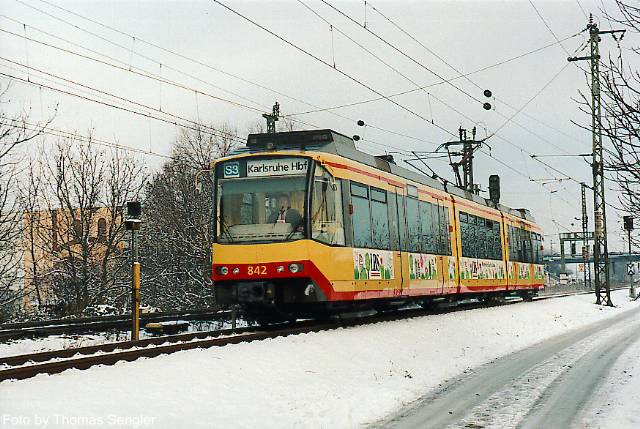
TramTrainGermany The in the snow in Germany
The cost to build a Vancouver to Chilliwack SkyTrain would be in the neighourhood of $9 billion to $10 billion!Ai??Ai?? It is suffice to say that there isn’t the ridership on the line to justify such an expenditure.
The cost of an electric LRT service from Vancouver to Chilliwack, using existing rail routes,Ai??Ai??would be in the neighbourhood of $1 billion, ($1.5 billion including a new Fraser River Rail Bridge)Ai??Ai??which is a manageable sum, especially when compared to the $2.5 billion RAV/Canada line.
With Diesel LRT, the cost of a basic Vancouver to Chilliwack service, using existing tracks, could be as low as $350 million for an hourly service. $350 million is about the cost of 2 km. of SkyTrain!
In a time of financial icebergs looming at TransLink, should not TransLink’s planners be thinking of much cheaper transit alternatives, instead of their grand SkyTrain and RAV lines, that despite their massive costs ($8 billion+) serve a region that only 11% of trips are made by transit, a number largely unchanged for over a decade.
It’s time for TransLink and all levels of Ai??Ai??politicians to think Light; think Rail; think affordable Transit.

TramTrain on the mainline in France
Ai??Ai??
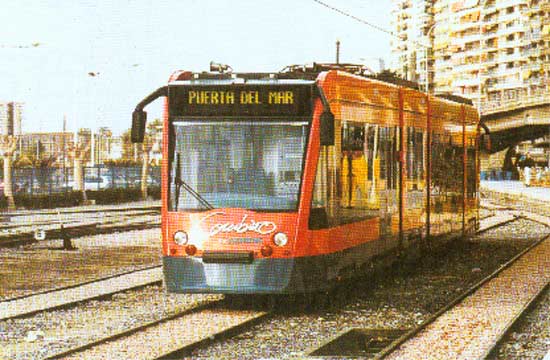
TramTrain in Spain
From the LRTA blog: LRT, very user-friendly & tourist friendly transit!

On the eve of RAV/Canada Line operation, with it’s premium fares to Vancouver International Airport (YVR), one reads with interest the following posting from the LRTA blog site. Now could it be, if the ‘powers that be’ opted for much larger, yet less costly light rail network instead of theAi??Ai?? now almost $3 billion RAV/Canada Line metro, TransLink could also offer tourist friendly fares as well?
Something else to mull over. The cost of a downtown to airport limosineAi??Ai?? is $39.00; a cab fare from Vancouver to the airport is $30.00 (direct hotel pick-up to YVR),Ai??Ai??while there will be a $2.50 RAV surcharge on a two zone ($3.75) Ai??Ai??TransLink fare. To get to the RAV/Canada line, a potential passenger must take a cab to a RAV/Canada line station with a minimum fare of $5.00 not including tip. The minimum cost ofAi??Ai??trip via RAV to the airport is $11.25, with one transfer. But if one splits the fare, two or three ways or in the case of a limousine, six ways, the cost by taxi/limousine could be comparable too or cheaper than using RAV/Canada Line!
Watch for a $10.00, one way, (based onAi??Ai??four persons per Limo) Limousine airport to hotel shuttle service to commence, very shortly after RAV opens!
From the LRTA blog………..
Earlier this week I visited the Swiss city of Geneva, and as I was about the leave the baggage reclaim hall I noted a ticket machine offering ‘free travel’ tickets.
Apparently these are for arriving air passengers and offers them an 80 minute ride-at will ticket for anywhere within the Geneva area. As is normal with ‘standard’ tickets in many Swiss towns and cities these allow break of journey, interchange between modes etc, the only difference is that they are free of charge and that the passengers must retain proof that they have just arrived by air (boarding pass, etc) in case they encounter a roving ticket inspector.
But thats not all… oh no…
When people check-in at hotels, camp sites, youth hostels etc in Geneva they are also given a complimentary ticket which allows free travel throughout the city for the whole duration of their stay – and back to the airport too!
These tickets are valid (within Geneva) on all transports including trams, single / double articulated trolleybuses & motor buses, water boats, and of course the mainline railway – many of which link in with major towns and cities throughout Switzerland.
From a British point of view it boggles the mind that a city should wish to do this, after all it effectively means that the tourists do not even contribute towards the cost of the transports (the burden falls on local people, etc).
As an aside, whilst there I saw some major works installing new tram tracks in the city centre. What would British politicians, the Treasury, etc think if anyone even suggested similar here?
How other countries see light rail and appraise light rail investments? From the Light Rail Transit Association
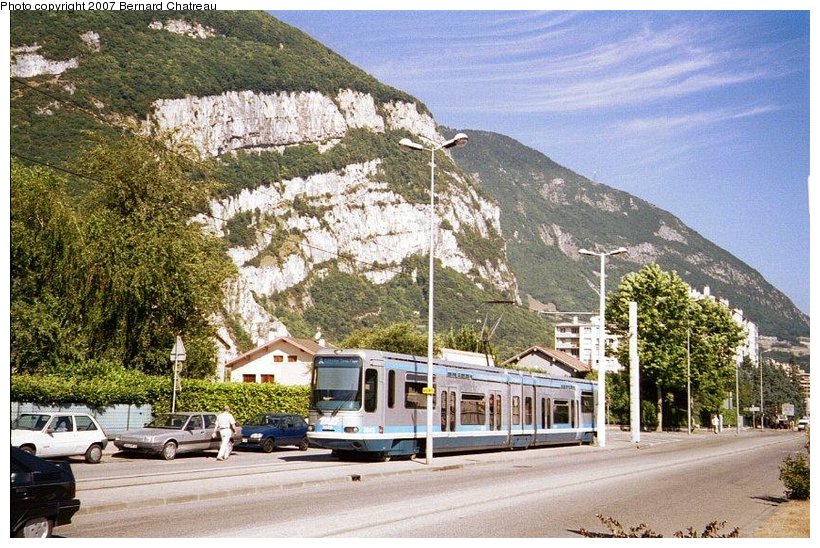
Article from the March 1999 edition of Tramways & Urban Transit
As anyone involved in a British light rail scheme knows, the appraisal system is rigorous and, many feel, fatally flawed, oriented as it is to short term and financial criteria rather than a properly broad social cost-benefit analysis. It is now also heavily influenced to favouring projects which are attractive to private companies under the Private Finance Initiative (PFI) and public-private partnership requirements which though they may well be the Nineties version of the EmperorA?ai??i??ai???s new clothes, are certainly the the flavour of the decade in the U.K.
Tramways & Urban Transit is pleased to publish a summary of the report prepared by Prof. Carmen Hass-Klau and Dr. Graham Crampton of consultants ETP (Environmental and Transport Planning). This article is a for a DETR Project on the examination of the appraisal methods and financial support mechanism used for light rail outside Britain. The full report studied the appraisal methods in France, Germany, Netherlands, Sweden and the United States.
Ai??
Advantages and disadvantages of Light Rail
Among the aspects discussed were the advantages and disadvantages of light rail in comparison to other public transport modes. The main disadvantage of light rail is that investment in light rail is more expensive than running buses along the same corridor because for buses the basic infrastructure – the roads – are already there. However there is quite a wide variation in the cost per km of light rail.
One of the advantages of light rail versus buses is that a typical light rail vehicle carries between 144-188 people (units with two or three carriages could carry 288-465 people) whereas an articulated or double-decker bus is only able to carry 80-160 people.
On the Continent, public transport experts believe that modern trams are perceived by the public to be a superior transport mode to buses. This appears to be in contrast to Britain where the run down trams of the 1950s and 60s left negative memories in the minds of many people.
Buses may have to use bus bays and make other sharp manoeuvres, as well as suffering engine vibration and road surface unevenness. Modern trams in contrast normally have a smoother and more comfortable ride.
As many trams have their own right of way, often established a long time ago, they are more protected from congestion and are normally faster than buses. Furthermore the same tram corridor can often also be used by buses. Even if bus lanes are available buses have problems with parked cars, which is not the case for trams as tram corridors are mostly in the middle of the carriageway. However at junctions delays can occur if cars are allowed to use the same right of way as trams.
Normally trams blend in better with the built environment of a city centre and other historic parts of the urban area. In practice the construction of a tram line can be used to redesign large parts of the city centre into a more pedestrian-friendly environment. With modern on-street running, there is no separation between the tram track and the rest of the carriageway. Pedestrians and trams mingle especially well together. Streets with trams can be designed much more attractively than streets with bus lanes. In Britain, the ugliness of overhead cabling is often an issue, whereas on the Continent, firstly people are used to it, and secondly it is normally designed to a high standard. Some tram routes have trees on both sides and/or lawn track beds. In the city centre similar pavement as in pedestrianised streets is used. Increasingly the traditional design of having tram beds looking like railway tracks has been abandoned.
Whereas underground rail is not visible to the public, surface trams have a strong marketing effect in favour of public transport. Zurich or Strasbourg trams have become a tourist attraction and are featured on public relations material for the cities, like the red buses in London. In contrast, elevated systems such as the VAL or the Docklands Light Rail are difficult to integrate into the urban environment; they are mostly too intrusive.
Environmentally, trams are much cleaner than normal diesel buses but increasingly local authorities are switching to earth-gas buses which have very low emission values. Trams are quieter than buses but this is not always the case.
Trams can be attractively designed, representing a futuristic image of a public transport mode as in Strasbourg. Buses have so far not been able to change their design significantly.
Ai??
Conditions for successful running of light rail
The success of light rail is dependent on many factors, of which population and the employment density of the light rail corridors and the frequency of service seem to be the most important aspects. Trams which run at low headways (high frequency) can gain a significant number of passengers. The higher the frequency of a public transport mode the more passengers will use it (or the more additional passengers can be won). However, the operators have to weigh the higher operational cost against the advantages of a high frequency. In many cases there is not even a choice, because the capacity to increase the frequency is not available.
In the past transport experts believed that the speed of the public transport mode was one of the major features to attract passengers. Again, there is little established evidence of this. Today we know from surveys carried out that speed itself is not the crucial factor. Passengers prefer ‘seamless’ journeys or short interchange times with immediate connections.
Even so, speed is still important. Many light rail lines in Europe have priority at traffic lights which can increase average speed and therefore give trams an advantage over cars.
We know little about how other factors like design and the comfort of the vehicle generate passenger growth.
The success of light rail is also dependent on the administrative and operational structure of which light rail forms a part. Competition between public transport modes is not particularly helpful in creating a successful public transport infrastructure.
An overview of the operational structure of public transport in some of the European countries shows great differences in the ways in which public transport is organised, with the Netherlands having the most centralised approach and Britain having in most cases no transport authority at all.
Ai??
The financing of light rail
Light rail investments have been funded by German governments since 1971. A specified percentage from national petrol tax revenues is awarded to urban public transport systems.
In previous years, up to 60% of the cost of urban rail investment has been paid by the Federal Government, up to 25% by the LA?Ai??nder and the rest by the local authorities. Since 1992, the Federal Government maximum funding percentage has been increased to 75% in West Germany and up to 90% in East Germany.
With the constitutional changes which introduced a new regional rail transport law in 1994 an amendment permits the LA?Ai??nder to receive even more petrol tax for those parts of the railway network which are defined as `regional’ rail transport (in practice the local rail network). This will also affect those light rail modes which run on traditional rail track like the ones in SaarbrA?A?cken and Karlsruhe.
Since 1992 all French transport regions with more than 20,000 inhabitants have the right to demand a public transport tax which can only be used for public transport investment but also helps to pay operational costs. Every employer with more than 9 employees who is located inside a transport authority may be asked to pay between 0.55 – 1.05% of its total payroll as Versement Transport to the authority.
The local transport authority can decide, following agreement within the Communes, how they want to spend the money, as long it is on public transport. However the upper limit can be increased if new public transport investment is built, and since 1990 this upper limit in provincial France can be 1.75%. In the Paris region the variation lies between 1.3 – 2.2%. However, there the employers also pay half of the cost of travel cards for their employees. This is in addition to the Versement Transport.
At the beginning of 1995, of 190 transport regions about 90%, which had the right to collect this tax, actually used this opportunity.
The Federal Government of the United States spent about $18.5 billion over 1980-95 on discretionary grants for new rail starts and extensions, contributing between 50-80% of the construction costs for these projects. This funding made it easier to initiate projects, and often made up funding shortfalls when projects ran over budget. Critics have argued that the whole capital grants program is discredited and the Federal Government has no business in funding new rail public transit systems at the local level at all. Others conclude that the main focus of any reform of the process should be to remove discretionary control of the funding, which has proved to be an easy target of misuse. The 1991 Intermodal Surface Transportation Efficiency Act (ISTEA) launched the first major re-structuring of the US’s surface transportation programs since Interstate Highway construction began in 1956. It embodied a Surface Transportation Fund, which includes roads amounting to $120.8 billion over 6 years. Within this was included a Mass Transportation Fund amounting to a $31.5 billion mass transit program over 6 years, with its 80% Federal share for capital programs and 50% for operating expenses.
Ai??
The evaluation of light rail investments
When studying the financing and evaluation methods in the various European countries and the United States, the political dimension of any method to justify light rail investment becomes apparent. Generally speaking, investing in light rail is seen by most politicians as being a good cause.
In Germany a traditional cost benefit analysis is used to justify the funds which come from the Federal Government. (This method is also applied in Switzerland, Austria and parts of Italy). One of the most important factors is the time savings to the public transport customer if a new line is installed. It is normally assumed that with each 1% time saving, additional demand of 0.75% for light rail service is created. It is further assumed that the transfer is made by the car users and not from any other mode. In reality, there is little evidence on how many people actually switch from car to public transport. Neither the public transport operators nor the Federal Government seemed to be interested in this question.
Although comprehensive traffic studies are normally carried out by the French transport authorities, no cost benefit analysis is demanded by the Central State. The British reader may find this surprising but this was also the case in Germany until 1982. Most major investment decisions regarding German light rail and underground were all made before this date. One of the reasons why the French may not require such an evaluation method may lie in the relatively low financial participation of the State in providing funds for light rail (only a maximum of 30% is funded). Funding of the rolling stock is not included in France but is in Germany. But the Versement Transport provides a significant proportion of the funds needed for light rail investment.
A very different approach is carried out in the Netherlands. Here the integration between land use and transport appears to be a very important factor. A traditional cost benefit analysis is combined with a multi-criteria approach, consisting of 20 different criteria. They include hard and soft measures and each of them is valued and weighted. This creates a balance sheet where the cost side is financial and the benefit side non-monetary. The results are provided as a benefit-cost ratio. Yet, independent of these calculations a high quality factor seemed to be decisive.
The Swedish studies allowed relatively little insight into their procedures but in the past a more traditional cost benefit analysis has been applied. This approach is questioned and new methods are being discussed that are similar to the Dutch appraisals.
The Federal U.S. Government does not seem to work with a cost benefit analysis as a decision device for the funding of light rail projects. But this does not imply that for an individual State that wants to obtain funding, cost benefit analysis is not carried out. In the past the decision making was highly political and more based on an equal distribution between the States than on a strict evaluation method. This may have been a deliberate choice because if such a method had been used the eastern States with their higher population and employment densities might have got most of the funding.
Ai??
Complementary measures
Apart from the operational and technical aspects and the location of the lines the role of complementary measures may be decisive for the degree of success of light rail investment. Whether a system is characterised as successful or not depends on the indicators used. If the success of light rail is measured in passenger growth since the start of operations then most newly built light rail lines are thriving. There are only very few exceptions known among experts, though unfortunately Sheffield’s tram is one of them. However, if success is measured by the extent to which car drivers are lured out of their cars, then most light rail lines are not as successful as they could be, possibly because there is a lack of policy measures that could be used to strengthen the role of light rail.
Complementary measures are defined as all those measures which are not connected directly to the operation of light rail for instance restraint policies (pedestrianisation, closure of town centres to through traffic), ticketing and marketing. Complementary measures can be divided into hard and soft. Measures which support light rail in order to ‘force’ a transfer from car to tram are called hard measures. Some authors prefer the word ‘stick’ instead of hard. In contrast, all those methods which primarily try to persuade car drivers to use light rail are soft measures such as marketing or comfort improvements. Ideally a combination of soft and hard measures should be used. Hard measures have to be sold well politically, otherwise people may not be willing to accept them.
The full report can be purchased from ETP, 9 South Road, Brighton BN1 6SB, Tel. 1273-540955, Fax 1273-508791, E-mail: etp@mistral.co.uk
Ai??
Mini-biographies:
Prof. Carmen Hass-Klau has a Professorship in Engineering and European Public Transport at the University of Wuppertal, Germany, and has also set up and directed Environmental and Transport Planning, a consultancy based in Brighton, England. She was also a member of the DETR Expert Committee advising on the preparation of the 1998 Transport White Paper.
Dr. Graham Crampton is a Lecturer in Economics at Reading University, England, and works for Environmental and Transport Planning on transport policy research projects.



Recent Comments