NEWS FLASH – Province launches review of BC Ferries and TransLink – From News 1130

Of course the province and Transportation Minister, Shirley Bond will not look at the real reasons of Translink’s financial problems: building light-metro (RAV & SkyTrain) on routes that do not have the ridership to sustain them. It seems the newly announced combined GST/PST (now known as HST) and potential massive new TransLink taxes and auto levies has raised the publics ire. But, unless the province employs BC’s Auditor General or engage an accredited organization such asAi??Ai??the UK’sAi??Ai??National Audit Office or NAO to look at TransLink, the review will be nothing more than self serving bumf, justifying Gordon Campbell’s inept and extremely expensive transit initiatives forced upon Translink.
Review will be completed by September 30th
Connie Thiessen / Mike Hanafin VICTORIA (NEWS1130) | Tuesday, July 28th, 2009
VICTORIA (NEWS1130) – The provincial government is launching a reviewAi??Ai??of BC Ferries and TransLink, the publicly funded, independently regulated transportation authorities.Ai??Ai?? The Finance Ministry and Transportation Ministry say it is to ensure customers and taxpayers are receiving maximum value for services.
Finance Minister Colin Hansen says that during challenging economic times, they must ensure that services are provided in a way that is financially sustainable and provides maximum value for people in B.C.Ai??Ai?? “Both BC Ferries and TransLink have been mandated to provide vital transportation services for millions of people, and we must ensure the governance arrangements are operating as efficiently as possible and the authorities are meeting their service objectives.”
The review was requested by transportation Minister Shirley Bond and are to be completed by September 30th.Ai??Ai?? The province says they’ll look at all aspects of the operations, from regulatory environment to
corporate structure to financial performance. A final report containing recommendations will be made public.Bond says, “It has been six years since BC Ferries became a private operation, and two years since TransLink’s governance model was revised. It is important we ensure both organizations are
meeting their financial and service expectations that came about with the new models.”The review will specifically look at:
* The division of responsibility between the Province and the respective
entities.
* The size, composition, appointment process and compensation for the
board of directors.
* The regulatory environment, including responsibilities, authorities and
powers of the Ferry Commission as well as the regional transportation
commissioner and Mayors’ Council on Regional Transportation.
* The operating costs and service delivery models, including the
company’s efforts to reduce costs using Alternate Service Providers, and
actions to increase productivity and quality customer service.
* A review of options available to the Province that are consistent with
the entities’ independence under generally accepted accounting principles
(GAAP) and which would ensure that existing and future independent,
regulated, publicly created authorities such as BC Ferries and the South
Coast British Columbia Transportation Authority are effectively
structured to:
o Protect ratepayers’ interests with minimal administration costs,
including hard caps on compensation levels for senior executives and
board members.
o Protect clearly mandated customer service levels.
o Improve transparency and public accountability for decisions and
performance levels.
What is guided bus? Is it B-Line BRT?
Guided buses are buses steered for part or all of their route by external means, usually on a dedicated rights-of-ways, thoughAi??Ai??not to be confused with a busway. This track, which often parallels existing roads or railways, excludes all other traffic, permitting theAi??Ai??operation of reliable schedules on heavily used corridors even duringAi??Ai??peak hours.
Guidance systems can be either physical, such as kerbs;

or remote, such as optical or radio guidance;

or by rail, making the guided bus a hybrid rail/monorail vehicle, retaining the ability to operate independently of the ‘rail’.
 Ai??
Ai??
On kerb-guided buses (KGB) small guide wheels are attached to the bus, and these engage vertical kerbs on either side of the track-way. The bus is steered in the normal way away from the guide-way. The start of the guide-way is funneled from a wide track to the normal width. The track-way allows for high-speed operation on a narrow guide-way.
Only a few examples currently exist, but more are proposed in various countries. The longest guided busway in the world is the O-Bahn Busway route in Adelaide, South Australia, which has been operating reasonably successfully since the mid 1980s.Ai??Ai?? Sadly, operating performance of the Adelaide KGB has not met expectations and no more KGB is to be built and modern LRT is now the preferred choice to provide urban transit to the city.
As reported earlier…….
http://railforthevalley.wordpress.com/2009/07/12/bus-raid-transit-a-transit-panacea-or-a-money-pit/
…….. Ai??Ai??the wire guided Dutch Phileas guided bus has also had operating problems in Turkey and the ‘rail-guided’ guided busesAi??Ai??operating in Caen has had severe teething problems. The real problem for guided bus is that its installationAi??Ai??costs are only slightly less (about 20% less)Ai??Ai??than light rail, which has much more operating benefits. Due to higher construction costs and operational problems, guided bus has become a niche transit mode, which does not compete with light rail, but with more conventional trolley buses!
From the BBC – Wales Southwest: The Swansea and Mumbles Railway, the first public railway that ended as LRT!
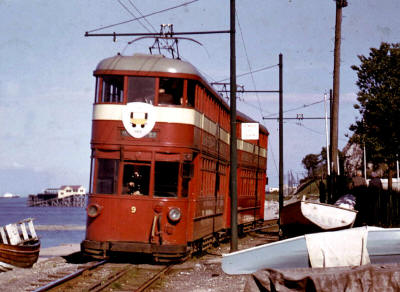
A little history lesson today: The Swansea and Mumbles Railway, the first public railway which operated fromAi??Ai??1807 to 1960.Ai??Ai??Starting fromAi??Ai??horse drawnAi??Ai??converted rail carriages, the Swansea and Mumbles Railway ended up as a light rail/interurban line, using rather large double-deck electric trams.
 Ai??Ai??
Early Days of Mumbles Railway
Ai??Ai??
From a four-wheeled dandy attracting international visitors for a “novelty” ride, to scenes when its passengers narrowly escaped being bombed – the history of the railway is intriguing and varied.
Even today the Mumbles Railway is held in remarkable affection by local people as historian Carol Powell now recounts in a series of features about its history and development.
Ai??Ai??Steam trains and bank holiday daytrippers
On 25 March 1807, the very same day that the British Parliament passed a Bill to outlaw the transatlantic trade in slaves, Swansea took its place in history with the inauguration of the world’s first passenger railway.
The carriage, initially a four-wheeled horse-drawn dandy, wound its way slowly from the Brewery Bank adjacent to the Swansea Canal in Swansea, around the wide sweep of Swansea Bay to its destination at Castle Hill (near the present-day Clements Quarry) at the tiny isolated fishing village of Oystermouth.
The line had originally been built in 1804 to transport limestone from the quarries of Mumbles to Swansea and thence to the markets beyond.
In March 1807, Benjamin French, one of its shareholders paid Ai??A?20 to the Tramroad Company, so that he could run a wagon on the line for a year to convey passengers. By 1813, the booklet ‘A Description of Swansea and its Environs’ noted that the fare was two shillings, (which would have been only affordable by the select few).
Some years later, ‘The New Swansea Guide’ of 1823 quoted one shilling – perhaps because of anticipated competition from the new toll road, which was due to open alongside in 1826.
The line continued for a while, but the horse-drawn buses made it economically unviable to operate the railway and the service had been withdrawn before 1830.
However, by the 1860s, the line was once more in business. On 17 August 1877, steam trains were introduced, but as the ownership of the line was in dispute, a situation was created whereby horse-drawn and steam trains competed on the same track at the same time, until the horses were phased out in 1896
In the late 1890s, the line from Blackpill towards Oystermouth was transferred from the roadside to the seaward side of the houses and was extended from Oystermouth across Horsepool, past Southend to reach the newly-constructed pier, the route that many of us remember.
Years leading up to the Great War
For many years, the Horsepool had been a natural harbour for the skiff owners to lay up and repair their boats.
This area was filled in when the new railway extension was built across it and instead a large wooden breakwater, which came to be known locally as ‘The Piles’ was constructed on the shore opposite the Antelope Public House-a move not very popular with the oyster- and fishermen.
At first, a fairground which included a figure-of-eight ride was set up on part of the infill, on what became known as the Ballast Bank, but today the area is occupied by the tennis courts, bowling green, Cornwall and Devon Places and Promenade Terrace.
The years leading up to the Great War were undoubtedly the heyday of the line with immense numbers of holiday-makers and daytrippers visiting the village, a fact amply illustrated when on a fine August Bank Holiday in 1913, some 48,000 passengers arrived on the train to enjoy a visit!
On 2 March 1929, a gleaming new fleet of red electric trains superseded the steam locomotives and these operated even throughout the war and on through the 150th anniversary of the line in 1954, until January 1960, when for many reasons, the powers-that-be decided that the days of the world-famous Mumbles Train were over.
http://www.bbc.co.uk/wales/southwest/sites/swansea/pages/mumbles_trainanniv.shtml
Ai??
Ai??
B.C. Rail, C.N. Rail & Gordon Campbell – Why it is important for ‘Rail for the Valley’ to understand the current situation.

The following item on David Berner’s blog……
http://thebernermonologues.blogspot.com/2009/07/really-big-smell.html
……is well worth a read, to understand the politics of TRIANGULATION, including Mr. Campbell, his family and the hierarchy of CN Rail.
It seems that the Premier regards ‘rail’ transit issues as a political plum, for his own amusement, phony environmental claims and multi billion dollar reelection metro construction. Rail for the Valley doesn’t want to get involved with “legal mattersAi??Ai??before the court”, but when CN Rail operates trains on part of the interurban route, one must worry that the Gordon Campbell Liberal government will forever drag its feet in allowing a Vancouver to Chilliwack service to operate.
One final question: Has the consulting firm, doing the Fraser Valley Rail Study, included diesel light rail? If not, then the study is not worth the paper its printed on.
TransLink mired in political standoff – Francis Bula, Globe and Mail

Ten years on, and TransLink remains stuck on the road to nowhere
Frances Bula
Vancouver
A?ai??i??Ai??Premier Gordon Campbell and Transportation Minister Kevin Falcon unveiled a $14-billion public transit plan to be completed by 2020 today. It is a key measure in the province’s greenhouse gas reduction plan, touching every region of the province.A?ai??i??A?
Those were the opening lines in a government news release distributed to reporters on Jan. 14, 2008, while the Premier stood amid charts and displays demonstrating the utopian future of transit in Metro Vancouver. With maps covered in a web of coloured transit lines, the plan included the Evergreen Line in the northeast sector, a 12-kilometre extension of the Millennium Line to the University of British Columbia, a six-kilometre extension of the Expo Line in Surrey, and herds of new clean-energy buses and SkyTrain cars.
That was then. Eighteen months later, the plan is mired in what has become a familiar standoff in British Columbia: the perpetual tussle between the province and a regional transportation agency.
In the latest chapter, TransLink says it can’t possibly pay for its part of the Premier’s ambitious plan without getting money from some new taps besides beleaguered transit riders, now paying as much as $5 for a single trip, and residential ratepayers, now paying an average of $235 a year for transportation.
The province, channelling its message through rookie Transportation Minister Shirley Bond, is insisting that the agency fulfill the promises the Premier made while balking at TransLink’s suggestions for new revenue sources. They include a vehicle levy of up to $200 a year, a share of the carbon-tax revenue, and road-pricing mechanisms such as tolls, distance charges and fees that would allow single drivers to use high-occupancy vehicle lanes.
What’s perplexing to almost everyone is why the province and TransLink, which is responsible for transit and roads in the Lower Mainland, have been locked in conflict almost from the day the agency was created by an NDP government in April of 1999. Today it’s the 10-year plan. A couple of years ago it was the province’s dissatisfaction over how TransLink handled approving the Canada Line, which led to a restructuring that took most decision-making power away from local politicians. And back when TransLink first got started, it was the vehicle levy that they parted ways over.
A?ai??i??Ai??The problem for TransLink is that while it is an innovative structure and it got the revenue tools, it never got the revenue streams,A?ai??i??A? says Pat Jacobsen, the former Ontario deputy transportation minister who was TransLink’s CEO for seven of its 10 years. A?ai??i??Ai??It’s the only authority I know of that has to fund 100 per cent of its bus capital, 50 to 70 per cent of its rapid-transit capital and all of its operating costs from local sources.A?ai??i??A?
The bill ends up being paid disproportionately by property taxes. According to a 2007 City of Edmonton study, transit costs account for 7.4 per cent of a Metro Vancouver resident’s tax bill, while just 4.5 per cent of the average Torontonian’s taxes go to fund that city’s system, which serves more than twice as many riders. The numbers are likely even farther apart now, since TransLink pushed through the maximum allowable property-tax increase last year.
That comes partly because provincial politicians of all stripes have been fearful of paying the price for introducing any new taxes.
During this year’s election campaign both the Liberals and the NDP refused to consider letting carbon-tax revenue go to TransLink.
A?ai??i??Ai??I get that you cannot ask a politician to go out and commit political suicide,A?ai??i??A? says former TransLink director Gordon Price, a passionate transit advocate. But with local mayors saying they are willing to take the heat for a vehicle levy, with the public saying it’s willing to pay more for transit, and with the need to do something to stop environmental degradation, Mr. Price says it’s time for the Premier to stand behind his plan.
But that leads to a second political dynamic at work A?ai??i??ai??? the fact that TransLink has always been a bit of an unloved child for the B.C. Liberals. They opposed its creation, and even though they essentially took it over two years ago by creating an appointed board, still don’t see the agency as truly theirs.
A?ai??i??Ai??I just don’t think Gordon Campbell ever wanted TransLink. And they’re always afraid of Vancouver getting too much,A?ai??i??A? says George Puil, a veteran former Vancouver city councillor and TransLink’s first chairman.
Mr. Puil has never been known as an NDP supporter or a green freak, but he can’t understand how the province thinks TransLink can come up with the $450-million a year A?ai??i??ai??? a 50-per-cent increase over its current budget A?ai??i??ai??? needed to fund the Premier’s dream plan if it isn’t given new revenue sources.
From the BBC – "Drivers ‘distrust’ road tax spend". Will regional mayors ‘here’ impose the auto levy?
And TransLink wants to add more taxes on cars. Local politicians take note.
A note added re comment, as the title states, this article comes from the BBC.

Motoring taxes have been handled so badly that drivers no longer trust what ministers say the charges pay for, an MPs’ report says.
Inconsistency over justification for green taxes “tarnished their image”, according to the transport committee.
Ministers should also abandon the link between unpopular congestion charge schemes and transport funding, it adds.
The government said billions had been spent on public transport and it was committed to improving travel options.
The cross-party committee concluded that road users remained “an important source of revenue” but needed to be treated “fairly and with openness”.
Voluntary road pricing schemes – such as allowing drivers to pay charges related to distance, time or congestion instead of car tax or fuel duty – could be an option, its members suggested.
They said drivers needed “clearer signals” about how their taxes were being spent to reduce congestion and pollution.
The report said: “Fuel duty has been presented, at different times, as a tool to reduce carbon emissions, a source of general revenue, and a means to fund transport investment.
“We are concerned that motorists are mistrustful of the government regarding taxes.”
Chairman Louise Ellman added: “The government handled a phased set of increases to Vehicle Excise Duty (car tax) so badly they tarnished the image of environmental taxes.”
Taxing drivers according to how much they use their cars remained the fairest method but the amount raised could be limited by the economic climate, she said.
Instead, the committee recommended the government develop other measures to address congestion.
‘Unacceptable’
The committee said proposed city-centre congestion charge plans had proved “unacceptable” in many areas.
Manchester and Edinburgh have rejected congestion schemes in recent years while plans to further expand the scheme in London were dropped last year.
Ms Ellman said distribution of money from the government’s Transport Innovation Fund should no longer be tied to such schemes.
But she believes individual drivers might be willing to pay road charges if they could offset them against road and fuel duties or get other incentives.
She said a scheme in Oregon, in the US, which linked charges to duty rebates and the offer of insurance and entertainment services, had proved successful.
Other suggestions the committee makes are for locally-funded transport improvements and tolls for foreign-registered lorries.
It also says car parking charges must be “proportional” and local authorities should not be charging excessive prices to pay for non-related services.
Although it said it had no evidence this was happening, the public was concerned about the issue.
Similarly, it says penalty fines must not be used as a “blatant” tool to raise money from motorists and councils must spend more of the revenue raised on creating more parking spaces and improving signs.
The Department of Transport said it had no plans to change the Transport Innovation Fund but stressed councils would still continue to receive funding if they did not pursue congestion schemes.
As well as increased investment in buses, trains and cycle routes, it said widening roads, extending hard shoulders and improving junctions would help tackle congestion.
“We are committed to implementing innovative and far-reaching measures to improve the transport options available,” it said.
RAC Foundation director Professor Stephen Glaister said drivers were given “no clear explanation” of what they got in return for around Ai??A?45bn paid in taxes each year.
AA president Edmund King added that the public had lost trust in all political parties on motoring issues.
Debunking the SkyTrain myth part 5. Thirty years of SkyTrain planning – the years that the Locusts hath eaten!
In the late 1970’s, after much study and with regional consensus, Greater Vancouver’s Regional Authority, the GVRD,Ai??Ai??was on the verge of approving three light rail lines; Vancouver to Whalley (via New Westminster); New Westminster to Lougheed Mall and Vancouver to Richmond. Costing $350 million to $460 million. It wasn’t to be. The then Social Credit provincial government forced the construction of the newly renamed Advanced Light Rail Transit (ALRT) System onto the GVRD and built a $850 million light-metro just to new Westminster.
A history lesson:
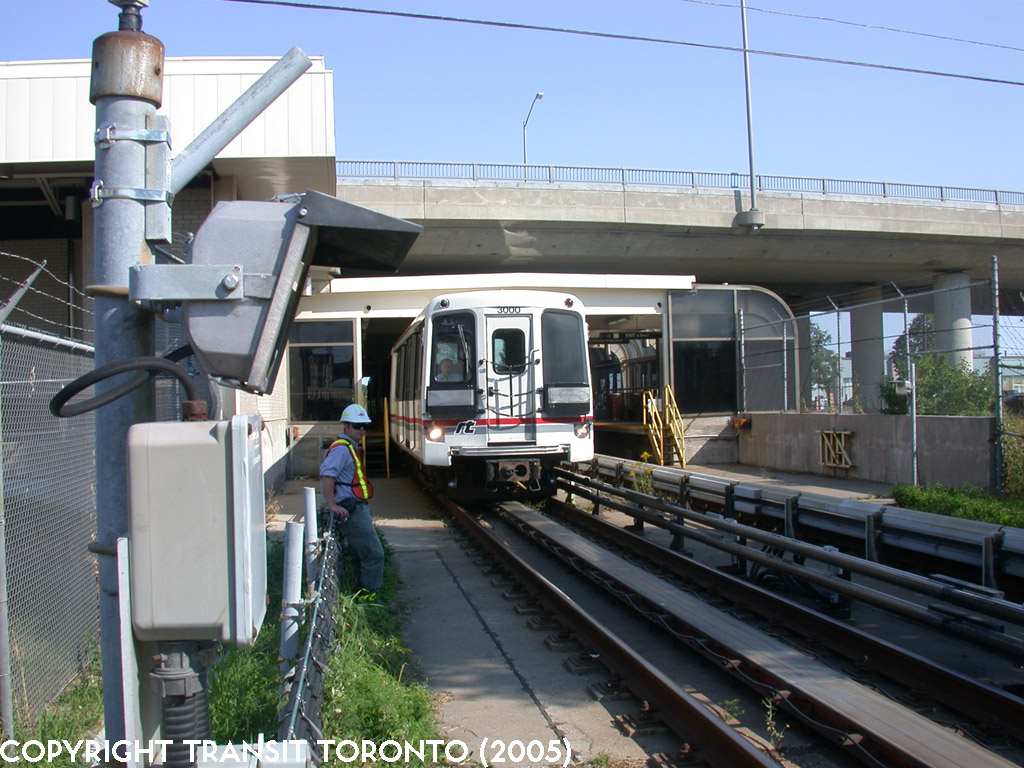
In the late 1970’s, the UTDC or Urban Transit Development Corporation, a Ontario crown corporation designed a new elevated light-metro called ICTS or Intermediate Capacity Transit System, for a public transit niche between the maximum ridership Toronto’s streetcars could carry and the ridership needed to justify a subway. The cost of ICTS was roughly half of a that of aAi??Ai??subway to build, though, according to the Toronto Transit Commission, “up to ten times more to install than light rail.”. Only two such systems were sold, Detroit (known locally as the mugger mover) and the Toronto, soon to be torn down, Scarborough Line.
Unfortunately for ICTS, it came after the Renaissance of modern LRT, which filled this niche and according to the TTC’s own studies, ICTS, despite the much higher costs, had about the same potential capacity of light rail!
To try to reinvent their proprietary light metro system and compete with light rail, the UTDC renamed ICTS’s to ALRT or Advanced Light Rail Transit in the late 1970’s. Then in a crass political deal with the then BC Social Credit Party, they agreed to purchase ALRT in exchangeAi??Ai??to obtain the then famous, Ontario Premier William Davis’s ‘Blue Machine’, which pioneered computer tracking of voters during elections, to desperately try to win the next BC provincial election.
The die was cast and the GVRD got SkyTrain “whether you like it or not.” Instead of originally planned LRT from Vancouver to Lougheed Mall, Whalley and Richmond, the region got SkyTrain only to New Westminster and as a bonus, the famed UTDC/BC TransitAi??Ai??‘SkyTrain speak’, which would even put George Orwell to shame.
The rest of the world came and saw SkyTrain at Expo 86, but the rest of the world built with LRT instead. No one else built with ALRT. The UTDC was sold to Lavalin which went bankrupt trying to sell the, again renamed ALM or Automated Light Metro, to Bangkok. Bombardier Inc. bought the shattered remains of Lavalin and ALM, redesigned the light-metro and renamed it ART or Advanced Light Metro.
In the mid 1990’s in other crass political deal, this timeAi??Ai??with Bombardier Inc., to get a (nowAi??Ai??abandoned) SkyTrain fabrication plant in Burnaby, the Glen Clark NDP government forced ART to be built on the Millennium Line. To date Bombardier as only soldAi??Ai??four ART systems, the Port Authority in New York, connecting the JFK airport to the subway system, Kuala Lumpur, Beijing, and Korea. It should be noted that ART was not allowed to compete against LRT forAi??Ai??all installations, strange as LRT has outsoldAi??Ai??ART by well overAi??Ai??70 to 1!
With SkyTrain came the ALRT/ART technocrats and bureaucrats who so perverted transit planning in the region, that we only plan for light-metro. After Vancouver had a well publicized temper tantrum, not wanting elevated SkyTrain, they got a much more expensive subway instead for the RAV/Canada Line. What Vancouver wants, Vancouver gets. As subway construction is about twice as much as elevated construction, RAVCo. and Intransit BC cut construction costs by building the somewhat cheaper cut-and-cover method, with the cost savings coming from not paying compensation to affected businesses.
The SkyTrain or light-metro trap
Regional planners have fallen into the SkyTrain trap, where all transit planning in the region is based on light-metroAi??Ai??including theAi??Ai??predicted ‘flip-flop’ on the Evergreen Line, whereAi??Ai??proposed LRT was planned as light-metroAi??Ai??andAi??Ai??then dutifully replaced withAi??Ai??SkyTrain. The SkyTrain trap is when one builds aAi??Ai??light-metro and then hires none but shills, who only plan for SkyTrain, which is a light-metro. Building much cheaper LRT would only show how inept previous transit planning has been and career bureaucrats and politicians, ever mindful of their reputations until the pension cheques roll in, will do everything in their power to prevent honest transit planning in the region.
SkyTrain trap:
Build small but very expensive proprietaryAi??Ai??light-metro line >> densify metro route by rezoning industrial & commercial lands to residentialAi??Ai??along the metro line to increase ridership >> increasing land values >> exodus of families and businesses, searching for cheaper homes and industrial landAi??Ai??>> new highways and bridgesAi??Ai??to cater to increasing suburban populationAi??Ai??>> increasedAi??Ai??traffic congestion as it too expensive to build with light metro in lightly populated areas >> build another light-metro line, thoughAi??Ai??not catering to suburban populations >> increased densification along the route to increase ridership >> further increasing land values >> a greater and further exodus of families and businesses to the suburbs, searching for cheaper homes and industrial landAi??Ai?? >> more new highways and bridgesAi??Ai??to cater to increasing suburban populationAi??Ai??>> increased traffic congestion >> more light-metro is planned, but not enough to cater to suburban populations >> increased densification >> and so on.
Most cities understand the SkyTrain trap is, with the first light-metro line built and subsequentlyAi??Ai??future transit construction isAi??Ai??with light rail; but no, not in Vancouver, where planners and politicians continue to plan for pie in the sky light metro lines.
SkyTrain, wins the battle but looses the war: Highways forever!
PortlandA?ai??i??ai???s Regional Planning Agency Highlights Two New Corridors for Light Rail – From the Transport Politic
Interesting news from Portland Oregon, where their light rail system keeps on growing at a steady pace, with taxpayer’s approving construction onAi??Ai??every new line. It must be remembered that Portland’s original light railAi??Ai??line cost one quarter of that to build than Vancouver’s SkyTrain and the regional taxpayer has never been allowed to vote on any ‘rail’ transit project.

13 July 2009
Second line to Gresham and new path to Sherwood would extend cityA?ai??i??ai???s high-capacity network.
PortlandA?ai??i??ai???s Metro regional planning authority has picked two corridors for future major transit investments, plotting the regionA?ai??i??ai???s path towards better public transportation. The new routes would extend east and southwest from downtown and will be developed consecutively after the completion of projects already in the engineering stage today. Metro also selected a number of other corridors for long-term consideration.
Along with the I-205 Green Line light rail scheduled for opening on September 12, the Portland region is currently planning a new light rail line south to Milwaukie, another north to Vancouver (WA), and a streetcar extension south to Lake Oswego. These projects, already being readied for the New Start funding process, will be the first completed.
MetroA?ai??i??ai???s new plans confirm that new routes between downtown and Gresham along Powell Boulevard and another between downtown and Sherwood via Tigard along Barbur Boulevard and Highway 99 will be the next to enter engineering. These routes were chosen after a close analysis of 18 possible corridors in the region and were determined to be the most cost-effective in terms of attracting ridership. Unlike the routes mentioned above, however, these lines have yet to be guaranteed funding. They also could theoretically be built as bus rapid transit, but PortlandA?ai??i??ai???s success thus far with light rail indicates that the city will continue investing in the latter mode.
The plan also argues for future consideration of other corridors in the southern and western parts of the region, though those projects are a long ways off.
PortlandA?ai??i??ai???s pursuit of advanced planning for its light rail program fits well with the cityA?ai??i??ai???s strict adherence to the Oregon-mandated urban growth boundary, which ensures that the countryside remains rural, rather than becoming exurban. Strong transportation investments in the right areas can allow for future growth in dense, infill neighborhoods and prevent suburban sprawl. The cityA?ai??i??ai???s streetcar expansion project follows a similar vein of thought.
The city and region could be doing a better job making that infill happen, however, and one hopes that the new lines will be the setting for a significant densification of the existing urban fabric. Though light rail has brought intense development to downtown and a few isolated spots along the routes, it hasnA?ai??i??ai???t been enough of a game-changer to reorient the auto-centered lifestyle thatA?ai??i??ai???s still present in much of the area. Part of the problem is that many of the light rail routes A?ai??i??ai??? including the soon-to-open Green Line A?ai??i??ai??? are located adjacent to or in the median of grade-separated highways. This makes them less than ideal places for transit-oriented, walkable neighborhoods.
But Powell Boulevard and much of Route 99, by virtue of their tighter girth, are connected to the neighborhoods around them, unlike I-205, for instance. ItA?ai??i??ai???s easy to imagine them transformed into urban boulevards, with four and five-story buildings facing the street and commercial districts situated around light rail stations. As downtown reaches its developmental limits, these corridors could become extensions of that core, adding a bit of mixed-use urbanity to neighborhood around the whole region.
http://thetransportpolitic.com/<!–Yonah Freemark–>
The demise of the Evergreen Line – How does this affect the valley interurban?
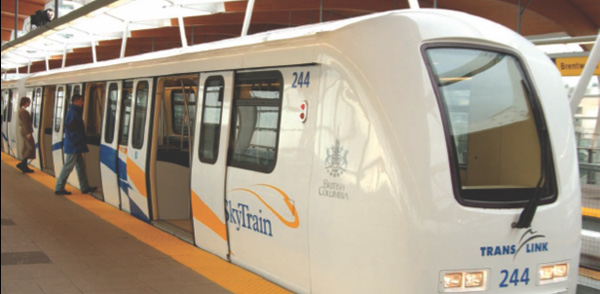
It seems that TransLink, which is in deep financial trouble, is on the verge of dumping the Evergreen SkyTrain Line. No surprise here as the proposed Evergreen line follows a route with little ridership potential.
Despite claims and opinions to the contrary, there is little demand for a SkyTrain metro extension to the Tri-Cities as peak hour bus ridership is still less that would sustain a bare bones tram system. Why then TransLink’s penchant for SkyTrain and light-metro?
It’s all about land development and not providing an attractive transit alternative, nor building a customer friendly transit system. Land valuesAi??Ai??near SkyTrain, especially at stations rises considerably as municipal politicians relax zoning and allow much higher densities. This in turn creates large windfall profits for the landowners. The lands adjacent to the Evergreen line have already been rezoned for higher residential and commercial densities and there was little scope for large profits. The $450 million shortfall in funding, poor ridership, and little scope for property rezoning and redevelopment, means the Evergreen Line will remain a vague political promise, with little chance of fruition.
What does this mean for the valley interurban?
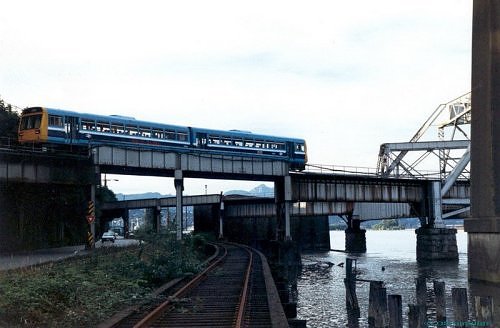
The deferral of the Evergreen Line could be good news and I stress ‘could be’ good news for the valley interurban. Why so? TransLink is ‘tapped out’ and taking on another short metro line will only add to their current financial woes. There is an ever increasing demandAi??Ai??from Fraser Valley politicians and residents that they too want to see ‘rail’ transit.
Including RAV, total spending on SkyTrain light-metro networkAi??Ai??is past $8 billion dollars (those huge annual debt servicing charges do add up), yet there is little to show for it south of the Fraser. If RAV/Canada Line doesn’t meet projected ridership numbers by August 2010, there possibly could be a demand by politicians (mindful of 2011 municipal elections) in the Fraser Valley for a more affordable and quicker ‘rail’ transit solution than a $3 billion or more ‘pixie dust’ SkyTrain line to Langley by 2040!
A hourly Vancouver to Chilliwack diesel LRT service could be put in place for about the same cost of two or three km. of SkyTrain and completed in under two years!
The collapse of the Evergreen SkyTrain metro will not herald a new era of light rail in the lower mainland, but may compel transit plannersAi??Ai??to build a cheap ‘rail‘ showcase light railway project fueled by political demands of the taxpayers south of the Fraser River, tired of funding ‘other people’s’ rapid transit lines!
Light rail – The safest public transit mode!
The following item is from Phoenix’s METRO Rail and addresses the safety issue of light rail. Much is said about the safety of on-street light rail or streetcars safety, especially at intersections, yet statistical analysis shows that a light rail/tram automobile intersection is much safer than an automobile automobile intersection. Accidents will happen and in the vast majority of cases of a tram/auto collision, it is the motorist who is at fault. Of course, those who decry at-grade/on-street ‘rail’ operation never mention that SkyTrain annual death rate is two to three times higher than Calgary’s C-Train death rate.
The recent non-fatal accident on Seattle’s new hybrid LRT system, caused by a car driver deliberately disobeying a traffic signal and driving in front of a moving tram,Ai??Ai??was given prominentAi??Ai??display by major media, including national mediaAi??Ai??over several days.

Yet this fatal accident, with a school bus is given just a footnote in the local media, as itAi??Ai??was too common place!.

Ai??
Ai??

Statistics indicate that light rail is by far a safer mode of transportation than other forms of motorized travel.
During the twelve-year period from 1994 through 2005, the National Center for Statistics and Analysis reports a fatality rate for all street and highway accidents of approximately 42,887 every year. According to the United States Bureau of Transportation Statistics, public transportation represents only about 0.004 percent of that national average and light rail only about 0.0003 percent.
The following statistics, available from the United States Bureau of Transportation Statistics, are taken from 1990 through 2002. They indicate that light rail is one of the safest forms of public transportation.
Transit Safety Data by Mode for All Reported Accidents (1990-2002)
| Average Annual Overall Public Transporation Fatalities | 178 |
| Motor Bus | 84 |
| Heavy Rail | 30 |
| Commuter Rail | 48 |
| Light Rail | 11 |
[Source: United States Bureau of Transportation Statistics]
With over 42,000 street and highway deaths recorded every year in the U.S., light rail is statistically one of the safest modes of motorized travel. Of the light rail accidents that do occur, 47 percent in 1998 involved cars making left turns in front of light rail vehicles. 51% of all the accidents on the Long Beach LRT line since July 1990 were the result of vehicles making improper left turns. [Source: Light Rail Now]
This improper left hand turn phenomena is not specific to light rail. ItA?ai??i??ai???s not uncommon for motor vehicle drivers to make improper left hand turns that cause accidents. Once in a while they also make these wrong turns in front of light rail vehicles.
In a 2002 statement before the Subcommittee On Highways And Transit Committee On Transportation And Infrastructure in the U.S. House Of Representatives, Mary E. Peters, Administrator of the Federal Highway Administration said A?ai??i??Ai??Transit has an enviable safety record. Across all modes of public transportation, accidents per million passenger miles decreased by nearly 28 percent between 1993 and 1999; transit passenger injuries per million passenger miles declined nearly 24 percent; and fatalities rates remained stable at .008 deaths per million passenger miles. Largely as a result of technological advances, both light rail and heavy rail showed very significant declines in accidents and injury rates.A?ai??i??A?
[Source: The National Highway Traffic Safety Administration]Ai??



Recent Comments