Posted by zweisystem on June 24, 2019 · 9 Comments

Kitchener’s new LRT, ION, is now open!
Stage 1 ION LRT, 19 km for $865 Million.
Stage 2 ION LRT, 18 km for $1.25 Billion.
Let’s see, 37 km of LRT $1.895 billion, sounds like a deal with the $3 billion, 5.5 km ART Movia metro Broadway subway or the short $1.65 Expo Line extension to Fleetwood.

By Kevin Nielsen Local Online Journalist Global News
Grand River Transit cut it close on its promise to have the ION LRT vehicles taking passengers through Kitchener and Waterloo by the end of spring.
The first train left the station at Fairway Mall on Friday morning at 11:40 a.m, just minutes before the end of spring.
“Isn’t it a beautiful spring morning,” Coun. Tom Galloway joked at the opening ceremony which launched the province’s first new transit system since the 1980s. “It’s a beautiful spring morning but I sense a Solstice about to arrive…
But that’s purely coincidental.”
The long-awaited LRT system has been under development since 2012 with its arrival coming months behind schedule.
Galloway, who has helped spearhead the project as part of the region’s Rapid Transit Steering Committee, also pointed to the economic benefits of the 19-station line which will run through the downtown cores of Kitchener and Waterloo.
“We are here today to report that with zero passengers carried, there has been $3.282 billion in completed, under construction or building permitted projects in the corridor,” he told the crowd.
“These numbers represent 13,000 new residential units and over four-million square feet of office and commercial space.”
A large crowd had gathered to watch the launch of the first ION train. It included many who had worked on the train, local MPs and MPPs, as well as many current and former regional councillors.
“This is one of the largest and fastest-growing urban centres in Ontario,” said Mike Harris, MPP for Kitchener-Conestoga.
“The Waterloo ION LRT project will provide a quick and convenient transportation option to more people between Kitchener, Waterloo and Cambridge, and mean shorter commute times that leave people more time for what matters most.”
Region of Waterloo chair Karen Redman noted how the trains, which can transport 200 passengers in each vehicle, will benefit the region as a whole.
“ION will connect seamlessly with Grand River Transit to create an efficient, easy-to-use public transit system,” she said.
Redman paid warning to the provincial and federal politicians that she will be knocking on their doors as the region turns its eyes towards the next phase which is intended to continue on from Kitchener to Cambridge.
“Once stage two is complete, ION buses will be replaced with rail creating a continuous LRT system across the region’s three urban centres,” she said.

Posted by zweisystem on June 19, 2019 · 1 Comment

The problem with TransLink is that you can never believe what it says; TransLink never produces a report based on the same set of assumptions.”
Former West Vancouver Clr. Victor Durman, Chair of the GVRD (now METRO) Finance Committee.
One hates to keep reminding people of TransLink’s lack of honesty, but dishonesty continues as nauseum.
It is interesting how TransLink has used this cunning method of manipulating analysis to justify SkyTrain in corridor after corridor, and has thus succeeded in keeping its proprietary rail system expanding. In the US, all new transit projects that seek federal support are now subjected to scrutiny by a panel of transit peers, selected and monitored by the federal government, to ensure that projects are analyzed honestly, and the taxpayers interests are protected.
No SkyTrain project has ever passed this scrutiny in the US.”
Gerald Fox, noted American Transit Engineer.
Again, one hates to keep reminding everyone that TransLink is just not honest with transit planning.
To counter the drive to reinstate a Vancouver to Chilliwack passenger rail service, operated as a regional railway, using mostly the former BC Electric interurban tracks, but using 21st century EMU’s, possibly powered by the “made in Canada” Ballard hydrogen fuel cells, TransLink blundered ahead with its own anti interurban plan.
This is the same TransLink who would tell all who listen that Broadway was the “most heavily used transit route in Canada and North America”, but after being caught on this exaggeration, they now claim “This is our region’s most overcrowded bus route.”
After two critiques of TransLink’s “Interurban Passenger Rail”, by UBC Professor Patrick Condon and from Mr. Haveacow (a Canadian transit specialist), TransLink is not being honest with the Mayors Council on Transit and the taxpayer.
I will comment on three important points.
1) The folks currently promoting the “return of the interurban” are not Rail for the Valley, but a separate group promoting this vital transportation link. To date there are at least three separate groups promoting the reinstatement of the former interurban service.
TransLink’s rebuttal seems to be about the letter Zwei sent to the two Langley’s comparing an affordable Vancouver to Langley rail link that could be built far cheaper and far quicker than TransLink’s underfunded ($1.4 billion underfunded) SkyTrain planned extension .
2) Those mandarins sitting in Translink’s expensive digs in Sapperton, haven’t even bothered to tour the interurban line and to see personally the many destinations that the rail service would cater too. Like the “Lotus Eaters”, they live in a pampered taxpayer paid world of their own.
3) TransLink is hugely afraid of publishing the projected costs of SkyTrain to Langley, which using TransLink’s own figures, now will exceed over $200 million per km to build. Nor is TransLink being candid with the operating costs of the extension and the $2 to $3 billion rehab of the Expo Line to cater to somewhat higher ridership.
Today, the cost for a reinstated rail service from Vancouver to Chilliwack, using EMU’s or DMU’s, range for $750,000.00 for an hourly service to $1.5 billion, for a deluxe three train an hour service per direction.
Three trains an hour per direction is more than many bus routes TransLink operates!
This spring’s massive hike in gas prices are due, in part, to SkyTrain’s huge annual subsidies. In 1992, the subsidy for the Expo line from Vancouver to New Westminster was $157 million. TransLink and the Mayor’s Council on Transit, utterly refuse to give a clear figure to operate the light metro network.
A source told Zwei that the annual subsidy, including payments to the SNC Lavalin lead consortium operating the Canada Line, is near $500 million annually!
Why are they so afraid to tell the truth?
The Mayor’s Council on Transit are like rubes at a fair, buying the magic elixir, a cure all, hawked by seasoned con artists.
Parochial politics, seasoned by politcal intrigue, supported by dirty laundered casino money is driving both SkyTrain extensions and it is time to say stop!
Who is in charge of the clattering SkyTrain?
The axles creak and the couplings strain,
and costs are too high, as fiasco nears,
and sloth hath deadened Translink’s ear,
and the warnings flash through the night in vain,
for the Mayor’s Council is in charge of the clattering SkyTrain.

Posted by zweisystem on June 19, 2019 · Leave a Comment

This reply by our friend, Mr. Haveacow is very much worth reading.
There are big problems extending SkyTrain; big problems equals lots of ta money, which equals more taxes and user fees.
Like high gas prices, just continue building with SkyTrain.
I will add to the professors point, the Hydrogen powered I Lint54, is a hydrogen fuel cell equipped version of Alstom’s top selling Lint 54 DMU /EMU commuter and regional rail vehicle. Ottawa’s O-Train uses the Lint 41 DMU for its diesel LRT equipped Trillium Line. The number in the title refers to the length of the individual DMU/EMU vehicle. It comes in 3 sizes 41 metres, 54 metres and 81 metres.
The Lint series of vehicle would require a minimum of testing because Ottawa already uses a version of this vehicle and has already recieved special dispensation to run on North American railways from Transport Canada. Only the Hydrogen Fuel Cell technology and the Hydrogen storage facilities would need the intense testing required for operations on Canadian mainline railways.
What Translink is really upset about is the same thing O.C. Transpo was upset about when the planning for the O-Train stsrted around 1997-98. They will have to negotiate with the railway for running rights. Then pay said railway while this system operates. To say most transit operators are uncomfortable with this, is a massive understatement. The history of your West Coast Express is an example of how much they (Translink), dislike not owning the right of way.
The benign neglect of Translink regarding the West Coast Express (WCE), shows the nature of the relationship between it and true regional level transit lines. The Skytrain is at best a downtown to suburb based rail system. As a regional level rail transit system (downtown to distant suburb or exurb), the Skytrain operationally is a very expensive and clumsy. This also clearly displays how both the Skytrain technology and Translink have a big problem of dealing with the geographic scale of true regional rail based transit. Both are not equipped to handle the issue and as a result, do it very poorly. This is an issue I have discussed before on this website, as Zwei will attest. Skytrain’s high level of technological complexity means that, any long distance stretch of track with little or no development like the Langley extension, will require many decades to get to the point were the ridership numbers come close to the current network’s average ridership revenue plus subsidy vs operating costs. Technological complexity means higher operating costs. These costs become a big limiter to service frequency if there isn’t enough ridership.
As per the service area boundary issue between B.C. Transit and Translink that is at best a red-herring! If Translink was interested in actually doing this Valley Service, the time between Translink proposing the idea and an agreement in principle with the province, could be measured in minutes. As soon as provincial officials realize that there is serious support for this locally in Translink, the process would instantly begin. I can see the meetings among provincial officials, “Someone other than us wants to operate a regional rapid transit service from Chilliwack to Surrey’s Skytrain Stations instead of B.C. Transit doing it! Sounds good to us!”
Finally what Translink just won’t talk about is the extreme high cost of building with Skytrain vs. low to medium passenger cappacity DMU ‘s and EMU’s using very much underused mainline railway rights of way, that already exist. I peg the cost of the Valley Rail Line project at 1/7 to 1/8 of the lowest end of Skytrain construction. The operational costs somewhere between 1/5-1/3 that of Skytrain. Yes, it will carry fewer passengers but so will any Skytrain line going out this far from the centre of Vancouver.
Posted by zweisystem on June 18, 2019 · 1 Comment
Zwei will comment on this and Translink’s rebuttal in the next blog post.
Translink has released a report dated June 6 to the Joint Regional Transportation Planning Committee later share with the Mayors Council on Regional Transportation.
https://www.peacearchnews.com/news/service-on-interurban-rail-would-be-expensive-miss-key-destinations-translink/?fbclid=IwAR2DqlC_P9oF_JLVhqovE2w9G-BiyITd6xt097Hto5FfPAvy8TA9q6qVpcI
It contains a number of misunderstandings and factual errors, some of which are addressed below.
*
Preamble:
*
The overarching misunderstanding is this: the concept of the Community Rail proposal is not driven by a desire or a need to connect the larger valley to the center of the Vancouver region as the Translink response seems to imply, but to serve what is an increasingly self contained urban region where more than 70 percent of all trips originating south of the Fraser now end south of the Fraser, a dramatic reversal from only 15 years ago. For example, in that time the South of Fraser Region has seen population and employment growth that is fifty percent higher per year than Vancouver’s. Air traffic out of Abbotsford International airport is increasing by almost 50% per year. Employment (such as at the new Molsons Brewery, which left Vancouver for Chilliwack) is rapidly moving to the valley in search of more affordable land, a stable labor force, and broader transportation access than that possible in Vancouver. Any assessment that does not elevate these facts to the status of first principles for analysis will be fatally flawed. Any assessment that is more than ten years old will be of little relevance. Any assessment that does not accept that rubber based transportation systems in the valley are already in a state of gridlock and crisis, and destined to remain so indefinitely absent a government response, is negligent. Detailed point by point responses are below.
*
1. Under the heading of “Purpose,” Translink falsely claims that the Community Rail proposal is suggested as an alternative to skytrain to Langley this is not the case. While the Community Rail serves many of the same ends as a skytrain to Langley proposal, at far less than one tenth of the cost, the Community Rail proposal has a far broader ambition: to serve the entire valley with affordable rail, not just the Surrey to Langley leg of the narrowly defined Vancouver Metro area.
*
2 Under “Background,” first paragraph. Translink mistakenly says that the line is owned by Canadian Pacific and Southern Railway. It is not. It is owned by the Province. Only freight rights were sold. Passenger rights were retained.
*
3. Under “Background” paragraph two. Translink mistakenly suggests that freight conflicts with freight movement would be a hindrance. It would not. The master agreement between the Province and the rail users stipulates that freight must give way to passenger use and that if double tracking is needed due to use conflicts, the cost will be borne by CP.
*
In the same paragraph Translink suggests that the alignment of the interurban line has “limited alignment with regional land use plans” which is hard to credit while Translink is proceeding with a plan for very expensive Skytrain through the lengthy unoccupied Green Timbers reserve, the lightly populated Fleetwood, and the agricultural lands of the Serpentine Valley before arriving at the same Langley Centre area also served by the interurban line.
*
4. Under “Background” paragraph three. Translink suggests that the line “may be part of a longer-term future, and opportunities should be retained for future services.” which is a positive statement. However valley citizens have long held the opinion that this future is now. Furthermore Translink overstates its mandate, which to date ends at the Langley border. The community rail proposal serves a region that extends at least 70 km east of that line.
*
5.Under “Background” paragraph four.
- Translink states that the line “does not directly connect relevant regional destinations (i.e. Surrey Central and Langley City),” while failing to acknowledge that the line does serve regional destinations such as North Delta, South Newton, and Cloverdale that their current plans fail to serve at all.
- Translink states that “resulted in less attractive travel times between key destinations” while failing to acknowledge that travel times are a function of the number of stops per unit distance and that the number of stops can be balanced against travel time objectives. Also that the interurban line is already in its own ROW and would not be slowed by traffic conflicts.
- Translink goes on to assert that the line “would require significant capital investments to meet safety requirements,” apparently ignorant of the fact that the Alstom hydrogen powered vehicles proposed can run immediately on the existing line without significant alteration and already meet Canadian safety standards.
- Furthermore in the same paragraph Translink states that these misunderstood cost factors would end up “resulting costs similar or higher than those along Fraser Highway or King George, but without commensurate benefits.” An independent assessment would prove this assertion to be dramatically misstated.
5. Under “Background” paragraph five. Translink helpfully suggests that “A new element of the Interurban proposal includes the potential use of hydrogen fuel cell trains, as being used in Germany for passenger service. This idea has not been evaluated.” We suggest that this evaluation be fast tracked as this technology removes many impediments. Self contained power eliminates the need to restore electrification of the line, which would be the major cost if new catenary and electrical power systems were required. With hydrogen they are not – nor does hydrogen pollute valley air.
6. Under “Discussion” first paragraph. Translink states, that “the Interurban alignment is indirect and through lower density and diverse areas. Both directness and density are critical factors in the performance of a successful rapid transit corridor” while their own maps shown clearly indicate that the interurban line connects key jobs centers including Scot Road, Delta/Surrey, South Newton, Cloverdale, and more of Langley than the proposed Skytrain line, while again failing to place this comment in the context of the much larger ambitions of the interurban proposal.
*
7. Under topic: “Freight volumes are expected to increase along the Interurban corridor.” Translink makes much of the volume of freight traffic flowing through the so called “shared section” of the line, shared by Southern Rail and CP largely to the north of the City of Langley. As mentioned above Translink seems unaware that CP is contractually obligated to pay the costs of double tracking this section should passenger use be impacted.
*
8. Under the topic: “Interurban requires substantial infrastructure investments comparable to building rapid transit along urban arterials”. Much of what Translink asserts must stem from confusion about the legal status of the line. The line is owned by the Province and available for use, for free, for passenger use immediately. Furthermore, with the exception of the “shared section” discussed above, the line is very lightly used and largely during off hours. Thus any discussion of double tracking the line is wildly premature.
*
Conclusion:
*
The detailed responses above are provided in an attempt to clarify what appears to be a deep misunderstanding on the part of Translink staff with regard to the interurban proposal. However this discussion may obscure the main point. The main public benefit of the proposal is not in how fast a few commuters might get from Langley centre to downtown Vancouver, but rather in how we might lay the spine for a more sustainable South of Fraser region. This region is experiencing explosive job and population growth, partly or largely driven by the exorbitant cost of housing closer to Vancouver. This growth, now almost entirely car dependent in form, has led to region wide grid lock. This gridlock is particularly severe on Route 1, where travel times during rush hours have slowed to a crawl, and where idling cars foul the air of the entire valley floor. We are suggesting that, at very very low cost, essentially the cost of just a few vehicles, interurban service could be resumed and could restore the walkable transit oriented structure that gave birth to the valley economy in the first place.
*
*
Professor Patrick M. Condon
University of British Columbia
James Taylor Chair in Landscape and Liveable Environments
2357 Main Mall
Vancouver, BC – V6T 1Z4
604 822 9291
Professor Patrick M. Condon
University of British Columbia
James Taylor Chair in Landscape and Liveable Environments
2357 Main Mall
Vancouver, BC – V6T 1Z4
604 822 9291
Posted by zweisystem on June 16, 2019 · Leave a Comment
Such an ill informed column in the Langley Advance Times, that one would think it is a plant, by those who want to spend billions on SkyTrain, which is well past its “Best Before” date.
Just who builds with ART Movia Metro (Expo and Millennium Lines) any more? Not one of the proprietary mini-metros sold in the past decade you say?
Why have only seven such systems have been built in the past forty years?

The failed TransUrban MAGLEV, the forerunner of ICTS, which was ALRT's previous name. What we call SkyTrain, is actually now called ART Movia metro and has had at least 5 previous names
The real issue is that the regional rail network, called SkyTrain, comprises of a conventional railway (Canada Line) and a proprietary unconventional railway called ART Movia Metro (Expo and Millennium Lines).
The now called ART Movia Metro is so unpopular because of poor design and operating characteristics that it has undergone six official name changes with only seven such systems have been built in the past 40 years! Of those systems, Toronto is soon to tear theirs down and in Asia the Youngin, Korea and Kuala Lumpur’s ART systems have embroiled Bombardier inc. and SNC Lavalin in legal ills.
The gross ignorance of railway operation by the author showed that he did no research, because if he did, he would have learned a thing or two.
First of hall a passenger and freight service can operate on the same line and do on literally thousands of railways around the world today. It is all about signaling and allocation of pathways for trains and the science for this goes back to the pre 1800’s, before the modern railway was conceived.
The “ace in the hole” is that the master agreement included with the portion of track purchased and used for the CPR allows up to 33% “wheel-age” for passenger operations, with the owning railway (CPR) paying full cost of all track improvements, including double tracking.
With a maximum of two freights a day on the remaining portion of line, poses absolutely no problem for passenger operation.

In Germany, TramTrain operates on mainline railways with mixed passenger and freight service, with little problems.
Then there is the extremely successful TramTrain, which in layman’s terms is a streetcar designed to operate on both on-street track and mainline railways. Both cheap and successful, TramTrain has affordably extended passenger services by rail at costs a mere fraction of that what would be spent building a SkyTrain style light-metro.
The first TramTrain line opened in Karlsruhe Germany in 1992 and saw ridership soar, in the first six months from 534,000 per week to 2,555,00 a week a massive 479% increase in ridership!

Karlsruhe Germany first TramTrain operation saw a dramatic 479% increase in ridership in the first six month of operation.
The Leewood Study, commissioned by the Rail for The Valley Group, done by Leewood Projects UK and released a decade ago, found that such a service was viable. The study was vetted by Canadian transportation specialist and Transport Canada. In Europe, the Leewood Study had great exposure for its forward thinking and affordability, featured in two transportation “trade’ magazines. In Canada it was ignored by the SkyTrain centered cabal planning transit in civic, provincial and federal levels.
The 2010 Leewood Study saw the per km cost of a DMU/EMU/TramTrain service varied from $5.2 to $7.2 million.

Alstom's Hydrogen fuel cell Coradia Lint is bringing a new dimension in public transport. Though not TramTrain, most TramTrain's will have a fuel cell option with in five years.
ART Movia Metro’s cost per km, using Translink’s own data, is over $200 million/km. And combined with onerous operating and maintenance costs, and lack of flexibility in operation makes it cost prohibitive to extend through Surrey to Langley. The automatic ART Movia Metro was never designed as a regional railway and it operates extremely poorly in snow.
It snows much more on the Surrey plateau, than Vancouver.
The success for a “return of the interurban” is dependent if it operates into Vancouver, providing a seamless and transfer journey from Vancouver to Chilliwack. The failure of building a combined road/rail bridge replacing the decaying Patullo Bridge and the absolutely decrepit Fraser river Rail Bridge, demonstrates a complete lack of foresight by regional politicians, especially the Mayor’s Council on Transit.

The GVRD were planning to replace both the Patullo and Fraser River Rail Bridge with a new road/rail bridge as early as the mid 1970's. Today, no such plan, a parochial politics is going to see the old 4 lane bridge replaced by a new 4 lane bridge.
If the Fraser Valley politicians want a rail connection to Vancouver, TramTrain or a hydrogen EMU is the way to or they will be waiting at a station for a SkyTrain that will never come.
Posted by zweisystem on June 14, 2019 · 3 Comments
TransLink, one of the most dishonest and unaccountable bureaucracies in the province, doesn’t want to reinstate the former interurban service. So powerful is TransLink, so totalitarian in operation, the regional mayors, the Minister of Transportation and the the Premier Horgan are deathly afraid of the bureacracy and cower in the shadows.
Such power, so abused!
I laugh when Translink blusters and fumes why it doesn’t want a reinstated modern interurban service, such utter nonsense. According to TransLink, the interurban doesn’t service key destinations?
Doesn’t service key destinations, you say?
Really, Really?
Is downtown Vancouver not a key destination?
Is North Delta/Surrey not a key destination?
Is Newton and Cloverdale not key destinations? Don’t tell the tens of thousands of people who, live there.
Is KPU Tech in Cloverdale not a key destination? Please don’t tell the students?

TransLink does not consider KPU Tech, which is a mere 400 metres from the interurban line a major transit destination.
Is downtown Langley not a key destination? I guess not.
Is Kwantlan Polytechnic University not a key destination?

TransLink does not consider KPU Langley, which is a mere 300 metres from the Interurban Line, a major transit destination.
Is Trinity Western University not a key destination?

Trinity Western University sits right on the interurban route and TransLink doesn't consider it a major destination?
Is the Gloucester industrial area near 56th Ave. and 272 St. not a key destination?
Is downtown Abbotsford not a key destination?
Is downtown Sardis not a key destination?
Is not Chilliwack a key destination?
What TransLink is really afraid of is optics, because for the same cost of SkyTrain to Fleetwood (aprox. 1.64 billion) the region can build a deluxe, three train an hour service from Vancouver to Chilliwack in each direction, providing a modern 21st century rail service using hydrogen electrical multiple units, (EMU’s) or the highly successful TramTrain.
TransLink would rather build with the dated (so 1970’s) SkyTrain light metro so land speculators and developers can build high rise towers and condos for the provincial money laundering crowd.
This begs the question: “Is TransLink building SkyTrain to benefit the public or criminal casino money launderers.
Over to you premier Horgan.
Service on Interurban rail would be expensive, miss key destinations: TransLink
Those pitching passenger service along the existing track call TransLink’s review ‘seriously flawed’
TransLink has released a report written for Lower Mainland mayors to assist in evaluating the pros and cons of a proposal to reactive passenger rail service along the existing Interurban line from Surrey to Chilliwack.
According to TransLink, activating passenger service on the line has “less attractive travel times between key destinations” due to a less direct route (compared to other alternatives); would not connect to key areas such as Surrey Central and Langley City; and would require “significant capital investments” to meet safety requirements and reliability objectives.
But TransLink’s review is being called “seriously flawed” by those pitching the plan.
A 99-kilometre, 90-minute route with 12 stops is proposed by the South Fraser Community Rail group, which says reactivated service on the existing interurban rail line would serve about 1.2 million residents in the region.
The TransLink report was released as proponents behind the push are holding “Rally for Rail” meetings, touting the use of “emissions-free hydrogen powered trains” along the track.
Behind the push is former B.C. premier Bill Vander Zalm, former Langley Township mayor Rick Green and also Patrick Condon, founder of UBC’s Urban Design program.
The group argues their train proposal would cost an estimated $12.5 million per kilometre, compared to the now-dead Surrey light-rail project’s estimated $157 million per kilometre (a figure provided by TransLink last September.)
TransLink argues it would be expensive, given safety regulations.
“To meet Transport Canada requirements for rail passenger safety, LRT vehicles must either be separated from freight train traffic through scheduling, or physically, by constructing separate tracks,” according to a 2012 TransLink study that evaluated the interurban corridor as a potential route for rapid transit expansion.
The report states that “constructing additional track and stations, acquiring right of way to add the tracks along the existing interurban corridor, and overcoming related construction challenges would be costly.”
TransLink’s most recent report summarizes the findings of the 2010-2012 Surrey Rapid Transit Study, when the transit authority assessed the interurban section between Scott Road and Langley to “explore merits of utilizing the Interurban corridor for fast, frequent, and reliable rapid transit service compared to Fraser Highway or King George Boulevard.”
At the time, TransLink notes, the “Interurban corridor was not selected, nor recommended for further consideration” for the aforementioned reasons and others, including freight volumes along the rail line that are expected to increase as well as potential environmental risks as the corridor travels along the Agricultural Land Reserve and floodplains of the Serpentine River.
The 2012 assessment study also pointed to land use along the corridor being lower density than other routes, and noted that it runs through a significant amount of agricultural lands, “resulting in lower potential ridership catchment near stations.”
“If there was a request to revisit previous assessment that this corridor could not effectively meet the objectives for rapid transit, the above and other challenges would need to be reviewed in the current context to provide an updated assessment of the transportation performance of the line,” the report notes. “TransLink staff have not completed an updated assessment of this idea.”
The new element of the interurban proposal – the potential use of hydrogen fuel cell trains – has not been evaluated by TransLink.
“The concept of using existing rail corridors and infrastructure in the rapidly-growing Lower Mainland is one that TransLink will be exploring through the update to the long-range strategy, Transport 2050,” TransLink’s report to the region’s mayors notes. “Transport 2050 will examine the long-term demand for improved inter-regional connections between the Metro Vancouver region and the Fraser Valley and examine what corridors could viably serve that demand. TransLink staff have met with proponents of the idea twice in lengthy meetings to hear the proposal and have shared with the group that management will be recommending that the Interurban concept be considered through the Transport 2050 process.”
But Green with South Fraser Community Rail called the TransLink evaluation “seriously flawed.”
“We have done a professionally supported critique on the TransLink reports which will be released by Monday next week,” said Green.
“To me and all of our team TransLink are embarrassing themselves with the material they are producing in support of their decisions,” he said. “One thing is sure, we have woken them up to a fight against their irresponsible decisions. The fact is TransLink staff have been receiving a fair number of questions from the region’s mayors about the Interurban because frankly very few of them knew anything about it.”
The Mayor’s Council on Regional Transportation has seen the report in a closed meeting, which was subsequently released to the public ahead of their June meeting. The region’s mayors are expected to receive the report as information at their next public meeting on June 27 in New Westminster.
Posted by zweisystem on June 11, 2019 · Leave a Comment

An open letter to the Prime Minister of Canada, the Premier of BC, Federal and Provincial Ministers of Transportation, Metro Vancouver members of Parliament and the British Columbia Legislature.
In the past few weeks TransLink and the mayor’s Council on Transit has been mounting a advertising blitz on Facebook and other social media pleading for more taxpayer’s money to pay for their ill conceived and dated transit planning.
This blitz included the the one question “push poll”; “Do you support SkyTrain to Langley”, which was misrepresented as a resounding support for SkyTrain and reported, ad nauseam, in the mainstream media.
The problem is, TransLink does not have an income problem, they have a spending problem. TransLink is spending up to ten times more building with an extremely expensive and obsolete light-metro network. This light-metro network is know as SkyTrain.
SkyTrain is not a transit mode in itself, but the name of Metro Vancouver’s regional transit system. The SkyTrain network operate two railways, a conventional railway operated as the Canada Line and an unconventional proprietary railway operated on the Millennium and Expo lines.
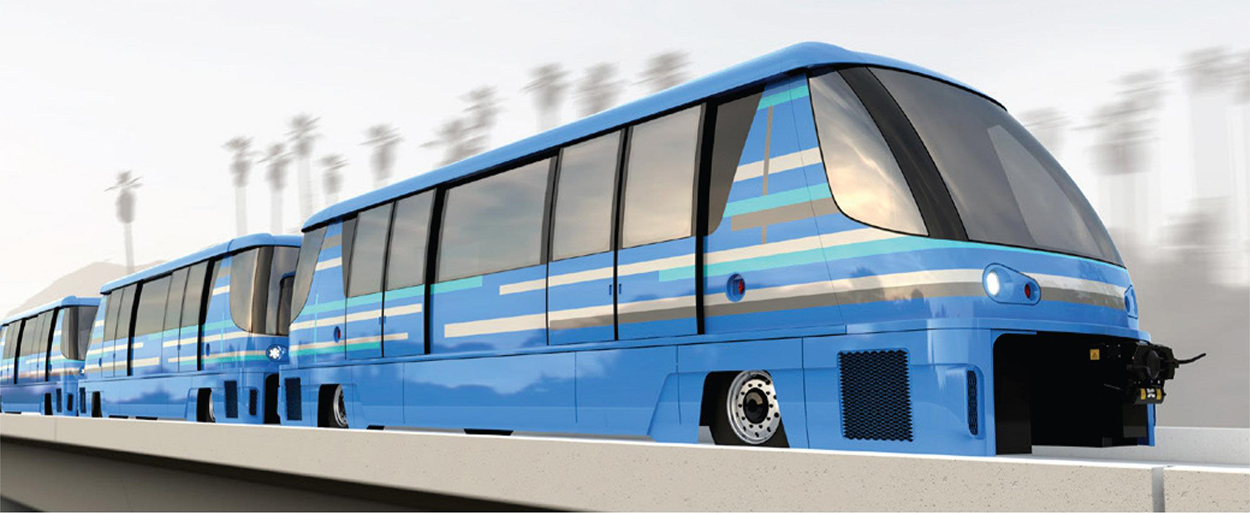
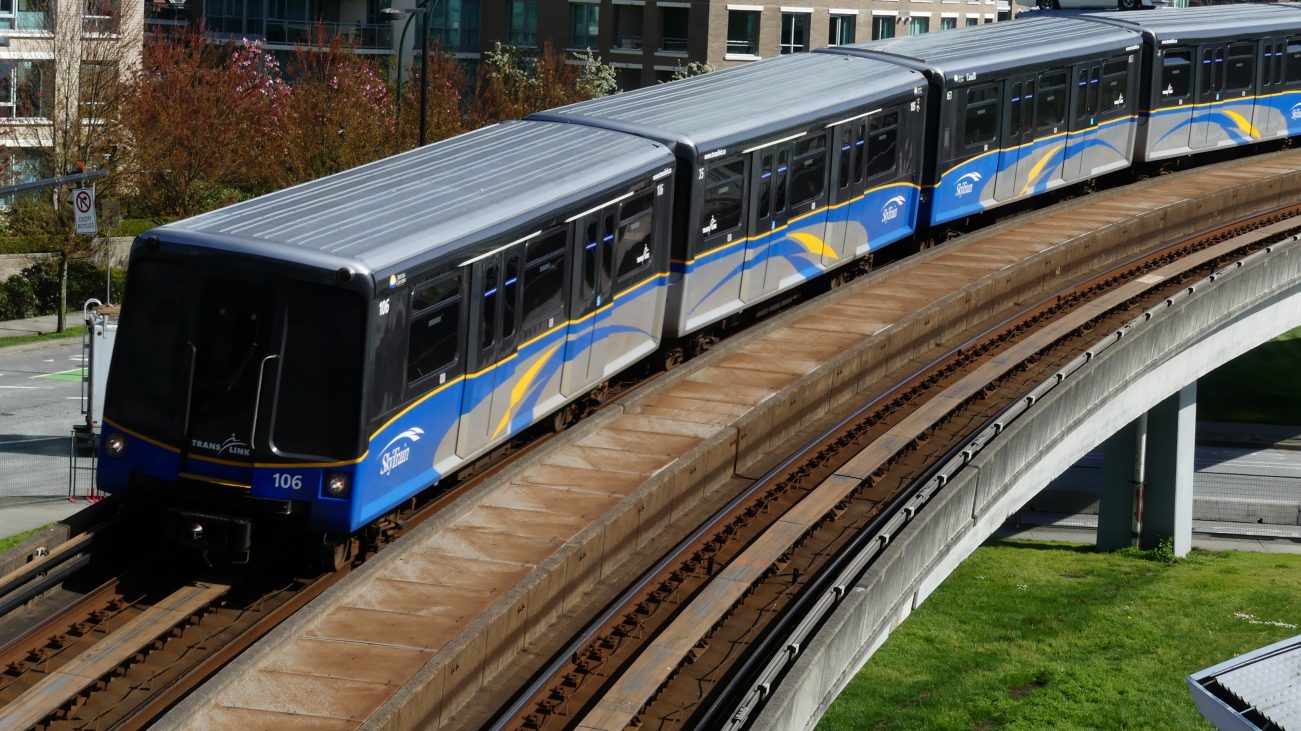
Contrary to popular belief, the above picture is Bombardier’s SkyTrain system, a proprietary
rubber tired airport people mover with no relation to the ART Movia metro used on
Translink’s SkyTrain system. Many elevated railways around the world are called SkyTrain.
The unconventional, proprietary railway is now called ART Movia Metro, which patents are owned by Bombardier inc. and SNC Lavalin.
ART Movia metro has been renamed many times, from the original Intermediate Capacity Transit System , to Advanced Light Rail Transit, to Advanced Light Metro, to Advanced Rapid Transit, to Innovia, and now Bombardier Inc. has folded the Innovia metro series into the Movia Metro product.
ART Movia metro is considered a unconventional proprietary railway because it is powered by Linear Induction Motors (LIM’s) and is not able to operate with any other rail system except for its own family of light metros. The Canada line trains cannot operate on the Expo or Millennium lines and visa versa.No other company offers an “off the shelf” product that will operate on the Expo and Millennium lines. This means Bombardier Inc.is the sole supplier of cars and spare parts.
Only seven of the ART Movia Metro systems has been sold in the past forty years and there has been no sales in the past decade. So poor is the ART Movia Metro (considered the Edsel of transit systems) that the next change will be the abandonment of production altogether. The reason for this is very easy to understand: ART Movia Metro costs more to build; more to operate; more to maintain; and it lacks the flexibility in operation that is so needed in the 21st Century. As well, the ART Movia metro lacks capacity!
Continued building with the now obsolete ART Movia metro means that TransLink, according to the Toronto Transit Commission’s 1983 IBI and ART Studies, is spending up to ten times more to provide rail transit than they should!
Current planning for “SkyTrain” expansion in Metro Vancouver is costing the taxpayer almost $5 billion, yet for that money, the region is getting a short 5.7 km subway and a extension down Fraser Highway to Fleetwood in Surrey.
TransLink has not been honest with their planning as there is not the ridership on Broadway to justify an almost $3 billion subway, nor is their the ridership to justify SkyTrain expansion in Surrey! Both projects will greatly increase operating costs (the subway alone will add, based on TTC’s estimates for a similar sized subway, $40 million annually) and the Surrey extension will trigger a $3 billion rehab of the Expo line to increase capacity beyond its Transport Canada Operating Certificate limit of 15,000 pphpd!
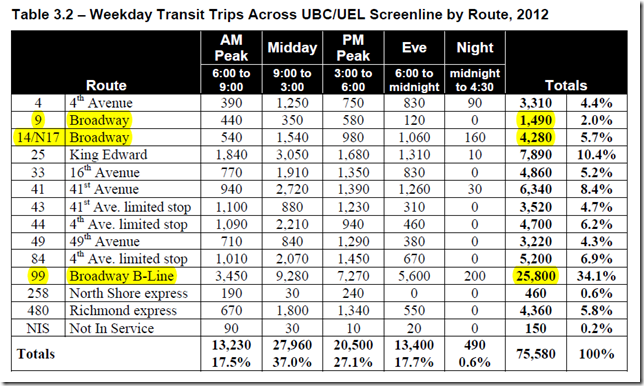
This chart from 2012 shows that the combined daily customer flows on Broadway fall way
short of the minimum Canadian and North American standard of 15,000 pphpd needed to
justify subway construction. Total customer flows to UBC all fall way short of the minimum
of 15,000 pphpd needed to justify a subway.
Added to this is that subways are very poor in attracting motorists from their cars and the Surrey extension does not offer any real incentive to attract the motorist from the car. Both extensions are considered very user unfriendly.
Both projects are being built for both politcal prestige and land speculation and development and not to provide a user friendly transit alternate to reduce congestion and pollution.
Vancouver wants subway to pretend it is a “world class city” because there is a belief that cities with subways are “world class” what ever that means. Vancouver’s decrepit downtown east side is also considered “world class”.
Vancouver and Surrey also want to use SkyTrain as a driver for land speculation and development, razing current affordable housing to build towers and high rise condos mainly for the overseas buyer. This mass densification, driven by SkyTrain, is also part of the “Vancouver Model” of criminal money laundering, which has made Vancouver and metro Vancouver “world class” example of being a hub of criminal money laundering operations!
Vancouver’s light metro system has been studied for almost 40 years and those who study Vancouver, build with light rail instead. Those cities that have built prestigious light metro systems now have regrets doing so. The USD $8.3 billion (CAD $11 billion) Hawaii light metro is a good example.
TransLink and the Mayor’s Council on Transit have willfully ignored the many warning signals about the high costs of light metro.
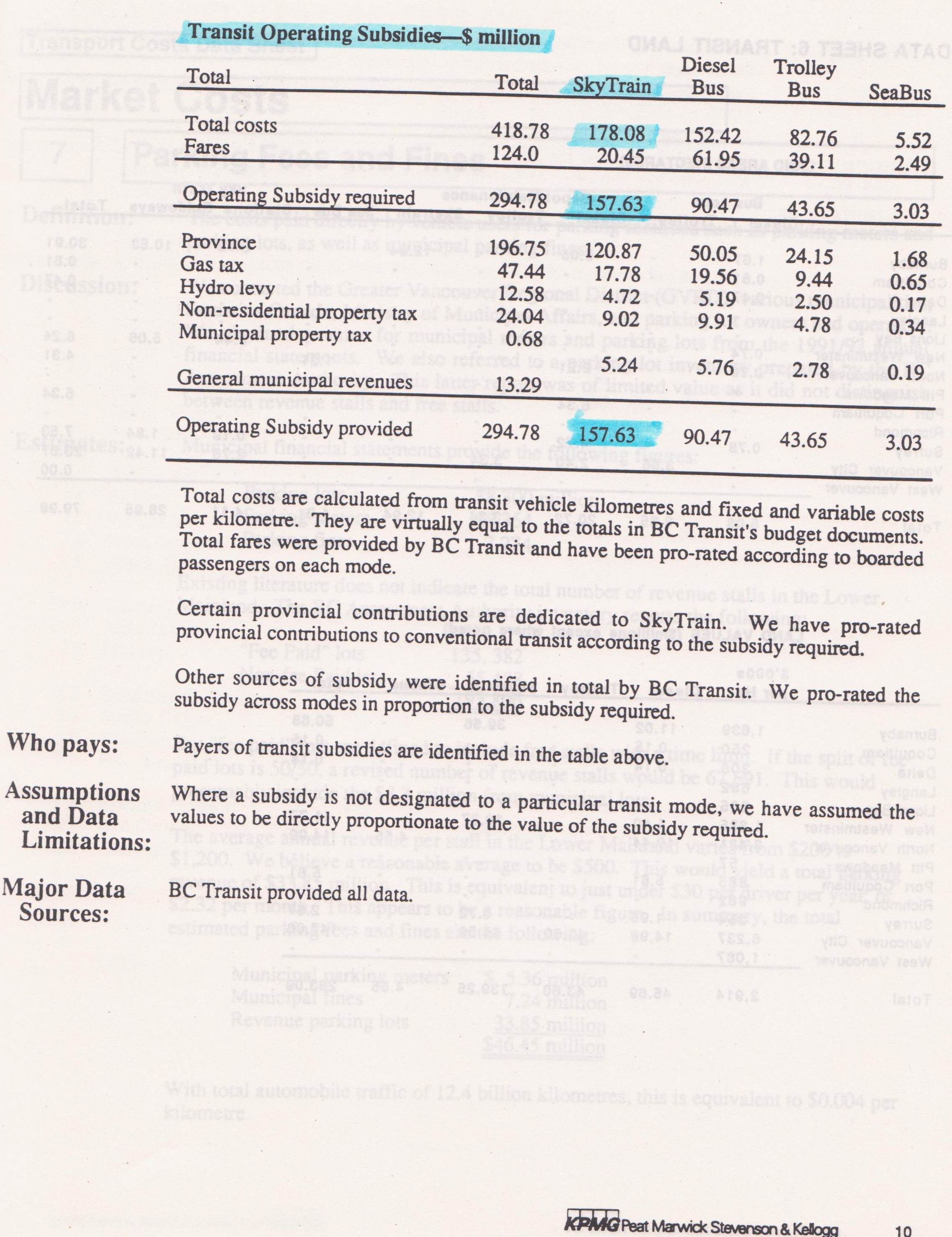
In 1992, the GVRD compared the annual $157.63 million subsidy for the Expo line operation from Waterfront Station to New Westminster and found it was more than the combined bus and trolleybus operation!
From the GVRD’s 1993 study. SkyTrain is subsidized at $157.63 million
($256.13 million in 2019 money) annually. How much is the SkyTrain system
subsidized today?
In the 1990’s, Former West Vancouver Clr. Victor Durman, Chair of the GVRD (now METRO) Finance Committee, stated: “The problem with TransLink is that you can never believe what it says; TransLink never produces a report based on the same set of assumptions.“
In 2008, American Transportation Engineer, Gerald Fox, stated, after he reviewed the Business case for the Evergreen Line: “It is interesting how TransLink has used this cunning method of manipulating analysis to justify SkyTrain in corridor after corridor, and has thus succeeded in keeping its proprietary rail system expanding. In the US, all new transit projects that seek federal support are now subjected to scrutiny by a panel of transit peers, selected and monitored by the federal government, to ensure that projects are analyzed honestly, and the taxpayers interests are protected. No SkyTrain project has ever passed this scrutiny in the US.”
In 2015 TransLink fired their two top planners, Tamin Raad and Brian Mills because they stated the obvious, that there was not the ridership on Broadway to justify a subway.
Again in 2015, regional voters rejected funding, by 62% funding, for TransLink. The plebiscite was a vote of non confidence of TransLink and the Mayor’s Council on Transit.
In 2019 TransLink admitted that Broadway was not the busiest transit route in Canada and the USA, rather it was Translink’s busiest bus route.
The mayor’s council on Transit has also ignored the legal turmoil that Bombardier and SNC Lavalin have embroiled themselves with. Legal ills with the ART Movia metro System in Malaysia and the former prime minister and the on going legal action Bombardier faces with the ART Movia Metro system in Korea, where it seems, only one car trains can be operated.
Who is in charge of the clattering SkyTrain?
The axles creak and the couplings strain,
and costs are too high, as fiasco nears,
and sloth hath deadened Translink’s ear,
and the warnings flash through the night in vain,
for the Mayor’s Council is in charge of the clattering SkyTrain.
Metro Vancouver and the Fraser Valley desperately needs a coherent and affordable transportation plan. Continued building with an obsolete yet very expensive light metro system, designed to deal with 1970’s inner city transit ills and not as a regional railway, will be a costly failure.
No one copies Metro Vancouver’s transit planning nor the exclusive use of light-metro!
There are better and cheaper options available, but TransLink and the Mayor’s Council ignore them, at the taxpayer’s peril. Provincial and federal politicians should be wary that support of TransLink and it’s current transit planning as its insatiable demand for more and more tax monies, is like an alcoholic’s craving for more liquor, may bring one’s politcal career to a grinding halt.
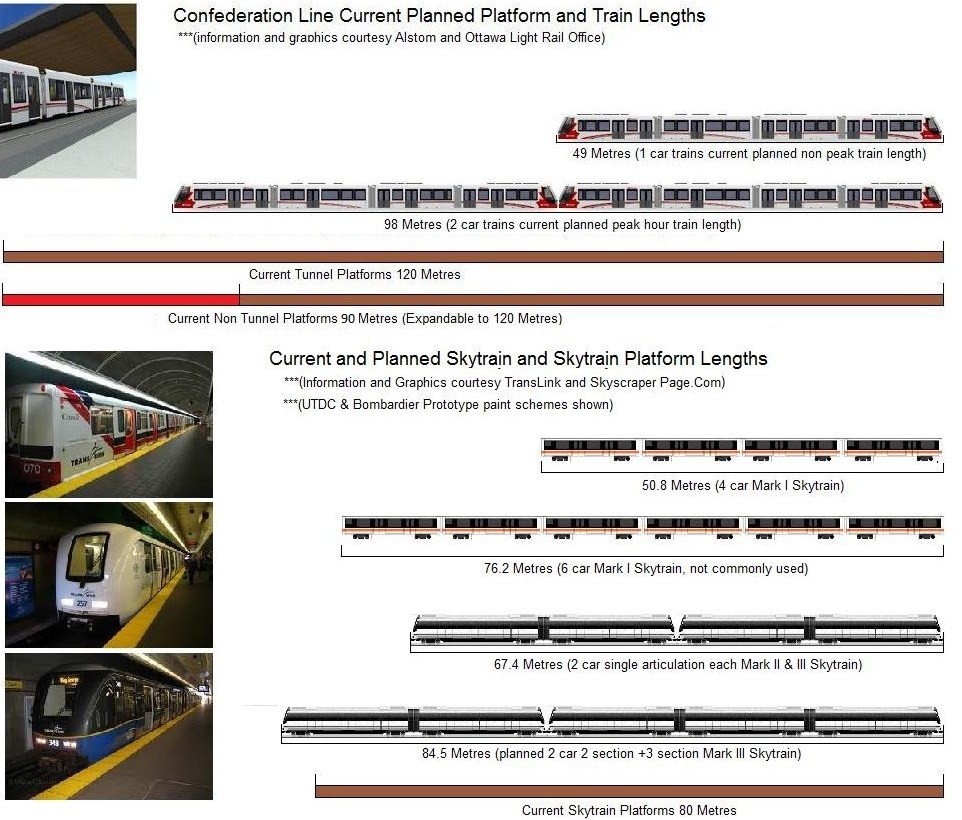
The above chart, comparing Ottawa’s new light rail vehicles with Vancouver’s
ART Movia Metro cars, comparing one modern tram is equal in capacity to
four MK.1 cars or 3 MK.2 cars. This clearly shows car cost and maintenance
advantages of modern LRT and the dated ART Movia Light metro.
The prophetic words of Norman Thompson; CBE, FCA, ACMA, English transit consultant and builder of the world’s busiest subway in the early 1980’s are coming true: “Vancouver is adopting a non commercial approach…….I hope they have lots of money“.
No more money should be allocated to TransLink and the point should be made with vigor; “Plan transit within your present budget“.
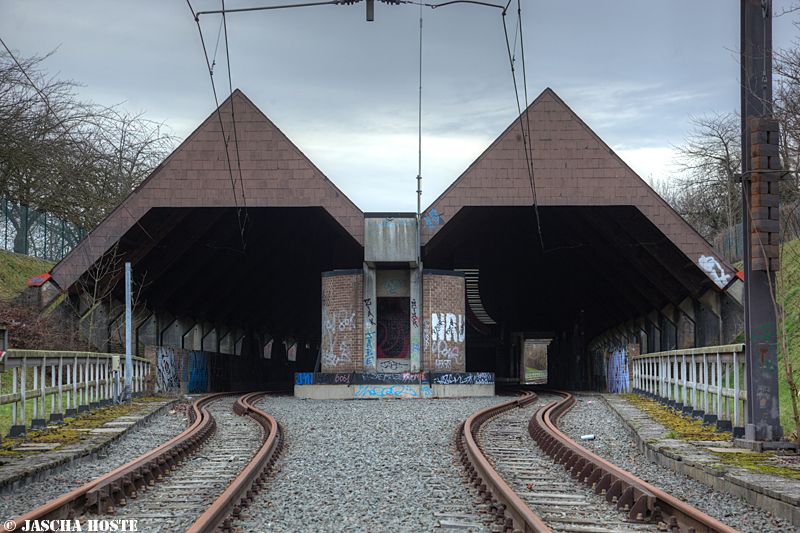 This could be the fate of TransLink’s and the Mayor’s council transit planning,
 a Charleroi fiasco,where the metro was built, but lacked the funds to operate it and it sits
slowly rotting a way, a testament of poor planning and politcal ennui.
Posted by zweisystem on May 30, 2019 · 3 Comments
Support affordable and realistic transit options for the Fraser Valley!

Posted by zweisystem on May 27, 2019 · 2 Comments

From the South Fraser Community Rail Folks.
Comments about TransLink’s recent push poll about expanding SkyTrain in Surrey.
The Truth about TRANSLINK’S SURVEY RESULTS EXPOSED….
southfrasercommunityrail@shaw.ca
|
|
May 26, 2019
|
South Fraser Community Rail
“Hydrogen iLink Passenger Rail, Scott Rd. SkyTrain to Chilliwack” #connect the valley
Press Release May 26th, 2019
The Truth about TRANSLINK SURVEY RESULTS EXPOSED….
Look into the untold facts behind TransLink’s misrepresentation! It’s startling!
The TransLink Survey results just released by TransLink yesterday exposes this organization for what it does very well, they are irresponsible with your tax dollars, conduct one sided Open Houses with only ONE option, conduct in-house on-line surveys with only ONE option and conduct market research offering only ONE option with ONE Question – Add all of this up, you get a ONE sided result surprised!
IMPORTANT – Added to the above is the fact the area being surveyed is absolutely starved for Transportation of any kind. In Langley/Surrey you get the results that have been published, all manufactured by TransLink for your pleasure. Wasting tax dollars is something they do very well.
Real Market Research seeks out the public’s views on a selection of issues, providing a variety of options to select from. Conducting telephone market research and asking the question ‘would you be in favor of SkyTrain to Langley City down the Fraser Highway” with no other option – WHAT DO YOU THINK IS GOING TO BE THEIR ANSWER? Especially, as stated above, they are starved for a transit option of any kind! It is an insult to the intelligence of the region, all designed with a preset answer.
On telephone market research, let’s break down their numbers:
In Surrey a sample size of 595, a margin of error of +/-4%, 85% support and in numbers 505.
In Langley City a sample size of 67, a margin of error of +/-12%, 90% support and in numbers 60.
In Township Langley, sample size of 180, a margin of error of +/-8%, 92% support and in numbers 165.
IMPORTANT NOTE: This phone call research again asked one question with only one option and you get 90%-92 %? In a transportation starved community, how did they not get 100%?
On Open House, filled out survey forms?
Pouring an endless amount of taxpayer dollars towards and into promoting; the website, Digital ads (Facebook, Twitter, Instagram, Google Search network, Google Display Network, G mail ads), Surrey Now Leader banner ads, advertorial, Facebook Posts, Langley Advance Times Banner ads, advertorial, Facebook Posts, SMS NextBus alert ads, eNewsletters, Social Media using Facebook and Twitter (Facebook events were created for each open house), Direct Outreach through corporate, business and community organizations, Mail out postcards to Surrey and Langley businesses and residents, Street teams (staff) distributing postcards at transit hubs, Community Events in Surrey, Information Boards at Surrey City Hall, Langley City Hall and the Township of Langley City Hall and finally transit ads! And you are Surprised at the result?
The level of awareness seems to have been the question of the day!
With the money poured into this one-sided Public Engagement Campaign the results are not at all surprising. Throughout the survey they talk about the plan for the South of Fraser – Surrey is NOT the South of Fraser region, it is a small part of it! Once again asking residents ONE question on ONE option in a region starved for any Transit Option does not constitute a survey of ANY value.
Seriously consider the following –
- Doug McCallum got elected with only 13.50% of the eligible voters in Surrey!
Promised SkyTrain at a cost of $1.65 Billion, actual cost will be $3 + Billion!
Promised City Police Force @ 10% cost increase– Increase will be substantially greater!
- The Safe Surrey Coalition has disbanded, Doug McCallum is the lone remaining voice and will cost the residents throughout the region increased TransLink taxation costs PLUS increased Surrey taxation for increased Policing costs. This financial irresponsibility has got to stop! Check out the Per Capita Costs below on all options:
- Original LRT, Guildford, Surrey Center to Newton Pop. 312,340 @ $1.65 Billion = $5,122. Per capita
- 11 kms in length 104th Guildford to Surrey Center down King George Blvd to Newton
- SkyTrain Surrey Center to Fleetwood Population 62,735 @ $1.65 Billion = $25,504. per capita.
- 7 kms in length down Fraser Highway to Fleetwood
- SkyTrain Surrey Center to Langley City Population 157,618 @ $3.2 Billion = $20,302. per capita
- 16 kms in length down Fraser Highway (About $800 million thru a Dead Zone, 25% no population)
The solution for our region follows and the questions regarding this option were not asked? WHY?
- Scott Rd SkyTrain to Chilliwack, Population 852,846 @ $1.250 Billion = $1,465. per capita
The Interurban State-of-the-Art Hydrail Passenger Rail proposal makes sense for 1.2 million people! Why wasn’t this option offered in their survey? Cost would be pennies on the dollar and would serve 14 Post Secondary Institutions, 7 First Nations Communities and 16 Cities, towns and municipalities!
Let’s stop insulting the intelligence of the Public. Let’s start by conducting a balanced survey that will MEAN something, save Billions of dollars and provide far better service at a fraction of the cost while we are at it!
It would be laughable IF it wasn’t so serious! TransLink continues to waste an immense number of tax dollars while the regions (1.2 million residents) are losing out on a FREE for use corridor.
For more detail from the South Fraser Community Rail Group – Contact Rick Green – 604 866-5752
Website www.southfrasercommunityrail.ca
Email address southfrasercommunityrail@shaw.ca
Posted by zweisystem on May 24, 2019 · 4 Comments
Good news everyone, the federal liberals are giving TransLink money to buy new cars and upgrade the Expo Line, yippee.
It’s not additional money of course, rather a renouncement of a renouncement.
Really, how much mileage can they get for $1.47 billion? A lot if today’s reannouncent is anything to go by.
Just to remind ourselves of the committed costs to date, I will restate the funded projects and the funding shortfalls.
Broadway subway: Funded to $2.8 billion. Real cost around $3 billion. Shortfall $200 to $300 million.
Surrey Expo line extension: Funded for $1.65 billion. Cost to go to Langley $3 billion. Shortfall $1.35 billion.
200 Mk.3 car order: $800 million plus. Funding included in the Federal financing. Shortfall $800 million plus from the two approved transit projects.
Expo & Millennium Line rehab: around $3 billion. Unfunded. Shortfall, around $3 billion.
Total funding shortfall: Over $5 billion!
As always, Translink’s numbers do not add up and the federal Liberals and the provincial NDP know this very well, but with such a dismal mainstream media in BC, renouncement of a reannouncement, of reannouncement makes big news!

New, reconditioned SkyTrain cars: Feds, province outline funding for Metro Vancouver transit
by Hana Mae Nassar
Posted May 23, 2019 10:05
BURNABY (NEWS 1130) – The federal government is outlining how the $1.47 billion it previously announced to upgrade public transit infrastructure in Metro Vancouver will be spent.
The money will go toward buying hundreds of new SkyTrain cars, as well as toward reconditioning dozens of older ones.
“It’s money that was announced back in January that we were sharing the investment with the federal government,” B.C. Minister of Transportation Claire Trevena says.
Of Thursday’s announcement, Trevena says she’s happy to be able to announce the upgrades and expansion of the Expo and Millennium lines.
“The upgrades wouldn’t happen without the commitment from all levels of government. We’re working in partnership with the federal government, and obviously with TransLink to make sure this happens. But, we do need to ensure that we are replacing the rolling stock, that we do get those extra carriages on, that we have the facilities, the storage facilities, to make sure the power system is upgraded.
“We need to get people out of their cars, we need to get them into public transportation,” Trevena adds.
The money is part of the federal government’s broader infrastructure plan, which Minister of Defence Harjit Sajjan says has been able to fund thousands of projects across Canada.
“Our investments are encouraging more people to take public transit and helping to reduce traffic congestion and air pollution,” he says.
Continued investments in communities across B.C. will help grow the local economy, Sajjan adds, as well as build more inclusive communities, all while protecting the environment and health of those living in this country.
“Here in British Columbia, we have provided and invested over $3.6 billion through our infrastructure plan to date,” Sajjan says.
-With files from Martin MacMahon
Editor’s Note: A previous version of this story quoted Minister Sajjan as saying the federal government has invested over $3.6 million to date. The minister has corrected his statement to say $3.6 billion.
Please see: http://www.railforthevalley.com/latest-news/zweisystem/adios-the-mk-1s/





Recent Comments