As the debate over trams/LRT and or proprietary light metro intensifies, let us look and modern trams in operation around the world.
Today, there is over 600 tram/light rail systems in operation or nearing completion, around the world.
Only seven of the proprietary ART Movia light-metros have been built in the past 40 years and there is good reason for this. With tram/LRT one can operate the in almost all locales, from small suburban lines to main transit arteries in major conurbations where peak hour customer flows exceed 20,000 pphpd.
With light metro, only somewhat short, yet very expensive trunk lines can be built, forcing many transit users to transfer from bus to mini-metro, which in turn deters ridership. This is but one, of the many reasons light metro has become somewhat obsolete in the 21st century.
This inherent flexibility of operation means that the modern tram can serve transit routes with low and high ridership; track share with mainline railways; and penetrate economically into dense city centres without beggaring the taxpayer.
Beggaring the taxpayer is a topic the SkyTrain lobby refuses to deal with.
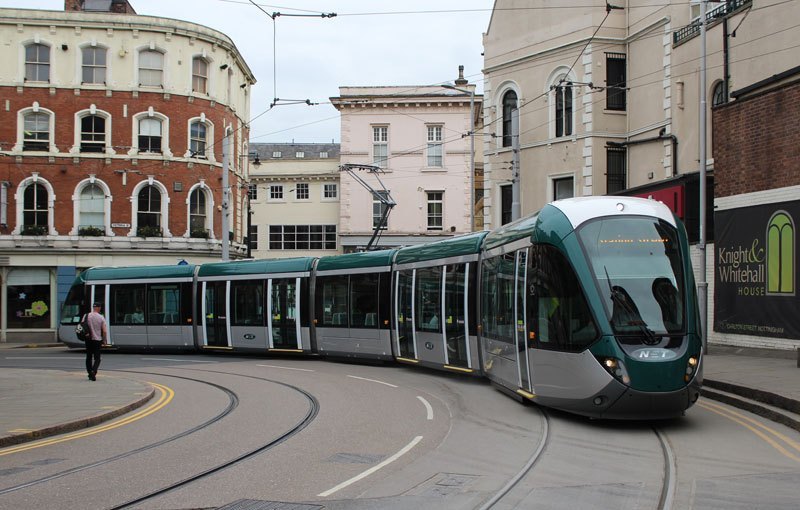
Nottingham's (UK) new tram system services the city centre with the minimum of cost.
Another view of Nottingham's tram, using city streets to affordably reach customers.
Innsbruck's tram services mountain customers, giving direct access to the city centre.
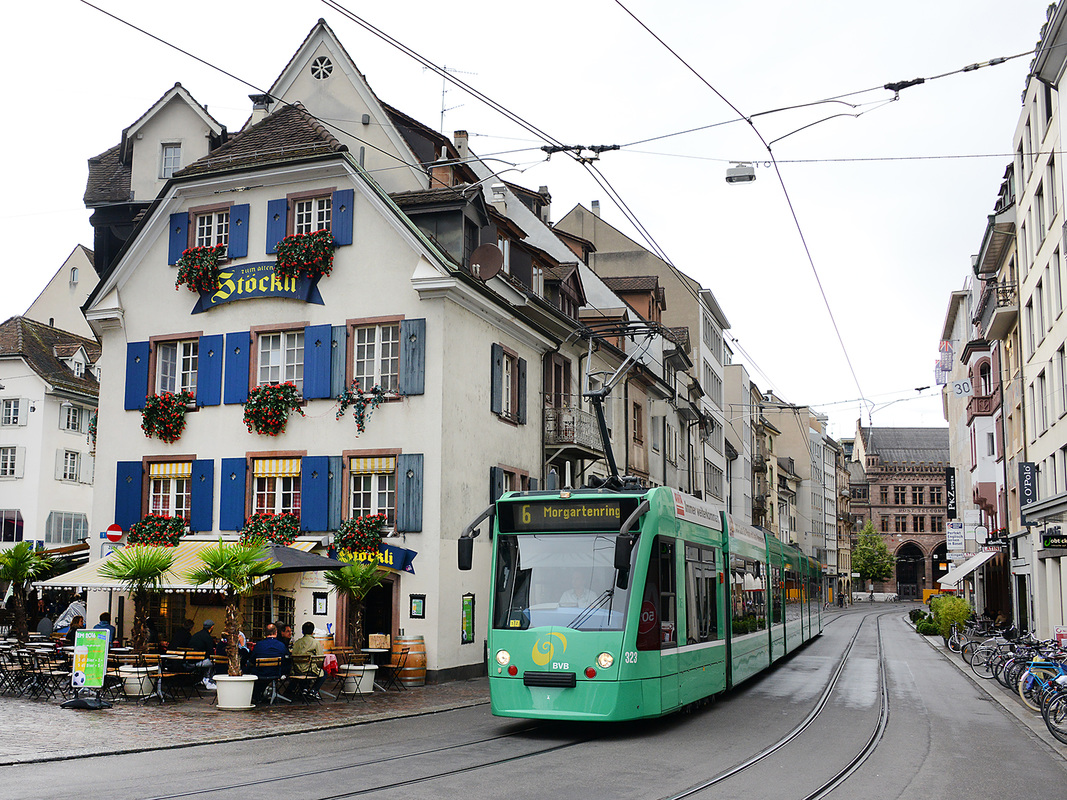
A Basel tram operating safely, on-street in the city.
A modern tram operating in Nice, France. Note the simple reserved or dedicated R-o-W.
From the response from the previous post with about lawned rights-of-ways for trams, I offer more glimpses of what modern LRT should look like in Metro Vancouver and in any city considering modern light rail.
Think of tram routes as linear parks.
Think of Vancouver with many linear parks, providing fast and efficient public transport.
Think of a linear park reaching as far as UBC; Stanley Park; or even SFU.
This is real “Green” transit, supported by the “Green” movement internationally.
Modern light rail, would bring “Green” transit to Metro Vancouver.
Note: the centre is used for the APS method of power collection (no overhead wires).
A simple station or stop on a lawned tram route.
A simple pedestrian crossing at a station in Basel Switzerland.
But it is in France, where lawned tram track is de rigueur, making the tram a part of the cityscape and not an eyesore. The modern tram is “green” in more ways than one.
Reserved or dedicated, at-grade rights-of-way and easy pedestrian access across the line is the hallmark of LRT.
All the benefits of a metro at a fraction of the cost.
So, why does the provincial NDP, the City of Vancouver and the Mayor’s Council on Transit not support light rail?
Why instead, does the provincial NDP, the city of Vancouver and The mayor’s council on Transit keep supporting the now obsolete and extremely expensive light-metro system, with two lines using the equally obsolete, proprietary ART Movia Metro?
Maybe it has something to do about certain political contributions and donations?
Age is an expensive journey for older transit systems, especially older proprietary transit systems and the MK.1 cars operating on the SkyTrain network are indeed showing their age.
The majority of Mk.1 cars are now over 34 years old and are in dire need of major maintenance and/or refurbishment.
This is why TransLink is ordering 200 new Mk. 2/3 cars because they are going to replace the original fleet, which will have seen 40 years of service by the time the first replacements arrive.
Here is the problem, this order for 200 new cars includes the cars previously announced and not the extra cars needed for the Fleetwood/Langley extension.
Then there is the thorny issue that Bombardier may cease production of the ART Movia metro cars altogether, as Vancouver is the only city in the world, out of the seven cities that use ART Movia Metro or its predecessors, that is expanding its system. No other company offers an “off-the-shelf” vehicle for Expo and Millennium Lines.
Has TransLink reached it’s own “critical” vehicle shortage?
The answer maybe found on the Millennium Line where TransLink operates two car train-sets only!
In Toronto, Transit issues are reported, unlike metro Vancouver where the mainstream media report TransLink news releases as actual news and politely ignore the rest.
Presently, only 2 car train-sets are used on the Millennium Line. Has TransLink reached its critical vehicle shortage?
Scarborough RT fleet reached ‘critical’ vehicle shortage last month
The Scarborough RT’s aging vehicle fleet reached a “critical juncture” last month when so few cars were available for service that the line was operating without any spares, according to the TTC.
The shortage of cars meant the agency had no margin of error to operate planned service on the RT, which serves more than 35,000 riders every day. It’s a bad omen for Scarborough transit users who are supposed to rely on the line for at least another seven years.
The TTC expects the Scarborough RT to stay operational until 2026. The agency has “not yet evaluated how/if we can keep the line operational” beyond then, says a spokesperson, despite a provincial plan that may not see it replaced by a subway until about 2029. (Rene Johnston Toronto Star / Toronto Star)
The situation “is a prime example of the need to modernize and replace our assets before they reach their end of life expectancy,” TTC CEO Rick Leary wrote in his latest report to the agency’s board.
To operate full service on the RT, the TTC requires five trains. Each is made up of four cars, paired in two-car units, for a total of 20 vehicles.
The agency has 28 of the vehicles, which allow it to perform tasks such as preventative maintenance on some cars while still operating full service.
But in mid-April, workers discovered an electrical fault on a car as they were preparing it for morning service. At the same time, a car in another unit was found to have an axle-bearing defect.
Both of the two-car units had to be taken out of service. And because two more units were already undergoing overhauls as part of a life-extension program to keep the RT running, over five days the TTC had just 20 cars available.
That’s the bare minimum, meaning if any other car had experienced a problem during that period, the RT would have had to operate with fewer than five trains.
“Depending on the time of day, fewer than five trains would mean longer wait times and increased crowding,” said TTC spokesperson Stuart Green.
“Although not ideal, we can run four trains in peak periods. Fewer than that and we would supplement service with bus shuttles (in addition to the trains). We did this a few times over the winter when we faced challenges on the line.”
Green couldn’t rule out a repeat vehicle shortage.
“Unfortunately, given the age of the vehicles, it is possible we could see a similar situation in the future,” he said.
The RT fleet entered service in 1985, and was intended to last 30 years.
A 2016 analysis by Bombardier, which owns the RT vehicle technology, flagged numerous problems with the cars, including “heavily worn” brake discs and holes in car bodies that “could compromise the integrity of the vehicle structure.”
The document, which the Star obtained through a freedom of information request, said in some cases maintenance had been done using a “piecemeal” approach. “Duct-tape has been used as a sealant, electrical wiring is exposed,” it said.
The TTC was already facing a struggle to keep the RT in good enough condition to operate until 2026. That’s around the time the one-stop $3.9-billion Scarborough subway extension council approved as a replacement for the RT was expected to enter service.
However, the Ontario Progressive Conservative government has tabled legislation to take control of new transit builds in Toronto and plans to construct a longer, three-stop $5.5-billion subway extension instead. Its version may not open until about 2029, raising the prospect that Scarborough transit users will be served only by buses for years after the RT is forced to shut down.
Both subway plans supplanted a proposed LRT that was supposed to replace the RT. It was scheduled to open in 2019 when council voted in 2013 to build a subway instead.
Councillor and TTC board member Jennifer McKelvie (Ward 25, Scarborough-Rouge Park) said reliability issues with the RT fleet is “a problem we’re going to be dealing with for the foreseeable future.”
She said she would ask the TTC at the agency’s board meeting next week to ensure it has contingency plans in case it’s not able to operate full service on the line.
She supports the three-stop subway over the one-stop plan or LRT, and made no apologies for backing the project that could leave riders taking the bus for years.
“This is our one chance to build important infrastructure for the next generation, and we can’t take shortcuts, we need to do it right,” she said.
She said her message to Scarborough transit users is “to continue to be patient and positive as we work on this important issue together.”
Green said the TTC is confident its vehicle life extension project, which is expected to cost $68 million, will enable the RT to operate safely until 2026, but the agency has “not yet evaluated how/if we can keep the line operational” beyond then.
With files from Jennifer Pagliaro.
Ben Spurr is a Toronto-based reporter covering transportation. Reach him by email at bspurr@thestar.ca or follow him on Twitter: @BenSpur
The ongoing planning charade currently being played out by the cities of Vancouver & Surrey, and TransLink with the proposed Broadway SkyTrain subway, is being fueled by professional misconduct, by all professionals and most politicians involved.
A notable exception is Vancouver City Councillor Colleen Hardwick.
Today, the message being relayed around the world is that the city of Vancouver lacks any modicum of professionalism, which is both a dark message for companies wanting to locate here, but also it sends a welcoming call to money launders, flim-flam artists and alike.
The following is a 2014 email from a real transit engineer from Germany on the subject of tram headway’s and capacity (Capacity is a function of headway). He is answering questions that were put to me by several local politicians claiming that LRT cannot obtain the same headway’s as SkyTrain.
I relayed the email to said politicos and bureaucrats. As of yet, I have not heard a reply!
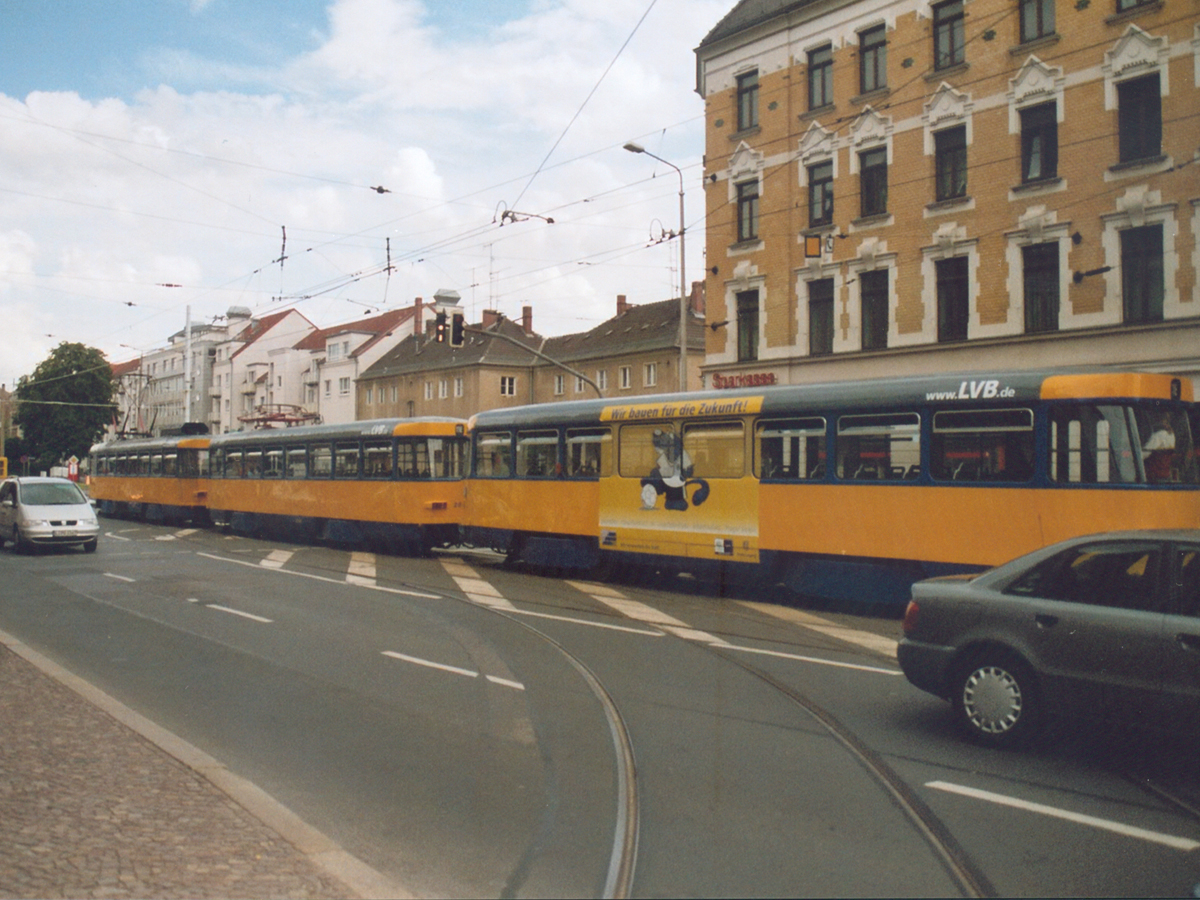
A coupled set of trams in Leipzig.
> = question.
> It is not possible to operate 36 trains per hour as traffic signals > will hold them back.
That’s the whole point of traffic light pre-emption. Which does not *increase* the green phase for streetcars, but *shift* it in time. So automobile traffic does not wait longer, it’s just different drivers who wait, statistically.
If there’s no significant automobile traffic parallel to the streetcar/light rail tracks (as typically the case in those “transit malls”), you can even dynamically reduce the green phase for the trains to the strict minimum required to clear the crossing (less than ten seconds, even for a four-car set), which will actually *increase* the green phase for crossing automobile traffic.
Right here next door, Leipzig is easily running 40 trains per hour on sections shared by several routes. And the infrastructure is not nearly at capacity, neither concerning trainset lenght (platform length would allow 60m instead of 42m), nor concerning frequency. Other operators do as well or even better. Karlsruhe’s 80 trains per hour are running through a pedestrian street. Calgary’s transit mall precisely seems to suffer from a lack of traffic light pre-emption, judging form the videos.
Another example, from Czechia, the streetcar at Prague. The section from Karlovo Namesti east to I.P.Pavolova carries the routes
4: 8 min 7.5 trains/h 6: 8 min 7.5 trains/h 10: 8 min 7.5 trains/h 16: 8 min 7.5 trains/h 22: 4 min 15 trains/h
That’s 45 trains per hour.
The tracks from Karlovo Namesti to the north carry the routes
3: 4 min 15 trains/h 6: 8 min 7.5 trains/h 14: 8 min 7.5 trains/h 18: 8 min 7.5 trains/h 22: 4 min 15 trains/h 24: 8 min 7.5 trains/h
That’s 60 trains per hour.
The tracks from Karlovo Namesti to the south carry the routes
3: 4 min 15 trains/h 4: 8 min 7.5 trains/h 10: 8 min 7.5 trains/h 14: 8 min 7.5 trains/h 16: 8 min 7.5 trains/h 18: 8 min 7.5 trains/h 24: 8 min 7.5 trains/h
That’s 45 trains per hour as well.
All figures given are for the morning peak. There are various other networks in Europe that have similarly dense operation on sections shared by several routes. 40 trains/h is not uncommon.
> In a subway, 31 trains are possible per hour with 14,640 passengers.
Boston’s green line is running 40 trains per hour, 90 second frequency. On sight in the tunnel, without ATC. Four branches, six minutes frequency each. They are running four-car trainsets for events so the platforms would be long enough.
First published in 2009. Updated 2014, 2016 and in 2019
A Wee Bit Of Local History
In early 1996, during BC Transit’s meaningless public consultation period for the Broadway Lougheed Rapid Transit Project which later morphed into the Millennium Line, Zwei received a phone call from an European Transit specialist, who worked for Asea Brown Boverai (later absorbed by Bombardier Inc.) regarding the project.
The European transit specialist, wanting to make contact with those planning for light-rail, had phoned BC Transit to arrange a meeting regarding the then proposed Broadway/Lougheed LRT project and was given Zwei’s phone number instead!
After his initial shock and displeasure being fobbed-off by BC Transit, the transit specialist entered into a long conversation with me on transit issues in the region and how modern light rail could help solve them. To make a long story short, he proposed a classic European style tramway for Broadway, with stops every 500m to 600m, going from BCIT to UBC, replacing all Broadway bus services and a second line via Main Street, Hastings St. to Stanley Park, that, he claimed would double present bus ridership on the two routes within two years, providing enough fare revenue for the tram to operate without any subsidy, with fares covering not only operating costs but most or all debt servicing costs as well. By doing so, a private company could build and operate the light rail line at no or little cost to the taxpayer.
The rest is history as they say and the SkyTrain Millennium Line was built instead and is subsidized by over $100 million annually!
The Light Rail Committee Proposes the BCIT to UBC and Stanley Park Light Rail Project.
In late 1996 the Light Rail Committee (now defunct) proposed a bold Broadway light rail plan: a tram/light rail line from BCIT to UBC via the Lougheed Hwy., Broadway, 10th Ave. and University Blvd. with a second line via Main street to Hastings Street to the Aquarium in Stanley Park. The plan consisted of lawned reserved rights-of-ways and on-street running; priority signaling on traffic calmed Broadway and Hastings Streets; tram/streetcar stops every 500 metres; a single track Vancouver General Hospital Loop via Fraser St., 10th Ave. and Cambie St., providing front door service to the hospital.
Commercial speed would be about 20 kph to 25 kph (depending on the number or tram-stops per km.) and the construction costs in the region of $25 million/km to $35 million/km; maximum hourly capacity of 20,000+ persons per hour per direction using modern low-floor trams.
Signaling would be line of sight with intersections and switches protected by local signaling. Headway’s could be as low as 60 seconds in peak hours.
What the LRCs plan would do is service many important transit destinations (UBC, BCIT, VGH, downtown Vancouver, Stanley Park, etc.), while providing economy of operation by replacing all bus services on Broadway and many in Vancouver, thus reducing operating costs by about half. Further economies are made by using existing masts and span wires along the proposed transit routes. The new LRT would be merely seen as the reinstatement of streetcar service by modern articulated trams, operating on 21st century rights-of-ways.
The concept of a private operator, by securing private financing to build the line at no or little cost to the taxpayer must be looked at by politicians. This type of P-3, not to be confused with the Canada Line scam, would see little or no subsides from government, unlike the Canada line which is heavily subsidized by TransLink by over $110 million annually.
The plan would reduce Broadway to one lane of traffic in each direction (passive traffic calming) except in areas of mixed operation, while keeping the all important on-street parking for local merchants. The plan would have offered a minimum of three transit routes: BCIT to UBC; BCIT to Stanley Park; UBC to Stanley Park.
The plan incorporates modern European light rail and tram practice; lawned reserved rights-of-ways, modular cars, high capacity, passenger comfort, and affordable cost. It was not to be, as the Glen Clark NDP government, for reasons that can only be speculated, dismissed LRT out-of-hand and went for a truncated SkyTrain light metro line, the only metro in the world that went nowhere to nowhere.
Now the City of Vancouver and TransLink are demanding a $3.5 billion dollar subway under Broadway.
It is time to again to consider again a BCIT to UBC and Stanley Park light-rail network, that could cost the taxpayer little or no money instead of a $3.5 billion subway to Arbutus or a $6 billion plus subway to UBC that ignores transit concerns East of commercial Drive.
This is an articulated tram. Notice the small centre car supports the two outer bodies. This configuration is sometimes called, "two rooms & a bath".
So boys and girls, lesson for today; what is an articulated car?
Definition:
Articulated cars are rail vehicles which consist of a number of cars which are semi-permanently attached to each other and share common Jacobs bogies or axles and/or have car elements without axles suspended by the neighbouring car elements. They are much longer than single passenger cars. Because of the difficulty and cost of separating each car from the next, they are operated as a single unit, often called a trainset.
The difference between an articulated tram and a Bombardier ART Innovia/Movia car is that in an articulated tram, on truck or bogie supports two bodies. With the ART Innovia/Movia cars, the body is supported by two trucks.
Another version of an articulated tram, where one body section is supported by the two adjacent body sections, with their own trucks or bogies.
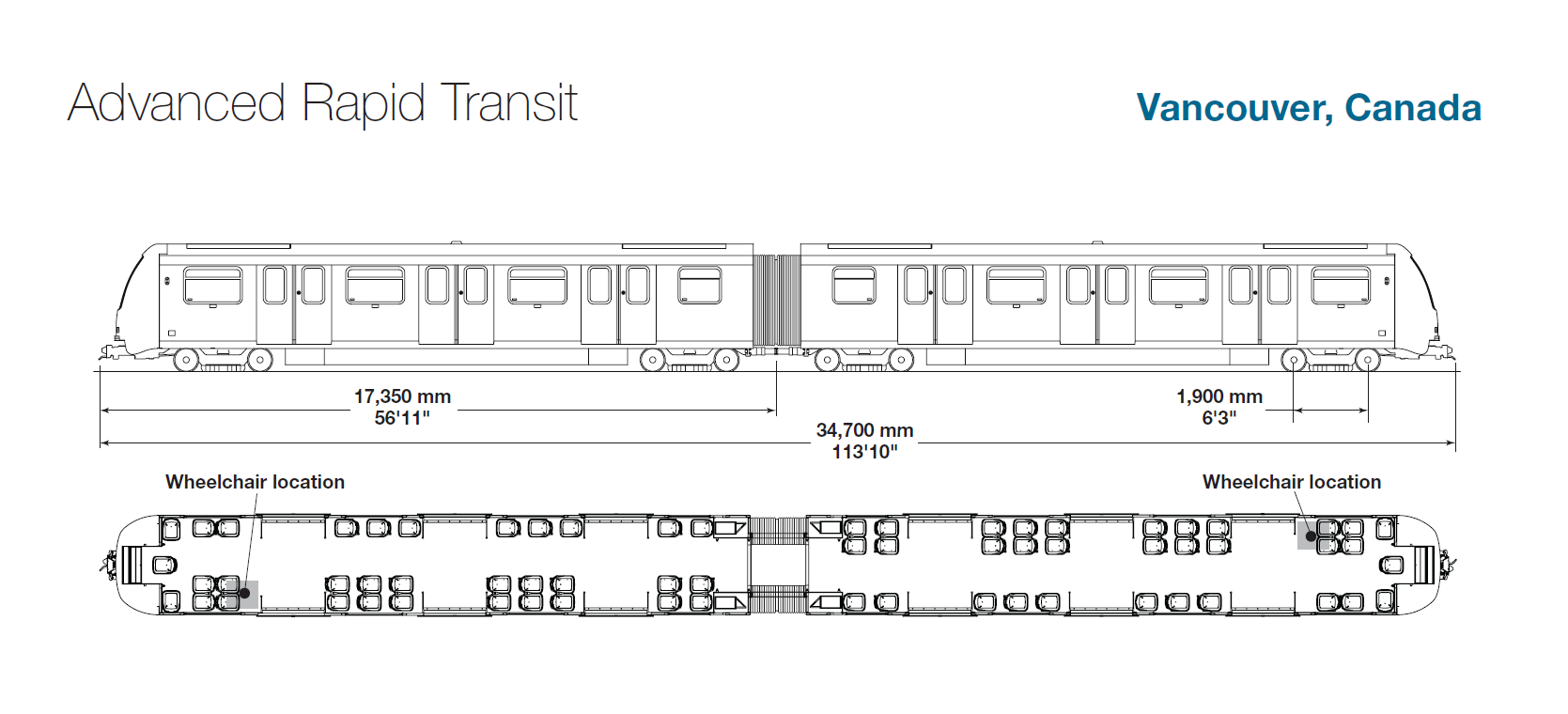
A Bombardier built ART innovia/Movia light metro car as used in Vancouver.
The non articulated Innovia/Movia light metro car. Notice that each body section is supported by two truck or bogies.
This is of great importance for Fraser Valley passenger rail.
The Stadler FLIRT is a close cousin of the Stadler GTW tramtrain and like the GTW, the articulated FLRT uses a diesel power-pack located in the middle of the train.
The FLIRT DMU is really a five section, articulated diesel rail car, with four sections and the power-pack, which can operate in multiple units.
Those who want a return of the Vancouver to Chilliwack interurban should c consider that articulated rail cars would ride the valley rails far better than non articulated cars and at a cheaper cost.
As the various vehicles that operate on the SkyTrain network, TransLink and a host of others remain ignorant of the benefits of articulated vehicles.
Also to be considered, the FLRT rail cars being delivered to Ottawa have been specifically designed to operate in Canada, making the FLIRT an “off-the-shelf” vehicle, ideal for the interurban and for the E&N.
Stadler wins first contract for multiple unit trains in Canada
The City of Ottawa and SNC Lavalin Group have declared Stadler as the winner of the contract for seven four unit diesel electric FLIRT trains, as part of the Stage 2 O-Train Trillium Line extension project. The contract is valued at approximately 80 million Swiss Francs (106 million Canadian Dollars). Canada is now the 18th country to purchase Stadler FLIRT trains. According to the contract, Stadler will deliver the vehicles starting in mid-2021 to Ottawa, where they will undergo extensive testing. This is Stadler’s second contract in Canada. Stadler is currently building double-deck dome cars for Rocky Mountaineer, which will take passengers on scenic routes northeast of Vancouver.
The seven four-unit trains for Ottawa are equipped with four 480 kW diesel engines. Parts of the traction equipment system and the diesel engines are housed in power pack units. With the current design the trains comply with the emission standard Tier4 final, with the North American Track Class IV, with ADA and are fully compliant with AODA (Accessibility for Ontarians with Disabilities Act) standards as well as with the North American fire safety standard NFPA 130.
With speeds up to 120 kilometres per hour, the Stadler FLIRT trains will service the extended Trillium Line.
The Stage 2 Trillium Line extension is a public-private-partnership project which will extend the existing Trillium Line by adding 16 kilometres of rail and 8 new stations, including a link to the Ottawa Macdonald-Cartier International Airport. TransitNEXT, a wholly owned subsidiary of SNC-Lavalin, will design, build, finance and maintain the Stage 2 Trillium Line Extension.
The Stadler site in Bussnang, Switzerland is building and assembling the FLIRT trains for Ottawa. Here, Stadler has ample experience with projects for countries with requirements for extreme winter weather conditions. In Estonia, Norway, Finland and Sweden the Stadler FLIRT trains are already in service with high operational availability, even under tough cold-weather conditions.
About Stadler
International rail vehicle construction company, Stadler, is headquartered in Bussnang in Eastern Switzerland. Founded in 1942, it has a workforce of over 8,500 based in various production and over 40 service locations. Stadler provides a comprehensive range of products in the heavy and urban transport segments: High-speed trains, intercity trains, regional and commuter heavy rail trains, underground trains, tram trains and trams. Stadler also manufactures main-line locomotives, shunting locomotives and passenger carriages, including the most powerful diesel-electric locomotive in Europe. It is the world’s leading manufacturer in the rack-and-pinion rail vehicle industry.
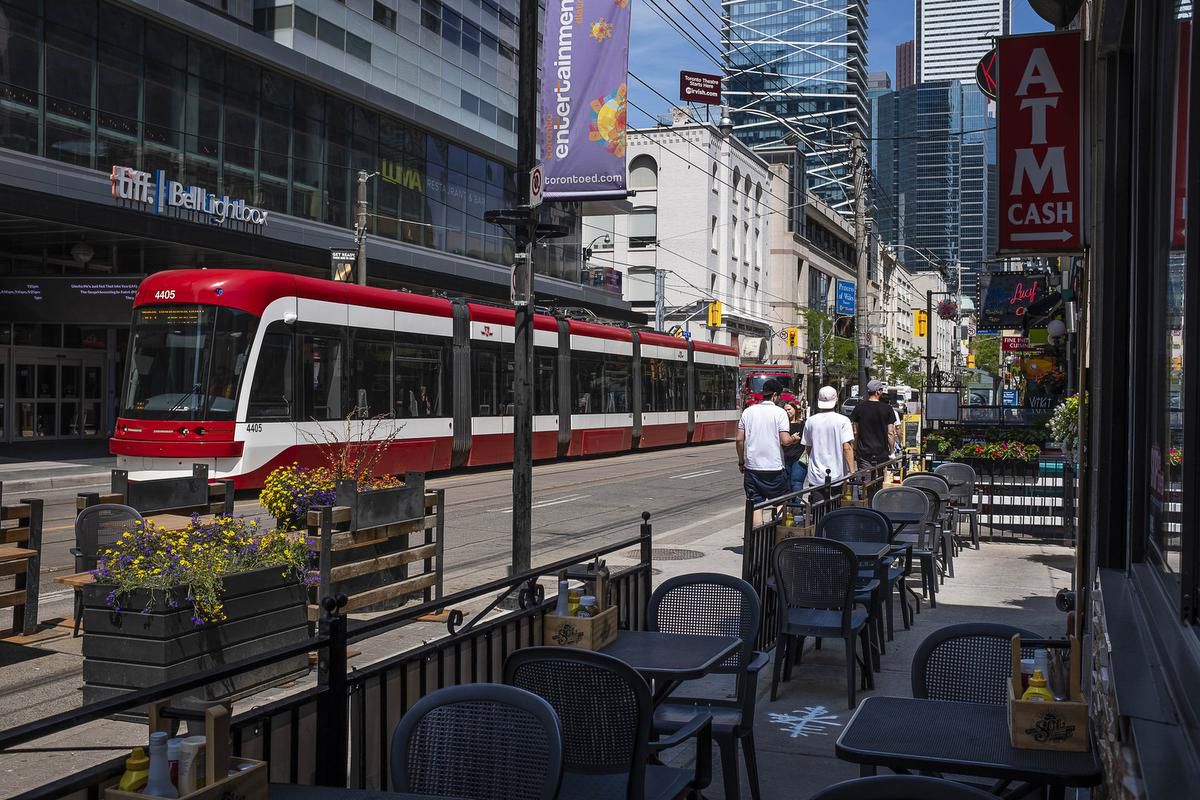
Kicking and screaming all the way, Toronto is now updating its heritage streetcar system to light rail standards and the the result is obvious, success.
Modern trams, reserved rights-of-ways, all the key ingredients for successful LRT.
Sadly, this puts Toronto 40 years behind most other European Cities.
As found in Europe, modern light-rail has changed the dynamics of public transports and except for a few bumps along the road, the successful King Street experiment may even change the way the TTC thinks, when planning for subways, except…………
…………for the real transit Luddites like Premier Ford, who wants to squander billions of dollars on subways or elevated transit so surface streets remain for cars only.
So 20th century way of thinking!
Toronto’s King streetcar pilot project is now permanent
Streetcars are officially king on King St. W., and their reign could expand to other streets.
City council voted 22-3 Tuesday to make permanent the King St. pilot project, giving streetcars priority over other vehicles between Bathurst and Jarvis Sts.
After the success of the King streetcar pilot project, Toronto’s transportation general manager says city staff are looking at other ways of “moving people out of cars and onto public transit.” (RANDY RISLING / TORONTO STAR FILE PHOTO)
After resounding success that saw, for a relatively modest investment, weekday rush-hour streetcar boardings skyrocket from 72,000 to 84,000, and overall people movement into downtown increase while vehicle traffic decreased, city staff are looking at other routes.
Barbara Gray, transportation general manager, said staff are not necessarily looking at restricting vehicles on the other transit routes, noting traffic signal improvement and relocated stops has helped make the King pilot a model that has other cities around the world looking to emulate it.
“When we start to look at … environmental goals and climate-change goals, getting people onto transit, walking and biking is a critical need and goal of the city and projects like King St. help to get us there,” Gray told council.
“We are looking at moving people out of cars and onto public transit.”
It restricts car movements on the 2.6-kilometre stretch of King by compelling drivers to turn right at most major intersections.
The project wasn’t a hit with everyone. Some King St. merchants said the pilot project hurt their businesses and even forced some to close. City staff acknowledged tracking growth in customer spending slowed to 1.7 per cent during the project, from 2.5 per cent the year before.
Mike Williams, in charge of economic development, said his department will continue working with businesses to boost foot traffic in the corridor and their receipts. Now that the pilot is permanent, city staff plan street improvements including elevated patios and comfortable seating in freed-up space.
Councillor Joe Cressy (Ward 10 Spadina-Fort York), who represents the corridor that includes the theatre district and restaurant row, urged his colleagues to officially acknowledge transit needs to be a priority over cars in the corridor.
“It’s a pilot for a reason, it’s not designed to be perfect, that’s what happens when you make it permanent and that’s the opportunity here,” he said.
Councillor Stephen Holyday (Ward 2 Etobicoke Centre) tried unsuccessfully to convince council to halt restrictions on private vehicles after 7 p.m. and overnight, and to give electric vehicles all-day access.
Holyday said allowing cars free access at night would help businesses, and that some of his Etobicoke constituents have told him the risk of getting a ticket on King is keeping them from going downtown.
Mayor John Tory acknowledged the challenges the pilot has proposed to some but said the overall increase in transit use can’t be ignored. He successfully asked council to have staff continue monitoring King St. transit performance.
Councillor Holyday, Michael Ford and Jim Karygiannis voted against making the pilot permanent.
With files from Ben Spurr
David Rider is the Star’s City Hall bureau chief and a reporter covering Toronto politics.




/https://www.thestar.com/content/dam/thestar/news/gta/2019/05/04/scarborough-rt-fleet-reached-critical-vehicle-shortage-last-month/scarborough_rt.jpg)









Recent Comments