South Fraser Community Rail is the latest group joining the struggle to get rail passenger service operating in the Fraser Valley.
Instead of TramTrain and its variants, they opted for the hydrogen powered electric train in the guise of an electric multiple unit (EMU) passenger trains.
I added this article to demonstrate that is Canada, simple streetcar lines can carry large volumes of people.
Each day, 84,000 people ride the King St. Streetcar, while TransLink claims a modest 60,000 people a day use Broadway.
The King car is not just Toronto’s busiest surface transit route. It carries as many people as the number riding the Sheppard subway and the Scarborough RT – combined.
What is more interesting:
The King car carries more commuters than the Miami Metro. The subway in Florida’s largest city has 23 stations and is 39 kilometres long.
The King car carries as many people as the Denver, Colo., system of light rail (LRT) and commuter rail, with 63 stations and 141 km of track.
On an average day, the number of passengers exceeds the entire daily traffic of each of the LRT networks in Phoenix; Minneapolis, Minn.; Seattle; and Houston.
It carries more people than the Seattle trolley-bus system, which has 15 routes and 109 km of overhead wires. It carries only slightly fewer people than the LRT network of Dallas – which with four lines and 150 km of track is the longest light-rail transit system in the United States.
So, when it comes to the Broadway subway, bigger is not necessarily better and in fact a much cheaper tram line, with some reserved rights-of-way and some priority signalling (oh my, that is light rail), carries a lot more people than many hugely expensive and over built transit systems in North America, is something to think about.
But of course it is transit in metro Vancouver and the Mayors council and politicians just love cutting ribbons in front of expensive subways, especially when the taxpayers must ante up the money, without any debate. Oh how Soviet of the mayors council on Transit, where fiction is preferred than fact.
One small step for the King Street streetcar, one giant leap for Toronto
Even Junius has to get to work in the morning.
The Globe and Mail editorial board’s fictional leader and author of the newspaper’s motto – “The subject who is truly loyal to the chief magistrate will neither advise nor submit to arbitrary measures” – tends to spend his time wrestling with weighty questions. Issues of principle. Matters of state. The capital-F Future.
But before any of that happens, there’s the small matter of getting to the office on time.
And each day, like 84,000 other people in Canada’s largest city, Junius rides the King Street streetcar.
A little more than a year ago, Toronto, site of some of North America’s longest commutes and home to the continent’s least taxpayer-subsidized public transit system, decided to try a little experiment. On the stretch of King Street running through downtown, streetcars would be given priority over cars. The goal was speeding up commuting times – with nothing more than a little change in the rules of the road. It involved installing a few concrete barriers and painting some yellow lines, over a weekend.
It wasn’t a multidecade, multibillion-dollar megaproject. It was an instant, cheap micro-project. And the impact has been enormous.
So far, though, it’s just an experiment – the King Street Transit Pilot isn’t permanent. Last week, city bureaucrats recommended that Toronto Council make it permanent, essentially creating a kind of instant, low-budget surface subway through the centre of town.
That should be a no-brainer. The little transit miracle on King Street deserves to be studied, expanded and emulated.
Thanks to the project, commuting times have been significantly shortened, and passenger traffic on the streetcars is up 17 per cent. New streetcars have been added to the route, but they’re still overcrowded at rush hour.
It proves that shortening commuting times doesn’t just benefit existing riders; it encourages new people to switch to public transit. The more a transit service is quick, frequent and convenient, the more people will use it. Obviously.
The King car is not just Toronto’s busiest surface transit route. It carries as many people as the number riding the Sheppard subway and the Scarborough RT – combined.
In fact, this one streetcar route serves more people than entire public transit systems in many American cities.
The King car carries more commuters than the Miami Metro. The subway in Florida’s largest city has 23 stations and is 39 kilometres long.
The King car carries as many people as the Denver, Colo., system of light rail (LRT) and commuter rail, with 63 stations and 141 km of track.
On an average day, the number of passengers exceeds the entire daily traffic of each of the LRT networks in Phoenix; Minneapolis, Minn.; Seattle; and Houston.
It carries more people than the Seattle trolley-bus system, which has 15 routes and 109 km of overhead wires. It carries only slightly fewer people than the LRT network of Dallas – which with four lines and 150 km of track is the longest light-rail transit system in the United States.
At first, the King Street pilot project generated pushback from drivers who feared their bumper-to-bumper gridlock would only get worse, and from a small but vocal group of local restaurateurs along King Street who worried about losing car-driving patrons. But Toronto’s downtown is so crowded that the only way to reduce paralyzingly heavy car traffic is to create more options for people to abandon cars for public transit.
And while Toronto still needs several big fixes, such as the so-called Downtown Relief Line subway, the quality of life in a city is also the product of lots of small decisions that can either improve the life of citizens, or immiserate them.
Right now, the stretch of King Street where streetcars have priority is only a couple of kilometres long. It should be gradually expanded, especially to the fast-growing neighbourhood of condos to the west of downtown. More streetcars should be added, further speeding up service. And, as in cities such as Montreal, restaurants can even be given the opportunity to set up patios on the street.
The big stuff – making a city easier to live in, faster to commute to and more desirable to visit or do business in – is the product of a lot of small steps. On King Street, Toronto’s small steps are having a big impact.
The real trick is to plan for rail properly, which is hard to do in Metro Vancouver, where politicians think they are better at planning for transit than the real experts.
It is hard to think any valley mayor and council would be against a viable Vancouver to Chilliwack rail link, which a basic hourly servcie would cost around $750 million.
$750 million is less than half the cost of a SkyTrain extension to Fleetwood.
In the real world, this would be considered a no-brainer, sadly in metro Vancouver, no-brainer solutions for our traffic woes are few and far between.
While the Surrey to Langley SkyTrain extension is still very much in the early planning process, another group is pitching a passenger train linking Surrey with stations across the Fraser Valley.
The South Fraser Community Rail Group believes rapid transit could be built south of the Fraser River utilizing the existing interurban rail line that runs from Chilliwack to the Pattullo Bridge at a fraction of the cost of SkyTrain, or even the light-rail project that was scrapped last year.
The group believes using hydrogen power would save on the expense of electrifying the entire 90-plus-kilometre network of track.
Rick Green, a former mayor of Township of Langley and spokesman for the South Fraser Community Rail Group, says the cars will be more expensive to buy but will be nearly free to run, producing nothing but water as emissions.
He believes all the pieces are in place — it is just a matter of political will to get it done.
“We can build this thing for somewhere between $12.5 million and $14 million per kilometre. We can build the whole thing including rolling stock, construction, and road closures for around $1.3 billion,” he said.
“The line will be accessible to 1.2 million people, and it goes right by 14 post-secondary institutions and connects 16 communities.”
The old interurban line was operated until the 1950s by the B.C. Electric Railway. The government-owned tracks were sold off, but a provision in the sales contract still allows for the re-introduction of passenger traffic.
Patrick Condon, a UBC urban planner who has been studying the problem of transportation south of the Fraser, says his research suggests Surrey is not only set to become the province’s largest city, but the entire population south of the Fraser could swell to three million people by 2060.
“There are only two options: build reasonably dense housing around existing infrastructure, or continue to sprawl out and eat up all the farmland. We can’t continue to build more roads to ease congestion,” Condon said.
According to the experts, those who live south of the Fraser can’t continue to rely on getting around by car, but spending billions on SkyTrain technology isn’t the right solution either.
Green agrees, calling the SkyTrain down the Fraser Highway “insanity” and adding the $1.6 billion to get the train to Fleetwood seems excessive.
“It just makes so much sense,” he said when comparing his proposal.
Although the TransLink Mayors’ Council on Regional Transportation endorsed further study on a SkyTrain Millennium Line extension to the University of British Columbia (UBC), its recently released meeting minutes show that serving the university with a $7 billion subway is not a regional priority.
It is clear from the mayors’ discussion that raising funds for the next phase of transit projects would need significantly increased resources to meet the vast regional demands. Many mayors see equity as a major issue because Vancouver and UBC are considered already well served by transit relative to other municipalities that are growing rapidly but have little to no transit.
The minutes say that “project costs must be borne by Vancouver and UBC as the line is not a regional priority.” So the municipal tax base will be used to fund transit, which is a provincial and federal funding responsibility, rather than funding the municipal services needed for a growing population.
More property taxes, development fees and a proposed land value capture tax would go to pay for a subway.
More rentals and affordable housing will not be achieved because the fees required to pay for the subway will need market strata development and much higher tower densities, like Oakridge and the Cambie corridor. Increased taxes will also make housing even more expensive.
Local businesses are already struggling. If the taxes don’t kill them, the business interruption from over a decade of subway construction will ensure most do not survive. It will also make commuting to UBC a nightmare.
A Broadway subway would make the Canada Line construction disruption on the Cambie corridor look like a dress rehearsal.
The main argument used to justify a subway is one of capacity, but this is mistaken. There are issues with both how ridership is calculated and how many could be served by only one subway along Broadway.
It is not accurate to count all ridership on 4th Avenue, Broadway, 16th, 25th, 33rd, 41st and 49th avenues and SW Marine Drive when determining potential ridership on a Broadway subway. People will continue to use the transit closest to them – especially if transit is plentiful and convenient.
Also, the updated McElhanney Consulting Services report showed that multiple routes of transit were more effective at wooing people away from automobiles than just one subway on Broadway.
Most of the reports on Broadway rapid transit have been biased towards a SkyTrain subway and have a questionable involvement with SNC-Lavalin. There is no independent study showing what could be achieved with multiple routes of more affordable transit options. This should include express buses to take commuters from the Millennium and Expo lines directly to UBC, diverting ridership away from Broadway altogether.
Vancouver was built as a streetcar city before the common use of the automobile. It was designed to be transit oriented with short blocks that are all within a 10-minute walk of a streetcar arterial grid. These were later converted to the more flexible trolley buses that still serve the city today.
The most cost-effective electric transit option is to expand the existing trolley system at $1 million per kilometre and $1 million per articulated double trolley bus. Some light-rail transit along routes such as the Arbutus corridor could cost $50 million to $100 million per kilometre, compared with the subway at $500 million per kilometre.
Even the currently approved subway funding of $2.8 billion for only 5.8 kilometres could instead cover multiple routes of trolleys 13 kilometres each to UBC and still have funds left over for other priorities like affordable housing, including student housing at UBC.
There are more reasonable ways to serve UBC transit while still respecting regional municipal priorities. •
Elizabeth Murphy (info@elizabethmurphy.ca) is a private-sector project manager and was formerly a property development officer for the City of Vancouver’s housing and properties department and for BC Housing.
Well, it has taken almost 90 years for transit planners in North America to realize that by giving a streetcar a dedicated lane it becomes light rail. European transit planners clearly understood by the 1930’s that by giving a streetcar a dedicated route, its performance almost matched that of a much more expensive metro or railway.
Sadly, it will probably take another couple of decades for the City of Vancouver to understand this simple lesson.
When there is billions of dollars to squander on a subway, SNC Lavalin and Bombardier Inc. are laughing all the way to the bank!
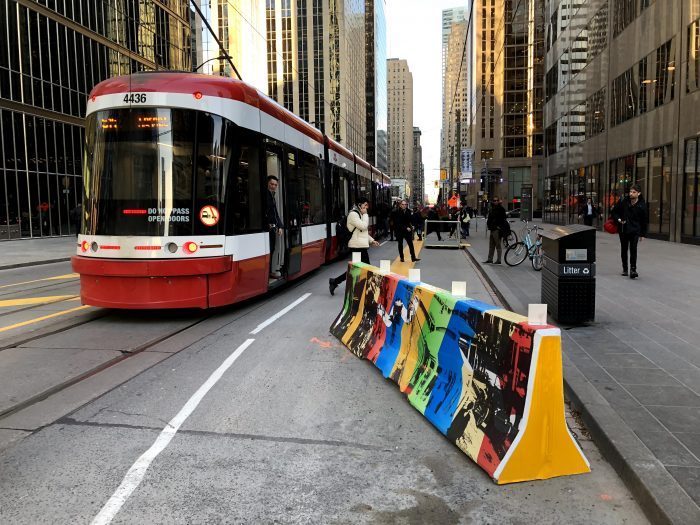
Using low-cost materials like this concrete divider, Toronto set up new streetcar stops on the far side of intersections on King Street, enabling safer boarding and cutting down on time stopped at red lights. Photo: Human Transit
In crowded urban areas, cars aren’t the most efficient way to move people. That’s the lesson from Toronto’s one year King Street “pilot,” which prohibited through car traffic on the high-ridership streetcar corridor.
New data from the one-year pilot experiment shows the King Street corridor is moving more people than it did before the city cleared cars out to the way. That’s because removing car traffic from King Street improved streetcar service so much, ridership has grown 16 percent.
A total of about 84,000 people are using the King Street Streetcar along the east-west corridor daily, the city reports. But only 72,000 people were using the roadway before the street was redesigned to prioritize the streetcar.
The data comes from new report from the city’s transportation staff recommending the corridor design be made permanent. The city estimates it will cost just $1.5 million to make the improvements permanent, providing a dedicated lane for existing high-capacity surface transit one of the best transit investments available to cities.
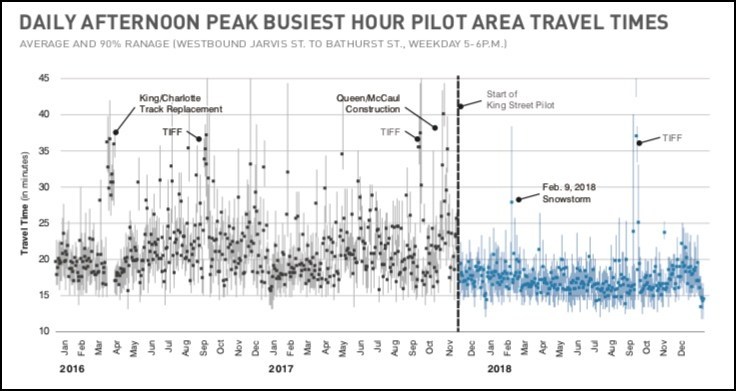
Not only is the streetcar moving more people, thanks to its dedicated lane, riders are happier with service as well. The King Street Pilot resulted in about 30,000 minutes saved by riders daily, the city reports. It was especially effective reducing major delays. The slowest average journeys — at the evening rush hour — decreased by five minutes.
A graph showing travel times on the King Street Streetcar before and after it was given a dedicated travel lane. Graph: City of Toronto
“Prior to the pilot, overall customer satisfaction with King streetcar service was low on key measures such as travel time, comfort, and wait time,” city staff writes. “Through the pilot period, customer satisfaction on all these measures have significantly improved.”
Cycling rates have also increased. There are about 380 more daily cyclists on the corridor at the afternoon peak, according to the city, “likely because reduced motor vehicle volumes made it more comfortable to cycle.”
Drivers haven’t been duly inconvenienced, the data show. Car travel times on parallel corridors is roughly the same as before the pilot began in January, 2017.
The pilot did show that retail sales were down very slightly, about 0.8 percent, most notably from restaurants. But the city says that reflects a trend that was underway before the pilot. There were a number of very outspoken business owners that opposed the pilot. But, overall, at least according to the city’s data, the experiment does not appear to have been the retail apocalypse some predicted and was very positive for tens of thousands of daily streetcar riders.
It seems the good burghers of Chilliwack see the benefits of a rail servcie connecting Vancouver to Chilliwack.
A basic Vancouver to Chilliwack DMU servcie can be had for as little as $750 million and a more elaborate service using hydrogen powered trains or electric servcie, with several trips per direction each hour would cost around $1.5 billion.
Expensive you say?
Well compare it with a $3.5 billion, 5.8 km Broadway subway, or a $1.6 billion, 9 or 10 km extension of the Expo line to Fleetwood.
Rail for the Valley welcomes Chilliwack on board the Valley Express!
Community rail proponent Rick Green appeared as a delegation before Chilliwack council to make a pitch for hydrogen-powered light rail from Surrey to Chilliwack.
“We’re leading the charge for South Fraser Community Rail, and calling it The Plan,” said Green, a former mayor of Langley Township. “It’s the smart way to solve the south of Fraser transportation and transit deficit.”
Green has made his pitch before in presentations for B.C. Premier John Horgan and the TransLink Board, and said the idea is backed by former premier Bill Vander Zalm.
Essentially, the plan is to reactivate the old “interurban corridor” using existing track, for emissions-free passenger rail service, powered by Canadian hydrogen fuel cell technology.
It would be cost-effective, “at less than eight per cent of the cost per kilometre of the Surrey to Langley LRT,” Green noted.
The old line was “protected” by a previous government for passenger use at “no cost for its use” due to a right-of-way owned by the people of B.C.
The estimated cost for the South Fraser community rail is $12.5 million per kilometre “all in.”
It would see a “spine” established as the main rail line, and a “rib” or road network feeding it by bus from the Pattullo Bridge and Chilliwack, “in the same way as the Skytrain,” Green offered.
The rail line would be “building economic growth,” while serving more than a million residents in 16 cities and communities, as well as 14 post-secondary institutions, the Abbotsford Airport, tourism and agri-tourism.
The Fraser Valley airshed “gets exponentially worse every year,” but the rail line would reduce emissions.
“One train would remove 177 cars from Highway 1,” Green told council.
“Development is a funny thing. We would all like to go back to the way it was but that isn’t going to happen,” Green said. “The Fraser Valley is growing exponentially and we have to manage it so we are able to live with a good quality of life.”
Green took issue with the support given from Chilliwack politicians for highway expansion as a solution to daily gridlock.
“Widening Highway 1, really?” he said. “Let’s be honest with residents.”
He said that would mean that widening a few kilometres at a time, which would take decades to achieve, and growth would outpace the expansion.
So what makes the community rail idea so attractive right now? he asked.
“The renewal of passenger rights in the Pratt-Livingston corridor, which is the section that goes through the two Langleys,” he said. “And the introduction of Alstom hydrogen technology, a B.C. invention and Canadian manufactured propulsion system from Missisauga.”
Green said the technology has been successfully operating in Germany for the past two years.
Green concluded with “the ask” for council support to establish a community-led and provincially endorsed task force to push the community rail proposal forward.
Coun. Chris Kloot thanked Green for the presentation. He called it a “no-brainer” and noted if the political will was there, the proposal “will happen.”
“I think it’s a project that certainly needs to happen sooner rather than later,” Kloot said.
In the end city council voted unanimously to send a letter to the Fraser Valley Regional District asking that South Fraser Community Rail committee reps be given an opportunity to make the presentation to the FVRD board.
More details on the plan for South Fraser Community Rail.
Artist Jake Berman plots old public transport systems in period style. From LA to Toronto, San Francisco to Buffalo, he has created maps of cities’ modern transit too, so you can click and compare
I include this article from the Toronto Star to illustrate the escalating costs of subway construction.
The one stop, 6.2 billion Scarborough subway cost has soared to $3.9 billion and climbing!
Vancouver’s 5.7 km six station Broadway subway cost has escalated past its $2.8 billion price tag and now is said to cost $3.5 billion or more.
With five more stations, with costs roughly around $200 million per copy, the BS Line final cost may surpass the TTC’s proposed Scarborough subway!
$3.5 billion or more to move a peak hour customer flow of under 5,000 pphpd to Arbutus!
Memo to Bruce Allen: When shilling for the Broadway subway or BS Line, please try mentioning the insane costs for the subway and the huge tax and fare increaes needed to pay for it.
The Scarborough subway was sold to us with a specific turn of phrase. We should have been paying attention
It’s hard to catch in real time, but sometimes when a professional in the public service uses a particular phrase over and over again, it’s worth paying close attention. By parsing it, you can see that they’re trying to say something very specific in a way that allows them to tell the truth without running afoul of the messaging of their political bosses.
Mayor John Tory and Chief Planner Jennifer Keesmaat, who developed and were unveiling the plan, were telling everyone who would listen it was essentially a two-for-one deal, cost-wise. That both projects in the revised plan would be paid for out of the “same funding envelope” of $3.56 billion already committed.
And what was city manager Peter Wallace saying? He was not contradicting that message. But his phrase was that the budget would remain in the same “order of magnitude.” Keesmaat used the same words speaking to city council.
Many people hearing it at the time, especially alongside the “buy one get one free” talk the proposal was announced with, interpreted it to confirm the political message that the already committed funds would get the job done, more or less. Many or most probably didn’t take the time to consider the particular phrase. As many of us know when we think about it, and as Peter Wallace emphasized in an internal email from the time that Pagliaro has obtained, the “same order of magnitude” doesn’t mean “roughly the same.” It means, “accurate give or take 1,000 per cent.”
The price of a Lexus LS — $103,000 — and of a house in Toronto — around $1 million — are in the same order of magnitude.
Wallace’s statement still holds up — at least for the foreseeable future, even as the cost of the one-stop subway alone has climbed to $3.9 billion. We’re several news cycles and city reports from the cost escalation on that project passing the $35-billion mark that would prove those words false.
But I think we can all agree that in retrospect, order-of-magnitude cost estimates are shown here to be essentially useless. At least from a public planning and budgeting perspective — I mean, if I’m thinking about renovating my house, it might be useful to know if I’m talking about thousands or tens of thousands or hundreds of thousands of dollars. But as a guide for decision making on infrastructure, consider that by at least one estimate, you could add a manned mission to Mars to the swollen budget of the subway extension and the LRT and still be in the same order of magnitude. It’s simply not helpful information.
Another email Pagliaro obtained, written by then-Deputy City Manager John Livey, suggests that cost estimates didn’t need to be particularly accurate to be helpful. “The sole purpose of the report is to get the idea in the public forum.”
It did that. I remain grateful for it. The Eglinton East LRT, which I think is a potentially great project, was off the table at the time. In danger of being forgotten. It is now on the city’s list of planned (if not entirely funded) projects.
The only problem is whether any money will ever appear to pay for it. And that problem, shared with other projects, is exacerbated all the time by the apparently endless swelling of the cost of the Scarborough subway extension. It is an ever-larger budget-gobbling monster that threatens to swallow every dollar in every budget in the city, and I doubt any politician in a position of authority will ever stop feeding it.
It remains a credible possibility to me that the original message about the one-stop switch may have been close enough to essentially correct, in that the one-stop extension and the new LRT line could both be built for roughly the same price as the extended three-stop line to Sheppard. It’s just that the “funding envelope” for the three-stop extension was always going to need to be more of a “funding jumbo-sized packing crate” anyway, and to contain way, way, way more than $3.56 billion. Each report shows the price of this thing going up, higher and higher, a tower of money reaching into the clouds. And we are fixated on digging a hole big enough to contain all of it.
I have recently — not for the first time in this protracted process — tried to make peace in my mind with the idea that this battle over the Scarborough subway extension is lost. Accept as a political reality that it is not going to change and it is not productive to continue debating it. I’m as tired of it as anyone else. But then every time the price goes up, and especially as the premier promises to make it longer and still more expensive, I can’t let it stop bothering me.
Because it is going over those latest developments that I recall again that this super-deep, superlong tunnel is being dug for no good reason at all. The subway line it is extending runs above-ground in dedicated corridors for most of the trip from Victoria Park to Kennedy already. The LRT line proposal this extension replaces would run entirely above ground in a dedicated corridor that already exists and does not go onto the road, and would serve more stops closer to where more people live and work. It wouldn’t just be vastly cheaper and faster and easier to build. It would be better transit for the people it would serve. It is better in every way except for a 30-second transfer between vehicles (like the one many riders make every day at Yonge and Bloor). And except that for some reason people want it underground. There’s this political fetishization of tunnels.
How much are we willing to pay for that tunnel? My revised estimate is that our leaders will be willing to pay anything. Or everything. Within an order of magnitude.
Edward Keenan is a columnist based in Toronto covering urban affairs. Follow him on
The province is proposing to build the Downtown Relief Line using unspecified “alternative delivery methods” as part of its proposal to take ownership of Toronto’s subway.
The vague and unexpected statement was among major changes to four projects the province outlined in a letter to the city released Tuesday. The province went on to say the relief line would be a “truly unique transit artery” and “free-standing project” separate from other parts of the “technologically outdated” subway system.
Seattle Center Monorail in Seattle, Wash. (DREAMSTIME)
The relief line, which the city has said could open as early as 2029, is planned to run across Queen St. downtown, north to Pape station, and, in Phase 2, further north to Don Mills station to take pressure off the bursting Yonge line. Previous estimates put the cost at $6.8 billion. The province says costs have doubled. The city disputes this.But what does this all mean? And what kind of project could they build beside a traditional subway?
We took a look at public transit projects around the world and came up with some options:
Boston, Mass.: underground bus rapid transit
Boston’s “Silver Line,” constructed in phases beginning in the early 2000s, incorporates buses that duck beneath the road’s surface.
Silver Line buses operate partially in underground tunnels, said Massachusetts Bay Transportation Authority deputy press secretary Lisa Battiston in an email.
Using buses both below and above ground was an “economic and geographically strategic decision” for the city, she said. The line’s tunnels operate beneath the Boston Waterfront area and let buses avoid street-level bridges, she added.
An Expo Line SkyTrain rolls across the elevated tracks in Surrey, B.C. (JESSE WINTER)
The vehicles, which take passengers all the way to Logan Airport from South Station in the city centre, also make connections with the traditional subway system. When they’re above ground they sometimes have their own lane, making it easier to escape traffic.
But Ryerson City Building Institute executive director Cherise Burdasays tunnels are the most expensive part of subways. So using buses instead of subway cars on the Relief Line wouldn’t save much money.
Vancouver, B.C: SkyTrain
Most of the transit system in the west-coast city is elevated, but some of it does run underground. It’s also completely automated and driverless, says spokesperson Lida Paslar.
It connects downtown Vancouver with Burnaby, New Westminster, Surrey, Richmond and the Vancouver International Airport. The first line was built in 1986.
Matti Siemiatycki, interim director of the University of Toronto’s School of Cities, said the elevated portions of the SkyTrain are the “followup technology” to Toronto’s Scarborough RT.
“It’s a number of generations down the path from that,” he said.
Seattle, Wash.: Center Monorail
Elevated monorail line in Seattle, Wash., that operates along Fifth Ave. (DREAMSTIME)
According its official website,Seattle’s monorail was built for the 1962 World’s Fair.
It now provides a quick, car-free connection between downtown Seattle and Seattle centre, an area home to tourist attractions such as the Space Needle..
The monorail has become a beloved landmark, and carries more than 2 million passengers a year, fitting up to 250 per train. But it only goes about 1.4 km.
Monorails, sometimes found in amusement parks, also run in cities from Mumbai to São Paulo. They run on a single rail and typically go more slowly than elevated rail like the SkyTrain.
A tram passes along Bahnhofstrasse St. in Zurich, Switzerland. (DENIS LININE)
But Burda said, given the proposed route of the relief line, any form of elevated rail or monorail would require heavy construction and intervention in densely populated, older neighbourhoods such as Leslieville.
“If you’re going to stick an elevated system above those streets you’re going to have a lot of opposition,” she said.
Zurich, Switzerland: Light rail transit with dedicated lanes
Streetcars in lanes without cars are already part of Toronto’s transit network.
But they’re much more common in European cities such as Zurich, Switzerland, where they run like clockwork and also rarely break down or short turn.
This type of transit works best on wider avenues, says Burda, and given Ford’s history of prioritizing cars on the road, this is highly unlikely as an option to replace the Downtown Relief Line.
Montreal, Que.: Le Réseau express métropolitain (REM) public private partnership
This 26-station, 67-km light rail network will link downtown Montreal with suburban communities of the South Shore, West Island, North Shore and the airport. It promises to be electric and completely automated, and will run on the ground, underground and overhead.
The estimated cost is about $6.3 billion, with $2.95 billion of that covered by the Caisse de dépôt et placement du Québec, the province’s leading pension fund company. The governments of Canada and Quebec will chip in another $1.28 billion each, according to La Caisse’s website.
This kind of funding model and independencefrom the rest of the transit system might be what the province is getting at with its phrasing in the letter, says Siemiatycki.
Ryerson’s Burda agrees the wording could hint at interest in a public-private partnership, or just be punting the project down the line.
“I would hazard to guess that that’s just a placeholder for, let’s find different ways to fund this and build this more cheaply, so that we can prioritize the things we really want to build,” she said.
A regular subway that isn’t exactly the same as the one we have now
This is the option that makes the most sense to Siemiatycki, who suspects the province’s careful language reflects wanting to have a separate project, rather than something that existing TTC subway trains and track could feed into.
This could be operated by the TTC, city or province, and possibly paid for with the help of the private sector, like the REM.
It would offer more flexibility in terms of procurement and operation as it wouldn’t need to be compatible with the existing subway infrastructure.
“I think what they mean is a line that isn’t interconnected and doesn’t have integrated tracks, or even potentially the same train technologies,” he said.
May Warren is a breaking news reporter based in Toronto. Follow her on Twitter: @maywarren11
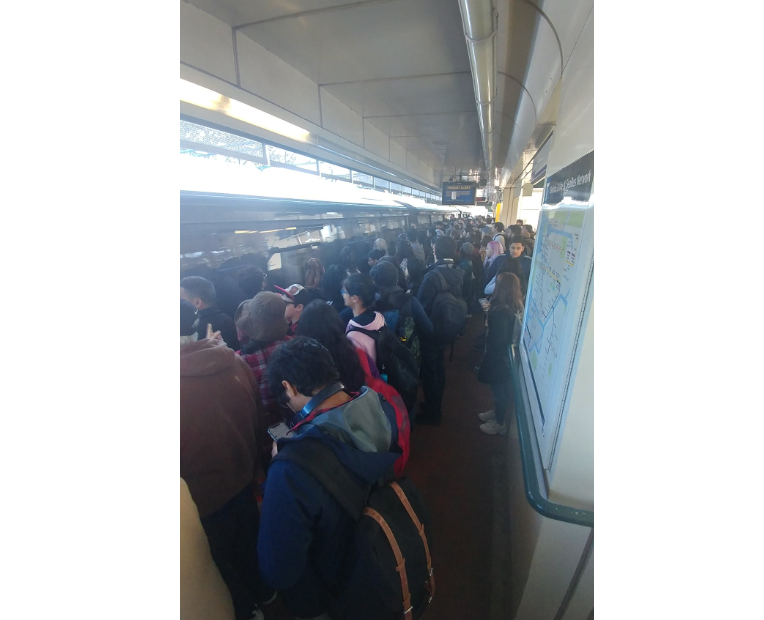
Passengers using the Expo and Canada Lines on Wednesday had to deal with major delays after both lines experienced separate problems.
The Canada Line was dealing with a stalled train that has disrupted service from Bridgeport Station in Richmond to Oakridge Station in Vancouver that was resolved shortly after 10:30 a.m.
A bus bridge was put in place during the outage, and TransLink warned that while it was in the process of restoring normal service “there are still delays, gaps in service and passenger crowding.”
The bus bridge was left in place to try and cut down on crowding.
On the Expo Line, TransLink said a “medical emergency” had disrupted service at Joyce-Collingwood Station around 9 a.m., closing the station down entirely.
TransLink implemented a shuttle train and a bus bridge connecting Nanaimo and Metrotown Stations.
Service began to fully resume around 12:45 p.m. and Joyce-Collingwood was fully reopened.
METRO VANCOUVER (NEWS 1130) – Commuters experienced long waits and large crowds, after five SkyTrain stations along the Expo Line experienced service disruption due to a medical emergency on Wednesday.
The issue was at Joyce Station, which was closed for about three hours.
A shuttle train and bus bridge were set up between Nanaimo and Metrotown Stations.
At around 12:45 p.m., TransLink advised that the Expo Line was going back to full service and Joyce Station was re-opened.


By Aaron McArthur Reporter/Anchor Global News
While the Surrey to Langley SkyTrain extension is still very much in the early planning process, another group is pitching a passenger train linking Surrey with stations across the Fraser Valley.The South Fraser Community Rail Group believes rapid transit could be built south of the Fraser River utilizing the existing interurban rail line that runs from Chilliwack to the Pattullo Bridge at a fraction of the cost of SkyTrain, or even the light-rail project that was scrapped last year.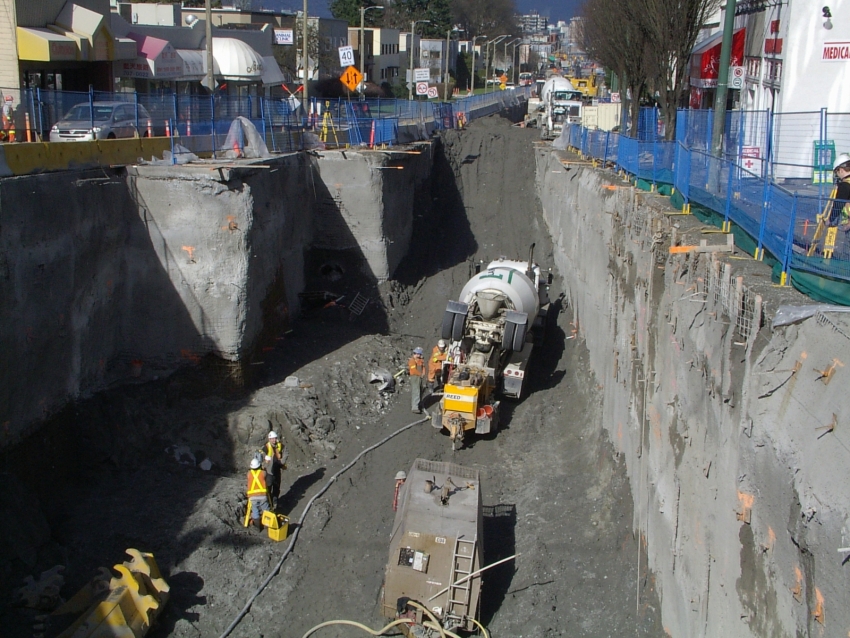


By Simon Little Online Journalist Global News



Recent Comments