As TramTrain expands in Germany, it is time that the mode is considered for Metro Vancouver and Vancouver Island.
Why is LRT so popular with transit planners and operators?
It is the inherent flexibility of the system and TramTrain has now enabled simple streetcar routes to expand affordably far into the countryside by being able to operate on existing railway lines.
By providing a seamless (no transfer) journey has made TramTrain extremely user friendly and user-friendliness is the prime reason people take transit.
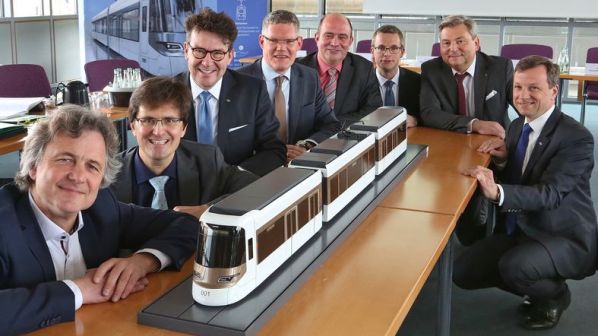
FIVE German transport authorities have signed an agreement to jointly procure up to 240 tram-trains with the aim of achieving significant savings in resources, lead times and costs.
The agreement was signed in Karlsruhe on March 11 by representatives of Albtal Transport Company (AVG), Karlsruhe Transport Authority (VBK), Saarbahn, Erms-Neckar-Bahn, and Central Saxony Transport Authority (VMS).
The partners have been working together since July 2017 through the VDV TramTrain project, which aims to ensure the future viability of the Karlsruhe model for tram-train systems and potentially open it up to new operators. This has led to the development of a standard vehicle concept, which is expected to reduce procurement costs by around €1m per vehicle.
“This lower unit price results from the fact that one-time costs for the development and authorisation of the standard vehicle can be distributed across a significantly higher number of vehicles,” says project manager Mr Thorsten Erlenkötter. “Variants for the respective transport companies can be derived from the base vehicle. For example, the entry level for barrier-free access varies between the operators’ systems.
“In addition, the project partners all want individual equipment and features in the respective company colours. We want to use a vehicle configurator – similar to the car industry.”
VBK and AVG have a requirement for around 150 vehicles and will therefore jointly manage the procurement on behalf of all project partners.
The first vehicles are expected to enter service in 2025. Final order quantities will depend on the outcome of negotiations for new transport contracts. Saarbahn says it is looking to replace its fleet of 28 Bombardier Flexity Link tram-trains with the new design.
AVG says the project partners expect to benefit from standardization by issuing joint maintenance orders and ordering large quantities of spare parts to bring down the unit cost of components.
“The project team has done pioneering work here,” says VBK managing director Mr Ascan Egerer. “I am very proud that Karlsruhe, as the inventor of the two system vehicle, together with strong partners from the tram-train family and the Association of German Transport Companies, has been supporting this.”
Could it be that the sickening stench of the Broadway Subway or BS Line deal has reached the lofty halls of Postmedia?
For decades, the Vancouver Sun and to a smaller extent, the Vancouver Province, refused to print negative stories about SkyTrain or do any investigative journalism about SkyTrain. This, in part has created a very powerful tool for the SkyTrain Lobby, where their repeated lies and innuendo has poisoned any chance of credible transit debate in the region.
That the Vancouver Sun is allowing questioning of the BS Line is nothing short of remarkable and it makes me wonder if the senior editors are aware of a distinct change in the air with transit in Metro Vancouver and in BC.
One wonders with only seven such proprietary light metros built since the late 1970’s (with 7 name changes) and with Bombardier Inc. all but abandoning manufacture or marketing of the proprietary ART Movia metro cars, may have something to do with it?
Has Postmedia sensed that the end is near for the proprietary ART Movia metro?
The recent McElhanney Consulting draft report used to justify a Broadway subway extension of the SkyTrain Millennium Line to UBC raises many questions regarding SNC-Lavalin involvement, assumptions, costs, ridership, mode shift and development. As a draft that has yet to be signed off by the engineers who wrote it, there are elements that look like it has been adjusted into a public relations document to favour a subway. This report is an update of the 2012 report prepared by SNC-Lavalin and Steer Davies Gleave.
However, on Jan. 30, 2019, before the SNC-Lavalin corruption scandal broke in February, Vancouver council was rushed into endorsing SkyTrain technology for a subway extension to the University of B.C. based on the theory that with the federal budget fast approaching in an election year it was critical to move ahead immediately. Same with the TransLink Mayors’ Council.
But now we know there is not likely new federal funding in the 2019 budget for the project, so the rush was unwarranted.
SkyTrain is what TransLink calls the Vancouver regional rail system. It is made up of two types of technology: the Canada Line, which is conventional, and the Expo and Millennium Lines, which are unconventional.
The unconventional Millennium Line technology would apply to the proposed extension to UBC, of which SNC-Lavalin (track and electrics) and Bombardier (cars) partnered to build the SkyTrain Millennium Line and continue to still produce and maintain the systems now in use.
SNC-Lavalin, with Bombardier cars, would therefore likely have significant advantage over other bidders for any extension of the Millennium Line, and it puts into question the ability to get meaningfully competitive bids. In the Canada Line-Cambie merchant court case, then-B.C. Supreme Court Justice Ian Pitfield called the bidding process where SNC-Lavalin won the contract a “charade.”
The current draft report makes assumptions that greatly limit the options, the largest of which is a subway from Vancouver Community College to Arbutus Street. This requires a handicap time penalty for transfer at Arbutus.
The reported cost estimates are also questionable. They use the same 40- to 60-per-cent contingency for both subway and LRT, even though subway has way more risks with underground conditions, water and services that require diversion.
For comparing the subway to surface light rail, rather than comparing actual costs of similar systems, the report refers to the cost estimates in the TransLink and Ministry of Transportation news releases.
While most LRT projects are delivered for $50 million to $100 million per kilometre — like the recently approve LRT in Ottawa — the report uses $240 million to $282 million per kilometre, creating a further handicap against LRT.
Although the bus system upgrades provide the greatest cost savings, the bus option costs are not provided at all as part of the comparison.
The minor costs to electrify the bus system to eliminate diesel and reduce greenhouse gas emissions by expanding the trolley network to the B-Line or for expanded service would only be about $1 million per kilometre, plus $1 million for each additional articulated double trolley bus. Since the distance from VCC to UBC is about 13 kilometres, it would be a minimal cost to upgrade the whole length of the corridor to electric trolley with doubled lines for bypass of the B-Line plus new articulated double trolley buses.
The current bus system throughout the corridor is far from maximized. Nor is it the busiest bus route in North America, as claimed. There are many more active areas such as in Ottawa and Mississauga, and many larger cities in the U.S.
There is a list of bus optimizations in the report, but the option that has the most promise is only mentioned once, without a bullet. It is to add an express bus that goes from the subway terminus to UBC.
If there was an electric express bus from VCC to UBC, it could take all UBC-bound ridership from the Millennium Line off of Broadway altogether, including the recent increase from the Evergreen Line. A new express route could further avoid congestion from VCC, along Second and Fourth avenues to Burrard Street and along 16th Avenue out to UBC.
The existing No. 84 bus on Fourth Avenue could also be electrified with trolleys with double articulated buses to increase capacity like a proper B-Line rather than the current single buses. Also, the current headway could be reduced from peak hour of six minutes apart to three minutes like the No. 99 B-Line on Broadway.
When comparing the current ridership between corridors, the report assumes incorrectly that all ridership going along corridors for Fourth, Broadway, 16th and 41st avenues would all be diverted to a Broadway subway.
In fact, each corridor is also serving local needs, including even some bus routes on Broadway that have many more stops between the few on the subway or B-Line. This local service will be reduced or eliminated with a subway, like what happened on Cambie Street.
However, would people who live close to 41st Avenue go all the way to Broadway to catch a subway rather than use a 41st Avenue B-Line? Assuming all this ridership would go to a Broadway subway is not accurate.
The McElhanney report identifies that multiple lines of rapid transit had better mode shift from automobile to transit usage. They said that if two LRT lines were provided (such as the addition from UBC along 41st Avenue to Joyce Station) it would have better mode shift and peak hour capacity than one subway.
But because the subway is assumed in all options from VCC to Arbutus, the longer double LRT line option was unfairly dismissed based on the artificially inflated cost estimates assumed for LRT plus the first phase of an assumed subway. But a continuous LRT from VCC to UBC that would cost substantially less, was not an option considered.
Vancouver was designed before the common use of the automobile as a streetcar city. Everywhere is within a 10-minute walk of an arterial for transit. The original streetcar system was replaced with a trolley bus system that is still in use. For a minor investment, the trolley bus system could be expanded and upgraded to multiple routes, including multiple corridors to UBC with some LRT.
This would be the most cost-effective way to broaden the most mode shift and serve the most people. It could be achieved for under $1 billion, while leaving most of the $7-billion subway funding to invest in affordable housing, including student housing at UBC.
Transit should be about affordably transporting people rather than adding expensive SkyTrain infrastructure for delivering luxury condo development for foreign capital. We do not have to repeat the mistakes of the Cambie Corridor and Oakridge. Each neighbourhood can provide more housing choice and affordable options while maintaining character and scale through neighbourhood-based planning.
Elizabeth Murphy is a private-sector project manager and former property development officer for the City of Vancouver and B.C. Housing. info@elizabethmurphy.ca
The proposed 5.7 km Broadway SkyTrain subway, just to Arbutus is funded up to $2.84 billion, but not including cars. The cost is expected to rise to $3.5 billion before the project is completed.
A comparison with Calgary, Edmonton and Ottawa easily demonstrates that taxpayers in those cities are getting a far bigger bang for their buck by building with light rail.
Please compare Vancouver’s 5.7 km, $3.5 billion subway BS Line with Calgary’s, Edmonton’s and Ottawa’s new LRT lines and extensions.
Stage 1 for Calgary’s Green Line.
• 20 km from 16 Avenue N to 126 Avenue SE • 14 stations • 8 bridges • 1 km of elevated track between Inglewood/Ramsay to 26 Avenue stations • 4 km Centre City tunnel from 16 Avenue N to Macleod Trail (this constitutes over one half of the cost of the project) • 1 light rail vehicle (LRV) Maintenance & Storage Facility north of 126 Avenue SE (Shepard) • Approximately 70 low floor vehicles • $4.65 billion capital construction cost
Edmonton’s Valley LRT Line Stage 1 & 2
Stage 1 Valley Line Southeast (Building)
The Valley Line Southeast will run 13 km from Downtown to Mill Woods, and will feature:
11 street-level stops
An elevated station with a 1,300-spot Park and Ride facility and a full transit centre located in the Wagner industrial area
The new Tawatinâ Bridge across North Saskatchewan River
A short tunnel from the north face of the River Valley through to the Quarters redevelopment
An interchange point at Churchill Square to access the existing Metro and Capital LRT lines
14.2 km length Lewis Farms to downtown stage 1 end of track on 102 Ave.
42 More Low Floor Light Rail Vehicles
On both Stage 1 and 2 station platforms will be 120 to 125 metres long, which allow for 3 car train sets. Initial operation will start with 2 car trains. Each car is 42 metres long.
Confederation Line Stage 1 (about to open)
12.5 KM, (2.5 in tunnel, includes 3 stations)
13 Stations in total
34 Alstom Citadis LRV’s
100 metre long station platforms, expandable to 120. Tunnel stations already have 120 metre long platforms.
Total Cost $2.137 Billion
Confederation Line Stage 2 (Starting construction in April 2019)
44 km of line service over 2 lines.
6 km is below grade (very shallow).
8 km of existing line to be refurbished. 24 stations in total.
Total Cost $4.66 Billion
Station platform length 100 meters, easily expanded to 120 metres. All below grade stations are already 120 metres long.
38 more Alstom Citadis Spirit LRV’s (Confederation Line, Line 1)
97 Metre long 2 car train sets
Each individual LRV is 48.5 metres long, which can be expanded a further 11 metres by adding a fifth section. Making each 2 car train 119 metres long!
Ottawa O-Train Network
7 Stadler FLIRT DMU’s 80 meters long each. (Trillium Line, Line 2)
Diesel Propulsion Unit can be replaced with Electric Propulsion Unit when required.
In today’s world, the lowest bid is not always the best bid, rather it is the lowest bid that will make profit for the company bidding. Thus the lowest bid does not produce the best product.
Like the Canada Line with its many problems, SNC Lavalin, which heads the P-3 consortium operating and maintaining the line only care about profit margins and not operating an acceptable product for the public.
Here are the problems for SNC Lavalin and Bombardier Inc for the BS Line.
From what I have been told, the federal portion of money for the BS and Surrey Lines must be included in a P-3 funding format. With a proprietary railway (which Bombardier Inc. is telling everyone that will listen that the ART/Movia proprietary light-metro is not a proprietary light metro), very few companies will bid on the P-3 because Bombardier and SNC Lavalin will have an insider’s edge and if SNC Lavalin is convicted in federal court for bribery, holding the engineering patents for the proprietary light metro may disqualify them from entering into the P-3 process altogether.
Makes one wonder with the BS Line, is the fix already in and all the bidding process, nothing more than an elaborate “charade”, as what Judge Pittfield called the Canada line P-3 bidding process, during the Susan Heyes lawsuit against TransLink?
Has the Trudeau and Horgan governments paved the way for SNC Lavalin and Bombardier Inc. to further increase their profit margins by allowing the two companies to flaunt the bidding rules for the two light metro projects?
Montreal-based company’s rivals easily met technical score, sources tell CBC
Joanne Chianello · CBC News · Posted: Mar 22, 2019
SNC-Lavalin won the $1.6-billion contract to extend and maintain Ottawa’s north-south LRT line even though it didn’t achieve the minimum technical score to qualify for the project — a threshold its competitors met easily, CBC News has learned.
The Montreal-based company beat out two other consortia to extend the Trillium Line from Greenboro into Riverside South, a decision cemented with a 19-3 vote by Ottawa city council on March 6.
However, sources with direct knowledge of the Stage 2 evaluation process told CBC that SNC-Lavalin failed to achieve the minimum technical score of 70 per cent, a requirement set out in publicly available documents.
CBC is not naming the three sources because they are not authorized to speak with the media.
The troubled company was one of three pre-qualified bidders for the extension of the Trillium Line. The other two — Trillium Link and Trillium Extension Alliance — scored well above the minimum technical grade of 70 per cent, according to CBC’s sources.
City ‘stands by’ process
City officials and their hired experts overseeing the procurement process have steadfastly refused to confirm whether SNC-Lavalin met the technical threshold.
When council debated and ultimately approved the spending for LRT Stage 2, which includes extending both the east-west Confederation Line and the north-south Trillium Line, Coun. Diane Deans asked if the winning bids had met the minimum 70 per cent score.
She was told the scores were commercially confidential. Deans replied she wasn’t asking for the score, only to be assured the winning bids met the threshold.
Again this week, the city refused to say whether SNC-Lavalin made the minimum grade, citing commercial confidentiality of the process.
Given more than two business days to respond to inquiries, the city refused to provide an in-person interview, sending instead an email attributed to Chris Swail, the director of O-Train planning.
“The city stands by the overall integrity of the procurement process in no uncertain terms,” according to Swail’s statement.
The statement also says city officials “are all satisfied with the results” of the procurement process and in “the winning proponent’s ability and capacity to design, build and maintain the Trillium Line extension.”
SNC-Lavalin has built rail systems all over the world, including the award-winning Canada Line in Vancouver.
“We are very proud of the proposal we submitted and look forward to getting started,” said an SNC-Lavalin spokesperson in an email.
The engineering and construction giant said it has no knowledge of the breakdown of the score as the process is confidential.
How the bids were evaluated
The procurement process was overseen by law firm Norton Rose Fulbright, consultants Deloitte, fairness commissioner Oliver Grant, city-hired engineering experts and the city’s own staff.
According to the statement from Swail, the three technical proposals were reviewed by a team of experts for “completeness” and “conformance” to make sure the submissions met the requirements of the contract.
In order to receive a passing score, a technical score threshold of 70 per cent for each of the criteria was required.
– City of Ottawa report
But these “completeness” and “conformance” reviews are not the same as the technical scoring, and in fact were conducted before the bids were scored for their technical merit.
The technical evaluation for the shortlisted bids occurred in two stages, according to public city documents.
Individual expert evaluators reviewed and scored the submitted bids for the Trillium Line on a number of criteria including project design, engineering and operations.
“In order to receive a passing score, a technical score threshold of 70 per cent for each of the criteria was required,” states a city report.
The evaluators then came together to decide on a so-called “consensus” score out of a maximum of 500 points.
It is common in procurement processes that a bid that doesn’t make the technical grade be disqualified and barred from the financial evaluation round. This week, the city would not say whether this was the case with the LRT Stage 2 procurement.
We were warned by the experts of the day to avoid the proprietary ALRT transit system, otherwise known as SkyTrain; we were warned by the best!
No one listened and today, we continue to spend up to ten times more to build with a dated proprietary light metro that no one else in the world wants!
The future is very bleak and I have nothing but contempt for the politicians agreeing to build more and more of what is now a museum piece.
A politician can be forgiven if he/she is unknowledgeable about transit, because they can learn, but if a politician refuses to learn and wishes to remain unknowledgeable, then that politician is ignorant and ignorant people cost the taxpayer dearly!
To day, metro Vancouver is infested with ignorant politicians who insist in doing the same thing over and over again, ever hoping for different results.
Prediction: The B.S. Line will break the back of Translink financially and may never be completed.
Bombardier's SkyTrain, a rubber tired people mover system.
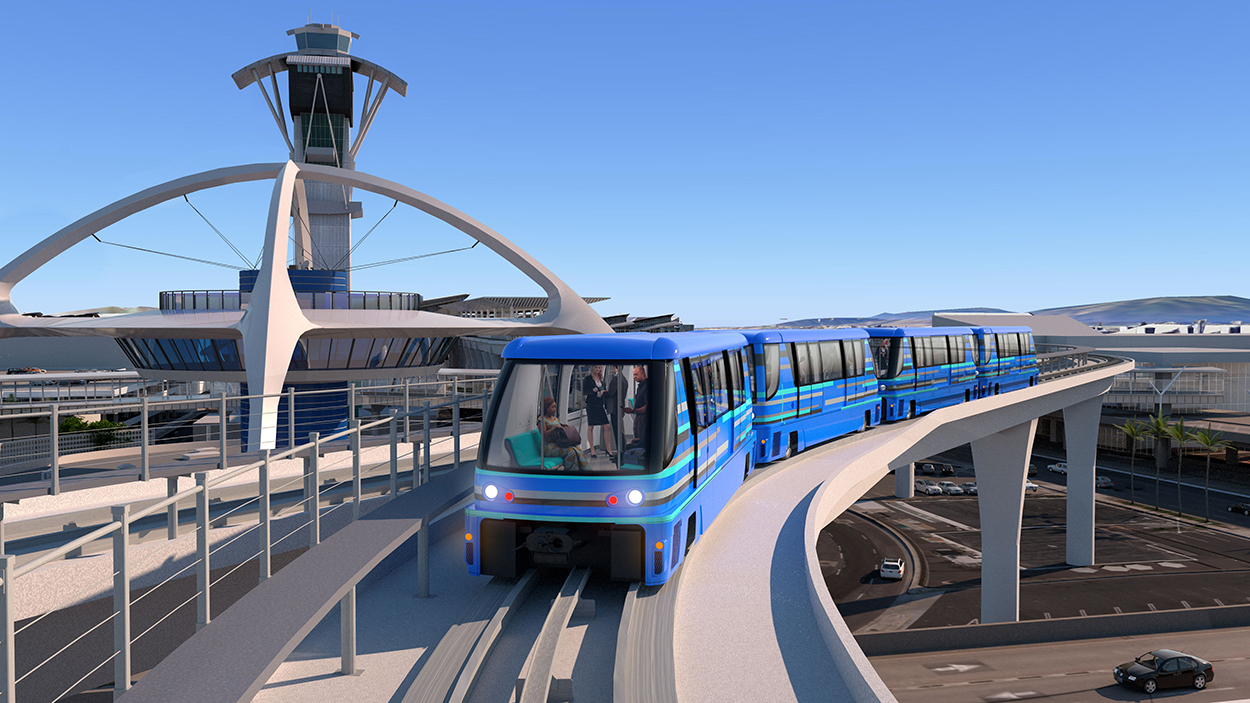
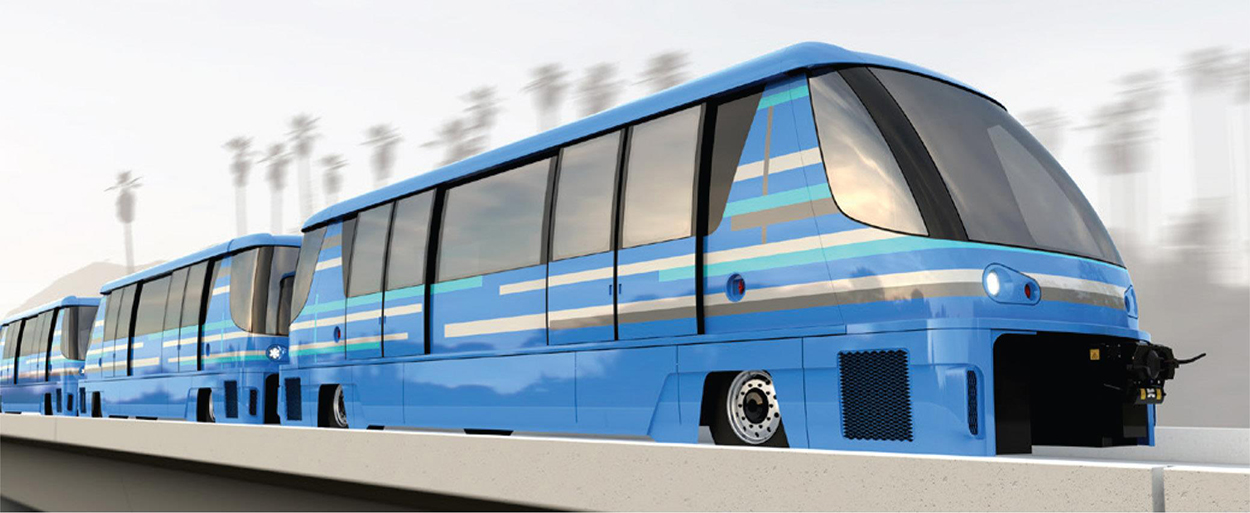
Los Angeles Airport (LAX)t is building a $5 billion SkyTrain system, which may cause confusion because in Bombardier’s line of transit systems, SkyTrain is a rubber tired people mover system and not the trains used on the Canada, Expo, and/or Millennium lines.
Cries of shock and disbelief!
The name SkyTrain, which was chosen by contest, is the name for the Metro Vancouver regional rail system and not the vehicles.
Bombardier’s proprietary ART/Movia Metro is now the official name of the Expo and Millennium Line’s cars and ROTEM, a subsidiary of Hyundai, supply the electric multiple units (EMU’s) for the Canada Line.
So calling the actual trains SkyTrain is wrong as the SkyTrain regional rail system operates two distinct railways, the conventional Canada Line and the unconventional proprietary ART/Movia lines.
They are not compatible in operation.
I would surmise that Bombardier Inc. liked the name SkyTrain so much that they use it for their airport people mover system, which is far more marketable than their now obsolete ART/Movia metro system of which only seven have been built in the past 40 years!
A white elephant is a possession which its owner cannot dispose of and whose cost, particularly that of maintenance, is out of proportion to its usefulness.
To recap, the Canada Line is not a true P-3, rather a mock P-3, where SNC Lavalin/Bombardier, bid against, SNC Lavalin/ROTEM.
Judge Pittfield who presided over the failed Susan Heyes lawsuit against TransLink, called the bidding process a “charade”.
The Canada Line is the only heavy-rail metro built in the world as a light-metro and being only able to operate 41 metre long, two car trains, has much less capacity than a modern tram costing a fraction to install!
At a minimum of $110 million to the SNC Lavalin lead consortium to operate annually, calling the Canada line a “White Elephant” is too kind!
The Canada Line can only operate 41 metre long two car trains, which is smaller than many trams on the market today. Thus the Canada line has less capacity than a modern tramway.
Burnaby Mayor Derek Corrigan says Surrey must avoid repeating the costly mistakes made when the Canada Line was built as a P3 partnership now that the city is clamouring to build new light rail lines.
Corrigan has been pushing TransLink to disclose details of the Canada Line arrangement, which he says forces the transit authority to pay the private partner not just a higher interest rate than if it had borrowed directly but also additional inflationary and other adjustments.
Those payments cover the cost of operating the line as well as the $721 million in private capital nearly one third of the $2.1-billion rapid transit line that was fronted by the partners after direct contributions from TransLink and senior governments.
The deal to secure and repay the “magic money” through the P3 has financially hobbled TransLink, leaving it unable to afford better transit service in the years since the Richmond-Vancouver line opened in 2009, Corrigan told the Metro mayors’ council Jan. 27.
Dortmund's SkyTrain - no relation to Vancouver's SkyTrain
Ah, the great SkyTrain debate is once again upon us and a Fox News style niche newspaper, the Daily Hive, has decided that SkyTrain is its best friend!
No doubt TransLink is happy, while it is desperately trying to hide the fact that Movia metro is a proprietary railway.
Sorry to say, Movia metro is a proprietary light metro system and a rather unsuccessful one at that, with only seven such systems sold in almost forty years.
SkyTrain is the name of the regional metropolitan rail network and not the name of the two very different railways that operate under the SkyTrain umbrella.
Bombardier's rubber tire SkyTrain, operating at Phoenix's airport.
There are several SkyTrain transit systems in the world, from MAGLEV monorails, to airport people movers.
The H-Bahn in Dortmund and Düsseldorf is a suspended, driverless monorail system called SkyTrain.
There is a SkyTrain corporation in the USA, marketing a monorail type system.
The Bangkok Transit System (BTS) is called SkyTrain, yet no relation to Vancouver’s SkyTrain.
The Phoenix, Arizona airport’s rubber tired people mover is called SkyTrain and is built by Bombardier Inc.
China calls its new monorail, SkyTrain.
And the list goes on; all proprietary railways, all Called SkyTrain, incompatible in operation with Movia metro.
BTS SkyTrain in Bangkok, no relation to Movia metro.
Vancouver’s SkyTrain system consists of a conventional railway (the Canada Line) and an unconventional railway, the now called Movia metro. It is the proprietary Movia metro we are concerned about.
The Movia metro is a proprietary railway which technical patents are owned by Bombardier inc. (cars) and SNC Lavalin own the Engineering patents (viaducts construction). SNC Lavalin inherited the patents when the amalgamated with Lavalin, when the went bankrupt trying to build Advanced Light metro (ALM) in Bangkok Thailand.
The now called Movia metro proprietary railway has had six previous names.
Movia metro was developed by the Ontario Crown Corporation, the Urban Transit Development Corporation and marketed under the name Intermediate Capacity Transit System (ICTS). Only two were built, as modern light rail made ICTS obsolete almost over night.
ICTS was renamed Advanced light Rail Transit (ALRT) and sold to Vancouver in what was then a very dubious business deal. The name change fooled no one, except the then Social Credit government and no other example was built.
The name again was changed to Advanced Light Rapid Transit, to try to deflect the fact it was indeed inferior to LRT.
None were sold.
The UTDC and ALRT was sold to Lavalin, which changed the name to Automated Light Metro (ALM). Lavalin went bankrupt trying to sell ALM to Bangkok.
SNC amalgamated with Lavalin to form SNC Lavalin and inherited the proprietary ALM system.
SNC Lavalin sold the technical patents to Bombardier Inc., but retained the more lucrative engineering patents.
Bombardier completely rebuilt the poorly designed (ICTS/ALRT/ALM) cars and marketed the vehicles as Advanced Rapid Transit (ART).
Only four were sold, with three being airport/theme park people movers and to Kuala Lumpor, which politicians thought ART was a monorail! (in fact Kuala Lumpor’s third transit line was indeed a monorail!)
Lack of sales caused Bombardier to fold ART into their Innovia light metro line and after a decade of no interest, Bombardier folded Innovia into their Movia metro line with linear Induction Motors as a customer add on.
Movia metro is indeed a proprietary railway as it is powered by Linear induction Motors and in fact it is powered by attractive LIM’s. Attractive LIM’s have been rejected elsewhere as being power consumptive.
Movia metro is only compatible in operation within its family of of seven ICTS/ALRT/ART systems operating. The Canada Line, a conventional railway cannot operate on the Expo or Millennium lines and Movia metro cannot operate on the Canada Line. This is the hallmark of a proprietary railway.
No other company produces off the shelf Expo or Millennium Line compatible cars (though they could provide cars if LIM propulsion were to be discarded) and to do so would cost a sizable amount of money by developing the trucks to accept the LIMs and develop a lightly constructed body shell and then safety case the cars to satisfy Transport Canada.
The cost to do this is around $60 million and as Vancouver is the only remaining customer for the obsolete proprietary light metro, why waste the money! This gives Bombardier a financial edge in any P-3 and the same is true for SNC Lavalin who have the technical patents for the viaducts and subway.
Footnote: Automatic train control is a signalling issue and not technology issue. ATC is very expensive and only used on transit systems which see traffic flows in excess of around 20,000 pphpd. ATC is also one of the reasons SkyTrain is expensive to operate.
In Vancouver, Movia metro’s capacity is limited to 15,000 pphpd, by Transport Canada’s Operating Certificate and to increase capacity around $3 billion must be spent to rehab the line to allow higher capacities.
As for Colleen Hardwick being a skeptic of SkyTrain, especially the Movia metro, Zwei again is reminding everyone that Movia metro has been on the market for over 40 years, showcased at Expo 86, one of the most studied proprietary railways in the world, yet only 7 were built, and only three seriously used for urban transport.
Toronto is soon to tear theirs down, due to it being both a proprietary and expensive to operate, as well, the guideway will soon be life expired and costly to update. Bombardier and SNC Lavalin are also embroiled in a corruption scandals in Kuala Lumpor and in Yougin Korea.
To conclude, Movia Metro (Expo and Millennium line) is a classic proprietary railway; the question is: “Why is TransLink, using the gullible Hive, trying to deny this?”
In 2016, Prime Minister Justin Trudeau (with then B.C. premier Christy Clark) announced that his government was increasing the federal contribution from 33 to 50 percent for municipal transit projects.
As I watch the breathless media coverage of the SNC-Lavalin scandal, it reminds me of a scene from the 1942 film Casablanca.
A German officer decides that it’s time to close a casino operated by Rick, played by Humphrey Bogart.
So the Nazi gives this order to Capt. Renault, played by Claude Rains, who blows his whistle and declares that the business is being shut down.
“I’m shocked, shocked to find that gambling is going on here,” Renault says.
Then he collects his winnings
Nowadays, the Ottawa media is expressing shock—shock that Prime Minister Justin Trudeau would have tried to put an end to the prosecution of SNC-Lavalin, which has more than 50,000 employees worldwide and posted $10.1 billion in revenues last year.
About 49 percent of this—or about $5 billion—came from the Americas and 32 percent of overall revenue came from engineering design project management.
Another 25 percent was from oil and gas, 22 percent from infrastructure, nine percent from nuclear energy, five percent from mining and metallurgy, and four percent from clean power. It’s a big business.
Now, let’s look at some statements from the Liberal Party of Canada platform in the 2015 election campaign:
“We will invest in sustainable infrastructure that makes our communities safer and more reliant.”
That included local water and wastewater facilities, clean energy, and flood mitigation systems—just the type of work SNC-Lavalin specializes in.
“We will establish the Canadian Infrastructure Bank to provide low-cost financing for new infrastructure.”
Bingo—another benefit for SNC-Lavalin.
“Over the next decade we will quadruple federal investment in public transit, investing almost $20 billion more in transit infrastructure.”
In case you’re wondering, SNC-Lavalin has played a major role in the development of all four rapid transit lines in Metro Vancouver. Anytime federal money flows in this direction, there’s a reasonable likelihood that it will benefit SNC-Lavalin shareholders.
“We will run modest short-term deficits of less than $10 billion in each of the next two fiscal years to fund historic investments in infrastructure and our middle class.”
Aside from the fact that the deficits vastly exceeded $10 billion, one of the winners of this promise is most certainly SNC-Lavalin.
Trudeau also pledged to end boil-water advisories on First Nations reserves by 2021. SNC-Lavalin is a big player in developing water-filtration systems, too.
That’s not to say these promises weren’t popular or worthwhile.
It’s just to point out that for a long time, the Liberals have ensured that SNC-Lavalin’s priorities are their priorities, too.
The Paul Martin government increased its contribution to the Canada Line from $300 million to $450 million. SNC-Lavalin is a partner in the operating company.
Canada Line is a prime example
You only have to look at the $2-billion Canada Line in Vancouver and Richmond.
In 2004, Liberal prime minister Paul Martin increased federal funding from $300 million to $450 million. A few months later, SNC-Lavalin/Serco won the bid to build and operate the 19.2-kilometre line.
Twelve years later, Trudeau promised to increase the federal contribution for rapid-transit projects from 33 percent to 50 percent.
Now, there’s talk of a SkyTrain extension to UBC’s Point Grey campus, which could cost $3.8 billion in 2018 dollars. That’s in addition to a SkyTrain project to Langley and a Millennium Line extension to Arbutus Street in Vancouver.
In 2016, Trudeau and Finance Minister Bill Morneau also decided that Canada would join the Asian Infrastructure Investment Bank, which is a Chinese government–created rival to the World Bank.
That helped offset the damage that occurred when the World Bank penalized SNC-Lavalin. In 2013, it was barred from bidding on World Bank–financed projects for 10 years following a bribery scandal in Bangladesh.
So who benefits when Canada joined the AIIB, likely over the objections of the U.S. government? SNC-Lavalin, of course, which is a major global player in megaprojects.
Then there’s the Trudeau government’s support for pipelines, including Enbridge’s Line 3, which will likely open this year.
The Trudeau government also bought the aging Trans Mountain system from Kinder Morgan for $4.5 billion. An expansion will gobble up another $9.3 billion to triple shipments of diluted bitumen from Alberta to the B.C. coast.
I repeat: a quarter of SNC-Lavalin’s revenues come from oil and gas.
So when the aging Trans Mountain infrastructure needs upgrading, there’s a good chance for more revenue for SNC-Lavalin.
But a criminal conviction would get in the way because it would be barred from bidding on federal projects—and the Trans Mountain pipeline system, right now, is federally owned.
Shocked—we’re just shocked!
The national media have been big cheerleaders of the pipeline purchase.
These newspaper and broadcasting companies have also collected a whopping amount of advertising revenue from supporters of the Trans Mountain pipeline project and the Trudeau government.
Yet now, like Capt. Renault in Casablanca, they’re blowing the whistle on Trudeau’s dealings with SNC-Lavalin in connection with its court case.
They’re shocked, just shocked, by the lengths to which the prime minister would go to assist the corporation.
The only thing missing from this movie is a dewy-eyed Ingrid Bergma
Mind you Ottawa’s, the Stage 2 LRT program went from $3.6 Billion to $4.7 Billion.
This was due to three reasons.
1. Inflation from the 2015-2016 price estimate, mainly concrete and paying user fees for the new lower carbon emitting concrete formulas. Concrete emits massive amounts of polluting gasses like CO2, during the curing process. All of the specialized steel needed for construction (only 3 steel mills make it, 2 USA, 1 Sweden ) are located in countries in which we slap a 25% import duty on this special product, until Trump we got stock US prices for the 2 US steel mills.
2. Originally the Stage 2 LRT project was adding only 30 km of service, now due to a upward scope pressure, mainly political, we have to pay for 44 km of service.
3. When the 3 final P3 proponents crunched the numbers none of them could build the add ons to the Confederation Line for the amount the city wanted, all were a minimum of $600 million over the city of Ottawa’s maximum amount!
Remember Stage 1 costs (12.5 km new line (including a subway)+ 8 km of existing line) $2.137 Billion.
Stage 2 (44 km) costs $4.66 Billion (including major engineering including viaducts and tunnels).
That’s 64 km for $6.797 Billion! Compared to the 6 km, $3.5billion Broadway Subway, is this a good deal?
The real costs for the Broadway subway will be closer to $3.5 Billion by the time construction on the first stage of the BS Line is ready to begin construction in 2020 or 2021.
Meanwhile back in Vancouver let us look at our rapid transit costs.
The extension of SkyTrain to Fleetwood – $1.65 billion (funded)
The extension of SkyTrain from Fleetwood to Langley – at least $1.5 billion (unfunded)
The Broadway subway to Arbutus – $3.5 billion. (funded to $2.8 billion not including cars)
The Broadway subway extension from Arbutus to UBC – at least $4 billion. (unfunded)
The Expo and Millennium line rehab, to increase capacity – $3 billion (full cost – unfunded).
The list does not include the minimum $2 billion rehab of the Canada Line, in increase its capacity, in 25 years hence, when the P-3 ends and the Canada line is handed back to Metro Vancouver and TransLink.
Over $11 billion in direct SkyTrain costs in the next decade or so and not a hint in huge increases in the operating costs for the BS Line; an estimate $40 million, just for the SkyTrain subway to Arbutus!








Recent Comments